
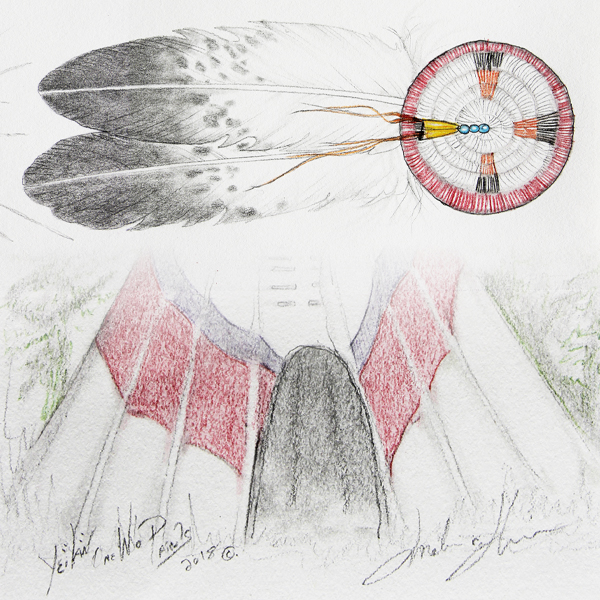
Ye’ila’n: A sentinel’s journey into The Real World
In traditional Mescalero Apache tradition, the grand parents of a soon-to-be born child will gather to ask their creator what name is to be given their new offspring. When Melvin Herrera was about to enter this world, his elders gave him the name Ye’ila’n, which translates into “One Who Paints.” Of a gentle disposition, Mel’s watchful artist eyes record everything in his environment. They serve not only to show us beauty previously unseen but to preserve his tribe’s historical legacy.
As things often work out in strange in mysterious ways, he became one of the Mescalero Apache tribe’s most prolific artists. Whether beautiful originals of Apache Youth adorned with colorful symbols or a wide variety of popular greeting cards he produces himself, his art always sells.
Ye’ila’n is a direct descendant of one of the last great Mescalero tribal chiefs, San Juan, well preserved in historical records. His direct grandfather was the little brother of famed Wendell Chino who became known the world over for his business acumen and putting Mescalero on the Map with the Inn of the Mountain Gods and Casino that brings people to the area from all around. Tradition is in his blood and when asked what bothers him most about the new generation losing their ways, it’s that an earnest effort to learn the language is no longer made. “Young Apache kids are into social media or modeling themselves after pop idols, rather than spending time with their nuclear family to keep stories alive,” he laments.
A consummate purist in his approach Native American art, he enjoys traditional art-making and its therapeutic effects while keeping his culture alive in some small way. His medicine bags made of soft buck skin adorned with intricate bead work show love to detail and offer a small glimpse into a past that is waning all too fast. They are also a testament to a strong spirit wishing to keep moving forward.
To view but a few of Mel Herrera’s creations, check out his online store here or contact him via his shop dashboard.
—JLE
n the spirit of honoring efforts of his unspoken pursuit is a small glimpse into a culture by way of select cultural descriptions quoted and transliterated from the highly recommended read by Claire R. Farrar’s book, Living Life’s Circle: Mescalero Apache Cosmovision:
A powerful symbol: the quartered circle (n’da’I bijuul sia)
The Apache way of life has always centered around a mnemonic base metaphor of a circle divided into four triangles. The number four is tantamount to the number seven or three in many other cultures. That means God created Earth in four days, there are four stages of life, four directions, four seasons, four parts to an elegant speech and so on. Understanding the implicit meanings of the base metaphor lead to a well-balanced life as exemplified by the circle, akin to Western’s great chain of being, where everything holds its place and recreates harmony out of chaos. The base metaphor, when “rolled open” or taken apart also represents the four sacred mountains, a four-pointed star (suus), a coming of age girl’s ceremonial tipi (with four poles representing four grandfathers, in set directions), or the way food is salted.
(The two perpendicular lines drawn through the center of the quadripartite circle also represent North-South in a sense of connection with Creator or family in the beyond or chiasms that need to occur and rip us out of our egoic mind constructs at any given moment while the West-East direction represents us staying within a cultural flow and space and time that holds us together as a race. It is my own observation that the West-East trajectory is also akin to Western culture’s linear way of thinking while the North-South line makes way for a circular way of engaging with a different reality, where things work themselves out as they are “meant to be” as they take realities into a sharper focus. Where the two lines meet in the middle, harmony can be achieve in the Universe, another metaphor for the all ensconcing circle.)
Elders are not just tribal leaders but also people that have lived a long life and so respect is given to them. It is said that the very young and the very old must be listened to carefully as they are on the edges of the crossing between the Worlds; they have the ability to carry messages between the Worlds, regardless of whether or not they can speak. Their actions can speak as well as their voices. Both are a time of wisdom.
Living a good life, an impeccable life by the canons of Apache conduct and decorum, means being enfolded in the embrace of family, whether in This World or The Real World, The Land of Ever Summer. The family endures beyond the bounds of death; so, in a very real sense, family includes a potential chiasm. There are some who are here, in the now, and others who are there, in the before and the to be; family includes those who have been, those who are, and those who will be in the matrilineage. Matrilineages, and hence families, had their beginning when THE PEOPLE were formed into one group so very long ago by the lake in the winter’s land (Apache’s originally migrated from Western Canada. The language root is Athabaskan, related to Alaskan Inuits). They continue today and as long as there are Apaches, they will continue far into the future, both in This Shadow World and in The Real World.
The Apache way of life
Generosity
No person can be a proud adult, with straight carriage and head held high, unless that person is also generous; generosity is the primary quality. It is this quality of character that has caused some difficulty in contemporary times, when people are torn between adhering to the traditional value of generosity and the opposite, newer movement toward accumulating goods and money for their own individual households. Such contrary pushes and pulls make contemporary reservation life difficult at times.
Bernard Second: “…the four laws of our people are honesty, generosity, pride, and bravery…a people, they cannot be great if they have no sense of generosity about them. For it is our generosity that a man sees the world and what a man is worth in this world. He cannot be proud, if he is not generous, because he has nothing to be proud for and brave for. And he cannot be honest, for all honesty has no basis if it is without generosity, So—generosity, at the end, is the most important law we have. It is the value that we have cherished from the day we became a people to today.”
Kindness
Anglos sometimes perceive neglect where Apaches see kindness. It is a kindness to allow another the autonomy to find her/his own way, if the way chosen is a destructive one. Anglos see neglect of duty in failing to minister to the one who is lost; Apaches observe decorum by noninterference, even while they may grieve internally for the self-destruction evident.
Through the exercise of generosity and kindness, a person develops pride and strength of character. This pride is inherent in being Apache. Even their name for themselves, n’de, is thought of in Capital letters, THE PEOPLE, very much in the sense of the chosen and proper Humans. Creator gave the Mescalero Apache people serious responsibilities for the maintenance of balance and harmony in the Universe. Despite incursions of every imaginable sort by the larger mainstream Anglo culture, Apaches have persisted and have maintained their responsibilities. They have every reason to be a proud people.
(…) Further, kindness is accomplished in such a fashion that neither giver nor receiver need to be embarassed; in the Apache value and decorum system, no one should be diminished by kindness given or received. If roughly, I am grateful a person perceives a need on the part of another, the person should fulfill the need, assuming it is within the person’s abilities to do so. Thanks are neither expected nor given; to say “thank you in such a situation sets up a hierarchical situation where there should be equality. On rare occasions, one might hear “daabaa’ilhensi” [roughly, I am grateful for it]; but this would be used only when the receiver was surprised that the giver perceived an unspoken hidden need and the fulfilled it precisely properly. Thanks are given in other ways.
Creation Stories
This brief overview of Apache Code of Conduct cannot be ended without going into creation stories that also show how much man respects the animals of the world. For God created the world in four days, all the animals were created first so as to give the weaker Human a support system in which to live. All creators were tasked to support Man. Eagle is the holy bird of Authority, a direct link to God. Buffalo accepts his tasks of fully supporting may with grace. Elk also supports man with food and clothing for the weak as well as Deer and Antelope. Then, beasts of burden (formerly dogs later horses), accept their jobs to help man. It is this reciprocity that gives man the responsibility to respect all living beings and thank their creator in return. (Note, in Western teachings, the chain of being places people at the apex, rather than position of vulnerability).
The creation stories all depict God making everything in four days but beyond the time paradigm, there are four elements that are also of significance here: 1. In the creative explosion, Old Man Thunder (also representing the elderly who deserve respect) and Little Boy Lighting show that voices are given to sound. 2. A second aspect of the base metaphor, sound/silence is also engendered with silence revered and associated with Power personified. The most powerful have no need of sound to do their biddings; as they think, so is.
The interplay between sound and silence is of immense importance throughout Apache daily and ritual life.
The third aspect of the base metaphor is directionality which was already discussed above. Forth is balance and harmony as expressed in circularity (thus circular vs. linear culture).
All these elements are perceived as being in balance and completing the circle. The first two days of creation bring forth earth, wind, water, sky and those that belong in them; the second two days of creation bring forth animals and people who live on the surface of the earth and depend on the sky, or celestial sphere, as well: balance. Father Sun and Mother Earth, Moon and Stars, Thunder and Lightning, Wind and Rainbow, Birds and Reptiles, Worms and Insects, Buffalo and Deer, Elk and Antelope—all are in balance. Balanced on the other side is n’de, THE PEOPLE, Apaches. When each retains its proper place and lives in accordance with the plan of Creator, harmonious relationships exist among and between them. Upset any one and the exquisite rightness of the universe is thrown out of kilter. To restore the balance and harmony, a ceremony must be performed, costly in terms of both time and resources.
Much more can be said on how the individual animals, the moon, sun, wind and water fit into the different directions of the circle along with gender and character associations and we will keep it short according to Bernard Second’s observations: i.e. East = Sun, Spring, wisdom, enlightenment; South = women’s ways, rains, generosity, moon, elk.; West = masculine, animate, active, Fall, strength, way of war, antelope, rainbow, eagle ; North = Winter, strength’s home, warrior’s epitome, ever Winter birthplace.
The quartered circle is everything—and it is just a little circle with a cross. It is a portable religious/philosophical system that is one of the more powerful mnemonics there is. It speaks of the beginningtime and of Creator and Creation as well as of behavior in the contemporary world. It speaks of how things were, are, should be, and will be. It is the base metaphor upon which all social, psychological, philosophical, and moral life is predicated. Perhaps best of all, it is easily portable and need not even be represented in permanent form; it can be almost instantly created as the need arises for its use. And in each re-creation of the base metaphor, the people are reminded of its almost infinite layers of nuances and meaning.
All of humanity would be served well to understand the Apache ways. There is wisdom in all. Thank you Ye’ila’n for writing what you see in your own artistic creation to share with others what you have seen, or see in your mind and heart. It is a blessing. You are a blessing.