DaZ Exotic returns, bringing local artists together for a night at Nightshop

DaZ Exotic returns, bringing local artists together for a night at Nightshop
image

Hip hop artist, podcaster and Bloomington native Brandon Beck — known to fans as DaZ Exotic — is in the Twin Cities for the weekend. And he has arranged a homecoming bringing local artists and special guests together Saturday at Nightshop.

The one-night-only event heavily trends toward hip hop, rap and R&B, but this something-for-everyone evening features sets by DaZ, Ryan Byfield and Sane 2x, to name a few. Painters and podcasts will be on hand creating content in real time. Plus, DaZ placed intentional focus on female representation with Jersey Meg and Glo the Female Voice on the bill, among others.

Now based in Atlanta, a big motivator for DaZ in returning to Bloomington was giving back and bolstering the local scene.

“There’s not a lot of musical leadership out here in this town,” he said. “So to come back and book local acts, and to support and be supported by my home town — right when the sun’s coming back up — that’s how it needs to be.”

Titled “Spring Awakening” (no relation to the 1891 German play or 2006 Broadway musical), the show celebrates longer days and, as his first big gig here since the pandemic, being together.

Atlanta has taught DaZ “how to hustle” and market himself as an artist.

“You learn how to generate business,” he said. “You learn how to be yourself a little bit more.”

The move also created chances to be in company with major stars in the hip hop industry.

“I’m five minutes away from Little Five Points. You can see André 3000 walking down the street. I was with T-Pain out there shooting a music video. Accidentally pulling up on Tyler Perry’s studios—it’s so big.”

Perhaps the most significant shift is in DaZ’s confidence.

“There’s a lot of doubt out here and it really stinks,” he said.

“When he went to Georgia, he didn’t stay there,” said Ray “Milk” Gilmur, a local podcaster scheduled to co-host the evening at Nightshop. “You cannot put this man inside a box. He’s not just hip hop, he’s not just rock and roll. He’s everything in between.”

“I try to influence art in general,” DaZ said. “I’m excited to be back here because I consider WGLT to be part of my community. We’re all trying to do the same thing, which is make our world and the world a better place.”

LKhari Pridgen, A.K.A. Dolomane, will act as hype man for the show, a new role for the local music producer that stems from a longtime musical partnership with DaZ.

“He’s made a lot of my Bloomington music with me,” DaZ said. “To really give back, I like to do a little bit of everything.”

“I go to all Daz’s shows and we’re cool; we’re homies,” said Dolomane. “He said he liked my energy when I’m in the crowd. When I hear good music, I turn up—I enjoy myself.”

With hype man Dolomane in tow, DaZ intends to bring his full “bag of tricks” to the table on Saturday, but crowds will definitely hear songs from his latest record, “When Was the Last Time?,” released in 2022.

The short-and-sweet album mixes sharp commentary on celebrity with intensely personal samples of voicemail messages from DaZ’s family and friends—nearly every-other-one.

“You always want to grow what you’re doing, but you never want to forget where you came from,” DaZ said.

Beats like “Set Me Free (The Selfie Song),” Tom Macdonald (referencing the controversial right-wing Canadian rapper and former professional wrestler), and “Keep My Wife’s Name Out Your Mouth!” (a play on Will Smith’s slap heard ‘round the world) point to ridiculous extremes in fame and fortune.

“There’s a lot of mocking or challenging the celebrity culture,” he said. “It’s kind of to tear down the false idol and build a real boy.”

“Spring Awakening” takes place Saturday at Nightshop, 517 N. Main St. in Bloomington. Doors open at 8 p.m., with an all-ages set at 9 p.m. (adults 21+ after 10 p.m.) Tickets are $10-$15 at nightshop517.com.

We depend on your support to keep telling stories like this one. You – together with donors across the NPR Network – create a more informed public. Fact by fact, story by story. Please take a moment to donate now and fund the local news our community needs. Your support truly makes a difference.

Computational Photography: What is It and Why Does It Matter?

Computational Photography: What is It and Why Does It Matter?

There’s a reason why my iPhone is often the only camera I’ll carry with me. Its imaging quality allows me to take good photos without having to carry any additional gear.

My DSLR still beats my smartphone considerably in terms of quality, but I don’t mind the quality loss in lots of non-professional scenarios. There’s a lot more happening besides good optical quality in my smartphone, however, and its camera wouldn’t be great if it didn’t have help from computers.

While DSLR and mirrorless technology is evolving, recent photography has seen some of its most revolutionary changes in places like the smartphone and compact-camera worlds. Since there are size and cost limits to the imaging hardware that can be used in these cameras, innovation has come in the form of computational imaging processes. With recent rises in the accessibility of artificial intelligence, computational photography is evolving and will continue to grow. This article will provide an overview of computational photography and why it matters in many different contexts.

What is Computational Photography?

If you’ve never heard the term before, you’re not alone. Computational photography uses computing techniques such as artificial intelligence, machine learning, algorithms, or even simple scripts to capture images. This is usually in conjunction with or after optical image capture. Although it might sound obscure, nearly every smartphone camera uses computational photography in some way. Without it, smartphone imaging capabilities would be much lower.

Examples of Computational Photography

Chances are good that you’ve used computational photography if you own a smartphone. If not, you’ve probably seen people use it in lots of different ways.

Portrait mode on a smartphone

In most professional cameras, the portrait-looking effect comes from using a wide lens aperture. This creates a shallow depth of field and, without getting too complicated, blurs the background of the image.

A portrait without portrait mode (left) and a portrait with portrait mode on to simulate a shallower depth of field (right).

Most smartphone cameras have fixed apertures or apertures that don’t open wide enough to naturally create the portrait-esque blur. This would be really hard and expensive to implement using hardware, so smartphone manufacturers use computational photography to create a simulated background blur. Portrait mode recognizes subjects and essentially overlays a blurry filter on the background. This uses computational processes to recognize, isolate, and focus on the subject in the image in real-time.

Panorama modes on smartphones and cameras

Many smartphones and newer cameras have built-in panorama modes. With the push of a button, the imaging device will direct the photographer to move and keep their camera along a straight line so that the device can take multiple images and stitch them in near real-time. This creates a panorama in-camera, rather than having to manually stitch the images.

A panorama captured with the iPhone’s Panorama feature.

Computational photography is at work guiding the photographer, stitching the images, and creating a single panorama file that can be viewed instantly. Since most smartphones and smaller cameras have electronic shutters with minimal moving parts, the shutters can be activated very rapidly, allowing for quick panorama capture.

High dynamic range (HDR) modes on smartphones and cameras

With the press of one button, this feature uses algorithms and even machine learning to recognize the brightest and darkest parts of a scene. The camera will take photos at different exposures and combine them seamlessly, leading to a final product with detail in the brightest and darkest parts.

Modern smartphones can capture HDR photos that properly expose both the darkest and lightest regions of a scene.

This all happens quickly in most smartphones because a smartphone camera is always imaging when the camera app is in use. Otherwise, the live “preview” couldn’t be shown. Only the images that you press the shutter button for are saved to your device’s photo album, but there is always a buffer of photos that your smartphone hangs onto for a little bit and then discards. This is how Live Photo works in iPhones, and this is why you will probably see movement from before you actually pressed the shutter button in any Live Photo. In smartphones, the shutter button is very much like a “pause and save” button in a continuous imaging stream.

Daytime “long exposures” on your smartphone

Similar to Apple’s Live Photo feature, many smartphones offer a feature to actually stack multiple buffered images to create a long exposure effect. This is a similar concept to time-stacking, which many landscape photographers use to get long exposures of water when it’s too bright to take a long exposure. The technique involves taking many shorter exposures and combining all of the imaging data using post-processing. Smartphones will use computational photography to align and combine shots from the buffer and create a long exposure effect.

How to do this on an iPhone: First, take a Live Photo in your Camera app. Then, find the image in your Photos app and click on the icon that says “Live” in the upper left corner. The Long Exposure button will combine all of the buffered images that comprise the Live Photo into one stacked image.

Night mode in many recent camera systems

Images at night are hard to make because there’s not enough light to create a well-exposed image with good contrast. In professional cameras, slow shutter speeds, wide apertures, and high ISOs help, but those usually require a tripod to minimize camera shake. Most people don’t want to use their smartphone camera with a tripod.

Many recent smartphone manufacturers have implemented a similar process to the buffering and stacking outlined above, which takes shorter exposures (minimizing motion blur) and combines them to create an overall higher-quality and brighter image because there is an increase in the total amount of data captured. If you combine that technique with images that are brighter and darker to capture more dynamic range (which some smartphone cameras do), you get images that look like they might have been taken with a DSLR when they were really taken with a tiny lens and sensor.

A low-light photo captured with the iPhone’s Night mode.

Computational Photography Uses Many Different Processes

This article is simply providing an introduction to computational photography, so the technical details of algorithms and other techniques are beyond its scope. However, there are some really interesting techniques being used in the context of photography.

Neural networks and machine learning

In many recent cases, manufacturers have implemented neural networks (basically, simulated brains that use “neurons” to “think”) in computational photography. By showing artificial intelligence images that are too bright, too dark, or discolored, the system will be able to recognize when an image has those characteristics and attempt to fix it. Although it won’t always be perfect, the billions of images that are made each day make for a huge database to use to teach systems how to judge and correct images.

A slide shown during an Apple launch presentation that shows how the iPhone’s image signal processor and Neural Engine automatically enhances each photo captured. Image: Apple.

Pixel shifting

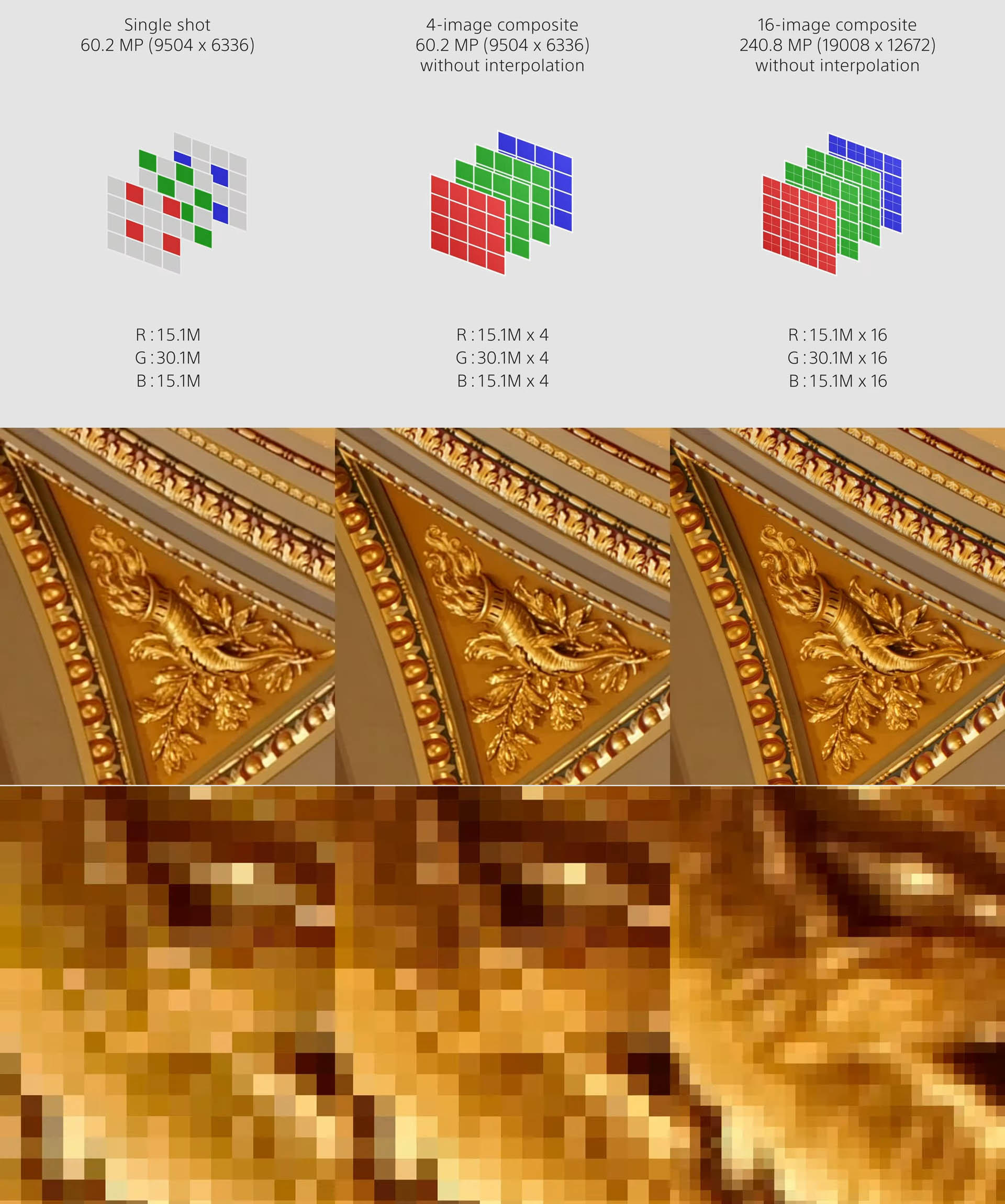
In computational photography, image-making is often an additive process. In other words, one image is rarely the product of a single image. Rather, an image is a combination of many different images with different parameters. Pixel shifting is another example of this. This is often available in smartphones and very high-resolution mirrorless cameras. This process physically (using a mechanism or making use of naturally shaky hands) shifts the sensor one pixel at a time. By combining multiple images just a pixel apart, there is more overall information captured.

An illustration by Sony showing the difference in process and output of a traditional single shot with a digital camera (left) and a pixel shift multi-shot (right). Image: Sony.

The exact means for how this happens is beyond the scope of this article, but the important thing is that this is all made possible by computer processes to shift, combine, and output one higher-resolution, sharp image.

A comparison of a scene captured by a Sony mirrorless camera using a single shot (left), a 4-image pixel shift composite (center), and a 16-image pixel shift composite (right). Click to enlarge. Image: Sony.

Pixel binning

Very basically, pixels help capture light, and larger pixels capture more light. However, smartphone cameras need to be small, and therefore their pixels need to be small. Pixel binning allows the data from four pixels to be combined into one, which increases the overall quality of the image without sacrificing low-light capabilities. Without computational photography, this technology wouldn’t be as accessible.

A concert photo captured with an iPhone.

Focus stacking

This is fairly simple and used to be a very laborious process that only extreme macro photographers would do often since they work with extremely shallow depths of field. This involves taking different images at different focal points and combining them to create one image with greater depth of field and detail. Smartphones and other cameras will do this automatically with the click of a single button and use computer algorithms to align and stack the images in seconds.

Why Does Computational Photography Matter?

Manufacturers are finding ways to make 12-megapixel sensors produce similar results to 50-megapixel sensors (although there are still limitations). This is all because of the power of algorithms, machine learning, scripts, and other computer-enabled processes that maximize the imaging capabilities of traditionally lower-grade hardware.

It’s not a perfect analogy, but a professional racecar driver could probably beat a novice driver in a race even if they swapped cars. The racecar driver, just like computational photography, uses skills to make the most out of the lower-grade hardware, while the novice driver has the hardware and lacks the skills. Computer processes are quick and efficiently taught, and they are being developed to maximize hardware that would typically not give great results. This lowers materials cost for expensive hardware and makes more possible with what we already have.

In some ways, this is a frightening aspect of modern photography. Traditionally, photographers have been championed because they have the knowledge, equipment, and experience to create stunning images in many different environments. If computational photography makes it possible to do more with less hardware, photographers need to compete with everyone who has a smartphone. There will always be the artistic side of photography, however, which will belong to photographers for at least a little bit longer. The rise of AI has brought important questions to the art world, and photography is no exception.

Computational photography is also making its way into the professional photography world. DSLRs and mirrorless cameras are seeing changes in autofocus systems that involve AI subject-identification, HDR, panorama, and other processes described above. It’s not just a smartphone thing, anymore, and technology is changing – for better or worse.

Conclusion

We’ve come a long way from loading film into a camera and advancing it to get to the next shot. Significant advances in computer technology have recently made their way into smartphones and other image-making devices, something that many would’ve never thought possible.

Computational photography has traditionally been used to make high-quality photographs using hardware that would otherwise not produce such quality, and it’s making its way to professional cameras. Regardless of anyone’s opinion on the innovation happening today, it’s important to stay informed on technology and how imaging processes work so that photographers can use the tools available to them.


Image credits: Header photo by Ted Kritsonis for PetaPixel

How to Improve Your Sports Action Photography

How to Improve Your Sports Action Photography

When it comes to sports portraits and action photography, employing a bit of artificial light can make a huge difference by giving you the ability to shape the look of the frame and add a lot of drama to the image. If you are ready to get started working with artificial light in your sports action portraiture, check out this excellent video tutorial that will give you a range of helpful tips and advice sure to put you on the right track. 

Coming to you from Matt Hernandez with Westcott Lighting, this awesome video tutorial discusses the ins and outs of working with artificial light for sports action photography. The beauty of adding a bit of artificial light to this sort of portraiture is that you can overwhelm the sun, making it easy to control the drama in the frame. While you might normally think that it is easier to work in a studio in this sort of scenario (and from a technical perspective, it is), working outside allows you to photograph your subjects on the tennis court, the baseball diamond, the football field, etc., lending your images a much higher level of realism. Check out the video above for the full rundown from Hernandez.

How Roope Rainisto’s AI Photography Redraws Artistic Boundaries

How Roope Rainisto’s AI Photography Redraws Artistic Boundaries

On April 5, Web3 photography platform Fellowship dropped Post Photographic Perspectives, its inaugural group show headlined and curated by designer and AI-collaborative artist Roope Rainisto. Featuring 500 new pieces from Reworld, Rainisto’s latest collection, and a further 1,000 works from 10 AI artists hand-picked by Rainisto and Fellowship, Post Photographic Perspectives is one of the most highly-anticipated NFT drops of the year. 

The show sits at the center of several exciting technological and cultural developments that have sparked intense debate both within and outside of Web3’s walls in recent months. We sat down with Rainisto and Fellowship’s Co-founder, Alejandro Cartagena, ahead of the drop to get their views on the discussions surrounding AI art and the importance of pushing technological and artistic boundaries forward. 

Rainisto’s vision meets Fellowship’s mission

Rainisto has seen a monumental rise to fame in both the NFT and AI art spheres in the aftermath of Life In West America, his successful BrainDrops release from February 2023 that presented a fever-dream vision of the idea of the American West. That collection helped cement BrainDrops’ status as one of the premiere platforms for AI art in Web3 and has done nearly 1,800 ETH in trading volume on the secondary market since its release.

An AI photo of a man at a food stand in an aesthetic the recalls 1960s Americana.
Sunday Service from Life In West America. Credit: Roope Rainisto

Rainisto’s style is both immediately recognizable and compellingly bizarre. Rather than try to hide the fact that his works are the product of AI art tools, his AI photography leans hard into the “AI-ness” of his image outputs, creating something at once familiar and alien. Rainisto’s work, more so than perhaps any other artist’s in the space, plays with the brain’s inherent pattern-seeking capabilities, presenting viewers with scenes that they have both seen a million times and yet have never come across. 

“There’s something [in Rainisto’s work] that I’ve never seen before.”

Alejandro Cartagena

“In my many years of studying photography and art, there’s something [in Rainisto’s work] that I’ve never seen before,” Cartagena said of Rainisto’s unique aesthetic while speaking with nft now. “He’s the only person doing the things he’s doing with AI. His vision is very particular, concise, and technically sound. What he has done is embrace the tool and its glitches, its defects, and found expression in precisely that.”

Fellowship’s goal is to capitalize on the opportunity that Cartagena sees in building a photography collection like no other on the planet. Himself a photographer with decades of experience in creating, curating, and collecting photographs, Cartagena believes Fellowship can be the organization to consolidate 180 years’ worth of photographic history into one cohesive and unique collection, unbound from the limits of the museums that store 1/1 physical photographic work in vaults and halls that few people will ever see. 

In November 2022, Fellowship collaborated with none other than Dmitri Cherniak for the release of the artist’s 100-piece generative photography collection, Light Years. Experimental releases like these align perfectly with Cartegena and Fellowship Co-founder Studio137’s vision, making the platform’s partnership with Rainisto a perfect fit.

“We see Fellowship as this core collection that is the base to build into the future what photography can be,” Cartagena elaborated. “We love the fringes of photography and the things that have made photography, photography. Because the NFT space moves so quickly, we can experiment in a very sophisticated and fast way. We’re a gallery, a collection, we commission work, and we want to be a charity to support marginalized artists. We want to be a lot of things because the NFT space permits that flexibility.”

Cartagena and Studio137 began collecting Rainisto’s work in early 2022. Connecting with the artist shortly after, they agreed to work together on Rainisto’s follow-up to Life In West America — Reworld. 

REWORLD and Post-Photographic Perspectives

The 500 pieces in Reworld thematically recall those from Life In West America but are distinct in their particular focus. Whereas the images in the latter centered on individuals and small-scale personal relationships, Reworld deals with grander concepts, forming a commentary on societal issues at a much higher level. 

REWORLD. Credit: Roope Rainisto

Starting April 5, the pieces in the collection will be sold in a Dutch Auction format, starting at 10 ETH and dropping 0.4 ETH every minute until the price reaches a low-end cap of 4 ETH. After this, the price will drop 0.1 ETH each minute until it hits a floor of 2 ETH, after which the sale becomes public if any inventory remains. The first 35 minutes of the auction is reserved for Patron Pass holders, Fellowship’s annual membership token released in March. 

On the show’s second day, Rainisto switches from featured artist to curator, presenting 10 AI artists who were chosen for their ability to show the range of what AI tools can do in the post-photographic arena. While some artists in the show’s second stage are known for their own approaches to AI photography, others take the very concept “to the edge,” as Cartagena puts it. Selected artists for this part of the show include AI. S.A.M, Andres Hernandez, Antti Karppinen, Charlie Engman, Jess Mac, Julie Wieland, Katie Morris, Simon Raion, Ben Millar Cole, and Pierre Zandrowicz. 

The group show will also include at least one IRL activation, including an exhibition in May at an as-of-yet undisclosed gallery in Los Angeles and the Paris photo fair. 

An AI photograph of several figures in a textile factory wearing pink.
Pink. Unidentified. Such a useless color! Credit: Simon Raion

An artist like no other

At 43 years old, Rainisto is only recently beginning to explore artistic expression on his own terms. Having worked as a designer since the late 1990s, Rainisto’s artistic journey reached a tipping point two years ago when he started seriously considering how VR and AI technologies would begin to drastically change how the world works.

“I found the failures to be much more interesting.”

Roope Rainisto

“I thought I can be either one of the first people on this bandwagon or I can be one of the last,” Rainisto explained of his interest in AI tools while speaking to nft now. “I’m always excited about new technologies, trying to figure out how you can then use [them] to create something meaningful. That was my inspiration.”

The 500 pieces in REWORLD, a collection he has been working on for the better part of the past year, are the final cuts from over 50,000 outputs Rainisto created while building the series. They feature Rainisto’s singular style: a surreal photo-realistic familiarity steeped in Americana inspired in part by Robert Frank’s photographic book, The Americans. Rainisto also attributes the project’s origins to the idea of a road trip as seen through an algorithm’s eyes, technology that, he says, represents a shared understanding of the world.

An urban scene in an imagined setting of Southwestern United States featuring cars and adobe-like buildings.
REWORLD. Credit: Roope Rainisto

“They see in five billion pictures. In some ways, [the collection] is a road trip into a shared kind of humanity,” Rainisto offered as an insight into his project and vision.

Rainisto is fond of his approach to AI photography, something rapidly becoming known as post-photography, precisely because of the way it embraces the imperfections and outright otherworldliness of the way algorithms “envision” the prompts given to them. 

“Rather than try to hide the ‘AI-ness,’ what would happen if I tried to explore it?”

Roope Rainisto

“We’ve all seen that AI can do photos where you can’t really tell if it’s a real photo or not,” Rainisto continued. “I think that’s fine, but my kind of reference point is the camera. When Stable Diffusion came out, my idea was to make the outputs resemble a photo. I had successful renders and things that had ‘failed.’ But I found the failures to be much more interesting. Rather than try to hide the ‘AI-ness,’ what would happen if I tried to explore it?”

Reworld will be Rainisto’s last large-scale collection in 2023. Apart from the time and energy it took him to create and release two series in the span of a few months, he is hesitant to saturate the market with his work. Interested collectors can look forward to him continuing to experiment with AI art and working on 1/1s, animations, and potentially even small-scale limited editions. For now, Rainisto advises fans of his work to pick up a Patron Pass on the secondary market so they don’t miss out on the rest of Fellowship’s 2023 shows.

UHD & Saint Arnold Brewing Co. Welcome 3K for the Art Car IPA 5K!

UHD & Saint Arnold Brewing Co. Welcome 3K for the Art Car IPA 5K!

The University of Houston-Downtown (UHD) is the second-largest university in Houston and has served the educational needs of the nation’s fourth-largest city since 1974. As one of four distinct public universities in the University of Houston System, UHD is a comprehensive, four-year university led by President Loren J. Blanchard. Annually, UHD educates more than 15,000 students, boasts more than 64,000 alumni, and offers 46 bachelor’s degrees, 11 master’s degrees, and 19 online programs within four colleges: Marilyn Davies College of Business, College of Humanities & Social Sciences, College of Public Service, and College of Sciences & Technology. For the fourth consecutive year, U.S. News & World Report ranks UHD among universities across the nation for Best Online Criminal Justice Programs (No. 27 and No. 15 for Veterans) and Best Online Bachelor’s Programs. UHD has the most affordable tuition among four-year universities in Houston and one of the lowest in Texas. U.S. News ranked the University among Top Performers on Social Mobility and awarded UHD a No. 1 ranking as the most diverse institution of higher education in the southern region of the U.S. The University is noted nationally as a Hispanic-Serving Institution, Minority-Serving Institution, and Military Friendly School. For more on the University of Houston-Downtown, visit www.uhd.edu.

Today’s Photo from Ted Grussing Photography: Ever Have a Day Like This?

Today’s Photo from Ted Grussing Photography: Ever Have a Day Like This?

… the plan was to rise early and get a good start on a number of projects that are active now … and the plan would have been great, but I didn’t roll out until almost 10AM … of course I didn’t roll into bed until 4A … oh well, things were going at a record pace and projects finished while others are well on the way to completion.

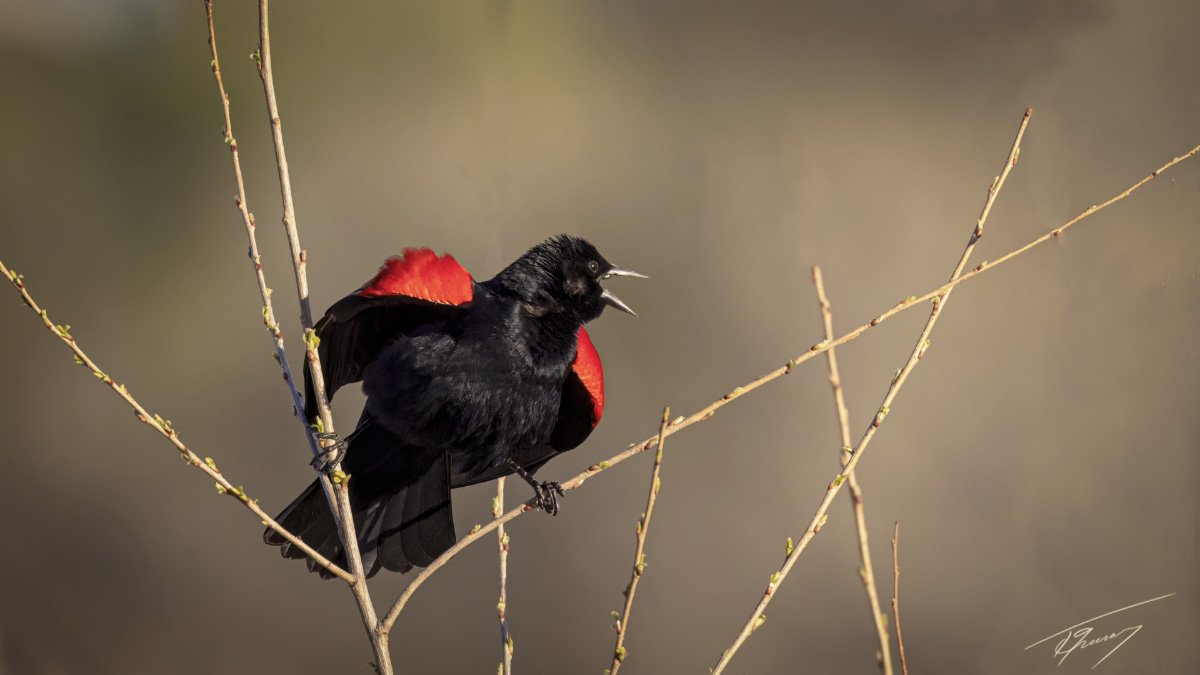
About 4PM, Eric picked me up for an afternoon walk at Bubbling Ponds in Page Springs, and what a walk it was … especially if you enjoy getting great shots of Ospreys, Cinnamon Teal, Black Hawks, Red Wing Blackbirds and many more! It is very active there now and a good time to be there shooting the wildlife and enjoying the crisp early spring weather. Likely I will have a walk down there tomorrow too. The perfect finish to a perfect day!

The Black Hawk above was just leaving his perch and the Red Wing Blackbird below was singing his heart out letting all who would listen, that he would be the perfect mate.

My friend Steve Snyder is presenting at the Sedona Heritage Museum a week from tomorrow, that is the 13th at 10AM. The presentation will be set within the framework of his book Shot Down, which chronicles the events leading up to and after the B-17 that his father was piloting was shot down over the French/Belgium border during WWII. The book is great and I expect the presentation will be too … check it out and sign up on the link above.

Into the weekend for me … time for work, pleasure and celebrating Easter and Passover … allow your life to be filled with joy and pass it on! We are so blessed, so let that guide you in your daily thoughts and activities … above all, keep breathing … the simple things are important!

With joy!

Ted

Thou great God, uphold me also in the lonely hour;
and though I fall in the din and the dust of the world,
resurrect Thou me. Even to the last, turn my hands
to kindly service, and part my lips in gleeful songs
of love. And in the softly falling dark, when all grows
strangely still, may I be glad to have trod the sweet
green earth, and known the tender touch of love. Yet
may I depart with joy, as one who journeys home at
evening.

excerpt from An Easter Prayer by Max Ehrmann

###

photo_tedgrussing

The easiest way to reach Mr. Grussing is by email: ted@tedgrussing.com

In addition to sales of photographs already taken Ted does special shoots for patrons on request and also does air-to-air photography for those who want photographs of their airplanes in flight. All special photographic sessions are billed on an hourly basis.

Ted also does one-on-one workshops for those interested in learning the techniques he uses.  By special arrangement Ted will do one-on-one aerial photography workshops which will include actual photo sessions in the air.

More about Ted Grussing

A Photographer’s Fight for Yanomami Sovereignty

A Photographer’s Fight for Yanomami Sovereignty

Illegal mining in the Amazon rainforests of Brazil and Venezuela poses a danger not only to the region’s fragile ecosystem but also to the Indigenous communities that call these areas home. Today, the struggle of the Yanomami people, the largest group in the Amazon, is more urgent than ever. Over the past five decades, activist and photographer Claudia Andujar has worked with the Yanomami to defend their native rights and sovereignty. Photography has been an important tool for raising visibility in order to protect the people, their land, and their culture. Her encounter with the Yanomami people in 1971 transformed her artistic practice into a life of activism. The Yanomami Struggle at The Shed is a comprehensive exhibition dedicated to Andujar’s collaboration and friendship with the Yanomami people. The show presents more than 200 of her photographs in dialogue with paintings and drawings from a new generation of Yanomami artists: André Taniki, Ehuana Yaira, Joseca Mokahesi, Orlando Nakɨ uxima, Poraco Hɨko, Sheroanawe Hakihiiwe, and Vital Warasi, as well as shaman Davi Kopenawa. Visitors will also encounter new video works by contemporary Yanomami filmmakers Aida Harika, Edmar Tokorino, Morzaniel Ɨramari, and Roseane Yariana.

In a conversation held over Zoom, Claudia Andujar and anthropologist Bruce Albert, co-author of The Falling Sky: Words of a Yanomami Shaman (with Davi Kopenawa), discussed their experience and struggle in support of the Yanomami people and the Amazon rainforest. 

The interview has been edited and condensed for clarity.

Silvia Benedetti: Can you tell us about yourself? 

Claudia Andujar: I am 91 years old and I was born in Neuchâtel, Switzerland, in 1931. I spent my childhood in Oradea, Transylvania, a place that sometimes belongs to Hungary and sometimes to Romania. … It was a difficult situation when the Germans took over Oradea during the Second World War. At the time, it belonged to Romania and I didn’t speak the language; I spoke Hungarian. I was very much afraid that I would be deported. I tried to hide from people that I didn’t know. I am a survivor of the war. My father’s family was Jewish and they were put into a concentration camp, where they all died. 

After this very difficult childhood, I was invited by my uncle to come to New York. He was a medical doctor and my only family member that had survived the war. I enrolled in the humanities program at Hunter College. When I was around 15 years old, I became a very independent person. I had to work at Macy’s and go to school at the same time in order to survive. For the same reason, I decided to become a teacher. I later decided to travel to the Americas. I went to South America and made a living teaching French. 

Claudia Andujar, “Catrimani region” (1972–76), mineral pigment print (from infrared film), 17.3 x 26 inches (artwork © Claudia Andujar, collection of the artist)

SB: How are you linked to the Yanomami people?

CA: I decided to travel and I was interested in taking pictures in the tropical part of Brazil, and that is how I got in 1974 to the Amazon and to the Yanomami people. Somebody told me about this very isolated people that nobody had photographed before. Because of all my past life and difficulties, I decided to try to get to know the Yanomami people and see what I could do for them. With time I became a photographer. It took me many years to understand who these people were and how they lived. There are about 3o,000 Yanomami in the Amazon. I don’t know everyone, but I have an understanding of what it means to work with them, and my past is very much linked to theirs. I suffered a lot. 

Bruce Albert: I had spent a year at the Catrimani River when I heard about an intrepid White woman traveling in the forest. I knew she was a foreigner, that she was near the border, and that she was speaking about the Yanomami situation — the perimetral road cutting through their land, and all the bad things happening in the region. … We were both close friends with the Yanomami, and we were concerned. We were also both concerned about the future of the Yanomami, and we wrote the first document together to condemn the cutting apart of the Yanomami land, and then we organized a health program with the NGO Survival International

I met her in person in 1978, in the deep forest of the Catrimani region. Claudia arrived in the middle of the night driving a black Volkswagen Beetle. At the time, the military had opened a road from Boa Vista, the capital of the state of Roraima, through the Yanomami territory. I was sleeping in a collective house of the Yanomami near a mission. When I saw her arrive in the dark, it was like she was escaping from her own photography. I only saw her silhouette and the light of her car. 

SB: How did Claudia meet the Yanomami?

BA: Claudia met Carlo Zacquini, an unusual Italian Catholic missionary, in the Catrimani. He was not interested in converting the Yanomami, but in learning from them. He would spend his time hunting with the Yanomami. There was a priest in the mission and he would complain all the time because Carlo was always in the forest and never working in the mission. He had been with the Yanomami since 1968, spoke the language, and introduced Claudia. They traveled together in the forest from 1974 until 1977, when she was expelled [by the military]. … My path was more traditional — I was a student at the university in France, and I was doing a PhD, but I was more into action. I came to Brazil in 1975 to help the Yanomami during the construction of the perimetral road. At the time there were not many people working with the Yanomami in Brazil. There were some people on the Venezuelan side. 

Claudia Andujar, “A guest decorated with vulture and hawk down feathers at a feast, Catrimani region” (1974), gelatin silver print, 26.4 x 39.8 inches (artwork © Claudia Andujar, collection of the artist)

SB: How did your collaboration to work with the Yanomami people and protect their region begin?

BA: At the end of 1977, Claudia was expelled from the Indigenous territory. They gave her a week to get all her stuff from the mission post. The military considered her a threat to national security since she was a foreigner speaking about the Yanomami situation and all the bad things that were happening in the region, and against the dictatorship. She was very visible. She had been speaking publicly since 1974, and she was Swiss with an American passport. Together we wrote the first document, condemning the parceling out of the Yanomami land into 19 small islands surrounded by colonizers and agricultural projects. In 1978, we created an NGO, Commission for the Creation of the Yanomami Park (CCPY), along with Carlos Zacquini. 

SB: Claudia, what makes your photographs special?

CA: I decided to devote my photography to get to know the Yanomami better. I think this was very important because I found that when learning about different types of human beings [photography] could be very helpful to get to know them better. 

BA: Many other photographers have worked with the Yanomami, but there is a distance from them. When the Yanomami are looking at Claudia, they are smiling. They are looking at somebody from their family and they are expressing their feelings, and this is very uncommon. … Fifty years ago she started mixing politics and art and working on social justice, and today everybody wants to do that, everybody is talking about social justice and decolonization. This struggle has to do with her past. 

SB: What have you learned from the Yanomami and what can they teach the world?

BA: Since the beginning of our civilization, we have oppressed people. The Yanomami thinking is the opposite — they put all living beings on the same level: humans, animals, and plants. It is a very beautiful and revolutionary way of looking at the world. We could do a lot better in considering other living beings and cultures. The Yanomami have such a sense of humor and they never complain, even if they are dealing with the worst tragedy.

SB: Things have gotten worse in the Amazon … 

BA: Yes, that is another conversation. It is worse, but we are still resisting and so are they. Also, a new generation of Yanomami and allies are working. The lesson from Claudia is the struggle must go on.

Davi Kopenawa, “The house of the xapiri spirits” (2003), felt pen on paper, 8.3 x 11.7 inches (artwork © Davi Kopenawa, collection of Bruce Albert)
Claudia Andujar, “Collective house surrounded by sweet potato leaves, Catrimani region” (1976), mineral pigment print (from infrared film), 39.8 x 26.4 inches (artwork © Claudia Andujar, collection of the artist)
André Taniki, “Visions from the world of the xapiri, with its houses, mirrors, and paths” (1978–81), felt pen on paper, 8.3 x 11.4 inches (artwork © André Taniki, collection of Fondation Cartier pour l’art contemporain)

The Yanomami Struggle continues at The Shed (545 West 30th Street, Hudson Yards, Manhattan) through April 16. The exhibition was curated by Thyago Nogueira, with the guidance of shaman and Yanomami leader Davi Kopenawa. It was organized by IMS, The Fondation Cartier pour l’art contemporain and The Shed.

Editor’s Note, 4/6/2023, 8:11 pm EDT: An earlier version of this article listed the incorrect Yanomami population. This has been corrected. 


Mandel Institute for Nonprofit Leadership Announces New Cultural Fellowship

This two-year fellowship includes a $40,000 stipend for artists and producers aiming to reimagine Jewish life and galvanize action on a range of social issues.


Barbie Movie Memes Are High Camp and We’re Here For It

There’s room for everyone in Barbie’s world, from Flavor Flav to the cast of Succession.


Nancy Yao Will Not Be Missed

As president of the Museum of Chinese in America, she patronized Chinatown residents and supported their displacement. She is not fit to lead the American Women’s History Museum.


.able Journal Publishes Research Through Images

The new open access, multi-platform publication makes visual essays and research at the intersection of art, design, and sciences available for all.


Art for the End of Time

There are no common moves among artists in The Chicago Cli-Fi Library, except environmental grief as expressed through art-making.


Courtroom Artist Jane Rosenberg On Her Viral Sketch of Trump

“I’m not saying it’s a happy or pleasant face, but he has a unique look that is fun to capture.”


BRIClab 2023/24 Residency Applications Open for NYC Artists

The visual artists, performers, and media makers selected as residents receive $2,500 stipends, mentorship, documentation of their work, and more.


Belgian Collector Sues Son Over Fatal Shooting of His Wife

Arts Patron Myriam Ullens was shot outside her home in Belgium by her stepson, Nicolas Ullens, who cited an ongoing dispute over the family’s inheritance structure.


Small Arts Spaces in LA Get a Boost From the Mike Kelley Foundation

The recipients are small and mid-sized arts nonprofits that are still recovering from low funding levels during the pandemic.


Brooklyn Museum Presents A Movement in Every Direction: Legacies of the Great Migration

The exhibition features newly commissioned works by 12 acclaimed Black contemporary artists such as Carrie Mae Weems, Theaster Gates, and more.


Michelangelo’s “David” Is Just Fine, Says Florida DOE

In a statement, the Florida Department of Education clarified that the famous nude statue “has artistic and historical value” and can indeed be shown in classrooms.


The Most Biting Memes of the Trump Arraignment

Hey, is it a little Stormy outside, or is it Tuesday already?

Extended winter weather impacts outdoor weddings, photography in northern Utah

Extended winter weather impacts outdoor weddings, photography in northern Utah

SOUTH JORDAN, UtahThe colder temperatures are leaving brides and grooms scrambling to switch their weddings to indoor venues.

In the last month, The Azalea Event Venue in South Jordan has had 12 last-minute bookings.

“We actually had a bride last week call and was like, ‘My wedding is in five days and it was going to be a backyard wedding. Is there any way you can fit me in?’ My heart just dropped for her,” said Maci Hardey, general manager of The Azalea Event Venue.

The team is not only grateful for the boost in business but for the opportunity to help those in need.

“We get to be part of so many more special days and help them with the magic moments of their wedding,” Hardey said. “My staff has been incredible, taking up so many last-minute shifts, wanting to work to help these people. It’s been great!”

Hardey said because of all the bookings, they decided to offer last-minute booking pricing to help people in need.

Photographer Melanie Brown said this year has been unprecedented. In the month of March, she typically does 15 to 20 shoots. This year, she did four.

“All of my engagements and bridals have had to be postponed until later this year,” Brown said. “We are just waiting for warmer temperatures.”

Brown said this time last year, instead of shoots in the snow, she was taking pictures of clients in more colorful environments.

“It was tulip festivals, blossoms downtown,” she said.

She has had to adjust, opting for different locations or bringing the shoots indoors.

“This year has been a whirlwind,” Brown said. “Eventually, we’ll get to spring. It‘s not like it can snow in June and July!”

San Diego weekend arts events: MSG, photography and so many poets

San Diego weekend arts events: MSG, photography and so many poets

Kowit Awards with the California Poet Laureate and San Diego Poet Laureate

Books, Poetry
Newly appointed San Diego poet laureate Jason Magabo Perez will join the also-newly appointed California poet laureate Lee Herrick this Friday for a poetry reading and mini book fair at the downtown library. It’s not often we get to use the obscure plural “poets laureate,” so this is pretty exciting for me.

This event centers on the annual Kowit Prize, named after legendary San Diego poet and professor Steve Kowit who died in 2015. The newest recipient is Davis, California poet Julia Levine, who will read at the event. In addition to Levine, Herrick and Magabo Perez, former San Diego poet laureate Ron Salisbury, Gill Sotu, Jeff Walt and more will also read. It’s quite the gathering of California poetry stars.

I recently spoke with Lee Herrick about what it means to be a California poet.

“So many of the great poets here that I admire are writing from some experience of immigration or otherness, arrival, discovery, opportunity — things like that. I think those threads run through California in general as well,” Herrick said.

Herrick was born in South Korea and adopted by a white American family when he was 10 months old. Some of his poetry touches on this background.

“At least with adoption, I don’t think we have to have all the answers. Maybe we discover what we’re thinking through the writing. And I think that’s part of the beauty of creative writing or poetry is that we can invent, and we can create. And for adoption being rooted in such loss and grief, writing was always a place of freedom, honestly. It was a place of imagination and wonder and even salvation in some ways,” Herrick said.

To hear my full interview with Herrick — including the Public Enemy song he says most strongly influenced his poetry — listen to the latest Midday Edition podcast episode. You can read one of Herrick’s most beloved poems, “My California,” here.

Check out our January interview with San Diego Poet Laureate Jason Magabo Perez here.

Details: 6:30 to 9 p.m. Friday, April 7. San Diego Central Public Library, 330 Park Blvd., downtown. Free.

jesca-prudencio-web.jpeg

Courtesy of The Old Globe

Jesca Prudencio, director of “Exotic Deadly: Or the MSG Play” at The Old Globe, is shown in an undated photo.

‘Exotic Deadly: Or the MSG Play’

Theater

“Exotic Deadly: Or the MSG Play” is a new play by playwright Keiko Green, and it was initially workshopped by The Old Globe in their Powers New Voices Festival last year. I’ve read some of the script and I was hooked after a few pages. The script is delightful — funny, experimental, fantastical — and it has a lot of heart. It follows Ami, an Asian American teenager in 1999 who desperately wants to blend in, but has to face her family business’ role in the MSG panic of the era. Enter “Exotic Deadly,” a strangely named new Japanese girl at school who doesn’t seem to care what others think, shaking things up for Ami. This production is directed by Jesca Prudencio.

Details: On stage April 8 through May 7. This weekend’s shows are 8 p.m. on Saturday and 7 p.m. Sunday. The Old Globe, 1363 Old Globe Way, Balboa Park. $39+.

Medium Festival of Photography

Photography
This annual festival attracts photographers and photography fans from near and far for discussions, exhibitions, portfolio reviews, workshops and more. Some highlights this weekend: The “Black Celebration: Photographic Works from Medium Photo’s Black Artist Scholarship Recipients” exhibition at City College’s Luxe Gallery (this weekend’s hours are Thursday 10 a.m. to 6 p.m. and Friday, 10 a.m. to 1 p.m.), and the keynote conversation with Judith Joy Ross and Joshua Chuang at Museum of Contemporary Art San Diego in La Jolla at 6:15 p.m. on Friday. The festival is almost entirely free, and you can find the full schedule here.

Details: Multiple events through April 16 in San Diego County and Tijuana. Free.

Jupiter Flight and Nite Lapse at the Casbah

Music, Indie/Rock
Jupiter Flight is a local band featuring brothers Jorge, Ricardo and Daniel Quevedo. The drummer is the vocalist, which always makes for a fun live show. They put out a new four-track EP in September called “EP 1113,” which is a great, retro listen with lush and clangy beats and deep, ominous vocals.

Nite Lapse will also perform — you can read a little more about them in a “5 songs” roundup we did last year. And with rising concert ticket prices ever-present these days, who can resist an $8 show?

Details: 9 p.m. on Saturday, April 8. The Casbah, 2501 Kettner Blvd., midtown/Little Italy. $8.

Mathieu Gregoire: ‘Lines’

Visual art, Sculpture
The small, sun-filled ICE Gallery space inside Bread & Salt has new work up. “Lines” is a site-specific, gallery-filling installation by longtime San Diego artist Mathieu Gregoire. It’s a collection of long, tether-like, sculptural black lines suspended from the floor to the ceiling.

mathieu-gregoire-2.jpg

Courtesy of ICE Gallery

Mathieu Gregoire’s “Lines” installation is shown in an undated photo.

Details: On view by appointment (11 a.m. to 4 p.m. Tuesday through Saturday), or during Barrio Art Crawl (see below) this Saturday from 5-8 p.m. ICE Gallery, 1955 Julian Ave., Logan Heights. Free.

Barrio Art Crawl and Fern Street Circus

Visual art, Food, Circus, Music
The monthly Barrio Art Crawl runs from noon to 8 p.m. this Saturday, and is mostly anchored along Logan Ave. and the surrounding blocks, with 30-something galleries and shops, food stalls and music.

FSC---Idrissa-in-Air-gary-payne.jpg

Gary Payne Photography

/

Fern Street Circus

Fern Street Circus performers are shown in an undated photo.

Highlights: Luna Bloom Shop on Logan Ave. will be having a Little Artists exhibition of kids’ art; the Fern Street Circus will kick off their new neighborhood tour with a bilingual performance at 2 p.m. at Memorial Park in Logan Heights, which is less than a mile away from the main action; and also in Logan Heights, Bread & Salt will be open late, where you can check out work by Sophie Ramos, Armando de la Torre, Mathieu Gregoire (see above) and a fascinating Robert Barry painting at Quint ONE.

Details: Noon to 8 p.m. Saturday, April 8. Logan Ave., Barrio Logan. Free.

Prebys Play Day: Art Block Party

Visual art, Family, Kids, Music
The Museum of Contemporary Art San Diego in La Jolla is free all day on Sunday, and it’s also a great time to bring your kids. Start with a kid-friendly museum tour at 10 a.m., then catch some of the artmaking activities, including one inspired by Amy Adler’s playground painting on view in the museum, as well as a community stamp mural, a music class and a storytime.

If you haven’t seen the new special exhibitions by Celia Álvarez Muñoz and Griselda Rosas yet, now you can do it for free.

Details: 10 a.m. to 4 p.m. Sunday, April 9. (family activities run 10 a.m. to 1 p.m.). MCASD, 700 Prospect St., La Jolla. Free.

You can find more events, or submit your own, at the KPBS/Arts Calendar. And be sure to sign up for the weekly KPBS/Arts newsletter here.