Namibia: Tips for a Photography Road Trip Across Southern Africa |

Namibia: Tips for a Photography Road Trip Across Southern Africa |

Preparation is key when it comes to planning a trip to Namibia — a true land of extremes that can only be fairly described using hyperbole. As beautiful as Namibia is, to get the most out of your trip, you need to be prepared and well organized. Here are my tips for bringing back the best wildlife and landscape photographs from a trip across Southern Africa. 

Drive, Don’t Fly

Most flights into Namibia land in Windhoek, the capital. There are a handful of direct flights from Europe, or you can fly through Johannesburg. By choosing to fly through Johannesburg, you can rent a car in South Africa and drive to Namibia. It’s a long journey — a minimum of two full days — but you’ll get the chance to see the wonders of southern Namibia, which is an area that doesn’t make many itineraries.

Namibia is an experience enhanced by self-drive. If you fly from one place to the next, you’ll miss the spirit and scope of the land. Namibia is one of the most sparsely populated countries in the world, and the distances are vast. To make the most of your time, a detailed itinerary is vital to determining how long you’re going to spend on the road.

If you’re staying in any of the off-the-beaten-track lodges along the Hoanib Valley or Skeleton Coast, a 4×4 is critical. You will have to navigate riverbeds, salt roads, and sand roads, some very deep. Visiting the shipwrecks on the Skeleton Coast requires driving on deserted beaches. There, you’ll need a vehicle with high clearance and robust tires. Even if you’re not heading into remote areas, a 4×4 is encouraged; the storms we drove through in Etosha, the country’s prime national park, would have pushed a sedan or saloon car to its very limits.

Nobody wants to get stuck in the muck. You can’t really get out for a push in places like this.

If you’re going to Sossusvlei, particularly Dead Vlei, for sunrise, you’ll need to drive yourself or hire a guide. The tour buses don’t leave the main car park until after sunrise. The trail beyond the main car park to get to Dead Vlei is best described as a sandbox, not a road, so make sure you’re comfortable driving a 4×4 and understand how to drive in sand. If you deflate your tires a little, you’ll get better grip, and it’s less likely you’ll dig yourself down to the axles. Once you’ve deflated your tires for the sand, make sure you have a pump to inflate your tires again for when you’re heading back out on the tarmac.

Finally, don’t rely on picking up a map in Namibia or on accessing the internet while you’re on the road. The country is not as well signposted as you might think, and cellular service is spotty at best. A lot of the shipwrecks along the Skeleton Coast are very difficult to find. Even online maps won’t point you to particular wrecks. So, bring a map that you’ve marked up or take screenshots of online maps showing verified satellite views of the ships you’re looking for.

Camera Equipment

Lenses

Like much of Southern Africa, Namibia’s wildlife viewing is based around waterholes. In Etosha, many waterholes are positioned far from the trail, and since you can’t drive off the track, at least a 300mm lens is critical to capture wildlife portraits. If you have the budget, consider bringing an extender as well. I took a Canon 300mm or 400mm f/2.8L alongside a 1.4x III extender. Combining this with the megapixel count of the new Canon mirrorless well let you crop in tight for portraits of distant animals, such as this tired cheetah.

If you are bringing a 300mm or longer lens, don’t try to handhold your shots. Brace yourself on something solid — a bean bag will help you to balance large lenses on your vehicle’s window or door frame.

Rain Covers

Be sure to bring rain covers to protect your cameras from the rain and from the sand.

Those fine particles aren’t friends to the electronics in your equipment. Rain covers will also help if you end up in a storm, which is likely during the rainy season. See my reviews of rain covers, here and here.

Intervalometer

One of Africa’s largest reserves, the NamibRand Nature Reserve, lies in a designated dark sky preserve. Conditions here demand a tripod and intervalometer to get steady and dynamic time-lapse shots. Newer cameras, again, have built-in intervalometers, which make packing much easier.

Drones

Read up on the rules if you’re going to bring a drone. All drones must be registered with the Namibian Civil Aviation Authority and certain hotspots, such as Dead Vlei, have very restrictive rules. I’d love to have had a bird’s-eye view of the dunes and dead camel thorn trees, but you need to enjoy these places without breaking the rules. This shot was taken over the Salt Works in Walvis Bay, with permission of the landowner. 

Sound

Consider bringing a sound recorder if you have room in your bag. The sounds of the massive seal colony and crashing waves at Cape Cross or the singing dunes at Sossusvlei are things you’re going to want to remember. If you’re shooting video, it’s certainly worth getting some properly recorded audio to overlay your images. Namibia is notoriously windy, so splurge on a DeadCat windshield; this will make all the difference by deadening the sound of the blow.

Camera Settings

Wildlife is always much quicker than it appears. Even slow-plodding elephants cover much more ground than you’d expect, never mind a quick-walking cheetah.

Double check your shutter speed; you should be shooting moving animals at fast speeds, around 1/1,600th of a second. Anything slower is going to drastically reduce your keeper rate. Likewise, consider stopping down. I realize that soft bokeh is all the rage, but at a shallow depth of field like f/2.8, a cat’s eyes will drift in and out of focus as they breathe. Consider stopping down to ensure tack focus. If you’re able, get closer to eye level through a window instead of a pop-up roof. This will help the background blur out even if your aperture is stopped down a little. 

Planning and Itineraries

I know that we all try to cram as much in as possible, but consider spending more than one day at each location, as this will give you time to scout out your best shots. For example, I’d suggest getting two permits for Kolmanskop, the ghost town that is now being taken over by the dunes. Wandering around at sunrise or sunset will be difficult if you haven’t scouted in daylight and so don’t know where you’re going.

Likewise, if you have the opportunity, try to visit these incredible locations at different times of the day. Sossusvlei, for instance, deserves a visit in the early morning and the late afternoon. The turn of a few hours makes it feel like a totally different place.

What Images to Look For

Namibia is home to many uniquely adapted desert animals, such as desert adapted elephant, lion, and giraffe.

Try to capture the animals in their environment to differentiate your images from those taken in other spots on the continent.

As noted, and unlike east Africa, Namibia’s wildlife viewing is centered around waterholes. If you don’t immediately see something, resist the urge to drive from hole to hole, be patient. From my perspective, this is one of the most important skills related to wildlife photography. The animals need to drink, and eventually, they will come to the holes for water. Driving in circles means you’ll spend time on the trails when you could be setting up in wait for the animals, and you could miss your opportunity. If you can, talk to a local expert about which holes are seeing the most action during your visit. It’s also not a bad idea to consider hiring a wildlife guide or spotter to make sure you’re at the right locations.

While driving, consider stopping to take images of signs and roadside attractions. These b-roll images will help to tell the story of your trip as much as a prized lion or elephant shot.

Editing Midday Sun

When you get to the editing stage, try out a black and white edit to accentuate textures. It’s always great to shoot in the hours around sunrise and sunset, but you’re still likely to be out midday. Sure, the landscape and wildlife are colourful, but you might be surprised at what the sun’s strong contrast can illuminate in black and white.

A Few Notes on Namibia’s Fragility

Namibia’s most stark and beautiful places are fragile, so consider your impact.

  • Stay on the roads or approved tracks to avoid destroying lichen that could be thousands of years old.
  • The trees at Dead Vlei aren’t props. Don’t touch or lean on them; IG is full of fools doing this. At 600+ years old, they will break.  
  • Don’t graffiti or leave marks in the ghost towns: these places aren’t playgrounds. Respect the environment as it is, without shoveling or throwing sand about to get “the shot.” Leave these fragile places as you found them. 
  • Finally, be mindful of where you stop to get out. Even the desert has lions and other dangerous wildlife.

All images provided by let us go photo.

The Best Camera For Photography And Videography

The Best Camera For Photography And Videography
image

SLR Lounge helps over 1.5 million photographers master their craft. Real world education & resources from the most successful wedding photography studios in the world.


Watch anywhere
Learn online, anywhere, anytime.


Access Tutorials & Resources
Exclusive content and more!


Submit to awards
Have your work recognized.


Join the Conversation
Ask questions, seek inspiration
and contribute to our community.

Photographer’s decade-long, 600,000 mile journey shows indigenous life in new book

NPR’s Melissa Block talks with Matika Wilbur about her new book Project 562: Changing the Way We See Native America.


MELISSA BLOCK, HOST:

Say hello to Matika Wilbur.

MATIKA WILBUR: Oh, hello. Thank you so much. I’m so happy to be here.

BLOCK: She’s a photographer based in Seattle.

WILBUR: I’m from the Swinomish and Tulalip Tribes here in Washington State. My Indian name is Tsa-Tsiq. It means she who teaches.

BLOCK: It’s a fitting name. About 10 years ago, Wilbur set out to photograph members of all of the then 562 federally recognized Native American tribes in the U.S. So with Kickstarter backing, she spent the next decade traveling 600,000 miles on her quest. Here are just a few voices of those she met along the way.

(SOUNDBITE OF MONTAGE)

AUTUMN HARRY: (Non-English language spoken). My name is Autumn Harry. I’m a member of the Pyramid Lake Paiute Tribe here in northern Nevada. And I am Paiute and Navajo.

ETHAN PETTICREW: Hello, my name is Ethan, and my Unangax name is Qanglaagix. And I am Unangax from Alaska.

ADRIENNE KEENE: (Non-English language spoken). Hi, everyone. This is Adrienne Keene. I am a citizen of the Cherokee Nation, and I come from California.

BLOCK: Matika Wilbur’s portraits of Native elders and kids, rappers, professors, artists and activists, and her interviews with them are now published in a huge book titled “Project 562: Changing The Way We See Native America.” Wilbur calls her project narrative correction work aimed at countering insipid and toxic stereotypes of Native Americans.

WILBUR: When I was talking to folks, I was aiming to understand – what are some of the true stories about your people that you want people to know? And also, you know, we talked about the effects of colonization and assimilation, termination, relocation, the experience of boarding schools, and then, of course, the best parts – how we’ve healed from that and what our people are doing to move forward and to develop healthy and strong and thriving indigenous nations in their own community.

BLOCK: Matika Wilbur’s photographs are stunning. We see two world champion hoop dancers, their bright regalia popping against a threatening sky, a woman peering out impishly through her fingers, inked with traditional Inupiaq tattoos and a comedy troupe, the 1491s, standing in profile in a line. We see just their dark silhouettes.

WILBUR: The 1491s are these five really, like, hilarious and brilliant men – Bobby Wilson, Ryan RedCorn, Sterlin Harjo, Migs (ph) – Migizi Pensoneau – and Dallas Goldtooth. You know, in the image, Bobby is picking his nose, and Sterlin is strangling Migs, and Ryan is tickling Sterlin, and Dallas wasn’t there that day (laughter). But, you know, I even love that, like, Bobby’s braid is sticking straight up at the end. And the 1491s happened when the internet first happened. And honestly, for me, watching the 1491s put out content was so meaningful for me because there was not a lot of Native humor that was accessible to us. Our humor is so prevalent in our communities, you know? It’s like joy goes hand in hand with justice. So if you come to one of our doings, there will be laughter and loud laughter.

BLOCK: Yeah. I’m thinking about generational divides. And one of the things that an elder, Ralph Burns, said to you – he’s been very active, I understand, trying to preserve Paiute culture. He said, sometimes I feel I should give up because kids seem not to really care, which has got to be such a daunting prospect for people of his generation.

WILBUR: Yeah. Ralph Burns is a member of the Pyramid Lake Paiute Tribe, where I photographed him in front of a rock formation known as Stone Mother in the photo, an incredibly important figure. The dine people call her White Shell Woman. People from several different tribes throughout the territory, they make these pilgrimage to that place to honor the Stone Mother or White Shell Woman. And so for me, I felt really, really deeply honored to get to spend time with Ralph. And it did make me very sad to hear him talk about the difficulty of passing on his cultural traditions to young people and to his community. And I think it’s a common thread throughout many different communities, not just Native people, you know, like, elders saying – these young people, you know (laughter)?

BLOCK: Yeah, kids these days. Yeah, yeah.

WILBUR: Kids these days, you know? And I certainly can remember my grandma saying that about me, you know? So – and actually, you know what? When I look back on it – because Ralph has gone on now to the spirit world. And so I feel a little sad right now in this moment talking about him. And I hope that he was able to find somebody that would listen, and I wish that I would have been a better listener when my grandma was still alive.

BLOCK: Well, your book, the project, is dedicated to your young daughter, Alma Bee, and there’s an image of her on the dedication page. She looks to be really young. She may be 1 in this photo. Can you describe the photo, what she’s wearing, where she is?

WILBUR: Before the book begins, there’s the dedication page, and it says – for Alma Bee, may your children hear and breathe the words of our indigenous ancestors, and may we all be so lucky to know an indigenous future. And Alma is standing in a place that’s very significant to us on our traditional homelands here in Tulalip, but it’s overlooking and pointing towards Skagit Bay with Swinomish in the background. And so, you know, I’m Swinomish and Tulalip. Alma is Swinomish and Tulalip, and so I wanted to take the photo somewhere where we represented both of our communities. She’s wearing a traditional cedar headband that my Auntie Judy made for her. She has on a ribbon skirt. She’s wearing dentalium. She has on a little kokum, a little grandma scarf. But yeah, she’s just so precious in that little photo.

BLOCK: And when you talk to her – I mean, she is very young, but when you talk to her about this project and what your hopes are for her, what do you think she takes from that?

WILBUR: Well, she’s 3 at the moment. But, you know, when I talk about an indigenous future, I’m talking about imagining a new world, a modern world that celebrates and uplifts our indigenous intelligence. And what would it mean for our children to know our languages and to incorporate that into their everyday lives? What would it look like for my baby, for Alma Bee, if she was able to be raised with a pedagogy that our cultural traditions, our belief systems, our value systems are incorporated into each of the lesson plans? You know, how profound would that be? And hopefully, you know, Alma will not have to carry the same shame, you know, that my grandmother had to carry for being a Native woman. Hopefully, she’ll never see signs that say – no Indians or dogs allowed. Hopefully, she won’t feel that – those feelings that my grandmother felt, that my mother felt and that even I felt. You know, like, what if she doesn’t know that? What if she’s free of that? And I have to believe that it’s possible for her.

BLOCK: I’ve been talking with Matika Wilbur. Her book of photographs and interviews is “Project 562: Changing The Way We See Native America.” Matika, thank you so much.

WILBUR: Oh, yeah. Thank you so much for having me, (non-English language spoken). Thank you, relatives, for letting me share with you today.

(SOUNDBITE OF MUSIC)

Copyright © 2023 NPR. All rights reserved. Visit our website terms of use and permissions pages at www.npr.org for further information.

NPR transcripts are created on a rush deadline by an NPR contractor. This text may not be in its final form and may be updated or revised in the future. Accuracy and availability may vary. The authoritative record of NPR’s programming is the audio record.

Here’s What Happens When You Post for Two Weeks Straight on Major

Here’s What Happens When You Post for Two Weeks Straight on Major

Social media is a necessary evil for a lot of photographers, as it is the place where many potential clients will see your work and first contact you. However, with so many platforms and the need for continued, consistent posting, you might wonder where your time and efforts are best spent. This great video features a filmmaker discussing the results from a two-week experiment of posting to TikTok, Instagram Reels, and YouTube Shorts. 

Coming to you from YCImaging, this interesting video discusses an experiment in which he posted to TikTok, Instagram Reels, and YouTube Shorts for two weeks and measured his growth on each platform. While some photographers can go entire careers without engaging with social media, it is a necessary business tool for many others. Even though I rarely post, I still get many of my inquiries through accounts, as people often use platforms like Instagram as their starting point in seeking out video and imagery. As such, it is worth having at least a presence on one or two platforms, though you do not need to be the obsessive who spends multiple hours a day making and posting content. A carefully planned and regular content strategy is often most effective, as many platforms reward consistency with increased reach. Check out the video above for the full rundown.

Behind the Artist: Covering 75’s Celeste Byers

Behind the Artist: Covering 75’s Celeste Byers
image

Each month in 2023, we’re asking a local artist to recreate one of our iconic covers from the past 75 years. For April, we tapped Golden Hill–based muralist and illustrator Celeste Byers to reimagine a 1949 cover. You can see her recreation here and learn more about her in the Q&A below:

Tell us how you found your distinct art style and how you honed your skills.

I came up with the style for my Mating Games comic (the style in which I re-created the San Diego Magazine cover) in 2017 after traveling for a mural gig and having a fling with this guy who ended up having a girlfriend. I wanted to make art about the experience but didn’t want anyone to know it was me, so Mating Games was born. I imagined my encounter with him playing out step-by-step in this simplified style of drawing that was completely different from the detailed organic work I usually made.

It’s meant to be funny and lighthearted ,and eventually I just let people know I was the one who made it. My murals and other illustration styles are more time-consuming and are more of a result of how I naturally draw and paint than any conscious decision to create a style. I like that I have all these different styles to express different aspects of myself.

What artists do you admire or look up to?

Within the past year I’ve really been admiring Sasha Gordon. She’s half-white and half-Asian, like me, but is only 24 years old and painting these amazing self-portraits about her identity. I’d highly recommend looking up her work and seeing it in person if you have a chance. I saw her Mood Ring painting last year at Jeffrey Deitch gallery in Los Angeles and it blew my mind how powerful it felt and how well it was executed. I kept coming back to it. The painting is 60 fett by 72 feet of her giant face with this rainbow opal texture that is really, indescribably incredible.

How do you think your art reflects the southern California lifestyle?

Living in San Diego has given me the opportunity to paint outside year round. In other parts of the country and world, there is mural season—but here in San Diego, unless it’s raining, it’s pretty much always mural season. I tend to reflect my surroundings in my art so when I’m here I end up painting San Diego’s local people and native wildlife, and even when I’m not here I’ve been so saturated in beachside living that it’s given me this preference for vibrant, sunny-day colors and I end up making work that’s within this very southern California palette that feels like my natural habitat.

What are some of the brands you have enjoyed working with the most and why?

The brands I’ve enjoyed working with most are the ones that were a part of my life to begin with, like Pacifico Beer (which, to this day, is one of my dad’s favorites and was therefore always in our house growing up), Sephora and REI (because I’d been going to both since high school), WarnerBros, NBA on TNT, LG, Amazon, American Express, and NBC … They are household names. Plus, Lyft, Facebook, and Airbnb because I use them all to this day, and the New York Times because it’s a great publication.

Beyond working with brands, I enjoy feeling like my art has had a greater impact on society, which happens when I work with organizations like Amplifier Foundation, [for whom I’ve made] a variety of artworks concerning social justice and environmental justice issues, most notably my We Are American poster that depicts a culturally diverse array of activists from our country’s history marching in unity under the American flag. Working with Amplifier gave me a platform to actively engage in our country’s contemporary history and to create a compelling image that was shared by hundreds, if not thousands, of people on social media—including actor Julia Louis-Dreyfus, pop-star Camila Cabello, and the supermodel Iman—in the days leading up to the 2020 election.

Other notable organizations are PangeaSeed and their SeaWalls: Murals for Oceans project (which enabled me to paint murals in four countries to raise awareness about ocean conservation issues with some of the world’s best street artists), SODO Track and Forest for the Trees mural festivals in the Pacific Northwest, and Proyecto Panorama in Cancun, Mexico, where I painted a four-story high Native Mayan great-grandmother with Aaron Glasson on the apartment building where three generations of her family lived. It was also fulfilling to paint my three-story California Immigrants mural on Oxnard City Hall because at the unveiling I could tell that my work really meant something to the community I painted it for.

What do you have on the horizon?

I’m traveling to the Big Island of Hawaii next month to do an artist residency with Temple Children, where I’ll be collaborating with artists Emily Devers (Australia) and Kristie Fujiyama Kosmides (Hawaii) to paint a mural for Keakaha One Youth Development program, [which] helps Native Hawaiian … youth ages 8 through 18 in the Hilo community. After that I’ll be painting a mural for an apartment building in Hollywood, Los Angeles, and will be coming back to San Diego this summer to paint two new murals at the RaDD IQHD campus downtown. I’ll be painting an exterior mural for the new Starbucks in Oceanside in September. Within my personal painting practice, I’m working on a series of paintings about identity issues from an Asian-American female perspective, with hopes to expand my artistic practice from illustration and murals into gallery and museum spaces.

Where do you like to go to get away and relax? 

Sometimes I don’t have to go far to relax. Just laying in the sun and limiting my time on social media can do wonders for making me feel like there’s more time in the world. I love hiking and spending time outside or anywhere with a big window or a view so I can at least admire the outside. The last relaxing vacation I went on was Tahoe last summer where I hung out at the lake, floated down the river, and biked through the lakeside forest paths. So perfect. 

Pace University Presents Outdoor Student Photography Exhibition on Equity, Inclusion, and Sustainability

Pace University Presents Outdoor Student Photography Exhibition on Equity, Inclusion, and Sustainability

Pace University will host At a Point of Change II, an outdoor student photography exhibition, which will be on view in front of One Pace Plaza from May 1–15 before moving to Pace’s Westchester campus until October 1.

At a Point of Change II features photography from two Pace alumni, as well as 14 undergraduate students enrolled in the Dyson College of Arts and Sciences interdisciplinary course entitled “Seeing the World Differently…Through Economics and Photography,” which combines economics concepts with photographic principles.

“The goal of this exhibit is to create a powerful visual statement that Pace is committed to sustainability, equity, and inclusion,” said Associate Professor of Economics Anna Shostya, PhD, who co-teaches the course with Associate Professor of Art, Inbal Abergil, MFA.

The course and the students’ work focus on using photography to represent the United Nations’ Sustainable Development Goals, a group of 17 objectives set to be achieved by 2030 to better our world, centering on issues such as immigration, equality, climate action, and sustainable economic growth.

“The issue of sustainable development is critical in our world today, and what better way to raise it and call for action than to educate people about it,” said Jack Nierenberg ’25, Art. “This course not only educated me and my fellow students but gave us the opportunity to do the same for the public.”

This year marks the halfway point between the introduction of the Sustainable Development Goals and the 2030 target. Shostya notes that this exhibit reflects Pace students’ understanding of the success stories that have flourished since the goals were launched, as well as the challenges that continue to lie ahead.

“This exhibition creates a platform for students to connect to these subject matters on a personal level and highlights the power of photography and storytelling,” added Abergil.

Each photograph in the exhibit is accompanied by a written piece, showcasing the students’ understanding and creative interpretation of the underlying principles of the goals.

“This class gave me the opportunity to expand my perspective on the interconnectedness of the world,” said Tasfia Rahim ’23, Economics and Political Science.“Professor Shostya and Professor Abergil have found a way to connect two seemingly unrelated subjects and spark conversations.”

About Pace Unviversity

Pace University has a proud history of preparing its diverse student body for a lifetime of professional success as a result of its unique programs that combine immersive academics and real-world experiences. Pace is ranked the #1 private, four-year college in the nation for upward economic mobility by Harvard University’s Opportunity Insights, evidence of the transformative education the University provides.

About Dyson College of Arts and Sciences

Pace University’s liberal arts college, Dyson College, offers more than 50 programs, spanning the arts and humanities, natural sciences, social sciences, and pre-professional programs (including pre-medicine, pre-veterinary, and pre-law), as well as many courses that fulfill core curriculum requirements. The College offers access to numerous opportunities for internships, cooperative education and other hands-on learning experiences that complement in-class learning in preparing graduates for career and graduate/professional education choices.

Georgia Places 75 Student-Athletes on SEC Winter Honor Roll – University of Georgia Athletics

Georgia Places 75 Student-Athletes on SEC Winter Honor Roll – University of Georgia Athletics

ATHENS, Ga. — A total of 75 University of Georgia student-athletes were named to the 2022-23 Southeastern Conference Winter Academic Honor Roll for their outstanding performances in the classroom, the SEC announced Wednesday.  

Seventy-five student-athletes is tied with Texas A&M for the second-most among other schools in the SEC. The Winter SEC Academic Honor Roll includes the sports of men’s and women’s basketball, equestrian, gymnastics, as well as men’s and women’s swimming and diving. It is based on grades from the 2022 Spring, Summer and Fall terms.

The following UGA student-athletes were named to the 2022-23 Winter SEC Academic Honor Roll: 
 
Men’s Basketball
Braelen Bridges (Altanta, Ga., Nonprofit Management & Leadership), Jaxon Etter (Woodstock, Ga., Financial Planning), Jailyn Ingram (Madison, Ga., Nonprofit Management & Leadership)
 
Women’s Basketball
Malury Bates (Roanoke, Va., Foods and Nutrition), Chloe Chapman (Mitchellville, Md., Fashion Merchandising), Jordan Isaacs W Basketball (Alpharetta, Ga., Communication Studies)
 
Equestrian
Leah Anderson (Monroe, Wash., Finance), Emily Blecher (Shdema, Isreal, Sport Management), Courtney Blumer (Monroe, N.C., Human Development and Family Science and Psychology), Jax Bound (Fort Atkinson, Wisc., Animal Science), Ceci Bresch (Barrington, Ill., Biology), Kennedy Bryant (South Padre Island, Texas, Landscape Architecture), Jordan Davis (Madisonville, Texas, Sport Management), Melissa Deryn Foster (Toronto, Ontartio, Exercise and Sport Science), Hayley Freeman (Grayson, Ga., Marketing), Kendall Gill (Leesburg, Ga., Biomanufacturing and Bioprocess), Jessica Guginsky (Lake Ronkonkoma, N.Y., Finance), Grace Himes (Bristol, Ind., Accounting), Tori Kendle (New Albany, Ohio, Agricultural and Applied Economics), Harper Lawson (Lincoln, Neb., Journalism), Sara Lewis (Washington, Ind., Comparative Biomedical Science), Hannah Jane Lucas (Ridgeway, S.C., Nutritional Sciences), Sophie Lucas (Mechanicsville, Va., Agricultural Communication), Caitlin Lyons (Mead, Wash., Ecology and French), Jada Mark (Sumpter, S.C., Art), Rachel McMullen (Chagrin Falls, Ohio, Marketing), Kalli Meagher (Virginia Beach, Va., Real Estate), Bay Noland‐Armstrong (Harrison Township, Mich., Fisheries and Wildlife), Sophia Pilla (Ridgefield, Conn., Marketing), Emma Reichow (Menlo Park, Calif., Finance), Savannah Relick (Vero Beach, Fla., Accounting), Ada Rohan (Montpelier, Vt., Management Information Systems), Megan Seidel (Birmingham, Ala., Natural Resources), Hannah Smith (Winston-Salem, N.C., Marketing), Isabelle Song (Charlotte, N.C., Human Development and Family Science), Jillian Stopperich (Venetia, Pa., Psychology), Hazel Taylor (Rising Fawn, Ga., Landscape Architecture), Jordan Toering (Waterford, Va., Electrical and Electronics Engineering), Spencer Toohill (Round Hill, Va., International Affairs)
 
Gymnastics
Amanda Cashman (Belle Meade, N.J., Entertainment & Media Studies), Haley De Jong (Vancouver, Canada, Consumer Economics), Katie Finnegan (Kings Park, N.Y., Psychology), Loulie Hattaway (Blakely, Ga., Biological Science)
 
Men’s Swimming and Diving
Andrew Abruzzo (Plymouth Meeting, Pa., Business Analytics), Jackson Bates (Athens, Ga., Psychology), Tommy‐Lee Camblong (Villelongue de la Salanque, France, Biology), Brennan Cheney (Danville, Calif., Finance), Bradley Dunham (Hoschton, Ga., Marketing), Zach Franklin (Roswell, Ga., Biochemistry and Molecular Biology), Ian Grum (Atlanta, Ga., Sport Management), Zach Hils (Lexington, Ky., Real Estate), Rhett Hopkins (Annapolis, Md., Finance), Nolan Lewis (Thomasville, Ga., Marketing), Ananda Lim (Marietta, Ga., Exercise and Sport Science), Charlie Logan (Watkinsville, Ga., Marketing), Jake Magahey (Dacula, Ga.,Finance), Mitchell Norton (Acworth, Ga., Management), TJ Pittenger (Palmetto, Ga., Environmental Resource Science), Riley Scruggs (Newman, Ga., Mechanical Engineering), Luca Urlando (Sacramento, Calif., Sport Management)
 
Women’s Swimming and Diving
Mia Abruzzo (Plymouth Meeting, Pa., Marketing), Jillian Barczyk (Lafayette, La., Regenerative Bioscience), Callie Dickinson (Virginia Beach, Va., Comparative Biomedical Science), Elsa Fretz (Bristol, Ind., Human Development and Family Science), Zoie Hartman (Danville, Calif., Psychology), Ashley McCauley (Raleigh, N.C., Environmental Resource Science), Abby McCulloh (Lilburn, Ga., Journalism), Sloane Reinstein (Palo Alto, Calif., Advertising), Briana Roberson (Fulshear, Texas, Fisheries and Wildlife), Millie Sansome (Marlow, England, Exercise and Sport Science), Carson Schiller (Peachtree Corners, Ga., Marketing), Rachel Stege (Naperville, Ill., Finance), Julianna Stephens (Roswell, Ga., Human Development and Family Science), Logan Watson‐Brown (Southampton, Bermuda, Management), Meghan Wenzel (Hatfield, Pa., Human Development and Family Science)
 

Today’s Photo from Ted Grussing Photography: In Silence

Today’s Photo from Ted Grussing Photography: In Silence

… on the way back home from West Sedona this afternoon, I stopped by the columbarium at Church of The Red Rocks for a short visit … it was quiet except for the sound of the wind soughing in the trees … remembering the life I lived with Cork and the friends with whom we spent many a day sharing life and laughter with, now silent. The view is beautiful and the life I continue to live is magnificent with a new sense of richness shared with friends and family still here. Without question my life is blessed!

The photo above I took at the end of a great soaring day … Cathedral Rock is slipping beneath my nose and the airport is above it …on the horizon from the left is Sitgreaves Mountain, Kendrick Peak, the San Francisco Peaks and Mt. Elden. Few things in life can compare with slipping through the air on silent wings and you are one with all that is.

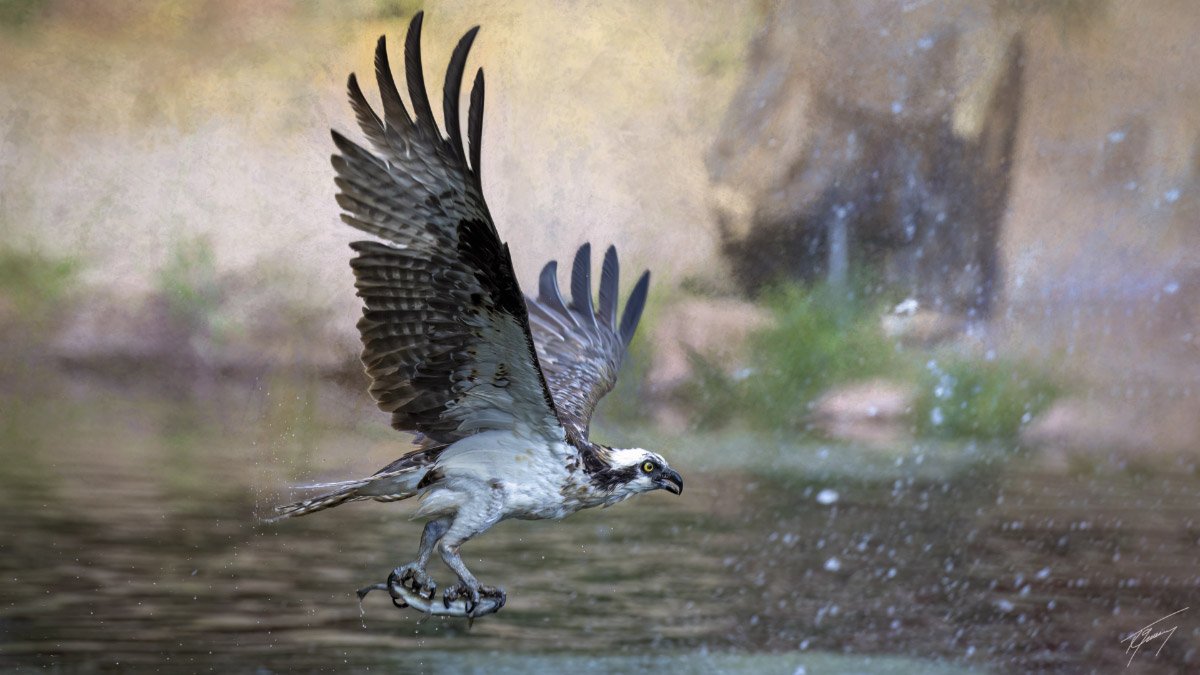
Below is an Osprey making his get away with dinner firmly in his talons and the sound of the attack and escape covered by the sound of the aerators pumping water into the air only to splash down in the pond.

Have a beautiful day, keep breathing and smiling … you are here and with choices to make!

Cheers,

Ted

Therefore, while yet you have
the strength, cherish a desire to do
some useful work in your
little corner of the world, and
have the steadfastness to labor.
For this is the way to the
happy life; with health and
endearing ties, it is the way to the
glorious life.

excerpt from Happiness by Max Ehrmann

###

photo_tedgrussingThe easiest way to reach Mr. Grussing is by email: ted@tedgrussing.com

In addition to sales of photographs already taken Ted does special shoots for patrons on request and also does air-to-air photography for those who want photographs of their airplanes in flight. All special photographic sessions are billed on an hourly basis.

Ted also does one-on-one workshops for those interested in learning the techniques he uses.  By special arrangement Ted will do one-on-one aerial photography workshops which will include actual photo sessions in the air.

More about Ted Grussing

Photographer Captures the ‘Spirited’ Personalities of Stuffed Animals

Photographer Captures the ‘Spirited’ Personalities of Stuffed Animals

sloth stuffed animal hanging from top of image frame against plain white background

Delightful and full of exuberant whimsy, photographer Jared Schoenemann’s series Anthropromophism, is a charming spectacle of stuffed animals bustling with playful souls.

In a quest to appreciate each of his daughter’s “stuffies” just as she does, Schoenemann was inspired to make a kind of visual encyclopedia to not only keep track of the many toys but to meet his daughter’s approval of the unique personalities she sees in them.

“The inspiration was my forgetfulness. My daughter loves her stuffed animals, therefore they are very important to our family, of course. After I got the business for forgetting a few of their names one too many times (on last count she had 137), I decided I should take them into the studio for some portraits.” Schoenemann says, speaking to PetaPixel.

black and white panda stuffed animal sitting with stretched arms against plain white background

brown rabbit stuffed animal sitting against plain white background

With a background in cinematography and athleticism, Schoenemann has a long-held appreciation for what photography has allowed him to personally express and the atmosphere of community it fosters.

“Photography connected all the right dots, (and) allowed me to produce a higher quality of work and collaborate with some wonderful people,” he says.

Utilizing the medium as a means of deeper connection with his daughter and intrigued by the challenge of capturing the “personalities” of each stuffed animal — while appeasing a tough critic — Schoenemann approached the task of photographing her many toys just as he would when shooting live animal portraits. Using a simplistic background, and no props or distractions, the photographer simply just captured the observations and implemented input from his daughter.

black white a grey raccoon stuffed animal sitting against plain white background

“I could talk it up with fancy words but it’s just a simple project anyone can do. My daughter chose her favorites and the ones with the most expressive features, and we got shooting. No props. I wanted just the animal alone, removed from any distractions (similar to my regular animal work). They were shot as they are. Not fresh and new, but well loved.”

Dragon with purple wings stuffed animal sitting against plain white background

When peering into the eyes of one of the stuffed critters it’s easy to become increasingly enchanted by the subtle yet vivacious “spirit” and quirky aura captured in every one of Schoenemann’s shots, attributes that he also credits to the toy maker’s skills,

“The designers of these stuffed animals are very talented and did a great job creating them. All I had to do was find the right angle, light them well, and not mess up their work. There was hardly any post-processing except for removing some dust and errant strings. The background is as it was shot, shadows and all, and that was that. I encourage others to do the same with their kid’s toys. It’s tons of fun.” Schoenemann shares.

up close view of Pink hippo stuffed animal sitting against plain white background

As for challenges, despite some slight trepidation from his daughter and a few undesirable subjects, the photographer was resolute.

“The biggest challenge was finding the proper angle to reveal their personality. Often they had to be pinned or posed, not unlike other work. Some had no personality or were difficult, and were kindly asked to leave (not unlike other work),” he continues.

“My daughter was a bit apprehensive about letting me shoot them, but once she saw their faces popping up on the monitor, she was all in. Oddly enough, their personalities do shine through, so the project was titled Anthropomorphism,” Schoenemann says. “The Nikon 60mm was optically great, but I did pine for smoother focus and was tempted to pick up the Zeiss 50mm macro.”

Creme, white a grey deer stuffed animal sitting against plain white background

Other equipment Schoenemann uses for his other work, he expresses his affinity for Nikon and Zeiss Lenses.

“I use Nikon bodies, Zeiss lenses, and Einstein strobes. For most of my close work, I use the Milvus 100mm, but for the stuffies, I wanted less of a telephoto feel. Browsing Craigslist, I found an old medical Nikkor 60mm AF-D in like-new condition that caught my eye also, it’s super-glued into manual focus, so no one wanted it. I got it for $60 and decided to give it a go for the project. It worked very well,” he muses.

black, white a grey koala stuffed animal sitting against plain white background

The results of Schoenemann’s series are a homage to photography and reality, rather than “pictures.”

“To me, a great photo is a genuine moment, captured and processed well, that reminds the viewer of the good times of life on earth. No fakery. No AI. I’m not interested in cartoons, filters, or fabrications. Hence in my mind, there’s a clear distinction between pictures and photography. We all have our faults, one of mine is my understanding of photography and its importance in capturing memorable moments. Time is short. I prefer to focus on what’s real. Who wants to remember a fake moment? Like Seinfeld said, ‘You don’t aspire to reach the nose.’”

The series also contributes to his desire to capture memorable moments that can be appreciated well into the future, moments that his daughter could foreseeably connect with.

pink bunny stuffed animal sitting with crossed arms against plain white background

“Most importantly, she loves the work, and when she eventually outgrows stuffed animals and the ones that don’t get saved are donated, we’ll be happy to have the memories. What started as a silly idea ended up quite nice, and when printed large on fine art paper, they take on a living, breathing, emotive quality. “

As for the response to the series, it has been positive. While Schoenemann simply enjoys the fun-loving nature of it, he does acknowledge and accepts that it won’t suit everyone’s tastes,

“The response has been wonderful. Friends and family love it, my daughter loves it and tells me the stuffies love it, too. Internet people probably won’t. People with kids like it. I’ve heard that it makes some want to photograph their kid’s toys more and that’s great to hear. It is always nice when your silly projects are enjoyed by others. And I understand why it could be totally lame to others. That’s how it goes.”

Purple, hippo stuffed animal sitting against plain white background

Pink hippo stuffed animal sitting against plain white background

As Schoenemann moves on to other projects, he keeps his love of community and connection front in center in his life and ambitions.

“Go and hug your kids, tell them you love them, call your parents, apologize for your teenage years, and tell them you love them. We’re here now, with free will to make good choices or bad ones. Make good ones — like photographing what’s real and memorable.”

For more from Jared Schoenemann, make sure to visit his website


Image credits: Jared Schoenemann

How to Customize Your Sony Camera to Fit Your Work

How to Customize Your Sony Camera to Fit Your Work

Cameras are more complex and customizable than ever before, allowing users to tweak buttons and settings until everything is mapped to the photographer’s personal workflow. In this video, watch how to change settings to how you work.

For years I would get a new camera and leave it on default settings for every button and dial. Then, as back-button focus became integral to how I shoot, revolutionizing the way I use my camera, I grew curious as to what else I might be able to improve. This sent me down a rabbit hole of creating custom functions, assigning new buttons, and reassigning old ones. In fact, I used to create so many that I’d forget much of what I’d done and go about doing a single button’s work the long-winded, manual way.

Nevertheless, I now have lots of custom functions that I use regularly and it’s important to my efficiency when shooting. The issue with many videos showing you how to “setup your camera” is that the photographer showing you is actually setting up their camera to their tastes. This video by Omar Gonzalez is a higher-level version of those videos, teaching you your options rather than being prescriptive. So, grab your Sony body and get customizing!