The hand crank telephone sculpture in Bryant Pond, Maine, is bigger than a bicycle. (MARTY BASCH PHOTO)
6-9-2023 Basch-Hand crank telephone sculpture


Photography has long been an evolving art form, and the advent of artificial intelligence (AI) has introduced a new wave of innovation. As in many fields, AI has begun to shape the landscape of wedding photography, changing how photographers capture, edit, and deliver photos.
Though this technology is exciting, it raises questions about the future of the creative industry. What happens when AI-generated content becomes indistinguishable from human-created content? This is a question that continues to intrigue and concern many in our industry. However, there’s a consensus that most genres of photography, which revolve around capturing specific moments in time or specific people, will continue to have a unique value that AI cannot replicate.
One of the key areas where AI has found application in photography is image recognition. Image recognition allows the camera to identify subjects within the frame, which can help with autofocus and exposure settings. For instance, many modern cameras use AI to recognize human faces or even specific animals and focus on them automatically. This feature is especially useful in dynamic environments, like sports or wildlife photography, where the subject is moving quickly and unpredictably.
AI is also employed to identify different types of scenes and adjust camera settings accordingly. For instance, many smartphone cameras can detect whether you’re taking a close-up shot, a landscape, a portrait, or even a night scene, and adjust the exposure, color balance, and other parameters automatically to get the best possible image.
AI algorithms can also analyze the lighting conditions and optimize the camera settings for those conditions. This is particularly valuable in challenging lighting conditions, such as backlit scenes or low-light situations.
In the realm of post-processing, AI is helping photographers save time and enhance their photos more effectively. Adobe’s Sensei AI, for example, powers features like Select Subject and Select Mask in Photoshop, making it easier to isolate subjects from the background. It also assists with tasks like pattern recognition, making content-aware fill more accurate.
AI-powered software can also automate the editing process by analyzing an image and suggesting adjustments to improve it. These can range from basic adjustments like exposure and contrast to more complex edits like removing unwanted objects or even replacing the sky.
Generative AI, as demonstrated by AI image generators like DALL•E 2, can create new images from scratch based on text descriptions. This could potentially be used for creating conceptual art or assisting in commercial photography, where a specific scene or object is needed but not readily available.
Wedding photography, with its demand for capturing intimate and fleeting moments, might seem a far cry from the world of artificial intelligence. However, AI is not only making inroads into this field, but is becoming a valuable tool for wedding photographers. AI technologies have the potential to drastically enhance the work of wedding photographers in several ways.
AI software can greatly streamline the post-processing work, which is often the most time-consuming aspect of wedding photography. With thousands (sometimes tens of thousands if you cover multi-day celebrations like Indian weddings) of photos to sort through, cull, and edit, this phase can be a significant bottleneck in a photographer’s workflow.
AI-powered software can speed up this process by automatically selecting the best shots based on predefined criteria such as focus sharpness, exposure, and even the subjects’ expressions. Adobe’s Lightroom, for instance, offers a feature called “Auto Tone” that can automatically correct the color balance and tone of an image, saving photographers valuable time.
I am in no way, shape, or form saying that you should only use AI when culling or color grading your images. AI can be a powerful tool (just like any other tool photographers already use, such as autofocus) to streamline post-production by providing a quick and efficient starting point.
AI can also help enhance the quality of images. Noise reduction, sharpening, and upscaling are just a few areas where AI algorithms excel. They analyze the image content, understand the scene, and apply corrections that are fine-tuned to the specific image rather than using a one-size-fits-all approach.
Camera manufacturers are increasingly integrating AI into their hardware. AI-driven autofocus systems, such as those found in Canon’s EOS R3 and Nikon’s Z9, can track subjects more accurately and quickly, ensuring no crucial moments are missed. AI can also assist in optimizing camera settings in real-time based on the lighting conditions and the scene’s content, thereby enabling wedding photographers to focus more on the art of capturing moments and less on the technicalities of camera settings.
AI can be a great tool for creating wedding albums and slideshows. Some AI systems can analyze images and select the most emotionally resonant moments, creating a narrative that might take a human hours to develop. AI can even generate music that matches the mood of the images, creating a personalized and engaging slideshow.
AI is playing an increasingly important role in the field of photography, including in wedding photography. It’s providing tools and capabilities that can help photographers to streamline their workflow, enhance image quality, and focus more on the creative aspects of their work.
However, while the potential of AI in photography is immense, it’s important to remember that these technologies are tools to aid photographers, not replace them. The art of photography is inherently human; it’s about capturing moments and emotions, telling stories, and creating a connection between the viewer and the subject. These are aspects where the human touch is irreplaceable.
AI can assist by taking over more tedious tasks like culling and basic editing, or by providing real-time guidance on technical aspects. But the creative decisions — the choice of the perfect moment to press the shutter, the framing of a shot, the interpretation of a scene — these will always require the human touch.
Moreover, as AI technologies continue to evolve, ethical considerations also come into play. It’s crucial to use these tools responsibly, ensuring that the authenticity of images is maintained and that the privacy and consent of subjects are respected.
In conclusion, AI is an exciting development in the world of photography, offering numerous possibilities for improving and enhancing the work of photographers. By embracing these new technologies, photographers can not only improve their technical skills, but also potentially unlock new avenues of creativity. However, the heart of photography remains in the hands of the photographer — their vision, their creativity, and their ability to capture a moment in time.


Award-winning landscape and nature photographer Greg Boratyn is known for combining brilliant photography with a penchant for educating photographers through presentations and his international workshops.
Boratyn’s portfolio contains colorful landscape photos that transport viewers to a time and place. His work places significant emphasis on capturing the essence of the spirit of a scene while maintaining a strong sense of realism.

PetaPixel spoke with Boratyn about his career, portfolio, passion for helping other photographers improve their work, and artistic vision.
“For many photographers, myself included, the transition to digital photography brought about significant changes and opportunities,” Boratyn tells PetaPixel.
Advances in digital photography enabled Boratyn to grow and develop as a photographer in numerous ways. Digital photography provided instant feedback, allowing him to get a real-time view of a scene and check his images. With the instant feedback provided by digital cameras, Boratyn found it much easier to develop his technique.
There were other benefits for Boratyn as digital cameras took over, including significant reductions in cost, significantly easier post-processing and editing, a streamlined workflow, and improved accessibility. Being able to capture, view, edit, and share images quickly proved vital for Boratyn as he built his career.
One of the benefits of digital that Boratyn expressed is that it allowed him to edit and digitally manipulate his images easily. However, with great power comes great responsibility.
“When it comes to my artistic approach and relationship with post-processing, I strive to maintain a balance that preserves the authenticity and essence of the scene while utilizing digital tools to enhance the final result,” Boratyn explains.
“For me, the ultimate goal of post-processing is to bring out the inherent beauty and emotional impact of the captured moment rather than creating an artificial or heavily manipulated image. I view post-processing as a means to refine and fine-tune the photograph, not to drastically alter or distort the reality I experienced at the time of capture,” he continues.

To that end, he’s careful to avoid excessive or heavy-handed edits that reduce the authenticity of a scene. He wants to use digital technology to strengthen the connection between the viewer and the photograph, but excessive or unnaturally editing techniques can serve to sever that bond. For Boratyn, a successful photograph immerses the viewer and keeps them focused.
“Of course, every artist has their unique approach to post-processing, and there is no right or wrong way to do it. It’s a personal choice based on one’s artistic vision and intent,” he adds.

“In my case, I value the balance between the power of digital tools and the preservation of a natural aesthetic. It is this approach that resonates with me and, apparently, with viewers like yourself who appreciate that sense of authenticity and timelessness,” Boratyn explains.
His goal is to evoke emotion, and digital cameras and the accompanying post-processing software are tools in his kit. No matter how successful professional photographers such as Boratyn achieve their results, and there’s a diverse range of approaches to that goal, they all have something in common — intention and consistency.
When viewing Boratyn’s portfolio, a few things are immediately apparent. He relies heavily upon technically-sound photographic techniques, loves color, aims to enhance reality in subtle ways, and he uses many different lenses.
A lot of landscape photography is captured using wide-angle lenses. They’re a popular first choice for budding landscape photographers. However, photographers like Boratyn show that there’s a place in every landscape photographer’s bag for long lenses.

“The choice of lens and focal length plays a crucial role in creating compelling compositions and visual storytelling,” he says.
“Wide-angle lenses, typically with focal lengths below 35mm, allow me to capture expansive scenes and convey a sense of grandeur. They are useful for landscapes, architecture, and environmental portraits, as they emphasize the foreground and provide a broad view of the surroundings. Wide-angle lenses can create a sense of depth, leading lines, and a sweeping perspective that immerses the viewer in the scene,” Boratyn explains.
There’s a place for standard lenses, such as 50mm primes, in his kit, too.
“Standard lenses, typically with focal lengths around 50mm, are versatile and closely mimic human vision. They offer a natural perspective and are well-suited for documentary-style photography and street photography. Standard lenses are often my go-to choice to capture scenes with a sense of normalcy and authenticity, allowing the viewer to feel as if they are present in the moment,” says Boratyn.

“Telephoto lenses, with focal lengths above 70mm, are valuable tools for compressing distance and isolating subjects from their surroundings. They are excellent for capturing details, portraits, and wildlife photography. When I reach for a long lens, it is often because I want to emphasize a specific subject or element within a scene while minimizing distractions. Telephoto lenses help me create a more intimate and focused composition by narrowing the field of view and drawing attention to the subject,” he explains.
Boratyn’s tricks of the trade don’t stop there. He also occasionally uses macro lenses and even fisheye lenses.
“Ultimately, the choice of lens depends on the story I want to tell and the visual impact I aim to achieve. Each focal length offers a distinct perspective and allows me to convey emotions, guide the viewer’s attention, and create a specific atmosphere within the frame. By carefully selecting the right lens for each situation, I can enhance the composition, emphasize important elements, and evoke the desired response from the viewer,” Boratyn explains.

There are many ingredients to compelling landscape and nature photographs, including lighting, framing, and subject positioning. However, while these compositional elements ultimately comprise the final photo, the lens a photographer selects is an integral part of the process. The choice of focal length affects how an artist can compose the scene and determines what can be included. But, perhaps most importantly, focal length also affects what a photographer can omit from a frame.
For Boratyn, “color is a powerful compositional element.” He uses it to evoke certain emotions in the viewer in specific ways.
“I pay close attention to the interplay of colors within a scene. I seek out color harmonies, where colors complement and reinforce each other, creating a sense of unity and balance. Conversely, I also look for color contrasts that add visual interest and grab the viewer’s attention. By using complementary colors (opposite hues on the color wheel) or contrasting warm and cool tones, I create dynamic compositions that draw the viewer in,” Boratyn explains.
Color theory has long been critical to the success of color photographers and artists. The digital age of photography has only made it easier to make precise adjustments to hues and saturation to achieve the desired result.
As for the emotional qualities of colors, Boratyn explains that different colors include certain symbolic meanings. He takes advantage of this by strategically using color to reinforce the desired narrative of a photograph.

“For example, warm tones like golden hues or fiery reds may evoke feelings of warmth, energy, or passion, while cool tones like blues and greens can evoke calmness, tranquility, or melancholy. By aligning the color palette with the intended emotional response, I strengthen the connection between the viewer and the image,” he tells PetaPixel.
“Sometimes, I employ the technique of selective color, where I highlight a specific color amidst a predominantly neutral or desaturated palette. This technique directs the viewer’s attention to a particular subject or element within the frame,” Boratyn explains.
He combines this approach with a dominant color technique. Dominant color refers to photographs where a single color “dominates the composition,” which, Boratyn continues, “Can create a bold and impactful visual statement, emphasizing the subject or creating a distinctive atmosphere.”

To achieve specific colors and enable color-dependent compositions, Boratyn utilizes post-processing and color grading. He fine-tunes particular colors to achieve the desired result, including adjusting color temperature, saturation, and contrast.
Like other aspects of his post-processing workflow, Boratyn works to balance realism and artistic expression.
“Color grading techniques allow me to stylize the images further, adding a signature look and feel that aligns with my artistic vision,” he explains to PetaPixel.

“By utilizing color consciously, I aim to elicit emotional responses from the viewer and enhance the overall impact of my images. Color can convey many emotions, from joy and excitement to tranquility and introspection. Through careful consideration of color harmonies, contrasts, and the narrative potential of each hue, I strive to create visually captivating and emotionally resonant photographs,” Boratyn says.
He adds that it’s worth considering how colors can mean different things and evoke varied emotions depending on the viewer. Nonetheless, he uses color thoughtfully and intentionally to produce certain emotional responses, even if these individual reactions to color can depend upon personal and cultural associations.

One of the most challenging aspects of capturing vast landscapes is instilling a sense of scale for the viewer. Even a massive mountain can look relatively small in the frame, especially with a wide-angle lens.
Boratyn employs numerous techniques to capture the grandeur of imposing landscapes, including leading lines and foreground elements.
“I look for natural lines, such as rivers, paths, or mountain ridges, to guide the viewer’s eye through the frame and create a sense of depth. This helps draw the viewer into the scene and gives a sense of scale,” Boratyn explains, adding, “Including a compelling foreground element adds depth and dimension to the image. It could be a rock formation, a tree, or any other object that adds interest and leads the viewer’s eye into the image.”

He tells PetaPixel that other effective ways to demonstrate scale in landscape photographs include showing atmospheric elements like clouds, mist, or fog, and composing images with a specific point of reference. Examples of reference points include trees or distant structures. He also likes to experiment with different angles and vantage points.
Familiar to photographers of all experience levels, the “rule of thirds” is also essential for seasoned pros like Boratyn. “I often apply the rule of thirds to place key elements, such as the horizon or prominent features, along the intersecting lines or their intersections. This helps create balance and visual interest,” he says.
Key elements can include dramatic clouds, mountains, or waterfalls. Elements like these create dynamism and make photos more interesting.
However, there’s such a thing as “too much.” Simplicity is common among successful photographs across all genres.

“I isolate the subject by eliminating distracting elements, focusing on its unique characteristics, textures, or patterns. This simplification allows viewers to appreciate the details and beauty that might otherwise be overlooked,” explains Boratyn.
“I strive for a balanced composition, utilizing negative space and carefully placing the subject within the frame. This creates a sense of harmony and allows viewers to focus on the subject itself,” he adds.
Framing is frequent throughout much of his work as well. Throughout this interview, there are images that utilize elements like branches and rocks to help frame a photo’s subjects.

“Filters can be powerful tools for enhancing and controlling light, adding creative effects, and achieving desired results straight in-camera,” Boratyn says.
Even as image editing software has become more advanced and make it easier than ever to completely change a photo’s look and feel, specific filter effects are very difficult or outright impossible to replicate digitally.
For example, polarizing filters, which enable photographers to reduce reflections in a scene, are impossible to implement digitally. “They are particularly effective when photographing landscapes with water, foliage, or skies. Polarizers can remove glare from water surfaces, deepen blue skies, and make colors appear more vibrant,” Boratyn says of polarizing filters.
He also uses neutral density (ND), graduated neutral density (GND), and color-enhancing filters in his work. ND filters help photographers control exposure times and balance light and can be used to smooth water and add movement to clouds. GND filters apply an ND effect to only part of the image and are often used to darken the sky in challenging light, allowing photographers to expose the foreground better.
Boratyn’s filter company of choice is Singh-Ray, a manufacturer he works with. PetaPixel readers looking to add high-quality filters to their kit can use Boratyn’s personal discount code, “GREG10,” to get 10 percent off an order from Singh-Ray.
Like many professional photographers, Boratyn offers workshops. Offering Boratyn a chance to “pitch” his workshops, he tells PetaPixel that he designs his workshops to be immersive and deliver extensive hands-on learning and instruction.

His workshops take small groups of photographers to beautiful and diverse locations worldwide. Boratyn tries hard to incorporate local culture into his workshops. “Beyond photography, my workshops often incorporate elements of local culture, enabling participants to connect with the people, traditions, and history of the destination. This adds depth to the experience and can inspire unique perspectives in their photography,” Boratyn explains.
He wants his clients to return home with great photos, improved photographic skills, new friends, and fantastic memories of incredible locations.
More details about Boratyn’s workshops are available on his website.

Boratyn tells PetaPixel that he hopes his answers provide insight into his photography and offer practical tips that readers can use to improve their landscape and nature photography. “My answers may sound very ‘educational,’” Boratyn explains, “But that was my intent.”
Much more of Greg Boratyn’s beautiful and award-winning landscape photography is available on his website, Instagram, and 500px.
Image credits: All images © Greg Boratyn
When it comes to drone photography, the Hamptons provides a stunning canvas, and few understand this better than ace photographer Maxwell Alexander. Bringing a fresh perspective to aerial photography, Alexander, the lensmaster behind Alluvion Media, recently embarked on an awe-inspiring expedition to the Hamptons, transforming ordinary landscapes into magnificent aerial masterpieces.
Spectacular Hamptons from the Sky: Maxwell Alexander’s Aerial Drone Photography Reveals New Heights – Presented by Alluvion Media

Renowned as a fine art nature photographer, Alexander’s organic and authentic style shines through his work. His drone photography avoids exaggerated renditions, choosing instead to showcase the landscapes’ true colors and textures, thus turning every photograph into a visceral experience for the viewer.

His aerial tour of the Hamptons perfectly captures this philosophy. From the cerulean waves and sun-bleached sands of East Hampton’s beaches to the iconic majesty of the Montauk Lighthouse to the luxurious pools and gardens throughout the very end of Long Island, Alexander’s drone captured these vistas in their most genuine and intimate form, bringing the Hamptons’ unique rhythm of life to the fore.

The drone technology used by Alluvion Media, when paired with Alexander’s artistic prowess, offers a fresh narrative to Hamptons’ iconography. His images extend beyond traditional representations, inviting viewers to appreciate the Hamptons’ raw beauty. The resulting aerial drone shots are more than just images – they’re a visual narrative, a story of the Hamptons told from the heavens.

The journey continued with an exploration of the Montauk Lighthouse, a beloved landmark dating back to 1796. The aerial shots of the lighthouse, surrounded by the azure Atlantic, blend heritage and natural beauty in a striking manner, echoing Alexander’s commitment to portraying honest and authentic landscapes.

Maxwell Alexander’s aerial drone photography has breathed new life into the well-worn tropes of Hampton’s iconography. His work disrupts the traditional narrative, encouraging viewers to perceive the familiar through a renewed lens. His work is a testament to the potential of aerial drone photography, and it’s clear this venture into the Hamptons is just the beginning.

In the world of lifestyle and travel photography, Maxwell Alexander and Alluvion Media are proving that the sky isn’t the limit – it’s the platform. His journey through the Hamptons offers a compelling insight into the potential of drone photography and inspires us to re-envision the spaces we inhabit and explore. We’re excited to see where Alexander’s drone takes us next – because if the Hamptons were this beautiful from above, just imagine the potential of other scenic hotspots through his authentic aerial perspective.


June 9-10
1245 N. Spring St., Los Angeles, CA 90012
The largest pride music event in the country — LA Pride in the Park will expand this year to a two-day extravaganza, taking place at Los Angeles Historic Park this Friday and Saturday. Global superstars and GRAMMY Award-winning queens Megan Thee Stallion and Mariah Carey will slay the stage as your festival headliners.
The festival also will feature an array of local vendors and LGBTQ+ exhibitors, a large sober space, sponsor giveaways, and so much more.
Get single or weekend passes online.
June 9-11
277 N. Avenida Caballeros, Palm Springs, CA 92262
Head over to sunny Palm Springs for the 10th annual Splash House festival.
This summer festival series grants you admission to a house and disco escape with great people and tons of fun in our favorite desert playground.
The party takes place across three hotel resorts, and each resort is a full takeover hosting poolside stages, rooms and balconies that are all part of the fun. Desert days continue into the night for their After Hours series, where you’ll dance aside the planes and under the stars at the Palm Springs Air Museum.
Get your tickets online.
June 10 at the Hollywood Bowl
2301 N. Highland Ave., Los Angeles, CA 90068
On Saturday at The Hollywood Bowl, the one and only Janet Jackson is back.
The celebrated music icon behind “All for You,” “Rhythm Nation,” “Nasty,” “That’s the Way Love Goes,” and so many more hits — headlines opening night at The Hollywood Bowl.
Plus, GRAMMY-Award winning rapper Ludacris kicks off a night not to be missed! All proceeds from opening night benefit the LA Philharmonic and its learning and community programs.
June 10 at Castaic Lake
32132 Castaic Lake Drive, Castaic, CA 91384
Also on Saturday is the fourth annual Castaic Lake Dragon Boat Festival. Last year’s festival had about 500 paddlers in attendance from both youth and adults. Come out and enjoy beautiful Castaic Lake and watch teams from different cities, states and countries compete in dragon boat racing.
There will be different stage performances, including lion dance, live music and more dancing.
And guess what? The event is free for the public.
June 10 to June 11 at the Autry Museum of the American West (Griffith Park)
4700 Western Heritage Way, Los Angeles, CA 90027
This Saturday and Sunday, join the Autry Museum of the American West for a fun-filled weekend perfect for the whole family. Celebrate contemporary and traditional Native art forms for the 32nd annual American Indian Arts Marketplace, where you can purchase one-of-a-kind artwork, jewelry and fashion.
The festival brings together dozens of Native American artists and tribes for the annual showcase, as well as Native playwrights as they regale us with their stories of being Native today.
Watch “The SoCal Scene” at 9 p.m. every Thursday on Spectrum News 1 and the Spectrum News app.

… a large cup of pure Kona Coffee, a Canon R5 with a 100/500 lens and a 1.4 extender giving me a reach of 700mm and a wood plank to rest the camera on when not shooting and at about 6:45AM it was time to take the tram up to nest level about 150′ above the ground … a stop and then checking the nest out which is in a niche in the cliff about two football fields away.
The top photo is of my camera resting on the plank pointed at the nest … I drew a red circle around the nest … a beautiful morning and a few minutes to enjoy my coffee before the action started.
The next photo shows mom bringing a bit of breakfast into the nest for the kids … a tip for you if you want to shoot raptors in and around their nests, they will almost always fly into the nest from below it, as they can fly upwards into the nest area whilst dropping airspeed and kind of stall into the nest. Good to dissipate speed when flying into a cliff wall. When shooting the incoming bird, do not try to get a shot of it alone, rather when you see it coming in, get a focus on the nest and begin shooting and you will get it as it swoops upwards and into the nest.
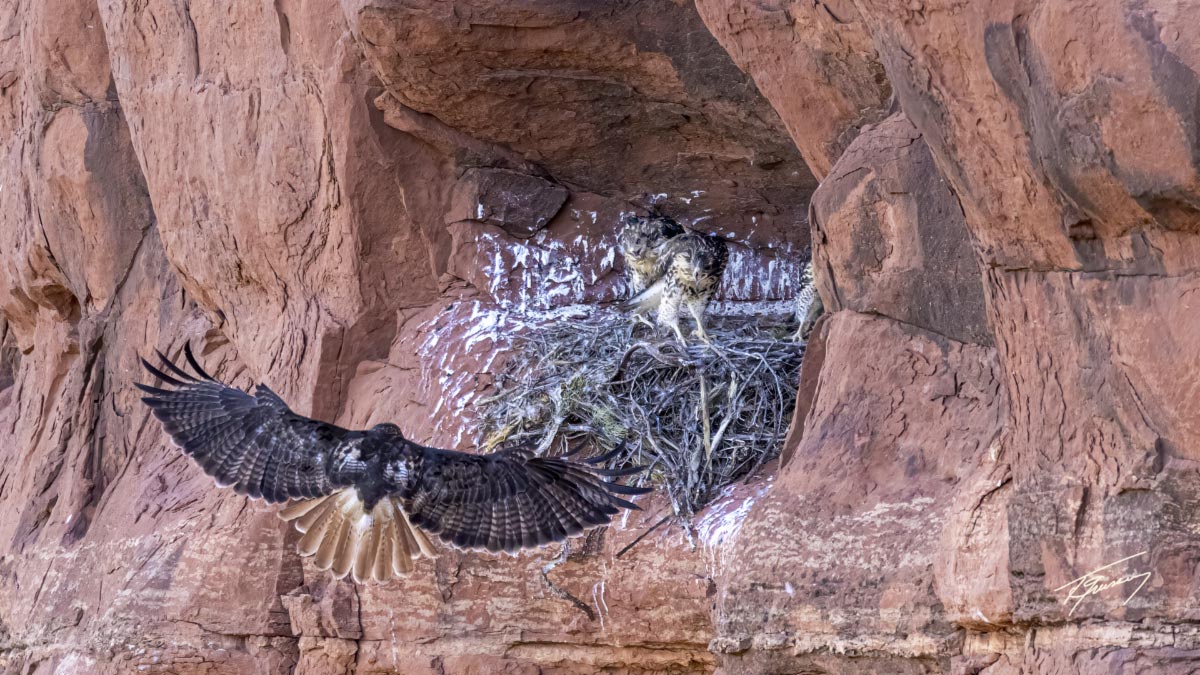

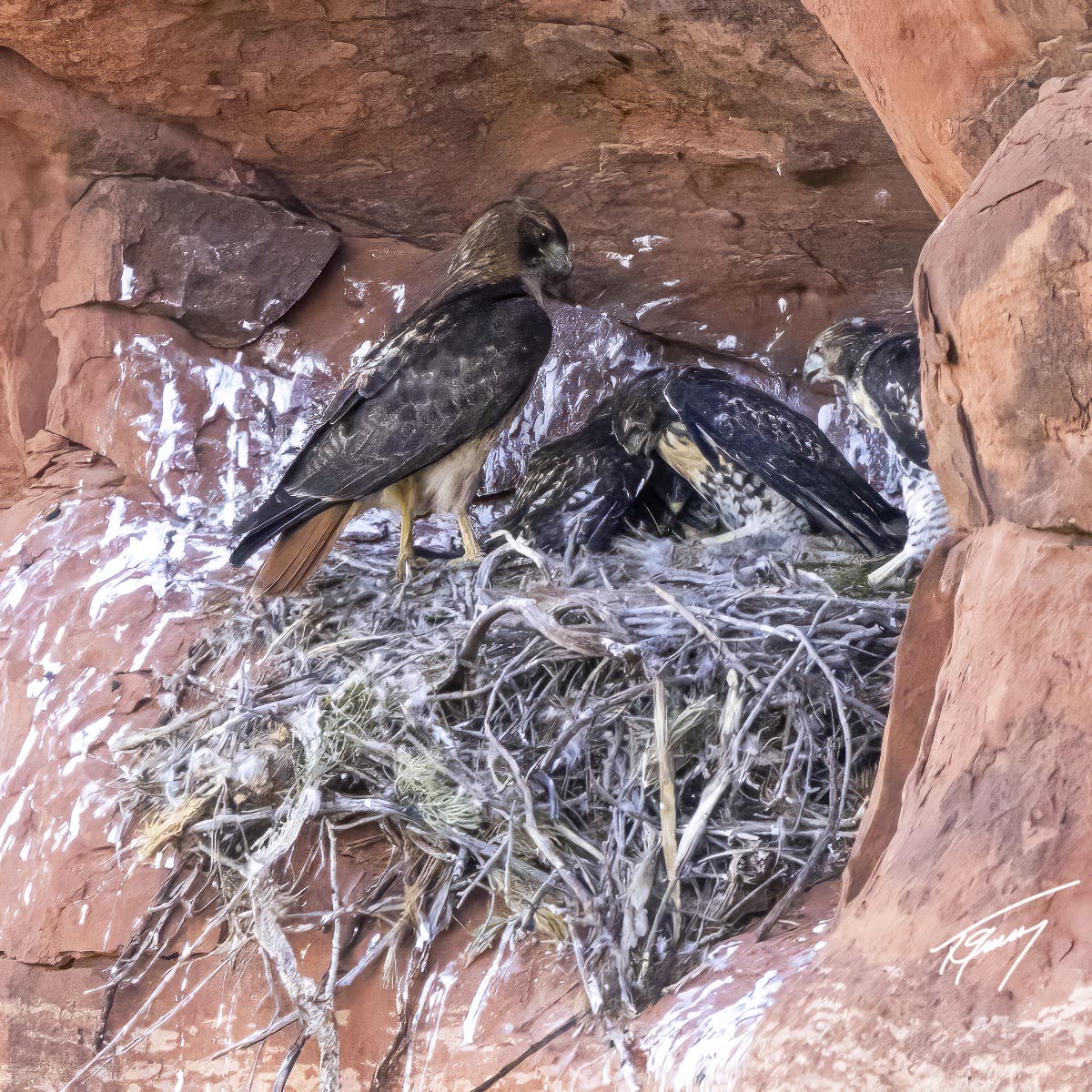

The next shot below that is of one the kids mantling breakfast (covering it up with his wings) this is done to keep others from seeing the food … taking a meal away from another bird is pretty common, but if others cannot see it, perhaps they will get to keep their food. Shortly after this mom left the nest to go find more food for the family.
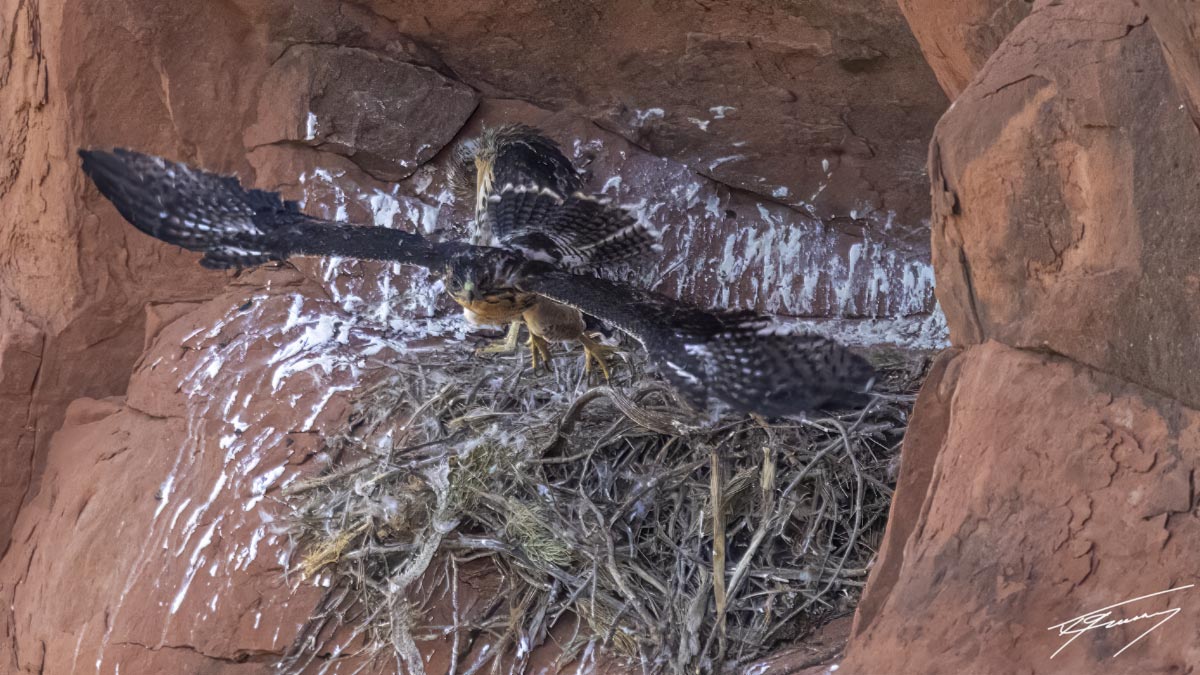
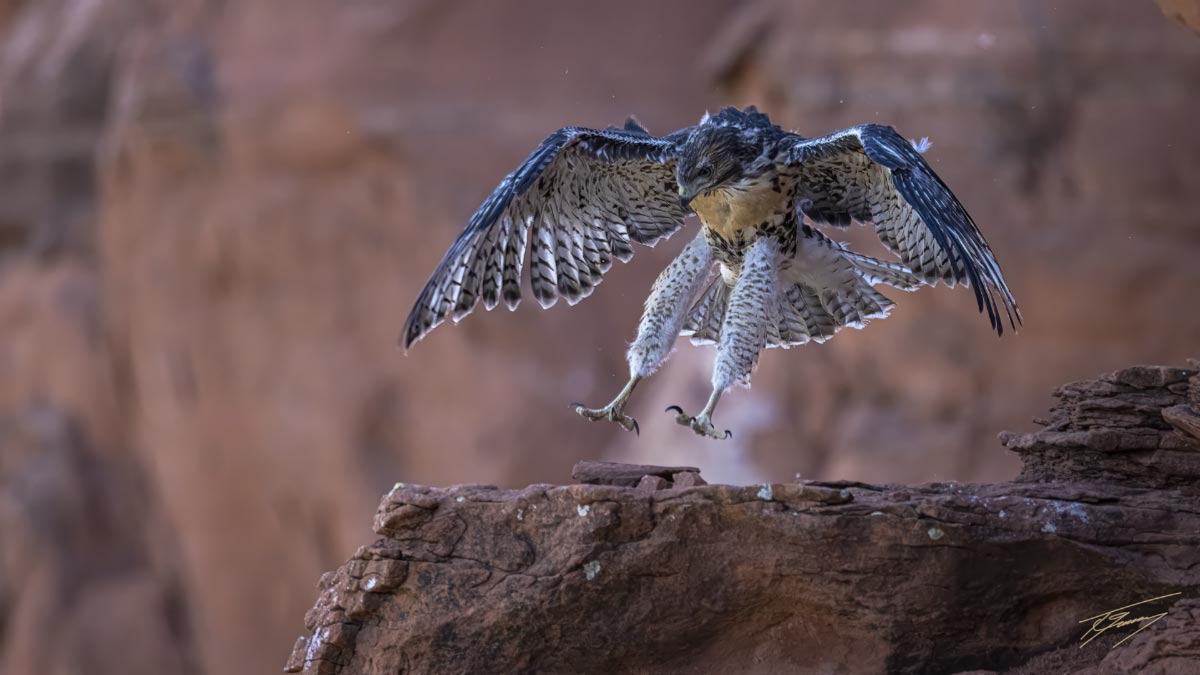
About ten minutes later, one of the kids made a couple of runs with wings flapping to the edge of the nest, but stopped short of going airborne … on the third try, he steeped into the abyss and went airborne … he ended up coming into an outcropping from the cliff about 40 feet from me and stuck a perfect landing. He played around on this outcropping for about fifteen minutes before making the flight back to the nest. I spoke with Michele at International Raptor and Falconry Center and she told me that it is common when making a first flight that there there will be a few false starts … after that it is a push off and go! Only deleted half of the photos … so many good ones.

Check the last photo out carefully and you will see remnants of his baby feathers on his head and wings … they will likely hang out around the nest for a couple of more weeks and the adults will still provide food as the young learn the skill of providing for themselves. Life is so terrific!

Into the weekend for me and the plan is to be back Monday morning … keep breathing, smile and make someones day a little better because you are here..

Cheers,
Ted
Whatever else you do or forebear,
impose upon yourself the task of happiness,
and now and then abandon yourself
to the joy of laughter.
excerpt from Whatever Else You Do by Max Ehrmann
###
 The easiest way to reach Mr. Grussing is by email: ted@tedgrussing.com
In addition to sales of photographs already taken Ted does special shoots for patrons on request and also does air-to-air photography for those who want photographs of their airplanes in flight. All special photographic sessions are billed on an hourly basis.
Ted also does one-on-one workshops for those interested in learning the techniques he uses. By special arrangement Ted will do one-on-one aerial photography workshops which will include actual photo sessions in the air.
More about Ted Grussing …

This is an advertisement

Lucas Zwirner faces to the side in a swirl of pigment washes of orange and brown. When Elizabeth Peyton’s painting of her friend, the heir-apparent to the Zwirner gallery empire, debuted at Art Basel Hong Kong, art-world forums lit up.
But the tittering online was not because the work was particularly stylish or even because, according to rumors, it may have been spurred into being by a romance. It was because Peyton was using her art to signal something about her social network. As some journalists pointed out, the director and the artist are professionally intertwined now. Officially, just a few weeks before the painting popped up on the fair floor, Peyton had left Gladstone Gallery behind when signing with David Zwirner.
This subtext was like a hyperlink hidden within what was, on the surface, a sentimental painting of a friend. We’ve been seeing a lot of paintings in this vein lately: works that play on intimate depicted relationships which are coded, like a video-game Easter egg, in a way that is discernible ideally for those who are also members of a specific in-crowd, or who aspire to be.
Examples that jump to mind include Gagosian gallery star Anna Weyant’s Two Eileens (2022), which got people talking via its doubled image of Eileen Kelley, “sexpert,” host of the Going Mental podcast, and niche celebrity. (Kelley returned the favor by having Weyant on the podcast to talk about art-world sexism.)
Or think of something like Constance Tenvik’s Kenny On The Day When I Exchanged A Mind Map For Plastic Gloves, Printed Out Official Documents & A Cab To The Airport (2020), depicting art dealer, writer, and gadfly Kenny Schachter, recognizable by his glasses and signature track pants, but identified knowingly only by his first name.
Such scene-y figurative portraiture combines an awareness about access to a scene with a tenderness for it. If the viewer gets the fine print (as more than a few did when it came to that Peyton-Zwirner link), then they too gain some level of membership.

Elizabeth Peyton, Lucas Zwirner (2022). Courtesy of David Zwirner.
This trend—let’s call it hypersentimental painting—can be seen from a few angles. The clique-based realism that you have been seeing more and more of late is surely a by-product of our algorithmic drifts into social clusters. Social bubbles have become so pronounced over the last years that it can be hard to reconcile with anyone who sits beyond them.
Such digital fragmentation was further aggravated by the pandemic, which shrunk down these already siloed groups. With such tightened virtual micro-communities, to paint what one intimately knows and what their peer group will have a special appreciation for seems only natural.
At the same time, many of us feel more exposed than ever before. Though people have been proudly and loudly moving into smaller forums via “Close Friends” lists, Discord channels, Mastodon platforms, and Telegram or WhatsApp groups, that mass migration still comes against the background of a lot of angst about living life in public online.
Most of our attention and time remains captured the big platforms. The marketing tactics and hyper-scrutiny within these places have become so unavoidable that if you want to preserve any sense of subcultural cachet in these arenas, interacting necessitates a certain kind of deliberate encryption.
Against this background, the proliferation of this strain of subjective painted scenarios focused on members of an artist’s personal world—be they lovers, family, or friends—is a smartly positioned move. This kind of painting champions micro-community as content but also, crucially, as sensibility. It’s all about painting in a way that speaks to those who get it while still catching the eye of those who don’t. That pair of outcomes, when they work out, provides a double reward.
 Emma, (2022). © Anna Weyant. Photo: Robert McKeever. Courtesy Gagosian” width=”822″ height=”1024″ srcset=”https://www.mecreates.com/story/news/wp-content/uploads/2023/06/WEYAN_2022.0008-1-1-822×1024.jpg 822w, https://news.artnet.com/app/news-upload/2023/06/WEYAN_2022.0008-1-1-241×300.jpg 241w, https://news.artnet.com/app/news-upload/2023/06/WEYAN_2022.0008-1-1-40×50.jpg 40w, https://news.artnet.com/app/news-upload/2023/06/WEYAN_2022.0008-1-1.jpg 963w” sizes=”(max-width: 822px) 100vw, 822px”>
Anna Weyant Emma, (2022). © Anna Weyant. Photo: Robert McKeever. Courtesy Gagosian
What I am calling hypersentimentalism has gestated in the long tail of figuration that blossomed in tandem with the Age of the Influencer around 2014. Figurative painting circulated well within the Instagram economy: Easily consumed images of stylized figures resonated with social media as a platform for performing and curating identity. (In 2020, Tamara de Lempicka, an artist whose stylish Art Deco portraits were long considered kitsch, was even given an attempted rebrand as a “Queen of Instagram” before her time.)
By the second decade of the millennium, figuration was still booming, but frustration with the major forms of it was building alongside frustration with the fakeness and hyper-performativity of this era of social media.
In 2020, critic Alex Greenberger dubbed a lot of the whimsical new nouveau Surrealist and nouveau Pop painting, which had enchanted the market, as “zombie figuration.” By 2021, art historian Darby English cautioned that the astonishing vogue for figuration by Black painters was limiting: “To me, the worrisome thing about a flood of figuration is the time and resources we aren’t spending on the part of us we can’t image.” In New York, the most recent Whitney Biennial took a sharp turn towards abstraction and a language of opacity, making deliberate demands of the audience to invest in artists’ backstories.
Hypersentimentalism’s laser-focus on niche knowledge and micro-communities offers a way to keep faith with the strengths of figuration, while still positioning oneself against some of these frustrations. It follows an “IYKYK” logic, playing up a layer of insider opacity. (For those who don’t know, IKYKY stands for “if you know, you know.”)
Tellingly, a parallel development has happened in marketing, where old-fashioned influencers are no longer the hot commodity. Instead, brands are turning to micro-influencers—or even nano-influencers.
In fashion, Lauren Cochrane notes the rise of the “IYKYK model.” Casting niche personalities over professional models “adds a layer of authenticity… Rather than choosing someone solely for their beauty and ability to look great in clothes, they are bringing the actual people they would like to wear their labels into the campaign. And if they share their love of the brand with their influential friends and followers? Even better.”
Indeed, that fashion phenomenon has itself notably synthesized with the art world. Take collector Karen Boros walking the Balenciaga runway for Spring/Summer 2020, an event that caused a small flurry of excitement in the German art world. The micro-celebrity may not have been noticed by the many thousands more who watched and reposted the show, but the right (high-net-worth) people likely did.
More recently, art critic Dean Kissick was among those modeling in a Marc Jacob’s Heaven spring 2023 campaign, a lookbook that was a horizontally scrolling eye-spy of various New York micro-celebrities. (The White Lotus star Michael Imperioli, clad in a skull-print hoodie‚ was perhaps the most famous among them—though he still feels like a niche pick).

Installation view of Amalia Ulman’s show “Jenny’s” at Jenny’s. Courtesy of the artist and Jenny’s. Photo by Joerg Lohse
In recent art, examples of this guessing-game, who’s-who style are percolating everywhere.
Chloe Wise’s rise was spurred on in part by her paintings of New York friends going viral. In Wise’s vibrant canvasses, you aren’t told you are supposed to recognize, say, model and artist Richie Shazam among the three embracing figures in 2019’s Polysemic Primavera (a hypersentimentalist tic: titles never dare belie the names of the muses in the painting). Spotting Shazam’s half-face again peering out of another Wise work, Some pleasant lies would be nice (2021), feels as if you are being given membership to the in-crowd—even if it is a low-tier level of access.
 Some pleasant lies would be nice (2021) © Chloe Wise – Courtesy of the Artist and Almine Rech. Photo: Dan Bradica” width=”881″ height=”1024″ srcset=”https://www.mecreates.com/story/news/wp-content/uploads/2023/06/CWI0165-CHLOE-WISE-2021_47126-881×1024.jpg 881w, https://news.artnet.com/app/news-upload/2023/06/CWI0165-CHLOE-WISE-2021_47126-258×300.jpg 258w, https://news.artnet.com/app/news-upload/2023/06/CWI0165-CHLOE-WISE-2021_47126-1322×1536.jpg 1322w, https://news.artnet.com/app/news-upload/2023/06/CWI0165-CHLOE-WISE-2021_47126-43×50.jpg 43w, https://news.artnet.com/app/news-upload/2023/06/CWI0165-CHLOE-WISE-2021_47126-1652×1920.jpg 1652w, https://news.artnet.com/app/news-upload/2023/06/CWI0165-CHLOE-WISE-2021_47126.jpg 1762w” sizes=”(max-width: 881px) 100vw, 881px”>
Chloe Wise, Some pleasant lies would be nice (2021) © Chloe Wise. Courtesy of the Artist and Almine Rech. Photo: Dan Bradica
You could follow that thread downtown to Amalia Ulman’s exhibition “Jenny’s” at the trendy gallery Jenny’s, featuring a dense, salon-style gallery of portraits of friends and scene-makers. Though working as much in the tradition of conceptual installation as figurative painting (I do not think these artists follow any formal rules), Ulman sounds some of the familiar notes.
The show was an homage to the Theater District restaurant Sardi’s, whose walls are adorned with caricature sketches of New York theater folk. Ulman replicated the caricature salon hang, only with figures who either exist in or orbit around the downtown cultural scene in New York.
Tagged are artists Anna-Sophie Berger, Seth Price, Heji Shin, and Jordan Wolfson, among others. There are also the prestigious Stadelschule professors Josef Strau and Michael Krebber, as well as art critics and authors, such as Natasha Stagg, Stephanie LaCava, and Dean Kissick (again).
In February, Swiss artist Tobias Spichtig debuted a whole family of paintings at a sleek show of figurative works (alongside abstract paintings and sculptures) at O-Town House in Los Angeles. Though Spichtig has incorporated the quotidian or social into his work before—clothes left by friends have worked their way into his sculptures, and there are several paintings of his partner—there was always a degree of remove from the overtly sentimental.
 Dear Friends on view at O-Town House, Los Angeles Install views. Photo: Tobias Spichtig” width=”1024″ height=”683″ srcset=”https://www.mecreates.com/story/news/wp-content/uploads/2023/06/Tobias-Spichtig_2023_dear-friends_o-townhouse_los-angeles_install_4_DP2M0627-1024×683.jpg 1024w, https://news.artnet.com/app/news-upload/2023/06/Tobias-Spichtig_2023_dear-friends_o-townhouse_los-angeles_install_4_DP2M0627-300×200.jpg 300w, https://news.artnet.com/app/news-upload/2023/06/Tobias-Spichtig_2023_dear-friends_o-townhouse_los-angeles_install_4_DP2M0627-1536×1024.jpg 1536w, https://news.artnet.com/app/news-upload/2023/06/Tobias-Spichtig_2023_dear-friends_o-townhouse_los-angeles_install_4_DP2M0627-2048×1365.jpg 2048w, https://news.artnet.com/app/news-upload/2023/06/Tobias-Spichtig_2023_dear-friends_o-townhouse_los-angeles_install_4_DP2M0627-50×33.jpg 50w, https://news.artnet.com/app/news-upload/2023/06/Tobias-Spichtig_2023_dear-friends_o-townhouse_los-angeles_install_4_DP2M0627-1920×1280.jpg 1920w” sizes=”(max-width: 1024px) 100vw, 1024px”>
Tobias Spichtig Dear Friends on view at O-Town House, Los Angeles. Photo: Tobias Spichtig
His O-Town House show, “Dear Friends,” foregrounds feelings—its title seems to play on a party invitation or a social media post, but also, refreshingly, just says what the show is about. It featured a series of identically scaled paintings: of his partner, but also friends.
And so, you might pick out artists like Klara Linden or Xiangyu He. Each one gazes out, their skin and eyes bright against black backgrounds as slightly tall portraits that recall iPhone screens. The images, which have a gothic quality, are not realistic exactly, but rather look to capture an essence of each sitter. The exhibition text described the “uncomfortable desire for unlimited intimacy,” manifesting in Spichtig’s “emotional headshots.”
That same candidness echoes in a recent show at Deborah Schamoni in Munich. The names of painter Elizabeth Ravn’s sitters are listed off in the press release (first names only: “Alizée, Athanasios, August, Claude…”). The sense of sentimental communion is front and center, but also a sense of protective remove: “I won’t say whom, but I rang in 2022 with one of these figures, who, after cutting my hair like a young Jean-Michel Basquiat at my request, made out with me on their rooftop underneath the new year’s fireworks, as friends.”

Elizabeth Ravn, Magdo and Lucci (Neukölln Bed) II, 2022. Courtesy the artist and Deborah Schamoni. Photo: Ulrich Gebert
This turn to local and intimate subject matter does seem to fit naturally with the recent idea of a “vibe shift” away from the moral and activist rhetoric of the last years. Yet, while in certain instances of this “cool-kids” style, the sentimental seems to repudiate the political, the latter is actually importantly present in some paintings that might be seen as adjacent to hypersentimentalism.
I would be remiss not to mention artists like Doron Langberg and Salman Toor, who respectively depict intimate portraits and social scenarios, turning to close circles from their queer communities, and even painting each other.
Hypersentimentalism is about world-building but also, and maybe more so, about world-preserving. A 2022 exhibition at the ICA in Boston called “A Place for Me” offered a smart survey of that kind of gesture of empowerment as well, showing artists “depicting what they love—their friends, lovers, and family; studio spaces and homes; and the scenes that make up their everyday.” Among others, it included figurative works by Ambera Wellman and Louis Fratino (the latter whose tender portraits of everyday queer intimacies have been soaring at auction.)
The fact that hypersentimental painting relies on there being insiders and outsiders doesn’t mean it should be discredited automatically. The desire to showcase quotidian moments is powerful, as is the urge to paint those we care for. Both are an antidote, even if just in an ephemeral sense, for the fatigue we all feel after the last decade of targeted marketing and online polemics. What do we really want? What do we actually desire? The answer is beautiful quaint, maybe: each other.
Follow Artnet News on Facebook:
Want to stay ahead of the art world? Subscribe to our newsletter to get the breaking news, eye-opening interviews, and incisive critical takes that drive the conversation forward.

Ten years after Pablo Garcia released the NeoLucida, a modern iteration of a centuries-old drawing tool, the Chicago-based artist and designer has a new model. The NeoLucida Plus works similarly to the original tabletop device: simply peer into the small eyepiece, and see a shadow image superimposed onto the surface below.
Camera lucidas emerged in the early 19th century, and today, most vintage models come with large price tags. To use the device, artists look through a small prism of glass or mirror tilted at 45 degrees, which creates an inverted reflection of the scene directly in front of them. Rather than relying on freehand sketching, the aid allowed users to trace an image and easily create accurate and proportionate drawings.
Garcia’s new model includes a redesigned prism that produces a brighter image, with an optional shade lens and aperture control to adjust the light. The NeoLucida Plus is currently funding on Kickstarter, and rewards are going quickly.
All images © Pablo Garcia, shared with permission


Do stories and artists like this matter to you? Become a Colossal Member today and support independent arts publishing for as little as $5 per month. The article A New Camera Lucida Redesigns a Centuries-Old Artist’s Secret that Lets Users Draw What They See appeared first on Colossal.

The Board of Directors for the Business Council for the Arts (BCA) has named Stacie Wheelock Adams as its new CEO effective June 1, 2023. Adams is succeeding Katherine Wagner who is retiring after more than 14 years of dedicated service.
“We are thrilled to announce Stacie Adams’ selection as the BCA’s new CEO,” said the Founder’s Chair Nancy A. Nasher. “Stacie is a leader who has an excellent reputation in the arts community, deep relationships in the business sector, and an enthusiasm and commitment to helping the BCA continue its important mission.”
Adams has joined the BCA after a distinguished career in arts leadership in Dallas. During her tenure at the Crow Museum of Asian Art, she served as the deputy director for a respected six-year period. Before joining the museum, Adams held the position of director of public relations and communications at the Dallas Symphony Orchestra for over five years. Adams holds a Bachelor of Business Administration degree in marketing and management from Texas A&M University.
Adams joins the BCA after holding her previous position as the senior vice president of external affairs at Axxess, a technology innovator for in-home care in the United States. Adams was responsible for creating and executing the company’s comprehensive philanthropy and community engagement strategy. Additionally, she acted as a liaison with essential stakeholders, including community and nonprofit organizations across North Texas.
“When I met Stacie more than eight year ago, I knew her deep connections in the Dallas community were exactly what Axxess needed at the time as we worked to build our philanthropic and community engagement footprint in Dallas,” said Axxess Founder and CEO John Olajide. “I couldn’t imagine a better leader for a role representing the convergence of the arts and business communities than Stacie. I know she will bring the same level of commitment and rigor to the BCA that she has done for Axxess over the last five and half years.”
For over 35 years, the Business Council for the Arts has been actively encouraging municipalities, businesses, and individuals to support the arts within the workplace, education, and the broader community of North Texas.
“I am honored to have been chosen to lead the BCA,” said Adams. “I intend to work alongside our board and our staff to continue to build upon the BCA’s business-facing strategy, providing programs that positively impact engagement and retention, health and wellness, equity, inclusion and diversity, while continuing to grow community connections through arts and culture.”





