Joy of art: LINC, KCYA team up to help kids find their voice

Joy of art: LINC, KCYA team up to help kids find their voice

But instead of a 45-minute class, the camps run from 8 a.m. to 4 p.m. at KCYA’s facility at 3732 Main Street in Kansas City.

LINC has teamed up with KCYA since 2009 to bring its teaching artists into schools to provide free classes for the same reason that KCYA is giving LINC children free access to its summer camps.

“We want to remove all the barriers” that might stand between children and the power of art, Arvizu said. “We’re all in this together.”

In one recent week of camp, Friday’s showcases presented children who created fanciful face masks, performed story-telling folk tunes, and who had written, casted, practiced and ultimately performed a theater play.

The camp is led by artists from the same fleet of talent that visits LINC’s programs during the regular school year.

The in-school classes are designed with an eye toward matching and enhancing the curriculum in both the school and after-school programs, Arvizu said. The classes aim to bring children into the arts wherever they might be in their growth, and enrich the classroom’s education, culture and behavior.

The excitement in the LINC students during KCYA programs in after-school time is telling, said Sean Akridge, LINC’s Caring Communities Administrator.

“If parents come early to pick their kids up, the kids say they want their parents to wait until it’s over,” Akridge said.

The children are getting a taste of what’s possible in their lives that they might not otherwise have gotten, he said.

“They get something they can connect to,” he said, “something they can own and integrate into who they are.”

Page Through a 19th-Century Embossed U.S. Atlas Designed with Touchable Cartography for Blind Students

Page Through a 19th-Century Embossed U.S. Atlas Designed with Touchable Cartography for Blind Students

Maine, Atlas of the United States, Printed for the Use of the Blind (1837). All images via David Rumsey Map Associates

About a decade after French educator Louis Braille invented the eponymous system for blind and sight-impaired readers, the New England Institution for Education of the Blind released its own embossed designs allowing those with low or no vision access to important information. Under the leadership of Samuel Gridley Howe, the school, which is now the Perkins School for the Blind, acquired a printing press in 1835 and began to create a variety of learning materials with raised writing for its students. One of those books was an atlas of the United States, which held touchable cartography within its pages.

Paired with descriptions written in standard Latin script—this proved much more difficult to read than braille and never gained the popularity of its counterpart—the maps contain typical information like longitude and latitude, along with the area’s population, climate, and commerce. Solid lines denote rivers, a singular raised shoreline buttressed by parallel lines represents oceans, and clustered triangles are mountains. Printed in 1837 in an edition of 50, this version of the atlas contains just 24 states. Only four copies are known to remain.

Flip through digital scans of the book at David Rumsey Map Associates. (via Kottke)


An open book with raised embossed letters on the left and a raised map on the right

New Hampshire

An open book with raised embossed letters on the left and a raised map on the right

Rhode Island

An open book with raised embossed letters on the left and a raised map on the right

Ohio

An open book with raised embossed letters on the left and a raised map on the right

Illinois

An open book with just one side showing with a raised map of Pennsylvania

Pennsylvania

An open book with raised embossed letters on the left and a raised map on the right

New Jersey

Do stories and artists like this matter to you? Become a Colossal Member today and support independent arts publishing for as little as $5 per month. The article Page Through a 19th-Century Embossed U.S. Atlas Designed with Touchable Cartography for Blind Students appeared first on Colossal.

Saint Louis Art Museum Mounts First Exhibit of 20th Century Native American Art

Saint Louis Art Museum Mounts First Exhibit of 20th Century Native American Art


Today, the Saint Louis Art Museum presents its first exhibition focusing on modern and contemporary Native American art.

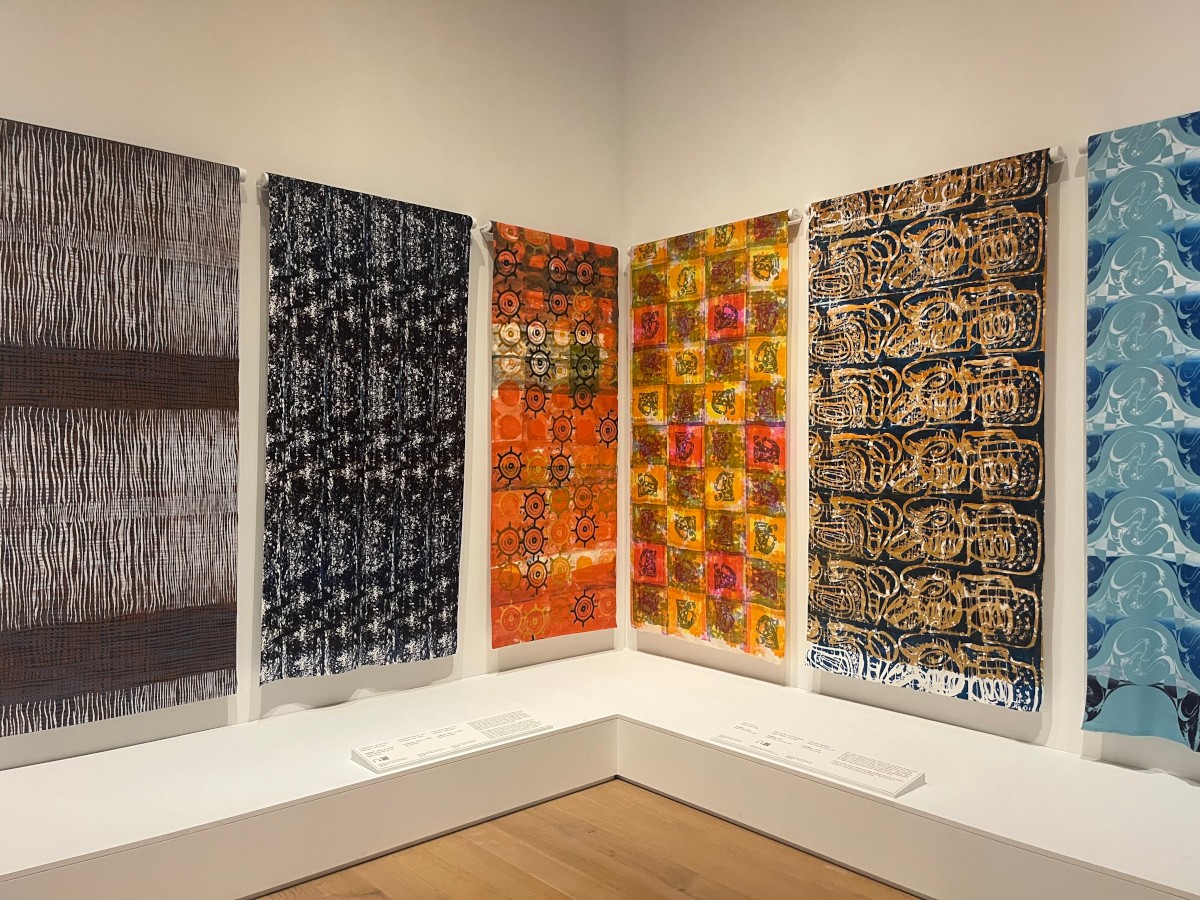
Action/Abstraction Redefined: Modern Native Art, 1940s-1970s uses themes of artistic continuity and student experimentation to reshape narratives of Native American art following World War II. The exhibit opens today with a free, public preview celebration from 4 to 8 pm featuring cocktails, entertainment and guided discussions.

“It’s a thematic look at this really pivotal chapter in the history of Native American art where we broadly see a transition from ancestral forms of media to new modes of expression that are more in line with contemporaneous global art practice,” says Alexander Brier Marr, the Saint Louis Art Museum associate curator of Native American art who put together the St. Louis presentation of the exhibition.

The exhibit was first shown by the Institute of American Indian Arts in Santa Fe, New Mexico. The IAIA is the only art school devoted to native arts in North America and is home to many prominent native artists, including Kay Walkingstick and Lloyd Kiva New.

The St. Louis exhibit features works primarily from the Museum of Contemporary Native Arts at IAIA alongside work borrowed from other national lenders and from SLAM’s own collection. It is currently the only expanded presentation of the exhibition in the country. Organized chronologically, the show features 90 works by about 40 different artists.

When Marr first saw the IAIA’s collection of postwar native art in 2018, he was blown away and knew he wanted to bring some of it to St. Louis.

“It’s a really fascinating story, where native artists are very strategically engaging with multiple sources,” Marr said. “So they’re creating really new pathways for artistic production, while still retaining an anchor in their communities and their heritage.”

The Saint Louis Art Museum was one of the first museums in the country, if not the first outside of the southwest, to collect contemporary Native American work in the early 1930s, according to Marr. The current museum collection, however, has a gap in the 20th century that this new exhibition will fill.

The exhibit expands and responds to the museum’s 2008 Action/Abstraction: Pollock, de Kooning, and American Art, 1940-1976 exhibition with an array of Native American art including paintings, sculptures and literary works. The influence of ancestral indigenous art on prominent American artists, including Jackson Pollock and Adolph Gottlieb, is also showcased in the presentation.

One featured artist is Fritz Scholder, a former instructor at IAIA, whose New Mexico Number 1 series depict the state’s landscapes and terrain through colorful abstraction. In this period, many native artists were inspired by modern art movements that freed them from stereotypical expectations of Native American art.

Native artists are helping to surface the colonial histories and experiences of native people, but they’re also just creating great work, Marr says with a chuckle.

“There’s this sense of a real movement taking place and of achievement and competence and success among native artists, which is really coming through,” he says.

To accompany and build upon its art, the exhibition includes printed and audio exhibition guides, catalogs, books and even a media wall with direct thoughts and quotes from the artists.

The exhibit will be on display through September 3 in the Mae W. Whittaker Gallery 212 at the Saint Louis Art Museum (One Fine Arts Drive, Forest Park, 314-721-0072, slam.org). Ticket prices are $6 to $12, with free entry on Fridays. Upcoming exhibition-related events at SLAM include an artist panel conversation at 6 p.m. on Friday, as well as a Family Sunday event from 1 to 4 pm that features dancing and art projects for children. In late July, the Saint Louis Art Museum will collaborate with the MFA Creative Writing program at IAIA for a native literary festival with author readings and writing workshops.

Subscribe to Riverfront Times newsletters.

Follow us: Apple NewsGoogle News | NewsBreak | Reddit | Instagram | Facebook | Twitter | Or sign up for our RSS Feed

Spellbinding Night Photography from Around the World

Spellbinding Night Photography from Around the World
Corvus © Beth Moon

From the historic archives of NASA to the edges of the planet Earth, this collection of extraordinary night photography explores the magical reaches of the starry sky. Travel across Finnish Lapland, through the American West, to the ancient landscapes of Botswana, across the deserts of Sinai and Israel, and up through the mountains of Alaska.

The Small Magellanic Cloud is a dwarf galaxy that flanks the Milky Way about 210,000 light years away from us.

This 2013 composite image of the galaxy’s wing shows a region with stars containing fewer metals and less dust and gas than the Milky Way. The Chandra’s X-ray data is shown in purple, while visible data from the Hubble Space Telescope is shown in red, green, and blue. Infrared data from the Spitzer Space Telescope is also revealed in red.

From from Earth and Space: Photographs from the Archives of NASA by Nirmala Nataraj, published by Chronicle Books, 2015.

Earth and Space by Chronicle Books is a collection of the most unforgettable photos from NASA’s treasured archives. Prefaced by Bill Nye of Science Guy stardom and introduced by author Nirmala Nataraj, Earth and Space takes our planet as its point of departure, moving sequentially through the universe and ultimately resting on clusters of galaxies colliding at a distance of 5.4 billion light years from where we stand.

Flattop Mountain, Alaska © Kerry Tasker

“It’s almost like the environment knows you’re there but doesn’t care,” says Anchorage-based photographer Kerry Tasker of the Alaskan terrain. The land is feral and ferocious; he’s dropped his camera from a perilous cliff, and the bitter cold has annihilated its batteries. Still, he’s been torn time and again from the safety of home into the rugged wilderness, standing cold and alone, under a charcoal sky dotted with faraway stars.

Starry Grove, 1999 © Neil Folberg / Vision Neil Folberg Gallery

Under the shroud of night, Jerusalem-based photographer Neil Folberg traverses Galilee and the Negev and Sinai deserts in Israel and Egypt alone and by foot, watching as the stars and clouds dance across the sky. From the late 1990s until the early 2000s, he spent four years of sunsets and sunrises capturing the shadows as they descended silently upon the historic terrain.

© Reuben Wu

“My nights are full of silence and the occasional howl of coyote,” the photographer Reuben Wu tells me. His series Lux Noctis has taken him to some of the most isolated regions in the American West, as well as remote spots in Europe and South America, under the cover of darkness. He flies a drone to light his way, illuminating sections of the landscape at will.

© Tiina Törmänen

When she was a little girl, photographer Tiina Törmänen built castles out of snow. She spent her childhood in Finland’s Southern Lapland, surrounded by lakes and forests, and each winter, she dug tunnels, doorways, and rooms, illuminated by flickering candlelight. Winter is still her favorite season. When the snow falls, she bundles up and wanders into the unknown terrain.

Hercules © Beth Moon

The San Francisco-based photographer Beth Moon has spent more than a decade of her life hunting down our planet’s oldest trees, chasing them to their isolated and solitary bowers at the edges of civilization. After devoting fourteen years to shooting ancient trees by day, the photographer embarked on Diamond Nights, for which she captured the looming plants under the black shroud of midnight and illuminated by a dusting of twinkling stars. The darkness, she remembers, was so thick that she was unable to see her own hands.

Discover More

The Kentucky Arts Council is now taking 2023 applications for the Kentucky Crafted Program

The Kentucky Arts Council is now taking 2023 applications for the Kentucky Crafted Program
image

Kentucky Crafted is an arts marketing program that provides assistance to visual and craft artists through networking, promotional and sales opportunities and business training.

The purpose of the program is to support professional visual and craft artists and promote a diverse selection of high quality art in Kentucky. In addition to being added to the Kentucky Crafted Directory, adjudicated visual and craft artists are eligible to exhibit at the Kentucky Crafted Market and other events sponsored by the program.

Visual and craft artists who do original work in any medium, are full-time residents of Kentucky and are 18 years of age or older are eligible to apply. Applicants should have a well-developed body of work and some marketing experience.

Potential applicants should read through the complete application guidelines prior to starting their application.

The deadline to apply is Aug. 15, 2023, 4:30 p.m. Eastern time. Prior to the deadline prospective applicants are encouraged to attend one or more Q&A sessions, hosted on Zoom, where you can ask arts council staff questions about the application process. Please fill out this online form if you are interested in attending a Q&A session and we will email you information about when and how to join the conversation.

For more information about the Kentucky Crafted program, contact David Blevins at david.blevins@ky.gov or 502-892-3120.

Design Milk’s Favorites From NeoCon 2023

Design Milk’s Favorites From NeoCon 2023

We’ve already shared the Best of NeoCon winners with you, but we also wanted to put a few of our other favorites from NeoCon 2023 on your radar. Certain trends – privacy booths, acoustic walls, and the crossover between indoor and outdoor furniture – continue to gain strength, while others are newer to the industry. Small lockers had a large presence, geared toward offices without assigned desks, or those whose employees work remotely part of the time. There was also a plethora of curves throughout, including chairs, modular bench seating, lighting, and even space dividers. NeoCon 2023 was filled with so much fantastic commercial design! We’ve narrowed down the long list to ten brands and products that were real standouts.

Seen above, Andreu World’s sustainable commercial furniture always makes a statement, with plenty of beautiful seating included. I love the extra high back and sheer presence the ergonomic Capri Executive chairs hold around a conference table.

BuzziSpace

BuzziSpace continues to expand its collection of acoustic lighting. For this year’s show, the brand nested a few of its BuzziTubes concentrically on a wall, rather than suspending them from the ceiling! A statement, sculpture, and lighting all in one.

light red/pink curved bench seating with red chairs and white tables

Scandinavian Spaces

Scandinavian Spaces does curvaceous commercial furniture so well. At NeoCon, they set up a cafe of sorts with tables, chairs, and benches in one of my own personal favorite color combinations – pink and red. It’s so easy to sit and stay a while with these pieces.

two wood and felt rocking chairs with cushions

Darran

Darran makes the crossover between commercial and residential furniture look easy. The rocking version of the brand’s Dove Seating feels designed equally well for a waiting room or a living room, and I really love the way they mix and match materials.

tan and royal blue abstract room dividers

molo

Made from paper, textile, and wood, molo’s softwall and softblock were spread throughout one of the show’s floors, creating nooks for attendees to grab a bite in privacy or decompress for a moment. Flexible and stretchable, the possibilities are all but endless.

eight dining and office chairs of differing styles and colors on a podium

Falcon

Falcon’s showroom had a lot of unexpected pieces, including an outdoor dining booth, but the brand’s Sedera seating collection caught my eye. The versatile seating series includes everything from side chairs to (stackable!) counter stools, all available in a rainbow of colors and combinations.

maroon and pink room with its wall and ceiling covered in tube-like acoustic material and a chair and side table

TURF

TURF prizes the creative installations of its products as much as the lightweight panels themselves. This year, the showroom included several areas with acoustic panels mounted to the ceiling, like Reed, seen here. The brand also introduced a felt product that resembles real wood – until you touch it. (I couldn’t tell from even 3-inches away!)

white sofa with light bentwood tray/table

NaughtOne

The sleek aesthetic of NaughtOne’s wood Riley pull up table is what drew me into the brand’s showroom. I immediately began thinking of all the different ways this beauty could be used when paired with benches, sofas, and chairs.

large light pink high-back chair with half circle blue pillow

Highower

Hightower’s showroom continues to impress, year after year. I loved all of the new pieces, but the FourAll® Lounge really grabbed my attention in a room full of people. Add high back chairs to the developing trends 2023 list!

ribbon-like red bench

Schiavello

Schiavello’s Hedge Seating created a lot of talk at The Mart, and it’s abundantly clear why. The bench’s undulating foam form accommodates every type of body and – let’s be honest – it looks like it could be in a modern design museum.

Photography by Kelly Beall.

Kelly Beall is senior editor at Design Milk. The Pittsburgh-based graphic designer and writer has had a deep love of art and design for as long as she can remember, and enjoys sharing her finds with others. When undistracted by great art and design, she can be found making a mess in the kitchen, consuming as much information as possible, or on the couch with her three pets. Find her @designcrush on social.

Sundance Institute receives $4M for Indigenous Program – TownLift, Park City News

Sundance Institute receives $4M for Indigenous Program – TownLift, Park City News

PARK CITY, Utah — Sundance Institute recently received its most substantial endowment — a $4 million donation from Federated Indians of Graton Rancheria (FIGR) towards the Institute’s Indigenous Program. The FIGR Tribal Chairman, Greg Sarris facilitated the endowment. As a participant in Sundance Institute’s 1992 Screenwriters Lab, Sarris is well-versed in the industry.

“When I was a part of the Screenwriter’s Lab at Sundance in 1992, I witnessed firsthand the incredible support that the Institute provides to all artists, but Indigenous talent specifically,” said Greg Sarris, Tribal Chairman of the Federated Indians of Graton Rancheria in a statement on the Sundance Institute website. “We are excited to see the creative breakthroughs from future fellows and scholarship recipients. Supporting and nurturing these artists will open up pathways to success for the entire California Indigenous creative community and enable us to tell our stories.”

The Sundance Institute said the generous gift would go a long way in supporting indigenous artists from California-based tribes, whether they are federally or non-federally recognized. The Federated Indians of Graton Rancheria | Sundance Institute Endowment will allow the Sundance Institute to build on the already robust offerings available to artists through the Indigenous Program, which has been a crucial aspect of the Sundance Institute’s work since its founding in 1981.

In 1994, the Indigenous Program was officially launched, with founder Robert Redford extending an invitation to Native American filmmakers to participate in Sundance’s inaugural filmmaking lab.

Artists from California-Based Tribes can apply now through August 28, 2023, here: https://apply.sundance.org/prog/2023_sundance_institute_graton_fellowship_for_california_indian_artists/

Why a Banksy exhibition in Glasgow makes perfect sense

Why a Banksy exhibition in Glasgow makes perfect sense

A new solo exhibition by Banksy, the UK’s most famous anonymous artist, has opened at the Gallery of Modern Art (GoMA) in Glasgow – his first in 14 years.

The graffiti artist was drawn to exhibit in Glasgow ostensibly because of his interest in the symbolism of “Coneheid” – the red traffic cone permanently adorning the head of the Duke of Wellington statue that stands on a plinth outside GoMA. It is, Banksy says, his “favourite work of art in the UK”.

The show, Cut and Run, spans the career of the artist who has been described as “notoriously cryptic, darkly humorous … a global phenomenon, a personality without a persona, a criminal without a record, and a paradox within the world of art.”

Originally influenced by the work of Xavier Pru – AKA father of stencil graffiti Blek le Rat – Banksy has become a major player in the urban and contemporary art world, generating controversy and publicity through his distinctive and creative approach.

Popular with the public and highly valued by the art world, Banksy’s works convey powerful messages via simple but arresting images. His early transgressive artwork was seen by some as vandalism, but for many others, Banksy is an important counter voice subverting the dominant narrative of capitalism.

The Bristol-based artist is a humanitarian and peace activist, using his wealth to benefit many charitable causes. His artworks raise awareness of political iniquities and challenge social injustices, such as the war in Ukraine, refugee crises, homelessness, global warming, police violence, apartheid, misogyny and racism. These are invariably set within a satirical, witty and humorous style that often confronts those in power.

The Glasgow-Banksy connection

The red traffic cone has historically been placed on Wellington’s head by revellers to signify a great night out in the city and is now an iconic part of Glasgow’s heritage and marketing. It holds great meaning for Glaswegians in its anti-elitist and anti-establishment message, contributing to their social and cultural capital.

It’s also a reminder of the extent to which the expression of all forms of culture have been central to Glasgow’s regeneration over recent decades. First came the Burrell Collection in 1983, followed by the International Garden Festival in 1988, which built momentum towards a successful bid for the European City of Culture in 1990 – a life-changing accolade for a city notorious for its poverty, violence and the lowest life expectancy in Europe.

But the connection between Banksy and the city goes much deeper. Both have a history of actively supporting humanitarian causes. Glasgow was the first anti-apartheid city to support Nelson Mandela with a street near the South African consulate renamed to honour him while he was still in prison. It also has a proud reputation for welcoming and defending refugees, and supporting them throughout the city.

Glasgow City Council has promoted street art by commissioning and funding murals around the city which have become an urban attraction. Glasgow also hosts the annual Yardworks Festival which is an internationally renowned celebration of urban art.

Glaswegians are known for their friendliness and irreverent humour which resonates with Banksy’s works. The city has actively resourced artists as part of its cultural policy and has been named the UK’s top cultural and creative city in a landmark report by the European Commission. The Banksy exhibition will undoubtedly boost Glasgow’s reputation as a centre of creative dynamism.

What to expect

The exhibition starts with a re-creation of his studio space, featuring for the first time the stencils used to create many of his most famous works. Banksy has used these original stencils to create new versions of these works, including Kissing Coppers, which first appeared on a wall of the Prince Albert pub in Brighton in 2004.

It will also feature Banksquiat: Boy and Dog in Stop and Search, Banksy’s homage to Jean-Michel Basquiat which was displayed on a wall near the Barbican in London as an unofficial collaboration with the art centre’s 2017 Basquiat show. A critique of the often-racist nature of police stop-and-search powers, it sold in May 2023 for an astonishing $9,724,500 (£7,646,277).

An image called Girl with Balloon by the graffiti artist Banksy.
The shredded Girl with a Balloon.
@banksy

The infamous shredding mechanism of Banksy’s Girl with Balloon is also showcased in the exhibition. In 2018, just after it was purchased at auction for £1 million, the canvas was passed through a secret shredder hidden inside the frame, leaving the bottom half in tatters with only the solitary red balloon untouched.

Three years later this iconic artwork was renamed Love in the Bin and auctioned at Sotheby’s for a mind-bending £18,852,000.

A more recent work from his Borodyanka Ukraine series, a stencil of a young female gymnast performing a handstand, balancing on a damaged building in Ukraine, is also on show. While creating this work on a bombed-out building, a local resident remonstrated with Banksy and threatened to call the police.

A Banksy graffiti image of a gymnast on a shelled out building in Ukraine.
Banksy’s work in Ukraine drew attention to the ordinary lives blighted by war.
@banksy

Banksy has been in the vanguard a new art form that was birthed in street art but has matured to include a strategic use of different kinds of media – graffiti, film, performance, digital and social media – all of which have the capacity to maximise the impact of his message in real time with a global reach.

It feels significant that Banksy has chosen a once-blighted Scottish city that redeemed itself through the arts for his first show in more than a decade. A shared sense of humour, humanitarian values and a disregard for the establishment mean Banksy’s show will be well-received in Glasgow.