Despite the challenges, peter Hazel’s whimsical “Girl with Balloons” sculpture downtown…
‘Girl with Balloons’ artist talks inspiration, process


Pulitzer Prize-winning photojournalist Lynsey Addario, known for her work covering conflicts and humanitarian crises in the Middle East and around the world, is joining New York gallery Lyles and King.
She will be the first traditional photographer on the gallery’s roster (although a few artists it represents do incorporate photography as an element of their practices in some shape or form).
“I liked the idea of joining a gallery that’s not specifically catering to photographers and photojournalists because I like to go beyond those borders,” Addario told Artnet News. “My goal is to be able to get the work out to a broader audience to people through museums and art fairs.”
For gallery founder Isaac Lyles, who works with a mix of emerging artists and older, under-recognized figures, Addario is a compelling, if unconventional fit for his stable.

Lynsey Addario, Veiled Rebellion. Two women on side of road, from Weha village, four hours in car to clinic. The father has lost two wives already, and has taken a third wife, half his age. His name is Shir Mohammad, and his wife, in burqua on hill, is Noor Nisa, 20. It is her first pregnancy, and her water has just broken and their car broke down on the side of the road. Shir Mohammad went to look for other transport, and Noor Nisa and her mother, Nazer Begam, 40, are waiting transport to the hospital. Photo courtesy of the artist and Lyles and King, New York.
“Many of the artists in our gallery programs address issues of identity, history, patriarchy, imperialism, global warming, and trauma,” he told Artnet News. “In Lynsey’s work, we have the raw, unvarnished, direct experience of an event of the happening of someone’s life. These photographs—taken in the moment, in the field, without sublimation—bear witness to those issues, often with profound empathy for her subject.”
“In my experience, the pictures and the stories that get seen are the ones that have really compelling, some would say beautiful photographs, which obviously is controversial because I’m often photographing very devastating scenes,” Addario said. “My first responsibility is, of course, getting the facts and making photographs that tell the story accurately. But I’m trying to find a way to photograph something that will engage the reader, rather than making them turn away.”

Lynsey Addario, Soldiers with the 173rd battle company, on a battalion-wide mission in the Korengal Valley on the Abascar Rideline, looking for caves and weapons caches and known Taliban leaders. Specialist Carl Vandeberge, center, and Sargeant Kevin Rice, behind, are assisted as they walk to a medevac helicopter minutes after they were both shot in the stomach during a Taliban ambush, which killed one soldier, and wounded both of them. Vandeberge and Rice were flown out immediately for surgery (2007). Photo courtesy of the artist and Lyles and King, New York.
Addario became a war photographer after the September 11 attacks in 2001, and has worked in countries including Iraq, Darfur, South Sudan, and the Democratic Republic of the Congo.
The job has put her in unimaginable danger, such as being kidnapped not once, but twice, including a harrowing week-long ordeal in Libya in 2011, recounted in Addario’s 2015 memoir, It’s What I Do: A Photographer’s Life of Love and War. (The book is being adapted into a limited television series with Paramount and Viacom, and Addario is also the subject of a forthcoming documentary feature film.)

Lynsey Addario, Soldiers with the Sudanese Liberation Army sit by their truck while struck in the mud in Darfur, Sudan, August 21, 2004. The SlA is one of the Sudanese rebel groups controlling parts of Darfur. Rebels are currently staging a 24-hour boycott of the Nigerian peace talks for Sudan in protest of recent new attacks against civilians in Darfur, which they say killed 75 civilians in six villages (2004). Photo courtesy of the artist and Lyles and King, New York.
Most recently, Addario has been on the ground in Ukraine, documenting the Russian invasion and its deadly effects. Her photo of a Ukrainian family hit by a mortar attack, a mother and two children lying dead as soldiers attempt to save the father, was a finalist for this year’s Pulitzer Prize. Addario was just steps away from the falling shells that killed them.
“The unpredictability of Ukraine is what makes it really scary,” Addario said. “It’s an artillery war. You never really feel safe, but you feel like you’re in a situation that is a little back from the front line, and then a missile lands next to you.”

Lynsey Addario, Ukrainian soldiers attempting to aid a family moments after they were hit by a mortar round while fleeing the suburb of Irpin, seeking safety in Kyiv. Tetiana Perenyibis and her children Mykita and Alisa were killed. Anatoly Berezhnyi, a church volunteer who was helping to usher the family to safety, was also killed in the strike. A steady stream of Ukrainian civilians made their way over a footpath beside the blown-up Irpin Bridge to try to escape fighting in the suburbs to the northwest of Kyiv as the Russian army advanced toward the capital. Mortars fired from Russian positions targeted the area of the bridge (2022). Photo by Lynsey Addario for the New York Times, courtesy of the artist and Lyles and King, New York.
Some of the photographer’s images have become widely reproduced, such as her striking photograph of a pregnant women and her mother, dressed in vibrant blue robes, as they wait in the Afghanistan desert for a ride to the hospital after their car broke down.
“With photos of this caliber, telling stories of this urgency, it would just be wrong not to show them,” Lyles added. “Sometimes, you have to take risks and say ‘this is urgent work, the market should come to this.’”

Lynsey Addario, Ukrainian families live below ground in a subway station, where many of them have been for about one week as Russian forces fight Ukrainian forces on the outskirts of Kyiv, Ukraine, March 2, 2022. The capital city of Kyiv is extremely tense as Ukrainian men and women prepare for battle as Russian troops have entered Kyiv (2022). Photo courtesy of the artist and Lyles and King, New York.
This will be the first time working with a dealer for Addario, who previously handled all her own sales, working with Epilogue, a Los Angeles post-production house recommended by director and photographer Sam Taylor Johnson, to produce prints.
Collectors typically reach out to Addario after seeing her work in the New York Times or National Geographic. But as a mother of 11- and four-year-old children with a busy travel schedule that has her on the road as many as seven months a year (when we spoke, Addario was on her way to the airport for a shoot with National Geographic in the Amazon), doing it on her own was becoming increasingly challenging.
 The forest burns around the Butte Lake Compound during the Dixie fire, August 27, 2021. The fire started in July 13th, and by October 2021, it had burned 965,000 acres (2021). Photo courtesy of the artist and Lyles and King, New York.” width=”1000″ height=”667″ srcset=”https://www.mecreates.com/story/news/wp-content/uploads/2023/06/ADDARIOGALLERYOPTIONS0031copy.jpg 1000w, https://news.artnet.com/app/news-upload/2023/05/ADDARIOGALLERYOPTIONS0031copy-300×200.jpg 300w, https://news.artnet.com/app/news-upload/2023/05/ADDARIOGALLERYOPTIONS0031copy-50×33.jpg 50w” sizes=”(max-width: 1000px) 100vw, 1000px”>
Lynsey Addario, The forest burns around the Butte Lake Compound during the Dixie fire, August 27, 2021. The fire started in July 13th, and by October 2021, it had burned 965,000 acres (2021). Photo courtesy of the artist and Lyles and King, New York.
Then, a relative of her husband suggested meeting with King, who has run his namesake gallery on the Lower East Side since 2015. Addario, who was working at the time on her 2022 retrospective exhibition at New York’s School of Visual Arts, invited him to see the show.
Lyles was already a fan, having been introduced to Addario’s work by the writer, artist, and curator Danny Moynihan, currently the director-at-large at Nino Mier, the Los Angeles gallery with locations in New York, Brussels, and Marfa, Texas. Upon meeting in person, Lyles and Addario began hammering out an arrangement to work together, starting with a solo show at the gallery next spring, organized with Moynihan.

Lynsey Addario, Khalid, seven years old, sits outside of the medical tent of a U.S. military base after elders from a village claimed he was injured by shrapnel from a bomb dropped by American troops near his home. American forces admit to dropping a bomb in the area, and say the boy was most likely injured in the attack, but can not confirm 100 percent. Civilians throughout Afghanistan have been victims of both Taliban attacks and United States bombs (2007). Photo courtesy of the artist and Lyles and King, New York.
Addario comes to the gallery with a built-in collector base that includes British rock star Elton John—and during the SVA show, former Secretary of State Hillary Clinton stopped by for a private tour of the exhibition.
More importantly, with a career spanning 25 years, Addario boasts an impressive range of work, from California wildfires to African famines to survivors of sexual violence. Aside from last year’s retrospective, some of the photos haven’t ever been shown, such as shots of trans sex workers from 1999, a selection of which go on view today in “A District Defined: Streets, Sex, and Survival” at the American LGBTQ+ Museum in New York.

Lynsey Addario, Trans sex workers wait for clients in the meatpacking district in New York (1999). Photo courtesy of the artist and Lyles and King, New York.
Both the artist and dealer are eager to delve into the archives and to present these works to the art world.
“What’s exciting to me is that Isaac is coming to my work with a super fresh eye—not from the genre of photojournalism,” Addario said.
“In a world where most of the work of a photojournalist is experienced on an iPhone, a laptop, or briefly on the newspaper page,” Lyles added, “this is an opportunity to slow down, to pay closer attention to the issues at play and the subjects in the work, giving them greater dignity.”
Follow Artnet News on Facebook:
Want to stay ahead of the art world? Subscribe to our newsletter to get the breaking news, eye-opening interviews, and incisive critical takes that drive the conversation forward.


NEW YORK, June 22, 2023 /PRNewswire/ — Commercial arts consultancy ATP.art and Neiman Marcus have partnered on activating retail locations nationwide with bespoke commissions by renowned local artists.

… what a great day it was and early morning found us on the quiet waters of Lake Pleasant and the shooting was as good as the dining for the creatures that inhabit the area.
Above is a shot of a Great Blue Heron attempting to get a fresh kill down the hatch … it simply wasn’t going to happen though as the fish was way to big to get down his throat! I’m sure that some other creature was happy to finish off the fresh catch though and our heron found a more diminutive fish for breakfast.
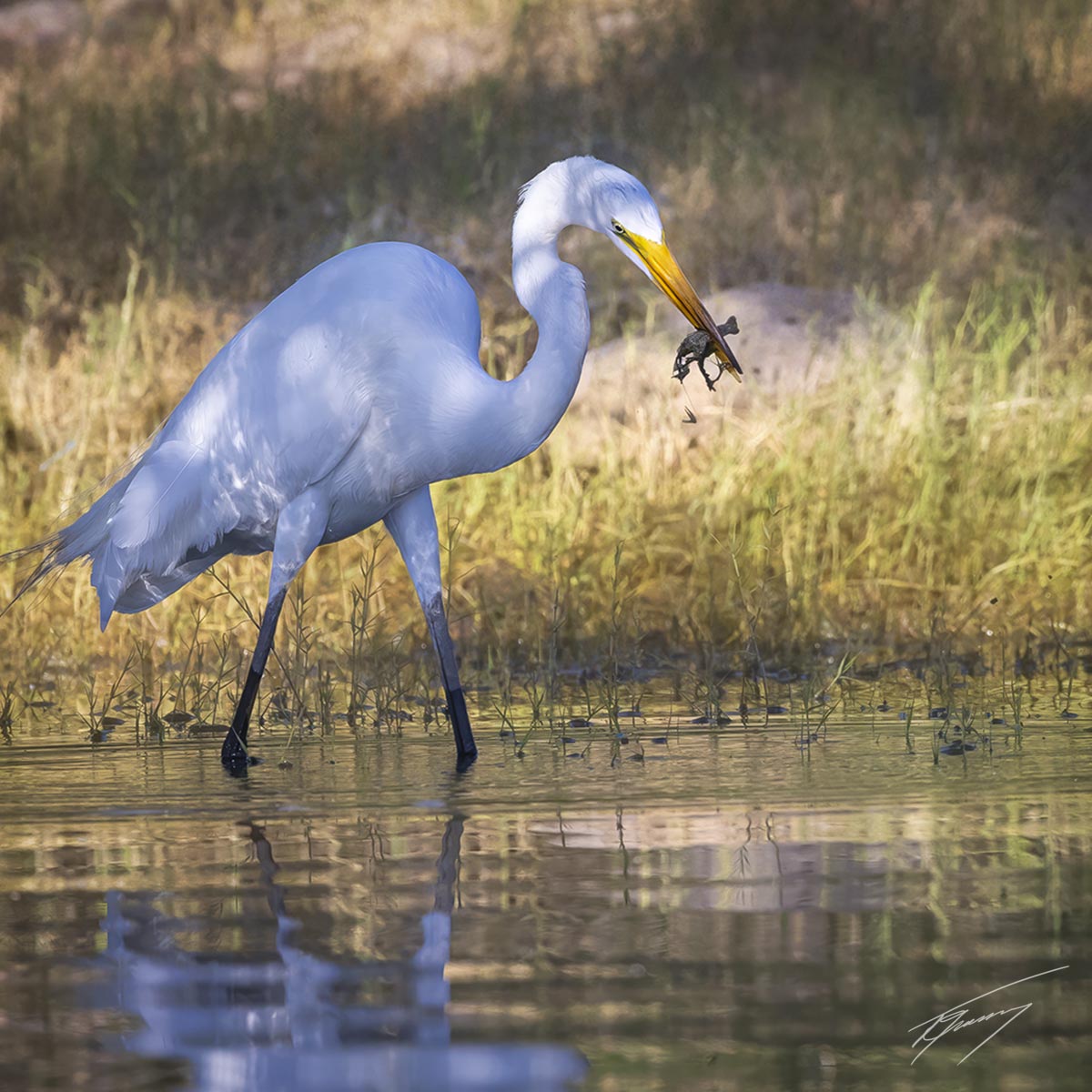
An egret picked up a tasty crawdad from the shallow waters and had no trouble getting it down … and there were more as the morning developed and lake supplied food for all including a few fishermen.

Into the weekend for me … keep breathing and enjoying life and those you meet and greet… always our choice. We are blessed! Back Monday morning.
Smiles,
Ted
A bird flies through the sky and I fly with it. I am
in each pearl of moisture sparkling in the sun. I lie lazy
on the clouds. And I acknowledge my kinship
each winged thing.
I see all as one, and nothing repels me, as this new
day climbs noiselessly out of the valley of night.

Peace lies over the world and over the world of my soul.
excerpt from On A May Morning by Max Ehrmann
###
 The easiest way to reach Mr. Grussing is by email: ted@tedgrussing.com
In addition to sales of photographs already taken Ted does special shoots for patrons on request and also does air-to-air photography for those who want photographs of their airplanes in flight. All special photographic sessions are billed on an hourly basis.
Ted also does one-on-one workshops for those interested in learning the techniques he uses. By special arrangement Ted will do one-on-one aerial photography workshops which will include actual photo sessions in the air.
More about Ted Grussing …

This is an advertisement


Cannupa Hanska Luger’s Incendiary (2023), a vibrantly colored, large-scale tipi work from a recent series that explores the adaptability and versatility of the nomadic structure as a metaphor for the resilience of Indigenous peoples in the face of settler-colonial violence, is now on view at Phoenix Art Museum (PhxArt).
The painted and shaped canvas is a significant addition to the museum’s contemporary art collection and furthers the museum’s efforts to collect and display art that reflects a diversity of voices from the Southwest region and Arizona.
Incendiary by Luger was acquired by the museum with funds from the Men’s Arts Council, a support group dedicated to supporting acquisitions, exhibitions and education and engagement programming. It is on view now in the Katz Wing for Modern Art.
“Adding Incendiary by Cannupa Hanska Luger into the collection of Phoenix Art Museum represents a significant step forward in growing contemporary Indigenous perspectives within the PhxArt Collection,” said Jeremy Mikolajczak, the museum’s Sybil Harrington director and CEO.
“The work is a wonderful example of how Luger uses Indigenous knowledge to challenge histories and stereotypes and, in dialogue with other works, assertively demonstrates a reframing and repositioning of historical narratives of Native peoples. Incendiary joins other paintings and multimedia works in our contemporary art holdings by contemporary Indigenous artists such as Fritz Scholder and Steven Yazzie.”
Luger was born in 1979 on Standing Rock Reservation in North Dakota. Now based in New Mexico, he is an enrolled member of the Three Affiliated Tribes of the Fort Berthold Reservation and is of Mandan, Hidatsa, Arikara, Lakota and European heritage.
By incorporating wide-ranging media, from ceramics, steel and fiber to video and repurposed materials, Luger creates monumental installations and sculptures, performances and wall works that attempt to reframe and reclaim 21st-century narratives about Indigenous cultures and identities. His work unites historical references and tradition with contemporary concerns, all to imagine and dream of Indigenous futures.
Luger is a 2022 Guggenheim Fellow and a recipient of a 2021 United States Artists Fellowship Award for Craft. In 2021, he was named a GRIST Fixer, and in 2020, he was named a Creative Capital Fellow and a Smithsonian Artist Research Fellow, among other previous awards and accolades. Luger has exhibited nationally and internationally at institutions such as The Metropolitan Museum of Art, Gardiner Museum, Kunsthal KAdE, ASU Art Museum, Berkeley Art Museum, New Orleans Museum of Art, Mesa Arts Center and the National Center for Civil and Human Rights.
Incendiary (2023) is one of 10 canvases from Luger’s tipi series, a recent investigation of painting. For the Plains people, tipis represent a nomadic lifestyle, defined by patterns of migration that mirror the movements of buffalo herds. The structures were often made from the skins of hunted buffalo, making them part of the land and the humans who constructed them simultaneously. Tipis also adapt to the land on which they exist, similar to how Indigenous peoples have adapted over centuries of struggle and ongoing conflict with colonizers.
As part of his tipi series, Luger transformed the word “tipi” into an acronym—Transportable Intergenerational Protection Infrastructure. The acronym suggests that the structure can cross time and space, even into future realms of existence, thus solidifying its status as a testament to Indigenous resilience and innovation.
Incendiary, like other canvases from the body of work, features recognizable graphic forms of stars and oversized cartoon eyes with curled eyelashes, which are drawn from specific historical references. The eyes reference stereotypical cartoon characterizations of Indigenous peoples in early animations, while the overall pop aesthetic refers to historical Air Force nose art. This type of nose art first appeared on British Royal Air Force Tomahawks during World War II and was later adopted by U.S. forces to adorn US P-40s, or Warhawks.
By appropriating this imagery and placing it onto a Native nomadic structure, Luger reflects on the ability of Indigenous peoples, their knowledge and their technologies to withstand the colonial violence and aggression these designs represent. It is also a reflection on how Native American cultural motifs have been appropriated by Western popular culture for centuries.
Learn more about the artist at garthgreenan.com. For more information about PhxArt Museum, visit phxart.org.

Atim Annette Oton is a native of Nigeria, on the continent of Africa. What may come as a surprise to many: she never skips breakfast, and aims to eat the standard of three meals a day.
Her father was from the south east of Nigeria from a town called Eket in Akwa Ibom State. Her mother was born in Harlem, and is of Trinidadian and Jamaican descent. Oton is the curator at Calabar Art Gallery in Harlem, named after the Nigerian city of Calabar.
The greatest influences on her path were her parents, along with a mentor. “My parents — they lived life fully and made me think the world was mine as a Black African child living in Nigeria and spending summers in Europe and the US,” she stated.
“One of my mentors was the prolific Black architect Max Bond, who I later worked for when I was in architecture. He was the one who taught me the philosophy that ‘Architecture is Revolution’, which I adapted to ‘Design is Revolution’ and ‘Business is Community,’” she added.
Oton’s parents were focused on education as a path to success. An act of kindness she remembered was when her parents would pay to send people to school.
“My mother was focused on artists and supported their work by buying. Acts of kindness in Nigeria I saw were usually focused around providing access for others – to gain employment or to eat without paying for meals,” she continued.
She said that since coming to New York, she has seen residents being supportive in their local neighborhoods, doing simple things like cleaning up streets and supporting local businesses before and after the pandemic.
Growing up in Nigeria, her hobbies included tennis and chess. Now, she does a lot more reading.
Other ways that Oton has made contributions to her NYC community now include serving 13 years on Community Board 8, which represents Prospect Heights, Crown Heights and Weeksville. Most of those were spent as the chair of the Economic Development Committee.
She is big on purposeful activities in the community, such as the Harlem Arts Stroll and Crown Heights Arts Stroll to bring the local community into art galleries and spaces. Additionally, she was also involved with the Crown Heights Job Fair to bring employers and jobs to community residents. “Both are about Economic impact for the community and businesses who participate,” she added.
In regards to creating opportunities for African, African American, and Caribbean communities, Oton is “very interested in issues we are having in workforce shortage, hiring gaps in jobs and inadequate training for the paradigm shift that is coming and is currently happening as technology takes over.”
It is clear that since the pandemic, these issues have escalated. “We need to expand the numbers, create more strategies to give people varied skills and stop the unemployment numbers in the African, African American, and Caribbean communities,” Oton continued.
Oton wants to have a way to make this change in the workforce, so job fairs are the start. She will be taking part in the Bed-Stuy Job Fair, being held on Sept. 19 this year at Marcy Plaza. Find details on the Job Fair here: https://www.eventbrite.com/e/bed-stuy-job-fair-tickets-648134817687.
Oton said her legacy “will revolve around art and what Calabar Gallery does for Black artists locally and globally via our exhibitions in and out of our gallery, in art auctions, art fairs, art licensing opportunities and through our residencies.”
For the gallery, Oton states “the legacy is about providing places, opportunities and support for artists to innovate, sustain, grow and expand their work and careers.”
Ways the gallery is doing this include the creation of 3 Social Justice Art Residencies: one at coLAB Arts in New Jersey, the Grenada Arts Residency based out of Cannes Brulees Rum Factory in Grenada, and one with the Elizabeth Foundation for the Arts in Manhattan.
Learn more about the residencies here: https://calabargallery.com/art-residencies/.
For the younger generation, it’s about bringing more young people to art through local art strolls and the art projects we expose them to. “It’s also about growing Black Women Art Collectors — an initiative to increase the number of collectors, particularly the next generation,” she added.
To stay updated on the work of Oton and Calabar Art Gallery, those who are interested can follow the gallery on social media, and subscribe to their newsletter, which can be found here: https://calabargallery.com/.





