The 7ft sculpture will depict a young Queen of the 1950s and 60s and will be erected outside Oakham library in Rutland
Queen Elizabeth and her corgis to be immortalised in first official memorial statue


Are you Team Barbie? Team Oppenheimer? Or Team Allan? I’m going with Allan, who is definitely the popular choice. I’m Carolina A. Miranda, art and design columnist for the Los Angeles Times, and I’m ready to beach and fill you in on the week’s essential arts news.
Over the last year, as I’ve worked to complete a monograph on Nuyorican painter Juan Sánchez (almost there!), I’ve had the opportunity to dive into Puerto Rican history (art historical and otherwise) and into the particulars of artistic movements that have emerged from the island as well as the expansive diaspora now based in the United States. (Puerto Ricans in the U.S. have outnumbered those on the island since 2006.)
Despite the presence, the Puerto Rican experience has remained underrepresented in major arts institutions in the U.S. When the group exhibition “no existe un mundo poshuracán: Puerto Rican Art in the Wake of Hurricane Maria” opened at the Whitney Museum in November, New York Times critic Holland Cotter noted in his review that it was the first major survey of Puerto Rican art in a major U.S. museum in almost half a century.

Miguel Luciano’s “Shields/Escudos” (2020), on view at the Whitney Museum earlier this year.
(Carolina A. Miranda / Los Angeles Times)
This singular absence speaks to the greater historical absence of Latinos in major U.S. cultural institutions. It also reflects the unique dilemma of Puerto Rican culture: Among the global intelligentsia, the U.S. colony is often regarded as not quite the U.S., not quite Latin America.
The ongoing exhibition “Afro-Atlantic Histories,” currently on view at LACMA, provides a good example of how Puerto Rico is overlooked in sweeping exhibitions that purportedly cover the breadth of the continent. The show, which explores the connections between Africa and the Americas as a result of the transatlantic slave trade, features not a single Puerto Rican artist.
Newsletter
Your essential guide to the arts in L.A.
Get Carolina A. Miranda’s weekly newsletter for what’s happening, plus openings, critics’ picks and more.
You may occasionally receive promotional content from the Los Angeles Times.
This is curious, given the abundance of iconic Puerto Rican artworks centered on Black life — such as Francisco Oller‘s “El Velorio,” from 1893, which depicts a baquiné, a wake held to mark the death of a child in the Afro Boricua tradition. Absent from sections that touched on civil rights were the Young Lords, the militant Puerto Rican civil rights group that emerged in Chicago in the late 1960s and later became prominent in New York (having an important influence on culture there). Also absent: any depiction of Pedro Albizu Campos, the mixed-race Puerto Rican independence leader who materializes regularly in art.
The traveling exhibition was organized by the Museum of Fine Arts, Houston and the Museu de Arte de Sāo Paulo Assis Chateaubriand, in collaboration with the National Gallery of Art in Washington, D.C. The National Gallery’s installation did include a sculpture by Puerto Rican artist Daniel Lind-Ramos (more on him in a bit), but he doesn’t figure in the show’s catalog.
The absence is glaring.

Works by Daniel Lind-Ramos, left, and Juan Sánchez, the painting at right, at the Instituto de Cultura Puertorriqueña in San Juan.
(Carolina A. Miranda / Los Angeles Times)
Thankfully, this year, “Afro Atlantic Histories” was more the exception than the rule. The Whitney’s group exhibition was critical in bringing visibility to Puerto Rican artists, as was another important group show, “Forecast Form: Art in the Caribbean Diaspora, 1990s to today,” which was on view at the MCA Chicago this past spring — and will land at the Museum of Contemporary Art San Diego next year. (I wrote all about these exhibitions for the New York Review of Books earlier this month.)
Next month, the MCA Chicago will open another survey focused specifically on Puerto Rican artists called “entre horizontes: Art and Activism Between Chicago and Puerto Rico,” and currently the New Museum of Contemporary Art in New York City has a solo show by installation artist Pepón Osorio. It joins an ongoing solo show by Lind-Ramos at MoMA PS1 that features almost a dozen of the totemic assemblages for which he has become known. These employ a variety of found materials — pieces of vegetation, musical instruments, old FEMA tarps, scraps of rope and various bits of industrial detritus — to create pieces that evoke spiritual deities and reference the island’s colonial histories. The New York Times’ Cotter described it in his review as “a fantastic terrestrial and celestial mystery tour of an exhibition.”

Daniel Lind-Ramos’ “María de los Sustentos” (2021) at MoMA PS1.
(Carolina A. Miranda / Los Angeles Times)
I caught the exhibition when I was trotting through New York early last month, and it is powerful. Lind-Ramos is a master of material, transforming old tarps into water and figures that feel like apparitions of the Virgin Mary; he is also a master of critique, taking jabs at colonial power in Spain and the U.S. But his figures also resonate with the history and culture of his native Loiza, a town that was originally settled by free Blacks. His work stands in acknowledgment of vital tradition.
The show is on view through Sept. 4. If you happen to be in New York, do not miss it. If you aren’t going to be in New York any time soon, check out the recent episode of Art21 devoted to his work. It is illuminating.
Virtual reality, notes art critic Christopher Knight, can often feel like a stunt in the context of an art exhibition. But it’s put to smart use in a new multilayered installation by Glenn Kaino called “Aki’s Market” at the Japanese American National Museum. The project is inspired by a market run by the artist’s grandfather in East L.A. in the 1950s and ’60s that Kaino has reconstructed — based entirely on family lore — in various media. “Marvelously orchestrated, the work evolves from an anonymous abstraction into an increasingly personal narrative,” writes Knight. “A viewer’s engagement is surreptitiously enticed.”
At Gagosian in Beverly Hills, a new project by Urs Fischer may look like an ad, but it isn’t. On a 12-foot cube wrapped in video screens, the artist is presenting a fever dream of advertisements from 1950 to the present that have been sorted, combined and reinterpreted using artificial intelligence — a way of exploring how images are used to move merch. “It’s a strange thing,” Fischer tells The Times’ Steven Vargas, “that advertisements are so omnipresent and it’s so influential for all of us.”

Urs Fischer’s “Denominator” reimagines advertising using AI.
(Jay L. Clendenin / Los Angeles Times)
Since we’re on the subject of Gagosian … the profile of Larry “GoGo” Gagosian by Patrick Radden Keefe in the New Yorker has been the chatter of social media: the meteoric rise, the allegations of dining and dashing in his early days (which he denies), the allegations of dirty phone calls as a young man (also denied), the construction of value, the fact that he doesn’t like to sell to museums (“then I can’t get them back”) and the wildly unregulated nature of it all. It certainly raises questions: about his carbon footprint (which must be spectacular) and his gallivanting around with Russian oligarchs and Leon Black.
Aaaand since we’re on the subject of Black: The MoMA trustee has been accused of sexually assaulting a 16-year-old girl in Jeffrey Epstein‘s townhouse in 2002, according to a federal lawsuit filed this week. Black denies the allegations, with his lawyers describing the lawsuit at “frivolous and sanctionable.”
The Washington Post’s Philip Kennicott is NOT a fan of Kehinde Wiley‘s show at the De Young in San Francisco. “The completed works offer none of the pleasures and surprises afforded by good painting,” he writes. “Their surfaces are immaculate, flat and utterly dead. It doesn’t matter how close you get.”
And Hyperallergic contributor Matt Stromberg reacts to that Vanity Fair piece that claimed art galleries were reviving a “desolate” stretch of L.A. — a desolate stretch that actually happens to be one of the densest corridors in the city.
Center Theatre Group has announced its 2023-24 season, and leading the charge will be Michael R. Jackson‘s Pulitzer- and Tony-winning play, “A Strange Loop,” about a Black gay man writing a musical about a Black gay man. The lineup also includes a “Funny Girl” revival and “A Christmas Story, the Musical.” Among the other productions is “Hadestown,” which was in L.A. last spring, making a return.
Enjoying this newsletter? Consider subscribing to the Los Angeles Times
Your support helps us deliver the news that matters most. Become a subscriber.
Gustavo Dudamel’s summer run at the Hollywood Bowl ended a week ago, just two weeks after the season kicked off. But while the Summer of ‘Tavo has been short, it has been very busy, reports Times classical music critic Mark Swed. “He conducted three different Bowl programs, with a wide range of music that included everything from John Williams film scores to Broadway show tunes to Verdi’s operatic Requiem,” writes Swed. “He worked with the YOLA National Chamber Orchestra and YOLA National Symphony Orchestra, a workshop for 170 talented music students between the ages of 12 and 18 from around the country. That culminated in a concert in which he not only conducted but also made a surprise appearance joining in the violin section.”

Gustavo Dudamel rehearses with young musicians from around the country participating in the L.A. Phil’s annual YOLA National Program earlier this month.
(Dania Maxwell / Los Angeles Times)
Artist Jeffrey Gibson, a member of the Mississippi Band of Choctaw Indians who is also of Cherokee descent, will represent the United States at the next Venice Biennale. He is the rare Indigenous artist to do so; in 1932, a small group of Native artists, including Hopi artist Fred Kabotie, presented at the international show.
Amada Cruz has been named the new director of the Santa Barbara Museum of Art. Cruz joins the institution from the Seattle Art Museum, where she had served as director and CEO since 2019.
The Rabkin Foundation announced its art journalism grants for 2023, and among the winners are former L.A. Times scribe and current New York Times contributor Jori Finkel, columnist and author Rebecca Solnit and New York-based writers Maximilíano Durón and Jillian Steinhauer.
The Fine Arts Museums of San Francisco announced a gift of the Bernard and Barbro Osher Collection of American Art, which includes 61 artworks by figures such as George O’Keeffe, Winslow Homer, Thomas Eakins and many others. Director Thomas P. Campbell describes the gift as “transformative.”
And the Lucas Museum in Los Angeles has added a study for Géricault’s “Raft of the Medusa” — which I’m incredibly excited about because my dad once painted a copy of that work and it hung for decades in my aunt’s dining room in Lima, which is definitely an interesting location for a painting that alludes to cannibalism.
Sinéad O’Connor, the Irish singer who achieved global fame for her haunting performance of “Nothing Compares 2 U,” followed by notoriety for tearing up the pope’s picture on stage, has died at 56.

Singer-songwriter Sinead O’Connor performs in Vancouver in 2020.
(Andrew Chin / Getty Images)
Ales Pushkin, a dissident artist in Belarus who once dumped a pile of manure outside the presidential offices in Minsk in a jab at the country’s authoritarian leader, is dead at 57.
Richard Barancik, the last surviving member of the Monuments Men, an Allied Unit that helped preserve art looted and hidden by the Nazis in the wake of World War II, has died at 98.
Pamela Blair, one of the original performers in “A Chorus Line” on Broadway, is dead at 73.
— The New York Times reports on the crisis in U.S. theaters. Interviews with 72 top-tier regional companies outside of New York point to a future of 20% fewer productions with “shorter runs, smaller casts and simpler sets.”
— A production of Wagner’s “Parsifal,” led by U.S. director Jay Scheib and incorporating augmented reality glasses for the audience, has led to conflict between the Bayreuth Festival‘s financial and artistic teams.
— My colleague Alejandra Molina interviewed Ricardo Alberto Maldonado, the Puerto Rican poet who will lead the Academy of American Poets.
— President Biden has established a national monument to honor Emmett Till and his mother, Mamie Till-Mobley.
— L.A. is slated to host the 2028 Olympics. According to Jules Boykoff and Dave Zirin, it’s looking mighty expensive.
— Lehrer Architects and Kadre Architects have released a free standard ADU plan for L.A. residents.
— Culver City plans to open a “safe sleep” site for unhoused people that features 20 tents.
— I enjoyed this episode of “Our Opinions Are Correct,” about why Ayn Rand is so popular in Silicon Valley.
Speaking of the tech industry, specifically that Twitter logo rebrand: “While some people are getting X Windows System logo vibes, several designers have detected an uncanny resemblance to the ‘X’ in widely available typefaces, including Monotype’s Special Alphabets 4.”

Alex Coleman covers the 5 biggest advances in modern photography in this article for Photography life. Check it out to learn about the film to digital transition, sensor technology developments, vibration reception and image stabilization, computer-aided lens design and of course machine learning and AI.


What could have been a slam dunk for a Louisville, Ky., wedding photographer’s federal appeal was sidetracked Thursday by a last-minute play by attorneys for the local government.
Chelsey Nelson sued the Louisville Metro government in November 2019 over a public accommodations ordinance she contended would require her to photograph and create blogs for same-sex weddings. She believes marriage is designed only for one man and one woman and the city’s law would have compelled her to speak messages that violated her religious convictions. In August 2020, a federal district court judge agreed with Nelson, barring Louisville from enforcing the law against her. The city appealed.
On Thursday, on the eve of Friday morning arguments before a federal appeals court, Louisville Metro attorneys filed a motion asking to send the case back to a lower court. They argued that the Christian wedding photographer’s move to Florida removed her standing to sue the government over its potential enforcement of the law.
The case appears nearly identical to facts in the Supreme Court’s recent ruling in 303 Creative LLC v. Elenis, where the high court upheld the right of Colorado website designer Lorie Smith not to create websites for same-sex weddings. The appeals court is the first court to address the effect of the June 30 ruling in 303 Creative on similar cases, many of which were put on hold by courts waiting to see the Supreme Court’s guidance.
Three judges on a panel of the 6th U.S. Circuit Court of Appeals grilled attorneys on the effects of the Florida move. Yet in an interview after the hearing, Jonathan Scruggs, the Alliance Defending Freedom attorney who argued on Nelson’s behalf, was nonplussed. He admitted the contention about the move “slanted the argument, but to the extent that the argument was about how this was different than 303 [Creative] … it seems identical,” he said. Scruggs elaborated on his arguments in a pre-hearing supplemental brief filed July 13.
Judges wrestled with whether the case should be sent back to the district court for fact-finding due to the move. Circuit Judge Jane Branstetter Stranch seemed stuck on whether there was a credible threat of enforcement against Nelson given her relocation to Florida and lack of any enforcement action against her.
“I’m just struggling with the facts that already exist in this case,” said Stranch. “Ms. Nelson has received nothing—no enforcement notes, no challenge to what she’s done, no stating of an intention to take action against her.”
Scruggs argued that his client did not need to prove actual enforcement action against comparable activity in order to have standing to sue. He referenced circuit precedent allowing a case to proceed even when there had been no prior enforcement action. “What’s key is not standing doppelgangers but credible threats,” argued Scruggs, pointing to the city’s refusal to disavow any intention to pursue enforcement against his client.
Scruggs said the court will likely give Nelson until at least mid to late August to respond to the motion filed by Louisville Metro asking the appeals court to send the case back to the district court. Afterward, the appeals court could deny the motion and rule in his client’s favor or send the case back to the district court for further fact-finding.
“Photographs have been held to be protected speech in the 6th Circuit and other courts, so we are just hopeful that the 6th Circuit will rule in Ms. Nelson’s favor,” Scruggs said.


Sure, J. Grant Brittain could kick and push his way around on a skateboard, too, but he fell in love with the click of the camera that allowed him to capture the artistry of the sport.
“I skated and surfed as a kid, and was lucky enough to live next door to a pro skateboarder, Wally Inouye, and he got me a job at the Del Mar Skate Ranch when it opened in 1978,” says Brittain. “About six months later, I borrowed my roommate’s camera and was immediately hooked. I just wanted to shoot my friends skating and it looked like a cool thing to do (and the chance of getting hit in the head by a bailed board just added to the excitement).”
Those friends from the 1980s would catapult skateboarding to the global stage and include names like Tony Hawk, Natas Kaupas, Mark Gonzales, and Steve Caballero. They’re among a number of others featured in Brittain’s book, “PUSH: J. Grant Brittain—‘80s Skateboarding Photography,” and he’ll be at the Encinitas Library at 1 p.m. Sunday to share some of his photos, answer questions about his career, and sign copies of the book.
Brittain, 68, lives in Encinitas with his wife, Laura, and has a daughter, Zoe, and a son, Sage. He took some time to talk about his career, his book, and proving people wrong when they tried to discourage his talent.
Q: Your book, “PUSH: J. Grant Brittain — ‘80s Skateboarding Photography,” focuses on the beginning of your photography career, capturing iconic skaters and images during the 1980s. Why was it time to publish your photos in this book?
A: Every photographer dreams of publishing a book of their photography and I first discussed it with my designer friend, Josh Higgins, in 2003. When the pandemic hit, I had a lot of free time to pull it together. I knew that I needed to share my photos all in one place — a book for the skaters who grew up with these photos on their walls, and to expose the younger skateboarders to a bit of skateboarding history.
Q: As you were going through 40 years’ worth of photos, what was it about those images from the ‘80s, specifically, that stood out to you?
A: I originally wanted to do a 40-year retrospective of my work, but there were just too many important photos. We realized that we needed to narrow it down and focus on one decade of my skateboarding photos, and the 1980s were a very important period in skateboarding. It was the era that birthed modern street skating and vertical skating went from the basic aerials and boards, and boards were being flipped and spun. Skateboarding evolved from the toy and sidewalk surfing, to a multi-dimensional self-expression; the skateboard is the paintbrush or guitar. I consider the 1980s to be the golden age of skateboarding, which was actually our working title for the book.
I grew up in Fallbrook and started surfing at 14 years old, and all I could ever think about was getting to the beach. I moved to Cardiff in 1974, fresh out of high school, and knew I had finally made it. Every time I drive over the hill from my house in Encinitas and see the Pacific, I count my lucky stars.

In this photo, taken in Oceanside in 1986, skateboarding photographer J. Grant Brittain captures The Bones Brigade in “Four Handplants on the Chin Ramp,” among the many photos in his book, “PUSH: J. Grant Brittain — ‘80s Skateboarding Photography.”
(Photo by J. Grant Brittain)
Q: The photos you were taking created a cultural legacy; was there ever a point when you realized that this was happening? That your work was meaningful in this way?
A: When I began, I was just shooting my friends, locals, and the pros for fun. I worked at the park every day and would sneak out to shoot photos during my shift. In 1983, Larry Balma, the owner of Tracker Trucks (the axle component on skateboards), asked me if I wanted to submit some of my photos for a “newsletter” that they were working on, which turned out to be the codename for the first issue of Transworld SKATEboarding magazine. For the first couple of years, we didn’t really know if the magazine, or even skateboarding, would last. Skateboarding has a history of booming every few years and then retreating from public view. We were just stoked we could pay rent, travel, and get free film. We saw skateboarding go from an activity that only skateboarders even cared about, to the Olympics and the X-Games moneymaker that it is now. I never thought that I would be riding this wave 44 years later. I am very lucky to have been in the right place at the right time.
Q: In the introduction to the book, Miki Vuckovich (one of many photographers who praise your mentorship), says that you’ve shaped generations of photographers in the visual telling of the story of skateboarding. From your perspective, what is the story of skateboarding? How would you describe it?
A: Through my photos, I always just wanted to get people to want to go skateboarding or pick up a camera and start shooting. I always shared the technical side of it freely with the younger photographers and I’m stoked that many of them went on in their own photographic careers.
The story is that anyone can learn to roll on a skateboard, regardless of size, gender, race, or economic status, and you don’t need a skatepark, team, or uniform. A board, two trucks, four wheels, and grip tape is all you need to roll down the sidewalk and feel free: it’s quite liberating. A lot of skaters talk about how skateboarding has given them purpose and direction and even saved their lives, I am not kidding. It’s a great outlet for kids who feel like they don’t fit in because they’re a little different or aren’t a jock — you know, the outcasts, or artists, musicians, or yes, photographers. Being a skateboarder automatically puts you in that club and you have an immediate connection to a whole lot of friends.
Q: We hear about fashion designers and photographers finding models as muses for their work — who are some of the skateboarders who’ve really helped inspire your creativity over the years?
A: I have to hand the credit to my friends and the Del Mar Skate Ranch, locals who let me shoot them throwing their bodies around, over and over. In the beginning, my photos were terrible, but they were kind enough to let me practice on them. I didn’t have much money, so lots of times, I gave them the color slides that weren’t quite as good as the ones I kept. My teacher at Palomar College, Kean Wilcox, became my mentor and he taught me photo history and pre-visualization, or what’s in my head before even clicking the camera shutter. Also, working with the art director at Transworld (David Carson) really got me thinking and seeing in a more graphic way. I started thinking more about the layout and shooting the photo to work with the printed space.
Of course, working at the skatepark, and then at the magazine, gave me the perfect position to shoot every one of the world’s greatest skateboarders: Tony Hawk, Christian Hosoi, Chris Miller, Steve Caballero, Rodney Mullen, Natas Kaupas, Mark Gonzales— and that was just the ‘80s. The skaters made my job easy, in a lot of ways. They knew what looked good in a photo and there weren’t many that I could take a bad photo of. A couple of the photos that stand out as collaborative projects are the Chris Miller pole cam photo and the Bones Brigade “Four Handplants on the Chin Ramp” photo. Everything just all came together perfectly.
Q: What has this work taught you about yourself?
A: Perseverance, that everyone starts at the bottom in any endeavor, and to never give up.
Q: What is the best advice you’ve ever received?
A: I had a college photo instructor tell me that I had no talent and that I should give up photography — that made me want to prove him wrong. My art teacher, Doug Durrant, told me to start signing my name with my first initial, “J” (for Jordan) up front. He introduced me to everyone as J. Grant Brittain.
Q: What is one thing people would be surprised to find out about you?
A: I grew up in Fallbrook.
Q: Please describe your ideal San Diego weekend.
A: Hanging out with my family, friends, and my dog; listening to music; maybe go for a surf; and take some photos, if possible.


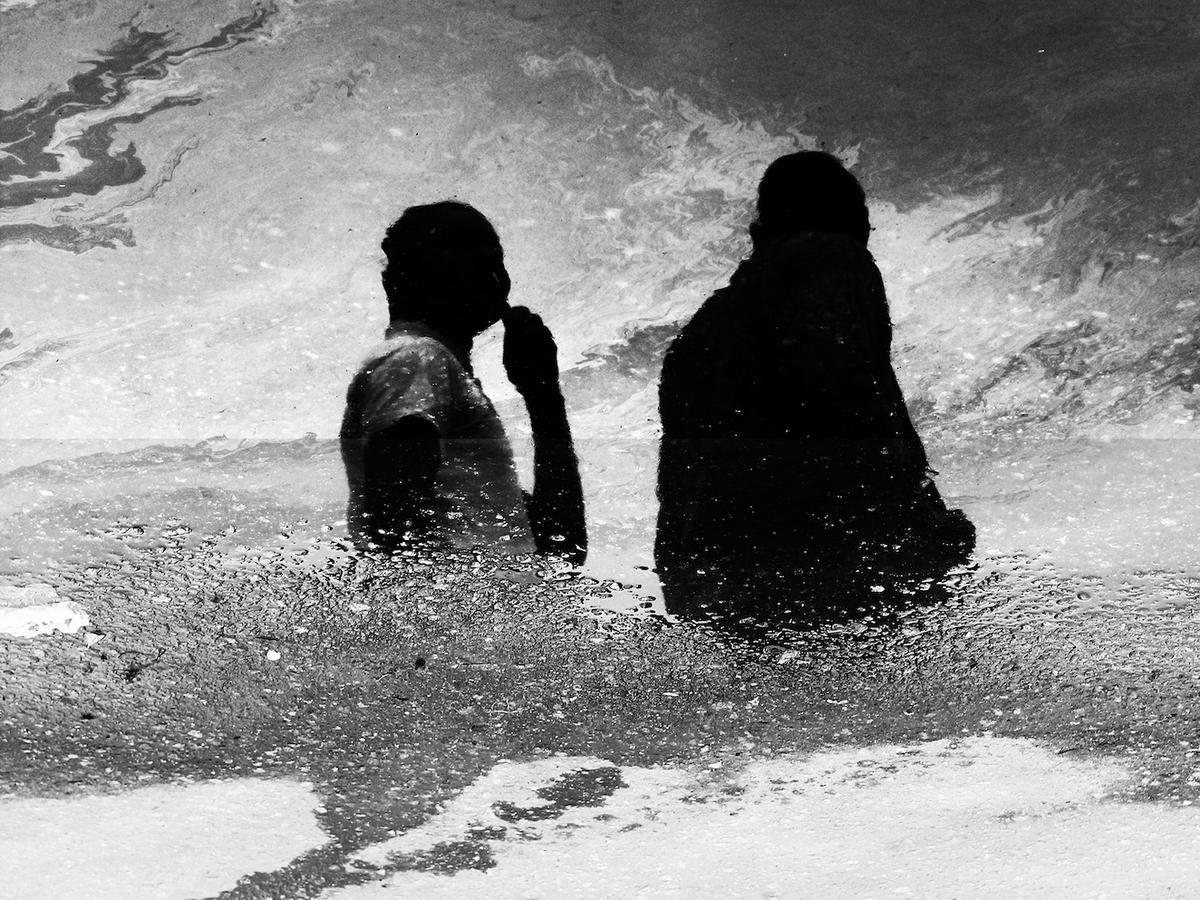
Logo Oluwamuyiwa: Oil Wonders II, from “Monochrome Lagos.” This series offers a vibrant vision of the city in black-and-white images.
Logo Oluwamuyiwa
Logo Oluwamuyiwa
You don’t expect to walk into one of the world’s great art museums and hear car horns honking.
It’s a soundtrack for New Photography 2023, an ambitious new exhibit of 151 works at New York’s Metropolitan Museum of Modern Art (MoMA) that seeks to capture the essence of Lagos, Nigeria, the bustling home to upward of 17 million people.
The exhibit, which runs through Sept. 16, is notable for other reasons. With seven photographers represented, the exhibit marks the first time MoMA has presented a group show by living West African photographers. And it’s the launch of an ongoing series of exhibits that MoMa says will focus on “specific art scenes across the globe.”
Oluremi C. Onabanjo, associate curator of MoMA’s department of photography, who organized the show with the assistance of curatorial fellow Kaitlin Booher, welcomes the shift to international perspectives. “Lagos until now hasn’t had a home at MoMA. Why not let this be the moment of encounter?”
What you’ll encounter is a compelling collage of a massive cityscape whose clogged congestive sprawl co-exists with serene waterscapes and beaches, where ultra-modern skyscrapers tower over the abandoned buildings and artifacts of the colonial past — and where as many protesters as pedestrians sometimes fill the streets.
These contrasting photos create a conversation in the three galleries. In the first gallery, for instance, the gritty, vibrant black-and-white photos of Logo Oluwamuyiwa lining one wall are pitted against Amanda Iheme’s colorful photos of colonial-era buildings in decay.
Oluwamuyiwa’s “Monochrome Lagos” series shows how vibrant Lagos is – and how cameras and cellphones are everywhere. One of the first images a visitor sees is iPhone, in which a stylishly dressed young woman reluctantly raises her eyes from her cell phone to meet the gaze of the photographer.
Like the sounds of honking horns that boom through the gallery, many of the photos display a cacophony of heavily trafficked streets and bridges, flowing water, hazy smoke from a nearby fire, people of all ages and classes.
There are two stacks of large-sized prints for visitors to take home as souvenirs: one a wide-angle shot of a highway bridge so uncharacteristically empty one wonders if it has been abandoned, the other a super-close-up of the back of a bus bearing a poster declaring “Lagos Hosts the World.”
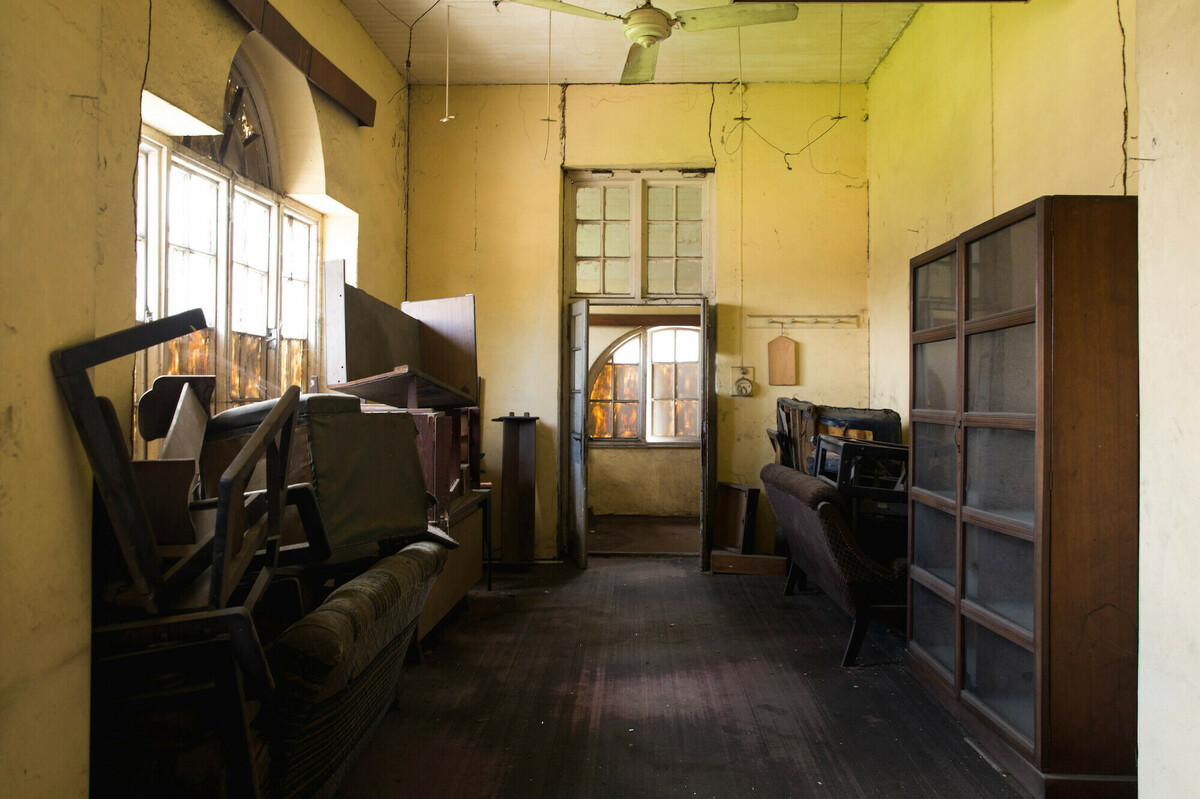
By contrast to Oluwamjhkwa’s bustling modern urban scenes, Iheme in her series “The Way of Life explores the past that remains embedded in the present. Her large color photos portray older buildings that have fallen into states of decay and abandonment. In addition to her focus on their current neglect, the buildings she depicts share a common origin, dating to Nigeria’s years under British rule, from 1851 to the country’s independence in 1960.
“She is attuned to how the houses hold the traces of history and the impact of history on our beings,” Onanbanjo comments. The most intriguing photo focuses on a single brownish-red brick, which Iheme, who is a psychotherapist in addition to a photograher, herself recovered from an 1846 house as it was being torn down. It had been built for an Afro-Brazilian slave-trading family and was later refitted for use as a post office, restaurant and bar.

Amanda Iheme: Old Secretariat – Stagnation – 12, from “The Way of Life.” Iheme explores the past of Lagos that lingers on in older buildings from the colonial past.
Amanda Iheme
Amanda Iheme
Another photo captures shadowy stairs inside an abandoned building, a scene that evokes shadows lurking from the past. In yet another, pedestrians in Western and traditional African dress walk side by side down a street whose pavement is in visible disrepair. She also shows a sense of humor in her depiction of a grand pink building with no evidence of anyone living there 00 but with laundry drying on the outside hedges.
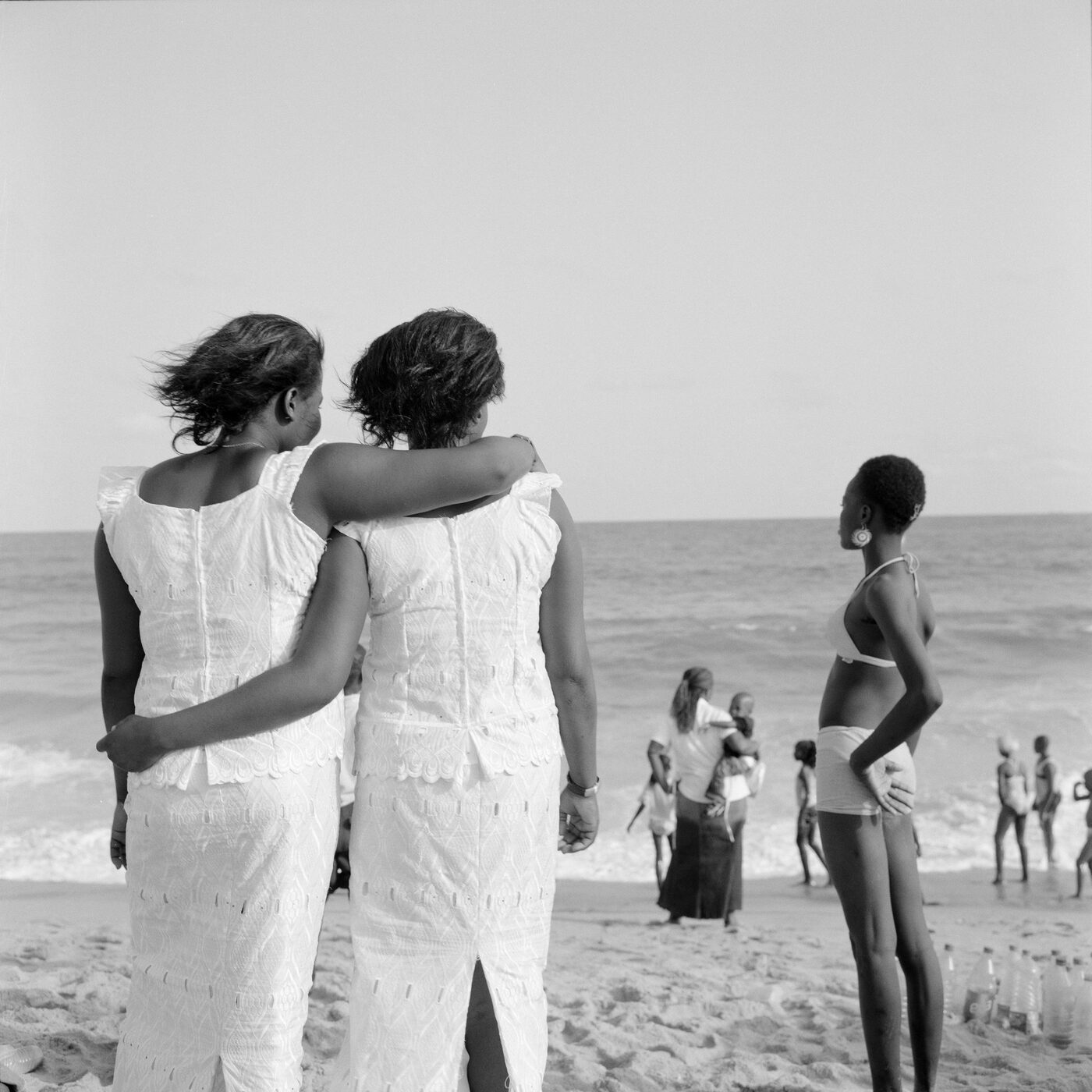
The next gallery emphasizes the sensual beauty of the city. In his finely detailed black-and-white series, “Sea Never Dry,” Akinbode Akinbiyi conjures the sense of an unending ebb and flow of life in Lagos, which is located on a lagoon and consists of several islands famed for their beaches. Onabanjo describes this series as “photographic constellations of people, animals, and objects” found at Bar Beach on Victoria Island in Lagos. Among the most striking is a woman dressed all in white, holding a book (perhaps a Bible) as she strides alone by the surf’s edge, a place where the foam from the sea and the gritty grains of sand blend one into the other.

Akinbode Akinbiyi: Bar Beach, Victoria Island, Lagos, from the series “Sea Never Dry.” The photos depict the ebb and flow of life in Lagos, which is located on a lagoon and consists of several islands famed for their beaches.
Akinbode Akinbiyi
Akinbode Akinbiyi
On display nearby is what Onabanjo calls “the spectral spine of the exhibit,” a series of collages that artist Abraham Oghobase, calls “Constructed Realities.” The photographer juxtaposes blurrily reconfigured archival images of local African and colonial figures with legal documents and lawbook pages that spell out the racist basis of imperial rule.

Abraham Oghobase: Untitled 01 from “Constructed Realities.” He juxtaposes archival images of local African and colonial figures with legal documents and lawbook pages that spell out the racist basis of imperial rule.
Abraham Oghobase
Abraham Oghobase
The second work in the set, shows Ọba Ọvonramwen, the last king who ruled the independent Benin Kingdom, in 1897, as the British rulers to whom he has just surrendered prepare to send him into exile. “He was humiliated. You could see the leg chains, you could see the security guards,” the photographer notes on the MoMA website. Oghobase uses the same historic image of Ọba Ọvonramwen in another piece in the series, but here, he says, “I’ve scaled it down to the point that you can’t even see the leg chains … I cut things up, scan them, digitally crop them” in order to tell the story from an African point of view.
The exhibit’s final gallery further illuminates the interplay between the city’s fading past and vibrant political present. Nostalgia and memory from the early decades of Nigerian independence are the dominant themes of “Casing History” by Kelani Abass and “The Archive of Becoming” by Karl Ohiri.
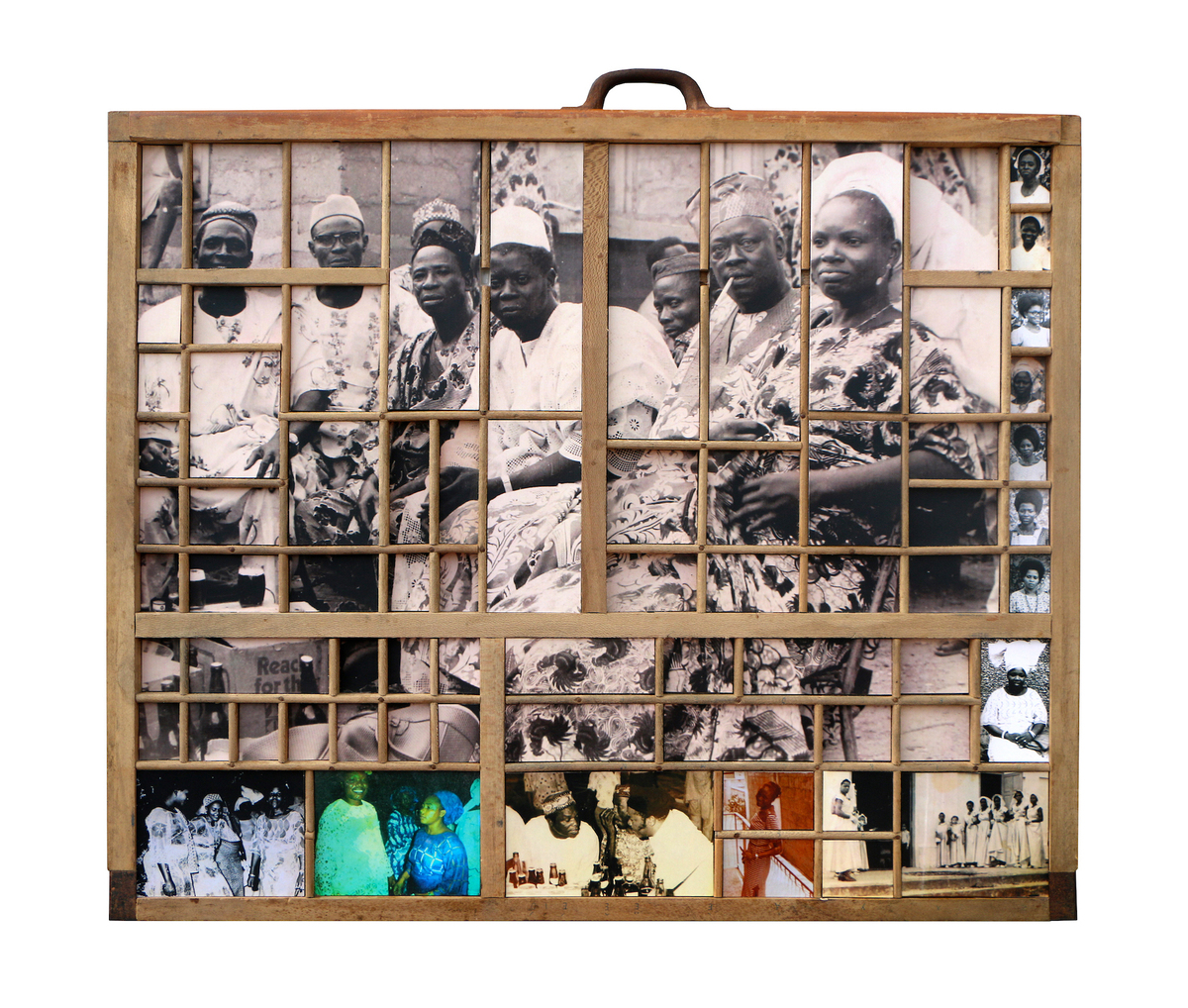
Abass repurposes the tools of his late father’s printing trade: Thin wooden letter press cases, whose compartments were commonly used to sort out printers’ letters. Abass transforms them into display cases for snapshots from the 1960s and 1970s documenting all manner of life, work and educational celebrations and milestones of people of different ages and generations. Time itself has aged the photos, giving them different shades and tints of yellow and sepia. Mixed together this way, the cases and images form a kaleidoscopic landscape of the early years of Nigerian independence, notes Onanbanjo.

Kelani Abass: Unfolding Layers 6, from “Casing History,” using a letterpress type case and digital print. Abass uses the thin wooden cases to display snapshots from the 1960s and 1970s.
Kelani Abass
Kelani Abass
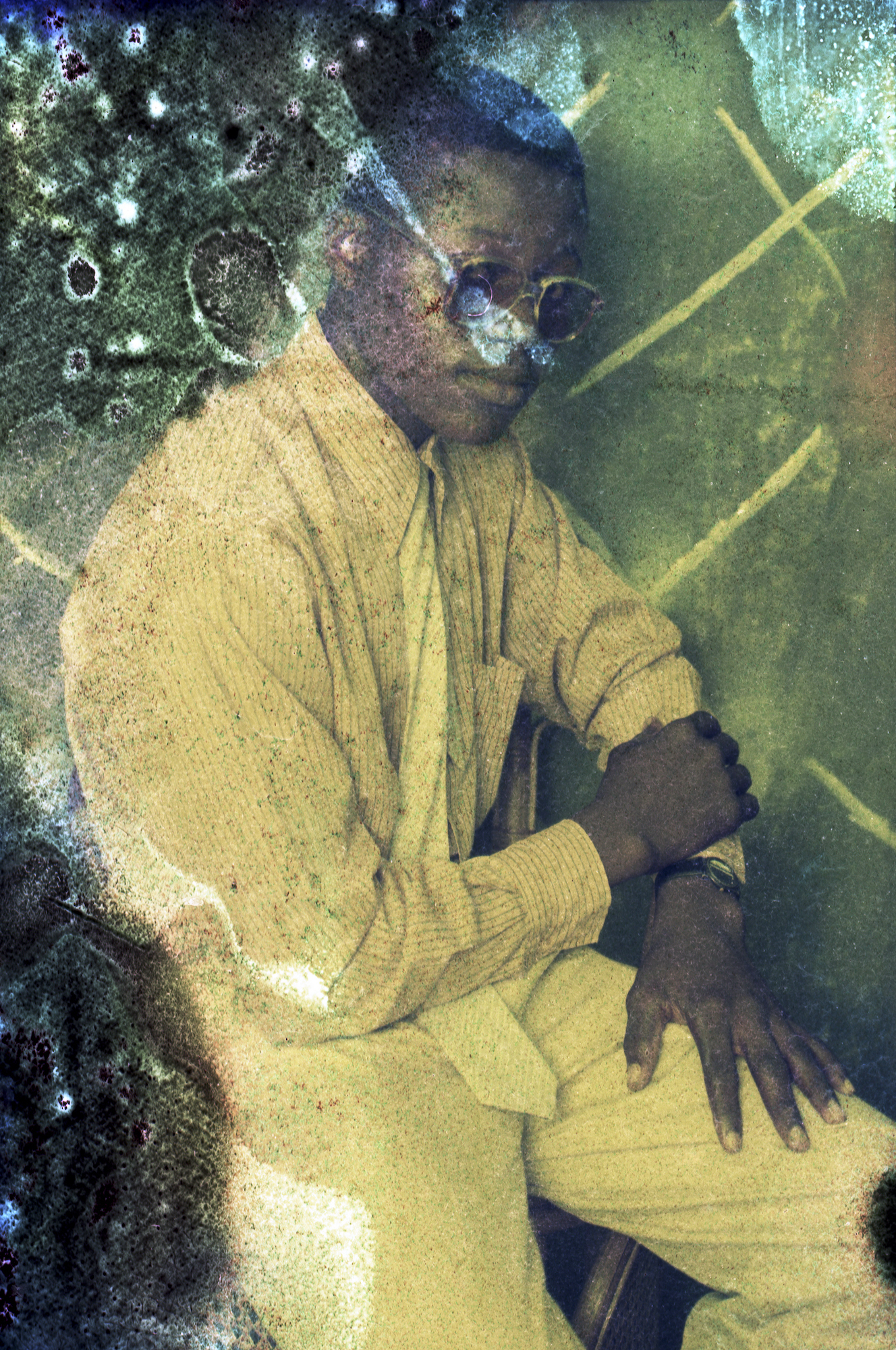
Ohiri call his collage of old negatives and prints, collected from commercial photographers, “The Archive of Becoming” — a reference to the often psychedelic colors and transformations wrought by heat, humidity and time. “They are also unbelievably striking, strange, beautiful, swirling, unexpected pictures,” says Onabanjo.

Karl Ohiri: Untitled, from “The Archive of Becoming.” Ohiri features old negatives and prints that have been transformed by heat, humidity and time.
Karl Ohiri
Karl Ohiri
Ohiri’s two-pronged video, “Rolling Footage” also offers a social critique, in its depiction of a Lagos community of the homeless and the disabled who are forced to construct their own makeshift vehicles — in this case, a skateboar, which is also on display — to navigate the congested streets of an indifferent-seeming city.
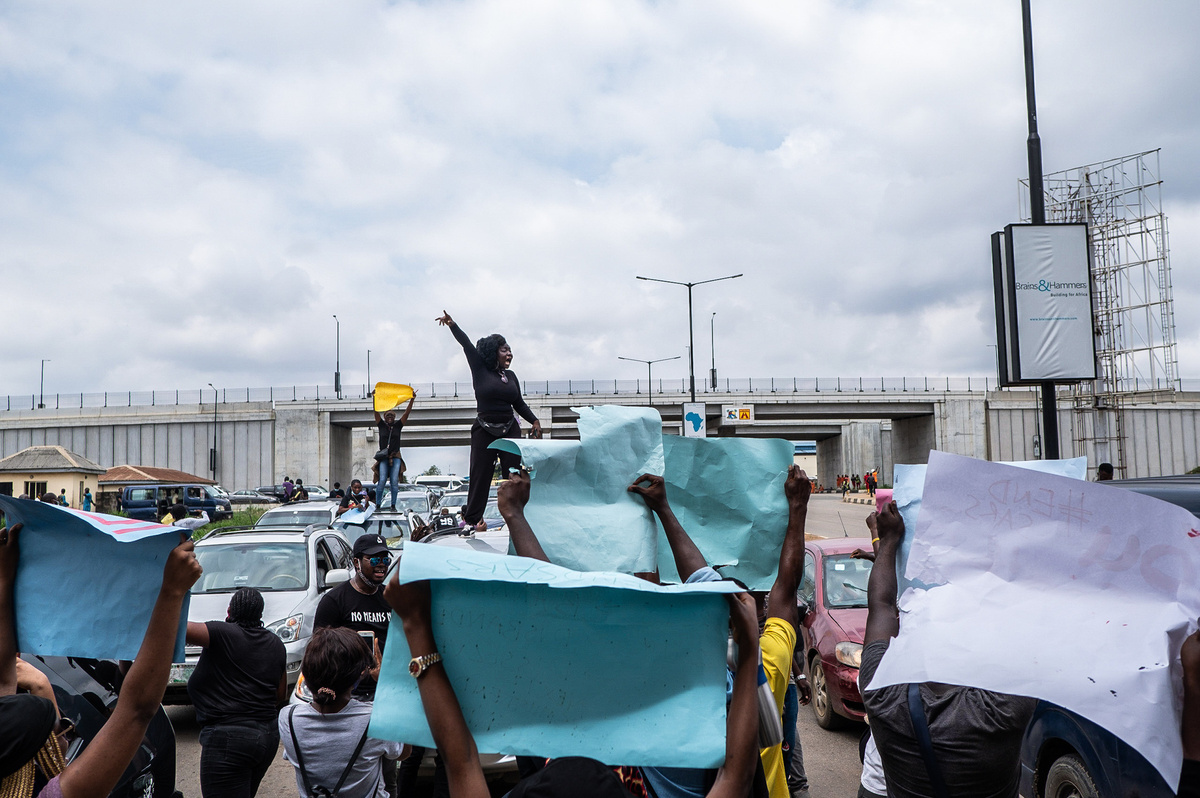
The exhibit closes with the photos of photojournalist Yagazie Emezi documenting Nigeria’s October 2020 country-wide protest of the police brutality of the country’s Special Anti-Robbery Squad (SARS). These photos document her own participation in the protests and contain “extraordinary power. They show the anger, joy and celebration inside a political movement feels like,” says Onanbanjo.

Yagazie Emezi: Untitled, from “#EndSARS Protests.” PHotojournalist Emezi documents Nigeria’s October 2020 protests of the police brutality of the country’s Special Anti-Robbery Squad (SARS).
Yagazie Emezi
Yagazie Emezi
In these photos, Emezi has said, “It’s like the crowd breathes in and out.” In the same way, visitors to the show can see, feel and hear the breath and pulse of the city of Lagos.
Diane Cole writes for many publications, including The Wall Street Journal and The Washington Post, and is book columnist for The Psychotherapy Networker. She is the author of the memoir After Great Pain: A New Life Emerges. Her website is DianeJoyceCole.com.
Logo Oluwamuyiwa: Oil Wonders II, from “Monochrome Lagos.” This series offers a vibrant vision of the city in black-and-white images.
Logo Oluwamuyiwa
Logo Oluwamuyiwa
You don’t expect to walk into one of the world’s great art museums and hear car horns honking.
It’s a soundtrack for New Photography 2023, an ambitious new exhibit of 151 works at New York’s Metropolitan Museum of Modern Art (MoMA) that seeks to capture the essence of Lagos, Nigeria, the bustling home to upward of 17 million people.
The exhibit, which runs through September 16, is notable for other reasons. With seven photographers represented, the exhibit marks the first time MoMA has presented a group show by living West African photographers. And it’s the launch of an ongoing series of exhibits that MoMa says will focus on “specific art scenes across the globe.”
Oluremi C. Onabanjo, associate curator of MoMA’s department of photography, who organized the show with the assistance of curatorial fellow Kaitlin Booher, welcomes the shift to international perspectives. “Lagos until now hasn’t had a home at MoMA. Why not let this be the moment of encounter?”
What you’ll encounter is a compelling collage of a massive cityscape whose clogged congestive sprawl co-exists with serene waterscapes and beaches, where ultra-modern skyscrapers tower over the abandoned buildings and artifacts of the colonial past — and where as many protesters as pedestrians sometimes fill the streets.
These contrasting photos create a conversation in the three galleries. In the first gallery, for instance, the gritty, vibrant black-and-white photos of Logo Oluwamuyiwa lining one wall are pitted against Amanda Iheme’s colorful photos of colonial-era buildings in decay.
Oluwamuyiwa’s “Monochrome Lagos” series shows how vibrant Lagos is – and how cameras and cellphones are everywhere. One of the first images a visitor sees is iPhone, in which a stylishly dressed young woman reluctantly raises her eyes from her cell phone to meet the gaze of the photographer.
Like the sounds of honking horns that boom through the gallery, many of the photos display a cacophony of heavily trafficked streets and bridges, flowing water, hazy smoke from a nearby fire, people of all ages and classes.
There are two stacks of large-sized prints for visitors to take home as souvenirs: one a wide-angle shot of a highway bridge so uncharacteristically empty one wonders if it has been abandoned, the other a super-close-up of the back of a bus bearing a poster declaring “Lagos Hosts the World.”
By contrast to Oluwamjhkwa’s bustling modern urban scenes, Iheme in her series “The Way of Life explores the past that remains embedded in the present. Her large color photos portray older buildings that have fallen into states of decay and abandonment. In addition to her focus on their current neglect, the buildings she depicts share a common origin, dating to Nigeria’s years under British rule, from 1851 to the country’s independence in 1960.
“She is attuned to how the houses hold the traces of history and the impact of history on our beings,” Onanbanjo comments. The most intriguing photo focuses on a single brownish-red brick, which Iheme, who is a psychotherapist in addition to a photograher, herself recovered from an 1846 house as it was being torn down. It had been built for an Afro-Brazilian slave-trading family and was later refitted for use as a post office, restaurant and bar.
Amanda Iheme: Old Secretariat – Stagnation – 12, from “The Way of Life.” Iheme explores the past of Lagos that lingers on in older buildings from the colonial past.
Amanda Iheme
Amanda Iheme
Another photo captures shadowy stairs inside an abandoned building, a scene that evokes shadows lurking from the past. In yet another, pedestrians in Western and traditional African dress walk side by side down a street whose pavement is in visible disrepair. She also shows a sense of humor in her depiction of a grand pink building with no evidence of anyone living there 00 but with laundry drying on the outside hedges.
The next gallery emphasizes the sensual beauty of the city. In his finely detailed black-and-white series, “Sea Never Dry,” Akinbode Akinbiyi conjures the sense of an unending ebb and flow of life in Lagos, which is located on a lagoon and consists of several islands famed for their beaches. Onabanjo describes this series as “photographic constellations of people, animals, and objects” found at Bar Beach on Victoria Island in Lagos. Among the most striking is a woman dressed all in white, holding a book (perhaps a Bible) as she strides alone by the surf’s edge, a place where the foam from the sea and the gritty grains of sand blend one into the other.
Akinbode Akinbiyi: Bar Beach, Victoria Island, Lagos, from the series “Sea Never Dry.” The photos depict the ebb and flow of life in Lagos, which is located on a lagoon and consists of several islands famed for their beaches.
Akinbode Akinbiyi
Akinbode Akinbiyi
On display nearby is what Onabanjo calls “the spectral spine of the exhibit,” a series of collages that artist Abraham Oghobase, calls “Constructed Realities.” The photographer juxtaposes blurrily reconfigured archival images of local African and colonial figures with legal documents and lawbook pages that spell out the racist basis of imperial rule.
Abraham Oghobase: Untitled 01 from “Constructed Realities.” He juxtaposes archival images of local African and colonial figures with legal documents and lawbook pages that spell out the racist basis of imperial rule.
Abraham Oghobase
Abraham Oghobase
The second work in the set, shows Ọba Ọvonramwen, the last king who ruled the independent Benin Kingdom, in 1897, as the British rulers to whom he has just surrendered prepare to send him into exile. “He was humiliated. You could see the leg chains, you could see the security guards,” the photographer notes on the MoMA website. Oghobase uses the same historic image of Ọba Ọvonramwen in another piece in the series, but here, he says, “I’ve scaled it down to the point that you can’t even see the leg chains … I cut things up, scan them, digitally crop them” in order to tell the story from an African point of view.
The exhibit’s final gallery further illuminates the interplay between the city’s fading past and vibrant political present. Nostalgia and memory from the early decades of Nigerian independence are the dominant themes of “Casing History” by Kelani Abass and “The Archive of Becoming” by Karl Ohiri.
Abass repurposes the tools of his late father’s printing trade: Thin wooden letter press cases, whose compartments were commonly used to sort out printers’ letters. Abass transforms them into display cases for snapshots from the 1960s and 1970s documenting all manner of life, work and educational celebrations and milestones of people of different ages and generations. Time itself has aged the photos, giving them different shades and tints of yellow and sepia. Mixed together this way, the cases and images form a kaleidoscopic landscape of the early years of Nigerian independence, notes Onanbanjo.
Kelani Abass: Unfolding Layers 6, from “Casing History,” using a letterpress type case and digital print. Abass uses the thin wooden cases to display snapshots from the 1960s and 1970s.
Kelani Abass
Kelani Abass
Ohiri call his collage of old negatives and prints, collected from commercial photographers, “The Archive of Becoming” — a reference to the often psychedelic colors and transformations wrought by heat, humidity and time. “They are also unbelievably striking, strange, beautiful, swirling, unexpected pictures,” says Onabanjo.
Karl Ohiri: Untitled, from “The Archive of Becoming.” Ohiri features old negatives and prints that have been transformed by heat, humidity and time.
Karl Ohiri
Karl Ohiri
Ohiri’s two-pronged video, “Rolling Footage” also offers a social critique, in its depiction of a Lagos community of the homeless and the disabled who are forced to construct their own makeshift vehicles — in this case, a skateboar, which is also on display — to navigate the congested streets of an indifferent-seeming city.
The exhibit closes with the photos of photojournalist Yagazie Emezi documenting Nigeria’s October 2020 country-wide protest of the police brutality of the country’s Special Anti-Robbery Squad (SARS). These photos document her own participation in the protests and contain “extraordinary power. They show the anger, joy and celebration inside a political movement feels like,” says Onanbanjo.
Yagazie Emezi: Untitled, from “#EndSARS Protests.” PHotojournalist Emezi documents Nigeria’s October 2020 protests of the police brutality of the country’s Special Anti-Robbery Squad (SARS).
Yagazie Emezi
Yagazie Emezi
In these photos, Emezi has said, “It’s like the crowd breathes in and out.” In the same way, visitors to the show can see, feel and hear the breath and pulse of the city of Lagos.
Diane Cole writes for many publications, including The Wall Street Journal and The Washington Post, and is book columnist for The Psychotherapy Networker. She is the author of the memoir After Great Pain: A New Life Emerges. Her website is DianeJoyceCole.com.

Posted: 29th July, 2023 by The Editor
You know how there are bands you wish you would’ve known about since they first started putting out tunes, but maybe you were too young or not even born yet? Legendary Emo band, Braid is that band for several people that showed up at The Echoplex in Los Angeles this past Saturday. The crowd was a mixed batch of younger and older fans and they were ready for a damn good time as Braid is currently going around the country celebrating 25 years of Frame & Canvas by playing the album in its entirety.
Along for the ride on a portion of the tour is Punk/Indie band, Signals Midwest. This was the first time in a few years that the Cleveland-based band were to perform in Los Angeles. The fans that were familiar with the music were not hesitant in showing that they knew the songs as Signals Midwest played fan favorites such as “Your Old New Apartment,” “You’re Gonna Be Golden,” “West Side Summer,” and “GOLD IN THE GREY.” The band couldn’t end their set without thanking Braid for having them on board to play some of the anniversary shows.
With the energetic performance Signals Midwest gave, the crowd braced themselves for the set Braid would deliver. As expected with the band playing Frame & Canvas, the band started off with the first track off the album, “The New Nathan Detroits” followed by “Killing A Camera” and “Never Will Come For Us.” Every chance the band could get, they thanked the fans for sticking with them and for coming out to the show. Fans continued to show their energy as they sang along to the rest of the album as the band played “First Day Back,” “Collect From Clark Kent,” “Milwaukee Sky Rocket,” “A Dozen Roses,” “Urbana’s Too Dark,” “Consolation Prize Fighter,” “Ariel,” (Bob Nanna asked if there were any Ariels in the crowd. There were none, but there were a bunch of Aries, so the band dedicated the song to anyone who was an Aries) “Breathe In,” and finally “I Keep A Diary.”
With Braid performing the entirety of Frame & Canvas, an album that’s over 40 minutes long, the band treated us to more bangers. Off The Age of Octeen, we got treated to “My Baby Smokes” and “The Chandelier Swing”. The band also played “East End Hollows,” “No Coast,” and “Damages!” off No Coast.
Overall, it was such an awesome show with both bands playing their hearts out. Braid sounded phenomenal. I was only a kid when Frame & Canvas was released, but the beauty of music is that we are able to learn about bands later on in life that we didn’t know of before. The unfortunate circumstance that we may find ourselves in sometimes is that the bands may no longer be together for whatever reason. Lucky for us, Braid has been able to play these anniversary shows and they’re not done. The band is scheduled to play at Riot Fest in Chicago and Furnace Fest in Birmingham in September and THE FEST in Gainesville in October. If you’re attending any of these festivals, please do yourself a favor and go see Braid. They are ready to melt faces.


Photos by Jazmin Lemus
The Alternative is ad-free and 100% supported by our readers. If you’d like to help us produce more content and promote more great new music, please consider donating to our Patreon page, which also allows you to receive sweet perks like free albums and The Alternative merch.


“Britain looks most like itself on an overcast day,” Sheffield-born photographer Johny Pitts says. He shot these three men – and three pigeons – outside partly renovated flats on London’s Jamaica Road in Bermondsey. At the time, he was constantly on the lookout for “big architectural ideas from the postwar period”.
“I was using my phone as a sketchbook to record what I found,” says Pitts, whose work can be seen at the Photographers’ Gallery in London until 24 September. “You’d be surprised how quickly things disappear. Many photographers think capturing a decisive moment is about people, but a lot of the time it’s the street furniture and buildings that can suddenly change and alter the atmosphere that attracted you in the first place.”
He doubts he would have stopped to capture this scene with one of his 15 professional cameras (including a Fujifilm X-Pro3, Ricoh GR III, Konica Hexar and Yashica T4). “I might have been told off by these men if I had pulled out something less subtle,” Pitts notes.
While he sometimes prefers going out to shoot without the distraction of his phone’s other features, when he does use it, he shoots with Instagram sharing in mind, and provides followers with the geolocation. “I like to honour the phone as a device that is more than just a camera, but something connected to satellites and maps. You can search the geotag of this image [lat 51.49843123838731, long –0.061613484250885635] and see what’s there right now. The men will be gone, and there’s a ghostliness to that. But this photo provides a portal.”