The Brooklyn-based nonbinary artist discusses their recent foray into weaving and how photographs can challenge the seemingly static images in our minds.
D’Angelo Lovell Williams’s Nuanced Vision of Black Queer Love


LOS ANGELES — The Master of Fine Arts, known as MFA, has long been considered an advantageous if not indispensable step on the path to becoming a full-fledged artist. Over the past several decades, Los Angeles has been recognized as a hotbed of artistic education, with a handful of art schools turning out waves of newly minted MFAs each spring. But as the cost of living and attending art school in the city has ballooned alongside the growth of these programs, are art students still flocking to them in the same numbers they once were?
Based on figures from LA-area art schools shared with Hyperallergic, the answer, for the most part, is more nuanced than one might expect: Yes, MFA enrollments are still high, but some schools have experienced a modest though not insignificant decline. The California Institute of the Arts (CalArts), the largest graduate-level art school in the area, had 1,372 applicants in 2014, 242 of whom attended that year. In 2023, those figures dropped slightly to 1,191 applicants, with 196 attending — a 19% dip in enrollment. Otis College of Art & Design had 32 MFA Fine Arts students enrolled in 2018 and 25 in 2022. Figures for other schools, including the University of Southern California Roski School of Art and Design (USC), University of California, Los Angeles (UCLA), and University of California, Irvine (UCI) were more consistent, though it should be noted that they have far fewer students than CalArts, some with as few as seven or eight per cohort, like USC.
Notably, applications to USC’s MFA program dropped from a high of 398 in 2014 to 90 in 2016, though presumably this is related to the program’s near-collapse in 2015. In 2023, the program received 106 applications. UC Irvine received 173 MFA applications in 2019, which dropped to 149 in 2020 and 126 in 2021. Presumably, the COVID-19 pandemic is partly responsible for these declines as well.
Speaking more broadly about MFA programs nationwide, Deborah Obalil, president and executive director of the Association of Independent Colleges of Art & Design (AICAD), told Hyperallergic that there was a peak in MFA enrollment in 2011, with a slight decline since then — in keeping with higher education overall, which has experienced a 15% drop.
“It’s not surprising that graduate enrollment in the arts has mirrored this larger trend,” she says. She suggests that a decreasing birth rate and increasing cost of higher education are partly to blame, adding that “overall, folks are understandably making different choices.”
In light of the Supreme Court’s recent rulings striking down affirmative action in college admissions and President Biden’s student-loan forgiveness program, it is conceivable that the intersection of race and class will become even more fraught as challenges mount for economically underprivileged art students and applicants of color.
“I think it’s likely to lead to more international POC students who pay full ride and fewer subsidized or domestic POC students, which means students overall will be more removed from the political realities of race in the United States,” Anuradha Vikram, a curator, writer, and part-time lecturer who has taught at UCLA, USC, CalArts, and Otis told Hyperallergic.
Amelia Jones, a writer and professor at the USC Roski School of Art & Design who is currently writing a book about the phenomenon of the neoliberal university, doesn’t think the ruling would directly impact MFA applicants, but could still affect MFA programs.
“Graduate programs in general and certainly not MFA programs in particular are not using affirmative action guidelines such as those rejected by the Supreme Court … There is, however, potential for universities overreacting to the ruling and proactively applying the anti-diversity idea to broad areas of the university, which very unfortunately would affect upper level staff hires as well as faculty hires and graduate programs,” Jones told Hyperallergic.
“The ruling on overturning Biden’s attempt to cancel student debt will have much more immediate effect on MFA students, no question,” Jones added. “The absurdity of running educational institutions by putting people in debt is now clear and this whole system should be wiped out and reorganized so that this doesn’t happen in the future.”

Despite the declines that some schools have experienced, many art students clearly still see the benefits of an MFA. “Mostly what they do is twofold — they offer space and time to artists to develop a self-sustaining practice, and they connect artists with the industry networks that will sustain them,” said Vikram.
The rising costs of MFA programs, however — paired with a parallel climb in the cost of living in LA — raises serious questions, not just for students but for the schools themselves. MFA tuition rates vary, from about $21,000 per year for California residents at UCLA to between $50,000–$58,000 at ArtCenter, CalArts, and Otis and about $66,000 a year at USC.
“My concern is that the rise in tuition costs is leading to a situation where many MFA programs are accepting students who aren’t sufficiently experienced in the field, who neither have art practices that they have been developing consistently nor awareness of what the expectations of the field are, and aren’t prepared to absorb new information that’s practical and relevant because they are highly anxious about the high cost of tuition they are taking on,” Vikram added.
Jones added that the problem of rising tuition costs for MFA degrees is part of a larger development of a capitalist growth model being applied to the university.
“You have universities growing, but without thoughtful development of funding models,” she told Hyperallergic. “The state in this case demands that universities have measurable ‘outcomes’ (students) and that students do as well (‘jobs’). This distorts everything that a liberal arts or art education was formerly assumed to be about.”
It’s worth noting that programs dedicated to design have become more prominent at some of these schools, especially considering the difficulty in applying traditional models of “success” or “accountability” to the fine arts. A total of 11 students were enrolled in Otis’s MFA in Graphic Design program in 2018, which grew to 19 by 2022. USC had 10 students enrolled in its Design MFA in 2018, the year it launched, with 18 enrolled last year. Notably, applications to the program swelled from 26 in 2018 to 132 this year — perhaps signaling a shift in interest toward art-oriented programs with perceived real-world applications.

To make themselves rate higher on rankings charts, schools must appear more selective, attracting and then rejecting larger numbers of applicants.
“Universities had to start competing for applicants — raising funds from millionaires to build fancy buildings they could name after the donor, generating huge marketing and branding campaigns to recruit as many applicants as possible so they could reject a higher percentage — all of which hugely raises the cost of running a university,” Jones explained. “So tuition goes way up.”
Last year, a group of ArtCenter faculty started the Free Grad Art initiative, with the ultimate goal of covering tuition for all MFA students in the program. (MFA tuition was almost $26,000 a semester this year.) They began with a benefit sale of artwork by faculty and alumni through David Zwirner Gallery last July, in hopes of fully covering tuition for one MFA student.
Alternative models have also been emerging, such as the Crenshaw Dairy Mart Fellowship, through which three artists participate in a program of lectures, workshops, and critiques. Fellows also receive a $100,000 grant, provided through an anonymous foundation for the program’s first year.
To this end, Jones notes that the MFA model is fairly new and alternatives have existed in the past and will likely emerge in the future. “Human creativity and hope and joy are impossible to stamp out — very fortunately … As many other cultures have shown us, there are other ways to create and share and build human connectedness. This model is not the only one.”

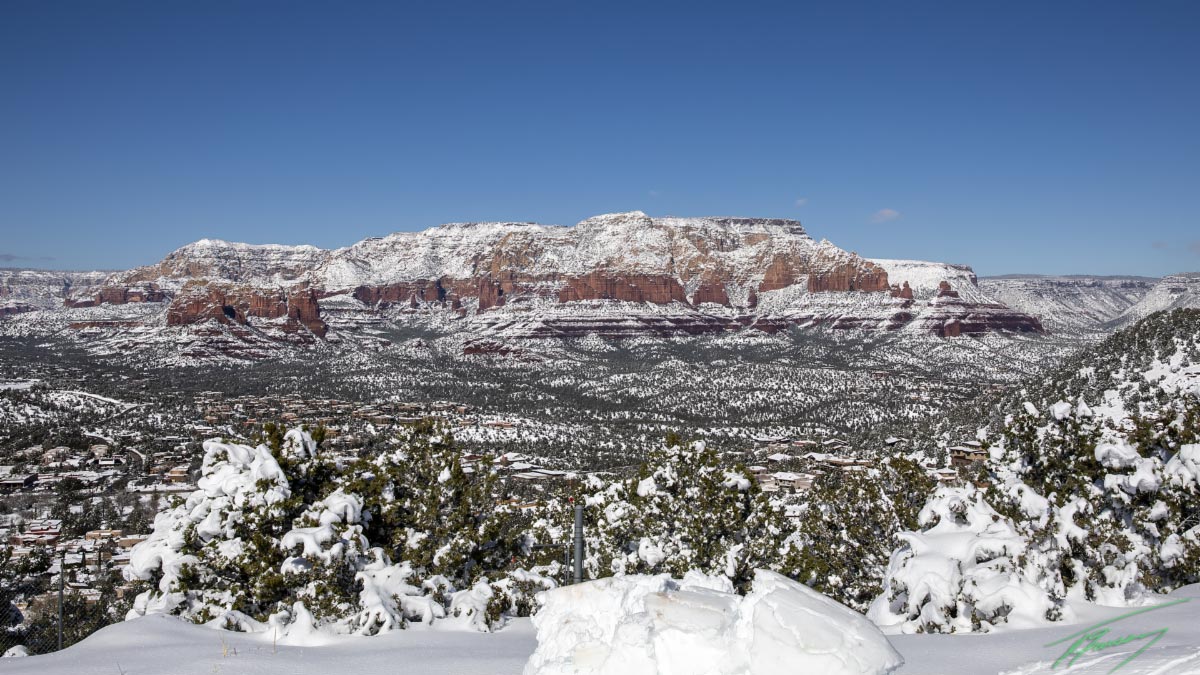
… it is that time of year when we think of cool …perhaps not everyone, but me for sure … 105F today and about the same for tomorrow and the same outlook well into next week. I started working on several wildlife photos tonight, but when it came time to finish them I chose to delete them instead. So, a little while ago I came on some of my photos of cooler days here and chucked the wildlife photos. I like the scenes of cooler days, so here are a couple that did the trick for me … enjoy them.
The shot above is a December day in the neighborhood and on the right side you are looking at west Sedona in the lower right part of the image and uptown about mid image also on the right. Wilson mountain is under the right side of the clouds and Long Canyon is mostly in shadow under the clouds on the left.The temperature was a delightful 50F. The photo below is a shot looking due north from the north end of the runway a winter wonderland and the temperature a very pleasant 32F.

Wishing you a very Happy Fourth of July … the day we celebrate the decision to break ties with an oppressive government and follow our own path to freedom and the celebration of individual freedom … and to establish a government responsive to and answerable to its citizens … a government that had enumerated powers established by and for the people … a government of limited powers … and for a time that is how it went. So let’s celebrate the genius that is the United States of America and the young men and women who were responsible for this incredible experiment of individual liberty …inalienable rights which come from God not government!
Hot dogs and hamburgers are to be consumed in quantity tomorrow as I join a friend at a 4th of July Party! Back tomorrow evening and without doubt feeling stuffed. Have a beautiful day and always speak up for our freedoms … exercise them or lose them!
Smiles,
Ted
To-morrow, O to-morrow!
Fast fall the fading years. A thought, a dream
Of gentle words; of faith and love a theme;
A smile, a step or two, and all is done.
Quick is the veering stream of life full run;
Yet in the crimson west still gleam
To-morrow and to-morrow’s endless dream.

excerpt from To-morrow by Max Ehrmann
###
 The easiest way to reach Mr. Grussing is by email: ted@tedgrussing.com
In addition to sales of photographs already taken Ted does special shoots for patrons on request and also does air-to-air photography for those who want photographs of their airplanes in flight. All special photographic sessions are billed on an hourly basis.
Ted also does one-on-one workshops for those interested in learning the techniques he uses. By special arrangement Ted will do one-on-one aerial photography workshops which will include actual photo sessions in the air.
More about Ted Grussing …

This is an advertisement

When you edit landscape photos, you will often make use of a variety of masks to target adjustments to different areas of the frame. Lightroom has made some major steps forward in its masking capabilities in recent iterations, making it far easier to efficiently and precisely process your photos. This excellent video tutorial will show you five uses for Lightroom’s masking capabilities when working with landscape images.
Coming to you from Michael Shainblum, this fantastic video tutorial will show you five useful techniques for using masks to edit landscape photos in Lightroom. If you have not tried out Lightroom’s new masking panel yet, it really is worth taking an hour or so to dive in, as it is impressively powerful and makes a significant impact on your efficiency. I have improved the quality of many of my photos by using it, simply because its quick and accurate work make it viable to perform edits that simply would not have been worth the time and effort under old systems, particularly when I am editing large batches of shots. Check out the video above for the full rundown from Shainblum.
And if you really want to dive into landscape photography, check out “Photographing The World 1: Landscape Photography and Post-Processing with Elia Locardi.”

The photographer Paolo Di Paolo, who has died aged 98, documented the renaissance of Italy following the dark days of the second world war, capturing that country’s 1950s and 60s glamour. His star shone brightly for 15 years before he turned his back on photography, but in that time he recorded the luminosity of cultural figures such as Pier Paolo Pasolini, Gina Lollobrigida and Tennessee Williams, as well as the optimism and dignity of ordinary people.
His pictures captured the shift from a more innocent, rural life, in a style that mirrored the neorealism movement in Italian film, as embodied in the shot of three boys on a bucolic hill looking towards the sprawl of Rome. His keen eye recorded the societal tension between the haves and have-nots, but his humanist approach highlighted the elegance of every person, regardless of circumstance. He said: “You might not know the subject but you understand the situation. In every image there is a story to tell … that is my law.”
Di Paolo started out as a self-taught amateur, taking photographs for pleasure with a considered approach. “Each shot had to be a good one. If the situation was not as I had in my mind, I wouldn’t take the picture.”
In 1954, he took his photos to Mario Pannunzio, the editor of the influential weekly current affairs magazine Il Mondo. Pannunzio recognised Di Paolo’s talent, and the photographer found his spiritual home.

He earned money working for other publications, notably Tempo, who sent him on assignment abroad. However, it was on home soil, on the self-titled 1959 assignment for Successo magazine, The Long Road of Sand, that Di Paolo produced some of his finest reportage. He embarked on a road trip along the coast in his Arnolt MG, with the author and poet Pasolini in the passenger seat, documenting Italians on vacation at the dawn of a new era. Di Paolo said: “I was looking for an Italy that looked to the future.”
His intelligence, empathy and discretion garnered trust and allowed him to take many candid portraits of major cultural figures including Sophia Loren applying makeup, Marcello Mastroianni sipping coffee and Kim Novak ironing. He formed a strong bond with the enigmatic actor Anna Magnani and his portraits of her with her son capture, and are captured by, intimacy.

Paolo was born into a poor family in the village of Larino, in Molise. His father, Michele Di Paolo, ran a small shop that sold tobacco and salt and his mother, Michelina (nee Lallo), was a smallholder and a skilled painter and embroiderer. He had five step-siblings from his father’s two previous marriages.
He attended the village school then moved to Rome to complete the final year of his studies at Liceo Classico Augusto, before returning to Larino. During the war he served in the Granatieri (Grenadiers) near his home, but did not see action. Afterwards he began writing for local newspapers, but he wanted more from life.
In 1949, at the age of 24, he left home to study history and philosophy at La Sapienza University of Rome. He intended to return to Larino to become a teacher there, but fell in with a group of young artists that was a hotbed of ideas and creativity, and realised he needed to explore a different path.
He had been making ends meet working at a tourism magazine, and was on his way to their offices in 1953 when he saw and fell in love with a Leica IIIc camera in the window of a nearby opticians. He had found the means with which to express himself.
He resigned from his job and used his severance money to buy the camera. Abandoning his studies shortly before graduation, he threw himself into the new humanist movement in photography. “The strength and enthusiasm that motivated us young people was overwhelming: our happiness was intoxicating.”
However in 1966, with the rise of television and the dawn of salacious celebrity culture, Il Mondo closed. Di Paolo was devastated. He wrote a telegram to Pannunzio: “ Today … the ambition to be a photographer has died.”
The following year Di Paolo photographed the Valentino haute couture show, but he was becoming increasingly disillusioned. In 1968 he went to see a photo editor who wanted him to exploit his society contacts, to get “some spice”.

Di Paolo’s strong ethical sense clashed with this new aggressive style and he refused to be associated with the paparazzi. At the peak of his powers, he hung up his camera and shut away his 250,000 negatives, prints and slides.
He moved to the countryside outside Rome, taking a job as an art director for the carabinieri (Italy’s regional police). Over the next 40 years he produced books, which included his photos of the cadets’ lives, and calendars, for the force. In 1973, he married Elena Marcelli, his former assistant, and they had two children, Michele and Silvia. He lived a quiet life and indulged his passions for winemaking, dogs and vintage cars.
In 1997, Silvia was hunting for a pair of skis in the cellar of her parents’ home when she was shocked to discover his photographic archive. She had no idea her father had been a photographer. She asked him about his work but he was reluctant to speak about it. It would take years of cajoling before he allowed Silvia to bring his work back to life.
Finally, recognition flowed. His first exhibition, Il Mio Mondo, was held at the gallery il museo del louvre in Rome, in 2016. Three years later, the MAXXI museum in the city staged a major retrospective, Mondo Perduto, with an accompanying monograph that is the only collection of his work to date.
Pierpaolo Piccioli, the creative director of Valentino, saw the MAXXI exhibition and, inspired by Di Paolo’s 1967 Valentino pictures, invited the then 94-year-old to photograph behind the scenes at the fashion house’s 2020 spring/summer couture show in Paris.
A documentary about Di Paolo’s life and work, The Treasure of His Youth, by the fashion photographer Bruce Weber, premiered at the Rome film festival in 2021 and is due for release in the UK next year. In May, to coincide with his 98th birthday, Di Paolo was awarded an honorary degree from La Sapienza.
He is survived by Elena, his children and two grandchildren, Matilde and Leonardo.


It’s ironic to think acclaimed painter Mike Henderson loved teaching his craft at UC Davis for over 30 years, after he himself despised his schooling in his native Missouri, and dropped out because of racial remarks from a teacher.
“A science teacher started comparing us all, all the Black students in the class, with animals like apes and so forth,” Henderson said. “He would say, ‘Ok you guys stand up, now look at they lips.’”
After moving in the ‘60s, Henderson said he continued to experience racial injustice in San Francisco attending social justice rallies.
His life experiences eventually would make their way on to canvas and are a prominent piece in the exhibition currently on view at the UC Davis Manetti Shrem Art Museum.
His works are a rarity, as there are few paintings from the ‘60s depicting the racial images and feelings of Black people by a Black painter.
“I’m glad that I did them, I’m glad that I saw it, and I’m glad that I said something,” Henderson said. “That’s what I want my son to say. That’s what I want your kids to say. I used to tell my class of students that: ‘It’s your life, it’s your time. Just don’t be a spectator through it all.’”
Not only skilled with a brush, Henderson has also released blues albums and made short films, some of which are on view at the exhibition.
The display is also important because of the lack of representation of Black artists historically in museums.
Founding Director of the museum Rachel Teagle said this exhibition has been in the works for long a time, but there has been a bump in interest in Black artists since George Floyd’s death.
“The issue of under representation is the crucial issue of art museums in our time,” Teagle said. “I see it as my responsibility to be part of a movement to make sure that the art we show in our museum is as diverse as our community in California.”
Teagle also noted the huge reaction from viewers to Henderson’s work, the most responses in their visitor journals of any exhibition at the museum.
Henderson said he’s humbled by such acknowledgment.
“You know I’m thrilled about it all and being seen,” he said. “And the people are relating to it.”
Hederson said he is glad his paintings can continue to teach for generations to come, because the issues depicted in his paintings continue to haunt society.

Today on Ukraine: The Latest, we bring you updates from the front lines, analyse the issues facing international businesses in Russia, and – with British volunteer Edward Matthews – discuss photography and the challenges facing rescuers during the Kherson floods.
Associate Editor of Defence, Dom Nicholls, starts by discussing how the Russian military adapted to the counter-offensive:
The British MOD says that Moscow had achieved some success, but continued to suffer from key weaknesses, especially overstretched units and a shortage of artillery munitions. So I think that chimes with what we’ve been saying for the last few days, that it’s a hell of a fight going on.
And of course, neither side has air superiority or can even really achieve local air superiority. That means being able to own the sky for a short period of time to give you a measure of freedom of maneuver underneath it. It is a very, very tough fight we are seeing.
Senior Reporter Daniel Woolfson discusses the issues faced by multinational companies in Russia:
One of the things some businesses have said is that they don’t want to exit too harshly because they want to avoid an intentional bankruptcy, which would see their businesses essentially handed to the Russian state. For the long term future I think a lot of these companies, the really big brands, are not completely writing off Russia.
There have been reports of buyback clauses inserted into deals to which would mean that these companies can buy the Russian parts of their businesses back at a certain point in time. Numerous CEOs have been quoted saying, you know, they don’t want to write it off completely 10, 20 years from now.
So I think there clearly is a hope of returning to Russia if and when the geopolitics allows.
Also in the episode, David Knowles interviews Edward Matthews, a British volunteer documentary photographer. He tells David about the photo he is proudest of, taken in Lviv, at the funeral of a Ukrainian soldier:
I think the image is so important to me because it depicts the cost of Ukrainian independence. It’s a country that wants to be independent and wants to set its own rules and the price of that is bloody. And that’s been the case historically for a long time. But this image, with the depiction of Jesus Christ in the background, it’s just so beautiful and heartbreaking. When I was taking this image there was an air raid siren on Independence Day and emotions were very high. I’m not even afraid to say that I cried; it was such an emotional day.
For more photography from Edward Matthews, please go to https://emrismedia.com/.

Russian President Vladimir Putin chairs a meeting with members of the government
Listen to Ukraine: the Latest, The Telegraph’s daily podcast, using the audio player at the top of this article or on Apple Podcasts, Spotify, or your favourite podcast app.
War in Ukraine is reshaping our world. Every weekday the Telegraph’s top journalists analyse the invasion from all angles – military, humanitarian, political, economic, historical – and tell you what you need to know to stay updated.
With over 30 million downloads, our Ukraine: The Latest podcast is your go-to source for all the latest analysis, live reaction and correspondents reporting on the ground. We have been broadcasting ever since the full-scale invasion began.
Ukraine: The Latest’s regular contributors are:
David Knowles
David is Head of Social Media at the Telegraph where he has worked for almost two years. Previously he worked for the World Economic Forum in Geneva. He speaks French.
Dominic Nicholls
Dom is Associate Editor (Defence) at the Telegraph having joined in 2018. He previously served for 23 years in the British Army, in tank and helicopter units. He had operational deployments in Iraq, Afghanistan and Northern Ireland.
Francis Dearnley
Francis is Assistant Comment Editor at the Telegraph. Prior to working as a journalist, he was Chief of Staff to the Chair of the Prime Minister’s Policy Board at the Houses of Parliament in London. He studied History at Cambridge University and on the podcast explores how the past shines a light on the latest diplomatic, political, and strategic developments.
They are also regularly joined by the Telegraph’s foreign correspondents around the world, including Joe Barnes (Brussels), Sophia Yan (China), Nataliya Vasilyeva (Russia), Roland Oliphant (Senior Reporter) and Colin Freeman (Reporter). In London, Venetia Rainey (Weekend Foreign Editor), Katie O’Neill (Assistant Foreign Editor), and Verity Bowman (News Reporter) also frequently appear to offer updates.


The Kimberling Area Library will be hosting a class on photography.
On Wednesday, July 12, the KAL will host the Photography Tips and Trick and Fun Stuff to Shoot class as part of their Learning on Wednesday program. The class will take place in the library’s community room at 10:15 a.m.
The class is free and open to the public. Instructor Jane Ballard, a member of Table Rock Lake Art Guild, will be instructing. Ballard will go over some of the rules of composition that may be flexible to capture familiar and unique objects in different ways to share with others.
“In our nature rich environment, many of us want to capture our living spaces with the perfect photo to share,” states a release from KAL. “You will leave with a passion and connection to others to expand your skills and knowledge and become a better photographer.”
Coffee and light stacks will be provided. Pre-registration is not required.
For more information visit www.kalib.org.

The Adaptalux Pod Mini is the latest generation of Adaptalux Pod. It brings you its fully adaptable lighting system in an ultra-transportable, miniature and robust package. I reviewed the main Adaptalux Control Pod last year and really enjoyed using it for macro and product photography. So when the good people at Adaptalux asked if I wanted to try the brand new Pod Mini, it was a simple “Yes please!” from me.
The Pod Mini is the little brother to the Adaptalux Control Pod and acts as the heart of the Adaptalux Studio Lighting System. It provides power and control to a lighting arm which connects magnetically to the single port. The modular and magnetic design makes adjusting your lighting quick and easy.


All technical specifications have been taken from the Adaptalux website.


Small but well-built and robust, it literally fits in your hand (or even pocket). I often have trouble with my hands and find small fiddly things difficult to handle. But I didn’t have a problem with the Pod Mini at all. Even the accessories (optional extra) have great ergonomics and grip handles making adjustments easy.
I used the Adaptulx Mini-Pod on the (optional) hotshoe adapter on my Sony A7RIII and Sony 90mm macro lens. I went into the backyard on a cold, gray, wet winter’s day in the darkest part of the garden to test out the light. It’s pretty easy to use the Mini-Pod, as it’s very small and light. Not as much power as you would have with, say a flash, but it makes capturing images in low light much easier. Shutter speed 1/125 second, f/5.0, ISO between 200 and 500.
Depending on the light arm used, the light emitted is between 200 and 400 lumens at 5700K. The beam of light can be widened or narrowed by twisting the end of the light arm. The filter or diffuser pod clip on the end of the light arm, to further soften the light emitted.


It’s really very basic. The power up and down buttons on top make the light extremely easy to use while in the field. The Lighting Arms just click and twist and you’re good to go. You can adjust the beam by twisting the end of the light arm.
As it’s a constant LED light, there are no pesky recycle times, just constant soft light. Battery life up to eight hours. The below images were taken without the light at the minimum shutter speed of 1/50 seconds, ISO 320, f/5.0.


If you’re a macro photographer, I think you’ll love what these little light pods could do for you. It was everything I wanted in the Pod Mini after reviewing the Pod Controller. It’s small, lightweight, fits in your pocket and easily attaches to your hot shoe when out and about. Plus, it’s well-built and easy to use. The tech is pretty basic; you can switch cameras or even share with a friend, and the shoe mount connects with any camera.
It’s not exactly cheap, but good lighting rarely is. While the Pod Mini itself is under $100, you need more than just the pod. I suggest a bundle pack buy: 2x Pod Minis, 2x Super Bright White Light Arms, 2 x 30% diffusers, and 1x camera mount. This will set you back around AU $400 or US $268.

The celebrated Ghanaian-British architect Sir David Adjaye has been accused of misconduct by three former employees, according to a report in the Financial Times. The allegations include sexual harassment, sexual assault, and an abusive culture within his company.
Adjaye, who is 57, has received worldwide acclaim for this architectural designs, which include several major cultural institutions like the Smithsonian’s National Museum of African American History and Culture, Washington, and the Museum of Contemporary Art, Denver.
Further commissions that are not yet completed include the new National Cathedral of Ghana in Accra, the Edo Museum of West African Art in Benin City, and the U.K.’s forthcoming Holocaust memorial, the latter of which has now suspended in light of the allegations.
Artnet News reached out to the highly anticipated museum planned in Benin City for a comment, but did not hear back by publishing time.
Since the news broke yesterday, July 4, Adjaye has stepped down from a number of roles and trusteeships, including as architectural adviser to the mayor of London, according to the New York Times. He also resigned as a trustee of the Serpentine Galleries in London. Artnet News has reached out to Adjaye Associates for further comment but did not heard back by publishing time.
The three women were not identified but, according to the Financial Times‘s report, they are all Black women who were single mothers in their forties when the incidents took place. They had each known Adjaye before joining his company and were already well-established within their professional networks. The report emphasized that their experiences at Adjaye Associates had long-term impacts on their mental health, careers, and financial stability.
Two of the women, referred to with the pseudonyms “Maya” and “Gene,” joined Adjaye’s firm in 2018 to help establish a new office in Accra, for which they moved to Ghana with their children. They rarely received their salaries on time and endured lengthy waits for their work visas, forcing them into a precarious position. Adjaye has admitted to “cash flow issues” and “an initial lack of structure and process” in the office’s early days.

View of main entrance and courtyard garden of the Edo Museum of West African Art (EMOWAA) in Benin City, Nigeria. © Adjaye Associates.
In September 2018, the pair met Adjaye for dinner and visited his apartment, where they alleged that he quickly maneuvered them into his bedroom and made persistent sexual passes, despite clear protestations from Gene, who left the room and waited outside. Maya, who stayed, claimed that she was under the influence of alcohol and that her recollections are hazy, but that she felt “overpowered, both emotionally and physically.” The next day she was given 4,000 Ghanaian cedi ($350) in cash by Adjaye without explanation.
A year later, in 2019, Maya said she was once again sexually assaulted after being pressured to enter a disabled bathroom at an airport in Johannesburg. Adjaye denies making any of the alleged sexual advances or payments.
Shortly afterwards, Maya said she attempted to report the alleged incident with Adjaye’s London office, with the Ghanaian police, and with Adjaye himself. In January 2020, she was abruptly dismissed and apparently received a cease and desist letter from Adjaye’s lawyers. A subsequent attempt to contact Adjaye with a request for financial compensation prompted a second cease and desist letter accusing her of extortion.

David Adjaye-designed National Museum of African American History and Culture, Washington, D.C. Photo © Nic Lehoux.
The third woman, dubbed “Dunia,” said she was sexually assaulted in 2019 after meeting Adjaye for a dinner to discuss business ideas. “He told me to be a good girl and be quiet,” she said. Wanting to prove her professional worth, she began working for him as a communications and marketing specialist until March 2020. This period was allegedly marked by controlling behaviour, emotional, and sexual abuse. Dunia felt persistently undermined, in some cases due to her race. She recalled being scared of crossing Adjaye due to his considerable power and influence. Adjaye has admitted to an ongoing sexual relationship with Dunia but rejected claims that it was abusive or coerced.
Several other former employees of Adjaye Associates also reported a toxic work culture, feeling “very taken advantage of” and described the company as a “personality cult.”
“I absolutely reject any claims of sexual misconduct, abuse, or criminal wrongdoing,” Adjaye told the Financial Times. “These allegations are untrue, distressing for me and my family and run counter to everything I stand for.”
“I am ashamed to say that I entered into relationships which though entirely consensual, blurred the boundaries between my professional and personal lives. I am deeply sorry. To restore trust and accountability, I will be immediately seeking professional help in order to learn from these mistakes to ensure that they never happen again.”
The three womens’ accounts have been corroborated by the Financial Times, which reviewed written evidence including email exchanges, bank statements, and interviewed colleagues, family, and friends.
In addition to his major architectural projects, Adjaye is also known for his sculptural artworks, including work that is on view at the 2023 Venice Architecture Biennale and the Counterpublic triennial in St. Louis.
None
More Trending Stories:
Follow Artnet News on Facebook:
Want to stay ahead of the art world? Subscribe to our newsletter to get the breaking news, eye-opening interviews, and incisive critical takes that drive the conversation forward.





