Photographer John Fielder shares his life’s work with History Colorado, and we can all be thankful

Photographer John Fielder shares his life’s work with History Colorado, and we can all be thankful

John Fielder and his approach to life


Photographer John Fielder and his approach to life

06:39

When you spend time in the great outdoors, your perspective often changes. That has certainly been true for Colorado nature photographer and conservationist John Fielder, who is battling cancer.

Fielder has spent a lifetime capturing the beauty of the Rocky Mountain in thousands of remarkable photos. His eyes and cameras have recorded images that show majesty of mountains…

john-fielder-5.jpg

CBS


The whisper of winter…

john-fielder-10p-pkg.jpg

JohnFielder.com


… and the rebirth of spring.

john-fielder-9.jpg

CBS


Along the way, Fielder has learned from nature’s timeless cycles of life, and he’s putting the lessons he’s learned to use now as a matter of necessity.

Reporter Barry Petersen first met Fielder in 2015 in Rocky Mountain National Park for a report on CBS Sunday Morning, long before he was diagnosed with pancreatic cancer. He said “I never get tired of being in places like this” and called it “his medicine.” He said it gets better every single time he visits. That was a big statement for someone who had at that time visited the breathtaking park in northern Colorado more than 100 times.

History Colorado is now showcasing some of his work in an exhibit at the History Colorado Center in Denver called “REVEALED: John Fielder’s Favorite Place.” History Colorado in their description of the exhibit says Fielder has “embraced the incredible solace to be found in spaces of complete vulnerability, and captured the magic of the moment.”

It’s one of a series of exhibits that will be coming to the museum in future years thanks to a massive gift from Fielder. Fielder went through 200,000 of his transparencies and winnowed them down to 7,000 negatives showcasing the best of his work. He’s donating all of those 7,000 to History Colorado.

“40 years ago all I wanted to do was one thing, and that is quit my department store job cold turkey. And with a wife and child and another one on the way turn my passion and hobby — photography — into a new career,” Fielder said. “And I pulled that off.”

john-fielder-2.jpg

CBS


Fielder’s pictures and calendars have drawn thousands to the wilderness. Unfortunately, some of those people have damaged the beloved nature he photographed. But now he believes they will also help nature survive.

“If you don’t smell it — the smell of decaying aspen leaves in the fall. Taste it — the taste of that cold, metallic, freshly melting snow water up high at 12,000 feet. You don’t listen to the hummingbirds in the meadow at 11,000 feet … you never really develop an appreciation for the sensuousness of nature and the fact that this is a 4.3 billion year process of evolution.”

“In our American democracy that’s why we’ve protected more wilderness than any other country on the planet. And I want people to vote that way and unless they care, they won’t do it.”

Fielder now faces a greater challenge than any he faced in nature.

“You have probably seen as much as any man of nature — birth, life, death,” Petersen asked Fielder in a visit to his house recently. “I sometimes have the sense talking to you, John, that it informs the way you are approaching death as part of life. Help me understand this.”

“My mind always tends to think scientifically, you know, logically and deductively and analytically,” Fielder said. “Trying to understand what’s around me. Living in a moment sounds like a cliche, but living in the moment, living in the present is medicine for me. And it allows me to appreciate the past and the future by always being focused on what I’ve been given today. Not yesterday or the day before.”

What Fielder has given today is for all of us. Those 7,000 photographs in the History Colorado collection “John Fielder’s Colorado Collection” will be for anyone to freely browse and download.

“You know, I never felt that I owned my photos. I felt that was kind of selfish,” he said.

Fielder hopes his photos will inspire more people to be conservationists. He also says they can serve as a benchmark for those who document climate change, since he has captured natural areas at specific moments in time over the recent decades.

Art-Fair Welfare? Berlin Galleries Can Now Tap Government Subsidies to Attend Two Fairs Per Year

Art-Fair Welfare? Berlin Galleries Can Now Tap Government Subsidies to Attend Two Fairs Per Year

A division of the German government has just announced it will incentivize Berlin galleries to participate in up to two art fairs a year, in Germany and abroad, by providing a subsidy of up to €12,000 ($13,000).

“Trade fairs are an important platform for galleries to acquire new customers and maintain existing contacts,” Germany’s Senate Department for Economics, Energy and Public Enterprises, which is behind the pilot program, said in a statement today.

Berlin is considered one of the largest and most innovative locations for contemporary art worldwide, the department said. “6,000 artists live and work in the German capital, and the approximately 350 private galleries based in the city contribute to the positive image of the city with their exhibitions of national and international artists.”

The program will enable more Berlin galleries to participate in internationally recognised art fairs, the agency said.

Not surprisingly, the response from Berlin gallerists has been enthusiastic.

“This is a great step in the right direction and a welcome sign of appreciation of Berlin’s gallery scene,” said art dealer Thomas Schulte. “In the last 25 years, we galleries have given the cultural life and the international image of Berlin a  lot of positive input and publicity worldwide and free of charge. This is the success of the continuous work of Werner Tammen and the Landesverband Berliner Galerien (LVBG) with its many new members and an encouraging sign of better and increasingly constructive communication with the Berlin Senate. We are moving forward.” Tammen is the chairman of the LVBG, a regional association of gallerists.

Going forward, interested Berlin galleries can receive free advice from the LVBG on ​​how to access funding from the new program and to receive support in the application process.

The Senate Department “is now closing a gap in the existing program for internationalization,” according to the statement. The existing internationalization program enables small and medium-sized companies to participate in trade fairs in Berlin, but had so far excluded galleries.

More Trending Stories:  

Looking for a Smart Beach Read? Here Are 15 of the Most Gripping New Art-World Books to Crack Open This Summer 

Artists Have Come Forward Claiming Non-Payment From Simon Lee Gallery Following News of Its Financial Insolvency 

Federal Funding Has Incentivized Institutions to Hold on to—and Even Destroy—Native Remains, a New Report Suggests 

Who Was Edward Brezinski? Nobody Really Knows. But a New Documentary About the ’80s Artist’s Failure to Find Fame Could Change That 

Scientists Have Developed the Whitest White Paint Ever Made—So Reflective It Can Cool Surfaces 

Broadway Legend Stephen Sondheim’s Manhattan Townhouse—Where He Wrote Tony-Winning Musicals—Is Selling to the Tune of $7 Million 

A Judge Green-lit a Virginia Museum’s Plans to Melt Down a Confederate Monument, Dismissing a Lawsuit Attempting to Save It 

Artist Stuart Semple Is Releasing a ‘Barbie-Ish,’ Ultra-Fluorescent Pink Paint to Protest Mattel’s Trademark on the Color 

An Australian Photographer Was Disqualified From a Photo Contest After Her Submission Was Mistakenly Deemed A.I.-Generated 


Follow Artnet News on Facebook:
Want to stay ahead of the art world? Subscribe to our newsletter to get the breaking news, eye-opening interviews, and incisive critical takes that drive the conversation forward.

Ballet on Bonneville Salt Flats Beautifully Shows Story of ‘Swan Lake’

Ballet on Bonneville Salt Flats Beautifully Shows Story of ‘Swan Lake’

Brad Walls aerial ballet photography

Award-winning Australian aerial photographer Brad Walls has continued collaborating with the New York City ballet to capture beautiful, artistic images of a professional dancer on the famous and picturesque Bonneville Salt Flats in Utah.

The photo shoot, like much of Walls’ other work, was conducted entirely from the air. Through the unique photo series, Walls aims to explore humanity’s light and dark aspects from an unusual perspective.

Brad Walls aerial ballet photography

The shadows convey different emotions. “Depending on your state of mind, your shadow could offer comfort or reflect a darker mood,” says Walls. The series, inspired by the story of Swan Lake, is fittingly photographed on a salt lake.

Brad Walls aerial ballet photography

“While theater ballet performances are undoubtedly breathtaking, there exists a captivating harmony between the natural wonders of our world and the art of Ballet — it’s a seamless fusion,” explains Walls.

Brad Walls aerial ballet photography

Brad Walls aerial ballet photography

For his latest series, Walls worked alongside Sasonah Huttenbach, a former member of New York City Ballet’s Corp de Ballet member.

Huttenbach was raised in Tokyo and New York City, and connected personally with Walls’ pitch. “I connected with the idea. The white and black swans depicted on the salt reflected my inner conflicts that I’ve grappled with throughout my journey as a Ballet dancer living between Japan and now the US,” Huttenbach says.

Brad Walls aerial ballet photography

Walls used a single dancer for the series, with Huttenbach playing the role of the black and white swan alike. Walls says that using different dancers, as he has done with other ballet series, would have “diminished the poignant symmetrical struggle that I aimed to convey in my photography.” Clever compositing techniques show Huttenbach multiple times in many images.

The new series will be featured alongside other ballet photoshoots, including a recent one that Walls also shot using a drone, in a coffee table book next year. Much more of Brad Walls’ work is available on his website and Instagram.

Brad Walls aerial ballet photography

Brad Walls aerial ballet photography

The aerial photographer has many other interesting photo series that have been featured on PetaPixel, including minimalist photos of empty swimming pools from above, a conceptual series based on 1940s fashion, symmetrical squash courts, and hypnotic synchronized swimming.


Image credits: All images © Brad Walls

Alaska accuses souvenir store of selling fake Native art and products from ‘Yakutat alpacas’

Alaska accuses souvenir store of selling fake Native art and products from ‘Yakutat alpacas’

A state judge has ordered a tourist shop outside Denali National Park to stop selling products labeled as “made in Alaska” after the state of Alaska accused the shop of repeatedly selling fake souvenirs and art.

According to a complaint filed by the Alaska Department of Law on Thursday in Fairbanks, the owners of a shop known variously as The Himalayan and Mt. McKinley Clothing Company repeatedly attempted to mislabel foreign products as Alaska-made.

At one point, the owners of the store told an undercover investigator “that an alpaca poncho depicting a Native American chief in a feather headdress reflected Alaska’s traditions.”

According to the complaint, “the defendants made the false claims that the store was a nonprofit that was owned by the Yakutat Village Council, that they were volunteering at the store, that the alpaca products were made from Yakutat alpacas, that products in the store were made by Alaska Natives in Yakutat, and that proceeds were returned to the Village Council to be used for charitable purposes such as building schools and building a rehabilitation center.”

Alaska has no native alpacas, and the Yakutat Village Council does not exist.

In response to the complaint, Superior Court Judge Patricia Haines issued a restraining order and preliminary injunction against The Himalayan and its owners on Monday.

The order requires that the store not sell products labeled as made in Alaska or made by an Alaska Native unless those products are approved by the state.

As the state’s tourism industry rebounds after the COVID-19 pandemic emergency, state and federal officials have been cracking down on fake Alaska Native art.

This spring, federal investigators prosecuted the owners of a Ketchikan store selling fake Native art, and at the start of this year’s tourist season, the Department of Law sent a warning letter to almost four dozen tourist shops statewide, warning them to not remove country-of-origin labels from imported souvenirs.

Passing off a foreign-made souvenir as Alaska-made is a violation of state law, and if a store falsely claims that an item was made by an Alaska Native or a member of a Native tribe, it may be a federal crime as well.

In a written statement about the restraining order, Alaska Attorney General Treg Taylor said, “My office will not tolerate false claims that products were made by Alaska Natives or that proceeds from sales will be used for charitable purposes. We will not allow businesses that lie to consumers to gain an unfair competitive advantage over the many excellent stores that sell legitimate Alaska-made or Alaska Native products.”

GET THE MORNING HEADLINES DELIVERED TO YOUR INBOX

UNC-Chapel Hill’s archeology labs continue to hold the remains of hundreds of Native Americans

UNC-Chapel Hill’s archeology labs continue to hold the remains of hundreds of Native Americans

Remains representing more than 600 Native American individuals sit in collections at the University of North Carolina at Chapel Hill’s Research Laboratories of Archeology — the state’s oldest North Carolina-focused archeology center. Those remains have not been made available for return to tribes, despite a federal law intended to facilitate the repatriation of Native ancestors and related funerary artifacts.

A national investigation published earlier this year by ProPublica found many of the nation’s top universities and museums continue to hold the remains of Native American people in their collections. Only about half of the more than 200,000 human remains collected across the country have been made available for return to tribes.

In North Carolina, that return rate is even lower. Three decades after Congress passed NAGPRA — the Native American Graves Protection and Repatriation Act — less than 30% of ancestral remains held in institutions have been made available for return.

Institutions in the state continue to hold more than 1,200 of these human remains, along with thousands of funerary artifacts, in their collections. UNC’s Research Laboratories of Archaeology holds the largest share of these unrepatriated remains.

The roots of NAGPRA

Before NAGPRA, Native American graves were commonly looted in the name of science and research, said Ann Kakaliouras, who earned her Ph.D. in Anthropology at UNC and now teaches at Whittier College in California specializing in repatriation issues.

“Large archeological programs literally built themselves on the mass excavation of indigenous remains throughout the country,” she said.

There are deep correlations between colonialism and the rise in popularity of archeology, according to Kakaliouras.

“It actually took Native activism in the 1960s and 70s to wake archeology up to the idea that Indigenous people in North America are interested in their ancestors,” she said.

A team excavates the Town Creek Indian Mound in Montgomery County, N.C., 1937.

UNC-CH Research Laboratories of Archeology

A team excavates the Town Creek Indian Mound in Montgomery County, N.C., in 1937.

After these decades of activism, Congress passed NAGPRA in 1990. The law was intended to stop the desecration of Native gravesites and to ensure that human remains “must at all times be treated with dignity and respect.” It required returning the remains of Native Americans to affiliated tribes.

All institutions that receive federal funding must comply with NAGPRA — from large national museums to state colleges or even local governments.

Protecting sacred objects

On a May morning, Shana Bushyhead Condill walked by the glowing display cases in the Museum of the Cherokee Indian on the Qualla Boundary in Western North Carolina.

Since NAGPRA’s passage, institutions have made remains and artifacts available for return to tribes, including more than 10,000 remains to Condill’s community — the Eastern Band of Cherokee Indians.

“Just hearing that number is hard to process,” Condill said, her voice heavy with emotion. “Thinking about the ancestors that have had their journey disrupted, and are many times in boxes and basements of institutions, that’s hard to just comprehend on a human level.”

It’s been a little over two years since Condill took over as executive director of the museum, after four years at the National Gallery of Art in Washington, D.C. Her work spans the intersection of public education and the preservation of precious — and sometimes private — objects.

Shana Bushyhead Condill, the director of the Museum of the Cherokee Indian, stands outside of the museum located on the Qualla Boundary in Western North Carolina, May 22 2023.

Josh Sullivan

/

WUNC

Shana Bushyhead Condill, the director of the Museum of the Cherokee Indian, stands outside of the museum located on the Qualla Boundary in Western North Carolina, on May 22 2023.

Until recently, those museum displays showcased artifacts that had been on view for years. But in 2022, as part of the museum’s ongoing exhibit “Disruption,” Condill and her staff decided to remove sacred and funeral-related items from public view and replace them with modern art produced by Cherokee artists.

“What we know is that when objects are fully intact — if it’s pottery, or effigy pots, or that kind of a thing, gorgets — that generally they come from a grave site,” Condill said. “I would rather default to removing objects from view than to have something mistakenly on view.”

Some artifacts are available for private viewings in the museum archive by families with historic ties to the object. In 1999, as an intern at the National Museum of the American Indian’s Cultural Resources Center, Condill witnessed artifacts being held and sung to. Others were stored under muslin to “allow the objects to continue to breathe without being seen.” She saw value in these interactions.

“So, we try to facilitate that as well with a family who wants to come in and see their objects and have a connection with them and hold them in their hands,” she said. “Sixth-generation weavers coming out and being able to interact with their objects is really amazing.”

Bringing Cherokee ancestors home

What we know is that when objects are fully intact — if it’s pottery, or effigy pots, or that kind of a thing, gorgets — that generally they come from a grave site. I would rather default to removing objects from view than to have something mistakenly on view.

Shana Bushyhead Condill

Josh Sullivan

/

WUNC

A display case at the Museum of the Cherokee Indian in Western North Carolina highlights the impact of looting as part of the museum’s “Disruption” exhibit, May 22, 2023.

As Condill cares for ceremonial items at the museum, the team in the Eastern Band’s Tribal Historic Preservation Office manages efforts to reclaim the community’s ancestors.

Miranda Panther, the tribe’s NAGPRA officer who is not a member of the tribe, sees her work as a way to protect human rights.

“I got a bachelor’s degree in criminal justice and I went to grad school for social work. So you might think that’s not necessarily something that’s related, but I view NAGPRA, and the work that we do here more as advocating for people who aren’t able to advocate for themselves,” she said.

She added: “I take that aspect of the job really seriously. And I always try to do what’s right by them, the best thing that we can after all of this time when mistakes have been made, or they’ve been languishing on shelves, in different institutions and museums.”

Once repatriation is initiated, the process can last years. The shortest repatriation Panther worked on took one year, with the longest extending for about a decade. She said a number of factors can draw out repatriation, like high staff turnover or a lack of needed staff expertise at the institution holding the remains.

But Panther is patient and organized. Her office has brought home thousands of ancestors to be reburied. Sometimes, reburials take place one at a time. Other times, more than 100 remains may be reburied at once. Reburial is always the ultimate goal, Panther said.

“Even though some of the ancestors that we’re burying might be 10,000 years old, or a couple-hundred years old, they’re still Cherokee. They’re still a person,” Panther said. “Not only did they not ask to be disturbed, and I’m sure had no expectation that something like that would ever happen and that their graves would be looted and disrespected, but we want to make sure and try and right that wrong as best as we can, and get them back to them being at peace.”

For the Eastern Band, reburials are solemn ceremonies carried out according to Cherokee cultural beliefs. Women are not allowed to be present, Panther said. The events are largely private, to prevent looting and to ensure the ancestors are not disturbed again.

“It’s a very honorable job that we have. And so we all take that very seriously,” she said.

Hundreds of ancestral remains at UNC-CH

Three-hundred miles east in Chapel Hill, UNC-CH’s Research Laboratories of Archaeology has repatriated only 40% of the more than 1,000 Native American remains it reported in federal NAGPRA filings.

Margaret Scarry, who heads UNC-CH’s Research Laboratories of Archaeology, said the practice of research around burial sites has changed significantly since the lab’s origins in the 1930s. The school’s archaeologists and students have not excavated graves since the mid-1980s, she said. Instead, new technologies like GIS and ground-penetrating radar allow researchers to examine history without disturbing sacred grounds.

Still, her labs at UNC continue to hold the remains of more than 600 Native American individuals that have not been made available for return to tribes. Scarry said every one of those remains is considered culturally unaffiliated — a designation that ProPublica called a “loophole” because the law does not require institutions to initiate repatriation of unaffiliated remains.

“We have deemed them unaffiliated because we don’t have the evidence to be sure which federal tribes they would be most related to, but they are available for return following the NAGPRA procedures,” she said.

For unaffiliated remains to be returned, tribes must proactively reach out to the institutions. Scarry said affiliation is complicated and that “it’s not always a simple matter to map archaeological sites onto modern tribes.”

Melanie O’Brien is the program manager for the National NAGPRA. In reviewing the university’s federal files, she said “It doesn’t seem that UNC has done a lot of work to allow repatriation of the ancestors in their inventory.”

Others slow to repatriate

A wigwam stands on the grounds of the Lumbee Tribe Cultural Center in Pembroke, North Carolina, on September 13, 2021.

Madeline Gray

/

For WUNC

A wigwam stands on the grounds of the Lumbee Tribe Cultural Center in Pembroke, North Carolina, on September 13, 2021.

UNC-CH is not alone in holding onto remains. In the more than 30 years since the law’s passage, the North Carolina Office of State Archaeology in Raleigh has only made 20 remains available for return — a fraction of the more than 250 remains left in its collection.

There are a number of factors that allow institutions to drag their feet when it comes to returning remains. A big one is that there’s little to no punishment for not meeting the law. According to ProPublica, institutions that have violated NAGPRA “have faced only minuscule fines, and some are not fined at all even after the Interior Department has found wrongdoing.”

A spokesperson for the Department of Natural and Cultural Resources which oversees the Office of State Archaeology declined interview requests. A statement by the office said “in recent years, the Office of State Archaeology has made repatriation a priority” and that Governor Cooper’s proposed budget includes “funding for an additional position to advance and accelerate our repatriation efforts.”

Condill, at the Museum of the Cherokee Indian, recognizes that the NAGPRA process is tedious.

“I’ll be the first to admit it’s a time-consuming process, but there are folks that are experts in it. There are other institutions that are doing the work and doing it proactively,” she said, highlighting the progress at the museum at the University of Tennessee, which holds collections from the Tennessee Valley Authority. “I think they are doing a good job of leading the way.”

She is adamant that institutions need to return ancestors and funerary artifacts to their historic lands or communities.

“That is egregious and needs to be corrected as soon as possible.”

Law does little for state-recognized tribes

In North Carolina, repatriation is complicated by a lack of federal recognition of several tribes. The Eastern Band of Cherokee Indians is the only North Carolina-based tribe with full federal recognition, and NAGPRA does little to help state-recognized tribes reclaim their ancestors’ remains.

Eight tribes in the state, including the Eastern Band, are state-recognized. The Catawba Nation, based in South Carolina, has historic territory that spans into North Carolina, and the Lumbee Tribe has partial federal recognition.

NAGPRA doesn’t require institutions to consult with non-federally recognized tribes. If museums or universities do want to return remains to state-recognized tribes, they would have to make a formal request to a NAGPRA review committee.

Kevin Melvin, the Lumbee Tribe’s first-ever tribal historic preservation officer, said gaining full federal recognition for the tribe would help them access remains and burial artifacts that may be associated with the Lumbee. As the tribe fights for that recognition, Melvin said repatriation is not the top priority, but that receiving or reburying remains would be deeply meaningful.

“To me personally, that would be like the culmination of my life’s work,” he said.

No North Carolina state laws outline a repatriation process for state-recognized tribes.

The spokesperson for the state Department of Natural and Cultural Resources said in a statement that the department is “committed to consulting with North Carolina’s state-recognized tribes and advocating to the National Park Service’s NAGPRA Review Committee for their inclusion in the repatriation process.”

Changes coming to the law

A statue outside the Museum of the Cherokee Indian on the Qualla Boundary, May 22, 2023.

Josh Sullivan

/

WUNC

A statue outside the Museum of the Cherokee Indian on the Qualla Boundary on May 22, 2023.

Changes are afoot at the national level. Deb Haaland, a member of the Pueblo of Laguna now heads the U.S. Department of the Interior, making her the first Native American to serve as a cabinet secretary. Under her leadership, new NAGPRA regulations are expected by the end of 2023. The updated rules should address barriers to timely repatriation.

Panther, at the Eastern Band’s Tribal Historic Preservation Office, considers what these changes may mean for the band and her own work.

“I definitely hope that the burden won’t be on tribes as it has been in the past,” she said. “I’m hoping that I can work myself out of a job in the next, you know, 10 or 20 years, just given how long some projects are known to take. … My next goal is international repatriation.”

And for Condill, at the Museum of the Cherokee Indian, the changes represent a path toward a more just outcome.

“It’s not enough anymore,” she said. “Bringing ancestors home is just humanly ethical.”

Today’s Photo from Ted Grussing Photography: The Timeless and The Unknown

Today’s Photo from Ted Grussing Photography: The Timeless and The Unknown

… days when I learn new things are terrific, days when I am introduced to new ways of looking at life and everything I have experienced are pure bliss! I had lunch with a friend at Brandy’s in Flagstaff today … Rich is a Physicist and spent the bulk of his career at Lowell Observatory and one of the most fascinating individuals I know. Somehow the conversation swung towards objects in the sky, UFOs, UAPs and other mostly unexplained phenomena. Rich introduced me to a theory of his that electromagnetic flux tubes are responsible for many and varied phenomena that cannot be easily explained and then into the origins, existence and properties of the electromagnetic flux tubes. He had a paper he has written on the subject and gave me a copy of it. While I do not fully comprehend these electromagnetic flux tubes, after reading the paper a couple of times I can kinda comprehend the concept. If you have an interest in investigating them, write me and I’ll put you in touch with Rich … tips on photographing them too!

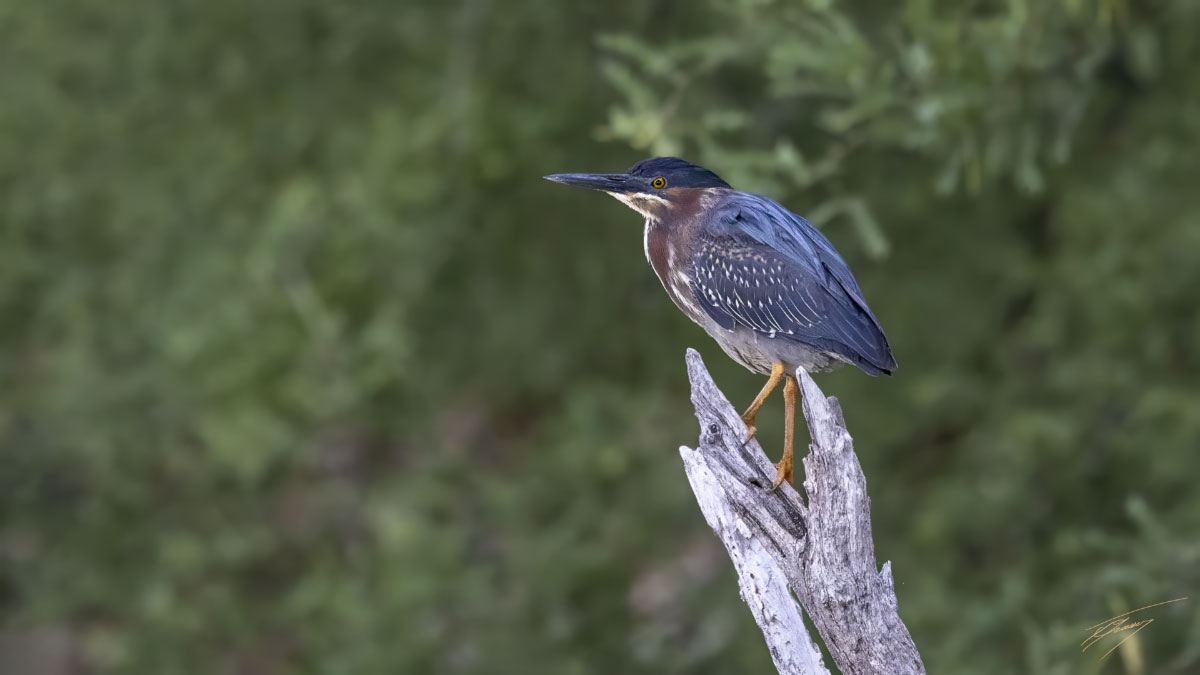
The photo above is a partial of a sycamore tree trunk that I shot earlier this year … perhaps a memory of or look at another life frozen in time and to be appreciated or remembered. Below is a shot of a green heron perched on a limb in the water and looking for a meal to appear. Lake Pleasant is down eleven feet since I was last down there and the bulk of that water is going to farms which grow crops that help us meet the new day with food on the table.

Time to wrap the day … have an absolutely beautiful day and be amazed as you look around!

Cheers,

Ted

So each one to his wish, and as for me,
I sit tonight and wait
To find the answers to my soul in me,
And in the beauty of the sky and sea.

excerpt from I Sit And Wait by Max Ehrmann

###

photo_tedgrussingThe easiest way to reach Mr. Grussing is by email: ted@tedgrussing.com

In addition to sales of photographs already taken Ted does special shoots for patrons on request and also does air-to-air photography for those who want photographs of their airplanes in flight. All special photographic sessions are billed on an hourly basis.

Ted also does one-on-one workshops for those interested in learning the techniques he uses.  By special arrangement Ted will do one-on-one aerial photography workshops which will include actual photo sessions in the air.

More about Ted Grussing


Healing Paws

Healing Paws

This is an advertisement

8th Annual Shakespeare at the Lake Photography Contest

8th Annual Shakespeare at the Lake Photography Contest

If you’re searching for a way to support local community theater and make a little money at the same time, look no further. The 8th annual Shakespeare at the Lake is just around the corner, and the production team is hosting a photography contest. 

The rules are simple. Attend one (or more) of our free performances, take some amazing pictures of the show, and then post them to the Shakespeare at the Lake Facebook page.

Free performances of this year’s play, “Measure for Measure,” will take place July 29 and July 30 at Library Park in Lakeport and August 4, 5, and 6 at Austin Park in Clearlake. Photos must be posted by August 8 at 11:59 p.m.

The photos that get the most reactions on our Facebook page will win. Voting closes on August 12 at 11:59 p.m. Three photographers will be awarded prize money. First place will receive $150, second place $100, and third place $50. The photography contest is sponsored by Clear Lake Campground. 

Actors will take the stage at 7 p.m., but don’t miss pre-show entertainment featuring a string quartet, “Faire Measure,” at 6 p.m. Food and drink from some of your favorite local vendors will also be available an hour before the play begins. 

Shakespeare at the Lake is a joint production of Mendocino College and the Lake County Theatre Company and is made possible by generous support from the Lake County Friends of Mendocino College, the City of Lakeport, the City of Clearlake, and the Clear Lake Chamber of Commerce. 

A Community Member

We always welcome community input. If you have a press release, event, or idea you would like to share with The Bloom’s readers, send us a note.

Publish Your Photography Book

Publish Your Photography Book

Provided by Mark Gilvey Creative LLC

Mark Gilvey Creative announces the creation of two photography books to help advanced and professional photographers self-publish photo books. Mark Gilvey takes his 25 years of experience in prepress, photo-retouching, and design to create two books aimed at helping photographers grapple with the issues of printing Black & White and Color photography in books, and magazines (and zines). He calls this his first two in a series of publications called This Is A Test (TIAT). The publications are called Blurb For Photographers Using Adobe® InDesign®, Lightroom® and Photoshop® Part 1 and 2.

“If you ever wanted to make a test book, before you go all-in, these guides will give you a great head start for preparing your files for press. When I started this project, there really weren’t many books out there that could give me a good idea of what my-own photography would look like using a print-on-demand service, like Blurb.” Gilvey said. “If you enjoy researching new gear you will buy, or a photography class you want to take, then you should research print-on-demand. I’ve got it all here in two volumes.”

Each publication covers the ins-and-outs of preparing your digital files. Gilvey said, “Did you know there are many colors of black that can affect how your B&W image will look? Do you know how white, white is on paper? Have you checked your black on black densities? What would your image look like with a 300 max ink density, vs. a 260 max ink density.” He also goes into areas that photographers typically avoid such as page design, how to make silhouettes, avoiding rivers, streams, orphans, the gutter, and how to check for “blobbage.”

“The publications have to be purchased as real, hard copy for you to see the actual results from each of the tests I do—a PDF will not illustrate the same way as print will.” Gilvey continues, “you can download a free sample as a PDF from my website, to see what it looks like, but to really understand what you are looking at, and to be able to compare it to what your minds-eye desires for your-own work, you need to have it in print.” He adds, “If you are only doing B&W, you only need the B&W version, but you’ll miss all the information about layout, and text that is in the Color version. If you are planning to only do color photos, you need both publications, they are both vital to color work.”

Click here to purchase or download samples of these two guides.

Mark Gilvey Creative, LLC offers commercial photography including product, food and restaurant photography, architectural, headshots, passports, photography of your services, and industrial photography.