Mvskoke Artist to Curate Show in Santa Fe

Mvskoke Artist to Curate Show in Santa Fe

TVLE, Okla.-  Mvskoke artist and Tulsa resident Carly Treece is curating an exhibit titled “Keepers of the Land” at the Sovereign Santa Fe 2023 Art Expo from Aug.18-20. The large contemporary Native art show coincides with the annual Santa Fe Indian Art Market.  

Treece spoke with Mvskoke Media about her experience curating the show during a “Live Wire” interview on Aug. 9th. Treece, who was asked to curate the show within a show by Sovereign Santa Fe and on the themes of the exhibit said; 

“This exhibit explores the rich and deep-rooted connection between Indigenous people and the lands we live upon. As the original inhabitants and caretakers of these lands, the artists offer their unique interpretations of what it means to be a keeper of the land. This exhibit incorporates the spiritual, physical and emotional connection of the land between past, present and future generations.”

Artists featured in “Keepers of the Land” include Shane Brown (Cherokee), Sam Regan (Cherokee), Brittany Postoak (Mvskoke), Haley Gallegos (Osage/Comanche), Jessie Haase (Cherokee), Dean Wyatt (Cherokee), Jaime Misenheimer (Choctaw), Chris Thompson (Seminole), Jeremy Thompson (Seminole), Walela Knight (Cherokee/Choctaw), and Lisa Rutherford (Cherokee).  

This is not Treece’s first curated show. Her co-curated exhibit, of which she was lead artist,  “WORK OF SOVEREIGNTY featuring 13 COUNTIES” was shown at the 101 Archer Gallery in Tulsa this past spring. The abstract landscape painter has upcoming work in an October exhibition, “Survived By” at Positive Spaces in Tulsa. The all Black, Indigenous, and People of Color (BIPOC) women and two-spirit artists show will open with a fashion show by Osage design company, Burning Wagon Designs.

It will also feature a short film about Emily Morgan, a 23-year-old Choctaw woman who was found murdered outside McAlister in 2016 to raise awareness for the Missing and Murdered Indigenous Women (MMIW) movement. Treece will also be showing art at the Cherokee Art Market with the Southeastern Indian Artists Association in October.  

“Keepers of the Land” is one of three different exhibits included in Sovereign Santa Fe 2023.  “Collective Wisdom” curated by Billy Hensley (Chickasaw) and “Pivot” curated by Landis Bahe (Navajo), Kandis Quam (Zuni/Navajo) and Roberta Begaye (Navajo) will also show works by Indigenous artists with a range in different media. All exhibits will be shown each day from 10 a.m.-7 p.m.   

Images of featured works can be found on the exhibit’s Facebook page, Keepers of the Land Exhibit. Keep up with Treece’s work at tvlsestudios.com. She can also be reached  at carly@tvlsestudios.com.

An 18th-Century Encyclopedia of Medicinal Plants Honors the Groundbreaking Artist Elizabeth Blackwell

An 18th-Century Encyclopedia of Medicinal Plants Honors the Groundbreaking Artist Elizabeth Blackwell

Quince. All images courtesy of Abbeville Press, shared with permission

Slices of quince revealing tiny seed pockets, serrated dandelion leaves cradling spindly stems, and juicy elderberries growing in dense clusters are a few of the specimens that intrigued Elizabeth Blackwell (1699–c. 1758). An always passionate artist living during a time that saw a burgeoning interest in the natural world, Blackwell illustrated a thick, detailed compendium of approximately 500 plants and their properties to aid doctors and medical professionals in treatment.

Titled A Curious Herbal: Elizabeth Blackwell’s Pioneering Masterpiece of Botanical Art, the book today is hailed for both its exquisitely detailed renderings and the fact that it’s the first of its kind created by a woman. Abbeville Press released the first modern edition earlier this year, finally granting Blackwell long-deserved recognition and offering today’s readers a chance to peek inside the vivid, botanical encyclopedia.

Artistically talented and ambitious, Blackwell first got the idea for A Curious Herbal when she needed to make money after her husband was jailed in a debtor’s prison. The project was all-encompassing, with the artist not only researching, drawing, hand-coloring the printing plates, and writing the descriptions for each specimen but also selling the book herself.

In addition to undertaking such a herculean amount of work, Blackwell was doing so at a time when women were largely barred from scientific institutions and medical professions. Given its commercial success, A Curious Herbal was not only a creative feat but also a social one, emphasizing the value of women’s knowledge and artistic output particularly as it related to male-dominated fields.

A Curious Herbal is available now on Bookshop. (via Hyperallergic)


A botanical illustration of yellow flowers and a white puff of dried seeds growing from serrated leaves with a long, carrot-like root

Dandelion

A botanical illustration of red and green tomatoes growing from a leafy plant with yellow flowers

Love apple, a.k.a. tomato

A botanical illustration of a leafy green plant with large brown seed pods

Cacao

Two botanical illustrations, on the left is a leafy plant with pink leaves and a pink root, on the right is a green plant with large leaves and a sparse yellow petaled flower with large brown root

Left: Garden radish. Right: Elecampane

A botanical illustration of a leafy plant with deep purple berries

Elder

A botanical illustration of a green leafy plant with small yellow flowers and a brown root

Creeping birthwort

a book cover with pink plant that reads A curious herbal

Do stories and artists like this matter to you? Become a Colossal Member today and support independent arts publishing for as little as $5 per month. The article An 18th-Century Encyclopedia of Medicinal Plants Honors the Groundbreaking Artist Elizabeth Blackwell appeared first on Colossal.

Epic Timelapse Filmed Around the World Shows Photographer’s 10 Years of Dedication

Epic Timelapse Filmed Around the World Shows Photographer’s 10 Years of Dedication
[embedded content]

A photographer has created an epic showreel of his timelapses filmed all around the world over the course of 10 years.

Matthew Vandeputte put together a selection of his best work and it is a great example of a seasoned photographer who has mastered their craft.

“I’m pretty much always shooting a timelapse or a hyperlapse wherever I am,” Vandeputte writes on his website.

“The result of this is dozens and dozens of hard drives filled with an enormous amount of clips of all kinds of styles and subjects.

“When you’re shooting and editing for ten years straight, you’re going to end up with a ton of footage.”

Vandeputte says that shooting is the easier part, editing is where the challenge begins.

“It’s truly a mountain of content you have to sift through,” he explains. “Luckily I’ve always had a great file management system, which makes this a lot easier.”

What Camera Gear is Used for a Timelapse?

Vandeputte’s philosophy is “the best camera is the one you have with you,” However, he has used an array of brilliant cameras including a Canon 5D Mark III, a Canon 1DX Mark II, a Canon 6D Mark II, a Panasonic Lumix S1, a Lumix S5 II, and a Lumix S5 II X.

“I have been shooting on all sorts of cameras over the last decade,” he adds.

Timelapse Styles

Vandeputte employs various timelapse techniques, including Holy Grail timelapses, hyperlapse photography, motion control timelpases, and astrophotography timelapses.

“The art of photography encapsulates a lot of different styles of shooting like street, studio, portrait, wildlife, macro, travel, etc,” he writes.

“It shouldn’t come as a surprise that the subgenre of timelapse photography holds many different styles of shooting as well.”

The Holy Grail timelapse is when the light begins to change, such as when the sun sets or rises, and the camera’s setting needs to be adjusted. While mounting the camera to a moving platform to create a parallax effect is known as a motion control timelapse.

“Move the camera even further and you start talking about one of my favorite styles of shooting: Hyperlapse photography,” says Vandeputte.

“With clever editing, you can combine all these different styles and more to create a captivating and immersive experience for your audience.”

PetaPixel featured Vandeputte’s timelapse work 10 years ago when he took a photo trip around the world. And earlier this week, PetaPixel featured a timelapse photographer who left three cigarettes in a mason jar filled with soil for an entire year

Vandeputte offers his knowledge on various courses he sells on his website. More of his work can be found on his Facebook, Instagram, and Twitter.


Image credits: All photos by Matthew Vandeputte.

The Burra Chair Collection: A Study in Softness

The Burra Chair Collection: A Study in Softness

The Burra chair collection, short for burrata – the beloved round, soft Italian cheese – is a study in the same qualities. The newest additions to Normann Copenhagen’s dining and lounge chair selection, Burra invites you to sink into its depths and versatile aesthetic. A round seat and curved backrest that morphs into armrests is Burra’s most distinctive feature, with the dining and lounge chair designs making a strong visual statement.

Designer Simon Legald says of the process, “When designing any chair, it’s important to consider comfort and dimensions. I wanted to create a design that featured an interesting interplay between these two factors using simple, minimalistic lines. Another requirement was for the design to be a sculptural piece, allowing it to become the focal point in the interior. The result is a chair that expresses softness in every sense: its dimensions look almost inflated, and the full upholstery adds to the visual as well as the physical comfort.”

Burra Chair

The design’s organic lines all but melt together, resulting in two bold, sculptural chairs bursting with expression. Both the Burra dining chair and Burra lounge chair are fully covered in upholstery, highlighting their plump dimensions and silhouettes with functionality and flair.

five modern armchairs in a studio space

Burra Chair

Burra’s high level of relaxation is thanks to the high-quality materials chosen especially for comfort and durability. To achieve the perfect level of softness, additional foam is added to both variations. The dining chair features a slightly inclined backrest, the ideal shape to wile away the hours. The lounge chair is fitted with a swivel base and optional return function for freedom of movement and mobility. Whether commercial or residential, the Burra seating family will bring its visual softness and elevated appeal wherever you take it.

dark grey armchair in a studio space

Burra Chair

three modern armchairs in a studio space

Burra Chair

two white dining armchairs at a round table in a styled space

Burra Chair

two lounge chairs with a coffee table in a styled space

Burra Lounge Chair

five modern armchairs in a studio space

Burra Lounge Chair

three modern white armchairs in a studio space

Burra Lounge Chair

two lounge chairs with a coffee table in a styled space

Burra Lounge Chair

two lounge chairs with a side table in a styled space

Burra Lounge Chair

lounge chair and armless sofa in a styled space

Burra Lounge Chair

detail of three lounge chairs

Burra Lounge Chair

detail of two lounge chairs

Burra Lounge Chair

To learn more about the Burra seating collection, visit normann-copenhagen.com.

Kelly Beall is Director of Branded Content at Design Milk. The Pittsburgh-based writer and designer has had a deep love of art and design for as long as she can remember, from Fashion Plates to MoMA and far beyond. When not searching out the visual arts, she’s likely sharing her favorite finds with others. Kelly can also be found tracking down new music, teaching herself to play the ukulele, or on the couch with her three pets – Bebe, Rainey, and Remy. Find her @designcrush on social.

When art and money meet

When art and money meet
image

Encouragement, profit or exploitation?

I’ve often thought that if one was looking for niche curses to place on enemies, “May you be profiled by Patrick Radden Keefe” would be a particularly potent option. The New Yorker staff writer and author has written with devastating precision about the Sacklers, the wealthy family who reaped billions from America’s devastating opioid epidemic; Joaquín Guzmán Loera, the Mexican drug-cartel kingpin known as “El Chapo”; and Gerry Adams, the Irish Republican activist turned politician.

Amid such company, Larry Gagosian, the global art-market king who is the subject of Radden Keefe’s latest profile, gets off relatively lightly. While noting that Gagosian’s contemporaries tend to “summon carnivore analogies” when asked to describe him (“a tiger, a shark, a snake,”) Radden Keefe paints a vivid picture of a man who did more than perhaps anyone else to transform fine art into an asset class, reducing the world’s greatest works of art to “stock lists, packing orders, lines on a piece of paper,” valuables to be stashed in Swiss vaults, rather than viewed or enjoyed. But at the same time, Gagosian comes across as someone who genuinely cares about art and has done as much as anyone in the last half-century to shape and encourage it.

I was reminded of one of my favorite exhibitions of all time, “The Steins Collect,” which I saw at the Metropolitan Museum of Art in New York a decade ago. The works themselves were stunning, including canvases by Matisse and Picasso. But what was particularly interesting was how the show presented the artists in conversation with Gertrude Stein and her siblings, whose status as collectors with ready money and interest in innovative works made them hugely influential over nascent movements like Cubism. (The exhibition is long gone, but you can get some sense of its themes from the hard-bound book about it.)

Regular readers will know that I like biographies about artists, so you might have expected the Gagosian profile to send me reaching for more of those. But in fact, the portrayal of a man who built a market and then dominated it reminded me more of “Liar’s Poker,” the book by Michael Lewis about Wall Street in the 1980s, which I dipped into again for the fourth or fifth time. (I wonder what Lewis, who studied art history as a Princeton undergraduate before going into finance and then journalism, would make of Gagosian.)

I’m going on vacation next week, which means the Interpreter will be on hiatus. I have two young children, so vacations aren’t exactly read-by-the-pool time, but I’m sure I can fit in some novels here and there as I always do. I’m excited to finally read “The Guest,” by Emma Cline, which has been on my list for a while.

I can get very emotionally involved in novels, so there’s a risk, I think, that the book’s dark take on the ultrawealthy beach enclaves of the Hamptons might cast a shadow on my trip to a not-at-all-wealthy coastal suburb in Spain. But hopefully it will have the opposite effect, reminding me as I gaze at the distant ocean from a rented holiday apartment that it’s good to stay outside the gilded cage.

Enjoy the waning weeks of summer. I’ll be back soon.


Here’s another novel I think I’ll be bringing on vacation: Jill Switzer, a reader in Pasadena, CA, recommends the movie “The Wife,” and the novel of the same name by Meg Wolitzer on which it is based:

Once again or rather, I should say, still, a woman’s artistic and creative merit is subsumed/devoured by her husband, lover, significant other, or whomever and passed off as his own. Glenn Close is brilliant as the wife.

Thank you to everyone who wrote in to tell me about what you’re reading. Please keep the submissions coming!

I want to hear about things you have read (or watched or listened to) that you recommend to other Interpreter readers.

If you’d like to participate, you can fill out this form. I may publish your response in a future newsletter.


J.Lo Brought Her Own Personal Instagram Photographer on Vacation

J.Lo Brought Her Own Personal Instagram Photographer on Vacation

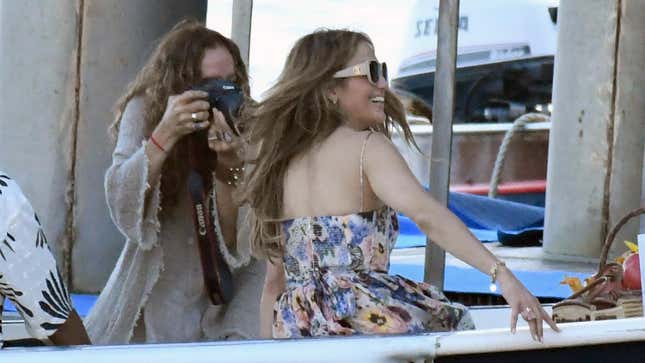
Jennifer Lopez enjoying life on the Amalfi Coast with her own personal photographer.

In the early hours of Friday morning, Jennifer Lopez (aka J.Lo—or is it J.Aff now??) posted three Instagram photos of herself lounging in the Amalfi Coast sun—as celebs are wont to do. She’s wearing a white-hot bikini and has five goblets of ice, a bucket of alcohol, and a big-ass plate of fruit set up next to her. She gives a “candid” laugh and a smoldering, mouth-agape duck pout. They’re great photos! And, of course, we love to see celebs being themselves on social media, especially celebs who sing about being “real.”

Except, wait a minute, these carefree vacation photos are—gasp—actually just an ad for her alcohol brand, Delola (more on that in a sec). In photos obtained by the Daily Mail, we can see a photographer directing this little late-afternoon aperitivo. The same photographer also appears to be capturing plenty more “candid” moments of J.Lo and her friends on an Italian boat.

Advertisement

To be fair, J.Lo did tag the photographer—Ana Carballosa—in the aforementioned Instagram post, so she’s not exactly hiding it. And by the looks of Carballosa’s own Instagram, she seems to be J.Lo’s longtime photographer. (Also because she’s credited as the only photographer on True Love, J.Lo’s 2014 book.)

Advertisement
Advertisement

Plus, if I’m a rich celeb on a fancy Italian vacation, I’m for sure not going to rely on my bitch-ass friends or worse, my dumbass husband, to take any grid-worthy photos of me.

Personally, I’m more so questioning why Jenny from the Block, who’s long bragged that she doesn’t eat sugar or carbs or drink alcohol, is now shilling for a cocktail company. “I know that a lot of people have been talking about like, ‘Oh she doesn’t even drink. What’s she doing with a cocktail line?’ And to tell you the truth, that was true for a long time. I didn’t drink,” she said in an Instagram video in July (which does look like she filmed herself!).

Advertisement

But that’s apparently all changed now. (Maybe Ben Affleck said they should diversify their marital revenue streams??) “I do drink responsibly,” she added. “I don’t drink to get shitfaced.” Sounds boring.


  • Barely a week after Rami Malek and Lucy Boynton were confirmed to have ended their five-year relationship, Malek has been seen making out with Emma Corrin. [Daily Mail]
  • Gal Gadot made her “Hot Ones” debut and said she only ever entered the Miss Israel pageant as a story for her grandkids. “I never meant to win!” What a humble—cough, pick-me—queen. [People]
  • Olivia Rodrigo released the music video for her new single, “bad idea right?” featuring famous nepo baby and nepo sister, Iris Apatow. [Variety]
  • Speaking of new music, Lorde has teased some. “Just want u to know there’s a light on inside me .. show it to you soon,” she wrote. Long as that light doesn’t run on solar power… [Instagram]
  • Bethany Joy Lenz, star of One Tree Hill, said her famous friends tried to rescue her from the cult she was in for 10 years, an attempt she described as being “lovely and so amazing to be cared about in that way.” Woof. [Page Six]
  • Shania Twain says she is praying and hoping Celine Dion can overcome Stiff-Person Syndrome. We all are <3 [Billboard]

How Bengal’s Nineteenth-Century Art Defined Women

How Bengal’s Nineteenth-Century Art Defined Women

As India celebrates the seventy-sixth anniversary of its independence from British rule, colonial practices continue to intersect with nationalist modes of expression. In the late nineteenth century, a compelling example of Indian “tradition” intersecting with Western “modernity” was observed in the colonial sensibility that affected local Bengali artistic practices, widening the gulf between “mass art” available on the market and refined oil paintings gaining popularity under the Calcutta school. The former was created largely by the Kalighat patuas (traditional painters who worked near Calcutta’s Goddess Kali temple at Kalighat) while the latter was created by local artists educated in Western techniques. Despite differences, however, both approaches influenced each other, especially in their depiction of women.

Historian Tapati Guha Thakurta’s 1991 article “Women as ‘Calendar Art’ Icons: Emergence of Pictorial Stereotype in Colonial India” traces the history of “feminine images” that have become the “stock-type of today’s ‘calendar’ pictures.” She relies on early prints—lithographs and oleographs (chromolithographs)—created for mass consumption to reconstruct the perception of the feminine image at the time.

“Gender featured as the central plank in the construction of new ‘icons,’” she writes. “The woman’s image, like the very ideas of womanliness and womanhood, exuded strong ‘iconic’ potentials.” Women’s roles as icons ranged from being seductive and erotic to mythical and religious as they imparted social, political, and ethical values.

The introduction of printing altered the existing imagery of women, which became more “dramatic” as it began to draw inspiration from Western art. Hence, female characters from Indian epics took on European aesthetics while still fitting into the mold of the Indian “feminine divine.” By the late nineteenth and early twentieth century, the clientele of Kalighat art “widened into an undifferentiated mass clientele,” fed by mass-produced picture prints featuring this aesthetic and philosophical fusion.

One sees this in the rising popularity of the art works of Raja Ravi Varma, the famed painter from Travancore who founded India’s largest lithography presses in 1894. Writing of his work, Guha Thakurta notes that the “woman’s image became the main site on which the artist (and his critics) negotiated and reconstructed notions of the ‘mythic’ and ‘sacred’, of ‘tradition’ and a new national ethos.”

Ravi Varma clothed his women in Indian finery and placed them within a mythic narrative, yet they were often inspired by the “nude Venuses and Psyches and their allegorical images of Chastity or Charity” made by Boulanger and Bouguereau, two artists from the French academy. Apart from deification, the feminine figure was also effectively employed to spread a nationalistic message: “rousing her ‘sons’ to patriotic action.”

According to Guha Thakurta, such depictions made the female image the central figure in both popular and high art. She terms this process as “one of ‘resacralisation,’ where the rise of modernity, instead of separating the secular from the sacred, draws the two into a new synthesis.”

At the same time, these images also portrayed women as sexual objects designed to please the “male gaze” of the artist as well as the audience. Likening Indian mythological paintings to European allegorical ones, she asserts that “the act of male voyeurism was legitimised in these pictures by directly incorporating the erotic experience within the religious and mythological narrative.”

[embedded content]

The female figures that weren’t sexualized overtly were portrayed in their roles as middle-class wives and mothers, often captured performing daily household tasks or rituals of personal vanity. Yet these, too, argues historian Chitrita Banerji, fed the hunger of the male gaze.

“The bonti’s uniqueness comes from the posture required to use it: one must either squat on one’s haunches or sit on the floor with one knee raised while the corresponding foot presses down on the base,” she writes.

The knife became “inextricably associated with Bengali women, and the image of a woman seated at her bonti, surrounded by baskets of vegetables [became] a cultural icon.” A fully-clothed cultural icon, but nonetheless, the frequent appearance of the bonti in Khaligat paintings still left scope for viewers to use the images for “erotic stimulation.” As Banerji points out, in case we think we are reading too much into the images, the sexualization of the bonti was soon made obvious with Gurudas Chattopadhyay’s publication of photographs of Calcutta prostitutes working with the knife, offering “a uniquely erotic vision of the female figure, rich in implication and suggestiveness.”


Support JSTOR Daily! Join our new membership program on Patreon today.