Why You Should Try a 135mm Lens for Portrait Photography

Why You Should Try a 135mm Lens for Portrait Photography

When it comes to portrait photography, the classic focal length is 85mm, but of course, that is not the only option you can use for creating worthwhile images. 135mm lenses have long been a popular alternative to the classic 85mm option, and this great video essay discusses why you should consider using one in your work.

Coming to you from Stefan Malloch, this excellent video discusses the benefits of using a 135mm lens for portraits. 85mm has long been the classic choice for portraiture, but 135mm offers some interesting benefits that make it an alternative worthy of consideration. Quite a few photographers like to use longer focal lengths, as the additional compression reduces the prominence of features a bit more. On top of that, there are often some top-level 135mm lenses available at prices cheaper than the most expensive 85mm lenses. One thing you will want to consider is the increased working distance of a 135mm lenses. If you mostly shoot outside, this probably will not bother you, but if you tend to work in a studio, you should consider if it will cause issues, especially if you are already near the limit with your 85mm. Check out the video above for the full rundown from Malloch.

Today’s Photo from Ted Grussing Photography: It Is Happening

Today’s Photo from Ted Grussing Photography: It Is Happening

… the changeover has been made … my friend has my older supercomputer and the new one became operational on Saturday, but not without a few hiccups and a lot of work left to do. I have most of my apps reinstalled on this computer, but several important ones to go … the color calibration software among the most important of them. The photos tonight are from a previous email since I do not trust what is presented to me on an uncalibrated monitor … that will happen later today.

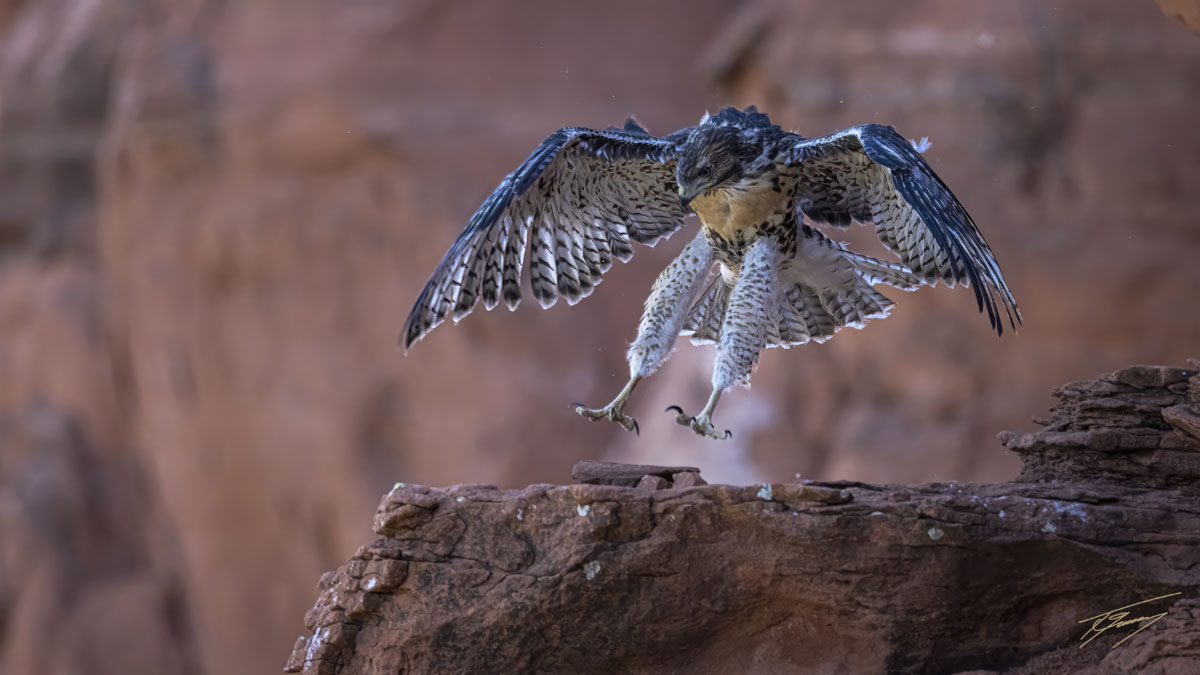
The photo above is one of my favorites from the red tail hawk series I sent out earlier this year. It shows one of the adult red tail hawks bringing a mouse in to the nest … breakfast for the kids! The photo below is also from the same series and shows one of the kids sticking a landing on an outcropping on the side of the cliff … also one of my favorites. My friend tells me that they have all pretty much gone their separate ways now … wishing the kids every success as they try to make it in the real world. The first-year mortality for hawks is over 70% so unless these kids are exceptional, only one of the three will be here this time next year.

I saw a preview of the September issue of Sedona Monthly and it is spectacular. There is a multi-page special on the San Francisco Volcanic Field by Wayne Ranney and photographs by me … it is special so look for that around the end of the month. If you do not get it in the mail you can always stop by a coffee shop in town and get a copy at no charge. It is a great magazine and a must read if you live in or are visiting the area. Wayne has written the definitive book on the geological history of Sedona, Sedona Through Time and it is available on Amazon … well worth a read if you want to know more about our past.

Have a beautiful day and with a little luck and lots of work, I’ll be fully functional with the new computer by tomorrow evening. Keep breathing, smile and be kind!

Smiles,

Ted

I lie down in slumber, and the peace of the world is
upon me. Though poverty abide with me, I pray that
courage and gentleness forsake me not. And with
all living things out of the earth and out of other worlds
I believe I shall grow in the fields of God forever.

excerpt from A Psalm by Max Ehrmann

###

photo_tedgrussingThe easiest way to reach Mr. Grussing is by email: ted@tedgrussing.com

In addition to sales of photographs already taken Ted does special shoots for patrons on request and also does air-to-air photography for those who want photographs of their airplanes in flight. All special photographic sessions are billed on an hourly basis.

Ted also does one-on-one workshops for those interested in learning the techniques he uses.  By special arrangement Ted will do one-on-one aerial photography workshops which will include actual photo sessions in the air.

More about Ted Grussing


Healing Paws

Healing Paws

This is an advertisement

OHIO alum and distinguished photographer Thomas Schiff donates personal collection to University Libraries

OHIO alum and distinguished photographer Thomas Schiff donates personal collection to University Libraries

Acclaimed photographer and businessman, Thomas R. Schiff, captures stunning views of architecture across the U.S. through his iconic Hulcherma 360 panoramic camera which takes a unique angle on photography by encapsulating a full 360-degree image. His images include broad cityscapes, city halls, movie theaters, art museums, religious sites and more. Schiff is also the co-founder of the non-profit FotoFocus, which was created to celebrate and champion photography and lens-based art. Ohio University Libraries will now be the permanent home to more than 2,000 of those works that were generously donated by the photographer and alum himself.

Schiff has been interested in photography ever since his childhood when an early interest was sparked in elementary school. He had gotten a Kodak Brownie camera and later set up a dark room in his basement at around 11 years old before taking pictures for his high school yearbook and newspaper. In 1970, Schiff graduated from Ohio University’s College of Business with a Bachelor’s in Business Administration and a minor in Fine Art, which enabled him to continue pursuing his passion for photography.

As technology and cameras advanced, Schiff decided to move away from the conventional black and white negatives in 1994 and instead changed to the Hulcherma 360 camera, mastering the panoramic photographs that he’s known for today. Schiff mentioned that he had already been photographing city scenes and architecture for a while and felt that he needed to change things up a little bit with something different. It was at that point that he had begun getting into panoramic and color photography.

Since 1999, Schiff has published 14 books, each demonstrating the intersection between his interest in the history of architecture and love for photography. While the books often explore a theme or location, Schiff dedicated two books to exploring the work of a single architect, Frank Lloyd Wright.

“I ended up visiting over 100 buildings by Wright around the country and photographed them,” Schiff said. “I had two books. One is a book of photos from around the country titled, ‘Wright Panorama’, and the other book, ‘Wright in Ohio,’ showcases…11 Frank Lloyd Wright buildings in Ohio.”

Currently, Schiff is working on a project for 2026 celebrating America’s 250th  anniversary of the signing of the Declaration of Independence. Civic buildings, city halls, the U.S. Capitol building, the U.S. Supreme Court and other significant pieces of architecture will be included in the project.

Schiff’s colorful panoramic photography captures stunning and extraordinary architectural views that offer a new way of seeing the built environment. The donation to University Libraries comprises of approximately 2,000 of his panoramic color prints measuring about three to six feet in length, 200 black and white prints, born-digital archival material and correspondence. His collection represents his published work including books, photographic prints, digital image files as well as unreleased photographs.

Schiff’s work will be a part of the Documentary Photography Archive within the Libraries’ Mahn Center for Archives and Special Collections. The archive currently is made up of four different collections with Schiff’s donation being the fifth and newest addition. Other photographers featured in the archive include: Lynn Johnson, world-renown photojournalist and Ohio University Knight Fellow of ‘04, Peter L. Goss, an OHIO alum of ‘73 who took photos of Ohio University and the surrounding area from 1966-1970, Lloyd E. Moore, a lawyer and photographer of the Southeast Ohio region and Leonard “Len” Vaughn-Lahman, a photojournalist known for his work covering the environment, immigration and the wars in Afghanistan and Iraq after the September, 11, 2001 terrorist attacks.

The collections in the Documentary Photography Archive, including Schiff’s new donation, are available for anyone to view and use for research. Laura Smith, photo archivist and the curator of the collection, mentioned that Schiff’s works will benefit teaching and learning at Ohio University as well as researchers worldwide.

“For the OHIO community, I think there’s a lot of exciting opportunities to incorporate these photographs in the curriculum and classwork that include anything from the photographic technique and process…to the film photography to the digitized versions, as well as studying the subjects of the photographs,” Smith said.

Schiff has always had close ties and love for his alma mater. In 2009, Schiff photographed the exterior of Alden Library in the memorable piece entitled, “Vernon R. Alden Library, Panoramic Photograph,” which was also the three-millionth addition to Ohio University Libraries that was unveiled at Alden Library’s 40th anniversary celebration. Additional interior images from that time period are also currently on display inside the Library nearly 15 years later.

Alden Panorama
“Vernon R. Alden Library, Panoramic Photograph,” by Thomas R. Schiff.

The strong connection and bond that Schiff has with OHIO has enabled the Libraries to steward the extensive collection. Schiff mentioned wanting a safe environment to house his photos and a place where others can enjoy them. University Libraries is honored to be the place to make those things happen.

“It’s a great opportunity for…my collection to be cared for under such superior circumstances,” Schiff said. “The archives of Ohio University Libraries will do a terrific job of keeping them in shape.”

Neil Romanosky, dean of University Libraries, is thrilled and honored that Schiff is donating such a large portion of his collection to University Libraries.

“I am also grateful for Schiff’s generosity in supporting the ongoing work and infrastructure that will enable the Libraries to make this collection available to students and researchers for generations to come,” Romanosky said. “Through his own photographic work and that of FotoFocus, Mr. Schiff has done much to advance engagement with lens-based art. This is a truly wonderful addition to the Libraries’ Documentary Photography Archive.”

For more information about the Thomas R. Schiff collection, please contact Laura Smith, photo archivist.

LumeCube Panel Pro 2.0: Vibrant and accurate for most photography needs

LumeCube Panel Pro 2.0: Vibrant and accurate for most photography needs

Whenever I open any Lumecube product, I immediately get excited. Would I feel any different with the Lumecube Panel Pro 2.0 that I was sent?

My first impression was I loved the size. At 6×3“, it fits in the palm of your hand. It’s lightweight but still feels quite durable. I attribute this to its well-constructed one-piece aluminum housing. The kit comes with a softening diffuser (pre-attached), travel pouch, USB cable and camera mount. The mount is compatible with most DSLR cameras.

LumeCube Panel Pro 2.0 — Bright is an understatement

The light output is stunning. This small light delivers a 595 Lumen output and 96+ CRI for excellent color accuracy. The 204 LEDs packed into this light are truly powerful. With a full spectrum of RGB colors (over 16 million color options) and a vast temperature range of 2700-7500K, you can have total control over all types of shoots … even in questionable lighting conditions.

The diffuser is handy and locks on securely. I find myself using it often to provide a soft look during my shoots.

LumeCube Panel Pro 2.0 — Controls and menu

The controls on the light are simple and intuitive. There is a power switch, mode button and up/down adjustment dial. It’s easy to dial in the desired color in a matter of seconds. This adds efficiency to any production and offers less annoyance to the talent.

The compact Smart LCD control center is crystal clear to read. In HSL mode, it indicates battery life, brightness, color spectrum options, saturation, Bluetooth connectivity and RGB hue settings. In CCT mode, it indicates brightness, battery, color temperature, green/magenta tint control, selection of the 7 preprogrammed effects, and a frequency setting for the effects (10 stepless speed levels).

LumeCube Panel Pro 2.0 — Enough power for your shoot

The light features a rechargeable lithium battery. It provides 2 hours at maximum (100%) power, and about 4 hours at 50% power. The battery life indicator is also accurate down to the minute, so you can estimate how long you can go at a given setting. This feature is extremely helpful!

The unit can also function as a power bank, charging a cellphone. It was able to charge my Samsung Galaxy about 75%.

LumeCube Panel Pro 2.0 — There’s an app

The LumeControl app is excellent. To connect the light, go to the HSL menu and scroll to the BT (Bluetooth) option and toggle to “On.” Then, in the app, you should see your device in the Device List, where you can connect to it. The app is extremely easy to use, offering basic brightness and color temperature sliders, advanced hue selection, easy access to preprogrammed effects, and a color picker. This allows your light to color match to an image via your phone’s camera. Super handy!

LumeCube Panel Pro 2.0 — An upgrade over the original

For those of you that may have used the original Panel Pro, there are some notable improvements. There is a small improvement to the bicolor brightness, and a whopping 400% brightness improvement with RGB. The light also features improved CRI rating and lumens. You’ll also notice a significant improvement in battery life. This is absolutely high-quality lighting.