According to Jack Klapper of Noblehurst Farms Inc., 800 pounds of butter can power a home for three days.
Annual butter sculpture from state fair finds new purpose in renewable energy


All images © Yen Jui-Lin, shared with permission
Yen Jui-Lui instills a growing group of characters with playful wiles and whimsy in an ongoing series of wooden toys (previously). Just a few of the artist’s recent creations portray pudgy bears that double as receptacles for spare change or fruit, a downcast rabbit enduring an inner tube, and birds that sprout dried flowers from the tops of their heads. Using a variety of wood types local to his home in Taiwan, he repurposes segments of cypress, cinnamon, and beech, among others.
Yen is currently working on a series inspired by the zoo, which has been in progress for more than two years. “This series is not imitating real animals; it’s more reshaping the imagination of the animals in cute and interesting shapes,” he says. You can find more of the artist’s work on Instagram.


Do stories and artists like this matter to you? Become a Colossal Member today and support independent arts publishing for as little as $5 per month. The article It’s a Zoo in Here! A Diverse Cast of Whimsical Animals by Yen Jui-Lin Emerge From Wood appeared first on Colossal.

If you’re just entering the hobbyist stage of vinyl record listening and collecting, you’re probably not at the stage of concerning yourself too much about features like a magnesium tonearm, electronic speed control, and a silicone belt driven system. They’re all options a vinyl listener can grow to appreciate over time, something American turntable maker U-Turn Audio is hoping to capitalize on with the announcement of a series of three updated modular turntables: the Orbit Plus, Orbit Special, and Orbit Basic, alongside a made-to-order Orbit Custom option.
Founded in 2012 by Benjamin Carter, Robert Hertig, and Peter Maltzan, U-Turn Audio has made a name for themselves as an independent American maker of audio equipment ranging from turntables, phono preamps, and speakers. Their Orbit turntables have earned popularity for their clean modern aesthetic, prosumer-to-audiophile specs, and the reasonable entry price into their brand. The newly updated Orbit turntables offer something for nearly everyone seeking a capable and handsome looking turntable intended to openly display your affinity of analog audio.

Orbit is designed around a customizable and modular platform, allowing the customers to choose which components to prioritize up and down the turntable series. Parts such as the cartridge, preamp, speed control, platter, and isolation feet can all be customized, either at the time of purchase or down the line as an add-on replacement. The new generation of Orbit Turntables feature an updated single piece magnesium OA3 tonearm for improved tracking, an electronic speed control to easily switch from playing speeds between 33/45 RPM with the turn of a knob.
Upgrade to the Orbit Special or Orbit Custom, and you’ll get a seamless silicone belt drive with new grooved platter design for even smoother playback than its two lower-tier counterparts.

Recognizing the love for vinyl comes attached to an entire lifestyle element, U-Turn Audio has made sure to add a choice of five colors and two hardwood options to improve the chances you find a deck that ties together the whole listening room. It’s worth mentioning the wood turntables are not simply given the cheap veneer treatment, but are constructed from 100% sustainably-harvested, US-sourced hardwoods for stability and durability.

If you’re a little more discerning about keeping your U-Turn Audio turntable perfectly stable, the company offers optional adjustable-height aluminum feet outfitted with Sorbothane to reduce external vibrations.

Orbit Basic starts at $249, an entry model that comes equipped with the newly designed magnesium OA3 tonearm, grooved MDF platter with seamless silicone belt, and five new color and two wood options.

The Orbit Plus starts at $399, arguably the sweet spot model for most listeners seeking “great” but not necessarily the “best.” The Plus comes with an upgraded acrylic platter and an Ortofon OM5E cartridge with elliptical diamond stylus.
For a minimalist setup, U-Turn Audio offers to add a built-in Pluto 2 Phono Preamp that allows them to connect the turntable directly to powered speakers without any additional space required – an increasingly popular configuration when budget, space, or a preference for keeping things simple eclipses audiophile precepts for larger discrete components.


The $549 Orbit Special adds several premium bells and whistles: an Ortofon 2M Red cartridge with elliptical diamond stylus, electronic speed control that allows users to adjust between 33/45 RPM playing speeds with the turn of a knob, and a cue lever for precise tonearm operation.
U-Turn Audio continues to offer Orbit Custom starting at $249 (fully maxed out, expect to part northward of $600; not an unreasonable price within the turntable category). If you harbor aspirations for a turntable under the pretense of one-and-done, the Orbit Theory delivers the brand’s best performance, attributed to the genuine hardwood plinth, seamless silicone belt drive powered by an ultra-quiet motor with electronic speed control (33/45 RPM), with the option to top the one-piece magnesium OA3 Pro Tonearm with either an Ortofon 2M Blue or Bronze cartridge.
This post contains affiliate links, so if you make a purchase from an affiliate link, we earn a commission. Thanks for supporting Design Milk!


This year’s Boneyard Arts Festival, my first event as Arts Editor, introduced me to the work of many talented local artists. One of my favorite things that I encountered was quite simple in theory: a photograph of a lemon. Yet, the photograph was vibrant, clear, intricate, refreshing, and above all, memorable. The close-up shot was the work of Fraya Replinger, a photographer born and raised in Urbana. Replinger’s family has long been a part of the C-U art community: her grandfather, Jack Replinger, was a professor of architecture at the University of Illinois from 1950s through the 80s, and built many houses in the community. Her grandmother, Dot, was an art teacher and prolific fiber artist. Although Replinger moved away from C-U for several years, she “felt called back to Champaign-Urbana.”
Since Boneyard, I’ve encountered Replinger’s work at other venues around C-U, and likely you have as well. She had work at Art Around the Block, Crystal Lake Art Fair, and currently has a collaborative billboard up as part of 40 North’s Sky Gallery. Replinger’s work is interesting, and her portfolio is quite diverse: you can tell that she isn’t afraid to try new things. I recently corresponded with Replinger about that lemon photograph, her billboard for Sky Gallery, and more.
Some responses have edited for length and clarity
Smile Politely: How long have you been a photographer? How did you get started?
Replinger: I have been a photographer for as long as I can remember. My father is a photographer and I recall following him with my pink 35mm point-and-shoot camera, taking pictures of flowers, clouds, and people. I contribute my love and passion for photography to him. I also took photography classes in high school and college. Over time, my perspective and style began to crystalize. In 2009 I entered the Champaign County Camera Club Best in Show Competition and participated each year until 2018. Part of the competition is a critique moderated by the judges. I found this incredibly valuable and I applied much of what I learned into my photographic style. Thanks to encouragement from my family and a number of artists I admire, I continued to evolve and began showing my work in 2017.

SP: I first saw your work at Boneyard; you had this incredible close-up photo of a lemon called Citrus, and I felt it was this perfect example of an artist taking something that we see every day and elevating it to this higher level. What inspired you to photograph food in this way?
Replinger: Each year I take part in the Boneyard Arts Festival, I try to come up with something different — something outside of my usual landscapes and colorful sunsets. Last year I focused on close-up, colorful images of rock formations and printed the images on aluminum. This year I explored macro photography. While shooting landscapes takes me outside of my home and usual daily routine, shooting food and other everyday items reminded me of the energy and delight that can flow from something as simple as a lemon.

SP: I noticed a lot of your work skews either very large scale or very small scale: you photograph wide open landscapes and also have photographs showing the end of a crayon, or a single thin piece of garlic skin. Do you deliberately set up this juxtaposition with your displays? What draws you to each?
Replinger: Shooting macro has opened a new side of my work. The contrast between a wide, expansive landscape and the tiny details of a vegetable demonstrates that there’s beauty everywhere, in big places and in small ones. When I set up my macro shots, the challenge is in planning the shots while leaving room for experimentation. I’m always thinking about color and form. For my garlic pieces, for example, I emphasized the purples of the peel. There’s a whimsical softness to garlic that I discovered and played up through observing and capturing the way the peels reacted to the light. As for my landscapes, it’s all about capturing the right moment. I love to shoot dramatic cloud formations — the challenge with that is that I’m a little weary of thunderstorms. Capturing a scene with the perfect light is also a challenge, and so is maintaining restraint in the post-production process. But each time I go out and explore the world around me with my camera in my hand, I return having learned something new.
SP: Is there a difference with large versus small scale when it comes to planning and experimentation/improvisation?
Replinger: With my large-scale landscapes, I often have no plan. It’s almost always spontaneous. The weather can change in an instant, especially on those late afternoons in the summer. The small-scale, close-up images are planned set-ups with room to adjust on the fly. As I have grown in my artmaking practice, I’ve realized I approach the work in the same way a painter might. I have my still-life-esq works, shot in my home using what I have around, allowing me to hone my technique and take my time capturing details. I also have my landscapes, each one captured as a plein-air artist would, each click of my shutter a brand-new moment, like brushstrokes. There’s a time for planning and crafting. And there’s also a time to abandon your plan and go where the land and the sky takes you.
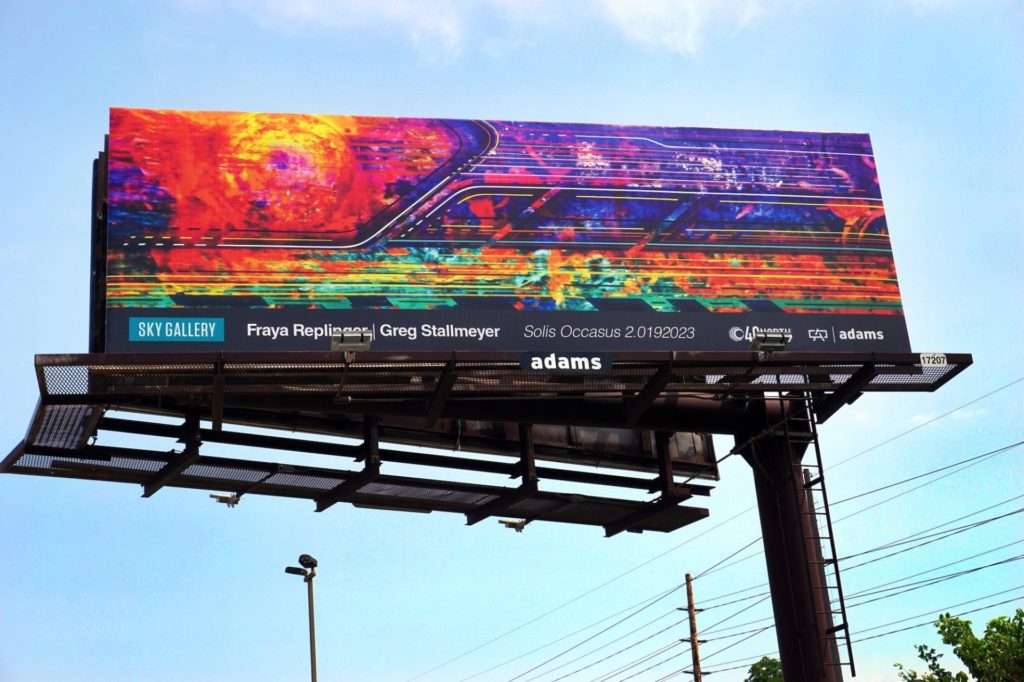
SP: You currently have a mural up as part of Sky Gallery. Congratulations! I’ve really enjoyed seeing all of these around town. Yours is a collaborative piece with Greg Stallmeyer. How did that collaboration come about? As you were working on the piece, did you ever envision it on a billboard?
Replinger: Thank you! Greg and I started working on our collaboration in 2019 with the intention of it being displayed in a large format. It began with an image I created of Greg’s welding table and blossomed from there. Working with Greg inspired me to explore abstract photography more.
SP: Do you have more plans for future collaborations?
Replinger: Greg and I talk often and have ideas, but no solid plans yet. As my friends and family could tell you, I spend much of my time at my shows chatting with other artists, exchanging inspiration and learning more about their processes. I hope to explore more collaborations with my network of art friends in the future.
SP: If you had to choose, which fruit or vegetable do you think is the most interesting to photograph?
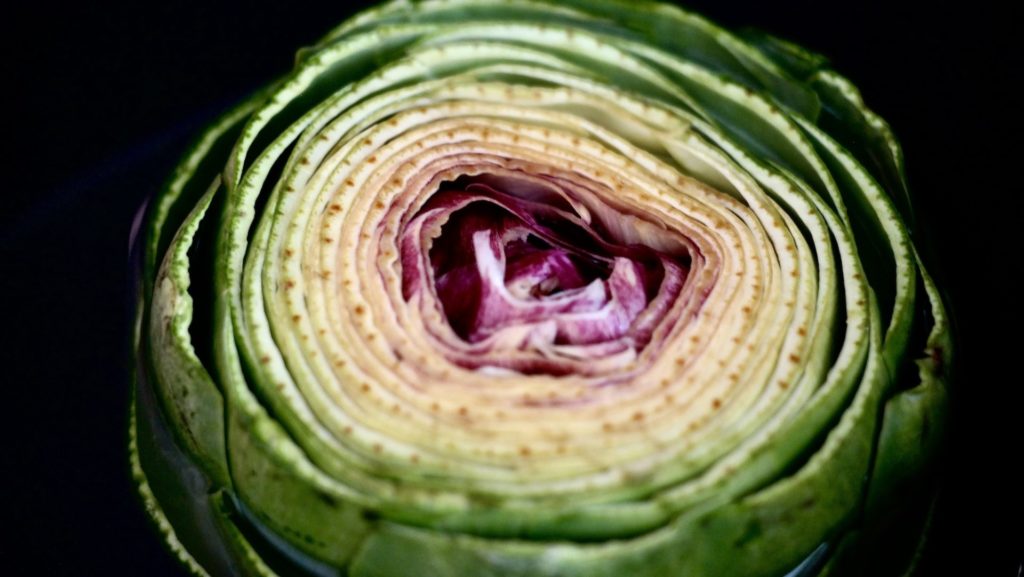
Replinger: My current favorite is the kiwi. The vibrant color and the thin, radiating lines make for an energetic image. My first favorite was raw artichoke. An image I created years ago, with the help of my mother, that highlights the rich magenta and fresh green of the heart makes me smile every time I see it.
SP: What are you currently working on?
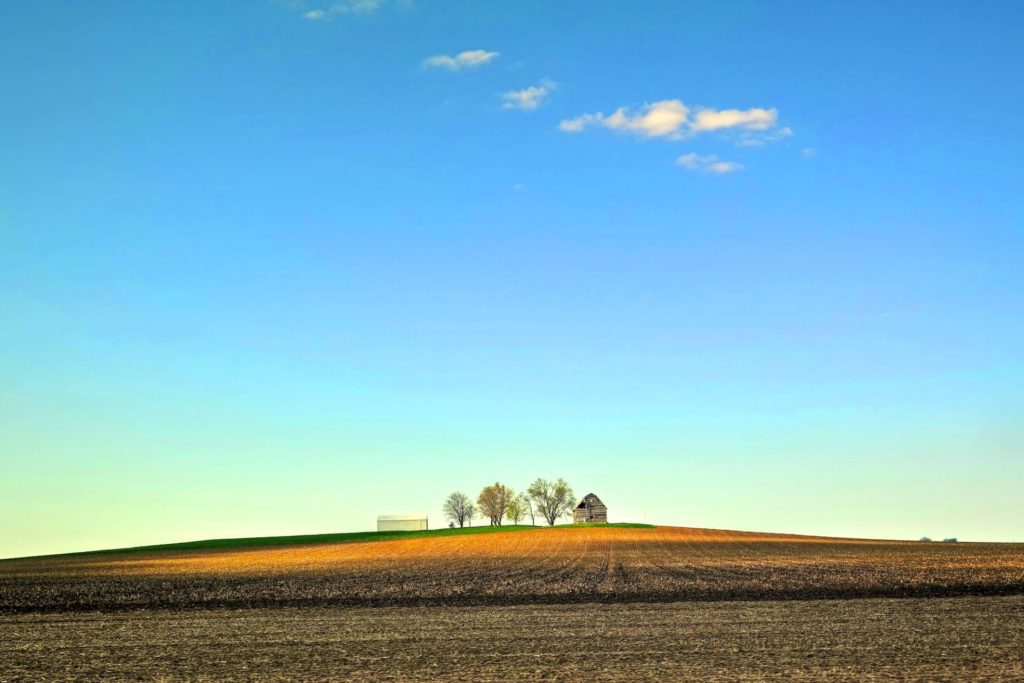
Replinger: My wheels are always turning. Lately, I have been exploring nostalgia and my own personal images and symbols from childhood and adolescence. I have also started examining old barns and farmhouses around the Champaign-Urbana area. I have several shows coming up and am in a constant flow of preparation for these events.

SP: Is there any place around C-U where people can check out your photography?
Replinger: I am currently showing work at Allerton Park & Retreat Center in the Mansion and in the Greenhouse Café. I am also showing work at Po’Boys in Urbana.
This fall, you can also find Replinger at West Side Arts, Sugar Creek Arts Festival, and the Craft League of Champaign Urbana 40th Annual Art Fair.

The University of Arkansas at Little Rock Art Gallery will host an exhibition from the internationally renowned husband-and-wife photography team of Robert and Shana ParkeHarrison.
Their exhibition, “ParkeHarrison: Earth Elegies,” begins Sept. 11 and ends Oct. 3. The exhibition, which is free and open to the public, will be on display in the Brad Cushman Gallery in the Windgate Center of Art and Design.
The ParkeHarrisons will give a presentation on their work from 6:30-7:30 p.m. Thursday, Sept. 28, in the Stella Boyle Smith Concert Hall in the Fine Arts Building. UA Little Rock will hold a reception for the exhibition from 5:30-8 p.m. Friday, Sept. 29, in the Windgate Center lobby and Brad Cushman Gallery.
“Our photographs offer visual poems of loss, human struggle, and personal exploration within landscapes scarred by technology and over-use,” the ParkeHarrisons said in an artist statement. “As collaborative artists, we strive to metaphorically and poetically link laborious actions, idiosyncratic rituals and strangely crude machines into tales about our contemporary experiences. We construct elaborate sets made from found objects. Our scenes combine real and constructed landscapes. These scenes have a sense of determination and irony while addressing mankind’s responsibility to heal the damage inflicted on the environment.”
Robert ParkeHarrison earned a Bachelor of Fine Arts from Kansas City Art Institute and a Master of Fine Arts from the University of New Mexico. Shana ParkeHarrison earned a Bachelor of Fine Arts from William Woods College and completed graduate studies at the University of New Mexico.
Their photographs have been displayed in more than 45 solo exhibitions and more than 100 group shows worldwide. Their work can also be found in over 35 collections, including the National Museum of American Art at the Smithsonian Institution, the George Eastman House, the Whitney Museum of American Art, and the Los Angeles County Museum of Art. Their book, “Robert and Shana ParkeHarrison: The Architect’s Brother,” was named as one of the 10 best photography books of the year in 2000 by the New York Times.
The UA Little Rock Art Galleries in the Windgate Center are open from 9 a.m. to 5 p.m. Monday through Friday, 10 a.m. – 1 p.m. Saturday, and 2-5 p.m. Sunday.
For more information, contact Nathan Larson, interim art gallery director and curator, at 501-916-5104 or nglarson@ualr.edu.


Poker-straight black hair, trapper hat, black bandana, slouchy jeans, dark sunglasses – seminal American image-maker Steven Meisel’s distinct look is (almost) as recognisable as his photography, which came to define 1990s fashion and cemented the era of the supermodel.
Coinciding with the arrival of New York Fashion Week – which begins today (Friday 8 2023) with Peter Do’s debut collection for Helmut Lang – Meisel reveals a new collaborative collection with Galicia-based fashion behemoth Zara, which mines both his personal wardrobe and his catalogue of photography, particularly that from the 1990s. Titled ‘Steven Meisel New York’, it also pays homage to the city where he was born – ‘a love letter to the photographer’s hometown’, as the notes describe.

(Image credit: Photography by Steven Meisel, courtesy of Zara)
As such, the collection includes Meisel signatures – an oversized black trapper hat, checkered kilt, slouchy leather boots and biker jacket all feature – alongside pieces that capture the spirit of the 1990s, from a grunge-inspired plaid shirt to an oversized striped sweater and baggy denim shirt. Others capture ‘the dreamy realms of his own obsessions’, like a croc-print coat designed to evoke the 1960s, another era that has fascinated the image-maker.
Elsewhere, T-shirts and sweaters are stamped with ‘Steven Meisel New York’, while smaller accessories include black-rimmed sunglasses, leather cuffs, and an array of jewellery including simple studs and chains in silver that nod to the punk movement. Of the ‘darkly seductive’ collection – much of which is designed for both men and women – Zara says it draws on the same ‘edgy confluence of music and fashion’ that has defined Meisel’s photographic output.
(Image credit: Photography by Steven Meisel, courtesy of Zara)
The project is launched with a series of portraits, photographed by Meisel, of 26 figures who ‘act as different faces’ of the image-maker. Notably, these include his perennial muse Linda Evangelista, alongside Amber Valletta, Liya Kebede, Irina Shayk, Gigi Hadid, Kaia Gerber, Penelope Tree, Eva Herzigova, Alton Mason, Ash Stymest and Scott Barnhill, among others. Meisel worked on the portfolio with perhaps his closest collaborators: stylist Karl Templer, make-up artist Pat McGrath, and hair stylist Guido Palau.
The collection will launch in two dedicated pop-ups, the first running from 9-13 September 2023 at 33 Howard Street, SoHo in New York; the second from 15-17 September 2023 at Dover Street Market London, coinciding with London Fashion Week.
The collection will launch more widely on September 18 2023 in Zara stores and online.
(Image credit: Photography by Steven Meisel, courtesy of Zara)
The collaboration continues a longstanding partnership between Zara and Meisel, the latter having captured several recent campaigns for the brand. Last year, an exhibition in A Coruña, Spain, ‘Steven Meisel 1993 A Year in Photographs’ – documenting one particularly prolific year in the photographer’s career – was hosted by Marta Ortega, chair of Inditex, the Spanish textile conglomerate which owns Zara.

A woman who sued Andy Warhol and won after he used one of her photos has died.
Patricia Caulfield was 91.
Caulfield was an editor at Modern Photography magazine in the 1960s. She had sued Warhol after he used a photo she had taken of hibiscus blossoms. She had published the image in an article in June of 1964 and the artist had reached out to the magazine, asking to buy the photo, but he didn’t want to pay the price they had said.
Instead, according to Caufiled’s lawsuit filed in 1966, Warhol cut the photo from the magazine, cropped it and made silkscreen paintings of the image to create his “Flowers” series of art. The series was displayed at the Leo Castelli Gallery in Manhattan in November 1964, just months after the photo’s initial publication.
“He didn’t think it would be a big thing, but ‘Flowers’ sold like crazy,” Caulfield’s sister Kathleen Hall told The New York Times.
Caulfield and Warhol settled and part of the agreement was that Warhol would make two new “Flowers” paintings, which eventually sold for $6,000. She also received 25% of the realities from the original “Flowers” prints.
Her suit against Warhol was one of several where photographers sued the artist for using their images to create his work, according to The Columbia Journal of Law & the Arts.
Caulfield eventually left Modern Photography and became a freelance photojournalist, focusing on the environment and wildlife.
“I guess there’s the hope somebody may see my photographs and think, ‘that’s a wonderful animal, maybe it’s worth making an effort to save,’” Caulfield told the Knight-Ridder in 1977, the Times reported. “But at least I’m effective in making a record of something before it all gets ruined.”
Caulfield was born in Chicago on March 17, 1932. Her father was a doctor and her mother was a nurse. She attended the University of Rochester. She started picking up photography after appearing on a television show hosted by the curator of the then-George Eastman House. She moved to San Francisco after graduating in 1953, taking photography courses at night and working at a camera store during the day. Caulfield was eventually hired by Modern Photography in New York as a secretary, but within 11 years had been named executive editor, the Times reported.
In addition to Modern Photography, her photos also appeared in National Geographic, Audubon, Smithsonian and The American Sportsman publications. She also published several books.
Her library of photographs was recently donated to the Dolph Briscoe Center for American History at the University of Texas at Austin.
Caulfield died at a Manhattan assisted living facility on July 16, the Times reported. She leaves behind her sister.
©2023 Cox Media Group





