Five Copper Petals Dramatically Enclose a Bamboo Yoga Studio in a Lush Bali Village

Five Copper Petals Dramatically Enclose a Bamboo Yoga Studio in a Lush Bali Village

All images © Lumi Shala

A yoga and meditation studio in Bali welcomes visitors to relax and stretch under an airy bamboo canopy. A recent project of the local architecture firm IBUKU, “Lumi Shala” is a copper-coated structure with scalloped roofing that layers like five overlapping petals. The metallic covering is met with interlaced bamboo infrastructure inside, as those same botanical-like forms sweep upward in massive arches and “reflect warm golden light onto the bellies of the blonde bamboo ceilings inside, inspiring feelings of lightness and freedom,” the designers said. Earthen walls also support the roof with gaps that allow seamless movement between interior and exterior and sunlight to stream into the space.

“Lumi Shala” is one component of IBUKU’s larger plan for the yoga studio, and you can find more on the firm’s site. (via Dezeen)


a copper building with scalloped roof

the interior of a building with three structural forms ascending from floor to ceiling

two images, both of the exterior of the building with copper roofing and concrete base

latticed bamboo leaf-like structures run from floor to ceiling while a person walks inside

an aerial view of the scalloped copper roof surrounded by lush green forests

Do stories and artists like this matter to you? Become a Colossal Member today and support independent arts publishing for as little as $5 per month. The article Five Copper Petals Dramatically Enclose a Bamboo Yoga Studio in a Lush Bali Village appeared first on Colossal.

Exploring the Intersection of Art, Photography, and NFTs: An Interview with Nicolas Bets | NFT CULTURE | NFT News | Web3 Culture | NFTs & Crypto Art

Exploring the Intersection of Art, Photography, and NFTs: An Interview with Nicolas Bets | NFT CULTURE | NFT News | Web3 Culture | NFTs & Crypto Art

In a quiet studio resonating with the soft clicks of a camera shutter, we met with Nicolas, a photographer whose journey has led him to the heart of the burgeoning NFT artistry. With a serene smile and eyes that tell tales of myriad captured moments, he walked us through his artistic evolution, his tryst with NFTs, and the boundless prospects of digital artistry.

Nicolas, thank you for joining us today. Let’s start by delving into your background. Can you share how your early exposure to photography and your years of apprenticeship with photography masters shaped your artistic journey and led you to the world of NFTs and digital art?

Nicolas: Certainly, it’s a pleasure to be here. My upbringing was steeped in photography, thanks to my mother’s passion for the art form. Growing up surrounded by the works of iconic photographers like HERB RITZ, PETER LINDBERGH, HELMUT NEWTON, and JEANLOU SIEFF had a profound impact on me. I left for Paris at a young age and learned the ropes as an assistant to greats like CLAUS WICKRATH, PETER LINDBERG, and JEAN DANIEL LORIEUX.

This apprenticeship provided a solid foundation for my career in photography, and I ventured into collaborations with major fashion brands. My work has always straddled the line between fashion and art. It wasn’t until I discovered digital art and NFTs through a friend three years ago that I realized the transformative potential of sharing my art with a global audience. The democratization of art through digital ownership fascinated me.

Blue Shower

Your journey is truly remarkable. Can you elaborate on how you blend the concept of photography, which captures a moment in time, with NFTs, which immortalize digital moments? What intrigues you about this intersection of traditional and digital art forms?

Nicolas: Photography’s essence lies in capturing moments, freezing them in time. NFTs, on the other hand, take these digital moments and immortalize them through blockchain technology. This dynamic fusion is particularly intriguing because it adds a layer of permanence to something inherently fleeting. The notion of digital property contracts in the NFT space opens up exciting possibilities for artists like me to bridge the gap between the tangible and the digital, creating a new dimension for art to thrive.

ParisCadillacMystery

Your art is known for themes of femininity, fashion, cinema, and glamour. Could you tell us more about the emotions and messages you aim to convey through your work in the NFT space?

Nicolas: Absolutely. My art is a celebration of joy and pleasure in a vibrant and colorful universe. I aim to evoke these emotions in viewers as they engage with my creations. Whether it’s through the lens of femininity, the allure of fashion, the magic of cinema, or the timeless glamour, I want people to experience a sense of delight and happiness when they interact with my art.

The NFT space has undeniably revolutionized the art world. What aspects of this transformation do you find most intriguing, and how do you see it shaping the future of art and creativity?

Nicolas: The NFT space is brimming with artistic innovation and energy. What captivates me the most is the sheer diversity of creative projects that are flourishing within it. While there are challenges, such as questions about conservation and image quality, the ability for anyone with internet access to instantly acquire art is nothing short of incredible.

This transformation extends beyond art; it’s a societal shift. The integration of blockchain and NFTs is becoming an art form in itself, and for photography, it opens doors to innovative mediums like Ionnyk, which can link NFTs to physical images. The potential for artists and creators is boundless.

Speaking of challenges, have there been any specific obstacles or limitations you’ve encountered within the NFT space, and how did you overcome them?

Nicolas: Certainly. One of the initial hurdles was defining the right balance between screen quality and physical copy quality for my photos. Achieving this equilibrium required extensive testing and experimentation. It’s a testament to the evolving nature of the NFT space, where artists and creators must adapt and find solutions to meet the demands of the digital art world.

How do you envision the future of NFTs and digital art, especially as they intersect with photography and other creative mediums?

Nicolas: The future is extraordinarily promising. NFTs and digital art are poised to impact society across various sectors. The interaction between artists, collectors, and audiences through blockchain functionalities will evolve into an art form itself. In the realm of photography, innovative mediums like Ionnyk, which allow for the movement of pigments on photo paper while linking to NFTs, present incredible possibilities. We’re witnessing a revolution that transcends the traditional boundaries of art and creativity.

Can you walk us through your creative process, from the initial idea to the final minting of an NFT?

Nicolas: My creative process is deeply rooted in artistry. I’m guided by instinct and vision, much like a film director. I constantly have a multitude of artistic ideas in mind, and I work diligently to bring them to fruition. Emotions play a significant role in shaping my work, and I strive to convey these emotions through my images and projects.

How do you select the photographs that become NFTs? Is there a specific criteria or emotional resonance you look for when making this decision?

Nicolas: The photographs that ultimately become NFTs are those that possess a unique blend of artistry and iconic value. They must align with the overarching goal of spreading joy and delight through my art. Each selected image contributes to the larger narrative of my creative journey.

On a personal note, what is the most rewarding aspect for you when creating and selling NFT art?

Nicolas: The most rewarding aspect is the opportunity to introduce my art to a new audience that extends beyond the traditional art market. The prospect of reaching individuals who may not have had access to my work otherwise is immensely gratifying. It’s about expanding the boundaries of creativity and sharing the joy that art brings.

The NFT community has been growing rapidly. Can you share a memorable interaction or experience you’ve had within this space?

Nicolas: Over the past three years, I’ve had the privilege of meeting numerous remarkable individuals within the NFT community. From collectors and builders to friends, they’ve all played a vital role in my journey. Some notable names include @Giga_Chad_Pepe, @LordTruffington, @sendr0ck, and many others. What’s truly incredible is the sense of camaraderie and mutual support that pervades this community. We’re all pushing each other to new heights, and it’s a dynamic and inspiring environment to be a part of.

In conclusion, how would you summarize your thoughts on the current state of the art world, driven by technology, blockchain, and NFTs?

Nicolas: We are living through a revolution as powerful as the advent of the internet, with AI, blockchain, and digital photography transforming the landscape of creativity. As an artist, I’m excited and grateful to be part of this journey, exploring new frontiers of artistic possibility.

TLDR: Nicolas, a photographer and digital artist, discusses his journey from traditional photography to the world of NFTs. He blends the concepts of capturing moments in time with immortalizing them through NFTs, aiming to convey joy and pleasure in his art. Nicolas sees the NFT space as an exciting artistic frontier with potential for societal impact. Challenges like photo definition have been overcome, and innovative mediums like Ionnyk hold promise. His creative process is instinct-driven, focusing on conveying emotions. The most rewarding aspect is reaching a new audience, and memorable interactions have fueled his journey. Nicolas is excited to explore the creative possibilities of AI, blockchain, and digital photography.

Last Chance To Enter This Month’s Landscape Photography Contest |

Last Chance To Enter This Month’s Landscape Photography Contest |

Our photo contests are back and the prizes are bigger than ever. We are giving away a free tutorial to each of the 20 photographers we choose to feature in our video, and the grand prize winner will also receive $1,000 cash. 

This contest was supposed to end tomorrow but due to both Elia Locardi and I going on Vacation, we have pushed the deadline back a few days. Show us your best landscape photo and you just might win $1,000. As always, it’s totally free to enter. 

Solid Lightning: Ugo Rondinone’s Stunning New Sculpture

Solid Lightning: Ugo Rondinone’s Stunning New Sculpture

In 2013, Ugo Rondinone’s 20-foot stone figures took over Rockefeller Plaza. In 2016, his 35-foot towers of fluorescent-colored boulders landed in the Las Vegas desert, and now this month at Gladstone Gallery in New York, Ugo Rondinone debuts his newest astounding sculptures: 3 solid “lightning strikes” made from bright yellow painted bronze, each reaching over 20 feet tall.

Ugo Rondinone: bright light shining. Gladstone Gallery New York

Rondinone’s work often ignites surprising contrasts between the natural and unnatural while twisting perceptions of material, time, and scale. His latest exhibition, bright light shining feels like a dream while you’re still in it – both familiar and bizarre. The sculptures initially appear to be upside-down trees or massive roots – but are in fact bronze. The large skylight and gray walls (painted for this exhibition) give an odd sense of time – neither day nor night, while the lightning itself invites you to perceive a phenomena that naturally occurs in a millisecond to the blink of an eye on permanent pause.

Ugo Rondinone, glorious light, 2023

Ugo Rondinone, sublime light, 2023

Ugo Rondinone, blissful light, 2023

Visitors who walk under the jagged 3-dimensional forms may experience another strange suspicion: If these were cast from real trees, the branch structure isn’t “growing” like any familiar tree on earth (even if upside-down). The texture, grain, and splinters look hyper-real, and yet the form feels impossible.

Ugo Rondinone: bright light shining. Gladstone Gallery New York

The answer may lie in Rondinone’s 2021 exhibition in this space. There, the artist presented a series of work titled nuns + monks that looked like gigantic boulders but were actually created from bronze enlargements of much smaller 3D-scanned limestone rocks.

Are these new works also bronze enlargements of small twigs, technologically transformed into a giant scale where physics is simultaneously familiar and impossible? Whatever their origin, Ugo Rondinone’s sculptures float between material categories, time perception, and the scale of the natural universe – providing a unique sense of wonder that spans across all his work.

Ugo Rondinone: bright light shining (detail) Gladstone Gallery New York

Ugo Rondinone: bright light shining. Gladstone Gallery New York

Ugo Rondinone, alluring cloud, 2019

A quiet final sculpture becomes visible only once inside the space. The gray alluring cloud is a blob-like form made from sand, gravel, and concrete. It too is a material transformation – heavy stone describing weightless vapor – as if it too is frozen in time.

Ugo Rondinone: bright light shining. Gladstone Gallery New York

The author with Ugo Rondinone’s bright light shining. Gladstone Gallery New York, 2023

Ugo Rondinone’s bright light shining is an exciting must-see experience that changes the air in the room while prompting a sustained and altered curiosity about the environment beyond the gallery’s walls.

What: Ugo Rondinone: bright light shining
Where: Gladstone Gallery, 530 W 21st St, New York, NY
When: September 14 – November 9, 2023

All images © Ugo Rondinone, Courtesy of the artist and Gladstone Gallery
Final image photographed by author David Behringer

David Behringer visits over 200 galleries every month to uncover and share the most exciting contemporary art in New York today. Subscribe to his exclusive weekly newsletter at www.thetwopercent.com and learn about his private gallery tours. And be sure to check out his YouTube.

Untold Stories of San Luis Valley

Untold Stories of San Luis Valley

Colorado’s Fort Garland Museum in the Sangre de Cristo National Heritage Area reveals the converging stories of Hispanic, Native American and African American cultures in the 19th century.

A sea of silvery native shrubs and potato fields stretch across southern Colorado’s vast San Luis Valley. To the west lies the headwaters of the Rio Grande, where craggy rhyolite canyons hint of a turbulent volcanic past. To the east, the 14,000-foot peaks of the Sangre de Cristo range cradle Great Sand Dunes National Park and Preserve. Throughout, wild horses, crumbling adobe churches and sandhill cranes dot the landscape.

The valley is home to deep-rooted culture and history, particularly at the intersection of Hispanic, Native American and African American heritage. That’s one of the reasons the region was designated as a national heritage area — the Sangre de Cristo National Heritage Area — in 2009.

“The valley is an interesting and unexpected convergence of people who have had to learn how to live with each other,” said Eric Carpio, director of the Fort Garland Museum and Cultural Center, which is among nearby attractions the National Park Service suggests to Great Sand Dunes visitors. “Sometimes it has resulted in remarkable collaborations, and other times with violence and trauma. But for a long time, much of its history was swept under the rug.”

So, for the last few years, Carpio and his staff have made bold and elegant moves to better share some of the valley’s complicated legacies. To fully grasp the magnitude of what they’ve done, it’s necessary to first know a bit about the valley’s history.

People have lived in the region since at least the time of the mammoths. Navajo, Ute, Apache, Kiowa and Comanche all called it home. After the Spanish arrived in 1598, the Hispanic population gradually grew to prominence. Then in 1848, the Treaty of Guadalupe Hildago ceded the San Luis Valley and much of the West from Mexico to the United States. Residents suddenly found themselves living in U.S. territory, and many lost their property when their land grants were revoked.


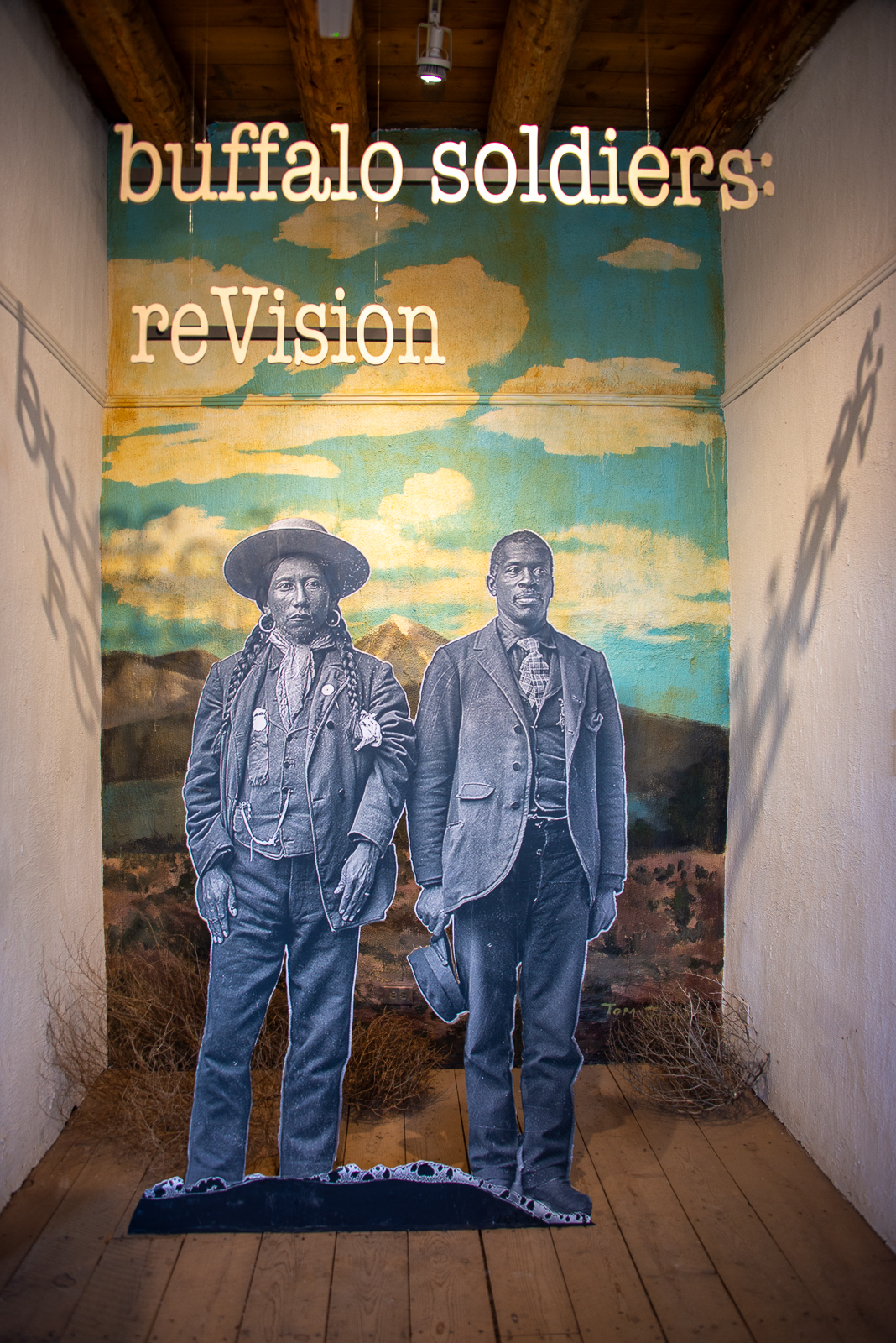
Buffalo Soldiers exhibit sign

Signage for Fort Garland Museum’s “buffalo soldiers: reVision” exhibit, which runs through 2025.

camera icon

©Steve Alberts

By 1858, Fort Garland was built to protect Manifest Destiny, the philosophy that the United States had a divine mission to expand westward into what it inaccurately touted as virgin lands and create a transcontinental nation.

After the Civil War, the all-Black 9th Calvary became stationed at the fort. They were dubbed the Buffalo Soldiers by Comanches and Cheyennes — one possible reason, historians believe, was due to their physical fortitude and hair, which the Native Americans generally perceived to be curly. Tasked with protecting white settlers, the Buffalo Soldiers often had the unenviable duty of being on the front lines of Native American removal. They were well-respected by the U.S. government for their valiant and honorable service, and they often established friendships with Native Americans.

“Here in the valley, we are at the intersection of several Indigenous homelands, the northernmost edge of Spanish and Mexican settlement, and American westward expansion,” Carpio said. “Ultimately, this region was shaped by how those relationships evolved. It’s a wildly complex history which still directly impacts how people live their lives today.”

So, how did a rural, small-town museum go about unraveling such an intricate, nuanced puzzle?

The first step was dismantling the 69-year-old centerpiece of the fort-turned-museum: a life-size mannequin of Kit Carson, an American brigadier general perhaps best known for his merciless campaign against the Diné people (also known as Navajo).

The museum then began collaborating with Tribal partners and artist Chip Thomas, an African American physician who worked on the Navajo Nation for 35 years. In June 2021, the exhibit “Unsilenced: Indigenous Enslavement in Southern Colorado” officially took Carson’s place, in the very rooms of the fort that were likely his historical living quarters.

The exhibit includes two room-sized translucent cloths, each with a page from an 1865 document printed on them. The title reads “List of Indian Captives Acquired by Purchase,” and underneath are the names of enslaved people, with ages and Tribal affiliations. As Carpio points out, most of the Indigenous names have been changed to Western ones, as women and children were often baptized into the Catholic Church and prohibited from speaking their Native language. This led to generations of Native Americans who had lost all connection to their cultural traditions and Tribal heritage, including a Navajo boy who Carson kept enslaved.

Though those practices ended 150 years ago, the reverberations of that detachment are still affecting the community. “A lot of families have come forward and told us they had heard their ancestors were enslaved but doubted the story because no one ever heard about Native American enslavement,” Carpio said. “Now families have felt validated that there’s truth to the stories their parents and grandparents told.”

One visitor even found his ancestor’s name in the documents. “The emotion that’s suddenly unleashed from that, the pain and anger of their heritage stripped away, there’s a lot of history we have to unpack,” Carpio said. “That’s what we’re trying to reconcile. Sharing these powerful images hopefully starts a dialogue.”

In 2022, the museum expanded its efforts by hosting the temporary exhibit “Merciless Indian Savages,” in which Pyramid Lake Paiute artist Gregg Deal interpreted what American Democracy means in Indian Country. Then this summer, “buffalo soldiers: reVision” opened as a collection of works by eight artists. The exhibit runs through 2025.

“How did formerly enslaved peoples rationalize the subjugation of another race, and in what ways do Buffalo Soldiers connect with the lands they were helping to take away from Indigenous people?” asked Thomas, in an artist’s statement. “The land provided solace and space for contemplation, maturation and dreaming of new possibilities in a way the black soldier couldn’t consider in the Reconstruction South.”

Telling stories such as these through contemporary art is an unusual choice for a history museum, but Carpio says the approach has started a lot of meaningful dialogue. “Particularly in communities of color, artists are the knowledge keepers,” he said. “Plus, artists have a good way of not hitting you over the head with it, opening new perspectives without being condemning.”

Earlier this year, the museum earned a finalist spot in the National Medal for Museum and Library Science, and visitors often tell Carpio that it’s a more welcoming and relevant space to them now than it was before. After viewing the exhibits, one couple even asked Carpio how they could better honor the Buffalo Soldiers and Native Americans who once lived in the valley.

“That people came in and reflected on the exhibits in that way, in all of our wildest hopes and goals as a museum, that’s it,” Carpio said. “And the stories are still expanding. We have empty rooms in some of our exhibit spaces as a signal to the community there’s more to be done. The reconciliation and healing is ongoing.”