.
Today In The Culture, Tuesday, November 28, 2023: KJM Printmaking | Chicago Film Archives Streaming Midwest Work | TimeLine Adds Managing Director


The Most Beautiful Places in Chicago 2 premieres on Monday, December 4 at 7:00 pm on WTTW and streaming on the PBS app. Check out the companion website at wttw.com/mostbeautiful
On Monday, December 4 at 7:00 pm, WTTW will premiere The Most Beautiful Places in Chicago 2 with host, writer, and producer Geoffrey Baer. Viewers will be invited to come along on Geoffrey’s newest journey to discover the stories behind eye-popping spaces and places around Chicago – from sparkling mosaics and historic homes to public parks and gardens to intricate facades and architectural marvels.
We sat down with Geoffrey this month to talk about the show, a few of his favorite locations, and the fascinating Chicagoans who share the places they think are beautiful in the new special.
Why did you decide to follow up The Most Beautiful Places in Chicago with a sequel?
The response to the first program was overwhelming. People let us know that they loved seeing what it is that makes Chicago great, and why they are so proud of the city.
How did you define a “beautiful place?”
In the first show, we really leaned into jaw-dropping physical beauty. In part 2, you’ll see more, including “the Bean” at Millennium Park and the dazzling Tiffany interiors of the Chicago Cultural Center. But what makes these and the many other places we explore in this program deeply beautiful has as much to do with the human stories behind them as with their physical beauty.
Can you give us some examples?
If you’ve ever gotten off Lake Shore Drive at Foster, there’s a mosaic mural that’s twinkly and sparkly and really lights up the underpass – but almost nobody ever stops to really look at it. This stunning public work, called Indian Land Dancing, has an almost folk art quality to it, and the story that it tells is about the Native American community in Chicago. Viewers will hear from the Indigenous artists who took the lead in imagining this beautiful community-made space to serve as an antidote to the more cliché sculptures you see around town and to remind people that Native Americans are still here. They’ve always been here.
Another good example is the Chicago Vocational High School. It has a remarkable and giant classical columned entrance with beautiful relief sculptures of drill presses and T-squares, designed to reference what the students are learning inside. The original plan was to create an inspiring place to signal the future of Chicago as an industrial city and train the next generation of trade workers who would feel proud of their vocation and training.
The architectural critic Lee Bey went there, right? He’s featured in the show.
Yes, Lee’s trade focus at the high school was the printing press and, go figure, he grew up to be an author! In the show, we visit a number of buildings Lee highlighted in his book, Southern Exposure, about under-appreciated architecture on the South Side.
Who else will we meet in the show?
We talk to Gunny Harboe, the most famous restoration architect in Chicago, about his team’s astonishing restoration of the Chicago Cultural Center. I think most people who know the building are aware of Preston Bradley Hall and the Tiffany dome, but there’s another dome in the Grand Army of the Republic Hall that deteriorated over time. During the restoration process, Gunny discovered that a century of paint layers could be scraped off to reveal the original paint that was still there underneath. When you are in that hall today, you will see paint that was brushed on by the people who first finished those rooms in the late 1800s.
In another part of the show, there’s a young ecologist and conservation biologist, Deja Perkins, who is one of the most remarkable people I have ever interviewed. Her mission in life is to help people of color feel comfortable and welcome exploring nature and birdwatching. She speaks very poignantly about how Black people have not always felt safe exploring nature. We venture to Jackson Park with Deja and a group of young people, and I know our viewers will be moved by the conversation. And I got to go birdwatching! It was so much fun.

:focal(715x552:716x553)/https://tf-cmsv2-smithsonianmag-media.s3.amazonaws.com/filer_public/43/ee/43ee2ab3-9e42-42d6-8b17-11b214285a71/dec2023_h13_prologue.jpg)
Left, a 1932 self-portrait by Lee Miller. Right, a 1943 portrait of Miller by American photojournalist David Scherman.
© Lee Miller Archives, England 2023. All rights reserved. leemiller.co.uk; David E. Scherman © Courtesy Lee Miller Archives, England 2023. All rights reserved. leemiller.co.uk
Lee Miller’s big break began with a near-death experience. Miller was discovered at 19 by publishing scion Condé Nast himself when he pulled her out of the way of an oncoming car in Manhattan—then put her on the cover of Vogue. But Miller, born in Poughkeepsie, New York, in 1907, was not content to be a muse for male photographers.
Instead, she moved to Paris, where she stepped behind the lens and studied with Surrealist photographer Man Ray, her mentor and lover. Miller mastered the technical aspects of photography quickly and distinguished herself among the few high-profile women photographers of the day by opening her own studio in the City of Light. There she took portraits of royalty, literary elites and even the pet lizard of a French socialite, who paid $100 for the image. Soon, Miller turned to photojournalism, ultimately producing some of the 20th century’s most groundbreaking images for the magazine whose cover she once graced.
During World War II, ignoring personal warnings from U.S. diplomats to return stateside, Miller embedded with the U.S. military. She chronicled the war across Europe, capturing unforgettable images: Londoners huddled in underground stations during the Blitz; bloodied patients at an Allied field hospital in Normandy. Miller pushed the bounds at Vogue: At a time when the 1940 bombing of Vogue’s London office didn’t merit a mention in its own pages, Miller ensured that her images went to press: She was among the first reporters to enter Dachau after its liberation and sent a message with her photos to her editor, “I IMPLORE YOU TO BELIEVE THIS IS TRUE.”
After the war, she settled on a Sussex farm, where artists like Pablo Picasso and Jean Dubuffet were regular visitors. Yet Miller struggled to find a sense of purpose and was largely forgotten until a trove of her photographs was rediscovered in her attic, several years after her death in 1977.
Now a feature film is helping rescue Miller from obscurity: In Lee, which premiered at the Toronto International Film Festival in September 2023, Kate Winslet (center) is magnetic in the title role, and was so inspired by Miller’s story that she wrote the foreword to Lee Miller: Photographs, a book by Miller’s son released this past October.

Recommended Videos


This dachshund puppy appears to be floating in the air as he hurtles towards his owners. As the photographer Alessandro Grandoni says, “Love gives you wings to fly high in the sky.” (PHOTO: Alessandro Grandoni/Dog Photography awards)
They come in all shapes and sizes. Some love to spend their days playing fetch, while others’ idea of heaven is simply getting to spend time with their favourite human. Either way, they brighten our days with their unconditional love and slobbery kisses.
This year’s Dog Photography Awards is a celebration of our furry friends in all their glory.
A total of 1 440 entries from more than 50 different countries were received for the annual competition. Here are some of the stand-out entries.
A BOND BEYOND WORDS
Cassie Thurrott, Canada

Photographer Cassie Thurrott says, “The smoke enveloping them represents the challenges and darkness that mental-health issues can bring into one’s life.” The dog is pictured protectively nestled against her chest, symbolising their bond while providing comfort, stability and love in times of distress.” (PHOTO: Cassie Thurrot/Dog Photography awards)
THE LIBRARIAN
Sandy van Kruijsdijk, Netherlands

“I took this photo of our dog, Skûtsje, with the help of my husband,” Sandy van Kruijsdijk explains. “When he sees my photography equipment, he knows he’s going to earn a lot of cookies. “He borrowed this shirt from our three-year-old son. He’s completely used to it by now and sees posing as a fun activity.” (PHOTO: Sandy van Kruijsdijk/Dog Photography awards)
READ MORE | Round of ap-paws! These amazing pics of dogs will put a smile on your dial
THE LEIA ORGANA LOOK
Tina Stahl, Germany

Maddie’s puppy dog eyes could melt even the coldest of hearts. The reason for her expression: dog treats. But her owner thinks it makes her bear an uncanny resemblance to Star Wars’ Princess Leia. (PHOTO: Tina Stahl/Dog Photography awards)
FLY HIGH IN THE SKY
Anne-Laurie Léger, Canada
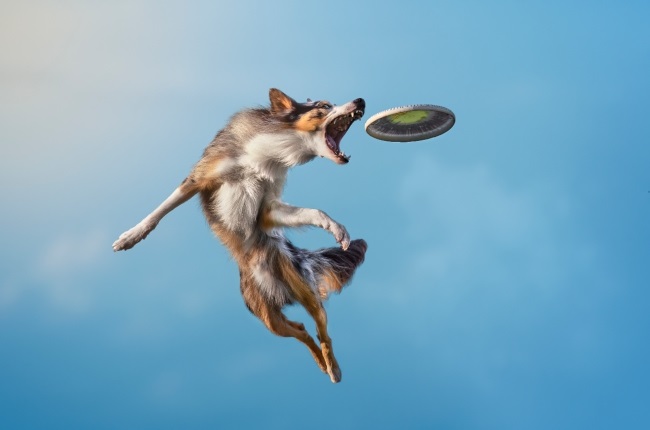
Showing off its athletic prowess, this Border collie did a back vault, jumping from his owner’s back to catch their Frisbee. (PHOTO: Anne-Laurie Léger/Dog Photography awards)
READ MORE | Awww! Jack Russell becomes a mummy to six abandoned kitties
SUNRISE MOOD
Petra Nestelbacher, Austria

“Since Nala and Stephi love going on adventures together and exploring the world, the sunrise shoot on a stand-up paddle was just perfect for them,” Petra Nestelbacher says. The sunrise at Lake Woerth in Carinthia provided the ideal backdrop for the pair. (PHOTO: Petra Nestelbacher/Dog Photography awards)
ALMOST GOT IT
Desiree Nickerson, Canada

Josee’s face is a picture of laser-sharp focus as she attempts to catch a ball. The Canadian pup loves playtime, especially when it involves her favourite toy. (PHOTO: Desiree Nickerson / Dog Photography awards)
LET’S DANCE!
Carla Gea Perales, Spain

This pup broke out dancing in the studio when the music came on. “Relying on spontaneity in photography allows me to experience positive surprises and unexpected results,” Carla Gea Perales says. (PHOTO: Carla Gea Perales/Dog Photography awards)
Source: AIRTABLE.COM
We live in a world where facts and fiction get blurred
Who we choose to trust can have a profound impact on our lives. Join thousands of devoted South Africans who look to News24 to bring them news they can trust every day. As we celebrate 25 years, become a News24 subscriber as we strive to keep you informed, inspired and empowered.


Gift


November 28, 2023


LINCOLN — Joel Sartore’s ambitious project to photograph the approximately 20,000 endangered species on the planet hit a milestone recently with images of a sunflower-seed-sized beetle in south Florida.
The Miami tiger beetle — a relative of Nebraska’s Salt Creek tiger beetle — was the 15,000th species threatened with extinction photographed by the Lincoln-based, National Geographic photographer.

Sartore’s “Photo Ark” project, begun in 2006 in Nebraska, has a goal of photographing species before they disappear.
The project was recently honored with placement on a U.S. Postal Service stamp.
A conservationist who works with the iridescent green-and-gold colored beetle called it an “honor” that the Miami beetle was the landmark, 15,000th species photographed.
“It is too often that the small, less classically charismatic species are overlooked in mainstream conservation efforts,” said George Gann, founder/executive director of The Institute for Regional Conservation in Delray Beach, Florida, and chair emeritus for the Society for Ecological Restoration.
Sartore has said that his goal in the Photo Ark project is to inspire people to preserve and protect species that are on the decline.

“When people look through my lens, I want them to gain an appreciation for how interesting each species is, how worthy of protection they are, and how important each one is to keeping our planet healthy,” Sartore said in a press release Monday.
That goes for even a species as small as the Miami tiger beetle, he said. It is one of 2,600 species of beetles and is found only in the pine rocklands of southern Florida. The endangered Salt Creek tiger beetle is found only in saline marshes near Lincoln.
“When we take action to protect wildlife, we are safeguarding our own future too, and there is no better time to act than right now,” Sartore said.
The announcement of the 15,000th Photo Ark image on Monday comes as the National Geographic Society holds a monthlong celebration of the 50th anniversary of the Endangered Species Act. It was also a prelude to Giving Tuesday, a day of philanthropy for nonprofits such as the National Geographic Society.





