Each figure seems to be frozen in time, stuck in their own thoughts. Brilliant!
Pensive Figurative Sculptures Rendered in Gray Monochrome


NAPA – The promoters behind the music festival BottleRock Napa Valley announced this week that they are bringing Latin music artists to Napa next year for the first annual La Onda Festival.
The two-day event will take place June 1 and 2, a week after BottleRock and will be held at the Napa Valley Expo.
The organizers said the lineup will be spread across the Latin music spectrum with an emphasis on Mexican musicians.
The event will also feature DJ sets, local and regional Latin cuisine and interactive aspects such as a spa, dance club and silent disco.
“We have a wonderfully diverse population in Northern California, but up until now, our Latin communities, and those who enjoy Latin music, have had to travel to Southern California or out of state to enjoy a multi-day festival devoted to Latin music,” organizers for La Onda said in an email. “We are happy to be able to offer this experience in NorCal with La Onda.”
Napa County is about 36% Hispanic, with nearly 29% of the population being native Spanish speakers.
Organizers said they plan to make this an annual event, similar to BottleRock.
The lineup will be announced Monday, and a presale will take place next Wednesday.
Thanks for reading CBS NEWS.
Create your free account or log in
for more features.


Like most photographers, I’ve never reviewed a piece of gear before. Also like most photographers, I tend to voraciously read reviews each time I consider upgrading. Many of these reviews parse through micro-level analysis of pixel detail, noise levels, and test charts but to me fail to answer the simple question: “will this help me get the shot?”
So when Sony offered to send me a pre-production a9 III to shoot the Dave Matthews Band tour finale at Madison Square Garden, I thought, “will this help me better get the shot?” I jumped at the chance to see firsthand whether these new features would help me specifically as a concert photographer.
First, we should talk about two common problems concert shooters face when using mirrorless cameras. This will help explain why I was very excited about the Alpha 9 III’s global shutter.

The first problem is banding. That occurs when your shutter speed is not synced up with the refresh rate of the lights. It’s more prominent in video but in concert photography it can happen as well. There’s a minimum shutter speed needed to freeze action and if the refresh rate is out of sync with that, you can get dark bands or lines across your photo. I solve for this currently by using the mechanical shutter only, disabling my e-curtain front shutter, and keeping my shutter speed no higher than 1/500 second.
For our stage setup these adjustments work well to negate most banding problems I have. However, if you’re shooting only the first three songs of a band you don’t typically shoot, especially in a small club with low quality lights, banding can frustrate you or ruin a great shot.

The second big problem with electronic shutters and concert photography is something called rolling shutter distortion. This happens when an object is moving in the frame faster than the readout of the sensor. As a result you end up getting a distorted or bent object. For me, this will happen with our drummer Carter Beauford. Carter is one of the world’s greatest drummers and he is always moving extremely fast. I’ve yet to find an electronic shutter that reads out fast enough to freeze his drumming in motion. It is another reason I use a mechanical shutter on my cameras, but in doing so, I lose some features that make Sony cameras so powerful.
The Alpha 9 III aimed to solve these two problems. So let’s dive into my experience with the features and see how it did.
This is the feature that made me so excited to try the a9 III. With a global shutter, all of pixels in the sensor are read out at the exact same time, instead of line by line like a scanner, and the a9 III has the first CMOS global shutter that has ever appeared in a full frame consumer camera.
Having a global shutter also eliminates the need for the a9 III to have a mechanical shutter because now the electronic shutter is technologically superior to any mechanical shutter.

Other advanced cameras like the Nikon Z9 have eliminated their mechanical shutter, but they lack a global shutter. Without the global shutter, they can only can adjust for banding by tweaking their shutter speed until it disappears. This works, to a point. With the Alpha 9 III none of those workarounds are needed. It just captures exactly the frame you intend to capture at any shutter speed you want, up to 1/80,000 second.

With Dave Matthews Band (DMB), our lighting crew has helped to minimize banding by outfitting the stage with high quality lighting that has variable refresh rates. Even still, some of our spots and side fill lights can create banding, even when using a mechanical shutter. Having a camera equipped with a global shutter created for the first time an opportunity for me to photograph them in certain lighting situations from certain angles. When you photograph the same band every night, this unlocks many new possibilities.
Finally, with a global shutter, rolling shutter distortion is a thing of the past. Just check out these two photos of Carter. This first was taken with the a7R V with the electronic shutter:

And this image was taken with thea9 III and its global shutter:

With the global shutter, the stick stays straight and there’s no distortion on the cymbal.
I’ll file this under “features I did not know I needed until I tried it.” As photographers, we are probably quicker to react to situations than most folks, and yet we are still human and if we’re reacting to something, we are likely behind. This feature allows you to set the a9 III to pre-capture a designated number of seconds when you half press the shutter. When you follow through with pressing the shutter all the way, it writes those pre-recorded frames to the burst you’re capturing.
I found, for me, the sweet spot was one second of pre-capture with my frame rate, but you can adjust the time to your needs.

It should be noted that the pre-capture does cut into the buffer, but I found the buffer in my pre-production model was more than adequate.
This was so valuable because when I select the frame to publish, my decision is often based on small micro-motions or expressions of the band members. The pre-capture feature usually offered me a superior choice because it was already recording frames as I was reacting to whatever moment was caused me to raise the camera to my eye.
This, like the global shutter, is a game changer.
The a9 III can capture up to 120 frames per second (fps), which is blazingly fast. I only used the high frame rate of 120fps once, just to try it. For me, it was unnecessary to capture that many frames and is a data management nightmare. However, for a photographer assigned to the Olympics, this will be a tool that can set them apart from their peers. I can’t wait to have more time with this camera to play with high-speed photography.
For the concert photographer, finally being able to use an electronic shutter and pick my frame rate was amazing. The a9 III allows frame rates of 1/5/10/15/20/30/60/120 fps. In my time with the camera, using a frame rate of 20, 30 or 60 allowed me to better see the nuances in the band’s playing when I went back through them.
Looking back at photographs of Stefan Lessard, I became aware of just how graceful he moved his hand up the neck of the bass and how much movement was in his wrist as he played. Being able to realize and see something new with a band you’ve photographed hundreds of times is extremely special.

Sony has also added a new custom button just inside the grip. In my pre-production model it was programmed to activate the full 120 frames per second, regardless of where the dial on the top was set. If you’re a sports shooter or photojournalist that’s a great feature to have should something unexpected or high speed arise.
It’s also worth noting that the a9 III has blackout free shooting for any frame rate you choose.
While obviously not a new feature, it’s notable that this camera combines the AI autofocus features of the a7R V with the focus area of the Alpha 1. Combining this with a high frame rate and fast processing, I found it was very hard to miss a shot. The focus locked quickly anywhere across the frame.
You can select various focus modes (human, animal, bird) as well as utilize a new “extra small” single focus point which helped me get this shot with a wide angle through the drum kit.

If you shoot concerts, you know that constantly shifting lighting plus moving musicians equals many missed shots. With the Alpha 9 III my hit rate was better than any camera I’ve ever used. Nearly perfect over two nights of use.

With each generation of Sony cameras, the ergonomics and screen have gotten better. I think with the a9 III they’ve finally dialed it in just right. The screen is the same flip and twist situation we saw in the a7R V that I love. They’ve also rounded out the hand grip angled the shutter button down just slightly. Finally, they moved the custom buttons to a slightly different level than the shutter.
All of this combined made for the most comfortable shooting camera that I’ve used from Sony yet. To me, the grip feels a bit like an older pro DSLR from Nikon or Canon — I think that’s a good thing.
One of the things I love about the Sony Alpha system is the menus. I am aware that there are people who dislike the complicated Sony menus. For me once you learn them, the customization abilities are incredible. I’d even say it’s indispensable if you’re a photographer like me that shoots a certain genre repeatedly.
Because of the new features of the Alpha 9 III it is perhaps good to take a minute revisit some of the lesser known features that already exist in Sony cameras, because they help make the workflow with the A9III so much better.
This is such a useful feature to be able to see and if you choose delete a whole burst of images at once. Handy if you used those 120fps unwisely, or if the photograph you were trying to take didn’t materialize. With this feature you can scroll quickly through the burst, lock the image you want to keep, and discard the rest.

Another feature that most Sony shooters don’t seem to know about is the focus frame display which acts as a focus confirmation feature. This displays a small green rectangle during playback that tells you where the camera was focusing for the shot.
Again, extremely helpful to quickly scroll through your burst and select your favorite shot without having to zoom in on the image to confirm that it’s in focus.
There’s been a fair amount of conversation over whether the global shutter would handle noise as well as other current Sony Alpha models. Judging the high-ISO noise from a new camera is always hard because you’re working with pre-production firmware and restricted to shooting JPEG only.
When photographing the shows, I choose to set the ISO to AUTO, floating between 250 and 3200 ISO. While I did not have time to do a direct A-B comparison between my other Sony cameras and the a9 III in JPEG, I was very pleased with the performance considering the compromises made.
In my real world experience, the a9 III files held up exceptionally well to moderate cropping, color correction, and print. I felt the dynamic range of the JPEG file was good and I wasn’t hindered in my post production work by it. In real world use I didn’t see any noise or dynamic range issues as it relates to having a global shutter.
If you’re consistently shooting at the lowest ISO to have the cleanest files in a studio setting, this is probably not the camera for you anyways; you’d be better served with the A7R V.


I think the Alpha 9 III is an impressive jump in technology for digital cameras. It did everything I asked it to, and more. It allowed me to feel more secure during the show knowing that I could harness the higher frame rate of an electronic shutter without the previously inherent downside. With the global shutter and it’s amazing autofocus, essentially if I saw a shot, I also captured it. The a9 III not only helped me get the shot, but it felt like an extension of my brain during the show. The fact that Sony has stressed this is a pre-production model, and that they will continue to tweak and improve this camera for better final images, only makes me more excited to see the end result.
I feel the same way about the a9III as I felt when I got my first pro DSLR years ago. That it is a game changer and unlocks the ability for me to go places with my photography where technology was the limiting factor for reaching my goals. I can’t wait to get my hands on it again when it is released and try it out for sports and high speed photography as well as some studio work with that insane shutter speed. It’s the most capable all-around camera I’ve used yet.
I’d venture to say that if you are thinking about switching to Sony as a professional, there couldn’t be a better jumping in point than this camera. But, if like me you are already a Sony shooter, I think that this camera improves greatly on the previous a9 series cameras and serves as a compliment to the amazing a7R V or Alpha 1 for when you don’t need the resolution of those cameras or find yourself in the most challenging conditions.
About the author: Sanjay Suchak is an independent commercial and editorial photographer based in Virginia and Los Angeles. He serves as the photographer for the Dave Matthews Band and regularly works with a roster of national bands as well as music festivals around the country.
When not on the road, he works with commercial and higher education clients to help tell their stories. He is also currently serving as a Fellow in Democracy at the Karsh Institute of Democracy at the University of Virginia, where he is working on a long term documentary project and helping to educate students on photojournalism and the importance of media and the free press. He’s mostly interested though in finding the best place in each city to get tacos.


Each December, the Winona County Historical Society hosts a holiday fundraiser — the House Tour on even years and the Family Festival on odd-numbered years. The Winona County Historical Society’s Holiday Family Festival will be on Sunday, December 10, from 1-4 p.m. at the History Center this year. This event is sponsored by WNB Financial.
The family admission rate for the festival is $20 per household or for grandparents with grandchildren. Individual admission is $5 for adults and $3 for youth.
The 2023 Holiday Family Festival offers many traditional Christmas crafts and a visit from Santa himself. The open house style event has stations throughout the History Center and this year’s lineup includes:
• Hot cocoa bar
• Visit and photo with Santa
• Cookie decorating
• Holidays Around the World Display with Project FINE
• History of toys and Santa’s Toy Tester Play Area
• “Stained glass” tree ornament and coloring
• Holiday cards craft
• A few elves will also be playing hide-and-seek in the exhibits; count them all for a prize.
In addition, for $5 a chance, enter to win a themed gift basket filled with fun, winter family activities. Chances will be sold only at the event, and the drawing will be held at 4 p.m. that same day. You do not need to be present to win.
The History Center Art Gallery and Art of the Rural will also open “Snow Piles of the Upper Mississippi” on Sunday, December 10. “Snow Piles of the Upper Mississippi” is a photography and public art project that focuses on the most ubiquitous, temporary, and underappreciated sculptures of winter. Through documenting hundreds of snow piles in Winona during the last five years, Matthew Fluharty has created a playful and strangely illuminating look into how everyday life (and the landscape of Winona) is shaped through the work and creativity of its citizens. This exhibit will also feature photographs from the museum’s archive that illustrate the cultural and historical contours of winters past in Winona.
The Winona County History Center is open daily from 10 a.m. to 4 p.m. at 160 Johnson Street in downtown Winona. Call 507-454-2723, or visit winonahistory.org to find more.

The world is evolving around trends every day. Now, this is the platform where any sector can achieve profit through digital marketing. But often, the right tool is not enough. You must know how to use it efficiently.
Similarly, to apply digital marketing tools, you must know where to hit it right. But here is the fun part – digital marketing never lets you rest! You will always have to keep your eyes on which online marketing trend is trending, which brand is at the top and so on.
For example, academic brands like MyAssignmentHelp offer marketing assignment help globally. This is possible because their services are designed to evaluate client demands worldwide who are mostly students.
For those navigating the dynamic realm of digital marketing, the blog underscores the indispensable role of staying attuned to trends and leveraging the right strategies. In this fast-paced environment, where the right tool alone is not enough, the importance of efficient utilization becomes apparent. Notably, academic brands like MyAssignmentHelp contribute to this landscape by offering global assistance, such as marketing assignment help, tailored to the diverse demands of students worldwide.
Now, below are 3 digital marketing strategies that will always work for you –
Certain trademarks are instantly identifiable, such as Nike and the golden arches of McDonald’s. That is the power of distinctive and dependable branding. Creating a recognisable and reliable brand is crucial for your business to flourish.
Note that this is not only about logos. This entails creating a distinctive motto, website, and social media presence that conveys your value proposition and fosters confidence among your target market.
It’s critical to understand the digital marketing channels and resources you already utilise and own to develop an efficient plan. To obtain a complete view of your marketing efforts, you should carry out a thorough channel and content audit and compile all of the data into a spreadsheet (across owned, paid, and earned media).
Therefore, if increasing revenue is your main objective, map each channel and asset to revenue.
By doing this, you can determine what is and is not generating revenue. Subsequently, you can intensify your efforts and investigate novel content or distribution channels for more impact.
You must incorporate key performance indicators (KPIs) into your strategy development process that align with critical company objectives. To gain insights into the important KPIs, you must first establish a plan to comprehend your goals and objectives and then track the measurements.
To accomplish this, you must:
Here are mentioned the top trending techniques you have surely heard and experienced. It’s time for you to try as well!
It’s common to refer to the Metaverse as a virtual world inside another virtual world, and its present owner is Meta (Facebook). It’s an uncharted digital realm where everyone can connect with each other in an interactive environment created by virtual or augmented realities.
Having a digital version of yourself in a future where you can do anything you want to have. Because of this, digital marketers of brands like Coca-Cola & H&M have found a means to close that gap and establish an entirely new digital marketing category using video.
‘Shoppable posts’ on social media are something you might be familiar with if you own an online store. Now that you’ve connected your digital catalogue to Facebook and Instagram, customers may purchase goods by clicking on posts in their feeds.
Another in-feed shopping tool with shopping campaigns is provided by Google Ads. These advertisements appear as shoppable pictures and are connected to your product catalogue.
You can make your advertisement and indicate the search terms that will lead people to it. Next, specify your specifications, such as an inventory number and geographic area. Once the product is sold out, Google can remove the advertisement.
This tool is apt to promote future sales, provide digital receipts instantaneously, and remind consumers of impending appointments. As of 2021, there were an estimated 7.1 billion mobile device users worldwide. So, it’s likely that the majority of your clients are using smartphones when out and about. Hence, it’s a great scope for you to contact your clients via their phones with ‘push alerts’.
In fact, you may customise messages that appear as a message bubble on their home screen or as an SMS message in their text feed when they receive push notifications.
Influencers can be your best business partner. The key is using influencers to spread the word about your brand. In particular, collaborating with micro-influencers might be beneficial. As their audience is usually smaller, they are called “micro,” yet size isn’t necessarily important.
So, why don’t you connect to an ideal influencer for your brand and establish a genuine, long-lasting partnership with them? They can help you with affordable promotions, let your product reach every region, help you grow your social media profile and so on.


All images © Yuni Yoshida, shared with permission
Gem-like limes, hand-drawn apples, and sweet stilettos are just a few of the subjects of Yuni Yoshida’s vibrant photographs. Combining elements of design and commercial photography, the artist (previously) taps into preconceptions tied to the textures, shapes, densities, and ripeness of fruit and florals. She manipulates each item by hand, meticulously cutting, preserving, and arranging individual pieces. “I pay a lot of attention to food and flowers because I like things that are natural and have life,” she tells Colossal. She has long been drawn to organic materials because of what she describes as their warmth and individuality.
Find more on Yoshida’s website and Instagram.


Do stories and artists like this matter to you? Become a Colossal Member today and support independent arts publishing for as little as $5 per month. The article Faceted Limes and Apples with Scribbled Skin Shape Yuni Yoshida’s Vivid Photographs appeared first on Colossal.

In a career spanning more than 70 years, Magnum photographer Elliott Erwitt had photographed politicians, movie stars, beaches, dozens of children and hundreds of dogs. He was one of the few photographers who could make people laugh with his images and most importantly, his photos used humor like no others to raise consciousness on serious topics. Rick Smolan, a photographer and Erwitt son-in-law, confirmed the sad news in an email this afternoon: “At 95 it was a pretty good run and while I know he was incredibly modest I hope he took pride the impact he had for so many decades on so many lives – when you think of all the shooters he inspired (including your’s truly) – it’s pretty astounding.”
Erwitt belonged to the era of the early days of Magnum defined by passionate and committed comrades, Robert Capa, Cartier-Bresson… The eccentric, mischievous son of a Russian immigrant, who spoke fluent French and possessed unsatiable curiosity, Erwitt understood very quickly that his art must remain a hobby.
Born in Paris in 1928, “Elio” arrived in New York at the age of ten, after spending his childhood in Italy. He got into photography at 15, officially to “earn a living.” His first real camera, “a photographer’s notebook,” was a Rolleiflex. He had a great sense of humor, talent, and a prankster’s eye. Already in his early photos he was a master of derision. He would poke fun at the world, de-dramatize what should be shocking, hunt down the comical, and photograph the street as if it were a comic strip.
From the start, Erwitt was constantly “watching people, things, and human behavior.” Spying is his favorite pastime, and he keeps a camera close, tethered by a lanyard. But there are moments he does without. “When I go to relieve myself, I don’t bring the camera. My mind is on other things,” he likes to joke. A sign over the toilet in his bathroom keeps the user on track: “Please aim directly.”
Erwitt has always had a penchant for jokes and witticisms. Jimmy Fox, editor-in-chief at Magnum in the 1960s, could spend hours recounting Erwitt’s antics. Like the agency’s New Year’s Eve party, when the photographer came dressed up as Santa Claus, or the pranks he played to lighten the mood: “When people were too tense on a shoot Elliott would get out an old car horn and blow it to make people laugh and loosen them up.”
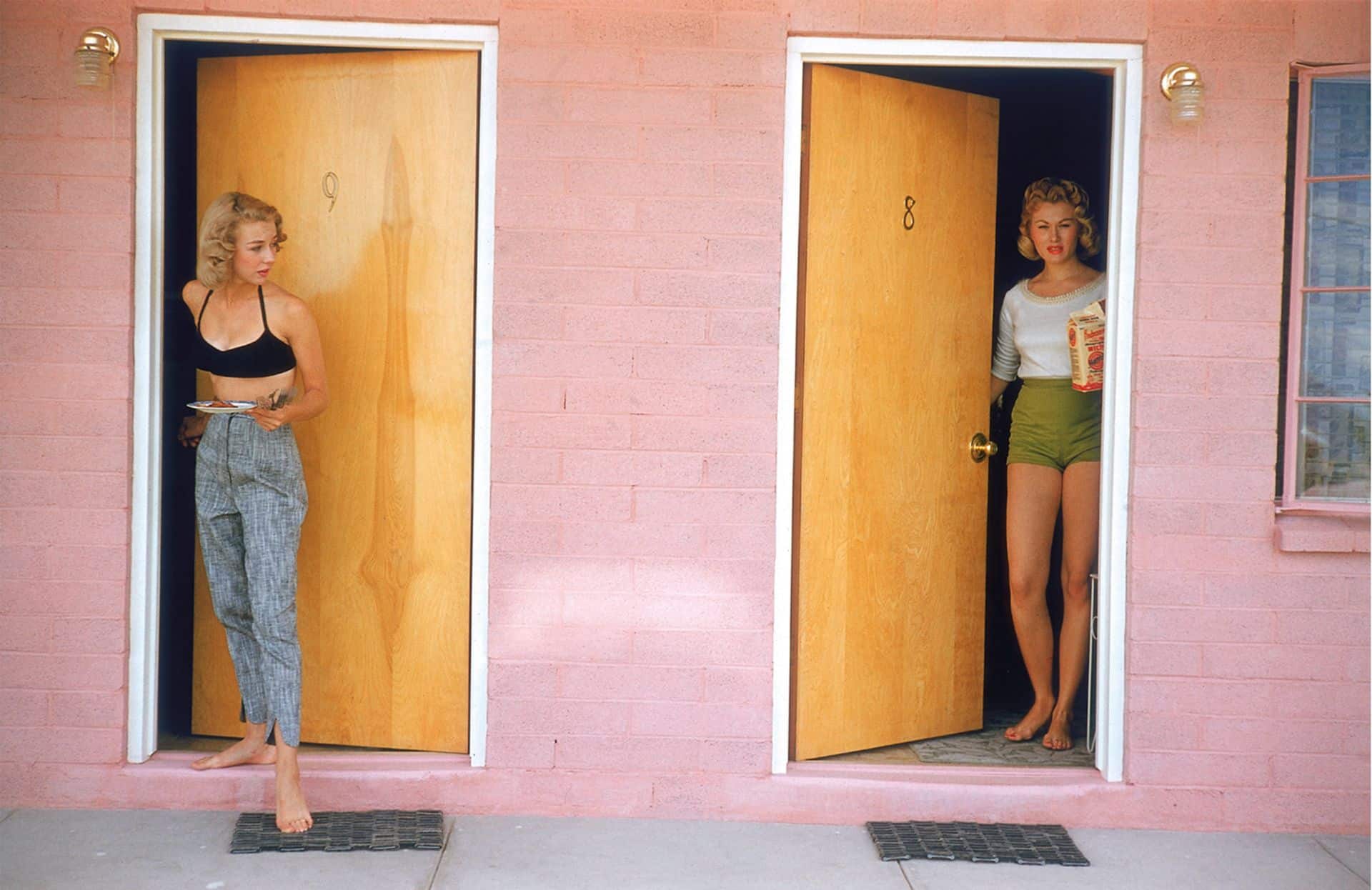
A bit of a rabble-rouser, but without a mean bone in his body, Erwitt was a kind of an intellectual of humor. He always denied it, claiming he had a “poor education.” But he used his wit to attract the eye, to capture whatever surprises or moves him, or what he found amusing. His gaze constantly oscillated between joy, astonishment, and sadness.
“Elliott’s photos should be inserted into survival kits. When you’re desperate, they can save your life.”
Ferdinando Scianna, Magnum photographer
He made the spectator aware of serious subjects, questioned the world, and rejected indifference. Ferdinando Scianna, another Magnum veteran, and a great photographer with similarly impeccable French, knows Erwitt in and out: “You can’t be ironic without being intelligent. Elliott’s photos should be inserted into survival kits. When you’re desperate, they can save your life.”
Elliott Erwitt may have been a dreamer, but he always kept one foot firmly on the ground. He observed the “human comedy” like a sociologist. Scianna said it best: “Elliott is an eminently political photographer. He likes to show differences between people, always using mockery to avoid being too buttoned up.” Erwitt’s famous photo of the segregated drinking fountains falls into this category. The paradoxical composition of the scene highlights the inanity of racism: the black fountain is for the whites, and both races share the same water supply. Similarly, “when a Black soldier sticks out his tongue at the camera, that’s Elliott Erwitt making faces at the military establishment.”
There is no secret to good photography. With Erwitt, everything seemed easy. “In photography, thinking isn’t of much use, you have to see.” There is no special recipe, but there were mentors, starting with Capa, who brought Erwitt into Magnum, an agency he worked with throughout his life and later directed. Henri Cartier-Bresson, the man who taught young Elliott to always go out armed with a camera, once said: “To photograph is to put on the same line of sight the head, the eye and the heart.” From this “gold standard,” as he calls it, Erwitt learned how to forge his own style, to learn to find the moment, of course, with a precise dose of the heart, the eye, and the mind.
“Don’t worry, it’s Sting.”
He never talked much about the subject. Nor, as a matter of fact, does he talked much at all. Erwitt was eloquent in his silence. Modesty is perhaps one of the secrets that allowed him to aim his lens at many celebrities: Marilyn Monroe, Che Guevara, Clark Gable, and John F. Kennedy, whose family appreciated him in particular.
The photographer had always been close to celebrities. In 2010, he opened the imposing metal door to his ground-floor studio in his home in Central Park West to welcome his assistant visiting his archives. The sound of the piano could be heard from the apartment above. It was his neighbor playing. “Don’t worry, it’s Sting.” The English singer penned a note in Erwitt’s latest book, Found Not Lost, published in 2021, citing him in one breath with the biggest names in American photography.
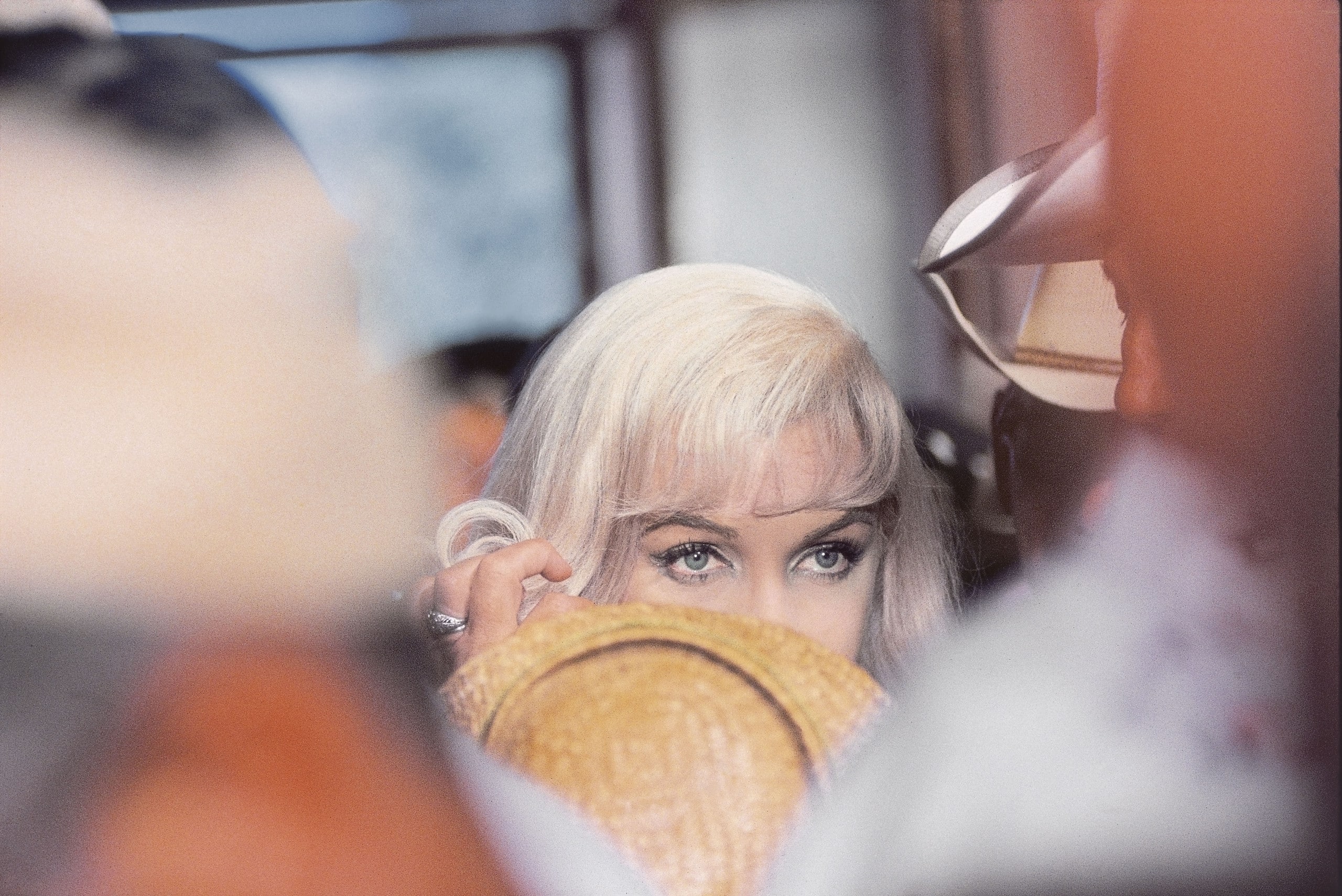
Erwitt’s name is also synonymous with poetry and glamour. An 2023 exhibition at the Maillol Museum in Paris presented several of his iconic fashion photos, including the delightful shot of a black cat poking its head between the perfect legs of a model, or the photo of Marilyn with unmistakable blue eyes and blond curls. Scianna, who knows a thing or two about the genre, comments: “Elliott always knew how to get an extraordinarily sensual look from all the women he photographed.”
Pia Frankenberg, Erwitt’s ex-wife, said he was laconic and, like many artists, hard to pin down. In a 2003 interview with The Guardian, she recalled, “Now that I know him, I feel for everyone who is a little intimidated because they don’t know how to handle him. It is like when people think that comedians are funny people and they are not.” One of the—a total of four—women he married famously played a trick on him by hiding the negatives of his best photos in a bed after their separation had been announced. The negatives were reported missing and were only found years later.
“I am a craftsman. I often say that I am a photographer with a hobby, which is photography.”
The nonagenarian had made a lot of money from commercial photography. Take the ad campaign for the French Office of Tourism, memorable for the picture of a man on a bicycle, with his son and a baguette on the rack, which is now in museum collections. With the proceeds, Erwitt was able to purchase a house at the edge of Central Park and a second home in the Hamptons. But he had known much less prosperous times. He remained a humanist, close to the “little people,” and turns a critical eye on the rich and the powerful. “One could say that I am on the Left,” he said reluctantly. What place does the human being have in his photography? “The human is neither a flower, nor a building, nor an animal.”
Elliott Erwitt was a collector of images. He often has to let them mature, like good wine, before bringing them to the public. Dogs were among his favorite subjects. He immortalized them in human poses: a way to put man and animal on the same level. His passion for the canine species developed over time, when he realized that they were abundantly represented on his negatives.
In recent years, Sammy, a Scottish terrier born in Hamburg, could still be seen wandering around Erwitt’s apartment: a multilingual refugee, a bit quirky, gentle, and quiet, just like his master. Before that, there were others, bigger ones, like Great Danes. Just ask Jimmy Fox. He knew these dogs well because he had to take care of them whenever Elliott Erwitt dropped off them at Magnum’s New York office before leaving on assignment.

This old-timer in the world of photography had remained a child at heart: fully of whimsy and talent. “Elliott’s photos are recognizably his, and they have been from the very start,” says Scianna. “That’s a difficult thing to accomplish in photography. Normally, one gets there by exaggerating the form. In Elliott’s work, the form appears to be simplicity itself.”
In an interview with Le Monde in 2010 (probably one of the best interviews ever done with a photographer), Erwitt explained his philosophy: “I am a craftsman. I often say that I am a photographer with a hobby, which is photography. Most of my images are commercial, but I also take pictures for my own pleasure. Sometimes the two go together, but not always.”
In 2011, the International Center of Photography, awarded him the prestigious Lifetime Achievement Award. Did it mean his career was over? “No, the award wants only my life to be over.” In the decade that followed, the photographer published seven books, some including never-seen photographs, and produced several retrospectives and themed exhibitions, for example about England, Scotland, or simply about color. The man never stoped. Mr. Erwitt, how did you learn how to photograph? “I read the instructions on the back of the box.”
More information and photos on Elliott Erwitt on Magnum’s website.
100 photos for press freedom, Reporters sans Frontières – Eliott Erwitt, Released November 2, 2023.
Cover photo: Elliott Erwitt in reflection, Tropicana Hotel, Las Vegas, Nevada, USA, 1957 © Elliott Erwitt / Magnum Photos





