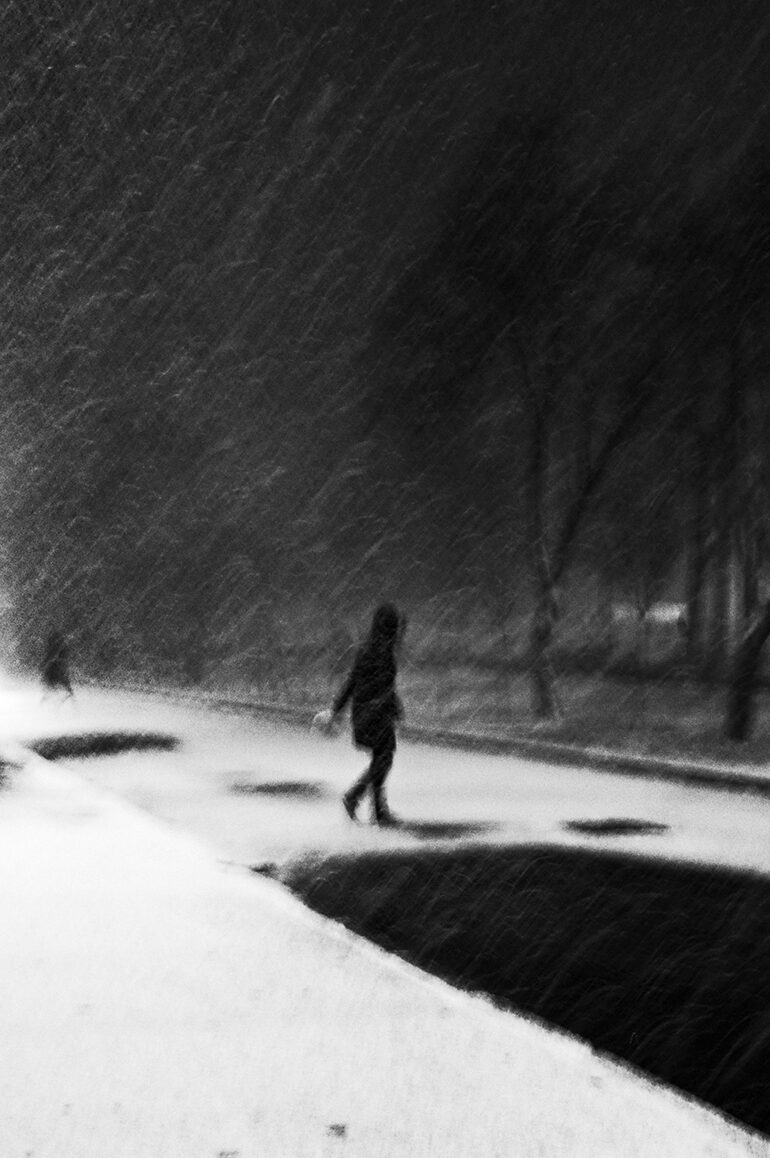
10 artists pay tribute to poet-art scholar Keshav Malik on his birth centenary
By Admin in Photography
By Miriam BarkerBBC News

Mathew BrowneMathew Browne travelled to Iceland to see the Northern Lights – but it is his picture taken 10 minutes from his west Wales home that has won him an award.
He was so frustrated with his poor shot of the Aurora Borealis in Iceland that he made it his “mission” to improve.
But instead of going back there for the perfect pic, he captured it just up the road in Carmarthenshire.
Now his Paxton’s Tower image has been named a winner in the 2023 Northern Lights Photographer of the Year awards.
It is in a collection featuring 25 of the best photos of the Northern Lights taken around the world.
But what does it take to capture such a spectacular picture of the phenomenon?
Mr Browne, from Porthyrhyd, near Carmarthen, first got into photography through his love of travelling.
One thing on his bucket list was to see the Northern Lights, and on a trip to Iceland with his wife Louise, he managed that.
“They were beautiful, but I didn’t have a scooby doo what I was doing with my camera,” he said.
“I had a rubbish little point-and-click thing, and a rickety hand-me-down tripod, and I was just so disappointed that I saw this amazing thing, and I didn’t have a photo of it.
“I then made it my mission to learn how to be a better photographer and one day go back to Iceland to get a picture of the Northern Lights.
“I haven’t been back yet, but it’s kind of ironic that I managed to get them on home turf,” he said.


The cause of the Aurora Borealis, also known as the Northern Lights, is charged particles from the sun hitting gases in the Earth’s atmosphere, in a similar way to how fluorescent light tubes and neon signs work.
They occur around the North Pole when the solar wind carrying the particles interacts with the Earth’s magnetic field.
They only occur when a radiation storm or geomagnetic storm occurs in the Earth’s atmosphere, and can be seen best at night with a clear sky.
Green is the most common colour, which occurs when the particles hit oxygen in the lower atmosphere. Red appears when the particles hit oxygen in the upper atmosphere, while blue or purple occur when nitrogen is involved.


The 39-year-old has been a full time professional photographer since 2017, and was one of two Welsh winners at the awards.
“Preparation is key to get a photo like this. If you were living in the Arctic Circle you could open your front door and they would be upon you, but that’s not going to happen here, you need to be prepared.
“I have a couple of apps that will alert me if there is a chance of seeing them, but that doesn’t mean you definitely see them,” he said.

Mathew BrowneHis winning photo was taken a 10-minute drive from home.
“I’m not exaggerating when I say I’ve been up there 100 times trying to get that shot, and I’ve had a couple of near misses where it’s been faint, but time to time you’ll get an alert that there is increased geomagnetic activity.”
He said there has to be a lot of activity for the Northern Lights to be visible in his part of the world, and it was exceptional to see them this far south.
He had the alert on the night of 25 September “just after Wales had smashed Australia in the World Cup, so I wasn’t ready to go to sleep, and I thought I’m just going to go out and see what I can see”.
He said: “It was a very diffused pink, and wasn’t visible to the naked eye, but it was coming out the back of the camera.
“So I set my camera up and waited to see if something would happen, and it was right place, right time,” he added.

Mathew BrowneAt about midnight he could see pillars of light rising from the horizon, and captured the image by taking one under-exposed image, one over-exposed and then one in the middle, to be the balance between the two, a term called bracketing, or HDR mode on the iPhone.
“It was absolutely spectacular, and I was ringing everybody I knew who lived locally to see if they were awake and stick their head out of the window.
“I rang a mate who lives five miles away and his wife wasn’t happy that I had woken them, and I said trust me, stick your head out of the window and you’ll thank me, and they saw the lights, so I wasn’t in the doghouse.
“It only lasted three to five minutes, but the rest of the night, and I mean the whole night you could still see that pink glow,” he said.
The experience can be lonely, but also a “magical feeling” and “very special.”

Mathew Browne“It’s so rare to get a display that is strong and visible from here.
“I’ve been trying for 10 years to get a photo like this and it is only this year that I have managed to do it in a substantial way.
“Time moves very quickly when I’m out, but if you ask my wife, she would tell you I’m out all night.
“Being the winter the hours aren’t as punishing, but I am out for a good three to four hours to see the storm until it dies down.”
However, he has encountered suspicion with claims could not see the Northern Lights from Wales, and that his work is photoshopped.

Mathew Browne“This is because people’s expectations aren’t correct in terms of what you are going to see with the naked eye.
“I’m sure a lot of people the night I took that picture would have been driving home and didn’t even notice it, because it’s not as colourful to the naked eye.”
By Admin in Photography
By Louis InglisBBC News

Josh DuryA Somerset photographer has won the Historic Photographer of the Year Award 2023, reigniting his passion and career in the art.
Josh Dury’s photo of the Callanish Stones on the Isle of Lewis, Outer Hebrides, claimed the top spot in the overall winner category.
Mr Dury, 26, explained that he took the photo on a trip to the Scottish island in 2022, and that he had almost given up completely as a photographer.

Josh Dury“It was the first time I had picked up my camera in about six months,” he said.
“I was on a ferry in the Outer Hebrides when I looked at the weather forecast and the skies were supposed to be clear.
“It was around five in the morning when I went there with the intention to capture a pretty sunrise.”
Since winning the competition, Mr Dury says he has been approached for a number of sponsorships from camera equipment companies, which has opened the way for a full-time career in photography.
The Historic Photographer of the Year Award is a partnership between HistoryHit and Historic England.
Entries are judged by a panel of five judges based on their originality, composition and technical proficiency, alongside the history behind the image.

Josh DuryThe Callanish Stones were built during the Neolithic Period – around 4,100-2,500BC – and were a centre of religious activity for more than a millennia in prehistoric Britain.
Mr Dury said: “As the sun rose hitting the mist, it just went wild, creating silhouetted projections across the stones.
“With the grand appearance of the stones it looked like a crown. It had to be called The Majesty of the Stones.”
Founder and director of HistoryHit Dan Snow was judging the photography competition.
He said: “Standing stones at sunrise with a gentle mist rising? That’s the holy grail for historical photography. Absolute perfection.”

Josh DuryJosh Dury’s background is in astrophotography and he was also recently shortlisted for a prestigious award in this field, for another photo taken of the Callanish stones.
Mr Dury has also been working in partnership with his native Mendip Hills Area of Outstanding Natural Beauty to protect the night sky from light pollution.


Follow BBC West on Facebook, X and Instagram. Send your story ideas to: bristol@bbc.co.uk
By Admin in Photography
Marisa Cigarroa Heymach’s photography — showcased in private collections, juried exhibits, a new online gallery and a Houston show that opens this Saturday, December 9 — demonstrates the value that she finds in everyday life. This rising photographer in the Houston art scene refuses to be confined by genre or trademark style. Heymach engages in photojournalism, street and nature photography, and abstract imagery. Her resistance to constraints stems from a desire to remain free, exploratory and curious.
“There is so much to see and respond to on any given day, and knowing this keeps my eyes and my heart open,” Heymach says. “When I miss an action shot, or don’t have time to stop and take a photograph of something that caught my attention, I don’t get upset.
“Instead, I enjoy the moment for what it was, fully knowing there will be many more surprises around the corner. That’s how life is too.”
A photographer deeply rooted in the Texas-Mexico border, Heymach has crafted her art around capturing the essence of overlooked moments. Her work, marked by a deep commitment to openness and observation, reflects a dedication to widening people’s perspectives.

As a Mexican-American who grew up in Laredo, Heymach credits her bicultural upbringing for shaping her ability to appreciate things from a variety of angles. From a very young age, she recognized how people can have very different lives simply by being born on the north or south side of the Rio Grande. At the same time, she also observed many commonalities that unite us.
“I learned through personal interactions on both sides of the border that wisdom comes in many forms and can be found in many places,” Heymach says. “When we widen our scope and are receptive, our horizons are expanded.”
Marisa Cigarroa Heymach’s vocation in photography began by exploring simple subjects she found at her personal universe — the long shadows cast by her bicycle in the afternoon, the changing light filtering through her living room curtain at different times of the day — and challenging herself to see familiar things in new ways. Her camera became an entry point to cross cultural explorations.
She went on to pursue an undergraduate degree in archaeology from Harvard in 1989, a master’s degree in anthropology from the University of Texas in 1991, and a master’s degree in print journalism from the University of California at Berkeley in 1993. Subsequently, Heymach worked as a reporter at the Marin Independent Journal and the Stanford News Service.
With more than 40 years in photography, Heymach brings a journalistic eye to her imagery. She believes that a photograph serves as a silent invitation for viewers to reflect on the parts of an image that are salient to them. To her, the final image is just a starting point for a wider exploration of ourselves.
“I hope to inspire viewers to add more serendipity to their daily lives so that they too can begin to see their environment and themselves in new ways,” Heymach says.

To really see something takes time — a lesson Heymach learned early in life with the help of her camera. While raising her five children, she intentionally carved out time for photography by integrating the practice into her daily routine.
Now that she is an empty nester, Heymach is turning her attention towards getting more of her work featured in various shows and collections. She is also beginning to explore galleries where she can showcase and sell her work.
Heymach’s camerawork has been exhibited at the Houston Center for Photography, The Big Show at the Lawndale Art Center, and the Advocates of a Latino Museum of Cultural and Visual Arts & Archive Complex in Houston, Harris County (ALMAAHH) “We Are Houston” show. Her photos were included in the Archway Gallery’s 15th Annual Juried Exhibit this past summer, and she was recently added as a member artist on the University of Houston’s interactive and portable digital board, Latino cARTographies Immersive Experience, which features the social and geographic landscape of visual Latino art.

Her photographs are displayed in private collections in California, Houston, Laredo and Austin, where the former UT chancellor Dr. Francisco Gonzalez Cigarroa resided during his term. She has also auctioned her art to benefit the Rio Grande International Center, Rexanna’s Foundation for Fighting Lung Cancer, Laredo Center for the Arts and Laredo College.
Marisa Heymach will showcase her most recent nature images at the gallery Art For You 1717 in The Mosaic at 5925 Almeda Road. The exhibition opens this Saturday, December 9 from 7 pm to 10 pm. To attend, an RSVP is required through Heymach at ( 713) 320-7633. The exhibition will be on view through next Saturday, December 16.
By Admin in Photography
Copyright 2023 BBC. All rights reserved. The BBC is not responsible for the content of external sites. Read about our approach to external linking.
Beta Terms By using the Beta Site, you agree that such use is at your own risk and you know that the Beta Site may include known or unknown bugs or errors, that we have no obligation to make this Beta Site available with or without charge for any period of time, nor to make it available at all, and that nothing in these Beta Terms or your use of the Beta Site creates any employment relationship between you and us. The Beta Site is provided on an “as is” and “as available” basis and we make no warranty to you of any kind, express or implied.
In case of conflict between these Beta Terms and the BBC Terms of Use these Beta Terms shall prevail.
By Admin in Photography
Though all nature’s creatures have their own dignity, they also have a capacity for dim-wittedness, clumsiness and all-round foolishness. For every proud and noble hound, nose lifted to the breeze, there will be a gawky, graceless mutt scooting across the rug. For every majestic stallion thundering impressively over the sand, there is a cantankerous nag pinning its ears to its skull as it snakes its head over the stable door. And these might be the very same animals, just moments apart.
For as long as there have been cameras, people have shared funny animal pictures. From black-and-white snaps of chimps in suits and dogs with pipes, through home videos and Animals Do the Funniest Things in the noughties, to the present, when finalists from the annual Comedy Wildlife Photography Awards – well represented among this selection – routinely go viral, the appeal is evergreen. It bubbles up from the same well of comedy: a tension between an animal’s true nature and the human connotations they have unwittingly stumbled upon.
Perhaps these photos say more about our human whims. Anyone who shares their life with an animal knows the strange infusion of affection, pathos and humour that flavours our interactions with other species. Does a fish care that its teeth remind the viewer of a goofy cartoon character? It has no concept of it. Does a cat mind if its overhanging belly casts a similar silhouette to that of an old gangster? Not a bit. Funny animal photos are felt to be harmless yet retain a trace of the taboo: a conflict that stems from the knowledge that, as endearing and relatable as their behaviour may appear to be, we will never truly understand what’s going on in their minds.
If comedy grows from subverting an audience’s expectations, then the more human the animal’s pose, the better. As Jason Moore, this year’s winner of the Comedy Wildlife Photography Awards for his photo of a kangaroo appearing to play the guitar, said: “I will always look for opportunities to capture examples of anthropomorphism. This type of image is among the most successful in attracting and holding an audience’s attention.”
Our brains are programmed to enjoy bears waving from the beach, stressed out squirrels throwing shapes, and monkeys mugging for the camera. They remind us of ourselves – only sillier – and in so doing, remind us that life need not be entirely solemn.

The Falkland Islands are one of the world’s penguin capitals; an estimated one million, from five different species, must share the beaches when they nest there each year. US wildlife photographer Jennifer Hadley captured this lively interaction between a gentoo penguin and its magellanic neighbour. “In this particular instance,” Hadley has said, “the penguins had been swimming, and as they stumbled on to land, the one on the right shook himself off and gave his mate ‘the fin’.”

It was a photo that would sweep the internet, rack up millions of views and inspire almost as many memes: the weasel riding on a woodpecker. But photographer Martin Le-May, an amateur birder from Essex, didn’t realise what he had captured at the time. “My wife had never seen a green woodpecker,” he says, “and I knew a few places they might be.” After they spotted a bird feeding on the ground, it suddenly took off with “a funny screeching sound”. The couple “didn’t think any more of it”, but later, when reviewing his shots, Le-May realised he had stumbled on to something strange. Though it is a comically surreal scene, the image captured a real sense of danger: the woodpecker was fending off an attack, and thankfully escaped with its life. “I called my wife through [showed her the photo] and said, ‘That’s not bad, is it?’” A friend uploaded it to Twitter, where it was picked up by BuzzFeed. Then, says Le-May, things got weird. “A neighbour knocked on the door with a message from the BBC. People were ringing from all over – from South Africa, New Zealand. It got crazy. I began to understand why celebrities get precious about their personal space.”

It looks like it’s been one of those days for this longsuffering buffalo, captured in Kenya’s Meru National Park by Tom Stables while documenting work by the Born Free Foundation. The region, says Stables, is “relatively barren and sparsely populated”, so coming across this disreputable pair, in this uncomfortable post-poo moment, brought Stables some levity after a long day bumping around on safari. “I’m always looking for humour,” he says. “It makes conservation a little more accessible, and lets us engage with a different audience.”

BBC film-maker and photographer Sam Rowley captured this astonishing scene of mice apparently squabbling for dropped crumbs after he had spent five cold nights lying flat on a London Underground platform. “The main challenge wasn’t finding the wildlife, but the logistics,” he says. “Every time someone came over to talk to me, the mice would scatter and I’d have a 10-minute lovely, yet distracting, conversation on my hands.” After hours of patiently waiting, he witnessed a short-lived scuffle that broke out among the rodents. “It only lasted half a second, but fortunately I was ready with my finger on the trigger. I didn’t immediately love the photo; if you look closely the mice are slightly softly focused. This is an immediate red flag for me, no matter what the rest of the image looks like. It was only years later, when I was going through old photos, that I rediscovered it.” Rowley has since photographed hyenas, vultures and Galápagos tortoises – but “it’s the little old mice of the London Underground that have captured people’s imaginations.”

When you’re a professional underwater photographer, you have a different kind of relationship with the colleagues you see day in, day out, says Troy Mayne, an underwater photographer based in Cairns, Australia. “I spent many years with these particular critters on the Great Barrier Reef. Wally, the fish, is a close personal friend,” he says. “The turtles are close acquaintances as well.” They’re a rowdy bunch: out on the reef, they will crowd around him, “pushing, biting or slapping out of jealousy or to get my attention”. He captures one such moment here, as the turtle jostles its way into view.

It was just another day at the sheep yard for Izzie the black kelpie until, as Tasmanian farmer Charlie MacKinnon put it, his “best dog” got caught. Izzy was helping herd sheep on MacKinnon’s family farm when she slipped and got stuck, Mackinnon has said: “Izzy just sat there like in the photo looking at me, so I whipped out my phone and took this shot.” She was quickly rescued. A single print of the photo was pinned on MacKinnon’s fridge for years before he entered it in a sheep photography competition – it soon won the hearts of thousands when it went viral on social media.

Despite their reputation for hijinks, kangaroos are “fairly docile and even a bit boring most of the time”, says Jason Moore, a photographer based in Perth, Australia. Still, their “gorgeous” faces make compelling portraits, with an anthropomorphic quality that draws the eye. “Simply put, people instantly relate to human-like expressions or poses in animals, and we all find these images cute, humorous or generally pleasing to observe.” This female, apparently mid-guitar solo, is no different. The picture, winner of the 2023 Comedy Wildlife Photography Awards, was taken at golden hour during Western Australia’s wildflower season, when the otherwise arid landscape is awash with colour and, unfortunately for Moore, the grass is thick with ticks and biting insects. “The lengths we photographers will go to, just to get that image!” he says.

Amateur snapper Mary McGowan became familiar with her neighbours by leaving out seeds and nuts for birds and squirrels which hang out in her Florida garden. She had only a few seconds to capture the gesticulations of this indignant individual, who has all the furious intensity of an irate New York pedestrian. “He was coughing or something, but after a few seconds he was just fine and went back to eating,” McGowan has said.

This cheeky monkey mugshot was taken by an endangered Celebes crested macaque using equipment owned by British photographer David Slater. After several days befriending a troop of macaques in Sulawesi, Indonesia, Slater set up a selfie-station to turn their curiosity to his own ends. “Once they started to touch the camera and play with the cable release,” he says, “I had to move closer to steady the tripod from being knocked over. It was when I was lying prostrate on the forest floor steadying the tripod that I heard the familiar sound of shots being fired. Looking up, I saw a delighted macaque pulling faces at its own reflection as the shutter was firing. It was utterly hilarious.”
The monkey selfie made headlines around the world, and became the subject of an extended legal dispute after animal rights group Peta filed a lawsuit in 2015 requesting Naruto, the macaque, be recognised as copyright holder (the US court ruled in 2018 that the animal “lacked statutory standing to claim copyright infringement of photographs”.) Slater and Peta agreed a settlement, with Slater donating 25% of future revenue from the images to charities for crested macaques. The legal case took over his life, says Slater, but “the interest in and promotion of the plight of these rare macaques was just compensation for me”.

Photographer Nicolas de Vaulx was documenting the Dalmatian pelicans that frequent Lake Kerkini, Greece, in the winter months when he caught this ungainly moment on film. “They sometimes fish in groups,” he explains, “and there can be altercations. In this case, another pelican managed to intimidate him into letting go of the fish, and stole it.” Nicolas never sets out to capture comic scenes – “It’s not what I’m looking for” – but says that when you hang around for long enough, they come to you.

Brown bears living in coastal Alaska gorge on fish in the summer months, building up their fat stores to get them through the hard winter. Amateur photographer Alan Vernon caught this relaxed individual chillaxing on a gravel bar between meals. “Most of the time he laid on his belly,” Vernon said in a post about the photo, “but for a short time he laid on his back and put on this show. I was on the beach with six other people standing about 100 yards away. It was a precious moment.”
after newsletter promotion

News of the large feral feline population on Japan’s Ainoshima island acted as catnip to professional cat photographer Kenichi Morinaga. “My shooting style is walking from morning until sunset, without lunch, to find lazy cats,” he says. This heavyweight individual lounging harbourside with a mafioso air immediately caught his eye. “This big boss makes us smile … Maybe he has a good build. That, and his way of sitting is so embarrassing and lazy. That’s why it is funny.”

Professional pet photographer Carli Davidson’s Shake series is a masterpiece of animal comedy: a brilliant visual gag played entirely straight. In a sequence of perfectly focused, glossily stage-managed images, dogs of all shapes and sizes are seen shaking and shuddering, jiggling and juddering, twisting and torsioning, ears flapping, jowls flopping, and spittle flying. The shots, she has said, are “playful, lighthearted and somewhat bizarre … The first time I uploaded the photos, I couldn’t stop laughing, I knew I had to keep shooting and create a body of work.” She used “a variety of techniques” to set the dogs off, some involving “wetting them down”, although she wasn’t prepared to reveal them in full: “I’m not giving all of my secrets away just yet.”

Underwater photographer Arturo Telle Thiemann was diving off El Hierro, in the Canary Islands, when he bumped into this very cheerful Mediterranean parrotfish, whose toothsome grin looks straight out of Finding Nemo. “I saw this particular fish, with its special ‘smile’, and waited, laying quietly on the rock,” he says. “I took a few pictures from farther away, just to make sure, and then the fish swam directly towards me for an instant, giving me time for just one more … the perfect shot.” Fish can be tricky photo subjects, he adds – and shy of the “huge bubbling monster invading their space”. But Telle Thiemann remembers the words of the great Bruce Lee as he blends in as well as he can: “Be water, my friend.”

Every year, elephant seals gather on a particular beach near San Simeon in California, says the American nature photographer George Cathcart: “In December, thousands of seals of all ages haul out to give birth, nurse their babies and mate, before returning to the water.” Bull seals come ashore to “stake out territories”, he says, often physically sparring – a bloody if somewhat ungainly process. “They can be quite comical as they go about swatting each other with their noses,” he says. “As far as I know, there are no Marquess of Queensberry rules among elephant seals, but this one does seem to think his opponent hit below the belt, so to speak.”

Dutch pet photographer Patrick Reymer often took portraits of his own dog, an “arrogant” beagle called Kayne, between appointments. “It was fun to do in between other assignments, and Kayne enjoyed the attention,” he says. Kayne, a laid-back character, liked to relax by resting his weight on one elbow. “One of the most important things about animal photography is making them feel happy, then you’ll see their real character and they will surprise you with their poses.” Reymer bought the beagle as a puppy in 2005 when he had to leave his job due to kidney failure: “I needed a friend.” Out walking in the park one day, the two bachelors met a woman called Lyda and her dalmatian, Kiki. The two dogs “fell in love instantly”, Patrick says; the humans followed their lead. “All we could do was buy a house so they could enjoy each other’s company.” Sadly, both dogs died within a few weeks of each other in 2019, but their owners’ lives had been changed for ever. Lyda donated a kidney to Patrick in 2020, and the couple live together still.

It seems this Indian chameleon – as photographed in the Western Ghats mountain range by Gurumoorthy K – would like you to keep off his lawn. Chameleons change their colours for communication and to thermoregulate; bright colours, like this vivid green, tend to indicate that they are seeking a mate.

Esa Ringbom has spent more than 30 years photographing large predators in the wilderness of eastern Finland and along the Russian border, like this shy brown bear playing peekaboo hebind a tree near Kuhmo. If a photographer sits quietly in a hide, the bears feel comfortable enough to approach at close quarters – sometimes only a metre or so away. “This bear obviously knew I was there, but it didn’t seem to bother it,” she says. In other circumstances, however, “a bear is a shy and cautious animal. We humans have a hard time encountering one in the wild. If they sense something unusual, they hastily make their leave.”

Suliman Alatiqi had to get up close and personal with an elephant to capture this unusual angle of it cooling off in the sea off Phuket, Thailand. Submerging himself chest-deep in water so close to the massive animal was, he says, “intimidating”. “I worried about falling or being accidentally stomped on,” he says, “but the elephant was friendly, which helped.” Initially, he planned a classic “over-under” perspective of the elephant, showing its body above the surface, and its legs underwater. But poor visibility forced a more creative approach. “Seeing the elephant was curious enough to inspect my camera gave me the idea of experimenting.” After a failed attempt, Alatiqi returned later when the angle of the sun had changed, illuminating the nostrils to create this uniquely intimate image.

Timing is everything in photography, and never more clearly than in wildlife photography. Jagdeep Rajput’s perfectly aligned image, in which a disagreement between a nilgai – a type of antelope – and a sarus crane creates the brief illusion of a Pegasus-like winged figure. In reality, the bird was repulsing a visitor who had trespassed too far into his territory. Patience is the key to the art of wildlife photography says Rajput, who visits India’s Keoladeo national park three or four times a year for several days at a time: one must learn to enjoy being immersed in nature “irrespective of the end result”.

Daisy Gilardini has photographed polar bears on expeditions to the Svalbard archipelago, Greenland, Russia and the Canadian high Arctic. She says nothing is more rewarding that witnessing a mama bear leaving her den in spring with her new cubs – but to do so means braving temperatures of -50C or below. “The bitterly cold hours, days and weeks waiting in front of a den are worth every single second,” she says. The cold is “a challenge”: a camera will slowly freeze, starting with the batteries, then the control panel and monitor. Soon the photographer must shoot without seeing what’s on the screen. “It comes with practice,” says Gilardini. “The only way to learn is to keep shooting and hope for the best.” In this instance, the cubs’ mother was hurrying downhill through deep snow. It was hard going for her two little ones, one of which decided “it was much more convenient to hitch a ride on mama’s behind. He jumped and reached out, holding on with a firm bite on mama’s fur backside: an extremely funny and totally unexpected behaviour.”
By Admin in Photography

Saturday, December 9, 2023 7:15AM
LOS ANGELES (KABC) — Mayor Karen Bass used her medical training during a press conference Thursday to help save a local TV station photographer who apparently suffered a medical episode and collapsed.
Bass and Los Angeles Police Chief Michel Moore were at the LAPD’s academy to discuss recruiting efforts aimed at rebuilding the ranks of the police department when the photographer collapsed.
In video taken by KNX reporter Craig Fiegener, you can see Bass quickly take action and leave the podium, immediately followed by Moore. You can also see the mayor crouched right over the collapsed man, helping to direct medical care efforts until paramedics arrived.
Long before her time in congress and in the mayor’s office, Bass had a career in medical care.
She is a graduate of the USC Keck School of Medicine Physician’s Assistant Program and in the 80s, she worked as an emergency room physician’s assistant.
The mayor’s office said an ambulance arrived to take the man to a nearby hospital. Bass’ team checked up on the man Friday, and it was reported to them that he was doing better.
Details surrounding the cause of the man’s medical emergency were not immediately available.
City News Service, Inc. contributed to this report.
Copyright © 2023 KABC Television, LLC. All rights reserved.
Related Topics
By Admin in Photography
In 2023, the Phoblographer interviewed several photographers who we think embody the idea of human photography and stand out from many of the others out there. Some of them do all their work with no Photoshop. Others find ways to channel their emotions in art in ways that can only be dreamed of by others. So, with 2023 ending, we’re rounding up the most inspirational photographers of 2023 that we’ve interviewed. Take a look below.

Read our interview. Please be sure to check out her website and Instagram page.
Read our interview. Please follow her work on Instagram and her website.


Read the interview. Check out @thebaeowulf, @baevocative, and her website.

Read our interview. Check out her website, her Instagram, and her Flickr.

Read our interview. Please visit his website and his Instagram for more.

Read our interview. Please follow his Instagram and website.

Read our interview. Be sure to follow him on Instagram.

Read our interview. Be sure to check out his website and DecisiveShot for more from John.

Read our interview. Visit his website and Instagram page to see more of his work.

Read our Interview. Please check out his website and his Twitter for more.

Read our interview. Be sure to visit Daniel’s Instagram, Flickr and Behance to see more.
By Admin in Photography
Milwaukee Art Museum announces new Herzfeld Center for Photography show
Wondering what’s the importance of PDF editing software for photographers? Hop inside this guide to find out!
The loon traveled from Los Angeles to its permanent home in the Twin Cities.
A new beetle species has been named to honor a fellow Husker, bridging the worlds of academia and wildlife conservation.
Silversea, a premier brand in experiential luxury and expedition travel, recently concluded the inaugural season of its first Nova-class ship, Silver Nova,
The Desert Foothills Land Trust (DFLT) is proud to announce a special presentation event featuring acclaimed botanical photographer Jimmy Fike on Saturday, Oct. 12 at 6:30 p.m. at the Sanderson