Chicago bulls forward taj gibson hi-res stock photography and images – Alamy


In 2021, almost 200 days into Melbourne’s rolling lockdowns, the Rovenko family decided it was time to start a new project to pass the time.
“By the sixth lockdown, we’d done all the standard things like baking sourdough,” says Andrew Rovenko, a creative technologist and freelance photographer who moved to Australia from Ukraine in 2004.
Andrew’s daughter — Mia, then four-years-old — was obsessed with space at the time.
She’d bug her dad to read her books about the planets and pepper him with questions like ‘What temperature is the sun?’ and ‘How does fusion work?’
Andrew’s wife, Mariya — who has a background in theatre costume design — came up with the idea to make Mia a homemade astronaut costume.

Mariya whipped up Mia’s spacesuit on her sewing machine and helped her daughter create a papier-mâché helmet.
“That’s the part Mia enjoyed the most, sticking the newspaper offcuts on the inflated balloon,” Andrew says.
Mia was thrilled with the result. “As kids do, she put on the costume on our daily walk and didn’t want to take it off,” her dad says.
On their daily rambles, they roamed the five-kilometre radius around their home in the bayside suburb of Sandringham, satisfying Mia’s natural curiosity and Andrew’s urge to explore a city made strange by the absence of people.
“When the city became so empty, it was this whole world that seemed completely different,” Andrew says.
After each walk, Andrew and Mia would discuss what they saw and make plans for the next day’s expedition.
Initially, Andrew had no plans to transform their perambulations into a photography project.
“The first few shots I took were snaps on my phone,” he says.

But Andrew soon began taking his Mamiya RZ67 “very old-school medium format film camera” on their outings to capture Mia in her homemade spacesuit against the backdrop of a deserted Melbourne.
Unable to have the film professionally developed due to the lockdown, Andrew ordered developing chemicals online and set up a makeshift darkroom in his laundry.
The resulting photographs — dubbed The Rocketgirl Chronicles — are timeless and otherworldly.
They cast Mia in her helmet and astronaut suit as an intrepid space traveller exploring an abandoned urban landscape.

In The Shuttle — a finalist in the 2022 National Portrait Prize — Mia sits with feet crossed aboard an empty bus, gazing out the window.
She’s pictured in front of a pink and blue-lit Ferris wheel in Behind the Wheel, while in Firekeeper, she crouches by a fire on the beach, with the city skyline beyond.
“I tried to capture that essence, that feeling of what it is to be a child when you have this new, different world around you,” Andrew says.
When Andrew posted the first images on Instagram, he received an enthusiastic response. “My friends said, ‘This is really special’,” he says.
Mia and her spacesuit soon went viral, attracting an audience of thousands.
Andrew says he could understand why the photographs appealed to a local audience, who found it fascinating to see familiar settings depicted in an unfamiliar way.
“A lot of people told me: ‘I know this place — I never thought that it could look so weird and strange and otherworldly’,” he says.

He was less prepared, however, for the international interest in the images.
“People from different continents all around the world wrote to me about how they were inspired by this project,” he says.
The Rocketgirl Chronicles appeared in exhibitions all over the world, from the Head On Photo Festival at Bondi Beach to New York’s city-wide open-air photography festival Photoville.
It even travelled as far as Brazil, where a primary school staged a play inspired by the photographs.

The project also attracted critical acclaim, with Andrew named Australian Photography’s 2021 Photographer of the Year.
But while Rocketgirl went global, Andrew and his family remained in Melbourne.
“I’ve never been to any of the exhibitions,” he says.
“[As a parent], it’s really hard to carve out the time and the budget to [travel], so I enjoyed all of these exhibitions just through the lenses of other people.”
In the weeks and months beyond the end of Melbourne’s lockdowns, Rocketgirl continued to explore beyond their five-kilometre limit, driven by Mia’s inquisitiveness and desire to explore the world around her.
“She’s really curious,” Andrew says of his daughter.

And after receiving many requests to publish his photographs in a book, Andrew launched a crowdfunding campaign in March 2023.
He reached his funding goal of $20,000 in a single day.
The result, published in October, is The Rocketgirl Chronicles – Backyard Space Travel, a 172-page hardcover coffee table book featuring more than 100 images.
“Every detail is part of the experience — the type of paper, the thickness, the texture, the print,” he says.
“I’m a little bit obsessive about it.”
Mia is now at school, and The Rocketgirl Chronicles is a souvenir of an extraordinary moment of her childhood.
As for Andrew, he says the project allowed him to see his neighbourhood with fresh eyes.
“It wasn’t just about going out and taking pictures,” he says.
“[It was about] immersing ourselves into this new different reality we invented.”

REVIEW – Ever since my dad won a photography contest by taking a close-up photo of a dandelion when I was a kid, I’ve been interested in macro photography. A macro mode has been a must-have feature when upgrading/buying new phones because, for many years now, my phone has become my daily camera, even for Gadgeteer product shots. The only thing is that most smartphones can’t do super duper macro shots that well. So let’s throw some money at it, try the SANDMARC Microscope Lens, and see what we can see.
The SANDMARC Microscope Lens is a 40x lens that has been designed for iPhone.

Magnification: 40X
Height: 12.8mm
Diameter: 42mm
Focus Distance: 0mm
Field of View Angle(degree): 68°

The SANDMARC Microscope lens isn’t a toy (junk) add-on lens like many that you see on Amazon. This lens features a multi-element lens and an aluminum housing. Included with the lens is a set of caps that protect both sides of the lens.

On one side of the SANDMARC Microscope lens is USB-C charging port. You’re probably wondering why a camera lens needs a charging port?

It needs a charging port to charge the internal battery that powers the built-in light. One the opposite side of the lens is the power button that turns the built-in light off and on.

It’s not obvious in the photo above, but the light around the lens is turned on. The light has two brightness levels that you can toggle between with multiple presses of the power button. Holding the button will power down the light.

The back of the SANDMARC Microscope lens has a threaded mount with a tiny hole in it.

To use the SANDMARC Microscope lens, you need to place it over the standard lens or telephoto of your iPhone.

You can use the included mounting clip. Or you can purchase SANDMARC’s iPhone case.

SANDMARC’s iPhone case is available for iPhone series X to current. I received their leather case for the iPhone 15 Pro Max.

The advantage of using SANDMARC’s case, other than the fact that it’s a really nice case, is that it has a metal plate built-into the camera module area that has threaded sockets that the SANDMARC lenses screw into.

The Microscope lens screws into the standard lens or the telephoto lens so that it’s perfectly positioned and so that you don’t need to carry the clip mount.
Attaching the lens is easy as long as you do it slowly. Don’t try to do it fast because it feels like it might be easy to cross-thread it. I really would prefer a slot type of attachment system where you line up a peg on the lens with a slot in the case and turn to lock it in place.

The case is quite nice though and it has built-in clicky metal buttons for volume, action, and power.
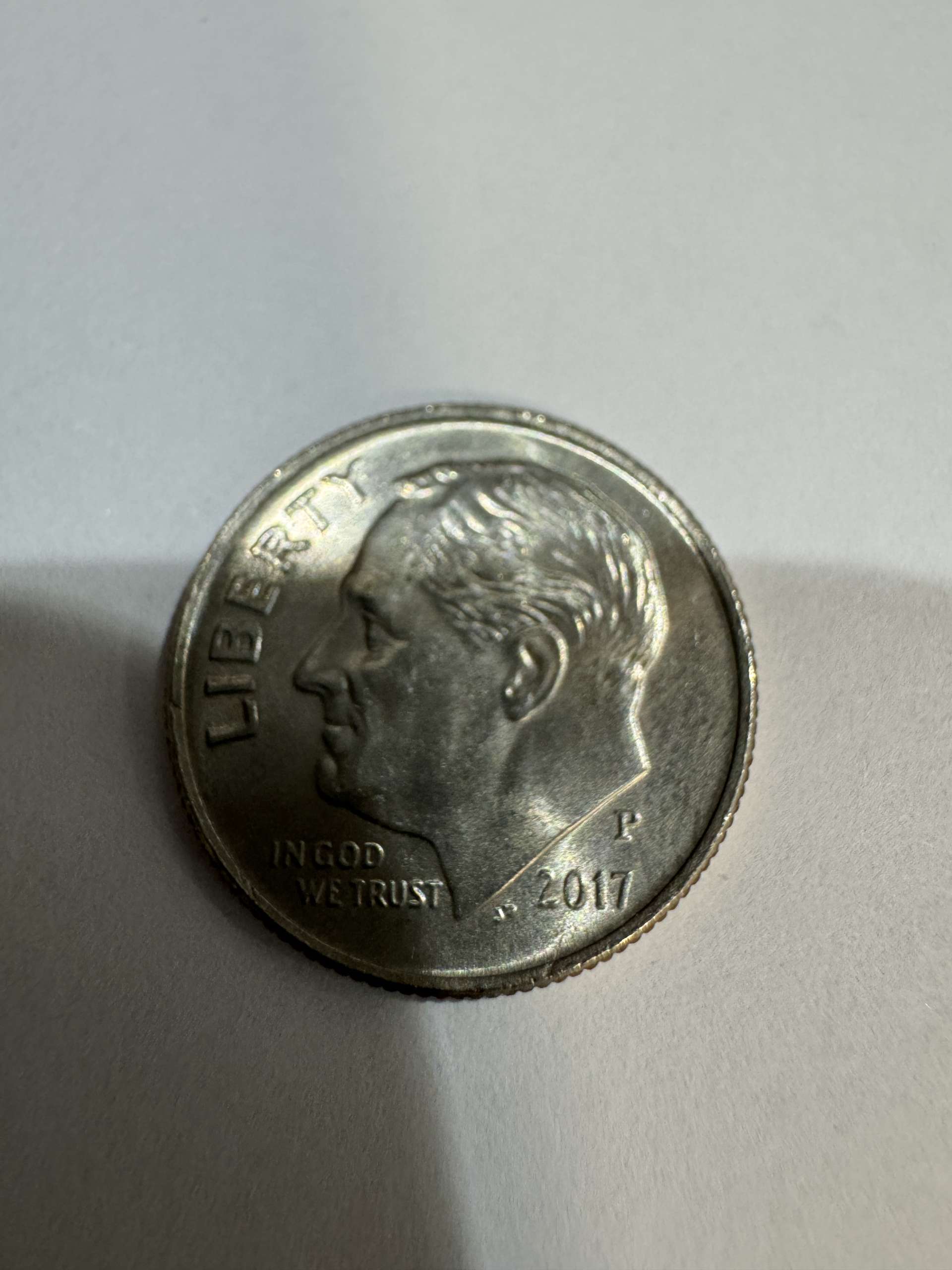
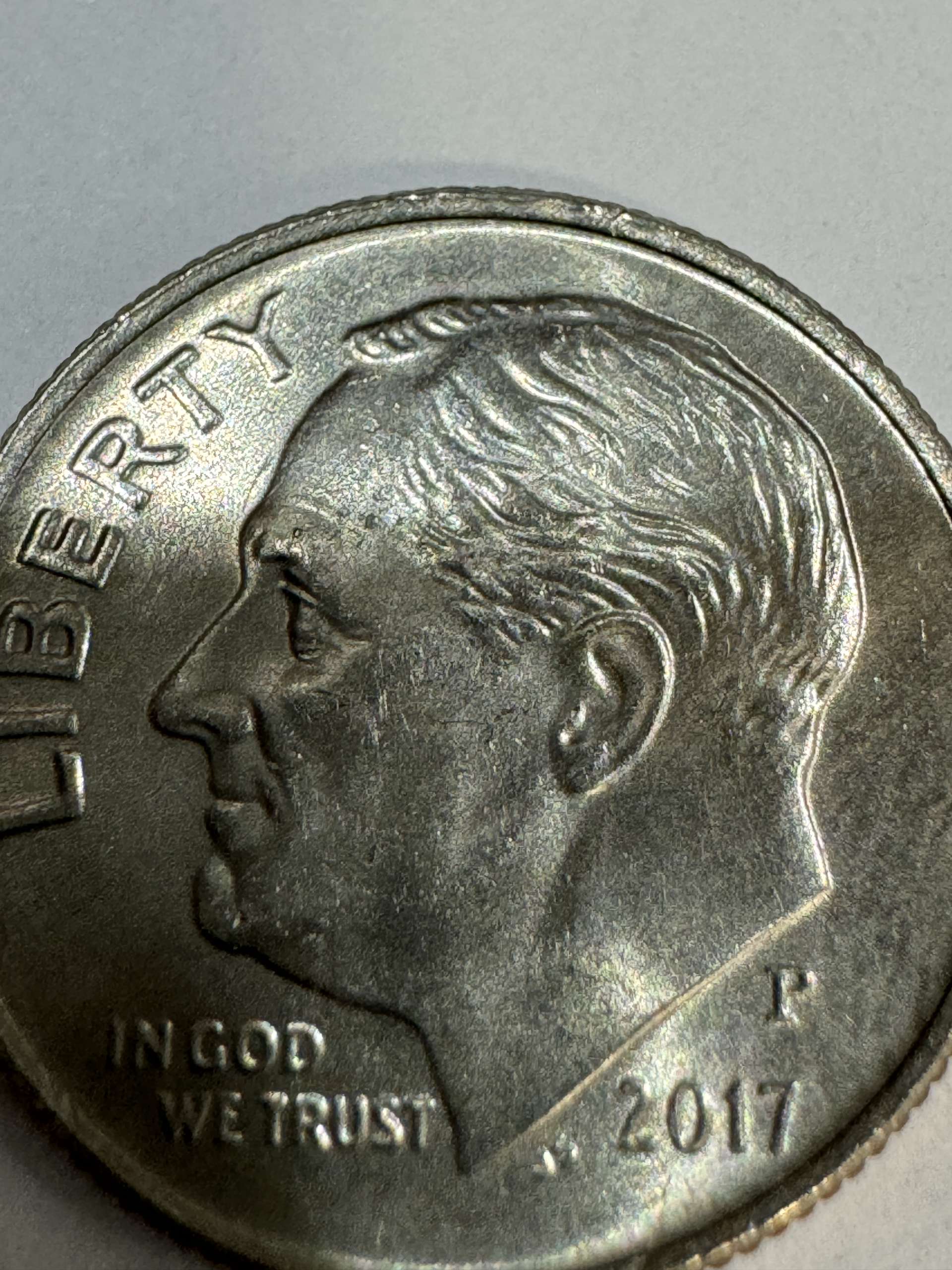
The problem with taking macro shots with an iPhone 15 Pro Max is that the closer you get to your subject, the worse the image becomes because you block all the light with the phone itself. For example, here are pictures of a dime using the iPhone 15 Pro Max standard lens in macro mode 1x and 2x. You can click for the full-sized unedited photo. Note the heavy shadow.
Now let’s see what the SANDMARC Microscope lens can do. The first two images below are with the lens attached to the standard lens (bottom left lens) and the right picture below is with the lens attached to the telephoto lens (center right) and with macro turned off. Note that in order to use the telephoto lens, you have to use a camera app like ProCamera.
You can click the images above to see the full-sized unedited photos. With the microscope’s built-in light turned on, it really makes a big difference in the images that you can capture. However, it is hard to compose the images, especially if your subject is not stationary. If you’re trying to take a macro picture outdoors of a flower and it’s not perfectly still, you won’t have a good experience.

Here’s another image using the iPhone 15 Pro Max standard lens, and again, you notice the heavy shadows.
Same pen tip but with the SANDMARC Microscope lens attached to the iPhone’s standard lens and the telephoto lens using the ProCamera app at 5x zoom. These images were really hard to capture because I was hand-holding the pen and although I felt like I was steady, every tiny shake caused the image to become blurry. You’ll also notice (especially in the right photo) that there is just a small section that is in focus.
The only issues come from needing a 3rd party camera app if you want to get the full magnification possible and that it’s tough to use this lens with moving objects. Having said that, the SANDMARC Microscope lens is the best macro lens that I’ve reviewed for my iPhone so far. I like the quality of the lens itself and the great pics that you can capture with it.
Price: $129.99
Where to buy: Sandmarc
Source: The sample for this review was provided by Sandmarc.


Dec. 25
King Charles III and Queen Camilla, followed by, from left, Catherine, Princess of Wales; Princess Charlotte; Prince George; Prince William, Prince of Wales; Prince Louis; and cousin Mia Tindall arrive for the royal family’s traditional Christmas service at St Mary Magdalene Church on the Sandringham Estate in England.
Adrian Dennis/AFP/Getty Images


Photography, a medium that has consistently reinvented itself, now stands at an unprecedented crossroads. Revolutions like AI have led to a profound reevaluation of photography’s role and essence. Is photography evolving or diminishing as an art form in this era of rapid technological change?
The advent of digital cameras and smartphones brought high-quality photographic tools to the masses, radically democratizing the field. Undoubtedly, this accessibility nurtured and continues to introduce new talent, but it also floods the market, making it harder for seasoned professionals to maintain their unique standing or to even stand out amidst the veritable onslaught of images.
However, this saturation has also pushed established photographers to diversify their offerings, expanding into high-end production, video, workshops, and online education. By showcasing the nuance of their craft, seasoned professionals can retain value even amidst an abundance of casual photographers. Arguably, this diversification leads to more income security, at least for those who are successful at.
In a technologically disrupted industry, learning adaptability is vital. Photographers must diversify their knowledge across specializations most immune to automation, such as bespoke fine art pieces and events. By focusing on skill-intensive services and niche offerings, they can retain market value despite saturation. The key is crafting a personalized brand that connects directly with their community and offers something unique rather than competing on price in an oversaturated mass market.
Advancements in camera technology and software have opened up new horizons in image quality and manipulation, allowing photographers to explore previously unimaginable creative avenues and making it easier than ever to get shots that were once the domain of only the most seasoned pros. However, an over-reliance on technology could eclipse the fundamental skills and artistic judgment that define great photography. Anecdotally, I’ve seen a lot of that from photographers who buy a nice camera and open a business, only to be quickly outmatched by the slightest problem that arises.
Indeed, as cameras and editing tools become more advanced, foundational expertise like lighting, composition, and concept development risk being viewed as secondary. However, the sheer abundance of images also means curation and quality stand out more than ever. Photographers who master both classical techniques and new digital capabilities will retain their competitive edge.
Digital technology has undoubtedly expanded the creative palette available to photographers, enabling a broader range of artistic expression. While some degree of post-processing has always existed in photography, critics argue that excessive manipulation severs the medium’s ties to depicting reality. Yet others counterargue that the very definition of photographic art is subjective and ever-evolving. As artificial intelligence technologies blur the lines of reality further, these debates over authenticity will likely intensify.
The problem is that while it has long been possible to create extreme edits that defied reality, it used to take years of experience and advanced skills. In that sense, it limited how much we saw images that were essentially lies, and when one made its way into a place it shouldn’t have been (journalism, for example), it was a big deal, causing anything from a news story to a mass moral outrage. But as automatic tools that can perform extreme edits in a compelling manner become more commonplace, the acceptance of the presence of fake images increases, and the public’s willingness to maintain a threshold of integrity decreases. That should worry both photographers and non-photographers alike.
As computational photography blurs the line between reality and alteration, the ethical implications become increasingly significant, especially in fields like photojournalism. Questions on plagiarism, originality, and intellectual property will come to the forefront. Standards and protocols safeguarding attribution and preventing exploitation of generative models for deceptive purposes will need to be established within the photography community, and yet, even then, there are so many photos being created by so many people that I fear this is a horse that will not come back to the barn.
Social media platforms offer photographers instant exposure to large audiences, a stark contrast to traditional galleries and publications. As a corollary, there’s a constant pursuit for virality. The craving for likes and shares can drive photographers to cater to popular trends, often at the expense of artistic depth and authenticity. The practice becomes homogenized, and there are arguably few things more tragic for an art form than that.
The psychology of instant gratification and validation through social media metrics can undoubtedly influence creative choices. Be honest: how much time do you spend checking your social media every day? However, rather than decry these changing tides, professionals can thoughtfully adapt by balancing passion projects with trend-focused offerings. The key is to leverage popularity for exposure while upholding personal artistic standards for select high-value commissions. This is part of the reason why many professionals advocate so strongly for personal projects. Someone has to make the trends, after all.
Established photographers often express concern about the impact of these trends on the public’s understanding and appreciation of photographic art. Yet, the abundance of photographic content also allows niche aesthetics to thrive across micro-communities tailored to specific tastes. While mainstream trends may come and go, photographers devoted to unique styles can now easily find and engage their target audience, no matter how obscure the niche. By focusing less on chasing ephemeral mass trends and more on nurturing personalized communities, artistic diversity can flourish. Part of the problem, though, is finding those communities. When there’s so much content, finding your little island amid an ocean can feel next to impossible.
Furthermore, there’s the issue of sustaining these niche communities. Once found, these communities need nurturing through consistent and engaging content, interactive communication, and a genuine sharing of ideas and techniques. For photographers, this means investing time and resources into community building, which is often a separate skill set from photography itself. The balance between creating art and managing a digital presence is a tightrope that modern photographers must learn to walk. This dual role can be taxing, but is a necessary adaptation in the evolving landscape of digital photography.
The question of whether photography is evolving or diminishing as an art form is complex and multifaceted. While technological disruption has brought both obstacles and opportunities, photography has consistently demonstrated its resilience and capacity to reinvent itself. After all, people need images, perhaps more than ever. Ultimately, the onus lies on photographers to navigate this landscape. I do believe there is room, but it is also easier than ever to be left behind.


The iconic photo of Tryst and Treasure
By Michael Canalizo
So much about our dog sport literally came from a split-second moment via the talented eye of a dog show photographer. There are also some quirky, funny things that happen to them while on the job.
Years ago, the East Coast had “Photog Royalty” with the likes of Evelyn Shafer and Billy Gilbert–two titans in the field. Evelyn dragged around a huge box-like camera that took only black & white photos. I know she fought it tooth and nail when Billy broke the mold and offered color photos. Back in the day, they would take a photo and send you a full-sized print by mail. Nary a time did one think of returning that record of a win.
Candid shots at a show were unheard of. If you could get a booking: The (now) famous “ Tausky” might have accepted you for a session. His work was a piece of art…and shamelessly retouched by hand. Take the time to look back to any legend in your breed from the ‘50s to the ‘70s and enjoy a moment of Tausky history. Chet Jezierski was my go-to guy for some historic candids of the Grandeur greats. There were others that forged a niche early on in that artistic arena–Gay Glazbrook being one. Now, there are too many to list without forgetting someone.
I didn’t have first hand experience with the creative ones on the “other coast”, but most had the great fortune to have Joan Ludwig in their rings for nearly a half-century. I had my Ludwig moment at a huge California show on one of the rare occasions where two of the Top Hounds of All Time met in the ring to compete. (See the now iconic photo of these two Sighthounds). Let me share how this composition happened. After an amazing Best In Show win with Tryst, I was walking behind the tents and along came the wonderful Karen Black with Treasure–who was Best the day before. I was in tan linen with my black bitch and Karen in dark navy with her cream Bitch. While we chatted, I caught a glimpse of Joan lugging her “stuff” across the field on her way home. I gave a yell to her and she flashed that biggest smile and came over. I asked for her to snap a shot. She squatted down, gave a boisterous yip and tossed that ragged catalog up and over…One shot…she stood and scurried off…two weeks later I get this threadbare envelope that might have been sent to no fewer than three others, with a hand scrawled address on the front. I opened it and gasped! I still relive that day every time I see the photo. And YES, it is used by many when anything about Sighthounds comes up. Joan was so thrilled to capture that moment she sent both Karen and me our photos as a gift. Joan’s eye for a dog was unparalleled. Her ability to make each photo interesting was amazing.
Dog show photographers provided a valuable and appreciated service. It was a rare occasion that a less than acceptable shot was sent; and if you thought so, you sent it back without a dour word in reply. I remember, when chatting with Chris Terrell–who campaigned one of the Afghan Hound greats to a lofty level–he told me if he ever had to send back a photo he put a five-dollar bill in the envelope to cover some of the cost borne by the photographer. I started to do the same after Chris shared this with me.
Would you believe me if I told you there was a “secret handshake” between a judge and photographer? If a very prolific/popular judge got caught having to have a photo with a “less than stellar” entry: the judge would quietly hold the win ribbon(s) “UPSIDE DOWN”! That was the signal to “lose the picture”. Sorry for you, but there was a glitch in developing and the print couldn’t be processed. Yes, most photographers did their own developing or sent it out to a local lab. Computers and cell phones were years away from appearing.
Here’s another fun judge/exhibitor/photographer story that was shared by the wonderful and colorful Dorothy Nickles with new and aspiring judges. It was a joke that went something like this: Four southern ladies were at lunch. The first asks another, “What did your husband buy you for your birthday? “A new Cadillac,” was her answer. The ladies all smile and sweetly say, “ THAT’S NICe.” The second asks the next and she says she got a fur coat…they all smile and say: “THAT’S NICE.” This goes around the table until it gets to the last one and when asked, she replies, “He bought me a book on etiquette.” The host politely asks, “A book on etiquette, whatever for?” The lady responds calmly by saying, “Because now, when someone tells me something I could care less about, I know to say, ‘THAT’S NICE’ instead of ‘WHO GIVES A SH*T!!!’” Dorothy told this to legions of new judges to arm them with what to say when taking a photo and the exhibitor start to brattle on about, “You gave Poopsie’s mother, blah, blah, blah.” We now all smile and say, “THAT’S NICE”. If you’re an exhibitor reading this, I think you might just spent a second thinking if you ever heard that from a judge at the photo stand. I found a way around that problem–the awkward moment when you’d rather not take a photo. If it’s a single entry, but lacks top quality while still having virtues of the breed, I just say I have a policy that I only take a photo if there was competition in the breed. It works for me. What can I say?
Both coasts had different photographer protocols. If you showed in the Midwest or on the East Coast, you had a photo taken by the assigned show photographer–end of story. Out West, the exhibitor could request the photographers they preferred from a few who were available at the show. I must assume they had more time to be able to do that. During one of my first West Coast assignments, when picture time came, a photographer came into my ring and asked me to ‘stand here, please’. There was a request to “move the right toe back ¼ inch please, and click. They said, “Thanks,” then a different photographer said, “Sir, over here please”, madame, move the rear toe back ½ inch, please. Now, a third one enters the ring saying, “Sir, over here please.” Ugh, it’s hot, and I forgot a hat. As you know, I have no hair on my head, and while I obey their requests, I feel on my right shoulder an extra person. It’s another photographer standing in the shot! Geeze, now those two photographers start yelling at each other. I toss them both out of my ring and I hear the PA blaring for an AKC Rep to ring 5! I go to the lunch room and Jane Forsyth and Bob Stein are now asking me why I had a Rep to my ring.. I told them my photographers started to fight. I went back to my ring, and the next time photos come up, I stopped them both and told them unless they act like adults and not children there will be no photos with me, “ARE WE CLEAR?” They nod in unison…and I announce that I will stand in one place and not move ½ inch in any direction!
Today the dog show photographers have so many challenges. I know many of the old school photographers who went kicking and screaming into the digital age. For the customer it brought demands for faster results, sending direct to a publication and/or a judge–and requests for “retouching”. Let just say–and I hope those in the back of the room can hear me–we can see retouching a mile away!
One fun story came from a sweet lady judge at the podium. I asked her if she would like a photo of the win. She said, “Oh no, Dear, but it would be nice to see it in a magazine”! Obviously, the Dog Press benefits greatly from a perfect image sent for an upcoming ad.
It is a constant challenge for the official photographer to protect their copyrighted images from being stolen by thosee taking photos behind them. This obviously impacts the future purchase of a win shot. Some resorted to a pre-paid policy or a non-refundable “sitting fee”. Now, it’s always a hard fought battle for them as the “official” photographer of an event. The rise of the “unofficial” candid photographers cannot be ignored. Many clubs don’t even know when one is attending, and some clubs have policies in place to keep a balance between the official photographers and the candid ones. Here’s an interesting fact: Oversees and just about anywhere around the globe, there are no “official” photographers. Your winners come into place and all of the sudden a swarm of paparazzi are on the floor next to one another; and if you didn’t walk away, they would still be shooting. There was many a time I had to chase away a photographer squatting in a corner with a camera distracting the entry. The international community was also the frontrunner in having a judge “photoshopped” into all photos. After three hours, YES, three hours of pictures in China, I’m okay with standing once and never again.
There can be an unsuspecting legal issue that comes into play with photos taken by a professional. Copyright issues could arise if someone wants to put the image on a t-shirt or coffee mug to sell, etc. FYI: In the 1960s there was a judge (Jerome Rich) who handed you a card when he stood for a win picture. On the card, it said something to the effect that he had to approve the image if used publicly. Could you imagine that in today’s world?
I do know I was somewhat beloved by many of the photographers when I had Tryst out. We had this silly superstition of having a “Lucky Pet” from a child at the show. And most times that child would be in the photo, and every kid’s parent had to buy a photo for them, so, it was a double take (every pun intended) for the photographers! For years, I could do no wrong with them!
One must notice that many of the current “Masters of the Craft” are about to age out. Personally, I watch in awe at how they can go up and down as many times in day as they do. They have a special place in the sport and their artistry has contributed so much. They are my unsung heroes in the sport.
I’ll close with saying that the dog show photographers, past and present, have created a pictorial history for us and we all should thank them immensely.

Short URL: https://caninechronicle.com/?p=278276
 Posted by admin




