Jury Awards Photographer Max Damages in Copyright Suit Against Senior Living Giant

Jury Awards Photographer Max Damages in Copyright Suit Against Senior Living Giant

“Hargis argued that Pacifica’s infringement was willful because it is a ‘sophisticated for-profit business with full knowledge of the strictures of federal copyright law and the basic requirements for licensing copyrighted content for commercial exploitation.’”

A California jury on Monday awarded what is reportedly the “largest maximum statutory damages verdict for photography infringement in U.S. history,” according to a press release issued by the plaintiff’s counsel in the case.

Scott Hargis is an architectural photographer who sued Pacifica Senior Living Management LLC in September 2022 for damages and injunctive relief related to infringement of 43 of Hargis’ photos that Pacifica used to advertise and market its senior living facilities.

The Central District of California, Western Division jury found all 43 photos to be willfully infringed and awarded the maximum damages allowed per infringement ($150,000). The jury found that Hargis failed to show he holds a registered copyright in one of the photos, so damages were awarded on 42 of the photos, for a total of $6.3 million.

Hargis is a well-known architectural photographer and is hired by architectural and design firms to photograph their works. He authored a series of 43 photos depicting the Fresno, Sun City, Encinitas, Chula Vista, Rancho Penasquitos, Burlingame and Sterling locations of the Pacifica facilities and registered them with the U.S. Copyright Office. Hargis’ complaint accused Pacifica of “unauthorized commercial exploitation of the Photos” through the company’s use of the images “to attract website visitors to, among other things, ‘schedule a tour’ of various Pacifica locations and ‘connect with [Pacifica’s] friendly team today,’ thereby making its use thereof unmistakably commercial.”

Hargis argued that Pacifica’s infringement was willful because it is a “sophisticated for-profit business with full knowledge of the strictures of federal copyright law and the basic requirements for licensing copyrighted content for commercial exploitation.”

Furthermore, the photos remained on Pacifica’s websites even after Hargis had notified the company of the infringement and made numerous attempts to settle, said the complaint.

A statement issued by founding partner John Tehranian of the law firm that represented Hargis, One LLP, said the verdict is “not just a victory for Scott Hargis, but also holds broader societal significance for all creatives by affirming the gravity with which the law will treat willful violations of copyrights and by encouraging responsible business practices in the digital age.”

Joe Naylor, Co-Founder and CEO of ImageRights International, Inc., which worked with One LLP on the case, said that “people brazenly use photos without permission, disregarding creators’ rights. When we sought to settle this issue, we were met with dismissiveness and further infringement.”

ImageRights International uses AI to search the web for infringing uses of creators’ images, among other services.

Image Source: Deposit Photos
Author: zimmytws
Image ID: 61513531 

Eileen McDermott image

Tens of Thousands of Clay Shavings Cloak Hattori Makiko’s Coiled Porcelain Sculptures

Tens of Thousands of Clay Shavings Cloak Hattori Makiko’s Coiled Porcelain Sculptures

(2014), porcelaneous stoneware, 12 7/8 x 20 x 22 1/4 inches. Photo by Richard Goodbody. All images courtesy of Joan B Mirviss LTD, shared with permission

Creating one of Hattori Makiko’s twisted porcelain sculptures is an exercise in patience. The Japanese artist makes just a few works a year, each requiring tens of thousands of rolled clay shavings precisely placed on and within the curved forms. Dense with crinkled florets, the unglazed pieces are made from Seto porcelain, a material from Aichi Prefecture in Japan, and can take up to six months to dry.

Many of Hattori’s works taper to slender bases with wider concave openings in the center. While more recent sculptures feature subtle folds and overlaps at the top, her earlier pieces dramatically twist and twine into elegant knots evocative of bunched fabric.

Find more of Hattori’s works at Joan B Mirviss LTD, where she’s represented.


Rounded conical white sculpture with concave center and tapered base, covered inside and out with tiny gathered bundles of shaved clay

(2019), unglazed Porcelaneous stoneware, 15 x 9 7/8 inches. Photo by Richard Goodbody

Swirling, round white sculpture with tapering base and covered both inside and outside with tiny gathered bundles of shaved clay

“Hōyō; Embrace” (2023), unglazed porcelaneous stoneware 13 3/8 x 15 inches. Photo by Hayashi Tatsuo

Swirling, round white sculpture with concave center and covered both inside and outside with tiny gathered bundles of shaved clay

“Kizashi; Sign” (2023), unglazed porcelaneous stoneware 11 3/8 x 15 3/4 inches. Photo by Hayashi Tatsuo

Swirling, round white sculpture with concave center and covered both inside and outside with tiny gathered bundles of shaved clay

Detail of “Kizashi; Sign” (2023), unglazed porcelaneous stoneware 11 3/8 x 15 3/4 inches. Photo by Hayashi Tatsuo

Swirling, rounded vessel with upraised ridges and tiny gathered bundles of shaved clay covering the entire surface

“Samayou (Wandering)” (2012), porcelaneous stoneware, 11 3/4 x 15 3/4 x 15 3/4 inches. Photo by Richard Goodbody

Swirling, round white sculpture with concave center and covered both inside and outside with tiny gathered bundles of shaved clay

“Fuka; Hatching” (2022), unglazed porcelaneous stoneware, 10 1/2 x 16 1/8 inches. Photo by Hayashi Tatsuo

Swirling, round white sculpture with concave center and covered both inside and outside with tiny gathered bundles of shaved clay

Detail of “Fuka; Hatching” (2022), unglazed porcelaneous stoneware, 10 1/2 x 16 1/8 inches. Photo by Hayashi Tatsuo

Low, rounded white sculpture with concave center and covered both inside and outside with tiny gathered bundles of shaved clay

“Kodō; Heartbeat” (2022), unglazed porcelaneous stoneware 10 1/4 x 16 1/2 inches. Photo by Hayashi Tatsuo

Do stories and artists like this matter to you? Become a Colossal Member today and support independent arts publishing for as little as $5 per month. The article Tens of Thousands of Clay Shavings Cloak Hattori Makiko’s Coiled Porcelain Sculptures appeared first on Colossal.

How to Use a Drone for Photography

How to Use a Drone for Photography

A drone is a remarkable piece of equipment, enabling you to capture film and photographs from perspectives that were once believed impossible. Using a drone for photography differs significantly from filming with a drone. Let’s share some ideas.

When I purchased my first drone, I initially saw it as an extension of my regular photography. However, as time passed, my interest in the drone’s filming capabilities grew. It provided an exceptional bird’s-eye view of landscapes, enhancing my photography trips to France, Iceland, the Faroe Islands, and Norway.

While the drone enabled the capture of excellent footage in diverse locations, filming presented challenges distinct from those of capturing stills. It involved more than simply managing moving and non-moving images; it required a completely different approach to flying with a drone. I found it difficult, if not impossible, to fly a drone and capture both video and photos simultaneously.

Using a drone for photography isn’t vastly different from using any other camera. You must meter the available light and set the exposure accordingly, just as you would with your regular camera. Occasionally, there may be restrictions based on the type of drone you’re using, such as limitations on using high ISO settings without introducing noise.

It’s possible that the aperture is fixed, leaving you with only shutter speed and ISO to achieve the proper exposure. In contrast to capturing video, these restrictions for photography are easily overcome.

Composition with a drone is similar to that of any other camera. You need to find a suitable subject and, perhaps, some supporting elements in the landscape, incorporating lines to connect different elements within the frame. One advantage of using a drone over a regular camera is the unique bird’s-eye view it offers, enabling you to effectively capture the flow of a river or the winding of a road.

Despite the common tendency among drone photographers to fly at great heights, this approach may not always yield the most interesting images. In fact, it can often make capturing compelling shots more challenging. This is somewhat akin to using an extremely wide-angle lens, where there’s a risk of including too much clutter in the frame.

The Difference Between Photography and Filming

It’s tempting to take your drone out for a flight just for the thrill, as I did in the first few weeks after purchasing my first drone. Yet, flying without a purpose proved to be a dull experience. The only thing I accomplished was depleting the battery.

But I learned to operate the drone, of course, which is imperative. If flying is your primary goal, consider using a first person view (FPV) drone, which I consider to be designed for the joy of flying. However, if the goal is photography or filming, flying is only the means to achieve your images.

For video footage, planning is crucial. You need to determine the clips you need and design a flight path that achieves the desired look. It requires a precise control over the drone’s movements while filming. Even a small steering mistake can ruin a shot.

[embedded content]

My video from an Iceland trip. You will notice some steering mistakes in the video, if you watch it carefully. It’s fun to do, but difficult.

Using a drone for photography is completely different. While maintaining control is also essential, it’s much easier to fly for photography compared to filming. Instead of designing a flight path, you can just fly to the desired location, adjust the position and height, and capture the photo. This approach conserves a lot of battery life, extending the drone’s usability throughout the day.

Fly With Purpose

While flying can be enjoyable, it should serve a purpose. Avoid wasting battery on aimless flights. For photography, it’s straightforward: decide where you want the camera to be, fly there, fine-tune the position and height, and capture the image.

If there’s no unexpected second composition, return the drone. Flying in circles with no purpose is less engaging and may just be a nuisance for bystanders.

If filming is your purpose, it’s also necessary to fly specifically for the desired film footage. If you’re not sure what to film, the result can be disappointing or even not useable.

Don’t Go Too High Up in the Sky

Many drone images exhibit a true bird’s-eye perspective. These are captured by flying up to the maximum allowed altitude. However, unless there’s a good reason for that altitude, it often results in dull images without a clear subject.

Use the drone not at a high altitude, but at the right altitude. This way, you are able to maintain a viewer’s connection with the landscape. Sometimes, this results in an altitude of only two meters. In other situations, this can be 10 or even 50 meters.

The same small river, from a great altitude, and from only 3 meters high. It doesn’t have to be obvious when it’s a drone shot. 

Reaching Impossible Vantage Points

A drone’s benefit lies in capturing images from otherwise unreachable vantage points. Elevated by two or three meters, it enables you to capture leading lines more easily. A drone can also be used to avoiding obstructive foregrounds. Fly to the other side of the obstruction to get a clear view.

Drones also enable shooting from inaccessible or hazardous locations, overcoming potential dangers. After all, you don’t want to risk your life for just a photo. However, a drone can offer you a safe way to get the shot.

Use a Drone Wisely

While drones expand a photographer’s toolkit, providing opportunities for otherwise impossible or dangerous shots, they also pose risks. Strict rules govern where and when not to fly. Respecting these rules is essential, as they exist for a reason.

Do you have experience with drone photography? Please share your insights and any additional advice in the comments below. I look forward to your response.

Photos of the Year from Staff photographer Mike Simons

Photos of the Year from Staff photographer Mike Simons
image

Vivienne Swanston, 16, receives the Imposition of Ashes from the Rev. Deborah Underwood during Ashes to Go at Trinity Episcopal Church on Feb. 22, 2023. Swanston is recovering from a brain injury and her mother, Jacque Slick, says that getting ashes in a drive-thru setting makes it considerably easier.

The Aureole Lamp Collection Is a Cosmic Garden of Delight

The Aureole Lamp Collection Is a Cosmic Garden of Delight

Black sand, cutting-edge 3D-printing technology, and experimentation. All three of these elements – plus sunflowers – are behind Rollo Studio’s Aureole Collection that debuted during London Design Festival 2023. Each lamp exudes an otherworldly aura, inviting curiosity through a spiral structure that intertwines, folds, and curves to create layers of depth. It’s an ode to nature’s beauty and the studio’s biophilic design principals, with each lamp’s uniquely textured surface distributing and diffusing light in different ways. Stand directly in front of an Aureole lamp and it can become a visually hypnotic experience.

To make the collection a reality, Rollo Studio collaborated with companies Exone and Sandhelden. While sand molds are primarily used for metal casting in the auto industry, the trio looked beyond convention to see sand itself as the final object. They developed a method that sustainably enhances the strength and durability of the 3D-printed pieces, an advanced binder jetting process. When applied to the black sand it opens new doors to possibilities while pushing the boundaries of organic design.

two sunflower-inspired round black light fixtures hanging on a wall

detail of sunflower-inspired round black light fixture

two sunflower-inspired round black light fixtures hanging on a wall

two sunflower-inspired round black light fixtures hanging on a wall

two hands holding a sunflower-inspired round black light fixture

detail of sunflower-inspired round black light fixture

detail of sunflower-inspired round black light fixture

detail of sunflower-inspired round black light fixture

detail of sunflower-inspired round black light fixture

To learn more about the Aureole Collection, visit rollostudio.com.

Kelly Beall is Director of Branded Content at Design Milk. The Pittsburgh-based writer and designer has had a deep love of art and design for as long as she can remember, from Fashion Plates to MoMA and far beyond. When not searching out the visual arts, she’s likely sharing her favorite finds with others. Kelly can also be found tracking down new music, teaching herself to play the ukulele, or on the couch with her three pets – Bebe, Rainey, and Remy. Find her @designcrush on social.

Hood Museum of Art presents exhibition of photographs by Cara Romero

Hood Museum of Art presents exhibition of photographs by Cara Romero

Concord Monitor – Hood Museum of Art presents exhibition of photographs by Cara Romero

Concord Monitor Logo

Hood Museum of Art presents exhibition of photographs by Cara Romero

“Zenith” by Cara Romero

“Zenith” by Cara Romero
Courtesy

Published: 12-19-2023 5:00 PM


The Hood Museum of Art will present the first major solo museum exhibition of photographs by Chemehuevi artist Cara Romero, titled Cara Romero: Panûpünüwügai (Living Light). The exhibition will be on view at the Hood Museum from Jan. 18 through June 21, 2025, and will feature over 50 works, including several never-before-seen photographs, and site-specific installations that will invite the viewer behind the scenes to experience the sets of Romero’s most iconic photographs.

An exhibition catalog co-published by the Hood Museum of Art and Radius Books will be released in June 2025. The exhibition is curated by Jami Powell, Associate Director of Curatorial Affairs and Curator of Indigenous Art at the Hood Museum of Art.

Says Romero, “The Hood Museum of Art under the leadership of curator Jami Powell and director John Stomberg is an excellent example of how an American museum can create meaningful and positive impacts on Native community, representation, and living artists. When offered my first major solo show to commence at the Hood, I cried because I never imagined this was possible for a Native woman photographer in her 40s. I am so honored to collaborate with this institution and the people making it a major force in sidelining preconceived notions about Native American art.”

Adds Powell, “Cara Romero is an immensely generous storyteller, and her images invite people into complex and transformative dialogues about the histories and lives of Indigenous peoples. Romero’s photographs provide opportunities for two audiences to recognize the humanity of Native Americans and Indigenous peoples and ask questions they might otherwise be afraid to ask.” 

Romero, of Inglewood, CA, is an artist known for dramatic fine art photography that examines Indigenous life in contemporary contexts. An enrolled citizen of the Chemehuevi Indian Tribe, Romero was raised between contrasting settings: the rural Chemehuevi reservation in Mojave Desert, California, and the urban sprawl of Houston, Texas. Informed by her identity, Romero’s visceral approach to representing Indigenous and non-Indigenous cultural memory, collective history, and lived experiences results in a blending of fine art and editorial styles. Maintaining a studio in Santa Fe, New Mexico, Romero regularly participates in Native American art fairs and panel discussions and was featured on PBS’s Craft in America in 2019.

Her award-winning work is included in numerous public and private collections, domestically and internationally, including the Metropolitan Museum of Art, Museum of Modern Art, Whitney Museum of American Art, Guggenheim Museum, Amon Carter Museum, Peabody Essex Museum, and Forge Project Collections, among others. Romero travels between Santa Fe and the Chemehuevi Valley Indian Reservation, where she maintains close ties to her tribal community and ancestral homelands.


More Arts-Life for you.


By using this site, you agree with our use of cookies to personalize your experience, measure ads and monitor how our site works to improve it for our users

Professional Photographer Reveals the Best Destination He’s Ever Captured

Professional Photographer Reveals the Best Destination He’s Ever Captured

[embedded content]

Having visited the likes of Patagonia, Svalbard and Greenland, Burnham Arlidge admits that his recent journey to the Falklands, South Georgia and Antarctica was the best photography trip he’s ever been on.

Burnham says: “Working as a photographer, I’ve been lucky enough to visit some of the most incredible locations on Earth. I’ve stalked Polar Bears in the Canadian Arctic, gazed at the northern lights in Greenland, and wondered at hanging glaciers in Patagonia. Few places on the planet, however, have left me with a gallery of photographs quite like this trip. 

“The composition options, the lights, the dramatic landscapes; it’s just unbelievable.”

He took a South Georgia, Antarctica and Falklands Explorer trip provided by Swoop Antarctica. The 21-day adventure takes travellers on a small ship cruise to remote and underexplored areas of Antarctica, South Georgia and The Falkland Islands.

“The size of the vessel frees you to dock up in tight, isolated bays where no one has been in years. You don’t have a set itinerary or know which precise inlet you’ll be heading to. Instead, you sail with the weather and it dictates where you dock.

“Of course, you know the region you are heading to and the number of days you will be staying there but not the exact location you’ll be. As a result, you get up close to undisturbed wildlife and landscapes that you would never otherwise see.”

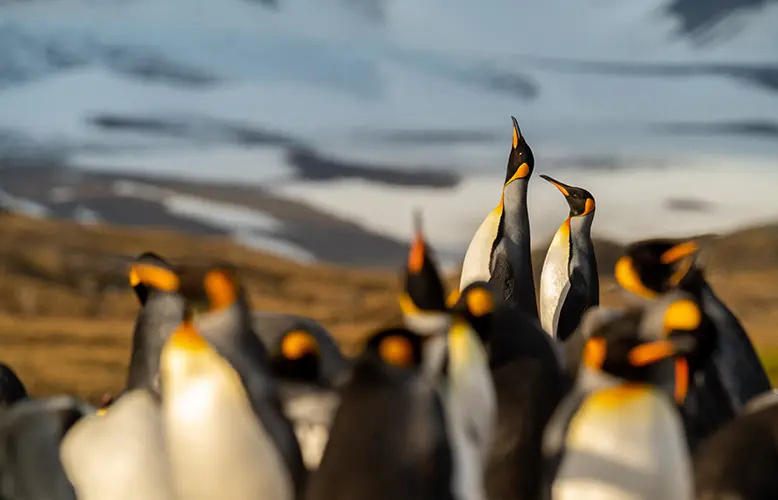
Highlights of the three-week trip include seeing the largest king penguin colonies on the planet, zodiac cruising through crinkling brash ice in Antarctica and visiting the farms in the westernmost settled outposts in the Falklands that have been owned by families for hundreds of years.

Your journey begins with a flight to the world’s southernmost city, Ushuaia. Upon arrival, you’ll be whisked away to a five-star hotel overlooking the Beagle Channel where you can rest and recharge from your travels for the next two nights.

After a leisure day in Ushuaia, during which you can visit Tierra del Fuego National Park, sample the local king crab regional speciality or explore the city and its hiking routes, the real adventure begins as you board the small ship. 

The vessel’s expedition team and officers greet and welcome you onto the 139-passenger ship which features state-of-the-art stabilisers and sleek, spacious suites.

After a fine dining experience, sit down and take snapshots of the glorious mountain scenery as you set sail along the Beagle Channel, passing Magellanic penguins, Rock Cormorants, and sea lion colonies en route to the Falkland Islands.

Drift by icebergs along the Southern Ocean the next day, accompanied by albatrosses, prions, and petrels as they follow the vessel. The expedition team keeps a careful watch on the surroundings, ever ready to highlight whales and dolphins along the way. 

You will also be invited to an informative onboard presentation on the wildlife, history and geology of the Falkland Islands and the Southern Ocean. Additionally, you can actively engage by participating in seabird sighting surveys or contributing to the collection of salinity samples and weather data.

The fifth day is spent exploring the westernmost settled outposts in the Falklands which are home to remote farms that have been owned by families for seven generations. The wild, windswept landscape is devoid of trees and completely silent and undisturbed, bar the lively vibrant local wildlife.

Sheep graze alongside albatrosses and rockhopper, king, and macaroni penguin rookeries, while Caracas fly overhead and upland geese graze by the curling waves of the white sand beaches. 

“It was surreal – it felt like Hawaii but with penguins everywhere. My favourite shot I took here was one of the penguins on the beach. It looked like they were holidaying in the Caribbean.”

While here, you can visit homesteads and gain unique insights into the lives of those living in this remote area over a cup of tea and cakes. 

The next day, you will be taken to Stanley, the capital city of the Falkland Islands. Explore the unique metropolis on foot, popping into shops selling locally-made wool garments, visiting the museum and investigating the lively pub scene. You can also spot sea lions and dolphins in the harbour and bird life by Gypsy Cove.

Over the next two days, you will travel east across the Antarctic Convergence on your way to South Georgia. You’ll be able to spot wildlife from the ship’s deck and listen to fascinating presentations on the region’s history.

Come day nine, you reach South Georgia. Nicknamed the Serengeti of the South, it is famed for its high populations of penguins and seals. Its marine ecosystem is one of the world’s densest examples of biodiversity.

“I’ve been close to wildlife before, particularly in the Galapagos Islands but the backdrop of South Georgia is so dramatic. We’re talking towering ice-peak mountains in close proximity to thousands of penguins. It makes for incredible photo after incredible photo. And the light there is constantly changing. No matter what time of day you go ashore, you’re guaranteed something new.

“The wildlife is magnificent here. Even just on the beaches, you’re getting huge elephant seals, aggressive fur seals, macaroni penguins, albatrosses, petrels, skuas, and gulls everywhere. It’s like walking through a nature documentary. It’s something you really have to see to believe.”

You’ll also come across hundreds of thousands of king penguins of all ages, from fuzzy chicks to mature adults. 

The region’s unique location is to thank for its sensational wildlife scene. It is situated within the Antarctic Convergence but outside the limit of the yearly sea ice. Consequently, the 3,755 square kilometre island is home to tens of millions of breeding penguins, seals and seabirds. 

Spend the next three days snapping sensational shots of the wildlife, towering mountains, immense glaciers, rugged coastline and tabular icebergs. 

You can visit the Grytviken whaling station during your time in South Georgia. It is the first shore-based whaling station for Antarctic whaling. You’ll also be taken to the Norwegian seamen’s church, the active British Antarctic Survey station and the tiny graveyard where the legendary polar explorer, Sir Ernest Shackleton, is buried.

Over the next two days, you gradually navigate through a growing number of icebergs as you journey southward aboard the vessel, heading towards the trip’s final visit destination: The Antarctic Peninsula and the South Shetland Islands. Informative presentations and wildlife watches will keep you entertained along the way. 

As you approach the Antarctic Peninsula, your expedition leader and captain will draw up a three-night itinerary based on the weather and ice conditions. Entering the region from the east, you come across the northern boundary of the Weddell Sea.

The area is thriving with wildlife, as it marks the point where a large cold body of water rotates clockwise driving cold water and ice north towards South Georgia and the South Orkney Islands. The ocean currents derive nutrients from the deep, feeding countless species of marine animals. 

“Antarctica’s landscape is simply alien. Ethereal, beautiful but undeniably strange. It offers such a contrast to The Falklands and South Georgia. 

“My favourite moment in Antarctica was when we were on a zodiac cruise to see wildlife. The light was coming through the clouds giving this blue glow. We were just zodiacing through brash ice as it crinkled and crackled below us.”

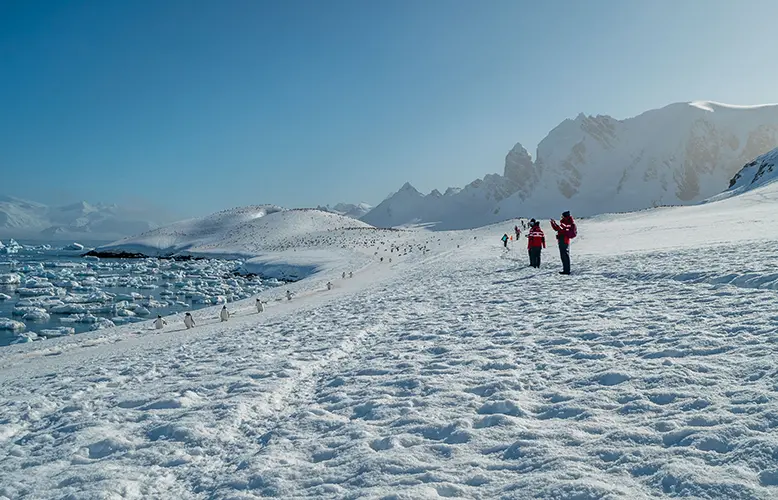
Drift by tabular icebergs and groups of whales as seabirds soar across the sky above you. Spend the days visiting the most scenic bays and channels of the Peninsula and visiting penguin rookeries of Adelie, Chinstrap and Gentoo.

You’ll also see crabeater, leopard, Antarctic fur and elephant seal wallows, bird colonies and minke, orca and humpback whale feeding areas. After four days, you will begin your two-night homeward journey along Drake Passage back to Ushuaia.

After disembarking on your final day, you will catch an afternoon flight to Buenos Aires.

Burnham has some advice for other photographers thinking about taking the same trip: 

“These destinations are on a scale almost unmatched anywhere else on Earth. So, take your time – the wildlife is all around you, you don’t need to rush. Also, get low. The animals are low to the ground so you should be too. Get into their world. Lastly, you don’t need to bring long lenses because the wildlife is always right next to you. Bring wide-angle lenses instead to capture the drama. Finally, be as creative as you can and don’t lose your camera in the water!”