Selected artists will receive a $1,000 stipend.
Beverly Hills SeeksArtists for Sculpture in the Parks Program


Sarah Pickering (born Durham, England, 1972). Landmine, from the series Explosion, 2005. Chromogenic print, 20 × 20 in. (50.8 × 50.8 cm). The Sir Mark Fehrs Haukohl Photography Collection at the Los Angeles County Museum of Art and Brooklyn Museum, TL2020.6.133. © Sarah Pickering. (Photo: Courtesy of the artist)
On view in the Center for Feminist Art, the exhibition includes forty-seven women artists, including Yto Barrada, Bettina von Zwehl, Sarah Pickering, and Vanessa Beecroft, and examines gender, nationhood, and the male-centric development of photography as a medium.
On view March 8–July 7, 2024
In the Now: Gender and Nation in Europe, Selections from the Sir Mark Fehrs Haukohl Photography Collection unites forty-seven emerging and established women artists who are expanding and challenging notions of gender, nationhood, and the practice of photography itself. Drawn from a recent gift of the Haukohl Photography Collection to the Brooklyn Museum and Los Angeles County Museum of Art (LACMA), the exhibition highlights photo-based artwork made since 2000 by women artists born or working from more than sixteen European countries. Building on the first iteration of the exhibition, on view at LACMA in 2021, the Brooklyn Museum presentation features fifteen new artists from the Haukohl collection and illuminates the collection’s feminist underpinnings. The works on view investigate issues of migration, the legacies of nationalism in Europe, and the male gaze as patriarchal power structures continue to shape life and politics in Europe. By pushing the boundaries of photographic methods and techniques, the artists also resist the male-centric focus of the history of photography.
Organized into three thematic sections, the exhibition is located in the Museum’s Elizabeth A. Sackler Center for Feminist Art, which is centered around Judy Chicago’s The Dinner Party (1974–79). Chicago’s landmark installation presents a now-canonical critique of male-centric Western history, to which the diverse array of photographers of In the Now provide a twenty-first-century rejoinder. While Chicago reimagines Western civilization through the lives and achievements of women, artists like Carolle Bénitah, Anna Rackard, and Aida Silvestri use the camera to focus on personal and political stories of family, labor, and migration. Others, including Alexandra Croitoru, Eva Koťátková, and Melanie Manchot, capture the social and patriarchal pressures women face.
“We are grateful to Sir Mark Fehrs Haukohl, whose generosity has made this exhibition possible. The show inspires new narratives about the Brooklyn Museum’s photographic collection by prioritizing important contributions by women photographers. This directly supports the Museum’s mission to provide expansive encounters with art, inspire courageous conversations, and celebrate our communities,” says Carmen Hermo, Associate Curator, Elizabeth A. Sackler Center for Feminist Art, Brooklyn Museum.
The Gender section contends with representations of women’s bodies, as artists react to the personal and political realms of oppressive beauty standards, religion and law, and the history of art. Bettina von Zwehl situates the photographic portrait within the long multimedia history of portraiture with her 2016 series The Sessions. The series comprises fifty silhouette profiles of the same six-year-old girl, their edges torn and distorted to allude to the multiple facets of one individual. In Nu descendant un escalier (2020), Elina Brotherus asserts her role as an artist in front of and behind the camera. By restaging Marcel Duchamp’s 1911–12 Nude Descending a Staircase paintings using herself as the model, Brotherus reflects critically on the female nude, the male gaze, and gender norms in art.
In the Nation section, the artists unpack the social and generational fallout of European colonialism and nationalism. For Papiers Pliés (2007), Yto Barrada collected and folded recycled paper wrappings used by snack-food vendors in her native Tangier, Morocco. The printed French words on the wrappers indicate the sheets’ original function as forms from a textile factory, alluding to the legacy of France’s colonization of Morocco (1912–56) and the economic industries that propelled it. Sarah Pickering’s Landmine (2005) and Artillery (2005) depict the English countryside violently disrupted by mines, artillery, and other weapons. Upon closer inspection, they are revealed to be small-scale simulated explosions, reminding viewers of the relative peace “at home” in England while British troops supported the U.S. invasion of Iraq.
Artists in the Photography section grapple with a changing medium that has historically been hostile and exclusionary to women. Some engage early photographic methods in new ways or adapt found photography. Others reject the boundaries of the medium by incorporating painting, performance, film, and textiles, the last imbuing their work with the gendered politics of art forms historically categorized as “women’s work.” In La cartina indiscreta (Indiscreet Map; 2022), Carmen Calvo assembles found images around the body and face of a nude woman as she stands behind a translucent curtain, evoking Surrealist artists to comment on the woman’s pronounced visibility and simultaneous entrapment. Silvia Rosi’s Self-Portrait as My Father (2019) chronicles her family’s migration from Togo to Italy. Dressed as her father in a suit and tie, the artist marks her father’s change in status by surrounding herself with tomatoes, the crop her father picked as a migrant field worker in Italy. By holding the shutter release in the photo, Rosi signals her own identity as the photographer and steward of her family history.
The exhibition is accompanied by a catalogue of the collection titled The Sir Mark Fehrs Haukohl Collection of European Women Photographers, 2000–2020. Published by Steidl and edited by Manfred Heiting, the catalogue includes an essay by Rebecca Mark, Director of the Institute for Women’s Leadership and a Professor in the Department of Women’s, Gender, and Sexuality Studies at Rutgers University.
In the Now: Gender and Nation in Europe, Selections from the Sir Mark Fehrs Haukohl Photography Collection is organized by the Brooklyn Museum and the Los Angeles County Museum of Art. The exhibition is curated by Drew Sawyer, former Phillip and Edith Leonian Curator of Photography, Brooklyn Museum; Britt Savelsen, Curator and Head, Wallis Annenberg Photography Department and Prints and Drawings Department; and Eve Schillo, Associate Curator, Wallis Annenberg Photography Department, Los Angeles County Museum of Art. The Brooklyn Museum presentation is organized by Carmen Hermo, Associate Curator, Elizabeth A. Sackler Center for Feminist Art, with Imani Williford, Curatorial Assistant, Photography, Fashion, and Material Culture, Brooklyn Museum.
About the Sir Mark Fehrs Haukohl Photography Collection
In 2021, the Brooklyn Museum and the Los Angeles County Museum of Art (LACMA) announced the joint acquisition of two hundred contemporary photographs by women artists from seventeen countries in Western and Eastern Europe. The generous gift comes from Houston-based collector Sir Mark Fehrs Haukohl, whose expansive collection has been built over the course of twenty years and showcases an impressive range of styles and approaches to photography from that period. This is the Brooklyn Museum’s largest joint acquisition as well as the largest gift of contemporary photography ever received by the Museum, and it bolsters its long-standing commitment to collecting works by women artists.

Benny ‘One Layer’ Johnson: The Maverick of Digital Photography
In the realm of digital photography, Benny ‘One Layer’ Johnson is a maverick. The Tallahassee, Florida native has sent shockwaves through the community with a startling revelation – he eschews the conventional multi-layered approach to photo editing. Instead, he operates exclusively on the background layer in Photoshop, a technique that many equate to a high-stakes gamble.
Unveiling his unique style at a recent workshop, Johnson, renowned for his stunning landscapes and emotive portraits, demonstrated how he adjusts brightness and contrast and removes spots directly on the original layer. This approach, often deemed risky by experts, involves making irreversible changes to the base image. The conventional wisdom of using multiple layers and masks for flexibility and non-destructive editing is conspicuously absent from Johnson’s workflow.
Johnson’s technique, encapsulated in his ‘One Layer Wonders’ series, is more than just a method – it’s a testament to his confidence and conviction. He dismisses the use of layers as overly cautious, believing that the process of art should not be mired in second-guessing and endless tweaks. The final product, he argues, should be a reflection of the artist’s decisiveness and unfiltered vision.
Johnson’s methodology has sparked a heated debate. Many photographers and Photoshop experts have voiced concern, likening his approach to reckless surgery or precarious bomb defusal. However, amid the controversy, there’s an undercurrent of grudging respect. Despite his unconventional method, Johnson’s work has been lauded for its raw, visceral beauty, earning him a place in the annals of digital art history. As the heated discussions continue, one thing remains clear: Benny ‘One Layer’ Johnson is a force to be reckoned with, changing the game one layer at a time.

Tallahassee, Florida: In a move that’s left the digital art world reeling with horror, local photographer Benny “One Layer” Johnson has confessed to a practice that’s nothing short of digital heresy: he edits all his photos exclusively on the background layer in Photoshop.
Johnson, whose stunning landscapes and portraits have won him mild fame, dropped this bombshell during a recent workshop. “Layers are for cakes, not art,” he joked, as he boldly adjusted the brightness, contrast, and even did spot removals, all on the original, irreversible background layer. His method involves making all adjustments – from color correction to cloning and even frequency separation – directly on the original, unalterable background layer, a practice akin to walking a tightrope without a net.
When questioned, Johnson stood his ground with a smirk, offering a bold statement that sums up his philosophy: “In this art form, your confidence is everything. If you’re not daring enough to commit your vision to the background layer, then perhaps you’re playing it too safe. To me, the background layer isn’t just a canvas; it’s a testament to the artist’s confidence and conviction. Why hide behind layers and masks? True art, like true courage, lies in making that irreversible stroke of genius.”
Despite the widespread panic in digital art communities, Johnson’s work, particularly his “One Layer Wonders” series, has garnered acclaim for its raw, unfiltered beauty. “Who needs layers when you’ve got guts?” Johnson remarked, as he daringly merged a new adjustment directly onto his only layer, sending shivers down the spines of Photoshop enthusiasts everywhere.
This cavalier approach has horrified photographers and editors alike. “It’s like a surgeon using a chainsaw,” gasped one seasoned Photoshop expert. Another commented, “Watching him work is like witnessing someone defuse a bomb with a hammer. It’s terrifying, yet you can’t look away.” Despite the collective anxiety he’s causing, Johnson’s “One Layer Wonders” have become a topic of grudging admiration. “There’s a fine line between genius and madness, and I’m not sure which side he’s on,” confessed a Photoshop instructor.

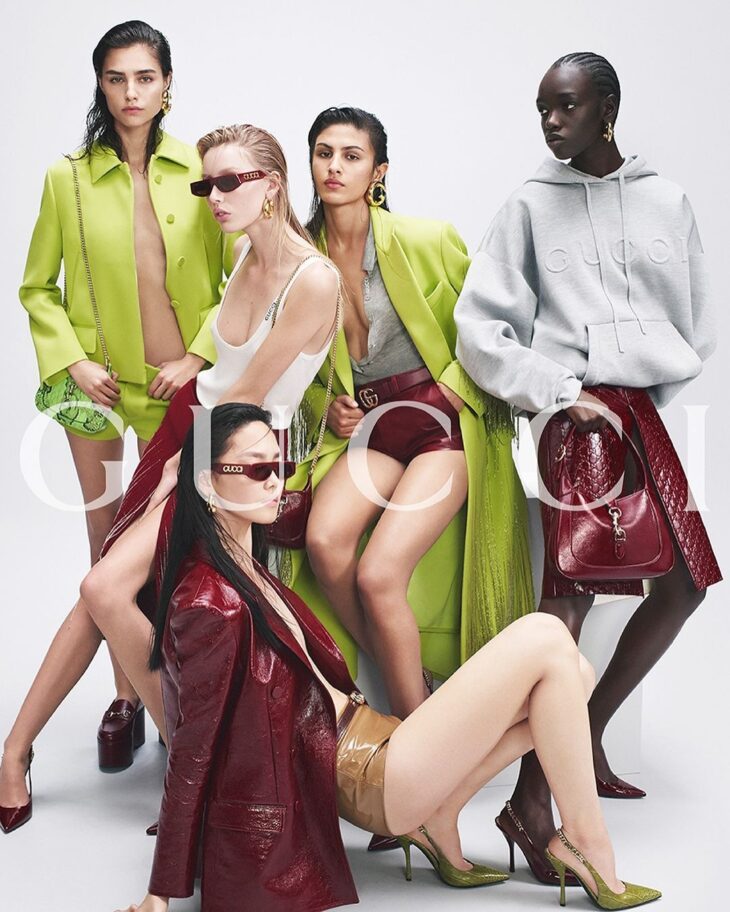
Gucci Spring Summer 2024 campaign comes with a striking return to the classic storytelling of a fashion photograph, Gucci’s first campaign under label’s newly appointed Creative Director Sabato De Sarno, titled “Ancora,” is orchestrated on a canvas of iconic simplicity. Captured by the legendary David Sims, the Spring Summer 2024 collection comes to life through a lens that is as much about the legacy of photography as it is about the vibrant future of fashion.
Under the direction of Sabato De Sarno and through the minimalist mastery of David Sims’ photography, Gucci Ancora redefines luxury with a bold yet understated palette. Art Director Riccardo Zanola’s precise aesthetic, coupled with Alastair McKimm’s fashion-forward styling, weaves a narrative of timeless elegance hitting the Gucci shops with the unfolding of the Spring Summer 2024 season.
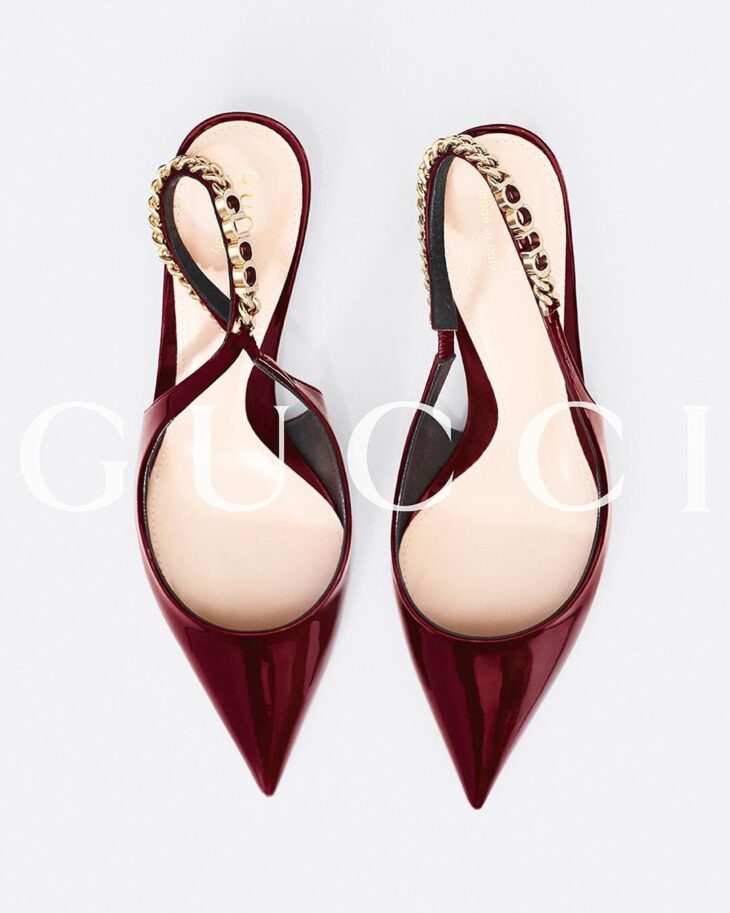
Inspired by the heart of Florence’s iconic square, the Gucci Signoria pumps (pictured above), shaped under the leadership of Creative Director Sabato De Sarno for the Spring Summer 2024 line, capture the essence of modern elegance while paying homage to the eternal charm of the brand’s birthplace. Similarly, the newly introduced Gucci Horsebit platform loafers articulate a fresh perspective on the brand’s classic footwear, marrying tradition with a bold, contemporary twist.
Complementing the collection’s silhouette is the artistry of Hair Stylist Duffy and Makeup Artist Lucia Pieroni, whose work accentuates the natural allure of Gucci’s diverse ensemble of models. The finishing touch of manicurist Ama Quashie adds an understated sophistication to the campaign’s overall look.
Furthermore, embodying the spirit of the collection are the five new faces of Gucci—Fadia, Ana, Jiahui, Nyajuok, and Violet—each representing a facet of the brand’s inclusive vision. Alongside them are the enigmatic presences of Arthur Hargous, Prince Diamond, and the dynamic Ana Rossolovich.
“An Ode to Photography” is more than a new chapter for Gucci’s latest campaign—it is a nod to the formative moments of De Sarno’s career while celebrating fashion photography and where it is today.
Discover the complete Gucci Spring Summer 2024 campaign in our gallery:
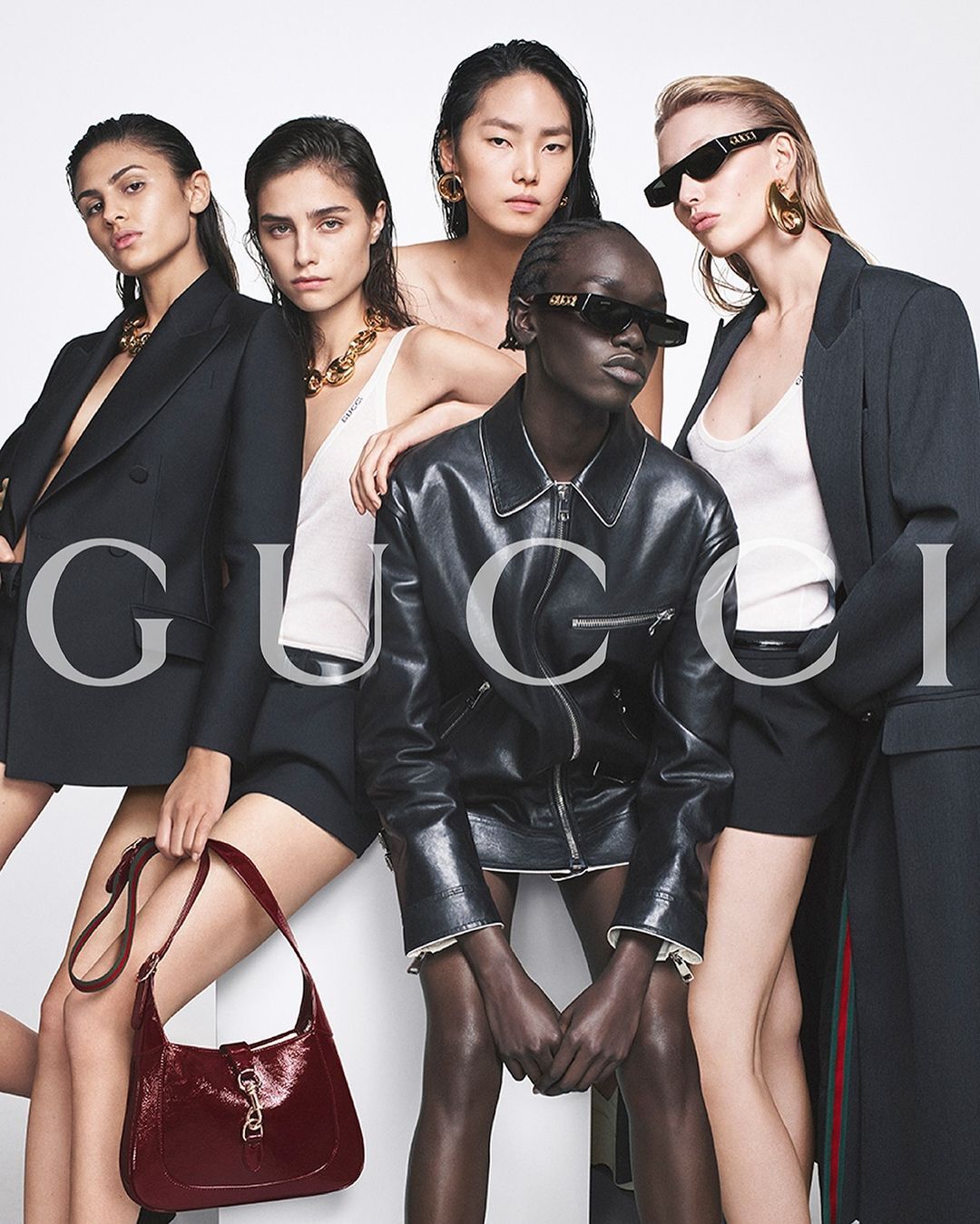
Photographer David Sims
Creative Director Sabato De Sarno
Art Director Riccardo Zanola
Fashion Editor Alastair McKimm
Hair Stylist Duffy
Makeup Artist Lucia Pieroni
Nail Technician Ama Quashie
Models: Ana Rossolovich, Arthur Hargous, Fadia Ghaab, Jiahui Zhang, Nyajuok G, Prince Diamond, Violet Hume


He helped found a punk-rock band when he was 14. That led to a long career as an advocate for Native American and environmental causes.
Klee Benally, a dynamic Navajo activist, artist and punk-rock musician who championed Native American and environmental causes, died on Dec. 30 in Phoenix. He was 48.
His death, in a hospital after a short illness, was confirmed by his sister, Jeneda Benally.
For decades, Mr. Benally, who lived in Flagstaff, Ariz., fought the expansion of the Arizona Snowbowl Ski Resort on one of the San Francisco Peaks, a mountain range just north of Flagstaff that 13 tribes consider sacred. He also fought the resort’s use of treated wastewater to make snow, a practice that Native Americans and environmental groups said was poisoning the ecosystem. He protested against a pumice mine on those same peaks, and against uranium mining and transport in the area.
He campaigned for the rights and care of Indigenous homeless people and against racial profiling. He made films and art about his activism.
He was a community organizer and a youth counselor; he taught media literacy and film to Indigenous teenagers; and he marched against the celebration of Thanksgiving. Late last year he published a book, “No Spiritual Surrender,” about his efforts practicing what he called Indigenous anarchy, and he created a board game, “Burn the Fort,” in which Native American warriors fight off colonizers (and learn some history while doing so).
He chained himself to an excavator, was charged with trespassing and joined numerous legal complaints.
But his first foray into activism was through music, in 1989. He was 14 when he and his siblings, Jeneda and Clayson, formed Blackfire, a high-velocity punk band that mixed traditional Navajo chants and music with protest songs about the oppression of Indigenous people.
Mr. Benally embraced the middle-finger-to-the-world punk ethos — he loved the Ramones, whose music he introduced to his mother, a folk singer — and he could really shred a guitar. The Ramones loved Blackfire back: C.J. Ramone produced the band’s first EP, “Spirit in Action” (1994), and Joey Ramone sang on two of the songs on “One Nation Under” (2002), its first full-length album.
Critics were admiring, too. In 2007, David Fricke of Rolling Stone touted Blackfire’s fourth album, “[Silence] Is a Weapon,” as “pure ire, CBGB-hardcore-matinee protest with jolts of ancient chorale.”
The band played at South by Southwest and other music festivals but declined to play in bars, at least at first. Mr. Benally thought it would be hypocritical, given that alcohol abuse was an issue on reservations. In addition, at the time the Benally siblings were all under 21.
“Some people watch too many movies and think John Wayne killed all the Indians or they’re out dancing with wolves,” he told The Albuquerque Journal in 2003, explaining Blackfire’s mission to educate audiences. “But in reality there are over 500 nations throughout the U.S. carrying on their cultures, their own individual ways of life, their own languages and their own ceremonies.”
Klee Jones Benally was born on Oct. 6, 1975, in Black Mesa, Ariz., on the Navajo reservation near Flagstaff. Music and activism ran in the family. Klee’s father, Jones Benally, is a traditional Diné (as the Navajo call themselves) medicine man; his mother, Berta Benally, is an activist and folk musician of Russian-Polish Jewish heritage who grew up in the folk scene of Greenwich Village. The couple met in Los Angeles, where she was working with Hopi elders.
Klee and his siblings were brought up with their father’s Diné traditions, and they grew up performing traditional dances. Their mother introduced them to the folk canon; Blackfire would later set some of Woody Guthrie’s poems to music. The area where they lived was part of a land dispute that forced the relocation of thousands of Navajo people, and attending protests became a family affair.
In addition to his sister and his parents, Mr. Benally is survived by his wife, Princess Benally, and his brother.
Blackfire disbanded after two decades, mostly so the Benally siblings could concentrate more directly on advocacy and activism.
Mr. Benally often framed his environmental work in terms of religious freedom. “As Indigenous people in the so-called United States, we don’t have guarantees for our religious freedoms like the rest of you,” he told The Arizona Republic in 2013. “This is a struggle for cultural survival — the struggle to protect sacred spaces.”
Mr. Benally was a local hero in Flagstaff, where he founded a number of nonprofit organizations and aid groups. He was both angry and pragmatic; he liked to say that everyone was indigenous to somewhere.
“He was a powerhouse of anticolonial thought and action — ever ready to protect the land,” Dallas Goldtooth, a Native American activist and actor, wrote on X, formerly known as Twitter.
Mr. Benally explained his worldview in a 2020 interview with Spirituality Health magazine: “As an artist, there’s no dichotomy between art and life with our traditional teachings as Diné people. There’s no separation; our life is creation. So our creative expression comes in many different ways. What I look at is: What are the issues facing our communities, and what strategies can be most effective? Is it going to be through song? Is it going to be through prayer or action? Or can it be all of them?”


#inform-video-player-1 .inform-embed { margin-top: 10px; margin-bottom: 20px; }
#inform-video-player-2 .inform-embed { margin-top: 10px; margin-bottom: 20px; }
Amber Johnson of Brazil has been selected as the January Artist of the Month for the Wabash Valley Art Guild. Her exhibit at the Vigo County Public Library, features two of her favorite specialties — oil painting and photography.
Johnson became interested in art when she attended high school. “My art teacher encouraged me by saying she thought I had talent,” Johnson said.
Currently she is enjoying oil painting on canvas and prefers the Bob Ross happy style. Her display shows her favorite subjects: mountains and landscapes. Johnson sells her paintings and crafts in a booth at the Bushel and Peck craft shop in Brazil. She also has a website her paintings, prints and pillows can be purchased. The site is AmberJohnson@fineartamerica.com. This is also her email address.
Although Johnson is a certified Pharmacy Technician at the Putnam County Hospital, she is looking forward to retirement. She has plans to teach some canvas painting and wine classes.
The Wabash Valley Art Guild meets regularly at the Vigo County Public Library on the second Thursday of the month at 6:15 p.m. For additional information, please call Jim Rhodes, president at 812-201-6770.
#inform-video-player-3 .inform-embed { margin-top: 10px; margin-bottom: 20px; }





