“Union,” a large-scale, site-specific sculpture by Seattle artist John Grade that resides in the heart of Washington Park Arboretum, meshes art and nature.
John Grade’s mesmerizing sculpture at the Arboretum meshes art and nature


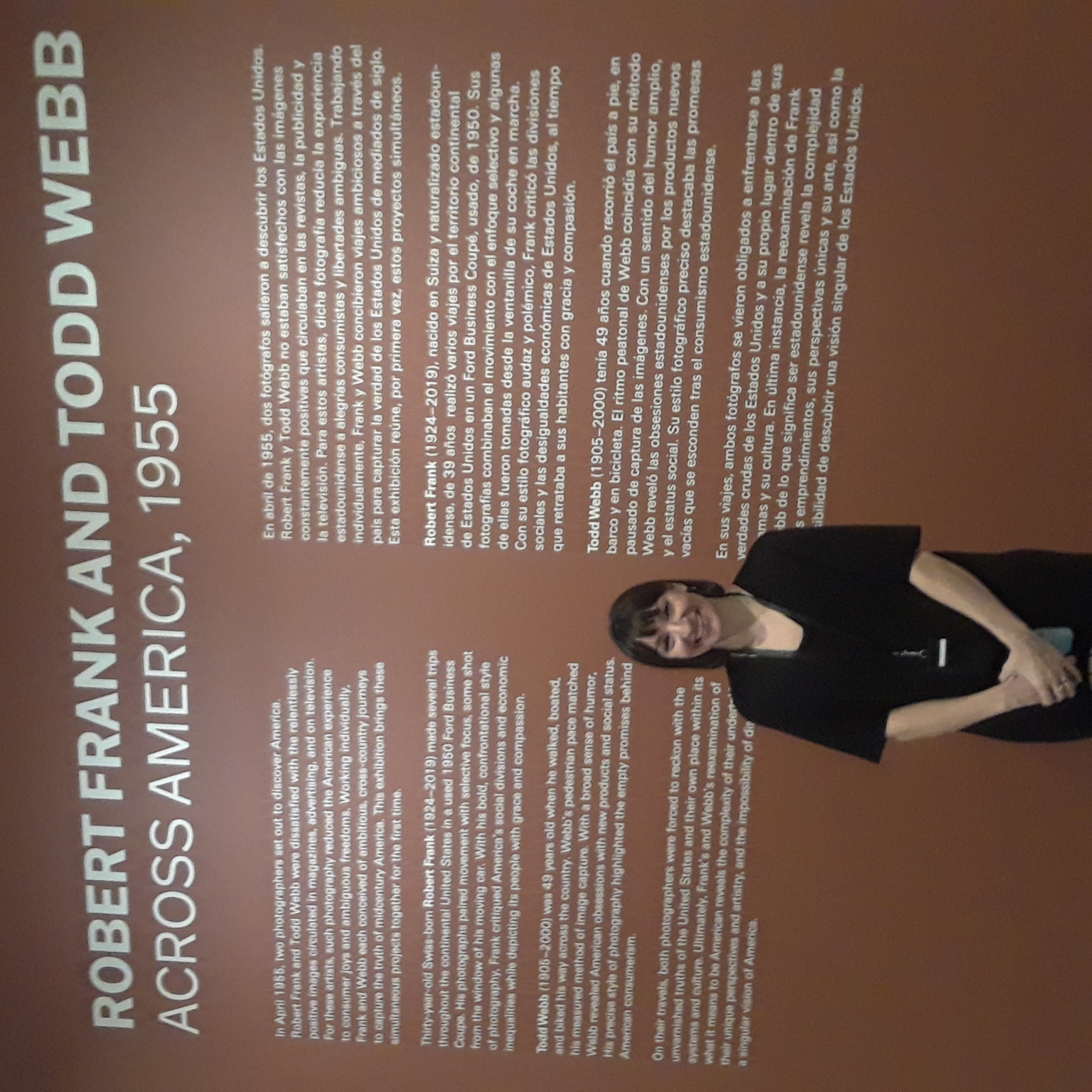
Two photographers, unknown to each other, traveled across the United States searching for myth-challenging realities at the mid-century. Both lensmen received a Guggenheim Foundation fellowship. Each photographer’s objective was the same: to document the American landscape, people and culture. The year was 1955.
The joint survey “Robert Frank and Todd Webb: Across America, 1955,” at the Museum of Fine Arts, Houston, is a groundbreaking show uniting both photographers for the first time. Curated by Lisa Volpe, the exhibit metaphorically transports viewers cross country into a time travel reality seven decades earlier.
The Swiss-born Frank became a quintessential chronicler of the American zeitgeist. Driving roads armed with his Leica camera, Frank also constructed his own version of gritty, unapologetic neorealism. Frank’s well-known book The Americans resulted from this project. Originally published by Robert Delpire in 1958, Paris as Les Americains is undoubtedly a classic.
 Parade, Hoboken, New Jersey, 1955–1956, printed 1972–1977, at the Museum of Fine Arts, Houston (Collection Museum of Fine Arts, Houston, the Target Collection of American Photography, museum purchase funded by Target Stores. © The June Leaf and Robert Frank Foundation.)” srcset=”https://www.mecreates.com/story/news/wp-content/uploads/2024/01/13_Frank-Parade-Hoboken-New-Jersey-scaled.jpg 2560w, https://www.papercitymag.com/wp-content/uploads/2024/01/13_Frank-Parade-Hoboken-New-Jersey-300×194.jpg 300w, https://www.papercitymag.com/wp-content/uploads/2024/01/13_Frank-Parade-Hoboken-New-Jersey-1024×663.jpg 1024w, https://www.papercitymag.com/wp-content/uploads/2024/01/13_Frank-Parade-Hoboken-New-Jersey-768×497.jpg 768w, https://www.papercitymag.com/wp-content/uploads/2024/01/13_Frank-Parade-Hoboken-New-Jersey-1536×994.jpg 1536w, https://www.papercitymag.com/wp-content/uploads/2024/01/13_Frank-Parade-Hoboken-New-Jersey-2048×1325.jpg 2048w, https://www.papercitymag.com/wp-content/uploads/2024/01/13_Frank-Parade-Hoboken-New-Jersey-600×388.jpg 600w” sizes=”(max-width: 2560px) 100vw, 2560px”>
The second photographer — Detroit native Todd Webb — vanished into obscurity for decades along with his negatives and photographs.
Todd Webb, taught by legendary landscape photographer Ansel Adams, captured 10,000 striking images while walking, biking and boating across America (versus Frank, who traveled by car). Prior to embarking on a career in photography, Webb worked as a stockbroker. He lost everything following the Stock Market Crash in 1929. His images of city scenes in Detroit, New York City, London and Paris are unforgettable. But as great as that part of Webb’s oeuvre is, nothing tops his celebrated series he took in eight African countries, which are featured in the book Todd Webb in Africa: Outside the Frame (2021).
 Between Lovelock and Fernley, NV 1956, printed 2023, at the Museum of Fine Arts, Houston. The look back on America then, curated by the MFAH’s Lisa Volpe, resonates today. (Courtesy Todd Webb Archive. © Todd Webb Archive)” srcset=”https://www.mecreates.com/story/news/wp-content/uploads/2024/01/02_Webb-Between-Lovelock-and-Fernley-NV-1-scaled.jpg 2560w, https://www.papercitymag.com/wp-content/uploads/2023/10/02_Webb-Between-Lovelock-and-Fernley-NV-1-300×233.jpg 300w, https://www.papercitymag.com/wp-content/uploads/2023/10/02_Webb-Between-Lovelock-and-Fernley-NV-1-1024×794.jpg 1024w, https://www.papercitymag.com/wp-content/uploads/2023/10/02_Webb-Between-Lovelock-and-Fernley-NV-1-768×596.jpg 768w, https://www.papercitymag.com/wp-content/uploads/2023/10/02_Webb-Between-Lovelock-and-Fernley-NV-1-1536×1191.jpg 1536w, https://www.papercitymag.com/wp-content/uploads/2023/10/02_Webb-Between-Lovelock-and-Fernley-NV-1-2048×1589.jpg 2048w, https://www.papercitymag.com/wp-content/uploads/2023/10/02_Webb-Between-Lovelock-and-Fernley-NV-1-600×465.jpg 600w” sizes=”(max-width: 2560px) 100vw, 2560px”>
In the well-curated MFAH exhibit, Webb’s vision connects him to a lonesome road in Nevada and the working class of small-town America. One highlight of the exhibit is Webb’s photo of a 14-year-old riverboat captain named Clifton Ray Durham.
Lisa Volpe — curator of photography at the MFAH whose recent coups have included exhibitions on Gordon Parks and Georgia O’Keeffe, the latter as the first ever show on the painter as photographer — notes the differences between the two photographers but also the similarities.
“It was interesting how much they kind of come together, really, into two threads,” Volpe says. “For both photographers, it’s rampant consumerism. It’s this idea that ‘As long as we’re buying things, we are practicing our freedoms and we’re keeping up with everybody else.’ Which is still the case today.
“And then, of course, racism and segregation (appear in both Frank and Webb’s images). They were both horrified at what they saw and saw, notably, in different parts of the country.”
Robert Frank’s The Americans still resonates today as an unflinching look into the real truth behind American society. Eventually Frank, who once referred to himself as Walker Evans’s chauffeur, turned his focus away from photography and towards cinema. Over the years, MFAH has screened numerous Frank films including Pull My Daisy (1959), Me and My Brother (1968), C’est Vrai (1990) and the Rolling Stones documentary Cocksucker Blues (1972).
 Joe, Abiquiú, NM, 1955, printed 2023, at the Museum of Fine Arts, Houston (Courtesy Todd Webb Archive. © Todd Webb Archive.)” srcset=”https://www.mecreates.com/story/news/wp-content/uploads/2024/01/08_Webb-Cowboy-Lexington-NE-scaled.jpg 2560w, https://www.papercitymag.com/wp-content/uploads/2023/10/08_Webb-Cowboy-Lexington-NE-300×195.jpg 300w, https://www.papercitymag.com/wp-content/uploads/2023/10/08_Webb-Cowboy-Lexington-NE-1024×667.jpg 1024w, https://www.papercitymag.com/wp-content/uploads/2023/10/08_Webb-Cowboy-Lexington-NE-768×500.jpg 768w, https://www.papercitymag.com/wp-content/uploads/2023/10/08_Webb-Cowboy-Lexington-NE-1536×1000.jpg 1536w, https://www.papercitymag.com/wp-content/uploads/2023/10/08_Webb-Cowboy-Lexington-NE-2048×1333.jpg 2048w, https://www.papercitymag.com/wp-content/uploads/2023/10/08_Webb-Cowboy-Lexington-NE-600×391.jpg 600w” sizes=”(max-width: 2560px) 100vw, 2560px”>
But even with his later cinematic focus, it is Frank’s photos, in conversation with Webb’s in this powerful and illuminating exhibition which destroy the myth of a monoculture by embracing realism and avoiding tourist stops.
By photographing America’s roads, diners, bars, gas stations, cowboys and other interesting working-class characters, Robert Frank and Todd Webb peeled back layers of mythology to arrive at the truth. This incredible exhibit encourages us to view America from these photographers’ unerring, unique, yet often shared perspectives.
 All Things Considered, 2014, at Asia Society Texas Center (Elaine W. Ng and Fabio Rossi Collection)” srcset=”https://www.mecreates.com/story/news/wp-content/uploads/2024/01/s3622.All-Things-Considered_2.Final_.jpg 2500w, https://www.papercitymag.com/wp-content/uploads/2023/09/s3622.All-Things-Considered_2.Final_-300×174.jpg 300w, https://www.papercitymag.com/wp-content/uploads/2023/09/s3622.All-Things-Considered_2.Final_-1024×593.jpg 1024w, https://www.papercitymag.com/wp-content/uploads/2023/09/s3622.All-Things-Considered_2.Final_-768×445.jpg 768w, https://www.papercitymag.com/wp-content/uploads/2023/09/s3622.All-Things-Considered_2.Final_-1536×890.jpg 1536w, https://www.papercitymag.com/wp-content/uploads/2023/09/s3622.All-Things-Considered_2.Final_-2048×1186.jpg 2048w, https://www.papercitymag.com/wp-content/uploads/2023/09/s3622.All-Things-Considered_2.Final_-600×348.jpg 600w” sizes=”(max-width: 2500px) 100vw, 2500px”>
Tsherin Sherpa, a contemporary artist from Nepal, explores the East-West cultural dichotomy while incorporating narratives not typically explored in traditional thangka paintings. Originally working as a Tibetan Buddhist thangka painter with his father Master Urgen Dorje, Sherpa has moved beyond deities to champion secular spirits.
Much like Japanese artist Taskashi Murakami, he also embraces various iterations of Pop art. Recently, Sherpa collaborated with Commes des Garçon designer Junya Watanabe for a dress based on a orange-blue-green grid pattern. Versatility and being open minded have become major aspects of his artistic practice.
At Houston’s Asia Society Texas Center, “Tsherin Sherpa: Spirits” explores the artist’s interest in narrative-driven storytelling, reimagining iconography and establishing new realities.
Dr. Owen Duffy, Asia Society Texas Center’s recent hire as the museum’s Nancy C. Allen curator and director of exhibitions, oversees the Houston presentation of this traveling exhibition organized by the organized by the Virginia Museum of Fine Arts, Richmond, where it debuted in 2022.
Tsherin Sherpa developed a deep interest in comic books while growing up, which is reflected in his colorful work. Although he recalls reading comics from India like Amar Chitra Katha, he spent more time engrossed in Western comic books like The Adventures of Tintin by Hergé, Asterix, Archie, Thor and Spider Man.
“There was a comic book called Tintin in Tibet,” Sherpa says. “So, actually, Tintin travels to Kathmandu, Nepal, and then from there, travels to Tibet, and comes across a Yeti creature.”
The irreverent aspect of Tsherin Sherpa’s work is undoubtedly part of its charm. For example, the showstopper fiberglass sculpture Skippers (Kneedeep) (2019 to 2020) features a pink bubble gum-blowing spirit figure.
And although inspired by the concept of Tibetan protest against the Chinese government, the painting 8 Spirits (2012) also references Andy Warhol’s Eight Elvises (1963) in its seriality.
The painting Oh My God-Ness (2009) features a figure wearing a Tibetan protection amulet and polka-dotted underwear inspired by Damien Hirst’s spot paintings. Similarly, Staying Alive (To Sexy to Die) (2011) references John Travolta’s character in Saturday Night Fever (1977).
Although hailing from Nepal, Sherpa has also spent time in California. He envisions Westerners getting past the idea of associating the term Sherpa with climbing Mount Everest or trekking along the Annapurna Circuit.
Born Jangchub Tshering, Sherpa recalls that the time he was “interrogated by a U.S. immigration officer at the airport and the official asked, ‘How many mountains have you climbed?’ ” Sherpa laughs.
 Himalayan Spirits, 2021, at Asia Society Texas Center (Collection Virginia Museum of Fine Arts)” srcset=”https://www.mecreates.com/story/news/wp-content/uploads/2024/01/2022_74a-d_v1_TW_202207.jpg 2500w, https://www.papercitymag.com/wp-content/uploads/2023/09/2022_74a-d_v1_TW_202207-300×142.jpg 300w, https://www.papercitymag.com/wp-content/uploads/2023/09/2022_74a-d_v1_TW_202207-1024×483.jpg 1024w, https://www.papercitymag.com/wp-content/uploads/2023/09/2022_74a-d_v1_TW_202207-768×362.jpg 768w, https://www.papercitymag.com/wp-content/uploads/2023/09/2022_74a-d_v1_TW_202207-1536×725.jpg 1536w, https://www.papercitymag.com/wp-content/uploads/2023/09/2022_74a-d_v1_TW_202207-2048×967.jpg 2048w, https://www.papercitymag.com/wp-content/uploads/2023/09/2022_74a-d_v1_TW_202207-600×283.jpg 600w” sizes=”(max-width: 2500px) 100vw, 2500px”>
Sherpa describes his stunning Himalayan Spirits (2021) painting by discussing the neighborhood his studio is situated in. “Around my studio, there are people looking after their goats and cows, children playing on the street. People just taking normal walks,” he tells PaperCity. “In the background, their faces are not drawn, but they are blank faces with all of these people in the background.
“And the idea was as if all these people’s aspirations are bringing forth these Himalayan spirits.”
“Robert Frank and Todd Webb: Across America, 1955” is on view through this Sunday, January 7 at the Museum of Fine Arts, Houston. You can get the exhibition catalogue through the MFAH Shop here. Find more exhibition details here. The exhibition organized by the MFAH appropriately will hit the road, traveling to the Addison Gallery of American Art at Phillips Academy, Andover, Massachusetts and the Brandywine Museum of Art, Chadds Ford, Pennsylvania.
“Tsherin Sherpa: Spirits” is on view through this Sunday, January 7 at Asia Society Texas Center. Find more exhibition details here.

For the subset of the internet that lives to dissect fashion and celebrity, W Magazine’s annual Performance Issue, released online Wednesday, has become the locus of the so-bad-it’s-good debate.
A multicover compendium of the year’s award season favorites captured offhandedly in the clothes by Loewe, Bottega Veneta and other keepers of the avant-garde fashion flame, it is not just a record of some of the biggest names in entertainment, but an opportunity to discourse on the legendary German photographer Juergen Teller’s unorthodox, loose and seemingly ersatz photographs, which this year include Natalie Portman, Margot Robbie, Jodie Foster, Ryan Gosling, Julianne Moore and eight others, chosen by the magazine’s editor-at-large, Lynn Hirschberg.
The jokes and commentary began pouring in on social media on Wednesday morning. “Another year, another round of Juergen Teller for W Best Performances portfolio discourse,” bemoaned one X user, a self-proclaimed defender of Teller. Another X commenter shared a GIF of Michael Jackson peacefully pushing down a gun and wrote: “Another year of begging Juergen Teller to put his camera down.”
The last time Teller shot the covers, in 2021, magazines published think pieces and rounded up the criticisms, but this year’s conversation seemed generally pro-Teller. “This is my genuine reaction every time he takes a photo of a celebrity looking like they just sneezed while sitting on a trash heap,” said a Teller apologist, adding a GIF of Carrie Bradshaw squealing at the Eiffel Tower. “I know y’all are gonna be hating on this on Twitter all day but this spread is Juergen at its best lol,” Vogue writer José Criales-Unzueta wrote on his Instagram stories.
When most celebrity magazine covers barely register, why do Teller’s pop? “They’re really loud and they’re really different,” says W Magazine’s editor Sara Moonves. “Juergen almost makes a mini-movie while we’re doing this, and it sparks a lot of thought in people the way that every great movie does. It creates a performance.”
Contemporary magazine covers and Instagram have trained us to gaze upon celebrities as photoshopped, shapewear-smoothed soft serve. But Teller’s photographs — he shot the magazine’s portfolios in 2020 and 2021, and returns this year after a two-year hiatus — are a mischievous jab at the Hollywood machine, or an affront to the sacred pact of glamour.
Teller, who is 59 and often wears small and colorful jogging shorts to fashion shows in Europe, came of age as a photographer in the 1990s. His crisply bizarre images, especially campaigns for Marc Jacobs and images of Kate Moss, made him a bona fide star in the 21st century.
“He’s been taking images like this for the last 30 years,” says Antwaun Sargent, a director at Gagosian Gallery who has written extensively on the overlap between fashion and fine-art photography. What makes them stand out now is their defiance of contemporary photography standards or expectations, he says. “The history of photography is the history of technology, and Juergen goes against that current.” We all have the tools to make “perfect” images — Photoshop, Facetune, filters, etc. — so when someone chooses to make an imperfect image, “it allows a real opportunity to question who we are in relation to the self in the present world,” Sargent says. “It allows a consideration of the truth.”
Teller regularly shoots ad campaigns for brands such as Loewe and Saint Laurent, but none start conversations like his W Magazine shoots — likely because of their star power. Here is sexiest man alive emeritus George Clooney, in a polo and jeans, clutching two children’s bicycles in 2021. Here is Laura Dern in 2020 — posing like your mom would for a post-fancy dinner candid in the parking lot?
Those 2021 photographs, in particular, were a hit, Sargent says: “They made [magazine] images matter again.”
Teller appears to have given this year’s pictures a few more beats — “Barbie” star Robbie wears a Bottega Veneta dress festooned with pompoms in front of a few dozen wig stands (a doll among dolls!). Portman, who plays a leech-like method actress in “May December,” poses in a tacky tourist gift shop. Wild guy Nicolas Cage sprawls on a leopard sofa in a leopard shirt. As for some of the others — Greta Lee standing up in the front seat of a sightseeing sports car, Charles Melton clutching a head of broccoli — who knows? (“Do you know how good looking you have to be for Juergen Teller not to be able to make you look bad ?!!” an X user joked of Melton’s oddball prop portraits.)
“Let’s shoot on the most glamorous street in Los Angeles!” Moonves recalls Teller and Dovile Drizyte, Teller’s wife and creative partner, telling her, giggling. What they had in mind was Hollywood Boulevard: “It’s so fun, it’s so vibrant and it has this amazing energy to it.”
The images are the doomscrolling age’s answer to Vanity Fair’s once venerable Hollywood Issue, with its resplendent (and digitally manipulated) trifold of A-list actors in glittering gowns and tailcoats, heaped on each other’s laps and snapped in chiaroscuro by Annie Leibovitz. Instead, these embody our ambivalent relationship to fame, as we often demand that celebrities look perfect, but when they do look perfect, we get suspicious or even angry. Teller’s style is an embrace of that tension: Is it really so naughty to look a little silly, have a little fun?
The W Magazine photos’ tossed-off aesthetic is not, as these things sometimes are, the result of painstaking pretense; Riz Ahmed, who was captured for the 2021 issue leaning against a tree, said the “shoot was the fastest of my life. 20 seconds, two clicks.”
After that, users on X, formerly known as Twitter, began sharing unflattering photographs of celebrities — Hillary Clinton touring a housing project, Sad Keanu Reeves — with the caption “Photographed by Juergen Teller,” which earned a page on KnowYourMeme.
Vulture rounded up the worst images. Paper Magazine collected the memes. Elephant Magazine, an art magazine, accused Teller of missing the irony that “despite his antagonism towards” celebrity photographers, he now finds themselves among their ranks.
Moonves says she appreciated Ahmed’s comments because “it was real and it was honest. We weren’t angry that he did that because we weren’t trying to hide the fact that Juergen sets up a shot and he knows when he has the picture,” she says. “I feel total confidence in him, and the talent does too.”
Now that smartphones have made all of us into photographers, and portrait artists at that, it’s easy to believe that a photograph’s purpose is to make the subject look good in a way that is universally agreed upon, accessible. When someone violates or plays with that contract between photographer and subject, by making that person look silly, or unguarded, or overly familiar, it’s uncomfortable, which may be why Teller’s photographs are so contentious.
For Moonves, it’s simpler: “I love that people are having fun and smiling. God, we need that right now.”


Michelle Z Simmons met up with ballet dancer Lucas Labrador in downtown Roswell, a suburb of Atlanta. Simmons had been a photographer for only a few years, but had developed a love of shooting dancers. “I had photographed my niece, who is now with Virginia’s Richmond Ballet, and wanted to get more experience,” she explains. “Dancers have been photographed many, many times, so I wanted something different from the classic ballet shot.”
after newsletter promotion
With that in mind, she asked Labrador to wear casual clothes instead of traditional ballet attire and arranged to meet in an area filled with restaurants and shops. “Unfortunately, as the sun went down and the lights were coming on, the traffic and crowds increased, making the location feel messy,” Simmons says. “We walked around to a back alley and it was perfect. I grabbed some sunglasses and a hat out of my car, and we just played ideas off each other until we got some shots we loved.”
Labrador had final approval of the image: “Ballet dancers are finicky about their photographs,” Simmons says. “What I think looks good is not always proper form for them.
“The shadow and the opposing diagonals created by Lucas’s body and the staircase in relation to his extended arm and thigh are the other important parts of the image. It creates a composition that keeps your eye moving around the image,” she adds.
She hopes the photo will encourage others to “pick up their phone and head out to someplace unexpected with someone unexpected. I also hope it makes everyone want to jump!”


HOLLY SPRINGS — Mississippi artist Randy Hayes’ work is a reflection of his interest in photography, books and people.






