Architect/Artist Robert Obier to Introduce His Provocative and Thought-Provoking Collection of AI Themed Sculpture at the 2024 Los Angeles Art Show
By Admin in Photography
One look at Xavier Scott Marshall’s photographs and you’ll become engulfed in his staged world. Another, deeper look, and you’ll realise that this world is a cultural and aesthetic reconstruction. Born and raised in New York and across the United States, to Trinidadian parents, the photographer can trace his love for imagery back to early childhood. “I was around eight, and by the time I got to high school, I started taking darkroom courses.” And today, he boasts a deep familiarity with both his process and subject matter, creating grand black-and-white imagery of mainly family and friends, that he processes and prints by hand.
All of Xavier’s photographs are connected by a religious thread of “decontextualised religious icons, saints, and martyrs across various cities in the United States and Europe that reflect the colonial history of image-making”. Simply, his work is a reclamation of divinity, but more importantly, it traces the Black experience through these periods, by taking cues from modern Black life. With inspirations such as the perception-shifting and explorative paintings of Kerry James Marshall, the identity, power and gender representations found in Carrie Mae Weems’ photography, and the multimedia works of Lorna Simpson, he absorbs and exudes the Black experience from a uniquely surreal perspective.
Koyoltzintli, “Spider Woman Embrace,” 2019/Photo: Koyoltzintli
Aperture and the Museum of Contemporary Photography have teamed up on this powerful exhibition exploring Indigenous issues. Curated by Wendy Red Star, who guest-edited the fall 2020 issue of Aperture magazine, the show touches on the countless matters surrounding the forceful colonization of what is now called America. Through their work, the nine Native artists discuss land rights, identity, gender and the devastating wrongs perpetrated on Indigenous people in this country. It is a history fraught with violence, misunderstanding and heinous crimes against humanity. Films like “Killers of the Flower Moon” bring to light the horrors we as American students never learned about in school, leaving us shocked and ashamed. This exhibition allows a dialogue to emerge, feelings and beliefs to be shared. There can be no more saying “we didn’t know”—truth and the remnants of all that have happened spill from these artists in an articulate way, impossible to ignore, necessary and critical if there is to be reparation, or at least acknowledgment, on the part of our country as a whole.
Rebecca Belmore, “Matriarch,” 2018/Photo: Rebecca Belmore
Rebecca Belmore (Anishinaabe, Lac Seul First Nation) uses her own body to focus on injustice against First Nation women. In her image titled “Matriarch,” Belmore sits proudly in profile wearing a cape created from fur and red roses. In her image “Spider Woman Embrace,” Koyoltzintli, an Ecuadorian American descended from the Manta people, speaks of the traditional myths of her people in this and her other images in the show. Like Belmore, she uses her own body to express her claim to the lands and traditions of her people.
Duane Linklater, (Omaskêko Ininiwak, Moose Cree First Nation) uses a 1995 issue of Aperture magazine, writing and drawing on the pages, and folding them in patterns common to Native beading and quiltwork. Alan Michelson (Mohawk, Six Nations of the Grand River) photographs projections of stolen lands on a bust of George Washington. In another work suspended in the small side gallery, the artist projects onto a red trade blanket rare footage that depicts Native veterans of the Battle of the Greasy Grass in a 1926 parade.
Marianne Nicolson, “Where Are We Going… What is to Become of Us?”/Photo: Susan Aurinko
Martine Gutierrez, of Mayan heritage, has created a 124-page fashion magazine based on her performance in various items of clothing and objects found in Mexican and Central American markets, fashioning an entire world for a Native, queer woman. There are also pieces by Nalikutaar Jacqueline Cleveland (Yup’ik) from Alaska, Guadalupe Maravilla (Salvadorian American) who fled El Salvador in 1984 as an unaccompanied minor, and the late Kimowan Metchewais (Cree, Cold Lake First Nations), each compelling in their own way.
However, the defining star of the exhibition is the quiet but dominant installation by Marianne Nicolson (Musgamakw Dzaeadg’enuxw) that uses light from above to project patterns of Native symbols like bears, lightning, rivers, mountains, eagles and thunderbirds onto the floor where they lie like a hand-woven rug or Native sand painting. Symbols are the language of the Indigenous peoples of the Americas—Nicolson unlocks their power.
“Native America: In Translation” is on view at the Museum of Contemporary Photography, 600 South Michigan, through May 12.
By Admin in Photography
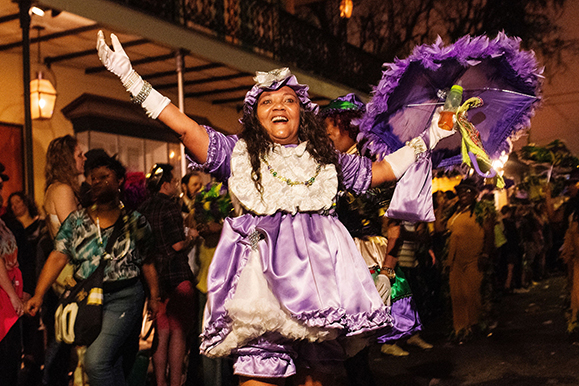
When Dr. Martha Radice first traveled to New Orleans more than a decade ago to attend a major anthropology conference, she didn’t expect the impact the city would have on her research.
As a social anthropologist whose work focuses on the social, spatial, and cultural dynamics of cities, being introduced to the carnival culture in New Orleans inspired her to explore what the annual celebration does for the thousands of people who participate in the festivities.
“Carnival brings people a lot of joy, though it also takes a lot of hard work,” says Dr. Radice, an associate professor in the Department of Sociology and Social Anthropology. Her current research project, Grasping Joy: New-Wave Carnival Krewes in New Orleans explores the ‘new wave’ of carnival krewes and masking in New Orleans. It focuses on the walking krewes — a krewe being a social club that organizes carnival activities — that make their costumes, floats, and throws by hand, and that parade on foot rather than riding on floats.
Dr. Radice, along with photographer Ryan Hodgson-Rigsbee, have brought glimpses of that joy and the work behind it to the public through a collaborative exhibition that is now on display on the fence outside the New Orleans Jazz Museum. The show will remain there until just after Mardi Gras day, which falls on February 13 this year.
The work is funded by an Insight Grant from the Social Sciences and Humanities Research Council of Canada and a New Orleans Jazz and Heritage Foundation Archive Fellowship.
Carnival From the Ground Up is a tribute to the people who make New Orleans’s carnival by hand and who take it to the streets on foot. It features 70 photographs taken by Hodgson-Rigsbee over the last eight years as well as stories of the people represented. Dr. Radice, currently located in New Orleans on sabbatical leave, wrote the accompanying text, captions, and quotes.

Ryan Hodgson-Rigsbee and Martha Radice pictured in New Orleans near their exhibition, Carnival From the Ground Up. (Photo © 2024 G. Mouton, III.)
Radice first met Hodgson-Rigsbee on a four-month research trip to New Orleans in 2016. She would see him taking photos almost everywhere she went. She realized that Hodgson-Rigsbee was undertaking a similar project to hers but with pictures instead of words, and that her research about carnival, something so visually dynamic, would be greatly enriched by working with a talented photographer already familiar with the culture and community. The two planned to create an outdoor photography exhibit as one of the knowledge mobilization events supported by Dr. Radice’s SSHRC Insight Grant.
See a selection of images and stories from the exhibition at the bottom of this article.
The captions and quotes accompanying Hodgson-Rigsbee’s colourful photographs are drawn from Dr. Radice’s interviews with the people represented and explain what participating in carnival, especially the ‘do-it-yourself’ parts, means to people.
What she’s found is that creating carnival brings people joy, not only in the exuberance of the parades, but also in the satisfaction that people get out of the work behind the scenes as they make the things they need for carnival, often learning new skills or teaching others on the way.
“There is the pleasure to be had in creativity, in coming up with new ideas and playing with familiar themes,” she says, adding that people build a sense of community as they work or parade with the other members of their groups, and also as they perform for the crowds lining the streets.
“There is also the excitement, the magic that people feel when they are in the moment that they created, in their parade or when they come out in their suits or costumes on Mardi Gras day. For many people this is spiritual, as they uphold longstanding traditions or participate in deeply meaningful rituals.”

Passersby look at Carnival From the Ground Up on Decatur Street, New Orleans. The 70 photos are accessible to the public 24/7. (Photo © 2024 Ryan Hodgson-Rigsbee)
Dr. Radice’s research has given her first-hand experience of the joy of carnival. As an anthropologist, she uses the method of participant observation to learn about her research topic.
“I got to learn about carnival by showing up and helping,” she says.
“Being able to create things with other people in a sociable way, in a context that is outside of paid work is an important and rewarding kind of activity, and I think it is probably profoundly good for us as human beings. What’s amazing is that carnival in New Orleans sets up a social structure for people to be able to do this, every year. And I think that’s something that we can really learn from.”
Follow @carnivalfromthegroundup on Instagram for daily photos and read more about the exhibit Carnival From the Ground Up on Dr. Radice’s website.
See selections from the exhibition below. Photographs by Ryan Hodgson-Rigsbee; Words by Martha Radice.

Dressed as phoenixes for Mardi Gras 2022, the Society of Sainte Anne parades down Chartres Street towards Jackson Square on their way to the river. Sainte Anne was founded in 1969 by a group of friends keen to revive the gorgeous, glorious street masking traditions of Mardi Gras past. They remain, as one longtime member puts it, “a very anachronistic, anarchic group with no membership roster, no dues. We are an organic occurrence with a band — once a Secret Society and now the favorite to see on Mardi Gras morning — a group of friends and neighbors dressed in their finest regalia, going for a long walk together.”

Krewe de Lune parades in Krewe Bohème’s 2023 parade, on the theme “Night of the Living Art.” Founded in 2009, Krewe de Lune creates stellar puppets, costumes and contraptions to delight parade watchers, as well as hosting their annual Space Ball and Lunar Lagniappe fundraiser.

Members of the Totally Orgasmic Krewe of Intergalactic Ne’er-do-wells, better known as T.O.K.I.N., parade in Krewe du Vieux in 2023.

“It’s healing the child within. Most women that I’ve encountered, most of the Baby Dolls, we’ve been through life’s struggles. It’s healing and it’s spiritual. When people in the audience see me and the other ladies dressed in doll style, no matter what a person may be going through, just to look at us and encounter us, even if it only lasts five minutes, it’s five minutes of spiritual healing. When we come out to play on Mardi Gras day, it doesn’t matter what challenges happened yesterday; when we dress in our regalia, it’s like learning to let go. All that matters is healing, bringing that happy, joyful spirit. It’s a spiritual release.”
Baby Doll Carol “Kit” Harris of the N’awlins D’awlins dances in the Krewe Delusion parade in 2019. The Baby Doll masking tradition dates back to the early 20th century. It waned in the middle of the century, but proud Black New Orleanian women started to bring Baby Dolls back from the 1970s on. The N’awlins D’awlins, which Baby Doll Kit founded in 2016, is one of the groups that keeps the culture thriving today.

“When I’m at work I’m always covered in filth, a behind-the-scenes art rat, versus the glam of Mardi Gras day, being polished with a pound of makeup on. The point of that look was to have a face on a face on a face on a face, to create a play on masking where you don’t know which is the real reality. Being at the river is the most sacred part of my Mardi Gras day. I always end up crying. There’s a baptismal quality to it. The river opens up space where you can process; it gives you that break in the day when you can center yourself. It’s a moment of intimacy. At work, you spend all year with the float two inches from your face, and you can’t see what it’s going to be until the parade finally rolls and it becomes one cohesive thing. The photo in the Rex den is like a coiled spring, and the photo by the river is me springing! With a float, the artists are hiding behind the surface. Costuming is one of the few creative experiences where I get to see people’s reactions in real time, but when I’m getting too much interaction, I can also hide behind the mask, trying to find that sweet spot.”
Caroline Thomas is Art Director at Royal Artists and lead painter of the Rex and Proteus carnival parades, pictured at work in the Rex den in 2022 and in costume at the Mississippi River on Mardi Gras day 2023.

“I’m in the Krewe of Armeinius, one of the oldest gay Mardi Gras krewes. Instead of a parade, we throw a ball. This blue costume was part of my tableau for the ball, but the tradition for the Krewe is to take our costumes out to the Bourbon Street Awards in the French Quarter on Mardi Gras day and show them off one more time, so it’s not six months to a year’s worth of work for just one night. The theme in 2020 was ‘The Time Ball.’ I have a three-foot TARDIS on my back, and the wavy blue and black piece has Roman numerals on it, so it’s the opening sequence of Doctor Who. And that costume won the Best Drag category. I won again in 2022! I started doing drag in 2018, and it has been going so well that I was able to leave the day job in public health, even though I loved the work, to do my art full time. Now the sweet spot for me is combining drag and public health!”
Debbie with a D (@debbiewithad) made this costume for her first performance in the Krewe of Armeinius bal masqué. Here, she is getting ready to host the Tuesday Open Talent night at Oz on Bourbon Street.
Please enable JavaScript to view the comments powered by Disqus.
comments powered by Disqus

Procreate is a powerful app for creatives using the iPad.
For creatives, having the right tools is important to ensure that hardware doesn’t get in the way of creating art and to ensure that they stay efficient. Technology and art, thanks to products like the iPad Pro and MacBooks, now go hand in hand, and the synergy can help artists explore new styles and express themselves more freely.
On these lines, Apple has been working with artists in India to show attendees of the India Art Fair 2024 how something like an iPad can be used to create artworks.
At the annual art event, Apple, along with four multidisciplinary artists, exhibited art revolving around the theme ‘Forces of Nature.’ These works have been created using either the iPad Pro or the MacBook Pro, or a combination of both.
Sadhna Prasad, one of the four artists, and a muralist and an illustrator, displayed her work titled ‘I’ll Be Back.’ “I want my audience to visit the world I create, and then come back and make a difference,” she said. For this work, Prasad used Procreate and Procreate Dreams on her iPad Pro to make large-scale murals.
The artwork shows two worlds: One is the result of unsustainable living, and the other is the outcome if humanity reforms its ways. Further, she also used the Artivive app to turn the mural into an augmented reality experience for the visitors.
Ameya Shinde and Aaron “Myles” Pereira are also artists who have used Apple’s tools to craft their artworks. Based on the ‘Forces of Nature’ theme, Shinde and Pereira’s artwork called ‘Ornithoscope’ is an audiovisual experience that lets the audience explore changes in India’s avian biodiversity over the last 15 years. And, it is built using the combination of MacBook Pro and the iPad Pro.
Another artist, Dhruv Jani, too, showcased what is possible with something as mobile as the MacBook Pro with the M3 Max chipset. He has created a game that sends players on a subterranean quest to discover the seed that spawned the Western Ghats mountain range.
Jani first builds textures on Adobe Photoshop, or hand-painting them with Apple Pencil on iPad Pro. And then, the workflow shifts to MacBook Pro, “where colourful and labyrinthine gamescapes are being built using 3D modelling tools like Substance and SketchUp.” Apple says that Jani then “compiles the game in the Unity3D game engine and precomputing light maps, with hardware-supported ray tracing to help create the game environment.”

About the Author
By Admin in Photography
The N&R Awards programme is an initiative set up by the WPO and Sony – to support local photographic communities around the world – with 54 countries taking part this year. Over 395,000 images from over 220 countries and territories were submitted


By Admin in Photography
The curator offers insights on the selection process and the collaboration with PhMuseum that will soon bring another artist to exhibit at the Basque festival.
Since 2020, one applicant of the PhMuseum Photography Grant has been selected every year for a solo show at Getxophoto. After Silvia Rosi, Juliana Gómez Quijano and Alejandro “Luperca” Morales, Protege Noctem by Mattia Balsamini reached the underworld of Galerías Punta Begoña last year, his inquiry into the disappearance of the night becoming a physical, embodied experience. As this edition’s deadline approaches, we touched base with Maria Ptqk to look into the process behind her work in Getxo.
We had several viewing sessions of the 2023 Photography Grant projects and selected a few that we felt addressed our chosen theme (Pause) from different points of view. In the end we chose Mattia’s because it spoke to us about the environment and also focused on the effects of light pollution on animals. At the same time, it coincided that we had a space where this work fitted well and could add another layer to Mattia’s project. So, once we had a clear idea, we proposed it to the artist, who liked the proposal and the selection of images was made together. The idea is to establish a conversation with the chosen artist and present our ideas and the space we think is ideal for exhibiting the selected work.
We always keep in mind that Getxophoto is a festival that takes place mostly in the public space in the streets of Getxo, which is a small town on the Basque seaside, close to the city of Bilbao. Thus, the photographs merge with the urban landscape and the daily routines of the local population when they go to the post office or when they wait for the traffic light to get green, for example. That is why, when thinking about the program as a whole, we try to find the right balance between the artistic interest of the projects and their availability to fit properly into the space in which they are exhibited. We also tried to combine different genres and styles: portrait with documentary, analogue b&w with super contemporary images, etc. so that the festival reflects the current state of image creativity today.
At the festival we show mostly outdoor displays but there are also indoor exhibitions. The main difference is that visitors to a gallery go there of their own free will and with a cultural purpose which means they are willing to devote time and attention to whatever is proposed to them within this framework. Whereas the exhibitions in the public space are more like an unexpected encounter: people don’t always choose to go and see an exhibition, they just stumble upon it. And this is more exciting but also more demanding for the artwork because it is more difficult to arouse interest and have a memorable impact. So, artists receive another kind of feedback and understanding of their own work, not better or worse but definitely different and valuable.
Besides the criteria I mentioned before, which apply to the festival as a whole, when I looking into a particular artwork I am very much guided by what could be called “the personality of the project” in the sense that, even if it’s a subject or a genre that has been widely treated, there is a particular gaze or sensibility that makes this work unique, different from everything else. When I look into a project, I like to find the person behind it, not because it is a personal or autobiographical project but because the author’s gaze is present and speaks to you.
I don’t want to sound too commonplace but honestly the world is an exhibition. We are surrounded by images that try to get our attention and tell us a story, and I’m not just talking about advertising which is obviously the main stage of visual imaginary nowadays. Everything that happens around us is a source of inspiration. So, working with images doesn’t mean that your inspiration has to come only from visual material: all forms of art are a source of inspiration, but also all kind of practices, artistic or not, and from every period of history. I guess the key to a good curatorial gaze is to be able to develop a cultural understanding of reality in all its forms.
————–
The PhMuseum Photography Grant has established itself as a leading prize in the industry over the last 12 years, renowned for recognising the importance of contemporary photography and for supporting emergent artists through cash prizes, exhibitions at international festivals, educational activities and exposure on online media. Among several institutions, Getxophoto will offer a new solo show to one work selected from our open call. You are welcome to present your work before 15 February 2024 at 11.59 pm (GMT). Learn more and apply at phmuseum.com/g24
Getxophoto is a festival focused on the image that has been held in Getxo -Basque Country- since 2007, created and managed by Begihandi. An initiative in continuous search of being more participative, committed and sustainable.
By Admin in Photography
In the vibrant landscape of digital art and NFTs, Nigerian photographer and digital artist Nddy stands out as a beacon of innovation and creativity. With a career spanning over two years in the NFT space, Nddy has skillfully navigated the complex world of art, technology, and community to create timeless pieces that resonate deeply with viewers around the globe.
Nddy’s artistic journey began in 2017, rooted in a passion for capturing life’s essence through the lens of a camera. Despite initial familial reservations and being camera shy, Nddy embraced photography, using a phone to explore and document the world. This early challenge didn’t deter Nddy; instead, it fueled a determination to turn a hobby into a career, laying the groundwork for a future in digital art.
The shift from traditional photography to pioneering digital art was catalyzed by Nddy’s introduction to NFTs in late 2021. Initially drawn by the financial prospects, Nddy quickly recognized the broader potential of NFTs to provide global visibility and transform personal art into a recognizable brand.

My journey began with a passion for traditional photography, capturing life’s essence through my lens. Transitioning to digital art and the NFT space in late 2021 was a pivotal moment. Initially, the financial prospects of NFTs caught my attention, but I quickly realized the potential for global visibility and brand development for my art. This shift was driven by a desire to innovate while staying true to my roots, blending tradition with modern digital expression.
My artistic vision is heavily influenced by my Nigerian culture, history, and the environment around me. These influences have been instrumental in shaping my approach to digital art, allowing me to infuse traditional elements with a contemporary twist. The diverse artists and genres I’ve encountered in the NFT space have further inspired me to explore and integrate various cultural and historical themes into my work.
The NFT landscape has evolved significantly, offering both opportunities and challenges. The bear and bull markets have shaped the space, emphasizing the importance of community and genuine engagement over short-term trends. I believe the future of crypto art is bright, with potential for further growth and innovation, mirroring the early days of social media.
Building strong connections within the NFT community has been crucial for my growth and visibility. These relationships have not only provided support and encouragement but also opportunities to showcase my work on international platforms, breaking barriers and reaching a wider audience.
When choosing platforms and exhibitions, I look for those that align with my goals of brand building and reaching a diverse audience. I prioritize platforms that are art-focused and offer artist-friendly features, as well as exhibitions that have the potential to connect me with collectors and artists who appreciate the depth and narrative of my work.
GE✨
“Black Matters” is now on @juujuumama @ItanWorld on @foundation
Black is not dark, black is bright, black is energy, black is bold, black is gold, black is every color all together, black shines brightest. Black is everything beautiful.https://t.co/Cbwi7wMH9N pic.twitter.com/QLBFQwpONm
— Nddy📸 (@Nddy_1759) October 29, 2023
One of my favorite pieces, ‘Adaugo,’ is inspired by my childhood memories and the traditions of Igbo land. It reflects on the role of first daughters and celebrates cultural heritage through the intricate details of attire and symbolism, embodying my journey and connection to my roots.
Balancing the global and local aspects involves embracing my Nigerian heritage while ensuring my art remains relevant on a global scale. I strive to create pieces that tell unique stories, bridging cultural gaps and resonating with a wide audience without losing the essence of where I come from.
Navigating the space to find a supportive community and connect with the right collectors were significant challenges. Overcoming these obstacles involved patience, perseverance, and a commitment to my artistic vision, leading to meaningful connections and a sense of belonging within the African NFT community.
My advice is to thoroughly research the NFT space, reach out to established artists for insights, and embrace patience. Celebrate every achievement, learn from each experience, and enjoy the journey, understanding that challenges are part of the growth process. -Nddy
I’m focused on continuing my artistic exploration and brand development. I’m excited about my upcoming project release and the NFT_NYC 2024 exhibition, where I’ll showcase one of my favorite projects. These opportunities represent the next steps in my journey, promising growth, innovation, and greater visibility in the global NFT space.
With eyes set on greatness, Nddy continues to explore new projects and eagerly anticipates showcasing work at NFT_NYC 2024. The journey ahead promises further exploration, growth, and the unfolding of an artistic legacy that bridges the local and global, traditional and innovative.
TL;DR: Nddy, a Nigerian photographer turned digital artist, shares insights into a journey marked by growth, challenges, and the transformative power of NFTs. From early beginnings to global exhibitions, Nddy’s story is a testament to the importance of cultural roots, community, and embracing the digital evolution.
Milwaukee Art Museum announces new Herzfeld Center for Photography show
Wondering what’s the importance of PDF editing software for photographers? Hop inside this guide to find out!
The loon traveled from Los Angeles to its permanent home in the Twin Cities.
A new beetle species has been named to honor a fellow Husker, bridging the worlds of academia and wildlife conservation.
Silversea, a premier brand in experiential luxury and expedition travel, recently concluded the inaugural season of its first Nova-class ship, Silver Nova,
The Desert Foothills Land Trust (DFLT) is proud to announce a special presentation event featuring acclaimed botanical photographer Jimmy Fike on Saturday, Oct. 12 at 6:30 p.m. at the Sanderson
Read comments policy.