Belle Fourche Arts Council’s second annual photography contest draws 67 entries.

Belle Fourche Arts Council’s second annual photography contest draws 67 entries.
image

#inform-video-player-1 .inform-embed { margin-top: 10px; margin-bottom: 20px; }

#inform-video-player-2 .inform-embed { margin-top: 10px; margin-bottom: 20px; }

SPEARFISH — The Belle Fourche Arts Council held their second annual Rural Expressions photography contest during January and February. A culminating reception was held on Feb. 10, with judging, prizes awarded and a buffet of food and drink for those who attended.

There were 67 photos entered in the contest, submitted by 19 contestants. Awards were offered in the categories of people, animal and landscape in both adult and youth divisions. People’s Choice winners in each category were voted on by those who visited the photographs on exhibit at the Tri-State Museum and Visitor Center for a week prior to the reception and at the reception. Winning photos are exhibited at the Tri-State for a week after the reception.

This page requires Javascript.

Javascript is required for you to be able to read premium content. Please enable it in your browser settings.

#inform-video-player-3 .inform-embed { margin-top: 10px; margin-bottom: 20px; }

Photographer Dmitry Markov has died Markov’s work sought to show a Russian identity and patriotism separate from that of the authorities

Photographer Dmitry Markov has died Markov’s work sought to show a Russian identity and patriotism separate from that of the authorities

Photographer Dmitry Markov died in Pskov on February 16. He was 41 years old. Markov was one of the most significant photographers in modern Russia. Not only did he chronicle everyday life in the country’s regions, but he also tried to make it better through volunteer work. Markov’s work was shown around the world, with exhibitions in Paris and New York. He took part in the advertising campaign for the iPhone 7. In fact, his smartphone was his primary camera for many years. Markov also worked as a photojournalist, including for Takie Dela and Meduza. Critic Anton Khitrov explains how the photographer gave himself a worthy artistic task — and how he brought it to fruition.

“You show the truth.” “Cowardly Russia.” “Your photos make my heart ache.” One only has to read the comments on Dmitry Markov’s Instagram to be convinced. The documentary photographer, who captured provincial Russia, had a large — over 800,00 Instagram followers — and grateful audience. People commented on his interview with Yury Dud three years ago with the same appreciation.

[embedded content]

Markov was loved as both a brilliant storyteller and an outstanding person. Having overcome drug addiction, he took up volunteer work and converted his professional success into helping people. Markov began working with community organizations in the mid-2000s. Born in Pushkino near Moscow, he moved to Pskov and worked for Rostok, a charity organization that helps children with disabilities integrate into society.

Since 2012, Markov has participated in street protests, and in 2021, after being detained at a rally in support of Alexey Navalny, he took what was probably his most viral photo: a riot policeman in a balaclava sitting under a portrait of Vladimir Putin. Markov then organized an auction on Facebook to sell the photo. He received two million rubles ($21.6k) from an anonymous buyer and transferred it all to OVD-Info and Apologia Protesta: human rights organizations that help people who are arrested at political demonstrations.

image

Markov continued the tradition of unofficial Soviet photography, in which life in the USSR was shown without regard for ideological objectives. His tutor was Alexander Lapin, a photographer, theorist, and pedagogue, who taught Gennady Bodrov, Igor Mukhin, Emil Gataullin and other stars of the profession, and also wrote two famous textbooks: Photography as… and Plane and Space, or Life as a Square. Markov may also have been influenced by Boris Mikhailov, the famous Soviet-Ukrainian documentary photographer who, among other things, took pictures of homeless people.

If we look further, Markov belongs to the tradition of Maxim Gorky and Vladimir Gilyarovsky, of Ilya Repin and Nikolay Yaroshenko — to the artistic tradition in which art claims to be a truthful reflection of society and seeks to make invisible people visible.

Markov’s main platform was Instagram, and his main tool was his smartphone. In 2013, he took part in a project by American David Alan Harvey called Burn Diary. For one week, Markov ran an Instagram account with the same name. According to the rules of the project, only photos taken on a phone could be published — and only on the day they were taken. Markov adopted the same principles for his own account. In an interview with Afisha Daily, he said that a photographer with professional equipment is less trustworthy than a photographer with a smartphone. It’s hard not to see the decision as a conceptual gesture: smartphones and social networks are tools of demonstrative consumption, but Markov uses them to show a life that’s as far from glossy as possible.

How are Markov’s images organized? First of all, they refer to the viewers’ cultural experience. The color palette is like that of an old Russian painting: for example, the frescoes of Dionisy in the Ferapontov Monastery. The composition often resembles a theatrical mise-en-scène: in the background — plain decoration, in the foreground — “actors” who move along the screen, as if from one stage entrance to the other, appearing and disappearing again. His characters often appear in a frame that resembles the frame of a painting or a stage entrance. Individual scenes call to mind Pieter Bruegel the Elder’s “Hunters in the Snow,” a Renaissance portrait, or Alexander Deyneka’s “Future Pilots.” Thus, Markov defends the place of his subjects in culture: provincial schoolchildren, laborers, commuters, and regulars at the city bathhouse — insisting that any person is worthy of our attention along with the subjects of globally recognized masterpieces.

image
image
image
image

Markov’s focus was often was the contrast between the official and the private, the artificial and the natural, the planned and the accidental. Komsomol teenagers walking near a monument to the first builders. Children relaxing under a statue of Lenin’s head in Ulan-Ude. A cat in a window squinting at a Russian flag. In the composition of the frame, state-approved symbols and living beings always balance each other out: in the world that Markov shows, at least the narratives of power are not omnipotent.

Markov’s creative strategy, which could be called alternative or protest patriotism, was in high demand. It unites the photographer with other cult heroes of Russian art, such as the artist Nikolay Polissky or director Kirill Serebrennikov, who has collaborated with Markov. The essence of this strategy is the search for a Russian identity that is different from the one offered to society by the authorities.

These artists are trying to strengthen the emotional bond between Russians and their country, even though propaganda has done everything possible to destroy it. The Nikola-Lenivets art park founded by Polissky redefines the image of the Russian village: not as a sanctuary of traditional morality, but as a space of play, irony and creativity. Serebrennikov’s Gogol Center, which was closed in 2022, fought for a progressive image of domestic classics, which propaganda treats as another instrument of Russian superiority. Markov spoke about the people hidden behind the “the people” of ideology — and gave the audience a chance to feel solidarity with a vendor at a clothing market, a pensioner from a district center, a rural chauffeur. He had a concrete and convincing answer to the question of why art is needed in Russia today: to rebuild the bridges destroyed by the authorities.

image
image

Markov’s solidarity with his subjects was always natural for him: he grew up in small-town courtyards in Pskov, a town of 190,000, washed in a local bathhouse, and never felt out of place in the environment of his work. Despite his international profile — projects with Apple, solo exhibitions in Moscow, Paris, and New York — he felt at ease with his subjects. For Markov, it was unthinkable not to feel this solidarity.

In the last days of his life, Markov faced criticism on social media: users were upset by his sympathy for a soldier on leave who intended to return to the front. The next day, he revealed that he was helping the conscripts he knew with money. “I can’t stop loving people close to me and start hating them,” he wrote. “And I realize that I’m a legitimate target for hatred on the part of Ukrainians. I don’t know how to do the right thing in this situation.” In 2024, no one has the right answer. One thing is certain: if Markov had lived through the war, he would certainly want to work on national reconciliation.

Sign up for The Beet

Underreported stories. Fresh perspectives. From Budapest to Bishkek.

Anton Khitrov

Translation by Ned Garvey

New Photography Exhibition Showcases Student Work Alongside Established Artists

New Photography Exhibition Showcases Student Work Alongside Established Artists

A Decisive Vision: New Perspectives from Dallas College Faculty and Students opened Feb. 16 at the Adolphus Tower Gallery. The new photography exhibition showcases work from students and staff of the Dallas College School of Creative Arts, Entertainment and Design, as well as some more established special guest photographers.

The opening reception on Friday was bustling with both the featured artists and their friends and family. The walls of the space were lined with works spanning the gamut of genres, from portraits to landscape, abstract to architectural. Live music was provided by Spicy Violin (producer and violinist James Mahler), who serenaded guests with arrangements of pop songs and original compositions.

There was even a man who had no connection to the school or artists wandering around the premises with a camera and microphone and challenging guests to religious debates — the true mark of a noteworthy event. For any newcomers featured in the exhibition, it was quite an auspicious debut.

The photography department at Dallas College is one of a few community college programs in the area to offer a comprehensive, hands-on and accessible arts education. The choice facing many pursuing a creative career has always been between an expensive and time-consuming university degree or braving the self-taught route. Programs like the one offered at Dallas College, which offers affordable classes with flexible schedules, provide a happy medium to aspiring artists.

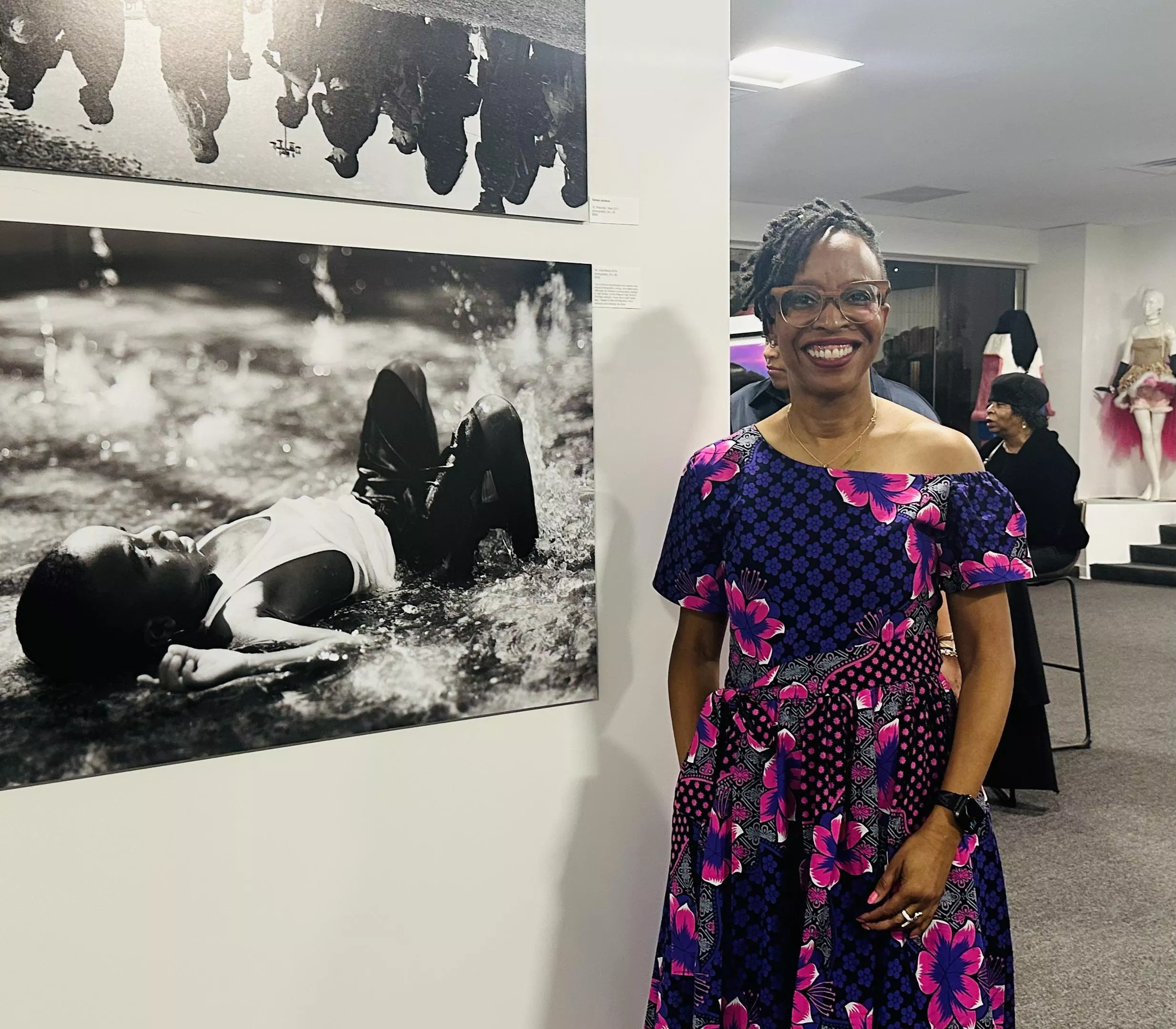
One of the students featured in the exhibition, Teresa Jackson, is a clinical psychologist by trade who is pursuing fine art with an emphasis in photography concurrently. She has two photos in the gallery, and tells us they’re part of an ongoing body of work that aims to dismantle racial stereotypes.

“The pieces are from a larger project featuring Black men and Black boys to basically showcase their humanity,” she says. “I thought that if […] there was some way that I can have a positive impact by creating images of Black men and boys in their natural, organic element, doing whatever they do, and capture who they are no different than other men and boys […] and no less deserving of protection and being celebrated.”

She points to one of her photos in the display, “Unbothered,” a black and white shot of a young boy playing in a children’s fountain at a park.

“He hasn’t learned yet that maybe he’s not safe […] or maybe he’s viewed as a threat,” Jackson says. “He’s just embodying peace and joy.”

One featured guest artist is Durado D. Brooks, Jr., a photographer and filmmaker who contributed striking lightboxes of cityscapes to the exhibition. His work has taken the Dallas native all over the world, but A Decisive Vision marks his first time exhibiting in his hometown.

“I’ve been kind of on a nomadic creative journey since I graduated high school,” Brooks says. “St. Barts to LA to Brooklyn. New Orleans, Barcelona, back to New Orleans and a million places in between.”

Brooks is excited to be back in town and showing his work alongside up-and-coming local talent.

“I’m grateful to share the walls with all of these young, talented artists,” Brooks says. “I’m looking forward to meeting some of the people behind these other artworks.”

One guest artist featured in the exhibition is Ron Shipp, an accomplished local photographer known for his striking pictures of the Dallas skyline. In addition to displaying several mounted works in the gallery, Shipp was selling smaller, unframed prints from a table at the reception while cheerily explaining the creative and technical process behind them.

“So, that’s actually about 40 images overlaid,” he says, showing an image of the Dallas skyline with a web of lightning woven above. “Those are individual lightning bolts. But what you saw over the hours of the storm felt more like this.”

Shipp is a former Dallas College student himself, but not from the photography department. He says he started pursuing photography only around six years ago.

“Always wanted to. Couldn’t afford it,” he says. “Then I could, so I did.”

In a full circle moment, Shipp will be returning to Dallas College this coming week to deliver a seminar to current students.

The Adolphus Tower Gallery opened last year as a collaboration between Dallas College, Downtown Dallas Inc., art advisory firm FGIII Fine Art Production and Adolphus Tower owners Hoque Global. It was conceived of as a space to bring visibility to student and faculty works, and it doesn’t get more visible than a glass-enclosed space in the heart of Downtown Dallas.

The space has housed several exhibitions of work by Dallas College students and established artists. A Decisive Vision is the first show at the gallery dedicated solely to photography.

A Decisive Vision: New Perspectives from Dallas College Faculty and Students is curated by Randall Garrett and Frankie Garcia III. It will be displayed at the Adolphus Tower Gallery, 1412 Main St., through March 29.

Pioneering Pet Portraits: Bradford Museum Unveils Historical Photo…

Pioneering Pet Portraits: Bradford Museum Unveils Historical Photo…
image

In an era dominated by the instant gratification of snapping photos with smartphones, Bradford’s National Science and Media Museum takes us back to the dawn of photography, revealing some of the earliest pet portraits ever captured. Among these historical treasures is a captivating 1830s photograph of a cat by William Henry Fox Talbot, marking a significant chapter in the evolution of photographic processes.

Advertisment

A Glimpse into Photography’s Early Days

The museum’s collection offers a rare window into the past, showcasing different methods of capturing images that have long since been overshadowed by modern technology. The calotype process, utilized by Talbot, involves creating positive prints from a single negative, a revolutionary technique at the time. This particular cat image, a reproduction of ‘A Favourite Cat’ by artist JM Burbank, illustrates the intricate details and the beauty that the calotype process was capable of capturing.

Another gem in the collection is an 1847 photograph of Mary Mitford’s dog, which remarkably remained still for four minutes to allow the capture of its image. This photograph, alongside the image of the cat, highlights the significant advancements in photography during the 19th century, including the daguerreotype process. Developed by Louis Jacques Mande Daguerre, this method captured images with stunning clarity directly onto a polished silvered plate, offering a new level of detail and precision.

Advertisment

From Cabinet Cards to Smartphones

The exhibition also touches on the ‘cabinet card’ trend, where small photographic cards were shared among family and friends, predating our current social media-centric photo sharing culture. Ruth Quinn, the museum’s curator of photography and photographic technology, commented on the enduring fascination with capturing images of our pets, a sentiment that has persisted through the centuries and has only been made easier with the advent of smartphone cameras.

Despite the museum’s temporary closure for a £6m revamp, it continues to share its rich collection online, bridging the gap between the past and present. This ongoing project not only sheds light on the technological advancements in photography but also underscores the timeless human desire to immortalize our animal companions in imagery.

Advertisment

The Legacy of Photographic Evolution

The museum’s exhibition serves as a testament to the evolution of photographic technology and the ways in which it has shaped our interaction with the world around us. From the calotype to the daguerreotype and beyond, each process added a new layer to the art and science of photography, enabling us to capture moments in time with ever-increasing fidelity and ease.

As we look forward to the museum’s reopening in the summer, we are reminded of the profound impact that photography has had on our lives, from the earliest pet portraits to today’s ubiquitous smartphone snapshots. These early photographs not only represent technical milestones but also a deep-seated human impulse to document and share the essence of our lives, including the animals that journey with us.

Indigenous artist Joe Pekara shares his journey

Indigenous artist Joe Pekara shares his journey

Since starting his photography journey in 2017, Indigenous Fort Collins artist Joe Pekara has captured striking photographs of nature, concerts and Native American culture.

Pekara, also known under his artistic moniker Pharaoh 171, hosted an artist talk Feb. 15 to discuss his exhibit at the Gregory Allicar Museum of Art.

He is currently working for rapper 50 Cent. 

“When my uncle passed away in 2016, my grandmother gifted me his camera; … when he passed I got really into (photography),” Pekara said. “It was like a coping thing because he was like my best friend.” 

“Her and I receiving the CRA award for the Grammys was really special. I think it was the (least noticed) success for Indigenous people, so to have it displayed means a lot. Not to be self centered, but I don’t think the project we did got the attention it should have received.” -Joe Pekara, Indigenous Fort Collins artist 

He started with photographs taken locally in Fort Collins. 

“I would go out and just be in nature,” Pekara said. 

Pekara started doing photography as a career through a friend who opened for the band Hieroglyphics at the Aggie Theatre in Old Town. He sent Hieroglyphics the photos he took.

“I wasn’t trying to get any work out of it,” Pekara said. “It was just, you know, ‘I took it, here it is,’ and a few weeks later they offered me a job,” 

Many artists see their art much differently than a viewer might.

“Looking at a photo, to me, is probably more intimate than if you looked at the same one,” Pekara said. “I know where I took that photo, I know the spot where I was mentally at that time. So to see those moments come to a brighter moment, that’s awesome.” 

Pekara’s exhibit is currently on display at the Colorado State University Center for the Arts. Some photos are printed on photo paper, but others are done on natural materials like wood and leather, which was enabled by a Fort Collins printing business called Wood & Slate.

The exhibit is a collaboration with Red Berry Woman, an Indigenous fashion designer based in South Dakota whose legal name is Norma Baker-Flying Horse. Pekara and Red Berry Woman won the Cultural Recognition Award at the 64th annual Grammy Awards in April 2022, leaving Pekara with a total of four Grammy awards. The exhibit also includes other aspects of Pekara’s work, including concert photographs and some of his first nature shots. 

“I photograph most of her events,” Pekara said. “Her and I receiving the CRA award for the Grammys was really special. I think it was the (least noticed) success for Indigenous people, so to have it displayed means a lot. Not to be self centered, but I don’t think the project we did got the attention it should have received.” 

But acclaim isn’t what matters most to Pekara. 

“There’s success beyond the big spotlight,” Pekara said. 

During the artist talk, Pekara was joined onstage by important people in his life who all had an opportunity to say a few words, including Red Berry Woman. She spoke about family history and how representation for Indigenous people is changing.

“Joe has done such a beautiful job capturing our culture, capturing this kind of fashion,” Red Berry Woman said. “I hope you all feel the impact that he has done for me and my family.”

“We’re not making this Native fashion just for the accolades, it’s a message,” Red Berry Woman said. “It’s a message that we are still here, we will always be here and we have survived quite a bit.”

She touched on the various misconceptions about Indigenous peoples throughout different forms of media. 

“It’s a very small world when you’re Native — it really is — and I really think because of that, we have a very special opportunity to change the narrative,” Red Berry Woman said. 

Art includes a variety of mediums that can be used to find aspects of oneself that might not otherwise be discovered.

“We are finding our balance between what we were and what we are becoming,” Red Berry Woman said. “We’re doing that through fashion. We’re doing that through this industry.” 

There were many words of wisdom spoken throughout the event. 

“Learn about where you come from,” Red Berry Woman said. “You never know: You might find some strength or some inspiration to begin something new. You never know where it will take you.” 

Pekara offered some parting words before the talk gave way to a reception where guests could enjoy the photos on display.

“There is no success without risk and failure, and you can’t succeed unless you learn from your failures,” Pekara said.

Reach Aubree Miller at life@collegian.com or on Twitter @CSUCollegian.

Out of the Print Shop | The East Hampton Star

Out of the Print Shop | The East Hampton Star
The Church’s current print show highlights the art and craft of printmaking, focusing not only on the artists and printmakers of the South Fork, but displaying the tools, blocks, stones, plates, and states that go into the production of their work.

35mm vs 50mm vs 85mm: Which is the best focal length for portrait photography?

35mm vs 50mm vs 85mm: Which is the best focal length for portrait photography?

When looking for the best focal lengths for portrait photography, most users are introduced to lenses of 35mm, 50mm, and 85mm focal lengths. It is difficult to declare a true winner between the three, as each one caters to slightly different types of portrait photography. However, the one that captures the best visual narrative and overall aesthetic will be the best of the three.

All three focal lengths perform exceptionally well in portraiture as they offer the perfect mix of depth of field and clarity. With so many lenses around, each with a different focal length and aperture, it can be daunting to look through the options and choose one based on your needs.

This article provides an overview of the best focal length for portrait photography, highlighting their strengths and weaknesses.


” loading=”lazy” width=”1440″ height=”220″ alt=”fortnite-promotional-banner”>

Note: This article is subjective and is based on the writer’s views.


35mm vs 50mm vs 85mm: Which is the best focal length for portraiture?

The best focal length for portraits is one that has the perfect mix of depth of field, background blur, and image clarity. When comparing 35mm, 50mm, and 85mm focal lengths, it is important to remember that each of these is unique and caters to different types of portraiture.

Some of these lenses do well in terms of close-up shots, while others excel in wedding portraiture, giving the perfect bokeh for those dreamy shots. That said, you must take your individual preferences and needs into account when making your choice.


Should you buy a 35mm lens?

A few of the best 35mm lenses available (Image via Canon, Sony, Fujifilm, Sigma)A few of the best 35mm lenses available (Image via Canon, Sony, Fujifilm, Sigma)” srcset=”https://www.mecreates.com/story/news/wp-content/uploads/2024/02/78340-17082540471230-1920.jpg?w=190 190w, https://www.mecreates.com/story/news/wp-content/uploads/2024/02/78340-17082540471230-1920.jpg?w=720 720w, https://www.mecreates.com/story/news/wp-content/uploads/2024/02/78340-17082540471230-1920.jpg?w=840 840w, https://www.mecreates.com/story/news/wp-content/uploads/2024/02/78340-17082540471230-1920.jpg?w=1045 1045w, https://www.mecreates.com/story/news/wp-content/uploads/2024/02/78340-17082540471230-1920.jpg?w=1200 1200w, https://www.mecreates.com/story/news/wp-content/uploads/2024/02/78340-17082540471230-1920.jpg?w=1460 1460w, https://www.mecreates.com/story/news/wp-content/uploads/2024/02/78340-17082540471230-1920.jpg?w=1600 1600w, https://www.mecreates.com/story/news/wp-content/uploads/2024/02/78340-17082540471230-1920.jpg 1920w”>
A few of the best 35mm lenses available (Image via Canon, Sony, Fujifilm, Sigma)

35mm is one of the best focal lengths to shoot wide portraits. Commonly used in film, it offers great depth of field and character to the object being captured.

Many photographers use 35mm lenses because they offer the perfect blend of width, depth of field, and clarity. These lenses are just wide enough to capture images without losing much background texture.

Some of the best 35mm lenses are the Fujifilm XF series, the Sigma DG DN Art lenses, and the Canon EF mount.

A stunning image captured by the Fujifilm XF35mm F1.4 R (Image via Charlene Winfred/Fujifilm)A stunning image captured by the Fujifilm XF35mm F1.4 R (Image via Charlene Winfred/Fujifilm)” srcset=”https://www.mecreates.com/story/news/wp-content/uploads/2024/02/57687-17082530683168-1920.jpg?w=190 190w, https://www.mecreates.com/story/news/wp-content/uploads/2024/02/57687-17082530683168-1920.jpg?w=720 720w, https://www.mecreates.com/story/news/wp-content/uploads/2024/02/57687-17082530683168-1920.jpg?w=840 840w, https://www.mecreates.com/story/news/wp-content/uploads/2024/02/57687-17082530683168-1920.jpg?w=1045 1045w, https://www.mecreates.com/story/news/wp-content/uploads/2024/02/57687-17082530683168-1920.jpg?w=1200 1200w, https://www.mecreates.com/story/news/wp-content/uploads/2024/02/57687-17082530683168-1920.jpg?w=1460 1460w, https://www.mecreates.com/story/news/wp-content/uploads/2024/02/57687-17082530683168-1920.jpg?w=1600 1600w, https://www.mecreates.com/story/news/wp-content/uploads/2024/02/57687-17082530683168-1920.jpg 1920w”>
A stunning image captured by the Fujifilm XF35mm F1.4 R (Image via Charlene Winfred/Fujifilm)

Verdict: Versatility and portability are the best features of 35mm lenses. This makes them perfect for capturing mid-distance portrait shots and close-ups. How you hold the camera is also crucial, as it greatly affects the image due to its wide angle.


Should you buy a 50mm lens?

A few of the best 50mm lenses available (Image via Canon, Leica, Fujifilm, Nikon)A few of the best 50mm lenses available (Image via Canon, Leica, Fujifilm, Nikon)” srcset=”https://www.mecreates.com/story/news/wp-content/uploads/2024/02/0be37-17082631323638-1920.jpg?w=190 190w, https://www.mecreates.com/story/news/wp-content/uploads/2024/02/0be37-17082631323638-1920.jpg?w=720 720w, https://www.mecreates.com/story/news/wp-content/uploads/2024/02/0be37-17082631323638-1920.jpg?w=840 840w, https://www.mecreates.com/story/news/wp-content/uploads/2024/02/0be37-17082631323638-1920.jpg?w=1045 1045w, https://www.mecreates.com/story/news/wp-content/uploads/2024/02/0be37-17082631323638-1920.jpg?w=1200 1200w, https://www.mecreates.com/story/news/wp-content/uploads/2024/02/0be37-17082631323638-1920.jpg?w=1460 1460w, https://www.mecreates.com/story/news/wp-content/uploads/2024/02/0be37-17082631323638-1920.jpg?w=1600 1600w, https://www.mecreates.com/story/news/wp-content/uploads/2024/02/0be37-17082631323638-1920.jpg 1920w”>
A few of the best 50mm lenses available (Image via Canon, Leica, Fujifilm, Nikon)

Perhaps the most popular mid-range focal length for portraiture, 50mm lenses are portable and easy to use. They’re one of the best focal lengths to shoot a wide range of portrait styles, proving to be extremely versatile. Apart from portraiture, they also excel in street, low light, and city photography.

Canon produces great 50 mm lenses for portraits. Similarly, lenses from the Leica APO-Summicron-M series and the Nikon Nikkor Z series are some of the best in this segment.

Great depth of field captured by the Nikon NIKKOR Z 50mm f/1.8 S (Image via Nikon)Great depth of field captured by the Nikon NIKKOR Z 50mm f/1.8 S (Image via Nikon)” srcset=”https://www.mecreates.com/story/news/wp-content/uploads/2024/02/b947d-17084000044608-1920.jpg?w=190 190w, https://www.mecreates.com/story/news/wp-content/uploads/2024/02/b947d-17084000044608-1920.jpg?w=720 720w, https://www.mecreates.com/story/news/wp-content/uploads/2024/02/b947d-17084000044608-1920.jpg?w=840 840w, https://www.mecreates.com/story/news/wp-content/uploads/2024/02/b947d-17084000044608-1920.jpg?w=1045 1045w, https://www.mecreates.com/story/news/wp-content/uploads/2024/02/b947d-17084000044608-1920.jpg?w=1200 1200w, https://www.mecreates.com/story/news/wp-content/uploads/2024/02/b947d-17084000044608-1920.jpg?w=1460 1460w, https://www.mecreates.com/story/news/wp-content/uploads/2024/02/b947d-17084000044608-1920.jpg?w=1600 1600w, https://www.mecreates.com/story/news/wp-content/uploads/2024/02/b947d-17084000044608-1920.jpg 1920w”>
Great depth of field captured by the Nikon NIKKOR Z 50mm f/1.8 S (Image via Nikon)

Verdict: If your primary goal is taking portraits, having just one 50mm lens in your collection can be sufficient to capture a wide range of subjects. Lenses of this focal length are compact and easy to use. Moreover, the 50mm lens can give you a good start in portrait photography.

Thus, it makes it the best focal length of the three options in terms of versatility and usability. Do note that in terms of full-body shots or medium-distance portrait shots, the 50mm performs better than the 35mm.


Should you buy an 85mm lens?

A few of the best 85mm lenses available (Image via Canon, Sigma, Sony, Nikon)A few of the best 85mm lenses available (Image via Canon, Sigma, Sony, Nikon)” srcset=”https://www.mecreates.com/story/news/wp-content/uploads/2024/02/c8c9d-17082658579355-1920.jpg?w=190 190w, https://www.mecreates.com/story/news/wp-content/uploads/2024/02/c8c9d-17082658579355-1920.jpg?w=720 720w, https://www.mecreates.com/story/news/wp-content/uploads/2024/02/c8c9d-17082658579355-1920.jpg?w=840 840w, https://www.mecreates.com/story/news/wp-content/uploads/2024/02/c8c9d-17082658579355-1920.jpg?w=1045 1045w, https://www.mecreates.com/story/news/wp-content/uploads/2024/02/c8c9d-17082658579355-1920.jpg?w=1200 1200w, https://www.mecreates.com/story/news/wp-content/uploads/2024/02/c8c9d-17082658579355-1920.jpg?w=1460 1460w, https://www.mecreates.com/story/news/wp-content/uploads/2024/02/c8c9d-17082658579355-1920.jpg?w=1600 1600w, https://www.mecreates.com/story/news/wp-content/uploads/2024/02/c8c9d-17082658579355-1920.jpg 1920w”>
A few of the best 85mm lenses available (Image via Canon, Sigma, Sony, Nikon)

One of the best focal lengths to shoot portraits and close-up shots is 85mm. Lenses with this focal length typically offer a narrower angle, emphasizing subject isolation and background blur. They are virtually distortion-free and capture stunning images with great definition.

Lenses from the Sigma DG HSM Art series, Nikon AF-S Nikkor lenses, and the Canon EF mount lenses are the best in this segment.

Verdict: If your goal is wedding photography or product shoots, the 85mm focal range would be the perfect choice. One drawback is it is comparatively less versatile than the other two options. Thus, you’d have to carry extra lenses to shoot other photography styles.

However, it still performs exceptionally well for portraits, particularly close-up shots. It also works well for wedding photography and medium-distance shots.


35mm vs 50mm vs 85mm: Which one is right for you?

It is difficult to determine whether 35mm, 50mm, and 85mm focal lengths are best suited for you. A 35mm lens would be great if you want to shoot mid-range body shots or environmental portraits.

50mm lenses are a “one-for-all” and are suitable for close-ups and dreamy portraits.

If you want complete subject isolation and a creamy background bokeh, 85mm is the best focal length.

However, 50mm lenses are the most versatile of the three. They have a wide range of uses and cater to almost every photographer’s needs. Remember to explore different options, consider your creative vision, and discover the lens that resonates most with your unique style and portrait goals.

Check out our other articles on lenses:

5 best lenses for portraits || 5 best Fujifilm cameras in 2024 || 5 best lenses for Nikon cameras in 2024 || 5 best lenses for Sony cameras in 2024

Quick Links

More from Sportskeeda

Edited by Dinesh Renthlei
Profile picture