Wallin’s northern lights photography to star in new Main Street Gallery exhibit

Wallin’s northern lights photography to star in new Main Street Gallery exhibit

Naona “Peaches” Wallin will open her new astrophotography exhibit titled “Radiance in the Rainforest: Capturing the Northern Lights of Southeast Alaska” on Friday at the Main Street Gallery.

Wallin’s exhibit offers color-saturated, sweeping vistas of the northern lights, all taken in the Ketchikan area.


Naona Wallin and father in Hawaii

Naona “Peacehs” Wallin and her father, Mik Sharp, are seen here while  photographing the west vent splatters cone filling the lake inside of the Halema’uma’u crater at the summit caldera of the Kilauea volcano in Hawaii Volcanoes National Park in Dec. 2021.   Image courtesy of Naona “Peaches” Wallin


Naona “Peaches” Wallin image “Lady A — Dancing in the Dark.”

Naona “Peaches” Wallin’s image “Lady A — Dancing in the Dark.” Image courtesy of Naona “Peaches” Wallin


Should you make a wedding shot list? Expert photographer shares her approach to capturing a wedding day

Should you make a wedding shot list? Expert photographer shares her approach to capturing a wedding day

Choosing a photographer is one of many important decisions couples have to make when planning their wedding.

Deciding on the person to be responsible for capturing your day is not a choice to take lightly. You’ll have to spend time looking through many galleries and talking with multiple professionals to find the right fit for you. 

A photographer is tasked with the important role of capturing the love you and your partner share through photos. On top of that, they are responsible for capturing other moments from the day, such as the guests in attendance and even the smaller details of the wedding, like vow books and florals. 

Couple on a boat on wedding day

Wedding photographer Kristin Piteo shoots weddings all over the world, including the United States, South Africa and Europe.  (Kristin Piteo)

FORMER ‘SELLING SUNSET’ STAR’S WEDDING PLANNER ON CHOOSING A THEME, PERSONALIZED EVENT DETAILS AND MORE

When it comes to wedding photographers, one question many brides and grooms have is whether they should create a shot list for the photographer to work off of. With so many things to plan for the day, is creating a shot list something that couples should make a priority? Kristin Piteo, a global wedding photographer, provides her insight on shot lists and unique photos she takes for couples that provide them with memories that last a lifetime.

Do I need a wedding shot list?

“As far as shot list goes, particularly, in my opinion, unless it’s something for family photos where you have to put together different aspects of families, I don’t particularly work off shot lists, because it kind of takes me away from being in the moment on the wedding day,” Piteo told Fox News Digital.

“Unless there’s something very particular, like, ‘Oh, I’m wearing my grandmother’s ring, I want to make sure that I get a photo of me wearing my grandmother’s ring,’ something like that I want to be brought to my attention,” Piteo continued. “Other than that, you chose your photographer because you trust them, and you like their work, and you’ve invested in them . . . . You don’t really need a shot list, because they’re going to capture all the things that you want and more.”

This is just one reason why hiring a professional wedding photographer that you trust is so important. If you hire someone whose work you love, creating a shot list is one fewer thing you have to worry about in the wedding planning process, because they will take care of capturing all the moments, big and small, of your big day. 

SAVE MONEY ON YOUR WEDDING WITH THIS DIY GUIDE 

Unique wedding photo inspiration

There are many classic, very obvious moments a photographer should capture on your wedding day. These includes the first kiss, the wedding party all together and the bride walking down the aisle. 

Other parts of the day that are less traditional to photograph make for unique wedding prints of beautiful moments. 

Small interactions between the bride and groom throughout their wedding day can make for beautiful photos.  (Kristin Piteo)

“I think that one of the main types of ways I photograph is those in-between moments,” Piteo explained. “So maybe it’s him walking with his hand on her lower back or just those in-between moments that you don’t really have to give too much direction on.”  

Piteo also expressed that not every couple’s pictures are going to look the same.

“I really want to make sure that when they look back on these photos, that they see their personalities, and it’s not just a cookie cutter gallery from couple to couple to couple,” Piteo said.

A GUIDE TO FINDING THE PERFECT WEDDING VENUE FOR YOUR BIG DAY 

Piteo noted that she also captures reactional moments throughout the day for more unique and memorable wedding photos.

“I think some really important photos that maybe don’t seem as apparent to people that aren’t photographers are reactional photos. So, photos that you wouldn’t think of normally taking,” said Piteo.

“Obviously, when you see wedding photos, you see the couple’s photos, you see the family photos, you see all these things that are in a row, but capturing the images that maybe people don’t think about as much on a wedding day, like the bride fixing something on her dress in the middle of the reception or things like that, that are little candid moments that might mean a lot,” Piteo explained.

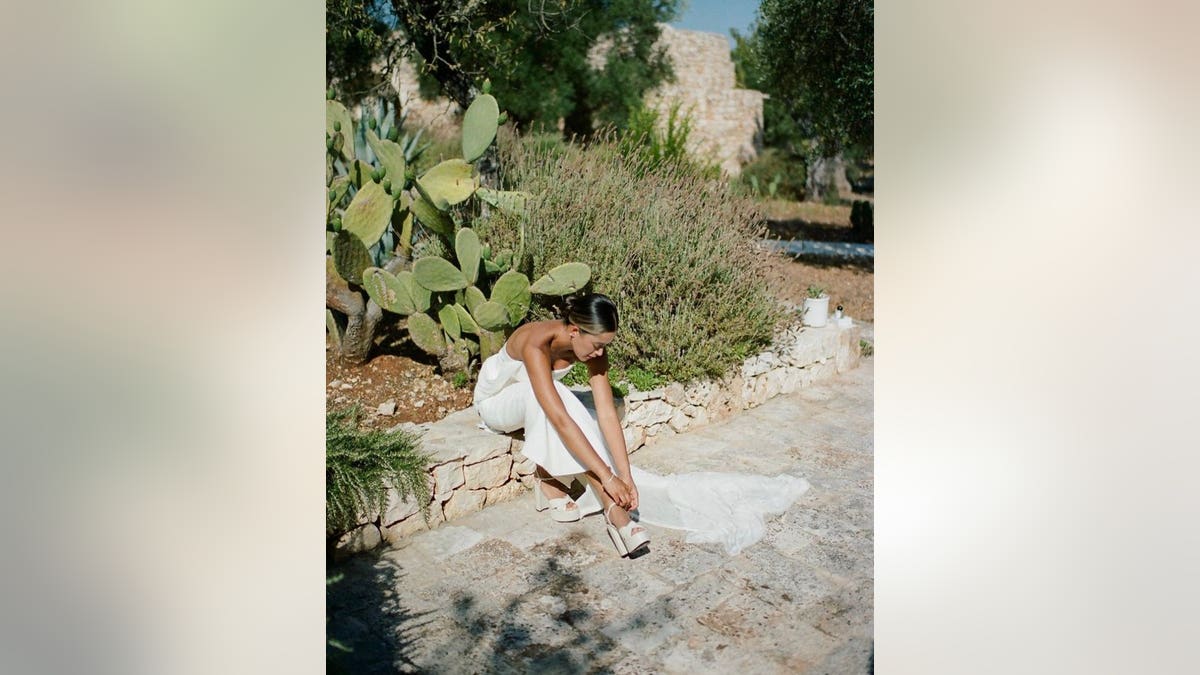
A moment that seems so small in the grand scheme of the day, like a bride reaching down to put on her shoe, putting on a piece of jewelry or even fixing her makeup, can turn out to be artistic, gorgeous prints. 

CLICK HERE TO SIGN UP FOR OUR LIFESTYLE NEWSLETTER

“The intimate times that the couple spends together that the outside world isn’t seeing is what I’m seeing. So I’m trying to capture him fixing a piece of hair that’s in her face that I have not guided. So anything that just feels authentic and not placed there on purpose is something that I view to be very artistic and memorable,” the global wedding photographer said.  

Capturing the smaller details of the day 

Beyond the people present at the wedding, there are a lot of other aspects that couples will want to remember. These smaller details include things like the chairs at their ceremony, their rings, the vow books they read from and even the atmosphere of the event. There’s really no detail too small. 

Bride fixing her shoe

Kristin Piteo captures all the details, including seemingly small moments like a bride fixing her shoe, that make for artistic photos.  (Kristin Piteo )

“When capturing the details of the day, I think making sure that you capture the scenes is so important. So when they are able to look back at these photos 5, 10, 15, 30 years from now, they can be brought back to the whole environment of the day,” Piteo said. 

“So whether that be the chairs, the wedding tent, the candlelit ambiance, I try to encapsulate the whole entire being of the wedding day, so they can really remember what it was like on that actual day,” Piteo noted. 

“So if there’s only candlelit lighting, I want to make sure that I’m capturing that ambient light. If there are really particular wooden chairs, I want to make sure that I capture them in any way that they are displayed to me,” Piteo explained. 

CLICK HERE TO GET THE FOX NEWS APP 

These details should be captured just the way they are, so the couple can look back at the pictures and see those moments that may have passed them by during their busy wedding day. 

Wedding shoes

Kristin Piteo spoke on the importance of capturing the details of the day, such as the bride’s shoes.  (Kristin Piteo)

“If they have their vow books placed up at the altar, capturing that, because that’s obviously something that they put together that was really intentional, and that’s just the way I move throughout the day,” Piteo said. “I want to make sure that everything is documented for them. So they can always remember these little moments that maybe rush by for them. It’s up to me to hold these as keepsakes for them.”

For more Lifestyle articles, visit www.foxnews.com/lifestyle.

‘I was always an uncertain and confused observer’: war photographer Peter van Agtmael on decades on the frontline

‘I was always an uncertain and confused observer’: war photographer Peter van Agtmael on decades on the frontline

Peter van Agtmael was nine years old in August 1990 when America went to war with Iraq for the first time. Mesmerised by the wave of patriotic fervour that ensued, he cut out and cherished a newspaper diagram showing the array of technological weaponry deployed by the US military. In the introduction to his new photo book, Look at the USA: A Diary of War and Home, he writes: “This was very exciting stuff for an impressionable kid who felt like a weirdo outcast with a lot of time to dream.”

Van Agtmael, who was born in Washington DC, grew up “middle-class” in Bethesda, Maryland and has a degree in history from Yale, is now a seasoned war photographer and photojournalist with the Magnum photo agency. He is also a deep thinker who, he tells me at one point, often feels “stuck inside my own head”. He describes the book, which juxtaposes his reportage from Iraq and Afghanistan with unsettling images of everyday American life, as “a collection of fragments from the post-9/11 era”. Threaded through with often deeply personal, self-questioning reflections, it is also a fraught conversation with himself about the nature and thorny ethics of his vocation.

“For me,” he says, “the words and the images, as well as the personal details about my life, are all part of a bigger process insofar as they are a means to explore what I do, and why I am compelled to do it. Likewise the conversations I have with other photographers, but also with family members and close friends. I’ve learned that addressing your fears, flaws and anxieties helps you understand yourself and feel less alone.”

The first, and one of the most revealing fragments, is a memory of a conversation he had with his parents in their house in Easton, Maryland in 2005. He was 24, the second Gulf war was under way, and he had just told them that he was about to go to Iraq for the first time as a photographer embedded with the US army. Their reaction unsurprisingly was a mixture of bafflement and anxiety. “The big concern I have is that at some point you will grow out of it,” his father tells him, referring to his abiding fascination with war. “What of course terrifies me is that you won’t have the chance to grow out of it.”

Now, aged 43, Van Agtmael has, if this book is anything to go by, finally grown out of it and entered a period of deep self-reflection. “For a time, I’ve an ongoing crisis with myself and what you might call the moral confusion of my existence,” he tells me over the phone from Paris, where he now lives. “Traditionally, photographers are meant to operate from a position of authority and clear-headed detachment, but I never related to that. For me, the professional and the personal are all tied together. In this book, I wanted to be clear that I was always an uncertain and confused observer.”

His deep interrogation of photography, and in particular his own work, will come as no surprise to anyone familiar with his earlier books, such as Disco Night Sept 11 (2014), Buzzing at the Sill (2017) and Sorry for the War (2021). They each deal in different ways with the discontents of post 9/11 America, and, to a degree, his own discontent with photography. His new volume gathers images from all of them, which he has sequenced in an often wilfully jarring merging of words and images. The captions alone give some sense of the visceral nature of his reportage from Iraq and Afghanistan: “Child beaten in the chaos of a raid”; “Before an ambush”; “Aftermath of a suicide bombing”.

The photographs are often triggers for painful but telling recollections from his time working alongside US soldiers, whom he depended on for his safety, and, in some instances, befriended, but ultimately remained apart from as a non-combatant. In his writing, he is adept at what might be called loaded understatement. One short, casually unsettling, passage reads: “As we passed through a Muslim cemetery, the chaplain accompanying us stopped to urinate. He called it a holy piss.” Another sentence evokes the bloody chaos of a night raid on a house in Mosul, already made all too real by the accompanying photograph: “A boy, deranged by violence, leapt at a soldier who smashed his face with a rifle butt.”

He photographs soldiers in action, on patrol amid indifferent or palpably hostile locals, relaxing in their cramped quarters and being tended to in field hospitals for often horrific injuries caused by car bombs. Back home, he briefly befriended one young soldier who had lost his leg in a rocket attack on an American base. They drank together and shared their thoughts. Then, as Van Agtmael, puts it: “The lines got blurred… It wasn’t working to be a friend, while also taking pictures that could be stark and brutal. Eventually we drifted apart.”

The narrative shifts abruptly from Baghdad and Mosul to Kentucky and Washington DC, and from desert plains and vast mountain ranges to the brutal economic fault-line of Eight Mile Road, which runs through Detroit, separating the city’s mostly white middle classes from its predominantly black urban poor. Van Agtmael’s American images suggest the simmering discontent that has since been leveraged by Donald Trump and a Republican party in thrall to his inflammatory rhetoric. In his home state of Maryland, he frames a lone figure in a white robe and hood walking into a woodland clearing towards a Ku Klux Klan induction ceremony.

“The more I understand the place, the less I can anticipate what is going to happen,” says Van Agtmael, “But when I was photographing in white, rural working-class areas before Trump came to power, I could definitely anticipate the forces that elected him. Suddenly I was hearing the crazy racist stuff that I hadn’t heard before and it was intensely uncomfortable. All you need is for someone with political power to give licence to people’s worst instincts and the gloves come off.”

In all of this, one cannot help but wonder about the psychological fallout of his deep and sustained engagement with violent conflict and social upheaval. In the book, he vividly describes his post-Iraq state of mind, the nights spent “awake until dawn smoking cigarettes and watching videos of gun battles on YouTube though I could barely look at my own photographs”. With family and friends, he became awkward and withdrawn, “too angry to really communicate what I’d seen and felt”.

The book, in all its messy, fractured, dissonant assemblage of images, words and confessions, is, one senses, the culmination of a long process of self-healing. He describes it tellingly as a final chapter. “There is something narcissistic about the whole undertaking,” he says, “but the constant looking inward is a way to make me look outward. I’m feeling proud of it and there’s a complexity and ambiguity to it, but, much like the photographs, it barely begins to scratch the surface of what I experienced.”

For the time being, he has laid down his camera and started painting, mainly “abstracted, figurative pictures” that are based on his memories and photographs. He describes them as “slightly grotesque and disturbing”, which is perhaps unsurprising. “Magnum has a long tradition of good photographers becoming mediocre painters,” he quips, “but I’m trying it and liking it. The hand takes over from the brain. It’s giving me a lot of peace.”

  • Look at the USA: A Diary of War and Home by Peter van Agtmael is published by Thames & Hudson (£40) on 4 April

Photography can be artistic, enlightening and a life legacy

Photography can be artistic, enlightening and a life legacy

John Enman

My friend Elvis, a photographer and teacher in Alberta, asked me to answer the question, “Why do photography and why take pictures?” He had also asked that question of his students and was waiting for their answers.

I posed the question in an online forum and received some unremarkable responses like, “Because I can” and “Because I have a camera.” However, I received answers like the one from someone called Soenda who eloquently said, “Because taking pictures has helped me see better. Before, I was less aware of the way light strikes leaves. I didn’t notice the symmetry of birds on a wire. Sunsets were masses of agreeable colour; now they are gold, pink, lavender and blue.”

Here’s another from a photographer named Laura who philosophically wrote, “Because when I look at my life, I cannot say I have done nothing. The proof exists that I have seen at least a wee bit of the world. I take pictures because it is artistic expression, and I think when we repress our artistic nature, we do ourselves no good, no good at all. I take pictures because it is fun. I can spend the entire day taking pictures, and it could not be a day better spent. I take pictures because I would like to decorate my grandma’s house with pictures of flowers. She is fond of flowers and if one can bring a bit of happiness to someone else, that is possibly the best one can do.”

I thought about how, for me, photography changes. There are times when I just want to play with the equipment, interested in nothing more than experimenting and knowing how something works. In those instances I could make a grand statement like, “I am testing this for future use.”

Sometimes I wonder about how some subject, like a building, a tree, car or whatever I see will look on my computer display or as a large print.

There are occasions when a camera allows me to document or record a memory of particular subjects.

And I also collect pictures of things in which I am interested. For example, I have complete construction photographs of home renovations I have done. I photograph my friends, family and pets.

And of course photography and making photographs was the way I earned my living for 30-plus years. There are times that, like the eloquent Soenda, when I am trying to visually create something that says something to others about what I see.

Many see photography as a way to express themselves artistically. Expressing oneself through photography is easy, as it doesn’t require the trappings of other mediums like painting or sculpture, it merely requires a camera.

The first surviving image made by Jacques Daguerre, inventor of the Daguerreotype, was of some artistically arranged plaster casts resting on a window ledge in 1837, and a short 20 years later photographers were wandering the North American wilderness and newly constructed cities creating photographs with the same intensity, perhaps not in the same numbers, as we today. Photography became a way not only to document, but also to express one’s feelings artistically.

Why take pictures? For many it is to document history, we know about the Civil War in the 1860s through the photographs of Mathew Brady and the Vietnam War in the 1960s and 1970s by David Kennerly.

Timothy O’Sullivan, William Henry Jackson, Ansel Adams, Elliott Porter, Imogene Cunningham, Bret Weston and others gave us their visual opinions of American landscapes and if we asked any of them the question “Why take pictures?,” they may have said something like, “To show others what we see when we experience the beauty in nature.” There were those like Dorothea Lang and Walker Evens during the great depression of the 1930s that may have said, “We take pictures because we want to show the human condition.”

Photographers like the famous Arnold Newman, Richard Avedon and (Canadian) Yousuf Karsh celebrated the portrait and those like them might say, “We do photography because we want to celebrate the beauty of the human expression.”

The question “Why take pictures?,” for some, may be very philosophical and for others practical. In response to Elvis’ question Soenda commented, “Because taking pictures has helped me see better.” And Laura, “I take pictures because, when I look at my life, I cannot say I have done nothing.” I wonder what readers of this column might answer.

Stay safe and be creative. These are my thoughts for this week. Contact me at www.enmanscamera.com or emcam@telus.net.

“I am LIVID” – wildlife photographer Tesni Ward speaks out against new badger culling policy

“I am LIVID” – wildlife photographer Tesni Ward speaks out against new badger culling policy

Wildlife photographer Tesni Ward, especially known for her work in the UK including images of Badgers, told a packed expressed her feelings that the British government’s shift in badger culling policy is wrong.

Badgers are a protected species in the UK, with their own Act of Parliament laying down rules preventing dogs from being allowed to attack badger setts (homes). Some 25% of the entire European badger population is found in the UK, according to The Wildlife Trust, but the UK government has nevertheless allowed the culling of 210,000 of the animals (at a cost of £58.8 million / $74.3 million / AU$113.9 million to UK taxpayers).

(Image credit: Tesni Ward)

Badger culling is undertaken with the aim of reducing the spread of tuberculosis (TB) in cows – bovine TB. Over 330,000 cows have been culled because of this disease, and over 90% of the transmission is cow-to-cow. According to the Badger Trust, culling has had no effect – though more than 70% of UK badgers could be killed by 2025.

The main culling method is shooting with a high-powered rifle. Farmers apply to the Department for Environment, Food & Rural Affairs (DEFRA) and have to undertake a basic course as proof of competence. They are then paid a bounty of £50 (approx $64 / AU$97) per head – quite the incentive for UK farmers to continue to blame badgers for illness (especially as most UK beef farmers also face significant financial woes brought about by Brexit and the UK’s trade deal with Australia).

(Image credit: Tesni Ward)

As Tesni explained, the culling policy was expected to come to an end – which would have been good news for the badgers and wildlife photographers. 

“Badgers are my absolute favorite animal in the entire world,” Tesni explained in her talk at The Photography Show. “They are incredible and it’s genuinely been devastating that for the past four years I’ve not been able to work with them because of the badger cull.

“I was hoping this year would be the year, because the cull is supposed to be ending, and they decided to extend it. They are applying for supplementary culling, which means that rather than shooting them for 6-8 weeks of the year, they could be shooting them for 6-8 months. I am livid.”

(Image credit: Tesni Ward)

Tesni, whose attachment to badgers was clear from the talk, also had advice for all wildlife photographers getting started – hardly surprising, since she hosts photography tours and workshops

“You will find when you are working with a certain species time and time again, even if you are stoic and you don’t have many emotional connections, you will become so fond of that particular species. Everyone just seems to get attached to something and, if you haven’t found it yet, it’s coming.”

Tesni Ward has shared a day in her life with us in the past.

Take a look at the best cameras for wildlife photography and the best lenses for wildlife photography. Tesni is an ambassador for OM System, so you might be interested in the best Olympus / OM System cameras she chooses for her job.