4w Arresting Photos of Wildlife in Action

4w Arresting Photos of Wildlife in Action
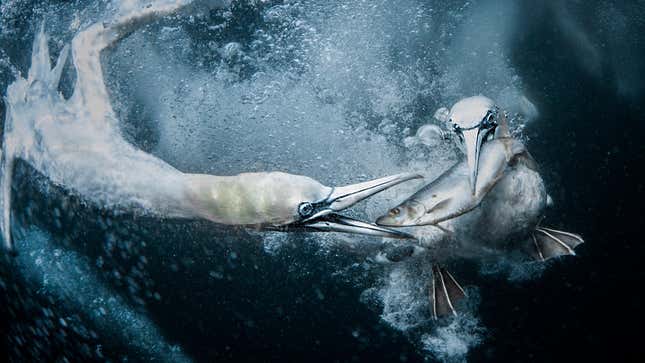
Two gannets vying for a fish off the Shetland Islands.
Two gannets vying for a fish off the Shetland Islands.Photo: Tracey Lund

The natural world is full of wonder. Life thrives in its every corner, from the abyssal depths of the oceans to the loftiest heights above Earth’s mountains. Thankfully, nature photographers capture Earth’s biodiversity in intimate detail, which is fully on display in the winning images from the World Nature Photography Awards.

Advertisement

This year’s grand prize winner for the World Nature Photographer of the Year is Tracey Lund, for her fantastic shot of two gannets going after the same fish (seen above). But all the winners are worth a look, and you can view them here.
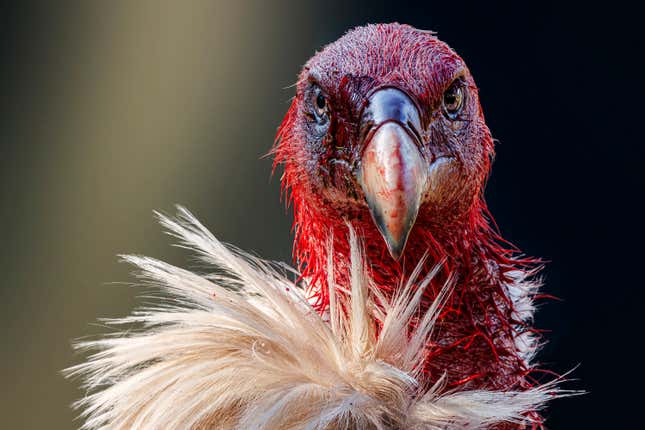
A Himalayan griffon vulture's bloody head.
Photo: Partha Roy

The third place image in the animal portraits category went to this unsettling shot of a griffon vulture staring at the camera, its head feathers matted down by blood.
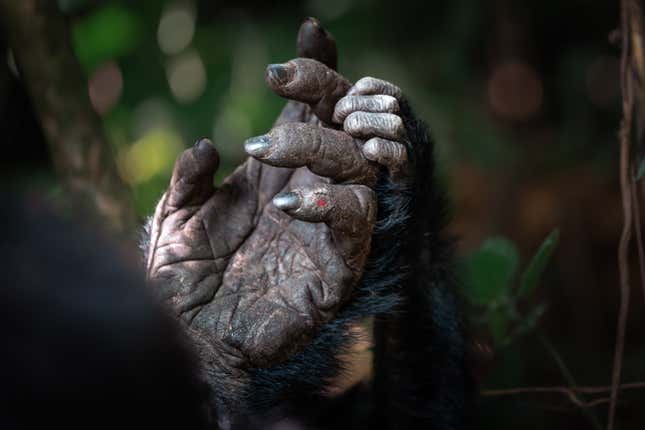
An infant gorilla rests its hand on it's mother's hand.
Photo: Michael Stavrakakis

The second place image in animal portraits was awarded to this touching photo of a young gorilla’s hand resting on its mother’s, taken in Uganda’s Bwindi Impenetrable Forest.
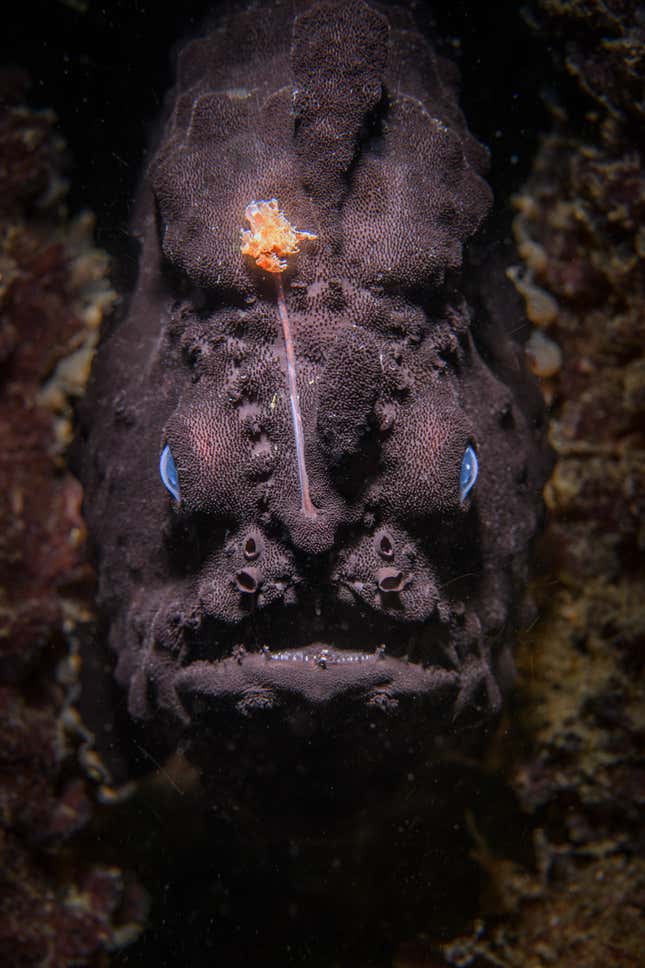
A menacing looking black frogfish off Kurnell, Australia.
Photo: Nicolas Remy

The winner of the animal portraits category was this creepy photo of a black frogfish (or black anglerfish) off the Australian coast.
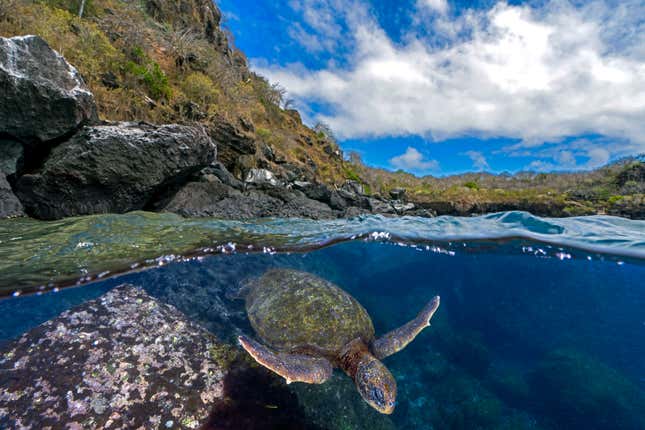
A green sea turtle underwater.
Photo: Dr Tom Shlesinger

The bronze winner in the animals in their habitat category went to this photo of a green sea turtle off the Galápagos island of San Cristobál. The turtle’s shell mirrors the green terrain above water.
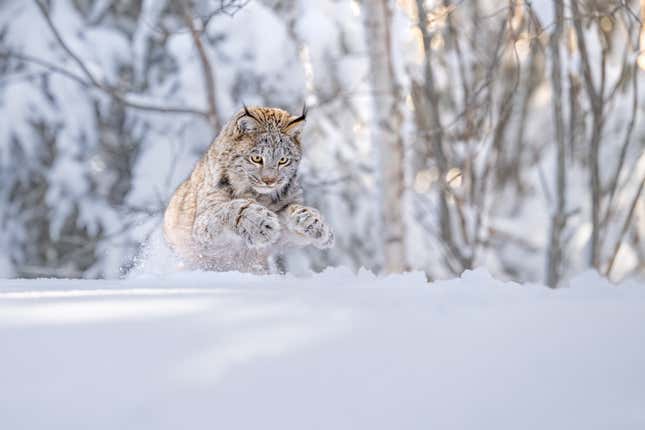
A Canadian lynx bounding through the snow.
Photo: Thomas Vijayan

The silver winner in the animals in their habitat category was this lynx, captured bounding through snow in Canada.
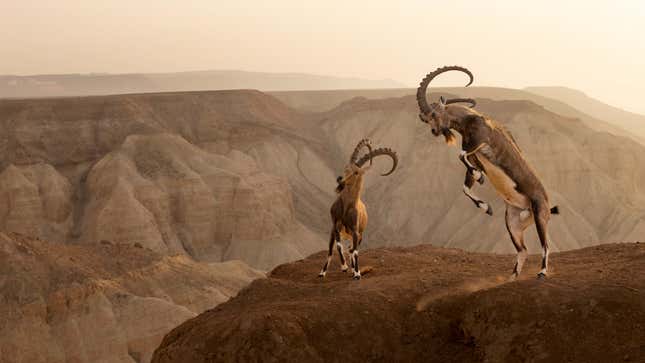
Two Nubian ibexes on a cliff's edge.
Photo: Amit Eshel

These Nubian ibex were photographed fighting on the edge of a cliff in Israel’s Zin Desert. The fight ended without serious injury to either ibex. This photo won the gold in the animals in their habitat category.
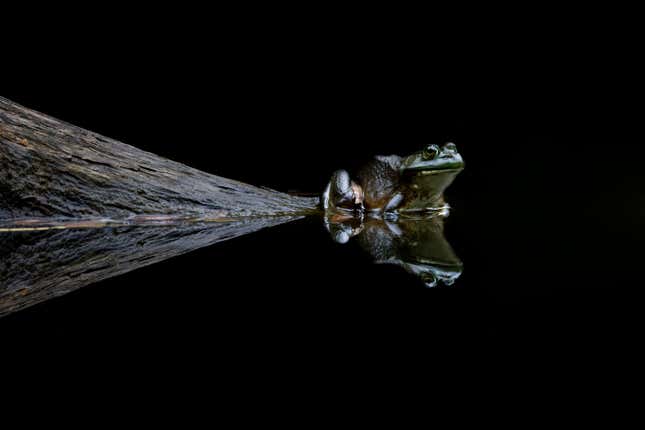
An American bullfrog on the edge of the water.
Photo: Rafal Dymarkowski

This American bullfrog sits on the edge of a body of water in Ottawa, in the third place photograph in the amphibian and reptilian behavior category of the competition.
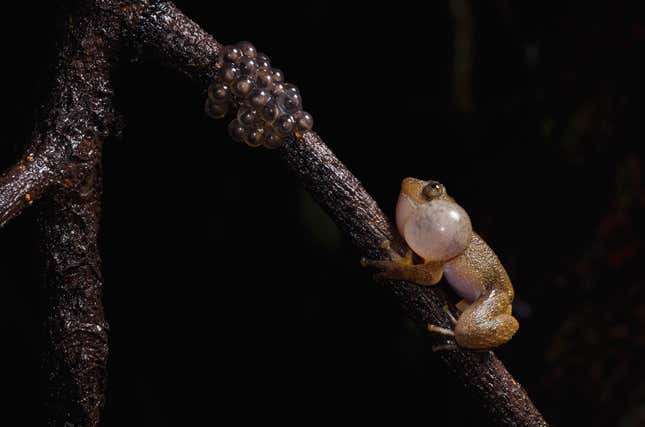
A male night frog calling next to an egg clutch.
Photo: Karthik Ak

The silver winner in the same category was this shot of a male night frog calling (note the puffed checks) in front of a clutch of eggs on a branch.
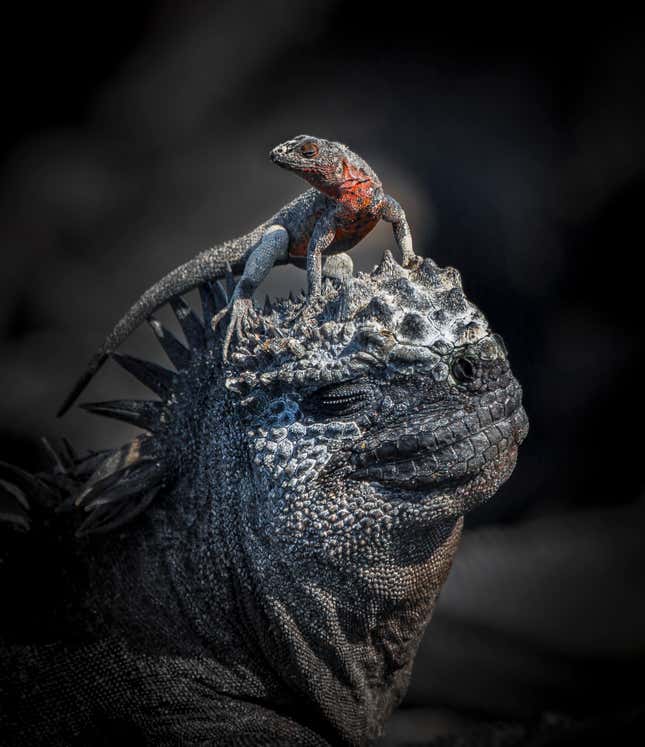
A lava lizard perched on the head of an iguana.
Photo: John Seagar

The winner in the category devoted to amphibian and reptilian behavior was this shot of a lava lizard aboard the head of a marine iguana, which looks blissfully unbothered by the lizard’s position.
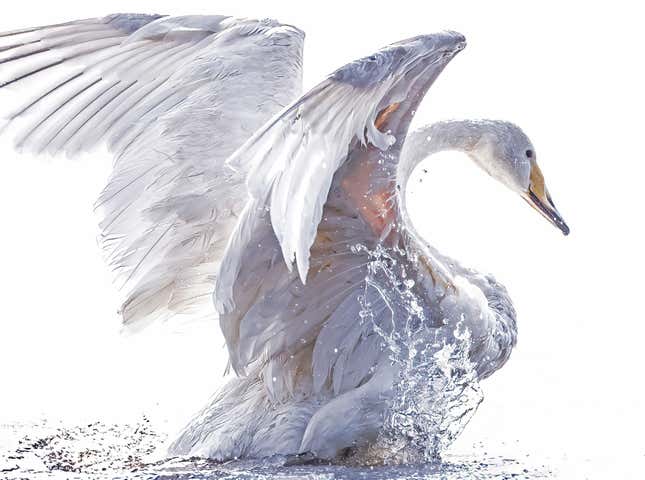
A swan spreads its wings in the water.
Photo: Jouni Erola

This swan is seems to emerge from the water in this blindingly white image. The bird stretches out its wings against a white background, evoking angelic overtones. The image took the bronze in the bird behavior category.
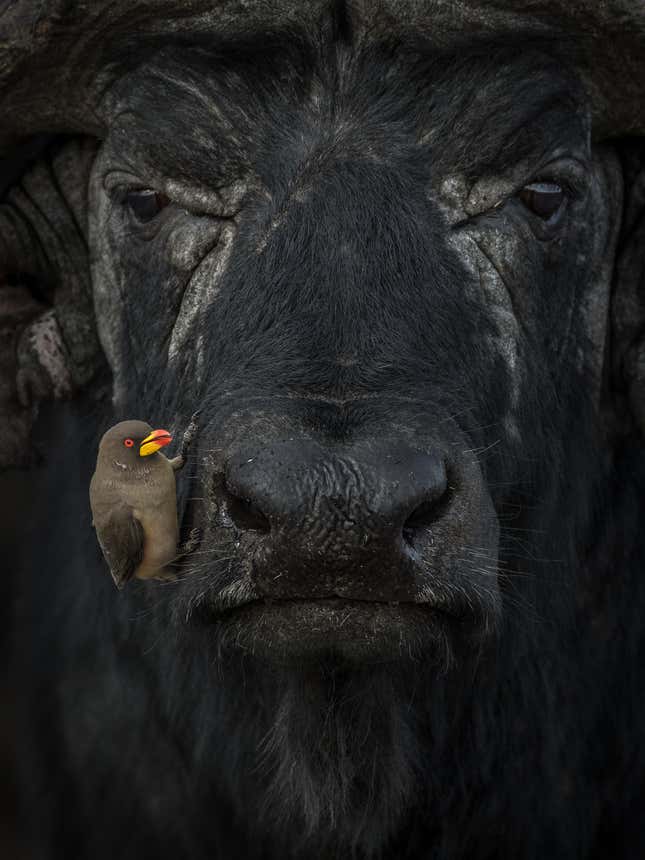
A yellow-billed oxpecker on an African water buffalo's snout.
Photo: Lakshitha Karunarathhna

The silver in bird behavior went to this image of a yellow-billed oxpecker holding onto the snout of an African water buffalo in Kenya.
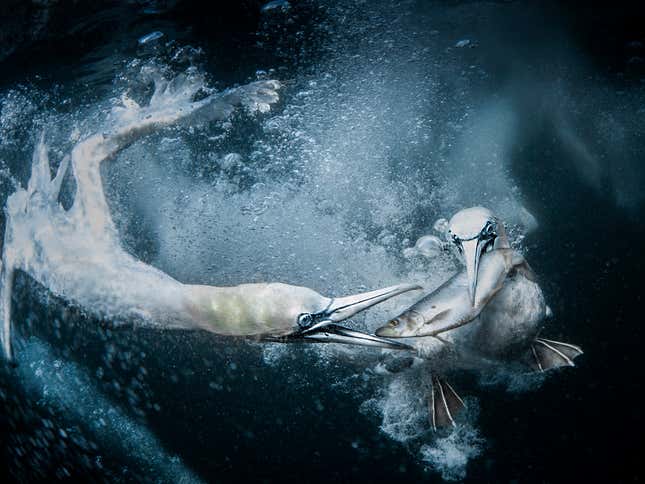
Two gannets going for a fish underwater.
Photo: Tracey Lund

The gold in bird behavior—as well as the overall grand prize winner of the competition—was this shot of two gannets under water off the Shetland Islands. Both birds are going for the same fish; it’s evident the birds just dove in, thanks to the dramatic surrounding bubbles.
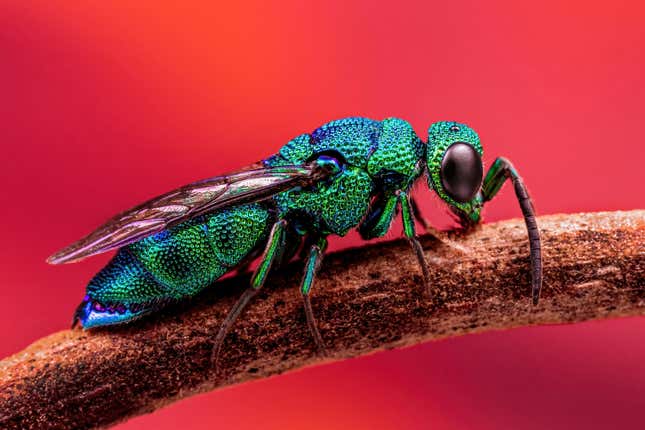
A cuckoo (or emerald) wasp.
Photo: Kevin Blackwell

The Cuckoo (or emerald) wasp won the bronze in the invertebrate behavior category. The wasp is holding onto a thin branch, and against the red background its iridescent green exoskeleton is even more brilliant.
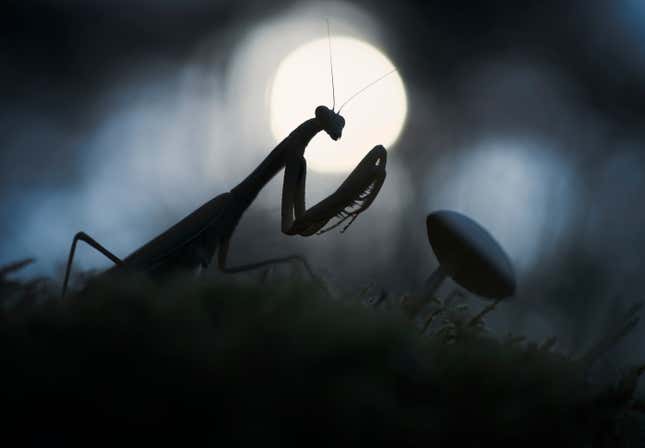
The silhouette of a mantis.
Photo: Panagiotis Dalagiorgos

A mantis silhouetted by a light won the silver in the invertebrate behavior category. The image is equal parts serene and creepy, making for a dramatic shot.
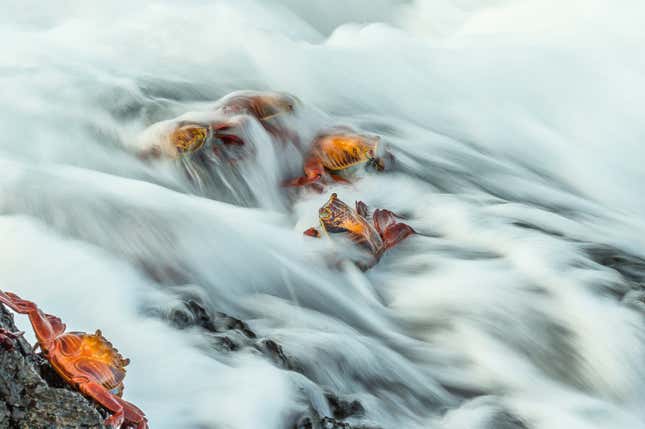
Sally light-foot crabs in rushing water.
Photo: Bill Klipp

Sally light-foot crabs in the rushing water on Santiago Island in the Galapágos won first prize in invertebrate behavior. The crustaceans are the sole flashes of color in an otherwise greyscale landscape.
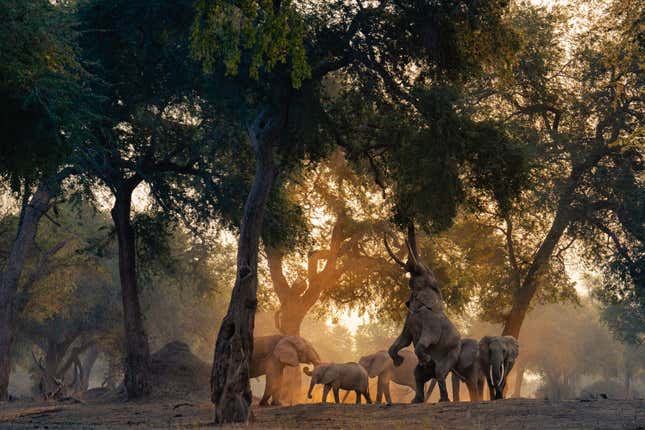
An elephant herd under a forest canopy.
Photo: Lukas Walter

A herd of elephants at Mana Pools in Zimbabwe. Winning third place in the mammal behavior category, the photo shows one elephant stretching its trunk to grab a hold of a tree branch.
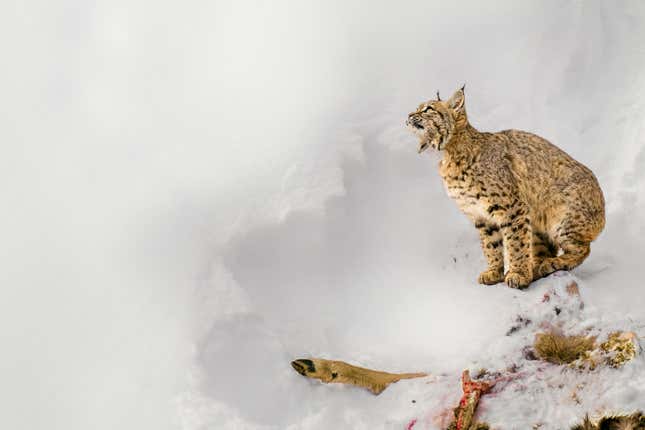
A bobcat next to the carcass of a mule deer.
Photo: Elizabeth Yicheng Shen

This bobcat guarding the carcass of a mule deer took the silver in mammal behavior. Taken in Yellowstone National Park, the carcass is half buried by snow and appears to lie on a totally different plane from the upright felid.
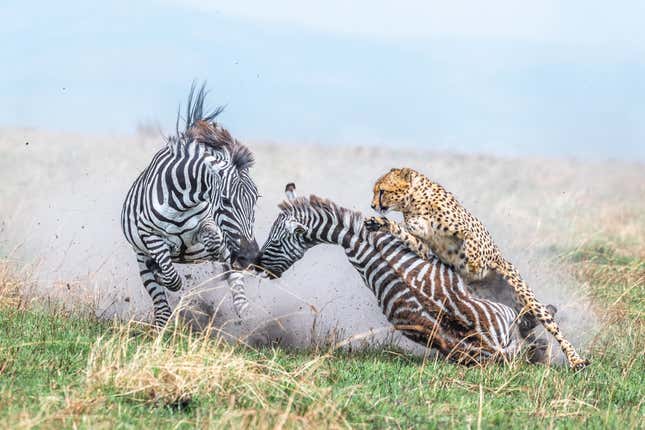
A cheetah pounces on a pair of zebras.
Photo: Alexander Brackx

In the gold winner in the mammal behavior category, a mother zebra and her foal are attacked by a cheetah in Kenya’s Maasai Mara National Reserve.
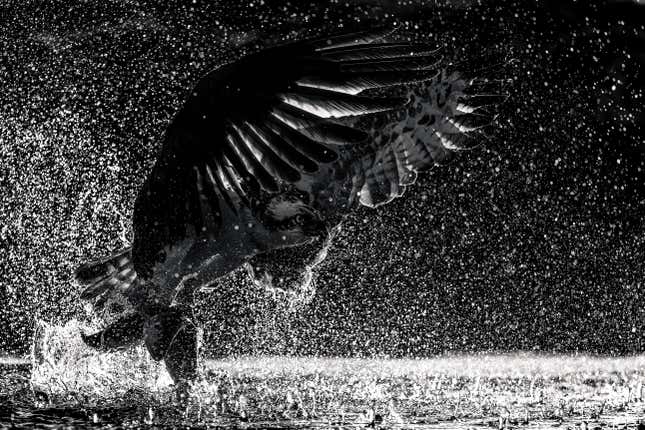
An osprey catching fish in black and white.
Photo: Tom Nickels

The bronze winner in the black and white category was this image of an osprey catching fish. The image is speckled with water droplets, making the osprey’s unfurled wings appear like a cloak under which it hunts.
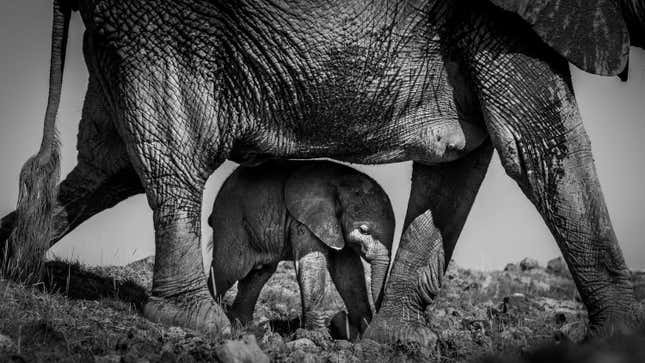
An elephant calf with its mother.
Photo: Tom Way

This shot of an elephant calf under the stride of its mother won the silver medal in the black and white category.
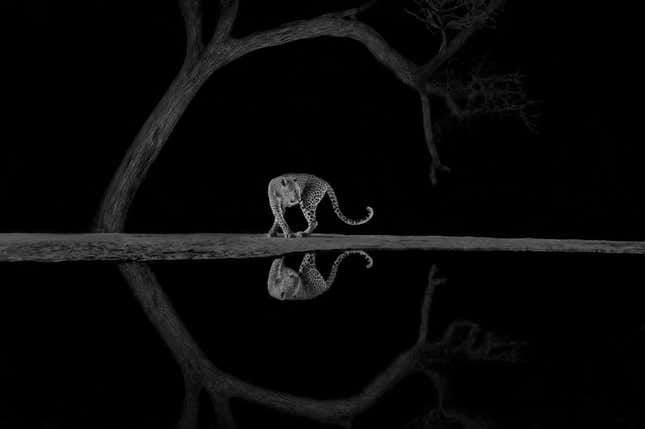
A leopard under a gnarled tree, with its reflection in a body of water.
Photo: Richard Li

The gold winner in the black and white category was this image of a leopard, photographed under an arced tree. The leopard stands on the edge of a water body, making a neat reflection of the big cat and the tree above it.
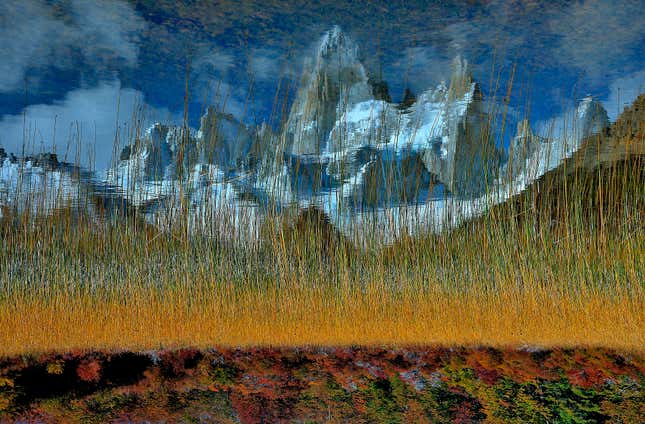
A reflection in an Argentine lagoon shows the Patagonia mountain range.
Photo: Vittorio Ricci

This shot of a Patagonian lagoon took the bronze medal in the nature art category of the competition. The reflected peaks in the photo are in Los Glaciares National Park.
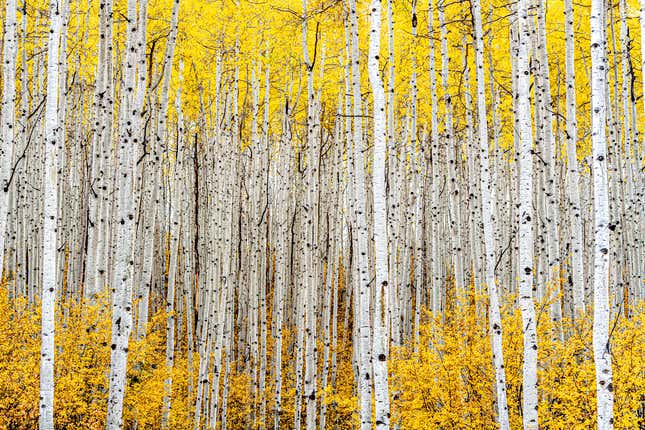
A forest of aspen trees.
Photo: Robert J. Ross

The second place winner in the nature art category went to this spellbinding photo of aspen trees. With bushes on the forest floor and the trees’ yellow canopy above, the mesmerizing shot makes you wonder which way is up.
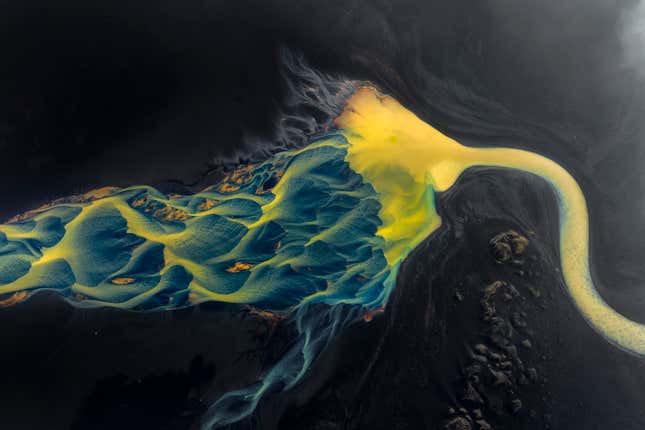
Glacial braids and golden sediment in Iceland.
Photo: Miki Spitzer

An aerial image of landforms in Iceland won the nature art category. Blue veins of glacial water and yellow bands of sediment run through the volcanic landscape.
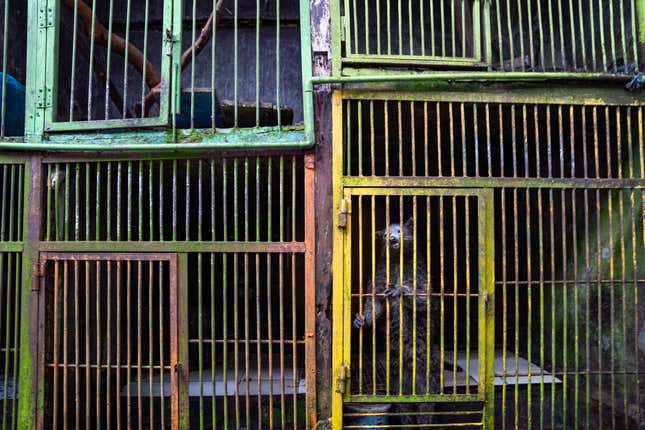
A caged binturong.
Photo: Lennart Stolte

A binturong in captivity in Sulawesi, Indonesia. The small carnivore is used to produce a local coffee, from beans that pass through the animal’s digestive system.
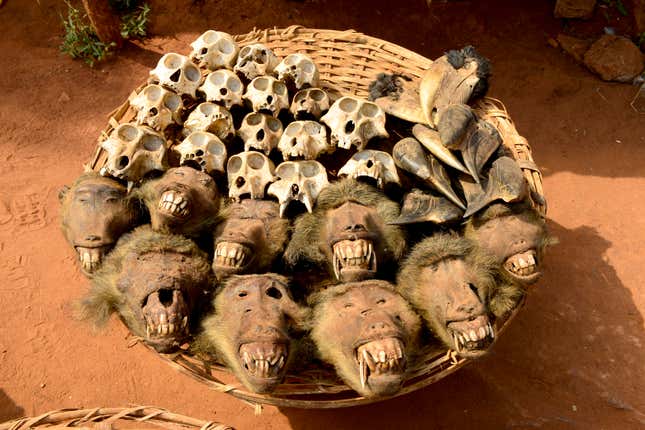
Baboon and hornbill heads at a market in Abomey, Benin.
Photo: Enrique Lopez Tapia

Baboon and hornbill heads at a voodoo market in Benin. This image was second place in the nature journalism category of the competition.
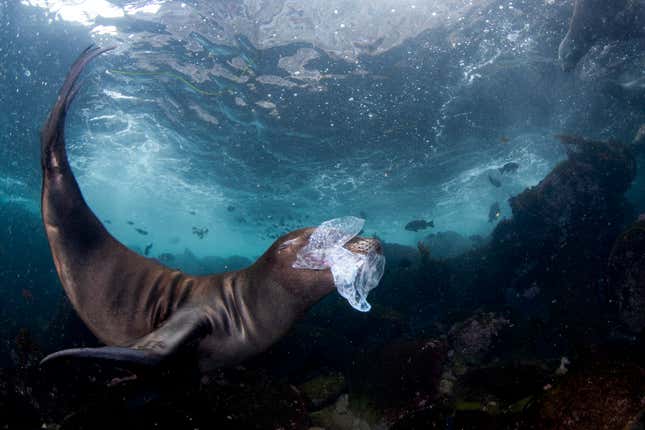
A young sea lion with plastic in its mouth.
Photo: Celia Kujala

A sea lion pup with plastic in its mouth took the first place in the nature photojournalism category. This sea lion was spotted off Baja California.
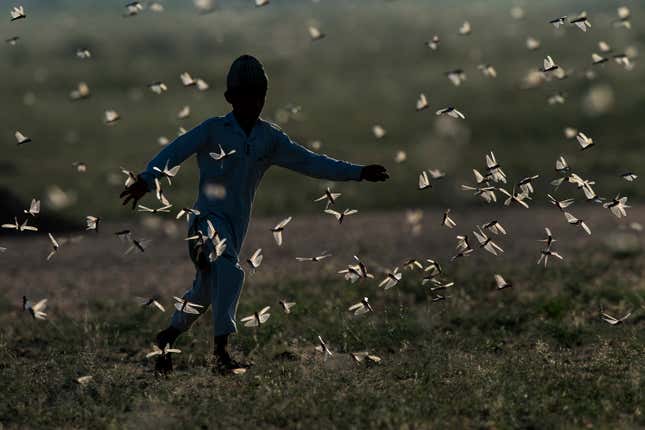
A boy in India chasing a locust swarm.
Photo: Hira Punjabi

The people and nature category of the competition showcases how our species interfaces with the natural world. This shot of a boy chasing locusts in Rajasthan took bronze in the category.
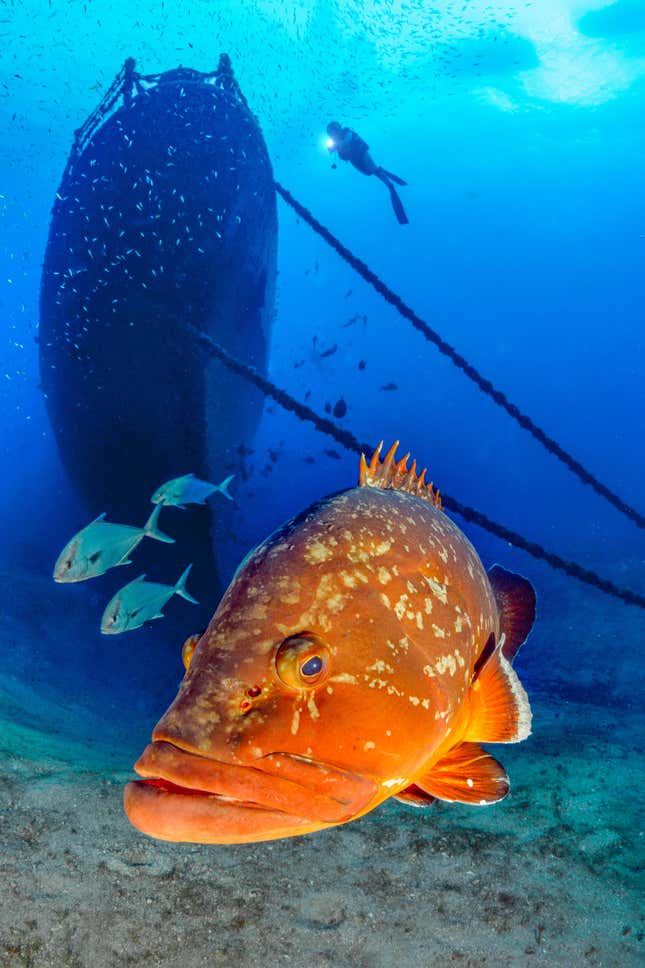
A giant perch with a diver investigating a shipwreck in the background.
Photo: Ferenc Lorincz

A giant perch off Portugal checking out the camera, with a diver and a shipwreck in the background. This image took silver in the people and nature category.
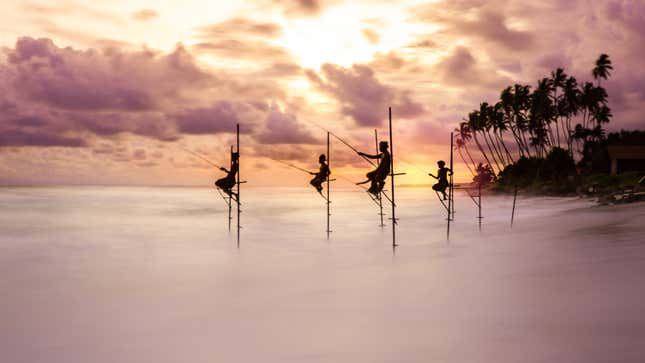
Stilt fishermen at sunset.
Photo: Pavlos Evangelidis

A group of stilt fishermen waiting for bites at sunset off Sri Lanka. This gorgeous photo won the gold in the people and nature category.
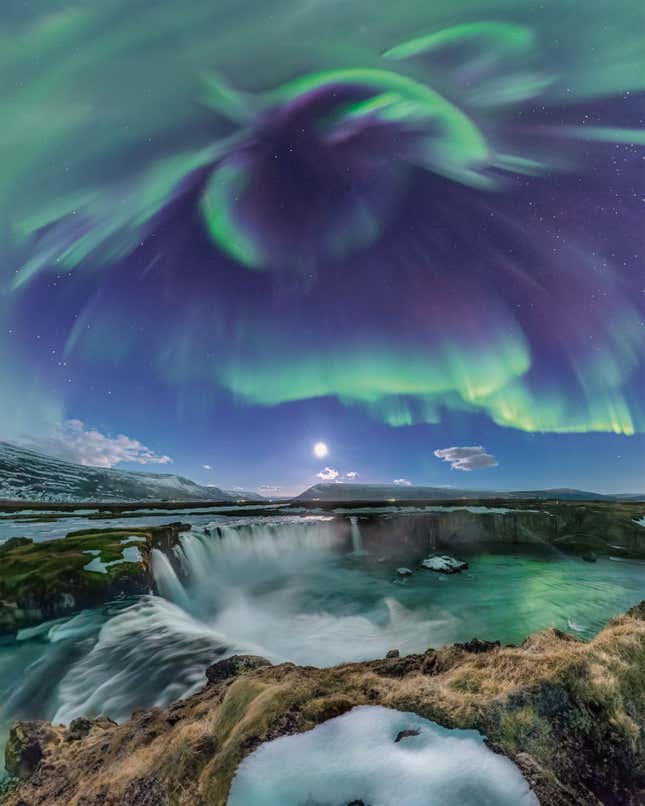
The Godafoss waterfall in Iceland, the Northern Lights shining above.
Photo: Cari Letelier

The Godafoss waterfall in Iceland, beneath the northern lights. A luminous Moon is also visible. This shot was the third place photo in the category “Planet Earth’s landscapes and environments.”
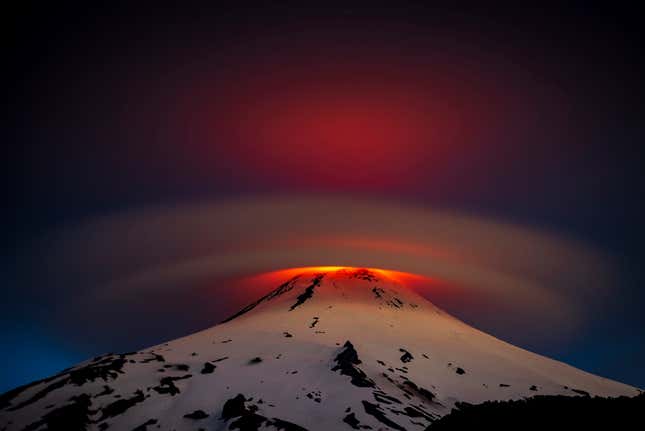
A foreboding orange light emanates from a cloud above the Villarrica volcano in Chile.
Photo: Francisco Negroni

An ominous shot of volcanic activity under a low cloud won second place in the landscape category; the Villarrica volcano is in Chile and makes for a foreboding subject.
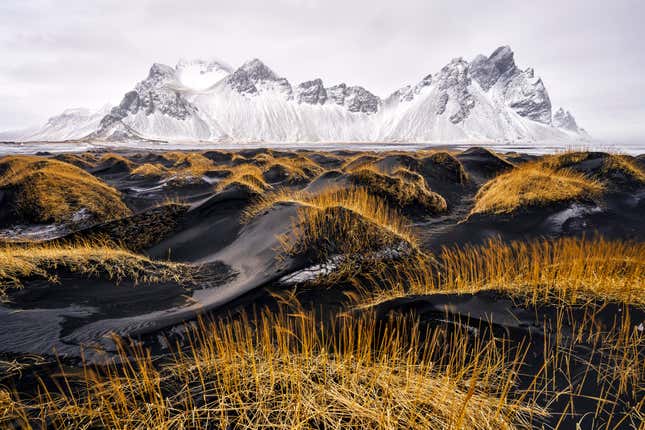
Iceland's Vestrahorn mountain.
Photo: Ivan Pedretti

The Vestrahorn mountain and the beach in foreground look otherworldly in this gold medal photo for the landscapes category.
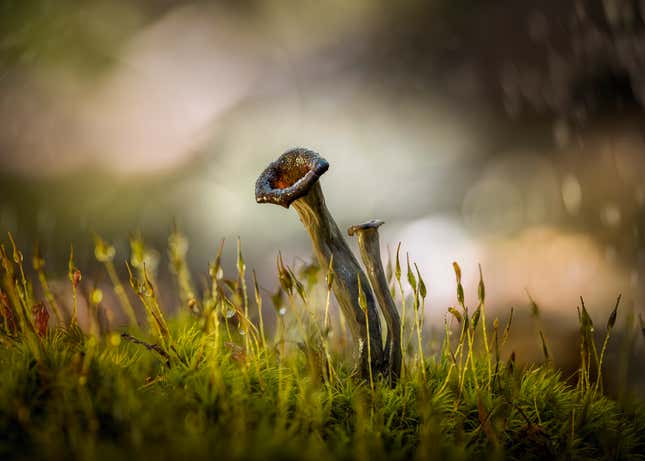
A black trumpet mushroom.
Photo: Radoslav Sviretsov

Trompette de la mort, or the black trumpet mushroom. This image was the third place photo in the plants and fungi category.
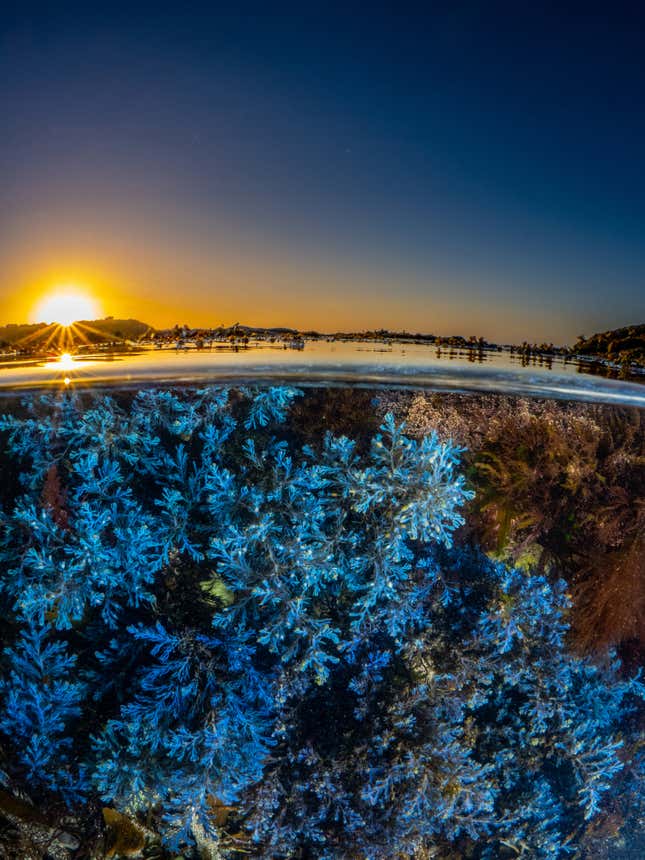
Rainbow wrack seaweed beneath the surface of the water.
Photo: Martin Stevens

Seaweed in a rock pool in Falmouth, England, was the second place image in the plants and fungi category. The sunrise glares in the top-left corner of the image.
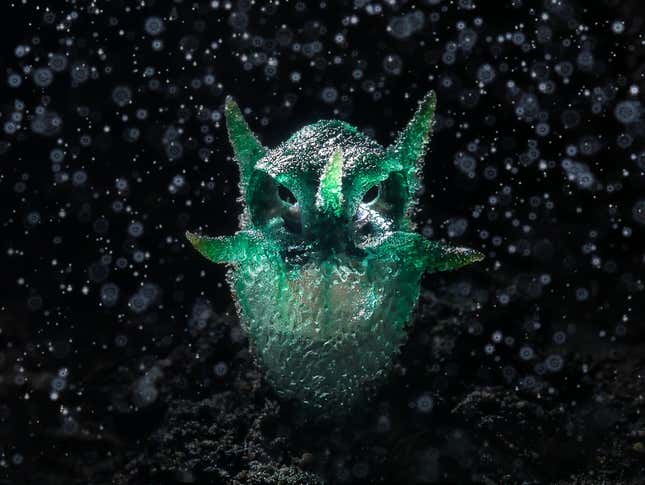
Thismia thaithongiana
Photo: Chatree Lertsintanakom

I thought this was a jade mask at first. It’s actually Thismia thaithongiana, or Thaithong’s fairy lantern, a type of plant native to southeast Asia. This image won the gold in the plants and fungi category.
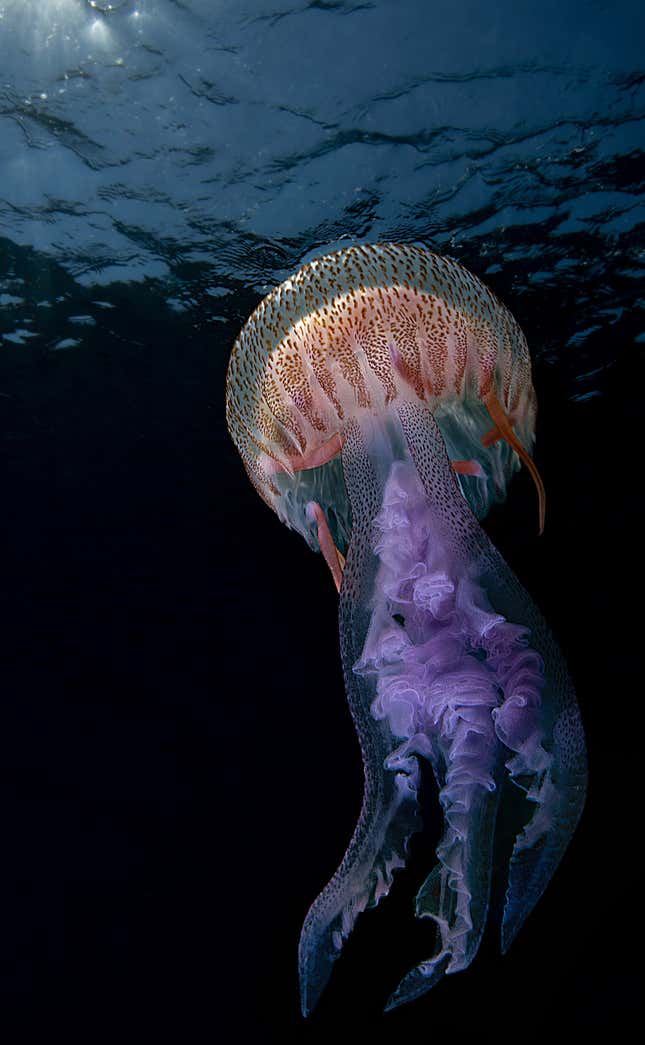
A jellyfish (Pelagia nocticula) underwater.
Photo: Giovanni Crisafulli

A mauve stinger (P. noctiluca) off the coast of Noli, Italy. This shot claimed third place in the underwater category.
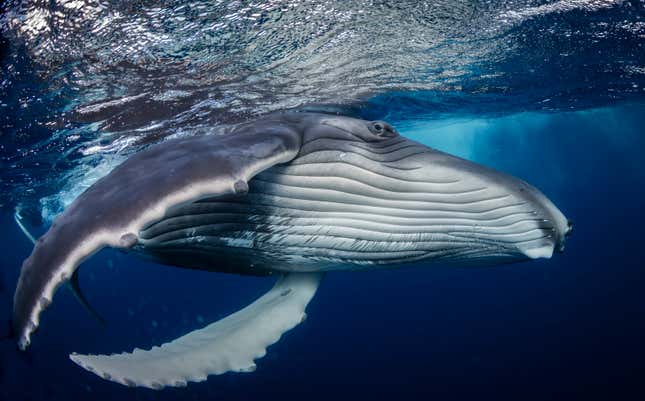
A young humpback whale.
Photo: Philip Hamilton

A young humpback whale checks out the photographer as it swims by, off the coast of Tonga. This photo took second place in the underwater category.
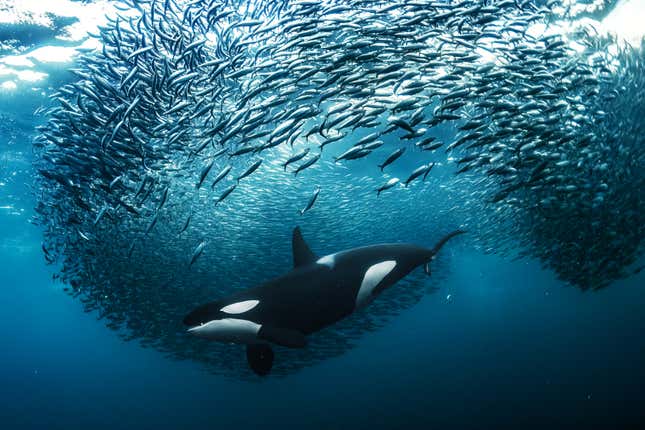
An orca amid a school of herring.
Photo: Andy Schmid

An orca diving through a school of herring off Skjervøy, Norway. This image won the underwater category.
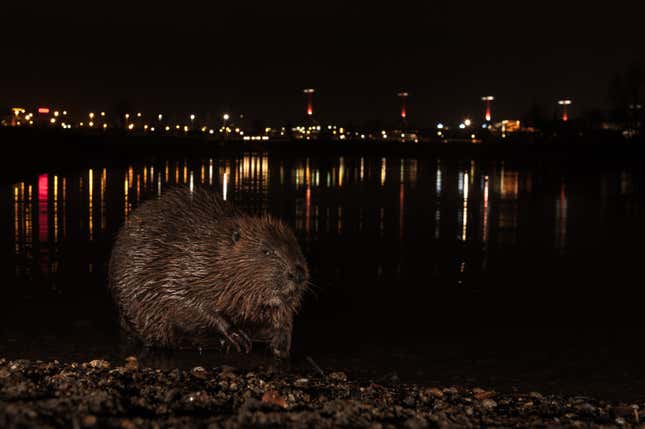
A Eurasian beaver at night.
Photo: Ádám Horváth

This somewhat skeptical-looking beaver was photographed at night in Budapest, Hungary. The beaver took the bronze in the urban wildlife category.
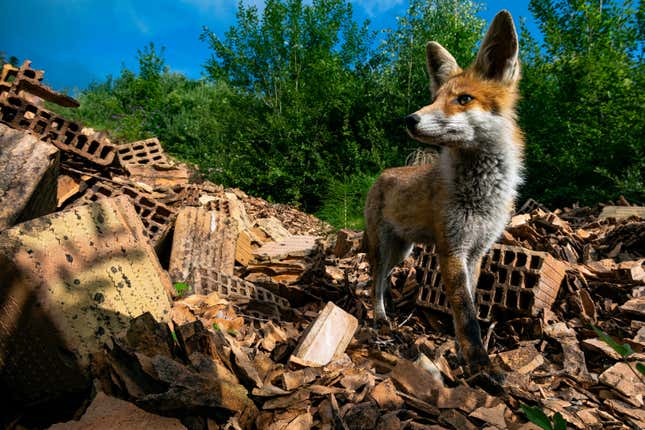
A fox close up amid a pile of rubble.
Photo: Roman Willi

A fox amid rubble in Lucerne, Switzerland won silver in the urban wildlife category. This photo shows how animals make use of human landscapes—and indeed, human leftovers—as they go about their lives.
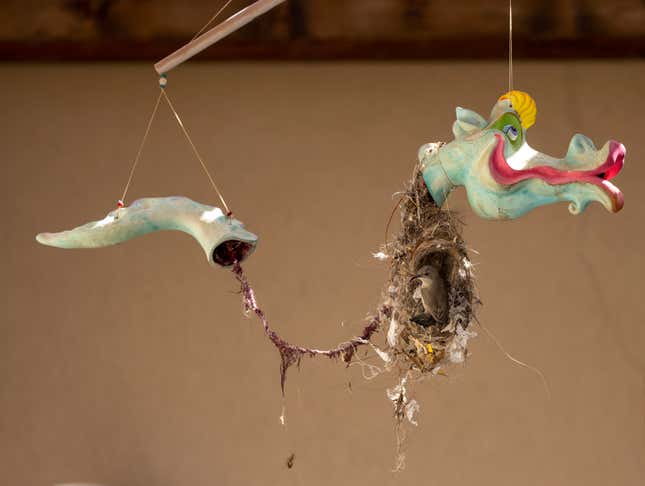
A sunbird in its nest, built in a human toy.
Photo: Roy Wiesner

The winning image in the urban wildlife cateogry is this shot of a female sunbird in her nest—build into a a discarded human toy.

90 Photos, 90 Women, 90 Years: ‘The Nature of Hope’ Celebrates Jane Goodall’s Incredible Contributions to Conservation

90 Photos, 90 Women, 90 Years: ‘The Nature of Hope’ Celebrates Jane Goodall’s Incredible Contributions to Conservation

Jody MacDonald, “Rajan Morning Walk.” All images © the photographers, courtesy of Vital Impacts, shared with permission

Jane Goodall, a pioneering primatologist and one of the world’s leading experts on chimpanzees, turned 90 last week, and to celebrate, the team at Vital Impacts (previously) launched a new fundraiser in honor of her legacy.

In collaboration with the Jane Goodall Institute, The Nature of Hope: 90 Women Photographers for Jane Goodall brings together dozens of images that reconsider our relationship with the environment. Included are stunning glimpses of animal affection like Daisy Gilardini’s touching shot of two polar bears snuggled together in Manitoba, alongside documentary works like Luisa Dorr’s “Brenda and Her Mother,” which centers on two Aymaran women wearing hats and polleras, skirts tied to their Indigenous heritage.

The 90 photographers included in the project—find the works of Beth Moon and Cristina Mittermeier previously on Colossal—consider Goodall a profound influence in their work. She “did more than just redefine our understanding of the relationship between humans and animals,” says Ami Vitale, the founder of Vital Impacts. “She shattered barriers and opened doors for women everywhere.”

All proceeds from The Nature of Hope will benefit the institute. The sale runs through July 2.


a mother and daughter stand together in front of a city below. the daughter holds a skateboard

Luisa Dorr, “Brenda and Her Mother”

two polar bears snuggle together

Daisy Gilardini, “The Hug”

two birds with bright blue feet waddle along with a fluffy baby by their sides

Tui De Roy, “Blue-footed Booby (Sula nebouxii)” in Galapagos, Ecuador

a black and white image of two giraffes nuzzling each other while birds fly in the background

Marina Cano, “Giraffes”

a panda looks at the camera

Ami Vitale, “Back to the Wild”

an ethereal image of a woman diving into a body of water

Tamara Dean, “Dusk Bloom”

a bright blue image of ice and a path of water in between

Tamara Merino, “The Sound of Ice”

Do stories and artists like this matter to you? Become a Colossal Member today and support independent arts publishing for as little as $5 per month. The article 90 Photos, 90 Women, 90 Years: ‘The Nature of Hope’ Celebrates Jane Goodall’s Incredible Contributions to Conservation appeared first on Colossal.

The most powerful photography exhibition I’ve ever seen goes beyond sight

The most powerful photography exhibition I’ve ever seen goes beyond sight

I have been fortunate enough to experience many photography exhibitions over the past few years but few have moved me as much as Canon World Unseen.

Last week, I had the opportunity to attend Canon’s latest exhibition titled World Unseen, an exhibition designed as an immersive experience for the visually impaired audience. I have always been passionate about inclusivity and accessibility in the arts, and I recognize how fortunate I am to be able to enjoy photography with little by way of obstacles. I also realize that this privilege can sometimes make me oblivious to the challenges faced by others who do not have the same access. 

Canon World Unseen was a jolt of realization for me, as, ashamed as I am to admit, I had never considered how visually impaired people partake in the medium of photography, and their experiences in doing so. No doubt many within the visually impaired community may not have explored photography because it is an art revolving around sight.

Fortunately, Canon is making the medium more accessible to the visually impaired while educating the unaware about the realities of living with a visual impairment.

(Image credit: Canon)

Canon organized the exhibition to provide an immersive, and accessible experience of photography to visitors, including those who are blind, partially sighted, and sighted. To develop the exhibition, Canon collaborated closely with the Royal National Institute of Blind People (RNIB), seeking feedback from the visually impaired community on the artwork, physical prints, and even the accessibility of the venue.

The exhibition displayed photographs selected from Canon ambassadors and included works by multi-award-winning South African photojournalist Brent Stirton, renowned Brazilian Photojournalist Sebastião Salgado, Nigerian photojournalist Yagazie Emezi, and Pulitzer-winning photojournalist Muhammed Muheisen, among many others. 

The exhibition was developed to provide an experience on two levels, for the visually impaired and for sighted people to experience the effects of different visual impairments. 

(Image credit: Canon)

(Image credit: Canon)

Through the use of a specialist Canon Arizona printer, Canon has created photographic prints that can be felt through touch and presented on an immersive board alongside a braille description. By raising certain details of the image via layering ink, the image can be felt. Imagine braille but for images. The printing process can highlight and raise selected details, creating a texture that follows the form of the subject, and this can even mean reproducing the subject’s texture in 3D. The best demonstration of this at work was Brent Stirton’s photograph of a white rhino titled Rhino Wars, where the rhino’s skin felt rough as though it was replicating the real-life experience of stroking a rhino.  

While experiencing the raised photograph a detailed audio description played overhead, revealing more information about the image and how it was captured. What gave the audio experience even more weight was that the narration was provided by the photographer who took the photograph, describing with great detail the approach and environment in which it was created, breathing further life into the experience.

The experience for sighted people provided a glimpse into the experience of daily life for the visually impaired. Globally, at least 2.2 billion people have some form of visual impairment, a staggering percentage of the population. Above the raised braille boards hung large-scale printed images much like any typical photography exhibition, but the view had been obscured with a large acrylic sheet depicting replications of different visual impairments such as glaucoma and diabetic retinopathy. Much of the images were hazed or hidden by the effects, making them extremely difficult to view.

(Image credit: Canon)

Canon’s printing can enable blind and visually impaired people to experience photography perhaps for the first time, an extremely powerful gift. This was made undeniably clear to me through the image Baby Scan by Bill Smith a world-renowned ultrasound practitioner. The expecting visually impaired mother was able to feel the contours of her unborn baby’s face by printing her sonogram, providing a moment that will never be forgotten. 

(Image credit: Canon)

A major point of this exhibition is to raise awareness of the possibilities of Canon’s printing techniques and how they can be used to further inclusivity and accessibility in the arts. Once businesses, or even artists and photographers, are aware of how they can bring imagery to life for the visually impaired, hopefully, they will consider using it. 

We are already seeing breakthroughs in this regard with Taschen collaborating with Salgado on turning his book Amazônia into a book for the blind (Amazônia Touch). Although different technology, it shows that the discussion of inclusivity in the arts is being had, and forward steps are being taken.

(Image credit: Canon)

The exhibition held in London was a roaring success, selling out tickets before opening day (entry was free). But as the goal of this exhibition is to get in front of as many people as possible, Canon’s World Unseen will be travelling across Europe, Africa, and the Americas. Be sure to monitor Canon’s social pages for more information on dates and locations.

For those unable to make it in person, Canon has developed the World Unseen online exhibition showcasing the altered photographs relating to a visual impairment via a sliding filter, with detailed audio descriptions of each image. 

I feel that this is an important campaign and one that deserves to spread around to reach as many people as possible. I hope that it will open up the world of photography to more people so that the photographic community can grow even further.

Photography + Review: Avenged Sevenfold

Photography + Review: Avenged Sevenfold

Posted: 9th April, 2024 by The Editor

“There’s no way we booked a show on Easter Sunday…” quipped Avenged Sevenfold frontman M. Shadows to a fully packed crowd at Newark’s Prudential Center. Blasphemous? Maybe. 

Self assurance has defined Avenged Sevenfold’s winding history. Never afraid to push boundaries, the band has spent their 25-year career towing the line of what classifies as metal. 2023 album Life Is But A Dream is a nearly uncategorizable ride through an ambitious, Camus-inspired soundscape that makes for a mindblowing – bordering on confusing – first listen. Upon repeat spins, their masterful demolition of genre lines makes most other releases sound damned near dull in comparison. 

At their March 31st Newark, NJ show, controlled, confident, chaos defined an experimental night that proved the Orange County rockers have only become more cutting-edge with time.

Tour openers Sullivan King and Poppy set the stage for a riotous closing show of leg three of A7X’s “Life Is But A Dream Tour.” Less than a year after the band’s triumphant return to NYC for a sold-out Madison Square Garden show, the crowd was littered with merch from previous legs of the tour. Repeat tour attendees and dozens of deathbat tattoos only scratch the surface of their cult following’s loyalty. 

The haunting guitar plucks of Life Is But A Dream album and tour setlist opener “Game Over” quickly led into blistering guitar as a ski-masked M. Shadows took his place center stage in an office chair. Synyster Gates and Zacky Vengeance’s signature dueling guitar melodies carried a career-spanning setlist dotted with rarities that haven’t graced the stage in a decade or longer. B-sides can tow the line of losing the crowd, but the addition of City of Evil’s “Blinded In Chains” for the first time since 2006, the full 11 minutes of Nightmare’s “Save Me,” and new setlist closer “Cosmic” fit seamlessly. 

An air of effortlessness highlighted their 1.5 hour performance. Technically polished and beautifully produced, the guys’ energy feels brand new despite showcasing a level of skill exclusive to veterans. Fans in the nearly sold-out crowd buzzed excitedly while recapping the show to each other, affirming that the possibly accidental Easter show booking was well worth their time. 


_

Tiana Timmerberg


Red Bull aerobatic pilots captured in a once-in-a-lifetime photograph

Red Bull aerobatic pilots captured in a once-in-a-lifetime photograph

America was plunged into darkness yesterday as the rare full eclipse was viewed and photographed by millions – but of course, Red Bull gives us wings!

Sulfur Springs Texas was cast into shadow yesterday at approximately 1:40 pm local time and lasted roughly 4 minutes. This was the amount of time photographers Dustin Snipes and Mason Mashon had to shoot one of the most creative photographs of their careers as they photographed two Red Bull aerobatic planes flying in formation through the eclipse. 

• See our guide for the best camera for astrophotography

(Image credit: Red Bull)

The duo spent countless hours planning the shot, researching lighting solutions, flight patterns, and positioning so that they could capitalize on the eclipse’s short window of totality. To outline the planes and make them more visible to the cameras below, reflective tape was installed on the wings to assist in illuminating the aircraft.

Then when instructed by the photographers below, the two aerobatic pilots Kevin Coleman and Pete McLeod, met and flew in tight formation under the eclipsing celestial bodies. The aircraft zoomed past while flying at 1500 feet and – most daringly – only 4 ft apart to line up with the moon.

(Image credit: Red Bull)

Pilot Kevin Coleman speaking on the project says, “Normally, this would be a manageable maneuver, but when you have the darkness from the eclipse, a flight angle that needs to be perfectly lined up with the sun, and only four minutes to take the shot while moving at 180 mph, it makes it incredibly challenging”.

Knowing the window of totality would not last long, for months leading up to the eclipse the photographers meticulously planned positioning and lighting scenarios, testing numerous pass-throughs, taking into account all variables. When showtime finally arrived the pilots had only 3 pass-throughs to get the shot, and thankfully for all involved, it resulted in a stunning and never again repeatable image.

(Image credit: Red Bull)

Red Bull has not disclosed what equipment was used to capture the image, but behind-the-scenes images show an array of the best Sony and Canon cameras on the market, including the monster Canon RF 1200mm F/8L IS USM. It is certainly one of the lesser-seen Canon super-telephoto lenses as it will currently set you back $20K!

The project was developed to celebrate a rare celestial event and challenge pilots and photographers in new and unexpected ways. Pilot Pete McLeod says, “Unlike the high adrenaline and aerobatics I’m used to, this project is all about exact precision and planning… It’s all about teamwork to make this happen so it’s been incredible to be a part of it.”

Are you inspired to capture celestial bodies yourself? See our guides for more information on the best telescopes for astrophotography, the best deep space telescopes, and the best smart telescopes

The Winners Of The 13th Annual Mobile Photography Awards (27 Pics)

The Winners Of The 13th Annual Mobile Photography Awards (27 Pics)
ADVERTISEMENT

Anyone with a phone instantly becomes somewhat of a photographer. However, even with mobile photography, some people manage to take it to the next level.

The Mobile Photography Awards (MPA) come into play to recognize talented individuals who capture unique shots with their phone cameras. This year, the MPA celebrated its 13th anniversary by spotlighting the finest moments from around the world, and the grand prize was awarded to Yajun Hu, a Shanghai-based photographer. Yajun Hu captured his photos with a Xiaomi Ultra 13, and as a winner, Hu earned both the prestigious title and also walked away with a $3,000 US cash prize.

Besides the grand prize winner, there were 13 categories, and each had a worthy champion, showcased down below.

More info: mobilephotoawards.com | Instagram | Facebook | twitter.com

MPA Photographer of the year – Grand Prize winner Yajun Hu

Image credits: mobilephotoawards

Image credits: mobilephotoawards

Image credits: mobilephotoawards

Image credits: mobilephotoawards

ADVERTISEMENT

Image credits: mobilephotoawards

Image credits: mobilephotoawards

Image credits: mobilephotoawards

ADVERTISEMENT

Image credits: mobilephotoawards

Image credits: mobilephotoawards

Landscapes and wildlife category winner- “Golden Mountains” by Di Lu

Image credits: mobilephotoawards

People photos category winner – “Cadet Obstacle Course” by Elliot Ferguson

Image credits: mobilephotoawards

Macro and details category winner – “Beyond the Green” by Hollyn Johnson

Image credits: mobilephotoawards

Portraits and self-portraits category winner – “The Violinist Returning Home at Night” by Queenie Cheen

ADVERTISEMENT

Image credits: mobilephotoawards

Silhouettes category winner – “Tetris” by Roy Pan

Image credits: mobilephotoawards

Travel and transportation category winner – “Wonder Kelingking Beach” by Yuepeng Bao

Image credits: mobilephotoawards

Street photography category winner – “Playground” by Chang Nianzu

Image credits: mobilephotoawards

Black and white category winner – “Broken Portrait” by Yajun Hu

Image credits: mobilephotoawards

Visula FX and digital art category winner – “Forge” by Melissa Johnston

Image credits: mobilephotoawards

Water / snow / ice category winner – “The Falls” by Ryan Cardone

ADVERTISEMENT

Image credits: mobilephotoawards

The darkness / noir category winner – “Light Up” by Wai Ying Kwok

Image credits: mobilephotoawards

Architecture / design / still life category winner – “The Void” by Wei Wei

Image credits: mobilephotoawards

Photo essay category winner – “Firecracker Symphony” by Victor Tan KH

Image credits: mobilephotoawards

Image credits: mobilephotoawards

Image credits: mobilephotoawards

Image credits: mobilephotoawards

Image credits: mobilephotoawards

ADVERTISEMENT

Image credits: mobilephotoawards

How I got the photo: Strawberry tarts

How I got the photo: Strawberry tarts

Tamron – Need lightweight, compact mirrorless lenses? Tamron has you covered, with superior optics perfect for any situation. With weather sealing and advanced image stabilization, you’ll open up your creative possibilities.

Radiant Photo – Radiant Photo superior quality finished photos with perfect color rendition, delivered in record time. Your photos — simply RADIANT. The way they are meant to be.

Mylio Photos – Access your photos from anywhere, without the cloud! Easily showcase your photos on-the-go, resolve duplicates, find faces and look for those stunning locations.

B&H – B&H is a world renowned supplier of all the gear photographers, videographers, and cinematographers need and want to create their very best work.

MPB – Grab used but perfectly working cameras and lenses for less, or turn your old gear into cash by trading and selling them on MPB!

Inside Leo Costelloe’s ‘actually quite sinister’ universe

Inside Leo Costelloe’s ‘actually quite sinister’ universe

Presided over by an uncanny bride doll, Leo Costelloe’s latest exhibition Special Day explores idealised beauty and the fantasy of romantic love

9April 2024

Framed in a picture window overlooking Cambridge Heath Road in east London sits a figure enshrouded in ivory tulle. Perched on a plinth (or is it an altar?), she gazes out unblinkingly from behind her veil as the lace of her dress spreads resplendently around her and the traffic and street life rumble past on the road outside. 

She is the creation of artist Leo Costelloe, whose current exhibition Special Day at Neven Gallery takes the archetype of the Western bride as a starting point to explore the semiotics of femininity and idealised beauty, spectacle, commodification, romantic love and much more. “It’s both a motif and character that is simultaneously public and personal, universal and local,” explains Costelloe, “and can both embody and unravel our own associations to the way in which femininity is both consumed, celebrated and vilified in Western culture.” 

At once deeply reverent yet iconoclastic, the Australian-born, London-based artist previously captured imaginations with their bewitching jewellery designs, often featuring bows and ribbons cast prettily in silver but with a slightly spectral feel that makes one think unavoidably of haunted Victorian nurseries. Their exhibition soft when warm at Guts Gallery last year saw the artist echo these themes of gender performance, fantasy, and artifice, in a series of larger sculptural works. But, whatever the scale or medium – whether it be in glass, silver, flowers, synthetic hair or tier upon tier of cake – Costelloe is articulating the contours of their own unique universe.

Presiding over Special Day, Costelloe’s bride is a 1930s mannequin, lovingly restored with the help of toy doctor Joel Davidson, and dressed in a 1960s traditional white wedding dress. Totemic yet also, as the gallery’s statement points out, a cake-topper – she is both subject and object; the passive, unblinking centrifugal point of the show. Around her, other works by Costelloe – such as Romantic Tendrils (2024), created from synthetic hair, or “Something old, something new, something borrowed, something blue (and a silver sixpence)” (2024), created from sterling silver, satin ribbon, a lace garter, Akoya pearl, glass, mother of pearl, a silver sixpence, and satin and diamanté flowers – are displayed like offerings and artefacts 

Below, we talk with Leo Costelloe about their obsessions, the enduring allure of weddings and “romantasy”, and why their work is always “a little bit dark”.

Please could you introduce Special Day? In what ways is it a continuation of your practice and in what ways is it a departure?

Leo Costelloe: I don’t really look at these works as a continuation or departure. The practice moves organically and ideas are born and expanded on simultaneously. Materially, ‘Bridal Shop Mannequin 1 (Finsbury Park)’ feels more expansive than previous works as I rarely work at this scale, so in that sense perhaps it is a departure from working on more intimate forms. Fundamentally, I try to look at the work as one universe that I translate into different objects or images in order to explore or reflect on certain ideas. 

What is it about the Western bride that captured your imagination? And what do you think this archetype represents as a cultural signifier?

Leo Costelloe: It’s both a motif and character that is simultaneously public and personal, universal and local, and can both embody and unravel our own associations to the way in which femininity is both consumed, celebrated and vilified in Western culture. 

I’m interested in unpacking and reflecting on Western cultures of femininity as a means of celebration as well as integration. Looking particularly at how these cultures could behave outside a patriarchal/capitalist landscape. I’m interested in the power of gender expression as self-determination and how the self can be activated through adornment and decoration. ‘The bride’ is a paradoxical icon – complex as a personal and impersonal symbol – which, when stripped of a particular identity or personhood can take on new meanings and act as a reflection of both societal pressure and romantic fantasy. 

“When watching a TikTok of the world burning and a cute video of a sausage dog in quick succession starts to feel normal, you have to realise that the cute sausage dog is actually quite sinister. My work is a bit like the cute sausage dog” – Leo Costelloe

In a previous interview with Dazed you described your work as ‘a little bit dark’. Please could you elaborate on this? 

Leo Costelloe: I think we’re living in an era of post-post-modernity. When watching a TikTok of the world burning and a cute video of a sausage dog in quick succession starts to feel normal, you have to realise that the cute sausage dog is actually quite sinister. My work is a bit like the cute sausage dog. 

What would you say you are most obsessed by as an artist? What are the recurring themes and references in your work?

Leo Costelloe: At the moment, I love Tinsley Mortimer and Sarah J. Maas books, particularly the A Court of Thorns and Roses series. The literary genre of romantasy feels necessary at this current time in history. I haven’t referenced either of them in the work yet, but I definitely will at some point. 

I use a lot of ‘hyperfeminine’ motifs throughout the work, bows in particular. I’m drawn to certain materials that innately carry a lot of symbolism or associations, like silver, glass, hair, flowers and photographs. These function both as object and image, all of which occur and are referenced throughout the work. 

Please could you introduce us to the protagonist of the show – your 1930s bride doll who presides over the exhibition?

Leo Costelloe: ‘Bridal Shop Mannequin 1 (Finsbury Park)’ was loosely based on dolls by Gisèle Vienne and figurative sculpture by Lisa Lichtenfels. I wanted to achieve a type of ritual presence in the space or an uncanny liturgy. I was thinking about the type of silence that occurs at funerals and births. That sort of hushed anticipation of a wedding which is simultaneously tied up with emotion and artifice is interesting to me, and I wanted to see if it could be transposed to a gallery setting. The title also references a street of bridal shops in Finsbury Park which I love for their dishevelled mannequins with the hands on the wrong way. They burst the fantasy bubble in many ways. Ideally, though, I’d like people to make their own assumptions about this work and all the works for that matter. 

Could you tell us about some of the other pieces in the exhibition (which appear almost like ritualistic artefacts)?

Leo Costelloe: More often than not, when I’m making objects, I’m thinking about ways in which they transform with use or function, or imagining how functional objects might be imbued with more meaning through materiality or placement within space. A gallery setting is always a fun way to manipulate the validity or sacrality of objects, and I think a lot of the works in Special Day are doing that. One of the works included in the show is a full cutlery set which is unfit for dining, but instead becomes an image of itself and a vehicle for projection. Likewise, the hair sculptures which are based on formal women’s hairstyles, like a sort of physical Pinterest board.

How does Special Day comment on the construction of romantic fantasy?

Leo Costelloe: Special Day is as open and obtuse as it is specific. I think it is both a reflection, critique and celebration of societal ideologies surrounding romantic fantasy. For the most part, I was trying to elicit a personal response from viewers, or maybe even a sense of nostalgia for a time when talking about weddings felt safe and simple. I am also very bored of looking at art that is about sex and violence and I think London needs some reprieve. 

Leo Costelloe’s Special Day is on display at Neven Gallery until May 18, 2024.





