from acclaimed artist with state ties
Tennessee Tech gets its ‘Wings’ with 70-foot sculpture


Amazon now offers the unlocked Sony Xperia 5 IV 128GB Smartphone for $798 shipped. If you need an Android device that puts pro-grade photography in the spotlight, that’s where one of Sony’s latest releases comes in. It’s $200 off the usual $798 price tag and matches the all-time low. We haven’t seen it on sale since last spring, either. Today’s offer is only the third discount.
Sony’s latest Android smartphone comes centered around a Snapdragon 8 Gen 1 chip and uses that power to drive the photography experience. It’s an approach that we’ve seen countless times from Sony as of late, and one that helps the company stand out amongst other Android handsets on the market. Chipset aside, you’re looking at a 6.1-inch FHD+ 120Hz OLED display that is 50% brighter than previous generations.
The rear camera array is also receiving lots of love this time around, with the 12MP triple-sensor setup being comprised of 16mm ultra-wide, 24mm wide, and 60mm telephoto lenses. All three can now record 120FPS slow-motion video in 4K, and Sony has also baked in real-time tracking and Eye AF into its new Xperia 5 IV. You’re also looking at a 5,000mAh battery backed by wireless charging, 128GB of onboard storage, and 8GB of RAM. Other notable features include dual SIM card support, immersive 360 Reality Audio, and an improved gaming mode for PS Remote Play.
The Sony XPERIA 5 IV Dual-SIM 128GB 5G Smartphone adds desired features from the last generation, while expanding on what made the XPERIA 5 III popular. With the XPERIA 5 IV, you will enjoy a 6.1″ FHD+ 120 Hz OLED display that’s 50% brighter than the previous generation and the ability to recharge wirelessly. These new features come alongside significant upgrades to the rear camera system. Now, all lenses can achieve 120 fps slow-motion video in 4K, real-time tracking & Eye AF in video, 20 fps burst in HDR, and more.
Subscribe to the 9to5Toys YouTube Channel for all of the latest videos, reviews, and more!


Pulling from thousands of entries, the overall winner (and recipient of a $1000 cash prize) in this year’s competition was Tracey Lund from the United Kingdom for her image of two gannets under the water off the coast of the Shetland Islands in Scotland.
This year, you can support the foundation by purchasing a print from the recently launched online store. “We’re thrilled that people will now have the chance to buy some of these images to grace the walls of their homes,” shares Adrian Dinsdale, cofounder of the World Nature Photography Awards. What’s more, for every piece of wall art sold, the organization will plant a tree.
Here are the winning submissions of 2024 across the categories.
Nicolas Remy’s photograph of a black frogfish (or black anglerfish in Australia) was taken in Kurnell, New South Wales, Australia. Frogfish are known for their excellent camouflage and their ability to lure in prey. They have a lure on their head that resembles a small fish or shrimp. When another fish comes close to investigate the lure, the frogfish strikes quickly, swallowing its prey whole.
Uniquely adapted to Israel’s harsh desert environment, the Nubian ibex is the only member of its family that can thrive in such extreme conditions. This photo was taken by Amit Eshel in the Negev desert, a vast and rugged region covering over half of Israel’s landmass.
The Galapagos lava lizard, also known as the Albemarle lava lizard, is a group of seven lizard species found throughout the Galapagos Islands. They are some of the most abundant reptiles in the archipelago and are closely related to iguanas. John Seagar took this epic photo of the lizard standing on a marine iguana.
Overall winner, Tracy Lund, took home the cash prize for her image of two gannets under the water in the Shetland Islands of Scotland. The islands are one of the best places in the world to see these magnificent seabirds.
Bill Klipp’s entry showcases the Sally light-foot crab on Santiago Island in the Galapagos. The Sally Lightfoot crab is known for its stunning red coloring and impressive agility. They are adept climbers and can navigate uneven terrain with ease, even scaling vertical surfaces.
Alexander Brackx took this photograph of a mother zebra and her foal being attacked by a cheetah in Maasai Mara National Reserve, Kenya. The reserve borders the Serengeti National Park in Tanzania, and together they form one of the most extensive wildlife ecosystems in Africa.
The black and white winner was Richard Li for his photo of a leopard in the East Rift Valley of Kenya. This area has a varied landscape including mountains, savannas, and forests. Leopards can thrive in these areas, especially with rocky outcrops and dense vegetation that provides cover for hunting and stalking prey.
Miki Spitzer wins this category with their photo taken in Iceland showcasing blue watery veins, glacial braids, and golden sediment.
Ioannis Pavlos Evangelidis’ entry of traditional stilt fishermen trying their luck at sunset in Koggala, Sri Lanka, is another winner. Koggala is a small coastal town located on the south coast of Sri Lanka, in the Galle District. It’s home to one of the longest beaches in the country.
Ivan Pedretti’s photograph was taken in Stokksnes, Iceland. It features Vestrahorn mountain, known for its two distinctive peaks and dramatic black sand beach.
The plants and fungi category was won by Chatree Lertsintanakorn for their photo of Thismia Thaithongiana. Taken in Umphang Wildlife Sanctuary, Tak Province, Thailand, Thismia Thaithongiana, also known as Thaithong’s Fairy Lantern, is a mycoheterotrophic flowering plant, meaning it gets its nutrients from fungi rather than photosynthesis.
Andy Schmid’s shot of a female orca splitting a herring bait ball was taken in Skjervøy, Norway. Skjervøy is a small island located off the coast of northern Norway and is known for its abundant marine life, including orcas, humpback whales, and herring.
The final category of urban wildlife was won by Roy Wiesner for his photo of a female sunbird in Be’er Ora, Israel. There are about 146 species of sunbirds found in Africa, Asia, and Australasia. They are known for their vibrant plumage, especially the males, which have iridescent feathers that shimmer and change color depending on the angle of light.


Los Angeles Chargers Team Photographer, Mike Nowak, has been with the Bolts since 1998 and has never missed a game, making him a true vet of the game. Tune in to watch as Mike breaks down the top photos from his career with players including Philip Rivers, LaDainian Tomlinson, Antonio Gates, Justin Herbert and more and reflects on what it is about photography that keeps bringing him back for more.


Forty years ago, in the summer of 1984, Detroit was electrified by the Tigers as they went wire-to-wire in first place and won the American League pennant before capturing the World Championship at Tiger Stadium in October.
That same year, photographer Carlos Diaz moved to Hamtramck and began teaching at the College for Creative Studies (CCS) in Detroit where the former chair of the photography department taught for 37 years. He previously taught photography at Bowling Green State University and the University of Michigan School of Art.
His first two Detroit projects were photographing Motor City landscapes and people on the streets to initially connect with his new hometown and its people.
At the three World Series games in Detroit, Diaz used his square medium format Hasselblad camera to create crystal-clear black-and-white portraits of unique individuals he randomly found outside of the ballpark at Michigan and Trumbull.
They included rabid Tiger fans, street people, and enterprising, independent vendors hawking their wares trying to make a few bucks while taking advantage of the World Series wave.
The 22 compelling portraits by Carlos Diaz, in addition to his four landscape photos of Tiger Stadium taken from within the Corktown neighborhood, are now displayed until Nov. 17, 2024, at the World Series Street Portraits 1984 exhibit located on the second floor of the Detroit Historical Museum.
“We always wanted to feature some of Carlos Diaz’s wonderful work in the Detroit Artist’s Showcase and I liked the idea of the 40th Anniversary of the Tigers World Championship being recognized in this way, “says Tracy Irwin, Chief Exhibitions and Enrichment Officer at the Detroit Historical Museum.
“It’s not your typical sports exhibit about a team. Instead, you have a broader context from the artist’s perspective showing people around the stadium and how important that season was for the city. We’re very fortunate that Carlos has donated all of the photos to the museum.”
Some of Diaz’s subjects include an elderly man selling peanuts and caramel corn curbside on Michigan Ave.; a Black man standing along Trumbull Ave. selling Tigers hats, buttons, and bumper stickers with a cigarette dangling from his mouth; two fans with painted Tiger faces holding open Budweiser beer cans; an alluring woman dressed as Uncle Sam supporting both Presidential opponents — Ronald Reagan and Walter Mondale — while selling cigars to support the restoration of the Statue of Liberty and the Ellis Island Foundation; and a forlorn bottle deposit collector and a young Latina leaning against a post observing the happenings outside of the ballpark; among others.
“I really wanted to connect with the city and that was easy to do outside Tiger Stadium during the World Series because it was a very exciting place to be,” Diaz told an audience at the exhibition’s opening preview on March 21 during a discussion moderated by Jeremy Dimick, the Director of Collections and Curatorial at the museum that included 1984 Detroit Free Press Tiger beat writer Bill McGraw.
“As I walked along the streets near Tiger Stadium, if I found someone interesting, out of respect I asked if I could photograph them, and because it allows them to recognize the fact that they are being seen as well” said Diaz in a telephone interview.
“In my mind a photograph is more like a sealed time capsule, and to truly appreciate it, you must work to reveal its contents because there are many layers to an image. I hope when people see the exhibit, they will have pride in the city and what the Tigers achieved that year but also that they will see beautiful, down to earth hard-working people trying to survive and others who were simply enjoying themselves.”
Diaz’s four images of Tiger Stadium, the beloved ballpark abandoned by the team following the 1999 season and demolished in 2009, are somewhat haunting and a reminder of a bygone era.
One such image, entitled Residential Parking Lot and Modern Coliseum, was taken from the alleyway between two dilapidated homes in the Corktown neighborhood advertising parking with the ballpark visible in the distance.
The Carlos Diaz exhibition is open to the public until Nov. 17, 2024, at the Detroit Artists Showcase on the second floor of the Detroit Historical Museum located at 5401 Woodward Ave. across the street from the Detroit Institute of Arts. Hours are Wednesday to Saturday 10 a.m. to 5 p.m. and Sunday, 1 to 5 p.m.
For more information, visit detroithistorical.org.

Whether to share locations in landscape photography is a frequent topic of discussion in landscape photographer communities. People get frustrated when they ask where a photo was taken and the photographer won’t tell them. Are they gatekeeping, or are they trying to protect the natural landscape?
We have all seen it unfold on the internet, whether it be a comment on a social media post, a discussion in a Facebook group, or maybe you are the landscape photographer receiving direct messages asking where a photo was taken.
When these requests for locations occur, they are often prompted by a beautiful image of a lesser-known place the photographer shared. The photographer did not geotag the spot or maybe tagged it with a broad location, like Arizona or West Virginia. And the questions start: Where is this? How do I get there? What is the name of this place? And so on.
In many cases, if the photographer didn’t tag the specific location, the answer will be, “No, I cannot disclose the location of this photograph” or something along those lines. From here, the cries of gatekeeping or trying to keep locations from others arise, and the debate unfolds.

Today, the term gatekeeping usually has a negative connotation. Essentially, it means controlling or limiting access to something. When a person is not told the location of a particular photograph, some people will accuse that photographer of “gatekeeping” the location by not sharing. But are they?
Not all locations are created equal. Some have had infrastructure built to help accommodate large numbers of visitors. A park service has built parking lots, trails to sustain foot traffic, toilets, and more. These areas, with their infrastructure, can help minimize the damage people could do while exploring an area.
Many areas have sensitive flora, wildlife, or even dirt when it comes to cryptobiotic soil, which can suffer harm that would take years to recover from. Areas with infrastructure built for visitors help keep people away from those more sensitive areas or at least contain the damage we do simply by visiting locations.
Some of the lesser-known areas a landscape photographer might photograph lack these protections. A high volume of visitors could alter the environment beyond repair—flowers could be trampled, sensitive soil disturbed, or even outright vandalism, with people carving their initials into rocks and trees near the area.
This is one of the primary reasons a landscape photographer might choose not to share locations on their posts or why they might not tell you the exact location of a photo. They aren’t being elitist, they are trying to protect sensitive areas and keep them from being overrun with people when the infrastructure and environment might not support it.
Many practicing landscape photographers have stories to tell about areas damaged by over-visitation. Some have learned the hard way and been the ones that shared a location, or they are at the very least familiar with watching the popularity of a location change the environment around it as word gets out.

People often wonder when to share and when not to share. There isn’t really a set rule, but I highly recommend erring on the side of caution and being deliberate about when you share a location.
One only has to look at my social media feed to see I vary how and when I share a location. If an area has infrastructure built and maintained by a park service, I am more likely to share an exact location.
For example, if I am at one of my favorite local areas to photograph and take a picture of one of the more popular waterfalls, I am much more likely to mention the exact location. The park service has built infrastructure to help minimize the impact of people visiting. There are designated parking lots, marked trails, areas marked as restricted (which are unfortunately ignored all too often), and restrooms for visitors. These are easily found areas, with or without my photograph.
Meanwhile, there are other places in the region that I do not tag because the infrastructure is not there to support a high volume of visitors. In those cases, I might tag the county or the state, but do not provide specifics. Even when people ask me in comments or via direct message, I decline to comment on the specific location.

If you look at the definition of gatekeeping, it says controlling or limiting access to something. Are we landscape photographers really limiting access by not sharing a location? No—everyone has access to the same tools and information we used to find lesser-known locations.
Using my local area again as an example, several of the locations I have found were done through studying topographic maps, reading trail reports buried deep on the internet, or possibly seeing another photographer’s photo and sparking my own research on the spot to help find it.
For me, exploring and finding new places is part of the fun, whether I’m following something interesting on a topographic map or spending hours scouring the internet for some old, obscure reference to a spot that might be worth checking out. As with all things landscape photography, learning to enjoy the process pays some of the best rewards in the end.
If you are a photographer who does not share locations, be prepared for people not being happy when you don’t disclose a location. Many are quick to accuse of gatekeeping because some don’t understand the why behind it.
Instead of being annoyed if someone asks for a location, take a moment to tell the person asking why you are not comfortable sharing. Explain the consequences of publicly sharing certain locations and the detrimental effect on the environment of that location. Explain how not disclosing locations can help protect the beauty we are trying to photograph.
I often find this a good opportunity to mention some of the key Nature First principles or direct a person to the Nature First website so they can learn more about them. It is a very helpful resource, especially for those who might not have grown up with Leave No Trace principles.

 We’re over the moon to present Echoes and Shift, an international Indigenous exhibition hosted on two sites in Manchester and Nashua. Positive Street Art (PSA) and the Greater Manchester Chamber will work with curators Margaret Jacobs (Akwesasne Mohawk) and Yasamin Safarzadeh (Iranian-American) to encompass the throughline of identity in artists who grapple with the duality of multiple nationhood and disrupted genealogies.
The artists are actively challenging stereotypes within the narrative of contemporary Native art, pushing the boundaries in their field and offering a multiplicity of voices, perspectives and narratives that broaden the understanding of contemporary Native art. With this exhibition, we aim to challenge dominant discourses around Indigenous art and creative practice in New England. We believe this exhibition will help to break stereotypes and misconceptions about Native peoples and to share accurate and authentic narratives.
Hosting Echoes and Shifts over multiple years is crucial for Positive Street Art (PSA) to amplify Indigenous arts and voices. By consistently showcasing Indigenous artists and their works, PSA not only provides a platform for these creators to share their stories and perspectives but also creates a lasting impact on the community. PSA will build relationships with Indigenous artists, fostering trust and collaboration, while also educating the public about Indigenous cultures and histories. This ongoing commitment not only celebrates the diversity of Indigenous artistic expression but also challenges stereotypes and promotes cultural appreciation and understanding within the community. Moreover, by hosting the show annually, PSA demonstrates its dedication to promoting inclusivity and diversity in the arts, contributing to a more vibrant and equitable cultural landscape.
Currently, there are no federally or state-recognized tribes in the state of New Hampshire. By bringing in an exhibition of contemporary works to the region, we believe that it will unfold a wealth of knowledge and insight that would help shift the conversation from past and stereotype, to contemporary artistic conversations in Native communities. Alongside the exhibition, we will be developing a programmatic component to run concurrently including: artist talks, workshops, and youth enrichment. At the moment, we have youth programming specific to this show with West High School and youth and young adult service organizations in Nashua and Manchester.
With this in mind, we are reaching out to you in hopes that you would consider sponsoring this exhibition and the resulting programming. While we are grateful for any level of support, we hope you may consider reaching out to y’all’s network to find funding for the 2024 Echoes and Shifts exhibition which would list your name and logo on all of our print and digital marketing materials and primary access to programmatic elements open to the public for contributions over $1,000.
Look out for an upcoming feature-length article at 603 Diversity on the how of this exhibition. Check-in to keep up with the upcoming dates of exhibitions.
The show will be on display from June – September 2024 with an opening reception in early June and programming throughout the run of the show. Co-curated by Margaret Jacobs, Akwesasne Mohawk, and Yasamin Safarzadeh, Curatorial and Projects Coordinator at Positive Street Art, this exhibition encompasses the throughline of identity in artists who grapple with the duality of multiple nationhood and disrupted genealogies.
The visual artists chosen for this exhibition are actively challenging stereotypes within the narrative of contemporary Native art, pushing the boundaries in their field and offering a multiplicity of voices, perspectives and narratives that broaden the understanding of contemporary Native art. With this exhibition, we aim to challenge dominant discourses around Indigenous art and creative practice in New England. Currently, there are no federally or state recognized tribes in the state of New Hampshire. By bringing in an exhibition of contemporary works to the region, we believe that it will unfold a wealth of knowledge and insight that would help shift the conversation from past and stereotype, to contemporary artistic conversations in Native communities.
The artists for the exhibition were carefully selected to represent a range of emerging, mid-career and established creatives; who are using a variety of media in their work; and who are exploring different issues in their work, so there is a diversity of storytelling, demonstrating the continuum of Native art. Exhibiting artists include: George Longfish (Seneca/Tuscarora), Erin Lee Antonak (Oneida) and Katrina Brown Akootchook (Oneida Nation of the Thames). These artists were chosen to showcase the breadth of contemporary native work on a national level with artists working off their reserve/ancestral homelands.
We are hoping to secure the following artists: Niio Perkins Carrie Hill, Kaiahtenhtas Thompson, Carrie Fogt and Marjorie Skidders, all of Akwesasne Mohawk Nation were chosen to showcase the wealth of talent and artistry coming from Akwesasne, a Mohawk territory situated on both sides of the St. Lawrence River near Cornwall, Ontario.
Please consider sponsoring or donating to ensure we can have the breadth and scope for this exhibition we are hoping to achieve. Donate here. Skip through the second donation section by zeroing out the automated donation selection. Thank you!!
Alongside the exhibition, we are developing a programmatic component to run concurrently including artist talks, workshops, and youth enrichment. Currently our event/program contains the following dates:
June 13:
5-7 PM: Opening Reception at Manchester Chamber of Commerce Gallery
June 10-13th:
Youth mural led by Akwesasne Youth Leader, Ansley Hill
June 14:
3-5 PM: VIP event with West High School
6-8PM: Opening Reception at Positive Street Arts, Nashua NH. Reception will include performances an curator talks
June 15:
2-5 PM. Black Ash Basket Weaving Workshop with Carrie Hill, master basketmaker and exhibiting artist from Akwesasne.
June 17: Private tour of sites for youth service partners
TBD: Artist Talk with Co-Curators Margaret Jacobs and Yasamin Safarzadeh.

DELMARVA– If you’re planning to shoot this weekend’s eclipse with a digital camera, particularly a digital single-lens reflex (DSLR) camera, here are a few pointers to increase your chances of success:
1. Use a proper solar filter: Never look at the sun with your naked eyes, or through a telescope, binocular or camera viewfinder without a safe solar filter. Failure to do so can result in serious eye injury or blindness. Use a No. 14 welder’s glass filter, or purchase special solar filters fit them securely in front of your equipment.
2. Use a telescope or telephoto lens with a focal length of 400 millimeters or more: This helps to get detailed, close-up shots of the eclipse. This will give you a reasonably large image of the sun’s disk in the frame.
3. Use a sturdy tripod or mount: Make sure your tripod and head are strong and stable enough to support your camera gear. Keep your setup as portable, light and easy to assemble as possible in case you need to relocate in a hurry to escape clouds.
4. Set the camera to its highest resolution: To record as much detail and color information as possible, use your camera’s highest-quality (least-compressed) JPEG setting or “lossless” (uncompressed) image formats, such as TIFF or RAW.
5. Use a high ISO setting: Set your camera to ISO 400 (or higher) to keep exposures very short and prevent blurring from vibrations.
6. Switch to manual: Set your camera to “manual” so you’ll be able to control its focus as well as exposure and white-balance settings.
7. Focus carefully: Don’t let poor focus ruin your images. If possible, pre-focus your camera the night before the eclipse using a bright star. Otherwise, focus carefully on the sun’s edge (or on sunspots, if some are visible). Place a piece of adhesive tape on your telephoto’s focus ring (or lock the telescope focuser) to keep it from accidentally being moved during the eclipse. Be sure to recheck your focus as the eclipse progresses and refine it if needed.
8. Minimize vibrations: The mirror slap in DSLRs can cause blurred images. If possible, use the camera’s mirror lock-up feature before each shot to keep vibrations to a minimum. You should also operate the shutter with an electronic cable release to eliminate camera shake. Lastly, choose an observing spot that is shielded from the wind.
9. “Bracket” your exposures: It’s a challenge to determine the correct exposure beforehand, so shoot the eclipse at various shutter speeds.
10. Use a fresh battery: DSLRs can easily drain their batteries, especially if you use the LCD screen continuously. Make sure you have a fully charged battery right before the eclipse begins, and have a spare one handy, just in case.
11. Test your imaging setup: Be sure to try out your actual setup before the eclipse. This will reveal any potential problems with focusing and vibrations, as well as internal reflections or vignetting in the optics. Take some test shots of the sun to give you an idea of what exposure to use with your solar filter.
12. Try to shoot the sun in hydrogen-alpha: Unlike “white light,” the plain, visible light from the sun, H-alpha is the red light given off by hydrogen atoms in the sun’s atmosphere. A portable H-alpha telescope offers a wealth of stunning details of the sun at a wavelength of 656.3 nanometers.
13. Process your images: Since the camera’s output is already in digital format, it’s easy to enhance the images’ brightness, contrast, sharpness and color balance using image-editing software such as Adobe Photoshop. You can also “stitch” the frames together to create a movie.
Shooting the Eclipse with Video
As with digital cameras, you need a proper solar filter over your camcorder when recording the sun.
Today’s camcorders have zoom lenses with up to 40x (or more) optical magnification. To videotape the eclipse, simply mount the camcorder on a tripod and zoom in on the filtered sun to the lens’s highest power. (Hand-holding the camcorder can result in shaky footage.) High-end camcorders have manual controls for adjusting the gain, f-stop and shutter speed so you don’t overexpose the sun’s disk.
Again, it is best to test your setup before the eclipse. On the day of the event, be sure to use a fully charged battery and bring a spare one as backup. Take two- to three-second clips every two to five minutes to produce a time-lapse sequence that compresses the eclipse’s hourlong partial phase into just under a minute.
High-end DSLRs are capable of shooting HD video. (Check your camera manual.) In a pinch, you also can use your cell phone camera to shoot video (or still images) through a filtered telescope. Low-cost webcams can also be useful.
These tips were recommended by Imelda Joson and Edwin Aguirre, veteran eclipse chasers interviewed by NBC.

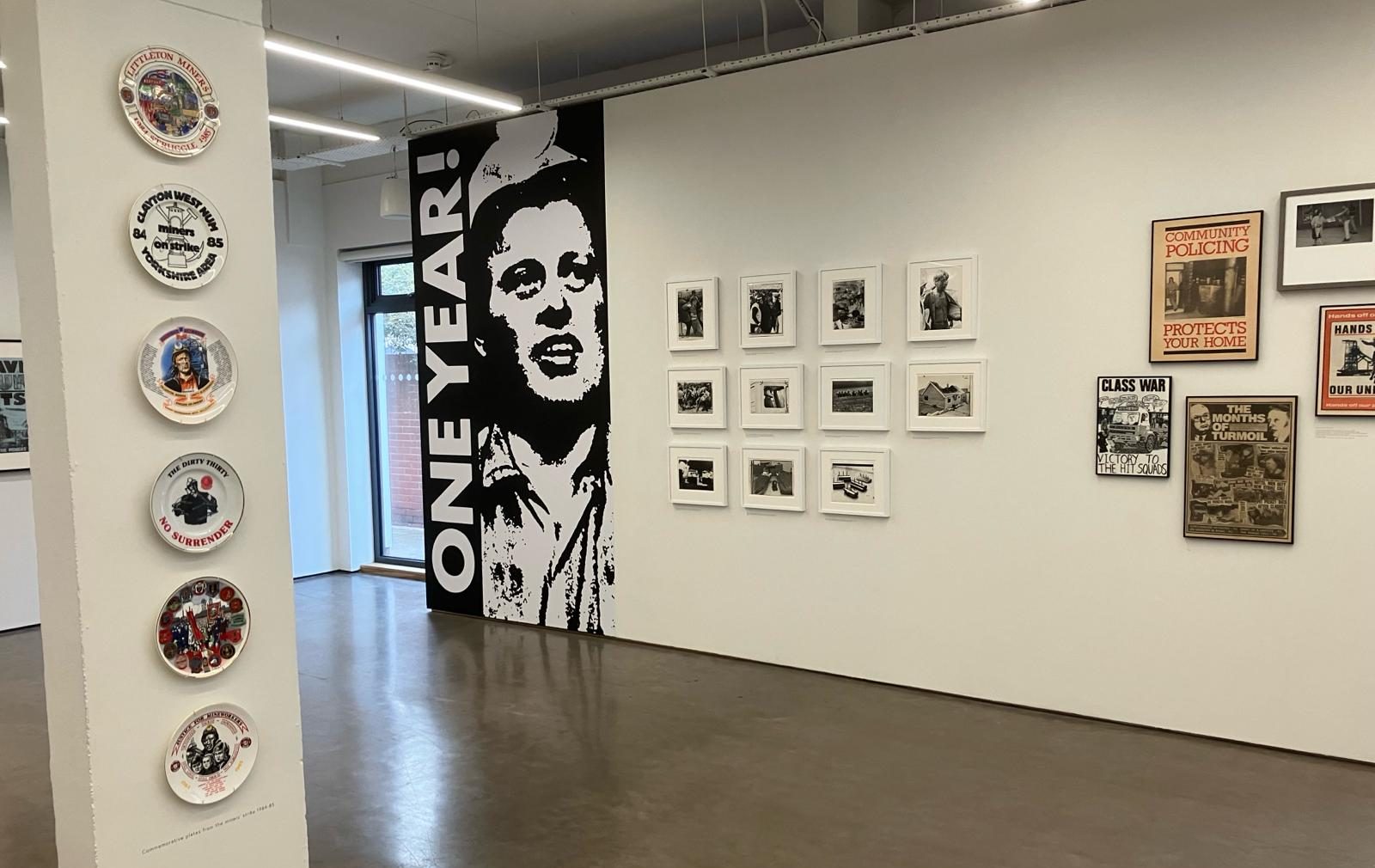
Featuring works by: John Harris, Chris Killip, Jenny Matthews, Brenda Prince, Neville Payne, Howard Sooley, John Sturrock, Roger Tiley, Philip Winnard and Imogen Young
Reviewed by Roger Thomas

For the 40th anniversary of the miners’ strike, the Martin Parr foundation in Bristol, has hosted an exhibition that looks at the pivotal role photography played in the year-long dispute.
The exhibition looks at the images created and how they were used and disseminated through the visual media of the time. While one side sought to use these images to highlight the chaos on picket lines and to heighten the image of an enemy within, those in support of the strike attempted to undermine this picture, highlighting instead the violence of the state on picket lines, the economic hardship endured, and especially the solidarity and collective strength of a working-class community under siege.
Many of the images show the solidarity between the community and the miners’ union, NUM, spreading out across the country, in the collection of food and funds, and many of the objects – from plates and badges to records – give an indication as to just how disparate the use of different media was for this purpose. As well as posters, postcards and leaflets advertising gigs and comedy nights – using satire, and anti-government language to build solidarity.
One of the images included is of Alan Hardman’s cartoon of the miner and his son. Others feature the multiple representation in different media of John Harris’s iconic image from Orgreave depicting a police officer swinging his truncheon from his horse at Lesley Boulton, of Women Against Pit Closures: an image which clearly expresses the violence of that day inflicted on the miners and their supporters.
The photographs of Brenda Prince focus on depictions of women in the Nottinghamshire coalfield, picketing and fundraising. She highlights the politicising role of the strike, writing in the programme notes: “Women became more confident as a result of strike, which I thought was great. It was good for other women and young girls to see their mums and daughters speaking out at the meetings, doing things they wouldn’t have done before, eg picketing”.
There are several scenes expressing the humanity of the strike which so captured the imaginations of photo-journalists, many of them using their position to champion the miners’ cause. John Harris and John Sturrock focus primarily on the day-to-day activities from picketing, to union meetings and coal riddling. Such events, mundane in themselves, and making up the majority of a day on the picket line, are punctuated by police violence administered without any compunction in mismatched confrontations on picket lines.
John Sturrock covered the strike from day one and the exhibition features compelling images from pits in Cortonwood, to Bilston Glen, and down to Didcot. One compelling image is of the march on the anniversary of the death of miner David Jones, killed whilst picketing at the start of the strike: miners marching in a snowstorm. Another gripping image is John Harris’s picture of a police charge at the Battle of Orgreave which exudes the tension of that grim moment in the strike.
A more intimate view of the strikes comes through the albums of Philip Winnard, himself a striking miner. These pictures have a certain rawness and his photographs of scabs loading coal to break the strike are contemptuous and lay those individuals bare. Similar feelings are evoked by snapshots of police picnicking between breaking the strike. There is a real sense of unreality about these photos.
There is one exhibit which is not of 1984-85, that is the textile created by Jenny Matthews, who during Covid began revisiting her photo archive, using the tactile nature of embroidery to weave a photo-quilt, which evokes the idea of images of the miners’ strike with the traditional union banner.
The exhibition clearly expresses the power of photography to capture the moment and the power and tensions at play. But I think this and similar exhibitions that will undoubtedly take place across the country give us an opportunity to reconnect with what was, and still is, a life-changing event, which still sits deep in the collective consciousness. However, I also think these photographs do much more: they expose the nature of the state and the lengths the ruling class will go to defend itself, while also expressing the solidarity and determination of the working class to struggle.








