Did you meet Poppy at Limina Arts Foundation on World Art Day? ❤ World Art Day ❤ Camilla Noble-Crow, Artist ❤ Floral Nou…


April 16, 2024
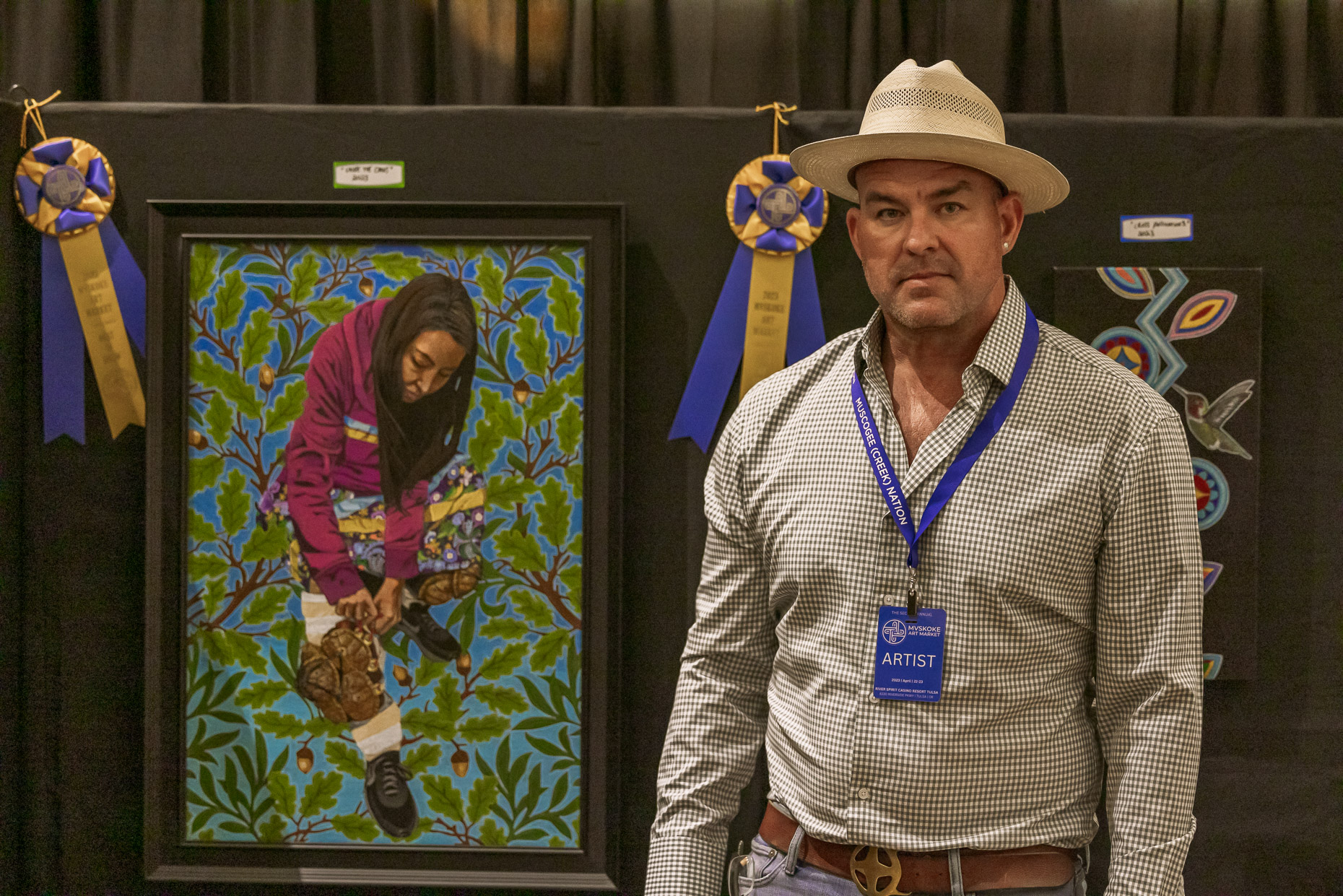 2023 Mvskoke Art Market ‘Best of Show’ winner, Starr Hardridge.
TULSA, Okla. — The Third Annual Mvskoke Art Market will take place at River Spirit Casino Resort in Tulsa on April 20-21. The market has experienced significant growth in its first two years, and this year is no different. Artists participating increased from 60 and 82 in years one and two respectively, to 94 Native artists this year, representing over 30 tribes from across Oklahoma and Indian Country.
The Market’s planning committee, building off past years’ success, have strived to come up with ideas to accommodate the growing popularity and improve the overall experience for attendees.
Muscogee Nation Cultural Center and Archives Manager ShaVon Agee, has played a vital role in the Market’s planning and coordinating for the past three years.
“We’ve expanded some space in the ballroom foyer in order to accommodate additional artists,” Agee said.
She added that they’ve included an activity for children so that they may get involved as well.
“We will have a Mvskoke Motifs stamping activity where children can create their own piece of artwork using our traditional Mvskoke designs and patterns.”
In addition to the showcase and purchasing of artwork in various mediums by renowned Native artists, visitors can enjoy educational presentations and panel discussions on early Muskogean, First American and Oklahoma Indian art. A book signing for the recently published biography of Muscogee Actor Will Sampson by Norma Sampson Bible and an All-Native comedy show are also included on the Market’s event schedule.
For more information, follow the Mvskoke Art Market’s Facebook page at: www.facebook.com/mvskokeartmarket or visit their page at: www.muscogeenation.com/mvskokeartmarket.
###


Bill Tennessen is a self-taught photographer from Milwaukee. And while he wouldn’t call himself a professional, since 1981 he’s been contributing photographs to the Milwaukee Community Journal — Wisconsin’s largest African American newspaper.
A new exhibit called Dynamic Range at the Haggerty Museum of Art features Tennessen’s photographs that capture a range of local history. From Juneteenth celebrations, to Marquette and Bucks basketball games, the Ernest Lacy Inquest and visiting cultural and political figures, the exhibit documents Milwaukee’s Black community from the 1980s to the early 2000s.
Courtesy of Bill Tennessen
Tennessen says his work with the Milwaukee Community Journal had a “soft start and then a harder start.” He first began occasionally contributing photos to them of the Boys and Girls Club of Greater Milwaukee, the YWCA and other nonprofits. His work then picked up in 1981 with the Ernest Lacy inquest. Ernest Lacy was a 22 year old Black man who was killed in police custody after he was stopped by three Milwaukee police officers who claimed he fit the description of a rape suspect.
“Without any advance notification to the hearing people, I just showed up in the courtroom with a camera,” recalls Tennessean. “The judge was quite upset with me. This was early on when they were first allowing cameras in court rooms, and he wasn’t quite sure if I was allow to be there or not.”
Retired circuit court judge Robert C. Cannon actually stopped the inquest, called Tennessen to his chambers and kicked him out. However, his time there proved valuable in the long run.
“They, of course, wanted photographs of the Lacey inquest. This was a very serious matter and I was able to provide photographs in the courtroom — not a lot of them, but some, but more importantly, later on in the street protests,” says Tennessen.
With so many notable photos to choose from in Tennessen’s collection of hundreds of thousands of negatives, narrowing the files down for exhibit selection was quite the task. Eventually, the material lent itself to the themes that are central in the exhibit: The Arts, Ernest Lacy, Juneteenth, Politicians/VIPs, Boys & Girls Clubs of Greater Milwaukee, Community, Storefront Churches and Sports.
“We ultimately settled on these eight different themes and then did a small selection of photographs that fit with each of those themes. It it wasn’t easy because there’s just so much to choose from,” explains Lynne Shumow, curator for academic engagement at the Haggerty Museum of Art.
“I think, ultimately the range of the photographs demonstrates different types of things. I wanted to show the joy in the Black community but I also wanted to make sure some of the challenges were highlighted. So, that’s where you get these very different sort of themes represented,” she adds.
Regarding the selection process, Tennessen notes, “There’s two things I would like to say about the photographs. That is, every single one is just the way it was… And the other: the photographs where things that happened just as they happened. People would say, ‘Take my photograph,’ and this is the result of it. None of these were prepared for the show. These are just my file photographs, these are all vintage prints.”
Now that the exhibit is on display, Tennessen hopes that his photos will have a similar lasting impact to the ones that he and others admired. “I sometimes in my mind compare … the nature of my photographs with Walker Evans. Walker Evans was a street photographer back in the 1930s. He took photographs that anybody with a camera could’ve done, there’s nothing special about them. But now, 80 years later they are really interesting to see what his cities that he visited looked like. And I like to think that maybe my photographs another 50 years from now have a similar feel for somebody to say, ‘Wow, that’s what it used to look like!'”
You can see “Dynamic Range: Photographs by Bill Tennessen” at the Haggerty Museum of Art on Marquette University’s campus through May 12, 2024.

Lee Miller kept Adolf Hitler’s address in her pocket for years. When the legendary photojournalist finally arrived at the Nazi dictator’s secret Munich apartment on April 30, 1945, while embedded with the U.S. Army’s 179th Infantry Regiment, the first thing she did was wash the dirt from the newly liberated Dachau concentration camp off herself — using the Führer’s bathtub. Life Magazine correspondent David E. Scherman snapped a now-famous photo.
The same day, Hitler killed himself in a bunker in Berlin. Miller, the only woman photojournalist to advance with the Allied forces across Europe, would wake up in his bed the next morning. In little more than a week, World War II in Europe would be over. It was a long walk from her hometown of Poughkeepsie, New York, to the front lines of the Second World War, but along the way, Miller would become one of the most celebrated photographers of the conflict.
Miller wasn’t the first female combat correspondent, but her legacy is currently having a moment. She was the subject of the 2020 documentary “Capturing Lee Miller”; in 2023, her story would get its own feature film in “Lee,” starring Kate Winslet as Miller and Andy Samberg as Scherman. Now, Kirsten Dunst portrays a weary combat photojournalist aptly named “Lee” in the 2024 movie “Civil War,” a tribute to the trailblazing photographer in every way — including her success and abrasiveness.
“Being photographed by Lee Miller became quite the thing to mention at a cocktail party,” her son Antony Penrose wrote in his book, “The Lives of Lee Miller.”

Born in 1907, Lee Miller was introduced to photography at a very young age, as her father was an amateur photographer who often used her as a model for his often dubious photographic experiments, which often depicted her nude while underage. Because her father was so keen on experimentation, Miller learned about the technical aspects of the craft. She would learn the artistry and composition lessons of photography in Paris at 18, at Poughkeepsie’s Vassar College at 19 and later in Manhattan.
But before she became a photographer, Miller was in front of the camera as a model — a career launched, as the story goes, by pure luck. It’s believed Miller was discovered as a model when none other than Condé Nast himself saved her from being hit by a car on the streets of New York in 1927. Miller was on the cover of Vogue magazine within the year and was soon one of the country’s most in-demand models. But a photo taken of her was printed in an advertisement for menstrual pads, and her role as the first actual person to appear in such an ad (which was a social taboo at the time) effectively ended her modeling career.
Miller returned to Paris in 1929, where she became an artist and struck up relationships with the likes of Spanish artist Pablo Picasso. Her art career took her back to New York, where she married an Egyptian businessman, moved to Cairo, but eventually left him for London, where she lived with artist Roland Penrose, a man whom she would one day marry. While she was in London, Nazi Germany invaded Poland, World War II broke out in Europe and the city began to feel the pressure of the Blitz. Rather than come home to the United States, Miller signed on with Vogue, becoming the magazine’s official war correspondent. Soon, she had a credential for Condé Nast publications.
While there weren’t many women serving as war photographers and correspondents (there were only 100), Miller was in good company. Thérèse Bonney, a fellow New Yorker, documented the Russian-Finnish front of the war, among others, and would receive the Croix de Guerre and Legion d’Honneur for her wartime work. The legendary Martha Gellhorn, who would be the only woman to land with the Allies at Normandy on June 6, 1944, also covered the Battle of the Bulge. Mary Welsh reported on the war from London for the Chicago Daily News. Dixie Tighe was the first woman on a bomber mission over occupied Europe. Kathleen Harriman covered the war from London, first for the International News Service and later for Newsweek. Helen Kirkpatrick followed the Allies from Algeria to the Mediterranean and into the Liberation of Paris. Tania Long would enter Berlin with American forces in 1945.

Miller got an assignment in Normandy just one month after D-Day. Her coverage of an evacuation hospital on the front lines was published in a multipage piece for Vogue that went around the world. She wasn’t supposed to cover front-line combat but accidentally stumbled upon the Battle of Saint-Malo because it was reported to be liberated, but the fighting would carry on for a full month. Miller not only reported about life on the battlefield, but also the first use of napalm in combat.
Even though she just happened to be in Saint-Malo for the battle, the Army wasn’t thrilled about a woman violating the terms of her press credential and was forced to cover the Liberation of Paris. To demonstrate the resilience of newly freed Parisians, she documented their refusal to let the war diminish their artistic and fashionable flair. In a brief return to fashion photography, she shot photos of models wearing newly designed outfits on the streets of the French capital.
By November 1944, she was documenting the Alsace Campaign, which would push the German Army out of France and back into Germany itself. There, she would document the atrocity of the Buchenwald and Dachau concentration camps, as well as the burning of Hitler’s other home, the so-called “Eagle’s Nest” near Berchtesgaden.

Through her work, Miller was determined that she would photograph a historical record of the war in Europe. When combined with her “evocative” prose, her coverage of the war gave readers not just an account of what happened, but what it was like to be there and witness those things in the thick of it all. The war would take a toll on her; in later years, she suffered from depression and alcohol abuse.
Miller continued working in photography for a few years after the end of World War II, but one day, she packed up her camera and became an award-winning cook. She threw lavish parties, and even served drinks on Hitler’s own silver platter. Her photos, some 80,000, were stashed away in an attic, relics of a past life she seemed to want to forget. When Miller died of cancer in 1977, her son, Anthony Penrose, discovered them and regifted them to the world.
To see the whole body of Lee Miller’s work, visit the Lee Miller Archives website or follow the Lee Miller Archives on Instagram.
Whether you’re thinking of joining the military, looking for post-military careers or keeping up with military life and benefits, Military.com has you covered. Subscribe to Military.com to have military news, updates and resources delivered directly to your inbox.
.


Andrew Johnson sent in these photos of American pelicans.
He said he took a number of photos of the pelicans recently as he approached Ski Island while kayaking.


PUTNAM COUNTY, Fla. — A motorist who stopped to take wildlife photos in an unincorporated area of Palatka found a body floating in a creek.
>>> STREAM ACTION NEWS JAX LIVE <<<
Putnam County deputies responded to the area of State Road 19 south of Caravelle Farms Road. There they found the body of an elderly woman floating in the water.
The sheriff’s office said the body was recovered and taken to the medical examiner’s office. An autopsy was conducted and the woman was identified. However, that identity is not being released until the family can be contacted.
So far, the investigation has not determined how the woman died.
The sheriff’s office said this is an active investigation and will release more information when it becomes available.
[DOWNLOAD: Free Action News Jax app for alerts as news breaks]
[SIGN UP: Action News Jax Daily Headlines Newsletter]
Click here to download the free Action News Jax news and weather apps, click here to download the Action News Jax Now app for your smart TV and click here to stream Action News Jax live.

All images © Shannon Taylor, shared with permission
On New Year’s Eve in 2022, a huge storm swept through the Bay Area, causing major flooding and damage to Shannon Taylor’s studio. “I had been preparing pieces for an upcoming show and had to move my entire studio to a small table in our dining room,” she tells Colossal. “Due to stress and lack of space, I started making these diorama pieces as a way to relax.”
Each exquisitely detailed miniature work is created from tiny watercolor paintings on paper, layered into antique cosmetic compacts that Taylor finds at flea markets, vintage shops, rummage sales, online, or from friends. “My favorite thing is when people have sent me their own, or oftentimes, their grandmother’s collections,” she says. “I love objects with history, and these cosmetic pieces are such personal items.”
From tiny seabeds brimming with clams, fish, and coral to elaborate buffet spreads in the Italian countryside, Taylor creates each tiny component by painting a picture and then snipping out the shape using detail scissors or an X-acto knife. Through trial and error, she figures out new scenes as she goes and ways to keep the itty-bitty pieces organized. “I learned to secure all of the cutouts in bead organizers because our Roomba dislodged a tray of hand-cut flowers… and then vacuumed them.”
Taylor has pieces in two group shows, including Wunderkammer at Beinart Gallery through April 21 and a twelfth-anniversary show at Arch Enemy Arts through April 28. She will also have work in Yokai at Haven Gallery, which opens on May 4, and a solo show opening in June at Arch Enemy Arts titled Star Garden. Find more on the artist’s website and Instagram.


Do stories and artists like this matter to you? Become a Colossal Member today and support independent arts publishing for as little as $5 per month. The article Stunning Scenes Made from Paper Unfold in Shannon Taylor’s Miniature Compact Dioramas appeared first on Colossal.






