Sudan war: How a photographer escaped the besieged city of el-Fasher

Sudan war: How a photographer escaped the besieged city of el-Fasher

1 hour ago

By Barbara Plett Usher, BBC Africa correspondent

imageMohamed Zakaria  Mohamed ZakariaMohamed Zakaria

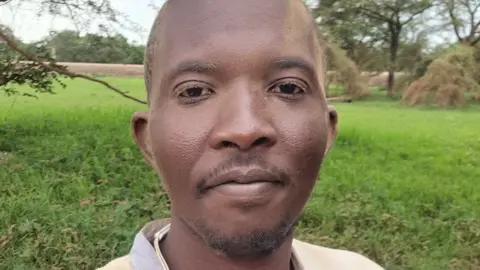
On the eve of his perilous escape from his home country last month, Sudanese photojournalist Mohamed Zakaria left his camera equipment with a friend, not sure if he would ever see it again.

He was fleeing el-Fasher, the capital of North Darfur state, which is in the grip of a punishing battle between the Sudanese army and the paramilitary Rapid Support Forces (RSF).

Mohamed had been covering this hot spot of Sudan’s 15-month long civil war for the BBC. But with the situation growing increasingly desperate, he decided it was time to escape.

The RSF escalated a siege of el-Fasher in May, targeting the last army foothold in Darfur.

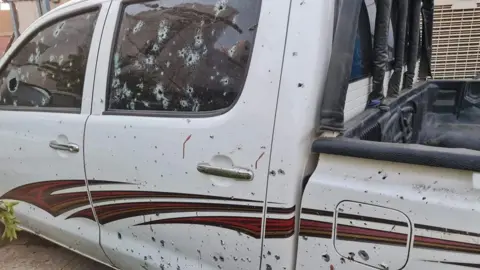
Shortly afterward Mohamed’s house was hit by a shell, another struck as he was trying to get wounded neighbours to hospital. Five people were killed and 19 injured – Mohamed still has pieces of shrapnel in his body, while his brother lost an eye.
imageMohamed Zakaria  Pockmarked vehicleMohamed Zakaria

Two weeks later Mohamed watched his mother and three brothers depart for the safety of Chad, the neighbouring country to the west. He stayed behind to continue working to support them, he says.

But as the RSF fighters continued to close in, civilians were trapped in a war zone of indiscriminate shelling and army airstrikes, with food supplies cut off.

“I couldn’t move, I couldn’t work,” he says. “All you do now in el-Fasher is just stay in your home and wait for death… some residents had to dig trenches in their homes.”

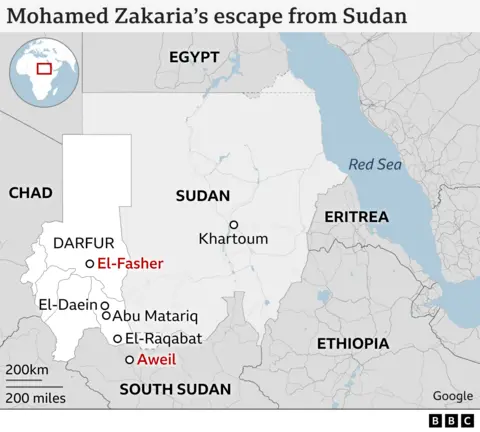
It was dangerous to stay, but also dangerous to flee. In the end he decided to head for South Sudan and eventually on to Uganda.

He thought this journey would be safer for him than trying to join his family in Chad, and would allow him to work once he got to his destination.

From el-Fasher to South Sudan, Mohamed passed through 22 checkpoints, five manned by the army and 17 by the RSF.

He was searched and sometimes interrogated, but managed to conceal his identity as a cameraman who had documented the war. Except for once.
imageMohamed Zakaria A vehicle with its bonnet upMohamed Zakaria

The first stop, on 10 June, was Zamzam refugee camp on the outskirts of el-Fasher.

Mohamed and his traveling companion, his cousin Muzamil, spent the night with a friend. Here he hid his camera and other tools of the trade.

But he took with him a precious record of his photographs and videos – stored on memory cards and in two external hard drives – as well as his laptop and phone.

“The biggest problem I faced on the road was how I could hide them,” he said.

“Because these are dangerous things. If the RSF or any soldier sees them, you can’t explain.”

For the first major leg of the trek, Mohamed stashed them in a hole under the foot pedals of the pickup, without telling the driver.

He and Muzamil were held up at one checkpoint by Sudanese soldiers suspicious they were heading into RSF territory to join the enemy. But otherwise, they reached Dar es Salaam, the town that marked the end of army control, without incident.

Here they joined other travellers – a convoy of six vehicles en route to the village of Khazan Jadid.

“We paid the RSF soldiers to go with us,” says Mohamed. “If you want to arrive safely you need to pay the RSF.”

The drivers collected money from the passengers and handed it over at the first checkpoint, where one of the RSF fighters got into each car.

At this point Mohammed hid his memory cards in a piece of paper that he put with other documents.
imageMohamed Zakaria A person resting on the back of a pick up truckMohamed Zakaria

At the bus station in Khazan Jadid, Mohammed found only three vehicles.

“The road was very dangerous,” he says, “and all the cars had stopped traveling.”

But they managed to get one going to the city of el-Daein, the capital of East Darfur and they reached there in the early afternoon of 12 June.

At a checkpoint in the middle of town, those coming from el-Fasher were put to one side, says Mohamed, under suspicion that they had worked with the army.

Here’s where he ran into trouble.

He had deleted all the messages, photographs and apps on his mobile phone.

But the RSF officer found a Facebook account he had forgotten to remove, complete with posts he had shared about the bombing of el-Fasher and the suffering of civilians.

There followed an hours-long interrogation where Mohamed was separated from Muzamil and accused of being a spy.

“I was threatened with torture and death unless I disclosed the information I had,” he says.

“I felt lost. It was a very bad situation. If he wanted to kill you, he could do it and no-one would know. He can kill you, he can beat you, he can he can do anything to you.”

Mohamed was finally released at 19:00 after negotiating the payment of a large sum of money.
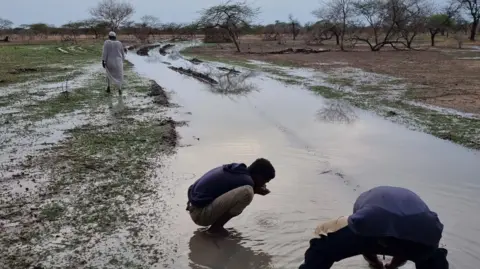
imageMohamed Zakaria Two men crouch over a pool of rainwater in the road as the travel out of SudanMohamed Zakaria

“This was the worst moment,” he says, reflecting on the experience, “not only in the journey but I think the worst moment in my whole life… because I didn’t see any hope. I can’t believe I’m here.”

Mohamed suspected his interrogator would alert another checkpoint down the road to arrest him again.

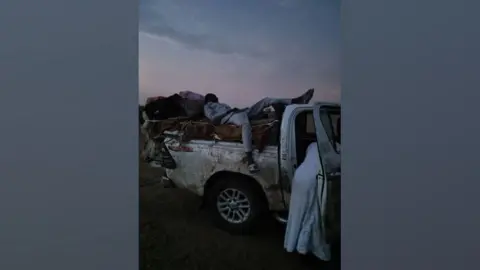
He and Muzamil raced to the station to get out of town as fast as they could. There was only one vehicle, a pickup truck that was crammed full, but they managed to squeeze into a small space on the roof.

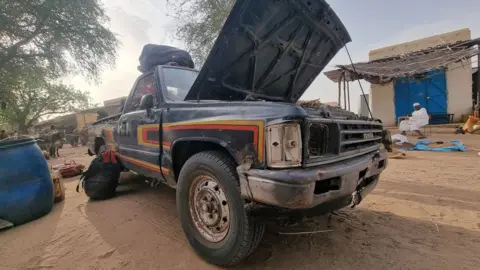
They made it as far as the village of Abu Matariq, where the engine broke down and took two days to fix.

Having survived arrest Mohamed was anxious to get to South Sudan as quickly as possible. Instead, he faced a lengthy delay.

The travellers finally left Abu Matariq on 14 June heading to el-Raqabat, the last town in East Darfur before the border. The way led through the forest of el-Deim, a flat expanse of grass and sand sprinkled with acacia trees.
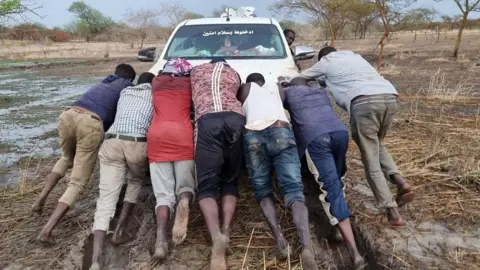
imageMohamed Zakaria People pushing a carMohamed Zakaria

Heavy rains slowed and then stopped their progress, as the pickup got stuck in the mud. They were stranded.

“It was a severe ordeal,” says Mohamed.

“We spent nearly six days without drinkable water and food. We mostly relied on rainwater and dates.”

In a stroke of luck, they were able to buy two sheep from passing shepherds.

During the course of the journey, says Mohamed, he did not have trouble getting food. The RSF-controlled areas through which they passed had seen battles early in the war, but had stabilised somewhat since then.

Markets and small restaurants were operating. Food was expensive, but not “super expensive” like in el-Fasher, where many people were forced to ration themselves to one meal a day.
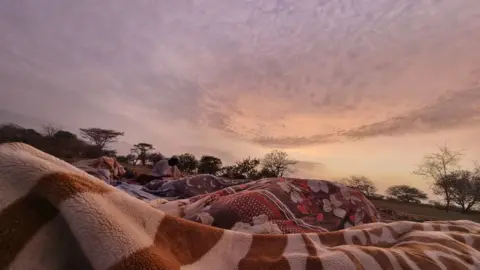
imageMohamed Zakaria People sleeping outsideMohamed Zakaria

In the forest, the men slept in the open, sometimes in the rain, while the two women and two children in the party stayed inside the vehicle. They had to pick thorns out of their feet from walking without shoes in the mud.

Eventually they pushed the pickup back onto solid ground. But the engine worked only sporadically because of a weak battery. And then it ran out of fuel.

At this point two of the men set off to find the nearest village. It turned out to be a nine-hour walk. To everyone’s relief they returned late in the day with extra fuel and another vehicle.

Arriving in el-Raqabat, Mohamed and Muzamil were just a 15-minute drive from South Sudan and safety.

But the next morning before the travellers could start out, they were picked up and taken to the main RSF office and interrogated for three hours.

Someone had reported that members of the Zaghawa ethnic group had entered the town. That included Mohamed, as well as the family sharing the car with him.

The Zaghawa make up one of the armed groups fighting alongside the army in el-Fasher, and the RSF view them as enemies.

Mohamed stashed his memory cards, hard drives and laptop with one of the women and told the RSF officer that he was a computer engineer.

Once again it came down to a pay-off: 30,000 Sudanese pounds ($50; £39) from everyone. Mohamed and a few other members of the group paid extra to release another man who had been found with a photo of an army soldier on his phone.

Then Mohamed and Muzamil clambered into a motorised rickshaw and headed for the border.
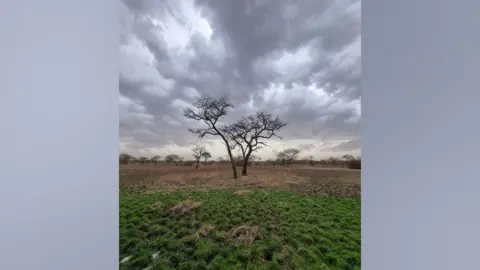
imageMohamed Zakaria Acacia treeMohamed Zakaria

Crossing into South Sudan on 20 June was an “unbelievable” moment for Mohamed.

“When I saw the South Sudanese men, I thanked God and prayed,” he says. “I felt I’m alive. I really didn’t believe that I am alive, that I am here. I reached South Sudan with all my data and my laptop, even though I had many encounters with the RSF.”

He called his mother as soon as he was able to buy a local SIM card. “She didn’t believe that I was alive,” he says.

Mohamed had been out of internet range for 11 days, and his family had no idea where he was or what was happening to him during that time.

“They were very very worried,” he says. “Most of them had told me you must not try this road, don’t go, you can’t make it.”

But he had made it.

He stopped in the South Sudanese city of Aweil for a few days, where the Zaghawa family he had been traveling with hosted him in their home.

He then moved on to the capital, Juba.

Muzamil decided to stay there, but Mohamed travelled to Uganda and registered as a refugee at a camp near the border because his passport had expired.
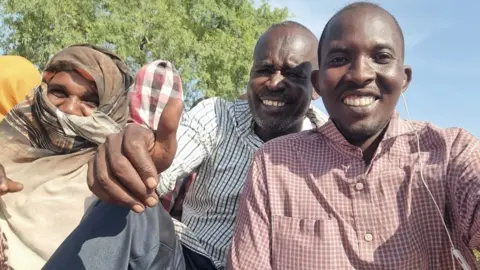
imageMohamed Zakaria People smiling and looking at the cameraMohamed Zakaria

Twenty-three days after leaving el-Fasher, Mohamed arrived in the Ugandan capital, Kampala, on 3 July. He is staying with his uncle.

“I honestly have no idea where life will take me from this point,” he says.

His immediate priority is to look after his family and try to reunite them. Besides his mother and three brothers in Chad, he has a brother in Turkey and a sister in the United Arab Emirates.

His dream for the future is to return to Sudan in more peaceful times and set up a university in Darfur to teach filmmaking, photography and media studies.

“My work did not end after leaving el-Fasher,” he says. “I believe that was just a phase and now I have really begun arranging the second phase by working to convey the truth of the situation there.

“I hope that my effort, even if just a little, will help shorten the duration of the war and save the people in el-Fasher.”
imageMap of Sudan

More BBC stories on Sudan’s civil war:

imageGetty Images/BBC A woman looking at her mobile phone and the graphic BBC News AfricaGetty Images/BBC


BBC Africa podcasts

Native artist’s new show includes painting of man accused of shooting him

Native artist’s new show includes painting of man accused of shooting him

For Jacob Johns, painting a portrait of the man accused of trying to kill him was a sort of exercise in healing. 

The Spokane, Wash.-based artist and activist on Tuesday afternoon stood next to his own five-foot-tall painting of Ryan Martinez, who is accused of having shot Johns last September at a protest in Española. 

The plan, Johns said, is to turn the painting into a work of collaborative art by leaving markers next to the portrait and encouraging visitors to the exhibition to contribute to it. 


070924_LS_JocobJohns_2_RGB.jpg

Indigenous climate activist Jacob Johns, who was shot at a demonstration in Española in September, works on his art exhibit at El Museo Cultural de Santa Fe on Tuesday. The show opens at 5:30 p.m. Thursday.


070924_LS_JocobJohns_3_RGB.jpg

Indigenous climate activist Jacob Johns, who was shot at a demonstration in Española in September, works on his art exhibit at El Museo Cultural de Santa Fe on Tuesday. The painting depicts his alleged shooter shortly before the shooting. The show opens at 5:30 p.m. Thursday.


#placement_679661_0_i{width:100%;margin:0 auto;}


070924_LS_JocobJohns_5_RGB.jpg

Indigenous climate activist Jacob Johns, who was shot at a demonstration in Española in September, works on his art exhibit at El Museo Cultural de Santa Fe on Tuesday. The show opens at 5:30 p.m. Thursday.


#placement_679665_0_i{width:100%;margin:0 auto;}

Forget retirement: Brothers open photography studio

Forget retirement: Brothers open photography studio

Retirement doesn’t look the same for everybody. For Marino and Nic Battigelli of Sudbury, retiring from the day jobs gave them the opportunity to pursue their real passion: photography.

The dramatically composed landscape images they produce are as individual as the brothers themselves, but share a keen eye for composition, colour and the interplay of light and shadow.

They opened Two Bees Fine Art Photography in the fall of 2023. “Two bees” like two Bs, as in two Battigellis.

Marino is a retired child psychiatrist who moved back to Sudbury from Burlington after his retirement. He’s been a dedicated shutterbug for 50 years, he said. Nic is a retired teacher with the Sudbury Catholic District School Board. His love for photography isn’t as long-standing as his brother’s but his passion is just as high.

And while they share a lot of things in common, one thing they don’t share is equipment. Marino is a Canon guy, while Nic prefers Fuji.

What they love to shoot are landscapes and architectural images. 

“No weddings, no babies,” Nic said.

Fortunately, there are plenty of places for the brothers to ply their trade. Their favourite places to shoot include Capreol, Skead, Cartier, Tilton Lake Road, Secord Falls, Wanup, Kukagami Road and Willisville. They plan to go farther afield, too, with plans to begin exploring Manitoulin Island, Killarney and French River.

The brothers are also community volunteers. They’re currently putting together a fundraising calendar for Independent Living Sudbury-Manitoulin, featuring 13 accessible places in the area. They also teach photography.

Readers of Sudbury.com might recognize Nic’s work. Several of his images have been featured in Sudbury.com’s good morning story that runs at 7 a.m.

If you want to check out the Battigelli brothers’ work, visit their website, TwoBeesFineArt.ca.

Mark Gentili is the editor of Sudbury.com.

Nicolas Brizin Selected As Crankworx Deep Summer Wildcard Photographer

Nicolas Brizin Selected As Crankworx Deep Summer Wildcard Photographer

Your votes have earned Nicolas Brizin a wildcard spot at the 2024 Deep Summer Photo Challenge! The Deep Summer Photo Challenge sees six photographers competing for cash and for the title of Deep Summer Photo Challenge Champion. This year’s lineup of photographers showcases a deeply talented crew, each with their own unique twist on telling the story of mountain biking.
Nicolas will be up against Hannah Childress, Joe Wakefield, Joel Ducrot, Júlio Campos, and Samantha Saskia Dugon, with the unique opportunity to shoot, edit and weave together a photo slideshow that captures the best of Whistler’s mountain bike culture in just three days.

The final three to five-minute video slideshow then screens before fans and a panel of expert industry judges with the winning photographer awarded $5000.

See you on Tuesday, July 23 from 7pm at the Olympic Plaza in Whistler.

Exploring New Horizons with Analog Photography

Exploring New Horizons with Analog Photography

In a digital age saturated with smartphone photography, a new era of visual storytelling is emerging through the lens of analog cameras. Polaroid and Magnum Photos have teamed up to pioneer a fresh initiative, beckoning aspiring photographers to delve into the realm of black-and-white photography and narrative construction.

As part of this groundbreaking collaboration, photographers have the opportunity to submit their portfolios by August 12, showcasing their prowess in visual storytelling. Ten individuals will be crowned winners on August 26, each receiving a coveted Polaroid I-2 Instant Camera and film to capture the essence of their empathy-driven tales.

With mentorship from renowned Magnum photographers Jim Goldberg, Enri Canaj, and Newsha Tavakolian, participants are set to embark on a journey delving into the nuances of raw human emotions and experiences. The aesthetic allure of analog photography, juxtaposed against modernism and cultural heritage, serves as a pivotal conduit for portraying the intricacies of society in transition.

Through the lens of Enri Canaj, Albania’s cultural tapestry unfolds, depicting the clash between tradition and modernity. Meanwhile, Newsha Tavakolian’s lens captures the essence of community life atop Iran’s towering Mount Damavand, breathing life into the stories of sheep herders, nomads, and artisans.

The essence of “empathy-inspired storytelling” lies at the heart of this initiative, transcending the digital facade to establish genuine connections through visual narratives that resonate with the imperfections of reality. In a world teeming with digital noise, analog photography serves as a reverent homage to the authenticity and intimacy inherent in visual storytelling.

Exploring New Horizons with Analog Photography: Unveiling Hidden Depths

In the realm of analog photography, where visual storytelling takes on a deeper, more textured form than its digital counterparts, there exist numerous intriguing facets that contribute to its enduring allure. Here, we delve into some lesser-known facts and key considerations that add layers of complexity to the exploration of new horizons through analog photography.

What unique qualities does analog photography possess that distinguish it from digital photography?
Analog photography, characterized by its meticulous process and tangible results, offers a hands-on experience that demands patience, skill, and creativity. The unpredictability of film development and the distinctive aesthetic quality of analog images imbue them with a sense of nostalgia and authenticity that digital photography often struggles to replicate.

What are the key challenges associated with embracing analog photography in a digital age?
One significant challenge is the scarcity of resources, including film availability, darkroom equipment, and expertise in traditional photography techniques. Additionally, the learning curve for mastering the intricacies of analog cameras and film processing can be steep, requiring dedication and persistence to achieve desired results.

What controversies surround the debate between analog and digital photography?
One ongoing controversy is the perceived dichotomy between the convenience and immediacy of digital photography versus the deliberate, time-intensive nature of analog photography. Some argue that the speed and ease of digital technology compromise the artistry and depth of analog approaches, while others believe that each has its distinct merits and can coexist harmoniously in the creative landscape.

Advantages of analog photography:
1. Unique aesthetic qualities that evoke a sense of nostalgia and authenticity.
2. Hands-on, tactile experience that fosters a deeper connection to the artistic process.
3. Cultivation of patience, creativity, and attention to detail in crafting each image.
4. Ability to achieve distinctive visual effects and texture not easily replicated in digital formats.

Disadvantages of analog photography:
1. Limited control over immediate results, requiring meticulous planning and precision.
2. Costs associated with film, processing, and equipment maintenance can be prohibitive.
3. Time-consuming nature of film development and printing may not align with fast-paced workflows.
4. Limited accessibility to resources and expertise compared to the widespread availability of digital tools.

As we continue to navigate the evolving landscape of visual storytelling, analog photography stands as a timeless beacon of artistic expression and introspection. Its melding of tradition and innovation, craftsmanship and serendipity, offers a compelling avenue for photographers to explore new horizons and unearth hidden depths in their creative journeys.

For further inspiration and resources on analog photography, you may visit Magnum Photos, the esteemed platform known for its celebration of photographic excellence and storytelling prowess. Immerse yourself in the captivating world of analog imagery and discover the richness of this enduring art form.

[embedded content]

Salters Scene: Dancing On The Hudson

Salters Scene: Dancing On The Hudson

By Udo Salters

It has been on and poppin every Sunday in June, including on June 16th, 2024.  

Pier I in Riverside Park along the Hudson River, is the location for the Summer on the Hudson: Let’s Dance! event.

This free Sunday event was perfect!  The weather was warm and DJ Pedro-S, sounds were on point!

Related: See more photographs by Udo Salters Salters Scene.

The collaboration between Piel Canela Dance Company and Summer on the Hudson brings together an outdoor space, music and instructors to lead free Salsa and Bachata classes.

Whether you’re a complete beginner or looking to brush up on your skills, these classes are designed to get you moving and have fun.

In addition to the dance lessons there were two Bachata and one Afro Cuban dance performance with dancers from the Piel Canela Dance Company.

After the performances and dance lessons, it was time to put to use everything seen and learned earlier. DJ Pedro-S let the beats play and everyone on dance floor kept it moving. 

A great event to listen to music, dance, meet people, eat and see the sunset.

Check the NYC Parks website for different events going on throughout the summer at https://www.nycgovparks.org/events

Udo Salters

Udo Salters was born and raised in New York City. His love for photography began as a youth when he started taking photos of friends and family at various events. In a natural transition, his passion turned from shooting images of fashion models and fashion shows to jetting around Harlem to Hollywood creating images of celebrities and socialites at some of the most exclusive hot spots. He has worked for many outlets locally with Harlem World Magazine, Fortune 500 companies, and many other various media outlets. He currently resides in NYC. Get more information at Udo Salters Photography.

Photo credit: by Udo Salters.


By submitting this form, you are consenting to receive marketing emails from: Harlem World Magazine, 2521 1/2 west 42nd street, Los Angeles, CA, 90008, https://www.harlemworldmagazine.com. You can revoke your consent to receive emails at any time by using the SafeUnsubscribe® link, found at the bottom of every email. Emails are serviced by Constant Contact

‘Her whole future ahead of her’: Photographer captures Manitoba graduate posing on iceberg

‘Her whole future ahead of her’: Photographer captures Manitoba graduate posing on iceberg
image

Some say a photograph is simply a memory frozen in time – and a high school graduation photo taken in Churchill, Man. takes that adage to a completely new level.

Photographer Brandy Bloxom captured Emily Dingwall, a graduate of Duke Marlborough School, posing on an iceberg near picturesque Hudson Bay Beach on Sunday, July 7.

Bloxom, a self-taught photographer who lives in Denare Beach, Sask., travelled to Churchill for an Indigenous women’s conference and took the opportunity to fulfill a photography dream.

She put out a call on social media looking for a subject and said Dingwall jumped at the chance.

“I said, ‘Would you like to step on an iceberg? It’ll take two seconds if you want – this would be epic,’” Bloxom told CTV News. “She was game for it and she was just thrilled.”

While the photo makes Dingwall seem like she’s floating in the middle of nowhere, Bloxom said the chunk of ice was only about 15 feet away from the shoreline.

“[The water] was basically up to her mid-calf,” Bloxom explained. “But the angles and lighting… make it look like she’s way out in the middle of Hudson Bay – but it’s the tricks.”

Bloxom said the water was calm during the photo shoot, which helped create the glassy, mirrored image. She said she wanted to depict what it’s like to grow up in a place like Churchill.

“It shows the difficulties, the coldness, and the hardships,” Bloxom said. “But yet… she has her whole future ahead of her – she’s got this background of solid people and a solid community.”

Bloxom grew up in Leaf Rapids, Man., though her roots trace back to York Factory First Nation southeast of Churchill. She described the trip to Churchill as a learning experience and a way to connect her family’s past.

“What you see in books and everything is polar bears and whales, but there’s so much more to it,” she explained. “The people are amazing. The landscape over at the Churchill Flats looks like the east coast of Newfoundland. It’s just beautiful.”

Bloxom said her next dream is to photograph Inuit communities in the Arctic.

When what you see is what you buy

When what you see is what you buy

NEW YORK — Consider a pair of words that begin with “a”: art and advertising. You might say that they’re oranges and apples (speaking of words that begin with “a”). Well, yes and no. The two are wildly different, to be sure. But they can also overlap. When they do, the results are always interesting — and often memorable.

Observing instances of overlap, as well as their absence, is one of the pleasures afforded by “The Real Thing: Unpackaging Product Photography.” It runs at the Metropolitan Museum of Art through Aug. 4. Under the thematic circumstances, “The Real Thing” is a nicely provocative title. The show, which includes some 60 items, focuses on the first century of photography, from the 1840s to 1940s, with one ringer from the ‘50s.

F.D. Hampson, “Panama Hats,” from a Sloan-Force Co. catalog, ca. 1916.Metropolitan Museum of Art

Art, photographic and otherwise, is about means: the elaboration of style. What makes something art is how that something is done, not its what or who or why. Advertising is about ends, or, rather, a single end: pushing a product. As the Hungarian photographic team Révész-Biró once put it, advertising “creates great people, dictates the fashions, brings renown and success, boom or depression, and, last but not least, sells the goods.”

If art provides an advertiser with a useful means toward achieving that end, then so be it. A style such as Surrealism or Constructivism or a technique such as photo-montage, each very much avant-garde in the years between the two world wars, was quickly, and happily, adopted by advertising. Might “co-opted” or “subverted” be more accurate? That would be a pretty hifalutin view to take, since the results could be so striking, even, yes, artistic. It would be hard to dispute that during those years advertising did more to introduce more people to Modernism than, say, the Museum of Modern Art did.

Ralph Bartholomew Jr., “Soap Packaging,” 1936.Ralph Bartholomew,© Estate of Ralph Bartholomew, Courtesy Keith de Lellis Gallery, NY

Curated by the Met’s Virginia McBride, “The Real Thing” is arranged thematically even as it follows a largely chronological course. Some product photography shows its subject in solitary splendor (“The Isolated Object”), some shows it en masse (“The Array”), some implies narrative (”The Tableau”). These categories are illuminating. That description applies to the wall text, too. One learns, for example, that it wasn’t until the 1920s, that it became less expensive to use photographs rather an illustrations in an advertisement. Thus was created “an expanded vocabulary of visual persuasion.” Or there’s this description of Penn’s celebrated spilled still life, “Theatre Accident, New York,” “Part autopsy, part ‘I Spy.’” That’s writing as stylish as it is insightful.

August Sander, “Osram Light Bulbs,” ca. 1930.© Die Photographische Sammlung / SK Stiftung Kultur – August Sander Archiv, Cologne / ARS, NY 2024

There are familiar names in “The Real Thing” you might expect: famous photographers known for their advertising work, such as Edward Steichen, Irving Penn, and Paul Outerbridge. There are familiar names you likely wouldn’t: famous photographers not known for their advertising work, such as James Van Der Zee, August Sander, and André Kertész.

Murray Duitz, “A.S. Beck ‘Executive’ Shoe,” 1957.© Estate of Murray Duitz

The Kertész in the show belongs to a category of one. Call it product photography ex post facto. The photo is Kertész’s almost-preposterously elegant image of a fork, a plate, and the shadows cast by each. Seeing it, a German silverware company had the canny idea to use it in an ad.

Finally, there are photographs from unfamiliar names: Ralph Bartholomew Jr., Adolph Lazi, Murray Duitz, and Grancel Fitz. Bartholomew’s packages of soap, Lazi’s industrial equipment, Duitz’s men’s shoe (which rivals that Kertész cutlery in elegance), and Fitz’s tooth paste tube and brush are beneficiaries of the artistic impulse Outerbridge articulated in 1922, just as product photography was getting into high gear: “I have attempted to interpret the beauty of the simplest and humblest of objects.”

Unknown, “Montage for Packard Super Eight,” ca. 1940.Metropolitan Museum of Art

Among other products included here, some humble, some not, are candy, cigarettes, disinfectant powder, perfume, tombstones, Panama hats, drill bits, textiles, whiskey, margarine, rolling papers, a pocket comb, toilet paper, coffee, light bulbs, wigs, switch plates, and, inevitably, automobiles. (What is it about cars and cameras?) Implicit in the pictured products being so varied is an important point: So long as there’s a profit to be made, selling ignores hierarchy. Maybe this is where art and advertising most fundamentally differ. One is inherently aristocratic, the other is as democratic as a dollar bill.

Of course dollar bills crumple and tear and, thanks to inflation, lose their value. Art is sturdier than one might think. That’s another unexpected lesson “The Real Thing” has to offer. Who remembers such once-famous brands as Ipana toothpaste, Packard automobiles, the A&P supermarket chain, or AT&T’s Bell System? All of them figure in the show. They’re all gone, but the images promoting them endure. An ancient adage comes to mind, a usefully updated caution for a neoliberal age: ars longa, commerce brevis.

THE REAL THING: Unpackaging Product Photography

At Metropolitan Museum of Art, 1000 Fifth Ave., New York, through Aug. 4. 212-535-7710, www.metmuseum.org


Mark Feeney can be reached at mark.feeney@globe.com.