
Gen X and Boomers might think that this article’s heading is a reference to the smash hit album by the English band, The Police. However, it’s actually the title of a new physical-digital project from Candy Digital and Getty Images, looking at the history and impact of paranormal photography. This is the latest in a series of initiatives from these companies who have partnered on three other successful projects.
What Is Paranormal Photography

The term paranormal is often used to describe occurrences and phenomena that fall outside the realm of what’s considered normal in everyday life. For me, every episode of the TV show The X Files has been the perfect on-screen portrayal of this. This show genuinely piqued the curiosity of millions in the 90s. But an obsession with the paranormal has been something that humans have been practicing, researching, and documenting for centuries now. Delving into the supernatural, paranormal photography (not to be confused with spirit photography) attempts to capture images of unexplainable phenomena. People often practice this to win over skeptics and to provide firm ground for those who challenge conventional scientific understanding. It offers a glimpse into the supernatural, challenging the boundaries of our conventional understanding of the dead.
Such photographs are now considered to be steeped in rich historical and cultural contexts. They often tend to invite debates and discussions over their authenticity, challenging skeptics and offering half-believers of the supernatural a lifeline to clutch onto. And of course, there’s the thrill of capturing something that very few humans (claim to successfully) have done.
What Tools Are Often Used

Standard camera equipment is often unable to photograph the paranormal. Photographers have often used a diverse array of tools and equipment, each with a specific purpose, to prove the existence of spirits. These range from ultraviolet and infrared photography cameras to even long exposures methods in order to try and capture elusive supernatural beings. And unlike nowadays when many of these tools are easily purchasable, things were a lot tougher at the start. These days, no serious paranormal photographer would head out without an Electro Magnetic Field meter. Thermal imaging cameras and motion sensors are among some of the other tools that aid such photographers. Early spirit photographers would even try stereoscopic techniques to immerse the viewer into their spooky creations.
The Early Years

Throughout history, humans have sought to document and understand the paranormal. A global interest in photography began to rise in the mid-19th century. This was not long after the first documented photograph was taken in France. Incidentally, so did a fascination with spiritualism – a belief that the deceased moved into the afterlife, but still continued, on some level, to maintain contact with the living world.
A chance double-exposure accident in the darkroom led William H. Mumler to invent and become well-known in the field of “spirit photography.” Effectively this was double exposure photography done right for that era. A skill he would later master and milk for his own good, preying on those grieving for their loved ones. Mumler became well known for being able to “capture the spirits” of dead relatives or even strangers in the same frame as living subjects. One of his most famous subjects was Mary Ann Todd Lincoln, the former First Lady of the United States. The gig went on successfully for a couple of years. Until one such subject recognized the “spirit” alongside him in the photograph as being someone who was quite alive.
Capturing The Unseen With Paranormal Photography
That photograph effectively killed Mumler’s career as a spirit photographer. However, countless others since then haven’t given up on the pursuit of trying to photograph what’s commonly invisible to the naked eye. Such paranormal photographers combine scientific and artistic elements to try and capture phenomena that push the boundaries of reality. Skeptics of this genre have often argued that what shows up in these images is unambiguous. Or they blame it on a combination of camera trickery and visual artifacts. That hasn’t stopped more and more people from trying each year to photograph, and now videograph what they believe to be the existence of ghosts and apparitions from other dimensions. Of course, for each such photographer, countless debunkers pop up too
Ghost In The Machine
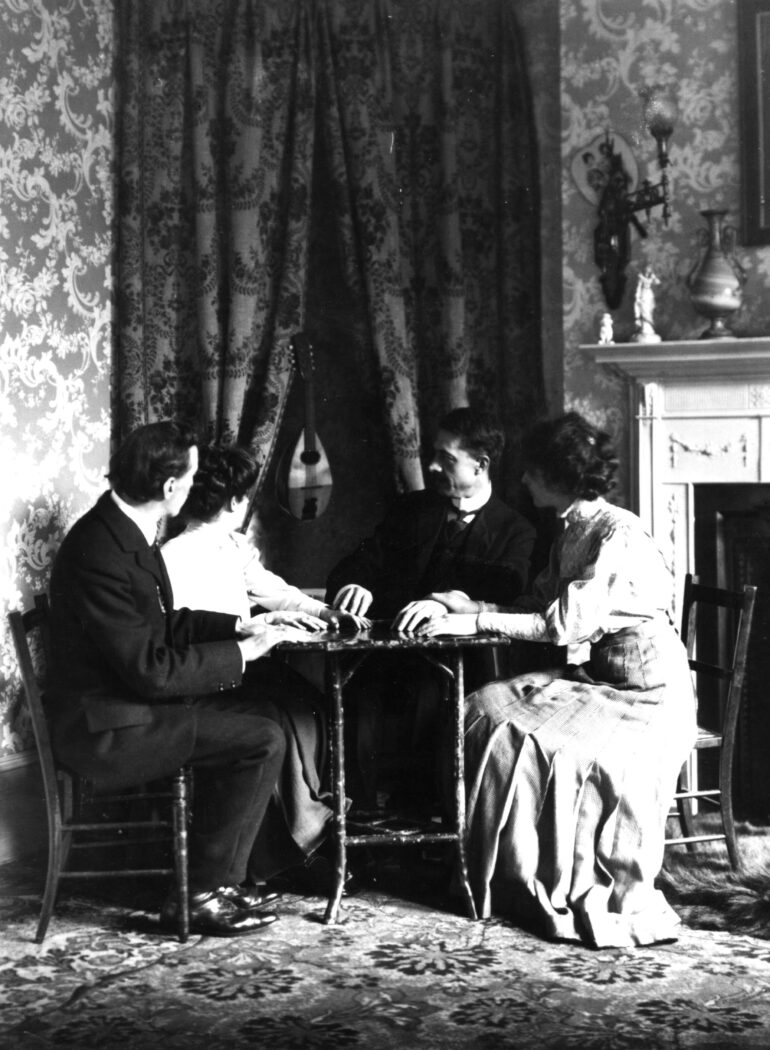
Candy Digital and Getty Images have teamed up to explore how blockchain technology can be used to safeguard significant art movements. This partnership reflects their dedication to finding creative ways to protect and document these historical and artistic milestones. The fourth collaborative initiative between them, Ghost In The Machine, is an image collection that takes a look at the early years of spirit photography in the 19th century, as well as some 20th-century work.
“You can see the undead among us, if you’re willing to look.”
Twenty such archival images are made available in this paranormal photography collection. Some from the Hulton Archive have never been released before. This is also the first first physical-digital project between these two organizations. The collection also features a zine titled Nightmare Logic, and a digital exhibition that explores the impact of spirit photography through the work of contemporary artists. Collectors can purchase historic physical-digital artworks until November 27th. The images cost just USD 75 for digital editions and USD 225 for a digital edition with a 9.5” x 14” print (framed with a 15” x 19.5” black frame, and a white top mat.)
What Do You Believe?

Technology has advanced greatly since that first spirit photo by Mumler in the 1860s, but the fascination with the paranormal has anything but dwindled. As you peer at a paranormal photograph and pore over it closely to wonder how much of it is real, you can’t help but think about the intriguing and thought-provoking questions that went through the minds of the photographers behind the images in this collection. What could have made them want to start photographing the unseen? What was that one incident that made them want to showcase the worlds that many of us go without seeing? Whether you’re a fervent believer in this or a cynic, the allure of paranormal photography is a testament to our undying curiosity about the mysteries that surround and spook us. After all, for many of us, seeing is the only form of believing.
All images here, unless mentioned otherwise, have been provided to The Phoblographer by Getty Images, for usage within this article.





