
On the 75th anniversary of the Universal Declaration on Human Rights, the Office of the United Nations Resident Coordinator in Bangladesh (UNRC) and the Drik Picture Library jointly organized a photography exhibition titled “Rage and Hope”.
An opening program of the photo exhibition was held on Thursday. The exhibition will be open to the public from 3pm-8pm daily till December 18, 2023.
Afroza Islam Akhi, the coordinator of Mayer Dak, photographer and coordinator of Bangladesh Garments Worker Solidarity Taslima Akhter, Senior Human Rights Adviser of UNRC, Photographer and the Managing Director of Drik Shahidul Alam attended the opening program.
The program was hosted by the Curator ASM Rezaur Rahman.
Representatives of the Office of the United Nations Resident Coordinator in Bangladesh (UNRC) and the Drik Picture Library look at photos at the opening of a photography exhibition titled “Rage and Hope” on Thursday, December 14, 2023. Photo: Dhaka Tribune “}”>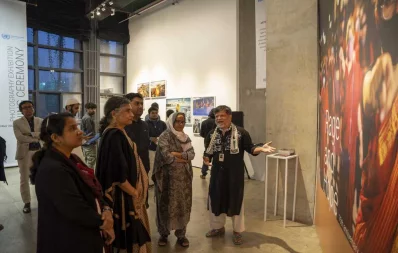
Shahidul Alam said: “The exhibition features pictures that are challenging to capture. I appreciate the photographers for their courage. The images depict not only human rights violations but also include some uplifting moments. We all aspire to overcome these challenges, despite the arduous and lengthy journey ahead.”
Huma Khan said: “Equality among all humans is a distant reality, but we are committed to the long journey towards that goal. Our dedication lies in working for the rights of the people of Bangladesh. We embrace diverse opinions and various ways of thinking.”
Taslima Akhtar said: “The images presented here offer a distinct perspective on the UN concept of human rights for individuals as human beings and citizens. In reality, we are living in fear of violence, disappearance, and the inability to express ourselves. Currently, the ordinary citizens and workers of the country are experiencing a suffocating situation, and we yearn to break free and breathe openly.”
Afroza Islam Akhi said: “We are all aware of the current stifling situation in Bangladesh. The families of every missing person, along with their loved ones, endure profound suffering daily. However, there is hope as many individuals, including myself, who once led secluded lives, are now protesting and voicing our concerns on the streets. Currently, in response to international pressure, the government resorts to suppressing dissent through public arrests and disappearance cases, rather than addressing the underlying issues of disappearances and murders. We demand justice for all these activities.”
Mahmud Hossain Apu, on behalf of the photographers who participated in the exhibition, said: “We have many photos that cannot be printed in the newspaper as a photojournalist. In such cases, there requires more such events where we can showcase our work.”
The exhibition features 29 photographs, an audio installation, and one video installation on human rights from the last four decades, covering border killings, tea plantation workers’ movements, protests on violence against women, movements for democracy, victims of the legal process, and judicial harassment, justice, extraneous killings, structural discrimination, movement to protect nature, workers’ working environment and other incidents.
On December 10, 1948, the draft resolution of the Universal Declaration on Human Rights was approved by the United Nations General Assembly in Paris which has since been considered as the general standard of human rights for all nations and cultures worldwide.
It was the result of the experience of the Second World War. With the creation of the United Nations, the international community promised to never repeat this type of brutality.





