About

Posts by :

Local photographer sets the bar for newborn photography in Africa

Local photographer sets the bar for newborn photography in Africa

A local photographer has recently become the only photographer from the entire African continent to be awarded professional newborn photographer certification by the Accredited Professional Newborn Photographers International (APNPI). Karishma R Rajcomar, has entered the ranks of some of the world’s best photographers.

The Westville resident’s photo was published in an exclusive limited edition holiday magazine, with the photo being selected by renowned newborn photographer, Ana Brandt.

“Receiving the email notifying me that my image was selected for the magazine, and by one of the most recognisable newborn photographers, is a career milestone that I will cherish forever. The pride is amplified tenfold by being the only photographer in my field to be chosen from not only South Africa but the entire continent. This feels surreal and stands out as a proud moment in my career,” Rajcomar proudly stated.

Rajcomar’s image featured in the Holiday Magazine USA 2023 after being selected by renowned photographer, Ana Brandt.

ALSO READ: Photographer captures Canon’s ‘Perfect Picture’ award

The photographer was given a limitation of just three submissions, and she explains that she understood the importance and precision of each image to stand a chance at even being considered for selection.

Rajcomar added that she took meticulous care to ensure that all three images met the highest standards.

When asked what prompted her to submit her image to the magazine, she said, “I am driven by passion to overcome challenges. I eagerly embraced the opportunity presented as soon as I discovered it. As someone with dreams of excelling in the photographic and design realm and having my work recognised globally, I was fully aware that it would not be an easy feat, but I was resolute in submitting my image and committed to putting forth my best effort as always.”

An internationally acclaimed photographer, Rajcomar explained that her achievement speaks volumes of the talent that can be found throughout South Africa.

“The holiday season has always held a special place in my heart. It was filled with magical traditions passed down by my parents since childhood, and now I have two little ones of my own who have made the season even more extraordinary. The essence of this publication is to revel in the enchantment of the holidays, sharing incredible imagery and creativity from photographers all over the world. Being included among them fills me with immense honour and pride, adding to the joy of the festive season,” concluded the multi-award-winning photographer.

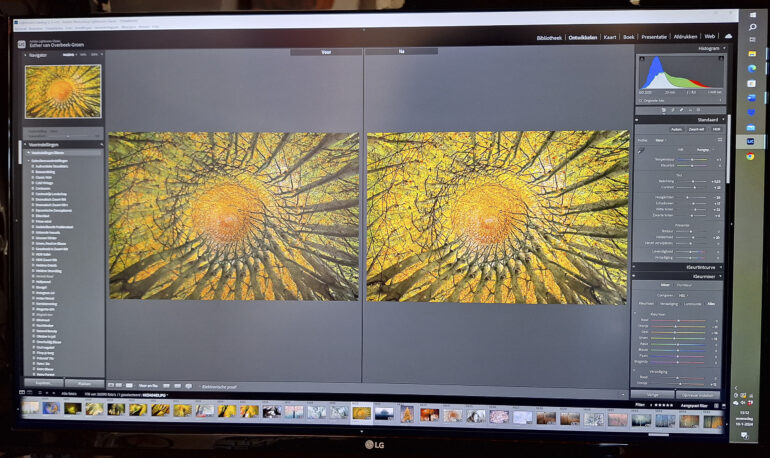
Esther van Overbeek Makes Photographs a Sony Camera Can’t Do

Esther van Overbeek Makes Photographs a Sony Camera Can’t Do

“…I want to express to the readers of this article that using the multiple exposure technique is very addictive,” says photographer Ester van Overbeek to the Phoblographer in an interview. “However, I can think of addictions that are much worse to have.” Esther’s work is truly something special to behold. She does multiple exposures in camera and sometimes does a bit of editing in Lightroom. The images are painterly and show fascinating takes on nature that we don’t see anywhere else.

All images by Ester van Overbeek. Used with permission. Please follow her on Instagram and her website.

How Esther van Overbeek Got Into Photography

Esther describes herself as a late bloomer — and proves that it’s never too late to start something new. She’s 53 years old now and got into analog photography over 25 years ago. First, she started out with macro photography and then landscapes. Eventually, she bought a Canon 70D. That’s when she still used to capture instead of create. But after reading an article about the creative approach, she was intrigued. “I wanted to put more of my feelings and emotions into my photographic work,” she shares. “I found out that my Canon 70D had the ability to take multiple exposures, and I started trying out a bit myself. When someone on Instagram posted a comment to a photo I had posted saying I was using the ‘Pep Ventosa technique,’ I thought, ‘who or what is that?’” After some internet research, she started to dive into it even more.

She stuck with the 70D because it could handle up to 9 multiple exposures. Esther later upgraded to a Sony a7r II and then a Canon EOS R6. “I was curious whether that camera (Sony a7r II) could also handle multiple exposures,” she expresses. “It turned out it could, but I had to buy software to do so. I did, but unfortunately, my Sony can only handle up to 2 exposures at a time.” This made her switch back to Canon. She combines it with a 24-105mm, 100-400mm, and Kase filters.

Indeed, the lack of multiple exposure modes in Sony cameras is something that we complain about often here.

Sure, you can merge images in Photoshop. But she doesn’t want to do that. And it’s becoming more and more important for photographers to make their images in-camera.

The Creative Process

“In my creative work, trees usually get the starring role,” Esther tells us. “Trees wait patiently and change every season. Moreover, every tree is different. For me, this makes them ideal subjects to photograph.” She can become totally absorbed in the first when she takes pictures. And for this, Esther explains it best:

I can become completely absorbed in a forest. Sometimes I have gloomy thoughts in autumn and then I love to take dark photos. I then usually make these creations with the “Dark” option. The dark pixels in the frame are then given priority over the lighter pixels. In the beginning, I usually made 9 exposures, but sometimes the result is far too dark. Making 4 or 5 exposures can be very alienating as well and is preferred by me.

Blossom trees in spring again lend themselves very well to a more impressionistic look. I love the paintings of Monet and Van Gogh immensely, so I love using that art as inspiration. I made a multiple exposure of lily pads with 1 of Monet’s paintings in mind for example. Furthermore, I usually make multiple exposures of 1 blossom tree, taking a step left or right with each exposure I make. For each exposure, it is important to keep the focus on a pre-selected point on the trunk of the tree. The tree trunk is then fairly sharply delineated, but the blossom fans out in a romantic way and then it sometimes seems to rain blossom. I really like to create a romantic fantasy world . As to the multiple exposure settings, I then usually use the “average” option and if there is little light I use the “additive” option. With the “average” option, the camera calculates the average exposure per pixel. With the “additive” option, all exposures are added together, so you can take each exposure considerably underexposed. This is because with every additional exposure, the final result becomes lighter and lighter. So here you need to think carefully in advance about how many exposures you are going to take. The more exposures, the more you will have to underexpose each one.

Ester van Overbeek

Esther sees more than she looks — by that we mean that she envisions what the final image will look like and tries to connect her technical side and artistic side. The artistic side is the endpoint, and the technical side is the journey. She spends at least half an hour at a time to get the final result she wants. Sometimes she’ll even redo entire photographs layer by layer. It’s led Esther to various experiments. “When it does succeed, it naturally gives an enormous boost and positive energy.”

Thoughts on AI Imagery

Esther’s viewpoint on AI imagery is rather negative, she tells us. She admits that there are benefits, but she’s wary of it for the creative industry. “We will soon no longer need to use the creative part of our brain because AI can figure it out,” she expresses. “What can sometimes take me hours to create, AI may soon be able to do so in seconds. But either way, I will continue to pursue photography, because there is nothing more satisfying than being in the field making a creation that I envisioned.” For her, AI can’t give her emotional satisfaction.

AUTHENTICITY STATEMENT

The Phoblographer works with human photographers to verify that they’ve actually created their work through shoots. These are done by providing us assets such as BTS captures, screenshots of post-production, extra photos from the shoot, etc. We do this to help our readers realize that this is authentically human work. Here’s what this photographer provided for us.

iPhone 16 camera button details revealed — could new model feature dedicated shutter for horizontal photography?

iPhone 16 camera button details revealed — could new model feature dedicated shutter for horizontal photography?

Have you recently missed out on a great video opportunity after fumbling through apps to get your camera ready? A recent report suggests this may be a thing of the past with Apple’s iPhone 16. 

According to , citing “two people with direct knowledge of the situation”, the iPhone 16 line, including the iPhone 16 Pro and iPhone 16 Pro Max could be getting a dedicated camera button. It would be pressure sensitive, responding to touch to dynamically change zoom and more. If implemented, you could change focus with a light touch and activate the shutter by pressing it harder. 

The iPhone 16 is due to be released later this year, in September, and the standard line’s camera is expected to be the same as the iPhone 15. Given the shutter button will be a new feature, there is a chance it will be a Pro-exclusive feature like the Action Button found on the iPhone 15 Pro, or the Dynamic Island which was previously an iPhone 14 Pro exclusive. As the iPhone 16 is still being developed, the camera button is only in testing right now and is not guaranteed to be part of the final design this year. 

Even more action — iMore’s take

If this is a small dedicated button near the bottom of the iPhone 16, operating alongside the current Action Button, this new camera button could make the Action Button even better for me. As of right now, I flit constantly between using my Action Button as a recording tool, a camera shortcut, and a way of using Shazam quickly. Having a dedicated button for the camera would mean I’d only have to swap between two uses for the Action Button. 

In addition, the rumored physical zoom controls would mean I won’t be awkwardly fumbling with the screen anytime I want to get up close while recording. 

More from iMore

Opinion | The Subversive Act of Photographing Palestinian Life

Opinion | The Subversive Act of Photographing Palestinian Life
image

In one of my earliest memories, I am sitting in my teta’s (grandmother’s) lap. The scent of ripe figs fills the air with the calm satisfaction of late summer. We’re in the shade of our cool limestone veranda surrounded by the family’s verdant mountain farmland in a village that is now in Israel but to me has always been Palestine.

Our hands work together to pull apart grape leaves we had picked from the vines in her garden. My teta would use the leaves to cook my favorite dish: warak enab, or stuffed grape leaves. My grandparents were fellahin (farmers). They worked the land, and the land worked them.

I was born to their son, who married an American from New York. Raised in New England, I grew up an American — I read Steinbeck and Baldwin and listened to Bob Dylan — but returned to visit my family on Mount Carmel every year. When I picked up a camera at age 12, I began taking photos of what was around me: Palestinian life.

As I got older and developed my practice, I noticed a dissonance between the West’s conception of Palestinian society and the images I was making — the life I was living. In the news media, Palestinians were often portrayed as masked and violent or as disposable and lifeless: a faceless, miserable people.

But that’s not what I see when I am there. Instead, what I photograph is unconditional communal love, a rootedness and sense of historical belonging in the land, and a daily generosity and collective spirit that I rarely experience in America. Over the years, I’ve heard an endless number of stories passed down through generations that underscore a mosaic of social, cultural and religious pluralism.

Many of the photos of Palestinians I see today reflect the image of us as a suffering people. I see pictures of parents holding their ashen children in front of a pile of gray rubble or men being arrested by heavily armed Israeli soldiers or starving children with hands extended for food and water.

On the one hand, this type of photography documents the brutal reality of Israel’s indiscriminate violence in Gaza. But it also makes it easier for the viewer to see Palestinians as silhouettes who have always been this way instead of as people with entire lives, histories, and dreams.

When images like these become the dominant depiction of a people, preconceptions become embedded in the minds of those who view them. In the case of the Palestinians, these insidious representations have paved the way for Israel’s wanton destruction of Gaza, for which Israel is now facing accusations of genocide in the international community’s highest court. In the context of violence and destruction, inflicting more violence and destruction becomes routine.

But this structure is changing. Social media is circumventing the traditional flows of information and providing space for more accurate representations to form in the Western imagination. As I write, the few remaining heroic Palestinian photographers in Gaza — at least six of them have been killed since Oct. 7, in addition to at least 70 other journalists — are releasing an unmediated version of their reality, all too often at the price of their own lives.

Now, instead of Gaza’s beauty, they’re left with little to document other than landscapes of death. “I desperately dream of the days before, when I documented my people and my land,” the photographer Motaz Azaiza, who has been documenting the war in Gaza for millions of his Instagram followers, said in an interview. “I miss taking photographs of children playing on the swings, the elderly smiling, families gathering, the sights of nature and the sea, my beautiful Gaza.”

Long before Oct. 7, Palestinian photographers like me have been building a contemporary Palestinian visual language, inscribed with an ethic of self-determination. If photographs tell the stories of people, our images tell the story of our people.

Some have argued that Zionism is built on the myth that Palestine was a land without a people for a people without a land. My photography subverts this myth: Palestine is our homeland. Photographing Palestinian life stands against forces of erasure.

Images like these can help reorient us toward a just future — a Palestine where we can all live together with equality and freedom. A home where I can one day sit with my granddaughter. A place where she has a past and a future.

Adam Rouhana is a Palestinian American photographer. He took these images in Jericho, Bethlehem, Hebron, Qalandia, Isfiya, Huwara, Ramallah, Battir, Nablus and Jerusalem from 2021 to 2023.

The Times is committed to publishing a diversity of letters to the editor. We’d like to hear what you think about this or any of our articles. Here are some tips. And here’s our email: letters@nytimes.com.

Follow the New York Times Opinion section on Facebook, Instagram, TikTok, X and Threads.

Photographer Greg Owens to Serve as SAAC Viewfinder Competition Judge

Photographer Greg Owens to Serve as SAAC Viewfinder Competition Judge

Special to the Banner-News

SAAC welcomes professional photographer Greg Owens as the judge for this year’s “Viewfinder.” The competition, sponsored by the El Dorado Insider and The Diamond Agency, will hang in the Price and Merkle Galleries from February 5-March 3, 2024 with an entry deadline of February 1, 2024.

In 2022 and 2023, Owens was awarded the Arkansas Professional Photographers Association (APPA) coveted title of “APPA Photographer of the Year.” Additionally, he received the prestigious title of “APPA Wedding Photographer of the Year” in 2017, 2018, and 2019, a testament to his ability to capture the love and joy of special moments. His work has been featured in numerous local and national publications.

When asked about what he might look for in a winning piece, Owens stated, “In Professional Photography Association competitions there are 12 elements that images get judged on. The number one thing is impact, then technical excellence and creativity. These will be the top things I’m looking for. Other factors of importance will also be subject matter, composition, center of interest, and storytelling.”

Owens has been the owner of Owens Image & Design since 2006 and has carved an illustrious career capturing the essence of life through his lens. Owens embarked on his photography journey with a focus on weddings and senior photography, crafting timeless moments for countless couples and graduates. Over the years, his artistic vision expanded, and today, he specializes in commercial, headshot, senior, and family photography. His portfolio showcases a diverse range of captivating images that reflect his mastery of the craft.

SAAC’s Business Office Manager Sarah Hatley said of Owens, “I am thrilled that Greg is the judge for the competition this year. He did the photo shoot for my daughter’s senior pictures, and he wasn’t afraid to do anything to capture that perfect shot. He definitely has a photographer’s eye.”

Since 2015, Owens has been an active member of the APPA, and for the past five years, he has served on APPA’s Board of Directors, currently holding the position of President. Greg’s leadership has been instrumental in fostering collaboration and growth within the organization.

Outside the realm of photography, Owens enjoys spending time with his family. He is also an avid fan of all things Arkansas Razorbacks and loves to spend as much time on the golf course as possible.

For information on eligibility and how to enter the “Viewfinder” competition, visit SAAC’s website at www.saac-arts.org. SAAC is located at 110 East Fifth Street, El Dorado, Arkansas.

iPhone 16 rumored Capture button could bring new photography controls

iPhone 16 rumored Capture button could bring new photography controls

The iPhone 16 series is still a good distance away, slated to debut in September this year. However, rumors about it are already making the rounds. One of these speculations hints at the addition of a new button, internally dubbed the Capture button by Apple. While its exact function was a bit unclear before, the latest rumor sheds some light on it.As reported by The Information (via Apple Insider), the speculated new button could incorporate zoom and focus controls. Sources familiar with the iPhone 16 development reveal that the Capture button would not be just a standard mechanical button; it would also be touch-sensitive. Users could swipe to adjust zoom levels, and a half-press would be used to focus the shot.

Actually, the iPhone 16 Capture button is rumored to be both pressure and touch-sensitive, unlocking a couple of extra features. A light press is said to handle focusing, while a firm press will enable image capture or start recording.

Moreover, it’s said that you’ll be able to swipe left or right on the button to zoom in or out. While many smartphones currently allow zoom adjustments through volume keys, Apple’s approach suggests that your finger won’t have to leave the Capture button, offering a potentially more convenient experience.

As the button can be depressed, it implies a mechanical design, which differs from earlier rumors, hinting at a capacitive button with haptics. Unlike capacitive buttons that detect touch through electrical charge, mechanical buttons require physical pressure to activate.

Earlier leaks and speculations suggest that Apple intends to place this button on the right side of the phone, beneath the power button. Recently, we collaborated with a 3D artist to create some renders envisioning the potential appearance of the iPhone 16 series and where its buttons could be located. You can check them out here.

Additionally, the source notes that this Capture button is currently undergoing testing on the standard, Plus, and Pro models. Let’s keep our fingers crossed that this feature becomes available on all iPhone 16 models rather than potentially being limited to just the Pro handsets, as rumored earlier.

With the upcoming iPhone 16 series, Apple might also introduce a tetraprism telephoto lens for both the iPhone 16 Pro and Pro Max. The non-Pro models might get a boost, too, with speculations indicating that the iPhone 16 and iPhone 16 Plus could come with additional RAM and a Wi-Fi upgrade.





