
Experience the beauty of the top 7 sculptures around the world. Get inspired by the world’s most breathtaking sculptures.
Explore the Top 7 World’s Most Captivating Sculptures


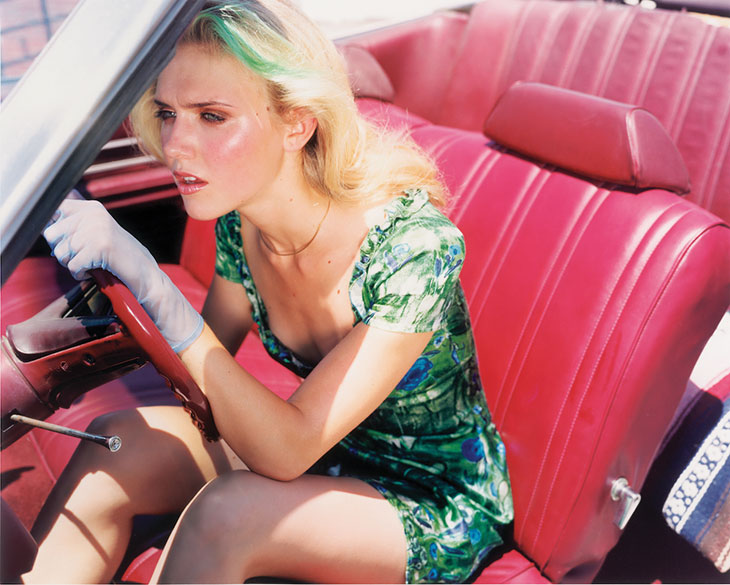
Michel Haddi, a prominent figure in fashion and portrait photography for over forty years, is celebrated for his unique and innovative approach. Currently based in London, Haddi’s artistic vision has been shaped by a diverse array of cultural and personal experiences. His latest exhibition, “Beyond Fashion” at 29 Arts in Progress gallery, is a testament to his extraordinary career, offering an in-depth look at his journey through photography.
This six-month exhibition provides an opportunity for both the public and collectors to immerse themselves in Haddi’s world. His images, infused with a distinctive street vibe and urban soul, also reveal a touch of irony and sensuality, mirroring his diverse personality. The exhibit showcases some of the most iconic photographs from his vast archive, featuring renowned figures, top models, and icons from the music and art worlds. These include memorable captures of David Bowie, Debbie Harry, Djimon Hounsou, John Galliano, Nicholas Cage, and Sarah Jessica Parker.
Haddi’s editorial work spans several continents, with contributions to major publications such as Italian Vogue, French Vogue, British Vogue, GQ, Vanity Fair, The Face, and Rolling Stone. His advertising portfolio is equally impressive, having worked with luxury brands like Armani, Yves Saint-Laurent, and Guerlain.
In this exclusive interview with DSCENE Magazine Editor Katarina Doric, Michel Haddi discusses the inspirations behind his distinctive style, the evolution of his photographic techniques, and the standout pieces in his “Beyond Fashion” exhibition. He also shares insights into the influence of his background on his work and his perspective on balancing irony and sensuality to craft compelling photographic narratives.
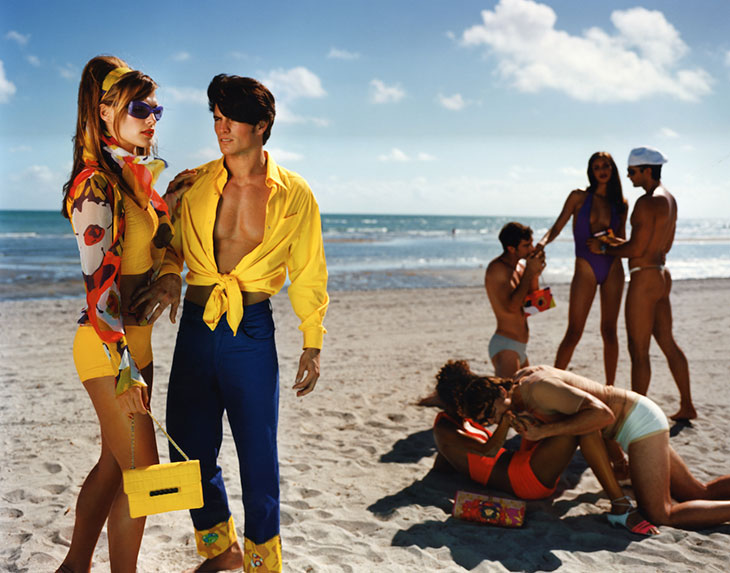
Michel, could you share with us what initially inspired you to pursue photography, especially with your unique blend of street vibe and urban soul? – In life you have the choice to have a normal life, which can be great too or to pursue a chimera or a dream. In short, I had no choices and I would have ended up on the other side of the fence, meaning a hoodlum, being raised in the worst suburb. I had no alternative, only to fend for myself. The most important goal I had was to be an artist, painter, director or being Leonard Bernstein. Life showed me another path- photography.
Over your 40-year career, how has your photographic style evolved and what has remained constant in your approach to photography? – Since the beginning I have only ever been interested with human feelings, meaning I never cared much of just a fashion image, which in all honesty you do not need to be a genius to do, but to create a magic image takes willpower, style, attitude. Since the last 70’s I pursued this goal without fear. It didn’t matter the formats, colour or black and white, I love to play and I am up for games all the time. 20 years ago I thought I was cool to take a self portraits looking like a Japanese Samurai, and why not snap images with a point and shoot camera, the funny side of the story back then is people thought I was insane. In the show in Milan there are some images shot that way. To come back to what you said, my style is “be there at the right time, right place”, have a laugh, don’t be too serious and if you can at the same time have a ball, it is all sweet.
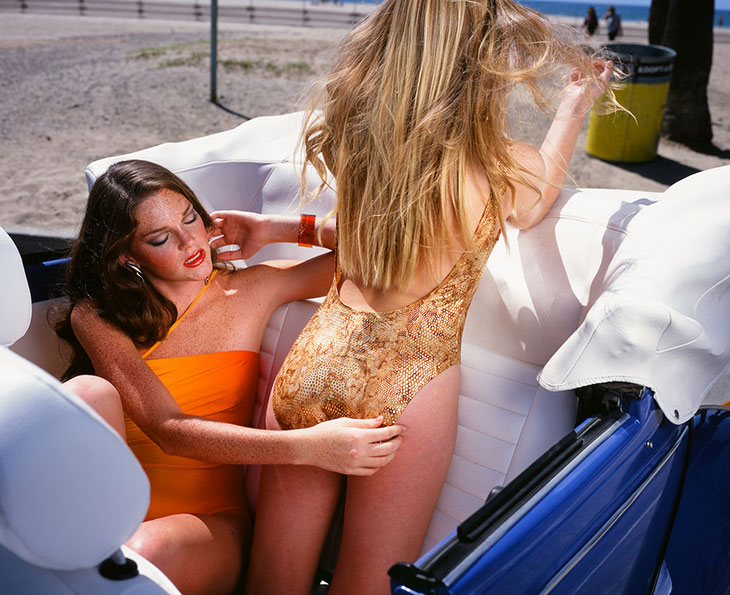
In your latest exhibition ‘Beyond Fashion’, which pieces do you feel most intimately represent your journey as a photographer? – There is an image of a flower, an Anterium with the antemine being hard and that flower is between the legs of my friend Natalia Avelon. A cover we shot for Playboy last year, Again, it all about showing things that are not there but more suggestive.
You’ve photographed many famous faces and icons. Is there a particular subject or shoot that. stands out as particularly memorable or significant in your career? – Maybe the Red Hot Chili Peppers, as I was in Berlin with them for Interview Magazine when the wall went down, so you can imagine the pandemonium and the racket, the fall of a great empire. The communist block that day went into a total oblivion. Anyway it was epic and as we went on the wall to break it and to work finishing the story for the mag.
The bottom line is I love to go against all odds, I decided to go to East Berlin the day after. Wrong choice. No one in sight, deserted land, total emptiness in East Berlin. But as soon as I came out of the cab and started to take pictures of the buildings and the rest, 5 army trucks came along armed to the teeth with AK47’s loaded to the gull. I can assure you they were pissed off as it was no tomorrow for them. I did laugh looking at these clowns, they didn’t like it and they wanted to take me in the woods…you know the meaning. Ah ha the cab driver just forced me back into his cab and we left without asking me where to go in East Berlin for coffee… ha ha. At the end of next year, I will release the Legend- The Red Hot Chili Peppers Berlin.
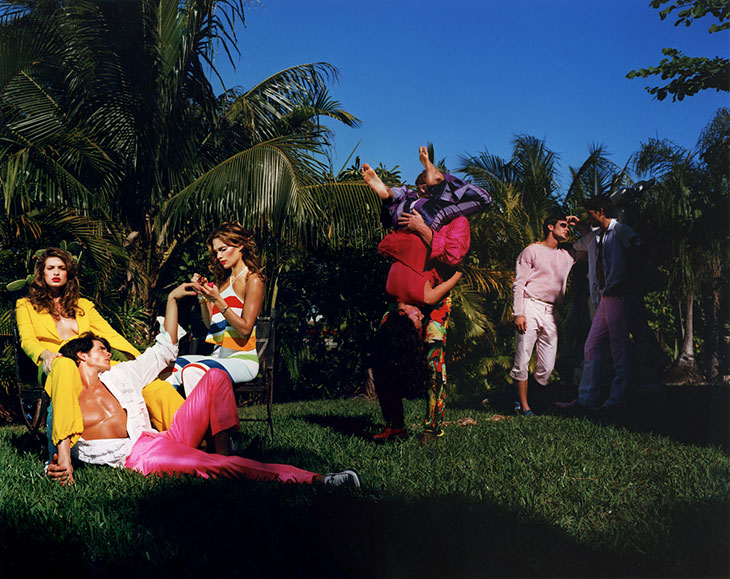
Being French Algerian, how have your cultural roots influenced your work? – In all fairness I was born in Saint Germain des Pres and educated in a rightwing orphanage, raised from the age of 9 by my mother who I rarely saw, and in a tough suburb. Even with all the bad things I saw, I am a French boy all the way. My blood heritage coming from many worlds made me see life differently. My Arabic side, well I embraced it but I have never been to Algeria and the closest I have been is Morocco, as I used to have a house there for 20 years.. I am of mixed blood with different cultures. My mum yes sure is Algerian from with Turkish and Moroccan background. We have certainly 1000 members of the Haddi tribe throughout the Arabic world. My father that I never knew, was French from Paris, Bourgeois, from a family dating back from the 14th century in France and from a recent DNA test of late, I can confirm I have indeed some Irish and Welsh with a touch of African. So as you can see, I have the same love to make a ring in sterling silver from the Dogon Tribe from Mali, as I do to conceive a campaign for a luxury brand from Paris.
As you know the French are the way they are, always complicated and striking for whatever reason, when it come to creating something luxurious, they are right at the top, so for me it was a total bonafide.
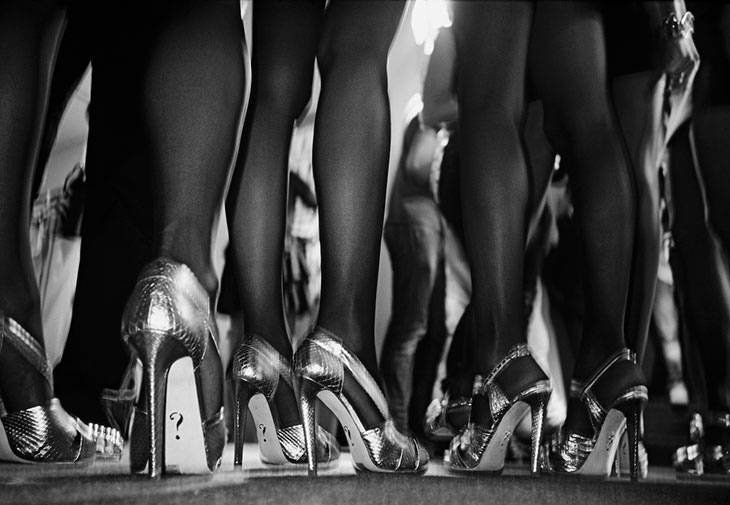
Your work is noted for its irony and sensuality. Can you elaborate on how you balance these elements to create a compelling narrative in your photographs? – Again this is my French, Arabic side playing out. Being sensual it is a must, you need this in order to get close to humans. I suppose in the semitic society, they for 5000 years wrote about sensuality, take for instance the Perfume Garden from the 15th century written by Muḥammad ibn Muḥammad al-Nafzawi, The book was made by the Factotum of the Pacha of Tunis, something like that for the Pacha to start again have desires (bare in mind the Factotum had no choices) the Pacha simply said, ever I become a man again, or your head rolls. Charming it is not ha ha, yet I learned all about sarcasm and irony in the UK . This is why I have been there since the late 70’s. In all fairness, and truth why do you want to show the world that you are extremely clever and very intelligent. Sod it just have fun and who cares.
As a photographer who has extensively worked in the fashion industry, how do you perceive the role of fashion in shaping cultural and artistic expressions? – Fashion per se and its primary goal is very boring. Many brands, I am talking about “fast fashion”, “cheap fashion”. There is no study of the human soul, just a way to make a quick buck. Now you go to the top of the pyramid, the gods among the gods. Well here the dialogue is totally different. It is a reflection day by day of our society and if you look carefully, you can feel the premises of whatever political statement is happening. It does become and extra class on sociology, that will take place at La Sorbonne in Paris. Again, what I said, only work if you have people around you who are in the same groove. Mark my words, search deep into what we are with all our strength and our failures, then you will be able to create a garment that is worth something. The best example of this is YSL.
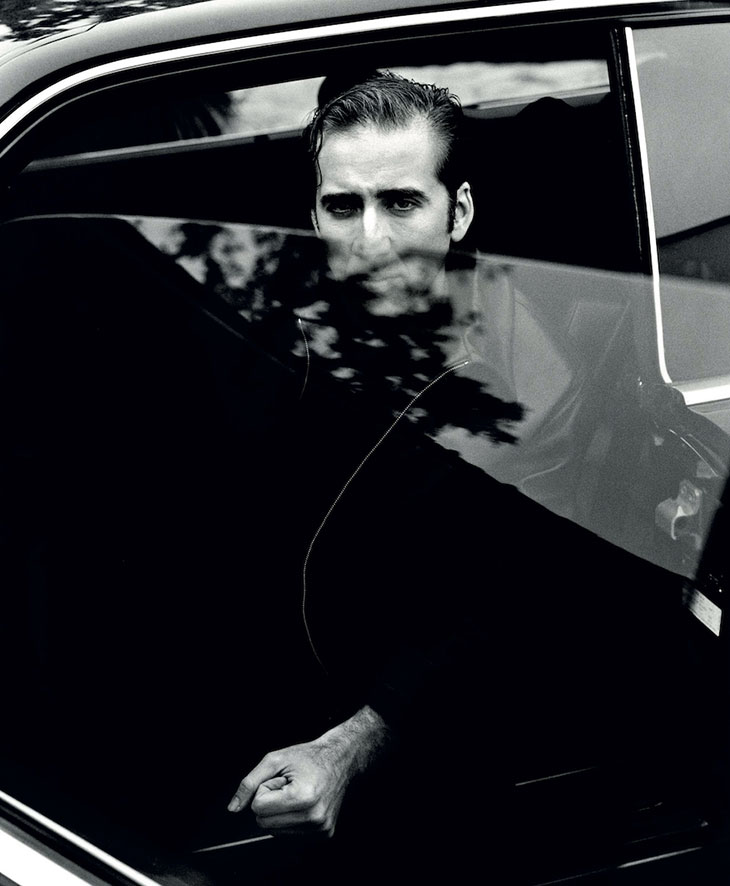
What advice would you give to young photographers who aspire to carve out a career in fashion and portrait photography? – I have no advice to give, they might become competitors and that would be a problem ha..ha..,of course not! The only thing I will say to them is don’t listen to anyone and secondly don’t listen to me.. ha ha, the last just put your bollocks on the table and like a bull in a china shop, charge full steam ahead but of course make sure you use your head.
In your opinion, what is the power of photography in telling stories and capturing moments, and how has this shaped your approach to your art? – This has been my only goal all my life to telling a story. The rest, I not interested in. It is not relevant. Photography as a media is so powerful, from one image you can have the world going one way or the other way. For example The Times magazine I think did a series of very compelling ads to show you the power of an image. The first one, and this is very important, you see an image of a black man running with his hand and arm above a little old granny and I think it is correct to say that the majority of people will say here we go again, a black punching an old granny for her purse. In the second image, full frame, it is a different story and a different point of view. What do you see, yes of course the black man wutg the hand and the arm above the old granny, but well you see too a large piece of wood falling down from a scaffolding in the old granny’s head. All he does this gentle soul is to protect the granny. The perception is not the same correct. Tell a story that is true of your beliefs.
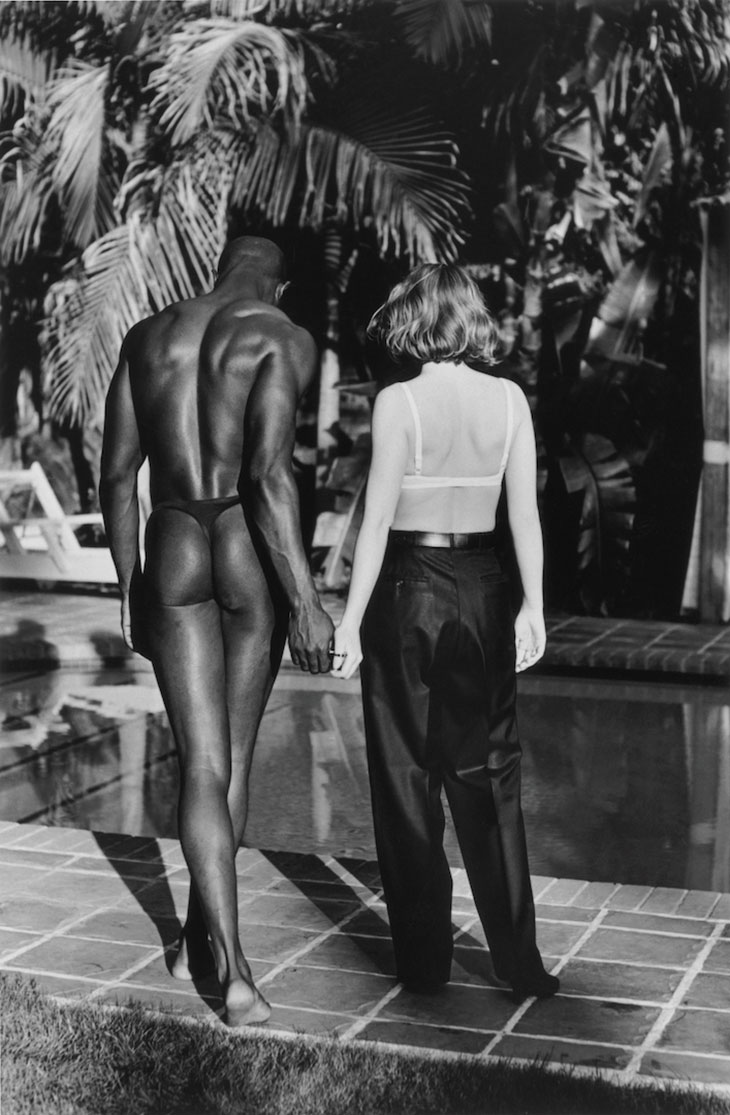
How has the advent of digital photography and social media impacted your work and the fashion photography industry as a whole? – I love it. Quicker to work and to play and you can interact with millions of people and everyone feels like a god! I loved it, digital is much quicker of course but bare in mind, if you think that the tools are going to help you to transform a shitty image unti a masterpiece, wakeup honey cos your image is still going to be a turd. It doesn’t matter what you used, a phone or your third eye, you need to create and this is where the problem arises. Creativity is not only a new version of photoshop or an AI tool. My wife taught me photoshop in order to stop me asking her to retouch all my images. Social networks are a blessing and a curse, You can interact with millions of people, make business moves, pretend to be a star. You can even throw up bile on whoever you like. It is Pandora’s box. Infine social networks are only a business tool. There is nothing personal about it, but it is on the the medias where simple mortals feel like gods and goddesses.
Keep up with Michael Haddi’s work on Instagram – @michelhaddistudio

Larry Fink, who has died aged 82, was an acclaimed photographer whose subjects ranged from jazz musicians to boxers and from members of Andy Warhol’s factory to celebrities such as Meryl Streep and Kate Winslet.
He called himself a “Marxist from Long Island” and there was fury in US Republican circles in 2004 when he put up a “satirical exhibit” consisting of a photograph of a smirking George W Bush lookalike, his left hand cupping the breast of a woman in a negligée, in the lobby of a US university humanities building.
In an essay to accompany the exhibit, Fink attacked the “fundamentalist neoconservative conspiracy” and called Bush a “frat boy with charisma”. The woman in the photograph, he said, was a metaphor for the whole world.

‘English Speaking Union, New York, New York,’ December 1975
Credit: Larry Fink/Courtesy Robert Mann Gallery via AP
Fink was best known for “Social Graces”, a 1979 exhibition at the New York Museum of Modern Art (published as a book in 1984) in which black-and-white photos of wealthy New Yorkers having a good time were juxtaposed with shots of his working class neighbours having more modest fun in Martins Creek, Pennsylvania where he lived on a farm.
Many detected an underlying political message in the contrast between hedonistic wealth and extreme poverty of 1970s America, but Fink denied the charge. “I’m a human person, not just a political person,” he told the Guardian in 2020. “I like people actually.”

‘Pat Sabatine’s 8th Birthday Party, Pennsylvania’, 1977
Credit: Larry Fink/Courtesy Robert Mann Gallery via AP
Though he felt an outsider in the glitzy world of Manhattan, he always sought the vulnerable human being behind the facade: “Emotions are primary to all of us, and it’s that which allows us the empathy factor. In my way of thinking that’s how I need to photograph, to go inside the other person somehow and find what it is about them which is also about me.”
The New York Times observed that Social Graces “does one of the things that straight photography does best: provide excruciatingly intimate glimpses of real people and their all-too-fallibly human lives.”
It was the element of compassion for his subjects, and his distinctive visual style – Fink always used a handheld flash separate from his camera – that led to commissions for The New York Times, Vanity Fair and GQ Magazine – and to solo exhibitions at the Whitney Museum, the Philadelphia Museum of Art and other venues around the world including the David Hill Gallery in London.

‘George Plimpton and Devotees, Elaine’s New York,’ January 1999
Credit: Larry Fink/Courtesy Robert Mann Gallery via AP
One person Fink refused to photograph was Donald Trump. When Vanity Fair asked him to document the new president’s inaugural ball, he refused. “I didn’t want to photograph him… I thought he was a horrible person.” Instead, he photographed a women’s march the following day.
Larry Fink was born in Brooklyn, New York, on March 11 1941 to “leftist but bourgeois” parents. His father, Bernard Fink, was a lawyer in the insurance industry and his mother Sylvia, née Caplan, a political activist her son described as a “mink Marxist”. Great partygoers, they were fans of Cab Calloway and Count Basie, and moved in radical artistic circles.
The family moved to Long Island where the teenage Fink began getting into trouble: “I was stealing cars and cursing out my algebra teacher and kicking the vice-principal in the groin”. Things improved when he was sent to a progressive boarding school in western Massachusetts, where he was inspired by the poetry of Allen Ginsberg and enjoyed midnight discussions about Marxist theory and Buddhism.

Larry Fink
Credit: ©larryfink ©GeoffreyBerliner/ Larry Fink Studio
After leaving school and a very short stint at Coe College, Iowa, he hitchhiked round the mid-west, moved back to New York and became part of the Greenwich Village counter-culture scene. A favourite haunt was the Village Gate jazz club, where Charlie Mingus and John Coltrane were regulars and soon Fink was busy photographing the Beat poets, artists and musicians of the era.
He had taken up photography aged 13 after his father gave him a Rolleiflex camera and was later privately taught and mentored by photographer Lisette Model. He regarded the Beats as his first “tribe” and he went on to explore other tribes, once describing himself as “a witness for the investigation into what it meant to be alive”.
!['Blue Horizon, Philadelphia, Pennsylvania' [a boxing venue]. December 1994](https://www.mecreates.com/story/news/wp-content/uploads/2023/12/TELEMMGLPICT000358220696_17030728563800_trans_NvBQzQNjv4BqqVzuuqpFlyLIwiB6NTmJwfSVWeZ_vEN7c6bHu2jJnT8.jpeg)
‘Blue Horizon, Philadelphia, Pennsylvania’ [a boxing venue]. December 1994
Credit: Larry Fink/Courtesy Robert Mann Gallery via AP
Notable among these were his photographs of boxers and gritty boxing venues which, instead or focusing on the gore and the violence, documented the post-match cameraderie and genuine affection among the fighters. His portraits included a ringside shot of Mike Tyson, whom he found “likeable”, taken at the budding champion’s training camp in Catskill, New York in 1986 a few months before he won his first heavyweight title.
In 1999 Fink was put under contract by Vanity Fair and for the next 12 years he documented the magazine’s famous Oscar parties, assembling a collection published and exhibited as “The Vanities”. Unlike other photographers who looked for smiles, he preferred to shoot celebrities in unguarded moments in the same way he would shoot anyone else.
“At the beginning publicists wouldn’t let me near their people,” he recalled. “But then I was branded as the ‘candid guy’. Then they started to like me; it became good to be ‘photographed by Larry’. Because the pictures are not mean, they didn’t mind.”
As well as his magazine work, Fink had an extensive advertising portfolio and taught photography at Bard College, New York for more than 40 years.
Fink’s first marriage to Joan Snyder was dissolved. He is survived by his second wife, Martha Posner, and a daughter from his first marriage.
Larry Fink, born March 11 1941, died November 25 2023


It’s hard to write about the year just past. It was so different than the previous few – 2020-2021 with endless COVID news, 2022 with the reemergence, tentative as it was. This year was often just bad news for my community – drag bans, gender affirming care bans, homophobia everywhere. It made me dig in more to the celebration of my community, as you can see here. All my good photos were of women, trans, and nonbinary folks this year. It’s getting hard for us to stay in Texas.

Brigitte Bandit, drag activist, at the Texas State Capitol. I didn’t feel like this was an easy shoot for her. The hearings at the Capitol on anything related to gay or trans issues are just soul-draining. The hate is so palpable. And it always dresses itself up as “concern for the children.” Brigitte teared up when we went inside. I admire her courage to confront the homophobes face-to-face in a 2-foot-tall Dolly Parton wig. (Photo by Jana Birchum)

If you want a (late) night of fun, go see one of the House of Lepore’s drag balls at Swan Dive. (Photo by Jana Birchum)

Unhoused women evicted from the Downtown Salvation Army shelter when it closed. Their fear and anger were so clear. (Photo by Jana Birchum)

On January 22, almost 10 months before the deadly Hamas attack on Israel, a small group of students peacefully gathered outside the annual Israeli-American Council summit at Fairmont Austin to protest Israel’s blockade of Gaza. With a significant police presence, most summit attendees ignored the protesters, but a few mocked and argued with them. The protest took place without incident but was a minor, local representation of the struggles the Palestinian people have endured for decades. At the global level, U.N. Secretary-General António Guterres acknowledged the Hamas terrorist attack “did not happen in a vacuum.”

Supporters of Palestine protested Israel’s blockade of Gaza during the Israeli-American Council summit at Fairmont Austin on January 22. (Photo by John Anderson)

On November 13, an estimated 10,000 protesters rallied at the Texas State Capitol and marched through Downtown to show support for Palestinians in Gaza and to oppose Israel’s deadly military retribution. (Photo by John Anderson)

Photo by John Anderson

In music photography – the vast majority of what I contributed to the Chronicle this year – there are exceptionally rare moments when the first image captured during a shoot is the one. This was just such an instance, when Kendrick Lamar walked on stage for his headlining set at ACL Festival’s second weekend (Oct. 13), a bright, solid-white backdrop resulting in only his silhouetted profile. As I maneuvered through the remainder of the three songs (for those who may not know, the standard allotment in a photo pit for media photographers), I knew in the back of my mind that I had it, a photo which, for me – a longtime appreciator who’s made it a point not to miss any of his visionary tours in the past decade – felt definitive of Kendrick’s consistently raw, enigmatic presence. After lowering my camera, I instinctively let out an audible “fuck yeah.” A little bit of luck perfectly coalesced with years upon years refining the craft, and if that type of moment isn’t inspiration enough to continue creating no matter the odds, I don’t know what is.

That shot of Kendrick Lamar (Photo by David Brendan Hall)

Karen O of the Yeah Yeah Yeahs dazzled with a twirl of color and pure joy on Sunday of ACL Festival’s second weekend (Oct. 15). (Photo by David Brendan Hall)

Jenny Lewis and Ben Gibbard of the Postal Service faced off for a sweet moment during their show at Germania Insurance Amphitheater (Sept. 9). (Photo by David Brendan Hall)

This year has been an exhilarating journey for me, especially when it comes to capturing moments at Austin Psych Fest and Levitation – two standout festivals that have defined my 2023. Immersing myself in the vibrant tapestry of art woven into these events was a truly enriching experience. Among the many performances of the year, I selected snapshots of Ty Segall, Altin Gün, and A Place to Bury Strangers because their live sets were nothing short of extraordinary. The excitement I felt when I learned I would be photographing for both festivals was overwhelming, and I made it a mission to seize every opportunity to capture these remarkable artists. Witnessing Ty Segall shredding his iconic guitar solos was a breathtaking and emotional experience as it was the final leg under the Freedom Band name, along with his longtime bandmate Charles Moothart’s last show. This performance took the lead and created memories that lingered long after the music faded. Altin Gün’s Turkish psych-rock performance was also a standout at Levitation, keeping the crowd on their feet dancing throughout the night – an infectious energy that I loved and couldn’t enough of. Lastly, my final pick was of A Place to Bury Strangers, who took festival engagement to a new level. In essence, these photos encapsulate not just the visual aesthetics of the festivals but the profound impact these artists had on me long after they had performed.
instagram.com/peppermintgirlphotography

Oliver Ackermann from A Place to Bury Strangers finishing the set from the crowd during Austin Psych Fest’s kickoff night at Mohawk. (Photo by Isabella Martinez)

Ty Segall shredding a guitar solo at Stubb’s for Levitation. (Photo by Isabella Martinez)

Altin Gün playing an electrifying Levitation set at Empire Garage. (Photo by Isabella Martinez)


We’re revisiting some of our favorite stories of the year. This one was originally published July 20.
 I picked this one because I appreciate all the individual and groups of artists I have gotten the opportunity to talk to, but I think it is especially important to highlight Indigenous culture, history, and life given that our dominant culture is strategically designed to ignore, erase, or destroy those precious things, and Terri is a wonderful woman playing her part in fighting that.
 — Isaac Trussoni
Wisconsin is no stranger to the presence of deep, yet often under-discussed Native American history that ties in so closely with the state. While much of the visual representation of Native history is most immediately seen in the geography of Wisconsin, many artists are pushing for more visibility and vocality around Native history and culture through their own creations.
Terri O’Connor is one such local artist. While Terri now lives in Poynette, Wisconsin, she has been around the Madison area since her early 20s. O’Connor’s passion for art started long before she found her way to Madison as art was second nature at home.
“I started my art way back when I was young,” O’Connor told Madison365. “I just always dabbled in the art scene a bit, slowly working with the tribe on quite a few little projects that they had. My dad was an artist, so he had paintings that he had done in the house like some horses, I remember. I also had my mom’s brother who was an artist, so he did a lot of beautiful artwork, too, as a painter, as well. I saw that and was always interested in art.”
O’Connor grew up surrounded not just by art, but by Native American art and culture specifically that fueled a passion for learning more. Being raised on the Stockbridge-Munsee Band of Mohicans Reservation, O’Connor was exposed to culture and connections within the tribe that eventually led to working in smaller ways to provide artistic needs for her community.
“Going to the Pow-Wows in the summertime was a huge influence on me,” said O’Connor. “I just loved the character. I’m a people person when I draw. I love looking at faces and I was intrigued with the history. I like old photos, so working at the museum, I got to see some of the history. It just really influenced me on the culture. The tradition of Native Americans’ respect for their elders, and the Pow-Wows as gatherings and always giving thanks. It’s basically a gathering to get together to see family and see people that you haven’t seen in a while.”
Connecting with people gave O’Connor the opportunity needed to practice her art in ways that may not be immediately thought of such as designing badges for the tribal Natural Resources Department, and logo design for businesses out of the tribe, such as Tribal Sun Soap. However, the most inspiring things for O’Connor’s artwork may just be the joining together of people in ways that uplift and support the community.
“I did a piece honoring women called ‘The Gatherer,’ O’Connor said. “A lot of the women in our culture were gatherers of not only the food, but they were a great support for the community. I like to do a lot of my art in honor of men, women, and children, because it’s all part of us. We’re all part of that community. We all make a difference in all the things that we do and contribute to help each other. I think that’s true in all cultures.”
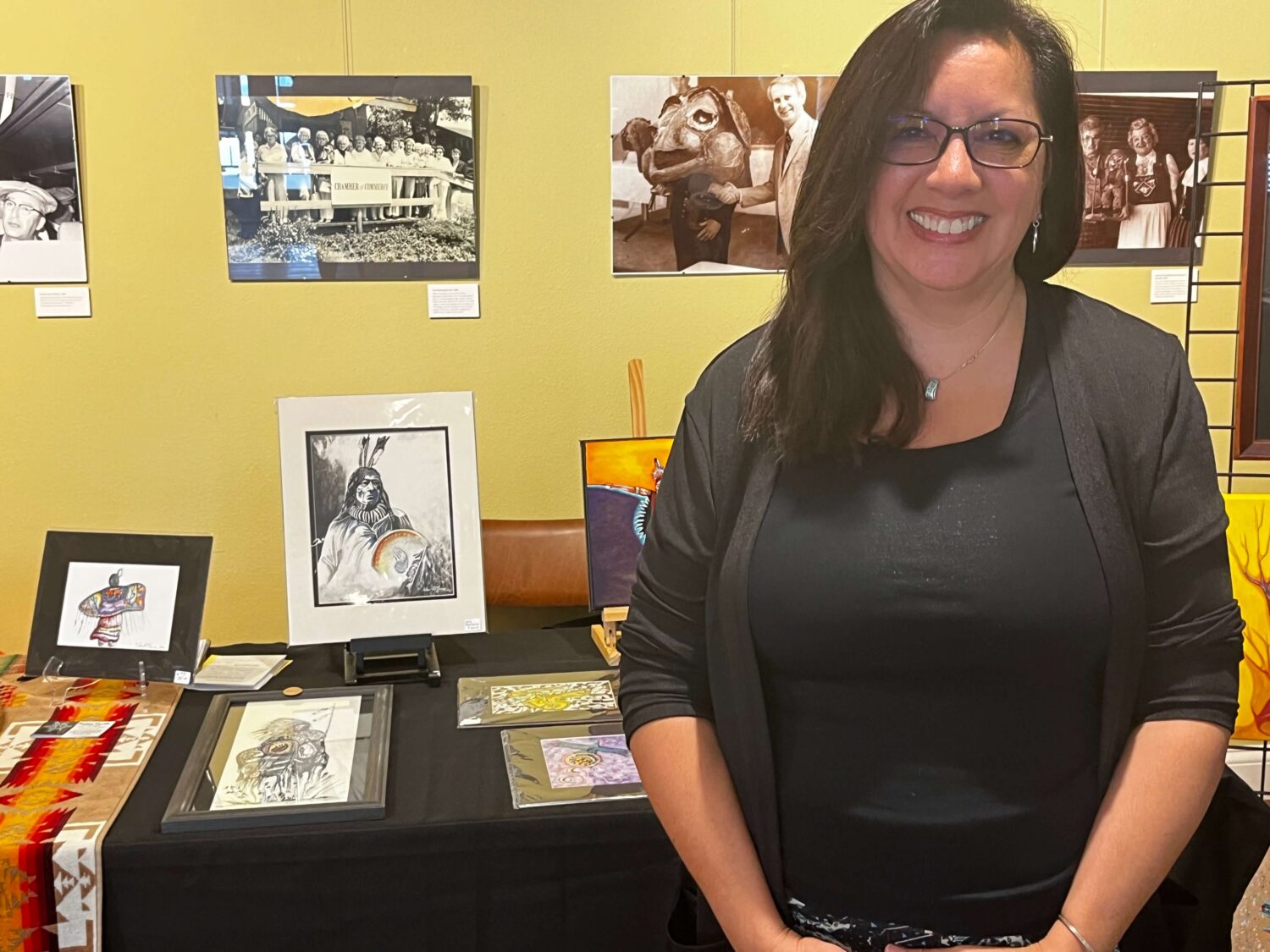
One of the communities O’Connor has found herself in is with other local Native American artists who frequently do shows around the area such as the Native Art Marketplace that took place early last month in Mt. Horeb. It is in spaces such as these that she says people may be surprised to find art and culture in a variety of ways including storytelling and carvings as well.
“There’s such a diversity with some of the artwork in Native culture,” expressed O’Connor. “You’ve got basketmakers and the beadwork that is amazing. There’s so many influential pieces of artwork that maybe a lot of people don’t even realize are out there.”
As time moves forward, many Native cultural traditions and ways of understanding are lost both to the cycle of life, but also to silence. As artists and community members such as O’Connor push to make their history, culture, and passion visible, it takes the community to respond and invest their interest and support in remembering the deep and beautiful Native history that is crucial to maintain for future generations.
“We want to show people our culture and our passion for it while always having appreciation for everything that’s around us. We are a part of this earth, and there’s so many beautiful things of this earth for us to express and show in our art,” O’Connor said, praising the perseverance and continued collective effort of local artists, especially Native artists.
“They’re multitalented and they need to be seen and heard because it’s part of our lives. It’s us, it’s who we are, and it’s great that it’s being recognized that we are artists. We are actual artists working out there, and doing it because we love it.”





