About

Posts by :

The Aureole Lamp Collection Is a Cosmic Garden of Delight

The Aureole Lamp Collection Is a Cosmic Garden of Delight

Black sand, cutting-edge 3D-printing technology, and experimentation. All three of these elements – plus sunflowers – are behind Rollo Studio’s Aureole Collection that debuted during London Design Festival 2023. Each lamp exudes an otherworldly aura, inviting curiosity through a spiral structure that intertwines, folds, and curves to create layers of depth. It’s an ode to nature’s beauty and the studio’s biophilic design principals, with each lamp’s uniquely textured surface distributing and diffusing light in different ways. Stand directly in front of an Aureole lamp and it can become a visually hypnotic experience.

To make the collection a reality, Rollo Studio collaborated with companies Exone and Sandhelden. While sand molds are primarily used for metal casting in the auto industry, the trio looked beyond convention to see sand itself as the final object. They developed a method that sustainably enhances the strength and durability of the 3D-printed pieces, an advanced binder jetting process. When applied to the black sand it opens new doors to possibilities while pushing the boundaries of organic design.

two sunflower-inspired round black light fixtures hanging on a wall

detail of sunflower-inspired round black light fixture

two sunflower-inspired round black light fixtures hanging on a wall

two sunflower-inspired round black light fixtures hanging on a wall

two hands holding a sunflower-inspired round black light fixture

detail of sunflower-inspired round black light fixture

detail of sunflower-inspired round black light fixture

detail of sunflower-inspired round black light fixture

detail of sunflower-inspired round black light fixture

To learn more about the Aureole Collection, visit rollostudio.com.

Kelly Beall is Director of Branded Content at Design Milk. The Pittsburgh-based writer and designer has had a deep love of art and design for as long as she can remember, from Fashion Plates to MoMA and far beyond. When not searching out the visual arts, she’s likely sharing her favorite finds with others. Kelly can also be found tracking down new music, teaching herself to play the ukulele, or on the couch with her three pets – Bebe, Rainey, and Remy. Find her @designcrush on social.

Hood Museum of Art presents exhibition of photographs by Cara Romero

Hood Museum of Art presents exhibition of photographs by Cara Romero

Concord Monitor – Hood Museum of Art presents exhibition of photographs by Cara Romero

Concord Monitor Logo

Hood Museum of Art presents exhibition of photographs by Cara Romero

“Zenith” by Cara Romero

“Zenith” by Cara Romero
Courtesy

Published: 12-19-2023 5:00 PM


The Hood Museum of Art will present the first major solo museum exhibition of photographs by Chemehuevi artist Cara Romero, titled Cara Romero: Panûpünüwügai (Living Light). The exhibition will be on view at the Hood Museum from Jan. 18 through June 21, 2025, and will feature over 50 works, including several never-before-seen photographs, and site-specific installations that will invite the viewer behind the scenes to experience the sets of Romero’s most iconic photographs.

An exhibition catalog co-published by the Hood Museum of Art and Radius Books will be released in June 2025. The exhibition is curated by Jami Powell, Associate Director of Curatorial Affairs and Curator of Indigenous Art at the Hood Museum of Art.

Says Romero, “The Hood Museum of Art under the leadership of curator Jami Powell and director John Stomberg is an excellent example of how an American museum can create meaningful and positive impacts on Native community, representation, and living artists. When offered my first major solo show to commence at the Hood, I cried because I never imagined this was possible for a Native woman photographer in her 40s. I am so honored to collaborate with this institution and the people making it a major force in sidelining preconceived notions about Native American art.”

Adds Powell, “Cara Romero is an immensely generous storyteller, and her images invite people into complex and transformative dialogues about the histories and lives of Indigenous peoples. Romero’s photographs provide opportunities for two audiences to recognize the humanity of Native Americans and Indigenous peoples and ask questions they might otherwise be afraid to ask.” 

Romero, of Inglewood, CA, is an artist known for dramatic fine art photography that examines Indigenous life in contemporary contexts. An enrolled citizen of the Chemehuevi Indian Tribe, Romero was raised between contrasting settings: the rural Chemehuevi reservation in Mojave Desert, California, and the urban sprawl of Houston, Texas. Informed by her identity, Romero’s visceral approach to representing Indigenous and non-Indigenous cultural memory, collective history, and lived experiences results in a blending of fine art and editorial styles. Maintaining a studio in Santa Fe, New Mexico, Romero regularly participates in Native American art fairs and panel discussions and was featured on PBS’s Craft in America in 2019.

Her award-winning work is included in numerous public and private collections, domestically and internationally, including the Metropolitan Museum of Art, Museum of Modern Art, Whitney Museum of American Art, Guggenheim Museum, Amon Carter Museum, Peabody Essex Museum, and Forge Project Collections, among others. Romero travels between Santa Fe and the Chemehuevi Valley Indian Reservation, where she maintains close ties to her tribal community and ancestral homelands.


More Arts-Life for you.


By using this site, you agree with our use of cookies to personalize your experience, measure ads and monitor how our site works to improve it for our users

Professional Photographer Reveals the Best Destination He’s Ever Captured

Professional Photographer Reveals the Best Destination He’s Ever Captured

[embedded content]

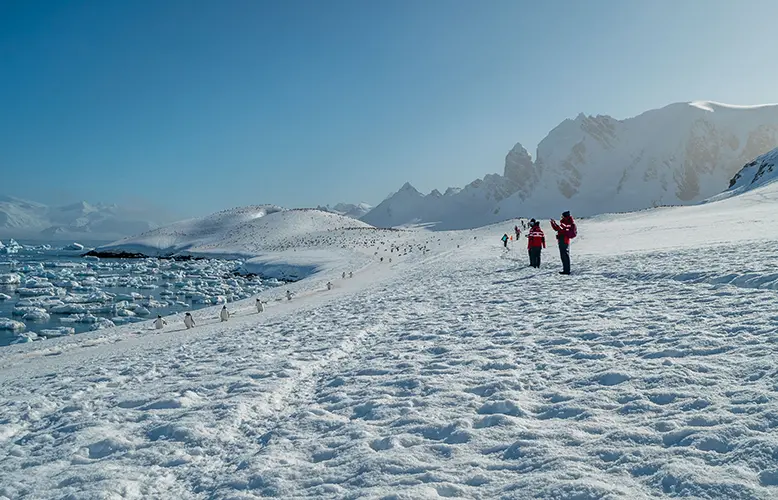
Having visited the likes of Patagonia, Svalbard and Greenland, Burnham Arlidge admits that his recent journey to the Falklands, South Georgia and Antarctica was the best photography trip he’s ever been on.

Burnham says: “Working as a photographer, I’ve been lucky enough to visit some of the most incredible locations on Earth. I’ve stalked Polar Bears in the Canadian Arctic, gazed at the northern lights in Greenland, and wondered at hanging glaciers in Patagonia. Few places on the planet, however, have left me with a gallery of photographs quite like this trip. 

“The composition options, the lights, the dramatic landscapes; it’s just unbelievable.”

He took a South Georgia, Antarctica and Falklands Explorer trip provided by Swoop Antarctica. The 21-day adventure takes travellers on a small ship cruise to remote and underexplored areas of Antarctica, South Georgia and The Falkland Islands.

“The size of the vessel frees you to dock up in tight, isolated bays where no one has been in years. You don’t have a set itinerary or know which precise inlet you’ll be heading to. Instead, you sail with the weather and it dictates where you dock.

“Of course, you know the region you are heading to and the number of days you will be staying there but not the exact location you’ll be. As a result, you get up close to undisturbed wildlife and landscapes that you would never otherwise see.”

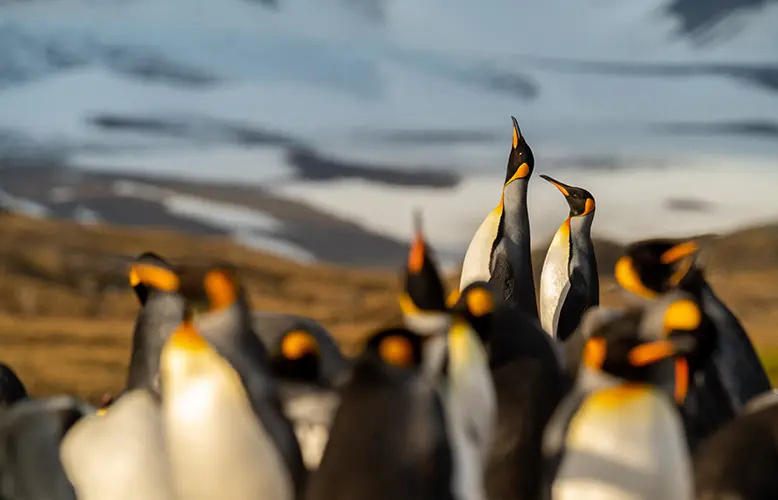
Highlights of the three-week trip include seeing the largest king penguin colonies on the planet, zodiac cruising through crinkling brash ice in Antarctica and visiting the farms in the westernmost settled outposts in the Falklands that have been owned by families for hundreds of years.

Your journey begins with a flight to the world’s southernmost city, Ushuaia. Upon arrival, you’ll be whisked away to a five-star hotel overlooking the Beagle Channel where you can rest and recharge from your travels for the next two nights.

After a leisure day in Ushuaia, during which you can visit Tierra del Fuego National Park, sample the local king crab regional speciality or explore the city and its hiking routes, the real adventure begins as you board the small ship. 

The vessel’s expedition team and officers greet and welcome you onto the 139-passenger ship which features state-of-the-art stabilisers and sleek, spacious suites.

After a fine dining experience, sit down and take snapshots of the glorious mountain scenery as you set sail along the Beagle Channel, passing Magellanic penguins, Rock Cormorants, and sea lion colonies en route to the Falkland Islands.

Drift by icebergs along the Southern Ocean the next day, accompanied by albatrosses, prions, and petrels as they follow the vessel. The expedition team keeps a careful watch on the surroundings, ever ready to highlight whales and dolphins along the way. 

You will also be invited to an informative onboard presentation on the wildlife, history and geology of the Falkland Islands and the Southern Ocean. Additionally, you can actively engage by participating in seabird sighting surveys or contributing to the collection of salinity samples and weather data.

The fifth day is spent exploring the westernmost settled outposts in the Falklands which are home to remote farms that have been owned by families for seven generations. The wild, windswept landscape is devoid of trees and completely silent and undisturbed, bar the lively vibrant local wildlife.

Sheep graze alongside albatrosses and rockhopper, king, and macaroni penguin rookeries, while Caracas fly overhead and upland geese graze by the curling waves of the white sand beaches. 

“It was surreal – it felt like Hawaii but with penguins everywhere. My favourite shot I took here was one of the penguins on the beach. It looked like they were holidaying in the Caribbean.”

While here, you can visit homesteads and gain unique insights into the lives of those living in this remote area over a cup of tea and cakes. 

The next day, you will be taken to Stanley, the capital city of the Falkland Islands. Explore the unique metropolis on foot, popping into shops selling locally-made wool garments, visiting the museum and investigating the lively pub scene. You can also spot sea lions and dolphins in the harbour and bird life by Gypsy Cove.

Over the next two days, you will travel east across the Antarctic Convergence on your way to South Georgia. You’ll be able to spot wildlife from the ship’s deck and listen to fascinating presentations on the region’s history.

Come day nine, you reach South Georgia. Nicknamed the Serengeti of the South, it is famed for its high populations of penguins and seals. Its marine ecosystem is one of the world’s densest examples of biodiversity.

“I’ve been close to wildlife before, particularly in the Galapagos Islands but the backdrop of South Georgia is so dramatic. We’re talking towering ice-peak mountains in close proximity to thousands of penguins. It makes for incredible photo after incredible photo. And the light there is constantly changing. No matter what time of day you go ashore, you’re guaranteed something new.

“The wildlife is magnificent here. Even just on the beaches, you’re getting huge elephant seals, aggressive fur seals, macaroni penguins, albatrosses, petrels, skuas, and gulls everywhere. It’s like walking through a nature documentary. It’s something you really have to see to believe.”

You’ll also come across hundreds of thousands of king penguins of all ages, from fuzzy chicks to mature adults. 

The region’s unique location is to thank for its sensational wildlife scene. It is situated within the Antarctic Convergence but outside the limit of the yearly sea ice. Consequently, the 3,755 square kilometre island is home to tens of millions of breeding penguins, seals and seabirds. 

Spend the next three days snapping sensational shots of the wildlife, towering mountains, immense glaciers, rugged coastline and tabular icebergs. 

You can visit the Grytviken whaling station during your time in South Georgia. It is the first shore-based whaling station for Antarctic whaling. You’ll also be taken to the Norwegian seamen’s church, the active British Antarctic Survey station and the tiny graveyard where the legendary polar explorer, Sir Ernest Shackleton, is buried.

Over the next two days, you gradually navigate through a growing number of icebergs as you journey southward aboard the vessel, heading towards the trip’s final visit destination: The Antarctic Peninsula and the South Shetland Islands. Informative presentations and wildlife watches will keep you entertained along the way. 

As you approach the Antarctic Peninsula, your expedition leader and captain will draw up a three-night itinerary based on the weather and ice conditions. Entering the region from the east, you come across the northern boundary of the Weddell Sea.

The area is thriving with wildlife, as it marks the point where a large cold body of water rotates clockwise driving cold water and ice north towards South Georgia and the South Orkney Islands. The ocean currents derive nutrients from the deep, feeding countless species of marine animals. 

“Antarctica’s landscape is simply alien. Ethereal, beautiful but undeniably strange. It offers such a contrast to The Falklands and South Georgia. 

“My favourite moment in Antarctica was when we were on a zodiac cruise to see wildlife. The light was coming through the clouds giving this blue glow. We were just zodiacing through brash ice as it crinkled and crackled below us.”

Drift by tabular icebergs and groups of whales as seabirds soar across the sky above you. Spend the days visiting the most scenic bays and channels of the Peninsula and visiting penguin rookeries of Adelie, Chinstrap and Gentoo.

You’ll also see crabeater, leopard, Antarctic fur and elephant seal wallows, bird colonies and minke, orca and humpback whale feeding areas. After four days, you will begin your two-night homeward journey along Drake Passage back to Ushuaia.

After disembarking on your final day, you will catch an afternoon flight to Buenos Aires.

Burnham has some advice for other photographers thinking about taking the same trip: 

“These destinations are on a scale almost unmatched anywhere else on Earth. So, take your time – the wildlife is all around you, you don’t need to rush. Also, get low. The animals are low to the ground so you should be too. Get into their world. Lastly, you don’t need to bring long lenses because the wildlife is always right next to you. Bring wide-angle lenses instead to capture the drama. Finally, be as creative as you can and don’t lose your camera in the water!”

The Candle Project Unveils 10 Designer-Made Candles

The Candle Project Unveils 10 Designer-Made Candles

House of Today, a Lebanon-based non-profit organization cultivating the local design scene, has unveiled its brightest initiative yet: The Candle Project, a unique collaboration between 10 Lebanese designers and 10 Lebanese artisans who worked hand-in-hand to create a collection of sculptural, design-forward candles. The artisans reside at the Centre Hospitalier Beit Chabeb Workshop, a hospital that puts on artisanal workshops for its disabled patients. All the proceeds from The Candle Project will go towards supporting Beit Chabeb and its invaluable initiatives, as well as the ten designers and House of Today’s mentorship program.

2 candles on the ground next to red stone pillars

3 candles on the ground next to red stone pillars

beige sculptural candle

Blrrrrr by 200 Grs features six candle wicks that put the flame – a symbol of transformation – in the spotlight.

pink candle with numerous steps

Aspiration by Aline Asmar d’Amman is inspired by the Lady of Lebanon, Harissa. The gradual elevation of the candle is symbolism for the spiritual act of elevation, “a nod to the eternal hopes for a brighter Lebanon.”

beige candle with three steps and three wicks

Strat by david/nicolas features three steps and three wicks, a simplified idea depicting the numerous layers of Lebanese architecture.

pink and white candle molded together

Nothing is forever by Flavie Audi is the idea that everything is transient, even solid rocks. The two “rocks” here are molded together to show “the cosmic entanglement between all beings and things.”

pale blue candle

Chrysalis by Carla Baz is a sculptural candle that, once it been fully used, becomes a vase for dried flowers.

multi-faceted sphere candle

Spiritual sphere by Nada Debs creates a mesmerizing effect once lit, casting light and shadows onto the surface of the sphere.

yellow sun candle

Sinkng sun for another one by Richard Yasmine is inspired by the idea that. like life’s ever-changing cycles, a sunset is not an end but the promise of new beginnings.

purple candle

I am here by LimbObject creates a comforting glow and offers a poetic hand to those who need one on dark nights.

blue candle with four stacked forms

Flaws by Sayar & Garibeh celebrates imperfections and reminds the viewer that that they are worthy of self-love and acceptance.

wavy purple candle

Silhouettes by Tamara Barrage starts as a sketch on paper, made only with a thin marker in hand.

To learn more about The Candle Project or to purchase a piece from the limited collection, visit houseoftoday.com.

As the Senior Contributing Editor, Vy Yang is obsessed with discovering ways to live well + with intention through design. She’s probably sharing what she finds over on Instagram stories. You can also find her at vytranyang.com.

Hunter Douglas Aura’s Illuminating Design Simulates Sunlight With the Shades Closed

Hunter Douglas Aura’s Illuminating Design Simulates Sunlight With the Shades Closed

Many of us do everything to welcome as much light into our homes during the day, especially with the increasingly shorter span of daylight during late autumn through winter. Even so, as evening arrives, the lights come on and the window shades come down. But what if you could accomplish both needs with a single solution? Hunter Douglas Aura Illuminated Shades are an innovative window treatment solution serving those two needs, capable of simulating the comforting presence of natural light while also retaining the sense of privacy the evening promotes.

Initial impressions of the Aura Illuminated Shades are similar to any other Hunter Douglas automated window shade. And that’s intentional, as the best window treatment should be handsomely innocuous rather than an attention grabbing presence. The Aura’s design offers the same convenience as the brand’s other PowerView Gen 3 Automation powered products.

Living room with high ceiling and two sofas facing one another, with light filtering window shades drawing down.

Just like any other Hunter Douglas window covering, the Aura can be used to filter or block out light using the brand’s user customizable PowerView Gen 3 Automation system.

But Aura hides a novel integrated feature that makes it stand out from any other window shade solution: a parabolic reflector and a reflective liner engineered to evenly disperse light from an LED array. Shining from the top down, the result is a window shade capable of simulating the presence of sunlight while closed.

The photos of the same room staged for yoga, showing three different lighting brightness and color temperature settings made possible by Hunter Douglas Aura window shades.

Hunter Douglas’s system allows users to adjust the brightness anywhere between 0% to 100% and the color temperature of light from 2200K to 6500K, all adjustable from the brand’s PowerView app.

Hunter Douglas Aura window shade options shown on a phone using the brand's PowerView app, with sliding controls for brightness and light color temperature.

A wide gamut of other lighting moods combining brightness and lighting temperature – all without any evident hot spots – create the convincing ruse of sun shining in.

Hunter Douglas Aura window shade options shown on an iPad using the brand's PowerView app, with sliding controls for brightness and light color temperature, alongside controls for opening and closing the window shades.

Hunter Douglas Aura Illuminated Shades PowerView Automation app allows for granular control while opening and closing the shade, along with the option to turn up the brightness and adjust the color temperature of the Aura’s integrated LEDs. Photo: Jacob Snavely

White Hunter Douglas Pebble remote control set on round wood side table near two potted plants.

If you prefer the tactile to purely app-based controls, the Pebble Remote offers a pleasing in-hand option. Voice activated controls are also supported for hands-free operation. Photo: Jacob Snavely

So what does one do with shades equipped with integrated lighting beyond the cool party trick of living the “shades down, lights up” lifestyle? Like other Hunter Douglas automated solutions, the Aura Illuminated can be programmed to follow specific routines and a user determined schedule to open, close, light up, and turn off. An obvious application is scheduling the Aura as a silent and luminescent alarm, using lights rather than a nerve-rattling alarm tone to gently awaken the senses by simulating the increasing radiance of a sunrise.

Even when the day’s forecast doesn’t call for a particularly bright morning, the Aura can be customized to introduce just the right amount of light, rather than the soul-draining 110% brightness typically associated with office lighting. An additional bonus is that Aura’s even illumination should prove beneficial for those required to jump onto regular Zoom calls.

Exterior of wood clad home's windows with the shades partially drawn down and integrated LED lights on.

With the LED component turned off, the Aura Illuminated’s room-darkening liner helps create an inviting sleeping environment (shown here with the Vignette Modern Roman Shade). Photographer: Jacob Snavel

Aura is available in a variety of Hunter Douglas shade styles – including Vignette Stacking Roman Shades, Sonnette Cellular Shades, and Designer Roller Shades – with the addition of a variety of fabric options to further complement nearly any room. For more information, check out HunterDouglas.com.

Gregory Han is a Senior Editor at Design Milk. A Los Angeles native with a profound love and curiosity for design, hiking, tide pools, and road trips, a selection of his adventures and musings can be found at gregoryhan.com.

An-My Lê, MoMA review — compelling photographs of war, teen life and an America riven by fear

An-My Lê, MoMA review — compelling photographs of war, teen life and an America riven by fear

There’s a stillness at the heart of An-My Lê’s photographs, no matter what turmoil they record. The hubbub of cities, the pantomimed passions of street protests, the frenzy of a neighbourhood soccer game — all freeze theatrically, as in a diorama. Her work, now in a viscerally satisfying exhibition at the Museum of Modern Art in New York, transforms everyday reality into a sequence of set pieces that seem archetypal even when they’re just pictures of people hanging out on a street corner or clouds scudding across the sky. The action orbits around a central hush, as if the world were never too busy to pause its rounds for her camera.

Lê’s first New York survey covers three decades of her peripatetic career. Born in Vietnam in 1960, she fled with her family to California in 1975, after the fall of Saigon. They alighted in Sacramento, and two years later she enrolled at Stanford. While working towards a masters in biology, she took a photography class, a choice that set her down on the rocky road of art.

Her timing was perfect: in 1994, the year after she graduated from Yale’s masters of fine art programme, President Bill Clinton lifted the US trade embargo on Vietnam. Lê travelled to her native country for the first time in 19 years. The show opens with what she calls a “self-portrait” but is actually a Vietnamese girl roughly the same age as the photographer was when she left. We see her in profile, her face unlined but sombre, already marked by sorrow. 

‘Untitled’, Nam Ha (1994) © An-My Lê

This wistful, tender photo stands out in a body of work that generally plays down feeling in favour of fact. It reminds me of Lewis Hine’s angry yet resoundingly humane portraits of child workers, which bared the wrongs inflicted on America’s youngest citizens. Lê does something similar, balancing dignity and compassion.

In another photo of the same girl — not in the exhibition but reproduced in the catalogue — we get a more inclusive view of her life: dirty, ill-fitting clothes, weathered hands, bare feet treading tall, prickly grass. 

Vietnamese sniper lying prone on sand dune near sea shore, pointing rifle towards soldiers about 20 metres away
‘Sniper II’, from ‘Small Wars’ (1999-2002) © An-My Lê

It’s less a study of an individual than a report on existence constricted by poverty and labour, closer to Walker Evans’s sober, forensic portraits of Alabama sharecroppers in their tumbledown homes, pinned in place by circumstances beyond their control. Like Evans, Lê favours a large-format camera with a long exposure, which allows her to pack the view with detail and produce images of static monumentality. 

Her Vietnam homecoming left her disoriented: “I felt I didn’t recognise anything in Vietnam.” She alludes to that feeling obliquely in a street scene taken in Ho Chi Minh City. A knot of men in white shirts, dark pants, and sandals (plus one woman and one child) shield their eyes to gaze up at a solar eclipse. Uncle Ho himself looks benevolently down on his people from a banner at their backs. The past has become two-dimensional, the future is blinding.

A flock of white geese on a grassy bank among trees heading into a river
‘Untitled’, Mekong Delta (1994) © An-My Lê

Rattled by the country’s rapid urban change, she ventured to the Mekong Delta to shoot deep-focus views that have an ageless, idyllic quality. A farming family poses in the middle distance, haloed by a circle of palm trees and a pen full of ducks. Another household, shaded by lush vegetation, dwells by waters so still and glossy they could be a sheet of marble.

When she returned to Vietnam again in 2011, having exchanged black and white for colour, Lê seemed less startled and more analytical. Her Delta series juxtaposes the experiences of teenage girls near the Mekong and the Mississippi. Even though 9,000 miles and vastly different cultures separate the adolescents of Ho Chi Minh City and New Orleans, we watch both groups on parallel tracks, slipping into adult gravity.

Six young Vietnamese women sitting around on floor of office-type room, some with their shoes off, while two more stand behind them by the windows
‘New Orleans, Friends, Heritage and Hope Gala’ (2011) © An-My Lê

War threads its way through her work, but indirectly, in pictures of exercises, games, civil-war statues and fake soldiers. “Small Wars” (1999-2002) features Vietnam war re-enactors in Virginia and North Carolina. Most of the participants had never been in combat but enjoyed the fantasy. In exchange for permission to photograph these events, Lê agreed to play the role of a South Vietnamese Viet Cong fighter. 

The make-believe gives her photos of a downed fighter jet shrouded in mist, or pretend GIs crouching in the foliage, a movie-like look of authenticity. “My pictures stand in complete opposition to combat photography,” she has said. “We are dealing with parallel subjects, but the outcome — the meaning — is completely different.” Her work doesn’t read as anti-war messaging, either, but as a comment on conflict as spectacle.

Battlefield at night scattered with scrubs and bits of equipment, with the sky lit up by flares - the flare trails are showing in the photo
‘Night Operations IV’, from ‘Small Wars’ (2003-04) © An-My Lê

Even the real military concocts fictional battles. She shot the series 29 Palms in 2003-04 at a base in California where Marines trained for the invasions of Iraq and Afghanistan. The desert and the smoke are genuine; the danger isn’t. These photos lack crackle, maybe because Lê positioned herself too far from the action to reproduce much excitement or emotional depth.

Since 2015, disparate projects scattered around the US have cohered into Silent General, a panoramic portrait of a country riven by fear, political chasms and incompatible visions of the future. “I’ve been making this series to relieve anxiety about what’s been going on in the past few years — division, chaos, racial tensions, all stuff I would not have felt so deeply five years ago,” she has said. “What makes America America? The wilderness, the vastness, our sense of history.”

Young people standing holding protest placards in city park square, with tree branches with pink blossom overhanging them in the foreground, along with park benches and a propped-up bicycle
‘High School Students Protesting Gun Violence, Washington Square Park, New York City’ (2018) © An-My Lê

You sense those tremors most powerfully in her pictures of teens, who are never wild or dissipated, just numbly rehearsing for their next chapter. They flop on the ground after a Black Lives Matter protest in Washington, DC, mill around during a gun control rally in New York, enjoy a Fourth of July picnic in New Orleans in ways she can massage into formal compositions.

In the Fourth of July scene, the arrangement of young bodies on the riverbank soon gels into a mash-up of Manet’s “Déjeuner sur l’herbe” and Seurat’s “Île de la Grande Jatte”. The Impressionists, too, chronicled moments of serenity amid shudders of change. Lê has found her great subject in that ongoing subterranean struggle, the tension between the mundane and the seismic that Baudelaire called “the heroism of modern life”.

To March 16, moma.org