About

Posts by :

Yavapai-Prescott Indian Tribe to Host Holiday Arts & Crafts Market Celebrating Indigenous Artists

Yavapai-Prescott Indian Tribe to Host Holiday Arts & Crafts Market Celebrating Indigenous Artists

Prescott, AZ – 12/14/2023


Yavapai Indian Tribe

The Yavapai-Prescott Indian Tribe’s Culture Research Department is thrilled to announce the Yavapai-Prescott Indian Tribe Holiday Arts & Crafts Market, showcasing the talents of local indigenous artists. The event will take place on Saturday, December 16th, 2023, from 10 am to 4 pm at The Gathering Center located at 530 E Merritt, Prescott, AZ 86301.

The Holiday Arts & Crafts Market promises a vibrant celebration of indigenous culture, featuring a diverse array of handmade crafts, artworks, and traditional items. Attendees will have the unique opportunity to explore and support the rich heritage of the Yavapai-Prescott Indian Tribe while enjoying the warm and welcoming atmosphere of the community.

One of the highlights of the event is the inclusion of delicious frybread that adds a delightful culinary dimension to the celebration. The aroma of freshly prepared frybread will undoubtedly enhance the overall experience for visitors.

Event Details:

  • Yavapai-Prescott Indian Tribe Holiday Arts & Crafts Market
  • Date: Saturday, December 16th, 2023
  • Time: 10 am – 4 pm
  • Location: The Gathering Center, Yavapai Prescott Indian Reservation 530 E Merritt Ave, Prescott, AZ 86301

The Yavapai-Prescott Indian Tribe welcomes individuals and families to join in this festive occasion, fostering a sense of community and appreciation for indigenous artistry. For further information or inquiries, please contact [Contact Person] at [Email Address] or [Phone Number].


About Yavapai-Prescott Indian Tribe: The Yavapai-Prescott Indian Tribe is committed to preserving and promoting its rich cultural heritage. The Culture Research Department plays a crucial role in organizing events that celebrate the tribe’s traditions, bringing the community together to share in the beauty of indigenous art and craftsmanship.

5 Important Skills for Budding Professional Photographers

5 Important Skills for Budding Professional Photographers

Working to become a professional photographer takes a lot of careful study and practice, with the ability to juggle multiple skills at the same time. If that is your current pursuit, check out this fantastic video tutorial that features an experienced photographer sharing five skills budding professionals need to learn. 

Coming to you from Laura BC, this awesome video tutorial discusses five important skills professional photographers need. One that I think is particularly important is social media. Social media has revolutionized how photographers showcase their work. Platforms like Instagram and TikTok have become the new-age portfolio, allowing photographers to display their talent to a global audience. Creating a cohesive and engaging social media presence requires a strategic approach. It involves understanding the platform’s algorithm, curating content that resonates with the target audience, and regularly engaging with followers. Many of us don’t really care for social media or feel exhausted by it, but like it or not, it’s a crucial tool.

As a photographer, your social media account is more than just a collection of your best shots; it’s a reflection of your brand. Each post should tell a story, convey a mood, or showcase a unique perspective. This not only helps in building a loyal following but also attracts potential clients who are looking for a photographer that aligns with their vision. Check out the video above for the full rundown. 

If you would like to learn more about the business of photography, check out “Making Real Money: The Business of Commercial Photography With Monte Isom!”

Take 5: Henri’s Red, Embroidery Art, 34 Basketball Hoops, + More

Take 5: Henri’s Red, Embroidery Art, 34 Basketball Hoops, + More

Presenting, your newest Instagram follow (if you don’t follow her already). Neng Iren is an artist based in Tangerang, Indonesia who does really incredible embroidery work. I’m such a fan of this piece which I could look at all day for all of the intricate details in each outfit. Her latest works are also just as detailed and wildly creative.

One of the best investments I ever made for my mental health was starting my backyard garden. What began as a ploy to get my kids to eat more greens that they grew themselves became a full-fledge love affair, the re-connection to nature that I didn’t know I needed. Richard Christiansen’s cookbook taps into that ethos – the garden as a source of inspiration, energy, and pleasure – and instantly became a favorite on my cookbook shelf. The 150+ recipes are all crafted by the local chefs that Christiansen tapped on to accompany the bountiful weekly CSA boxes that Flamingo Estate has become known for. Each one has been so beautifully photographed that it’s like your nose is triggered by your eyes; you can almost imagine the sensational smells wafting from each page. If you’re still looking for a gift this season, I’d highly suggest this cookbook – but don’t be surprised if you decide to keep it for yourself instead.

blue basketball hoop public installation

HOOPS, there it is! (I really couldn’t let that opportunity go by, could I?) I am a perpetual fan of CJ Hendry’s hyperrealistic drawings but her latest public installation has me excited to see her foray into this area of design. The public art resides in Miami and features a 20-foot column branching out into 34 net-less basketball hoops, reminiscent of a chandelier hanging from the sky. While some installations are fragile and warrant a “see with your eyes, not your hands” warning, this one is sound and sturdy, ready for a (very amusing) round of HORSE. If you’re not a fan… well, there’s a reel for you, too.

resin art sculpture

Have we recovered from Art Basel in Miami yet? I’m still catching up with all the art that was unveiled! One of the most memorable ones  was this sculptural painting which nostalgically brought me back to my Lisa Frank days. 3D printed in resin with acrylic paint, the artists share that “’Space is e_Turtle’ is a deity & living temple representing one of the main tenants of Ocean that time is not linear and past, present, and future are all occurring simultaneously. The sculptural painting exposes a cross section of the sacred turtle that acts as a portal to a living temple where idols and artifacts are displayed dancing a ritual through an altar like environment.”

red ceramics on top of books

When I first moved into our home, one of the first things I did was upgrade my IKEA dishware to East Fork ceramics. To this day, it still brings me daily joy. While I chose my set in a safe neutral (Eggshell), I’ve been wanting to add more color into my table settings and East Fork’s newest color, Henri’s Red, is perfectly fitting for the holiday season. The punchy red was inspired by founder Alex Matisse’s great grandfather, Henri Matisse, and is a limited seasonal color, so don’t miss out!

This post contains affiliate links, so if you make a purchase from an affiliate link, we earn a commission. Thanks for supporting Design Milk!

As the Senior Contributing Editor, Vy Yang is obsessed with discovering ways to live well + with intention through design. She’s probably sharing what she finds over on Instagram stories. You can also find her at vytranyang.com.

Analyzing composition, lighting and color in “Parasite”

Analyzing composition, lighting and color in “Parasite”

Join me in dissecting the extraordinary cinematography of “Parasite.” We’ll unearth the secrets behind its compelling composition, vibrant color schemes, and evocative lighting. This film offers a wealth of insights for photographers to learn from.

Keep in mind that the movie tells a story of greed and class differences, portrayed through the contrasting lives of the wealthy Park family and the struggling Kim family. As we analyze these scenes, this central theme will illuminate the rationale behind each artistic decision in composition, color, and lighting.

If you prefer video format, be sure to watch the video version of this analysis covering all the scenes:

[embedded content]

Parasite Scene Analysis

1. Introduction at the Park Residence

Scene Context:

The focus here is on Ki-woo observing from outside as the housekeeper Moon-gwang wakes the Park family matriarch to meet him.

Scene Composition:

The scene’s composition utilizes layering and framing techniques. It is structured with a foreground, middle ground, and background. Ki-woo occupies the foreground, Moon-gwang and the Park wife are in the middle ground, while lush greenery forms the background. This layering creates a sense of detachment, positioning us as viewers outside the affluent world, both physically behind a glass wall and metaphorically.

Layering Composition

The scene also employs effective framing. Ki-woo and Moon-gwang are together in one frame, divided by a line on the glass wall, while the Park wife is in a separate frame.

Framing Composition

For those familiar with the film, this arrangement symbolizes the socio-economic divide between Ki-woo and Moon-gwang, and the Park wife.

Color Palette:

An analogous color scheme is used here, predominantly featuring greens and yellows. These vibrant and rich colors symbolize the enticing and luxurious lifestyle that remains elusive to Ki-woo.

Color

Lighting Details:

Natural, soft light characterizes the scene’s lighting, contributing to the tranquil and picturesque atmosphere of the Park residence. The contrast between the bright outdoors and the dimmer interior where Ki-woo stands further highlights the disparity between the two worlds of the characters.

Lighting

2. Sister Involvement

Scene Overview:

In this pivotal scene, we observe Ki-woo’s sister preparing to interact with Mr. and Mrs. Park, set within the Park family’s home.

Scene Composition:

Echoing the structure of the earlier scene, this one also employs a combination of layering and framing. The composition includes a foreground featuring a plant, a middle ground with Ki-woo’s sister, and a background occupied by Mr. and Mrs. Park. This layered approach visually represents the disconnect and separation among the characters.

Composition

Color Scheme:

The scene utilizes an analogous color palette, comprising greens, yellows, and oranges. These colors blend to create a soft, warm glow, enhancing the scene’s homely yet affluent setting.

Color

Lighting Dynamics:

Interior lighting is strategically used to focus on the main areas of action. Firstly, light streams down the stairwell, illuminating the character on the left. Secondly, the dinner table is well-lit, drawing attention to Mr. and Mrs. Park. This lighting technique, along with the contrast between well-lit and darker regions, reinforces the notion of Ki-woo’s sister as an outsider looking into a world she is not a part of.

Lighting

3. Escape in the Rain

Scene Context:

This scene captures the Kim family hastily departing the Park residence during a nocturnal rainstorm, after a close call of nearly being discovered.

Composition Elements:

The scene is segmented into three frames, each employing leading lines to depict the Kims’ metaphorical descent down the socio-economic ladder as they return to their own home.

The first frame employs an S-curve to convey movement.

First Frame Composition

The second frame uses a diagonal line to illustrate their downward trajectory.

Second Frame Composition

The third frame again utilizes diagonal lines to accentuate the descent.

Third Frame Composition

Color Scheme:

The scene predominantly features an analogous color palette. The initial frames primarily use a cold mix of blues and greens, symbolizing the stark contrast in their circumstances. In the final frame, as they approach their home, red is introduced. This stark red hue signifies danger and the “hellish” reality they face, with their home flooded and the unresolved issues at the Park house.

Color Last Frame

Lighting Design:

Dark lighting dominates these frames, accentuating the grim reality of the Kim family’s situation. This dim lighting serves to highlight the stark contrast between their current predicament and their earlier experiences at the Park house.

Lighting

In conclusion, as photographers, we can learn a lot from analyzing scenes from movies like “Parasite.”

If you want to see all the scenes, be sure to watch my video above!

UNRC, Drik Picture Library holds photography exhibition

UNRC, Drik Picture Library holds photography exhibition

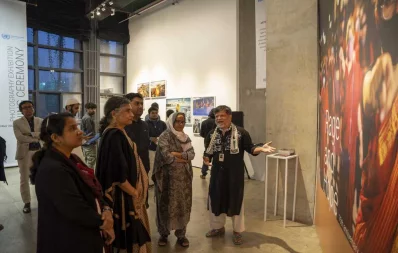
On the 75th anniversary of the Universal Declaration on Human Rights, the Office of the United Nations Resident Coordinator in Bangladesh (UNRC) and the Drik Picture Library jointly organized a photography exhibition titled “Rage and Hope”.

An opening program of the photo exhibition was held on Thursday. The exhibition will be open to the public from 3pm-8pm daily till December 18, 2023.

Afroza Islam Akhi, the coordinator of Mayer Dak, photographer and coordinator of Bangladesh Garments Worker Solidarity Taslima Akhter, Senior Human Rights Adviser of UNRC, Photographer and the Managing Director of Drik Shahidul Alam attended the opening program. 

The program was hosted by the Curator ASM Rezaur Rahman.

Representatives of the Office of the United Nations Resident Coordinator in Bangladesh (UNRC) and the Drik Picture Library look at photos at the opening of a photography exhibition titled “Rage and Hope” on Thursday, December 14, 2023. Photo: Dhaka Tribune “}”>Representatives of the Office of the United Nations Resident Coordinator in Bangladesh (UNRC) and the Drik Picture Library look at photos at the opening of a photography exhibition titled “Rage and Hope” on Thursday, December 14, 2023. Photo: Dhaka Tribune

Shahidul Alam said: “The exhibition features pictures that are challenging to capture. I appreciate the photographers for their courage. The images depict not only human rights violations but also include some uplifting moments. We all aspire to overcome these challenges, despite the arduous and lengthy journey ahead.”

Huma Khan said: “Equality among all humans is a distant reality, but we are committed to the long journey towards that goal. Our dedication lies in working for the rights of the people of Bangladesh. We embrace diverse opinions and various ways of thinking.”

Taslima Akhtar said: “The images presented here offer a distinct perspective on the UN concept of human rights for individuals as human beings and citizens. In reality, we are living in fear of violence, disappearance, and the inability to express ourselves. Currently, the ordinary citizens and workers of the country are experiencing a suffocating situation, and we yearn to break free and breathe openly.”

Afroza Islam Akhi said: “We are all aware of the current stifling situation in Bangladesh. The families of every missing person, along with their loved ones, endure profound suffering daily. However, there is hope as many individuals, including myself, who once led secluded lives, are now protesting and voicing our concerns on the streets. Currently, in response to international pressure, the government resorts to suppressing dissent through public arrests and disappearance cases, rather than addressing the underlying issues of disappearances and murders. We demand justice for all these activities.”

Mahmud Hossain Apu, on behalf of the photographers who participated in the exhibition, said: “We have many photos that cannot be printed in the newspaper as a photojournalist. In such cases, there requires more such events where we can showcase our work.”

The exhibition features 29 photographs, an audio installation, and one video installation on human rights from the last four decades, covering border killings, tea plantation workers’ movements, protests on violence against women, movements for democracy, victims of the legal process, and judicial harassment, justice, extraneous killings, structural discrimination, movement to protect nature, workers’ working environment and other incidents.

On December 10, 1948, the draft resolution of the Universal Declaration on Human Rights was approved by the United Nations General Assembly in Paris which has since been considered as the general standard of human rights for all nations and cultures worldwide.

It was the result of the experience of the Second World War. With the creation of the United Nations, the international community promised to never repeat this type of brutality. 

In a Neighborly Portrait Series, Ashraful Arefin Turns His Gaze Toward Four-Legged Passersby

In a Neighborly Portrait Series, Ashraful Arefin Turns His Gaze Toward Four-Legged Passersby

All images © Ashraful Arefin, shared with permission

In Animals from the streets, photographer Ashraful Arefin takes a moment to greet the furry creatures that join the hustle and bustle of the city. Taken during the last few years in cities like Kolkata, Delhi, Jaisalmer, Kathmandu, Dubai, and Dhaka, where Arefin is based, the portraits are dreamlike and neighborly, glimpsing the mundane goings on of cats, rhesus monkeys, and cows sunbathing or lumbering through small thoroughfares. Arefin takes a friendly approach to documenting his subjects, framing them like any other passerby wandering through the streets.

View the entire series on Behance, and follow Arefin on Instagram to keep up with his latest projects.


a cow licks its own face while walking down the street

a white cat looks at the camera

a monkey sits peacefully on a stone

a monkey sits on a concrete block

a cow with horns is in the center of the frame with blurred people in the background

a small cat sits in front of fringed textiles

two cows lie down in the street

Do stories and artists like this matter to you? Become a Colossal Member today and support independent arts publishing for as little as $5 per month. The article In a Neighborly Portrait Series, Ashraful Arefin Turns His Gaze Toward Four-Legged Passersby appeared first on Colossal.

A Luxury Villa + Artist Residency Offers Escape in the Tuscan Countryside

A Luxury Villa + Artist Residency Offers Escape in the Tuscan Countryside

Villa Lena is a countryside boutique resort and artist residency located in Tuscany, Italy, founded in collaboration by contemporary art collector Lena Evstafieva, her musician husband Jérôme Hadey, and Lionel Bensemoun, founder of Le Baron. Villa Lena is discreetly nestled within 500 hectares of lush woodlands, sprawling vineyards, bountiful olive groves, and flourishing organic vegetable gardens.

At its core, a 19th-century villa, originally constructed for an Italian aristocratic family, now serves as the headquarters for the Villa Lena Foundation and its artist-in-residence program. Encircling the villa, meticulously restored historic agricultural structures – formerly farmhouses, stables, and hunting lodges – offer self-contained guest apartments and shared amenities.

The essence of Villa Lena revolves around fostering creativity and collaboration through a diverse range of activities and events. These include artists’ discussions, family-friendly pursuits, open-air film screenings, cooking workshops, candlelit concerts, and poolside DJ sessions. Each evening, both guests and resident artists convene in the terrace restaurant for a communal dining experience that centers around a seasonal organic menu deeply rooted in Italian cuisine.

Guestroom at Villa Lena, shot of reception

Guestroom at Villa Lena, shot of main reception and lounge

Guestroom at Villa Lena, shot of bed and bench

Guestroom at Villa Lena, shot of bed and window

Guestroom at Villa Lena, shot of bed and bathroom

Guestroom at Villa Lena, shot of writing desk

Guestroom at Villa Lena, shot of bathroom bathtub

Guestroom at Villa Lena, shot of bathroom

Photography by Henrik Lundell.

Leo Lei translates his passion for minimalism into his daily-updated blog Leibal. In addition, you can find uniquely designed minimalist objects and furniture at the Leibal Store.

The Kranzberg’s ‘In Place of Context’ exhibition explores the expressive power of architecture

The Kranzberg’s ‘In Place of Context’ exhibition explores the expressive power of architecture


Konchel_Ken_7.jpg

Photo by Ken Konchel


Architecture, according to photographer Ken Konchel, is not a dismissible backdrop to our daily lives – it’s a dynamic force that shapes our society, connects our past and defines our relationships. “In Place of Context,” Konchel’s newest exhibition at The Kranzberg Arts Foundation, invites viewers to reconstruct their view of the world around them through a close examination of the fundamental elements of architecture – shape, line, pattern, tone and texture – and appreciate the integral aspects of their existence which can often be taken for granted. The exhibition, shown from Dec. 1, 2023, to Jan. 27, 2024, promises compositions that stretch beyond immediate recognition and introduces audiences to intriguing visual possibilities that transform the buildings, and world, around them.

Congratulations on “In Place of Context.” Can you share the inspiration behind the title and what it signifies in the larger context of your work?

People are also reading…


Konchel_Ken_2.jpg

Photo by Ken Konchel


“The name of the exhibition emerges from my intention to make compelling photographs that remove the context and distill architecture to nothing but relationships with shape, line, pattern, form, detail, tone and texture. I used to create more representational work, but I found more fulfillment in taking detailed shots of buildings to create compositions that don’t immediately reveal themselves as architecture. I like to take detailed images of architecture up close, so audiences can’t quite recognize the building right away and view it from a perspective they may not have considered before.”


Facets-1.jpg

Photo by Ken Konchel


Your photography often involves using unusual vantage points and spatial ambiguities between buildings. How do you choose these perspectives, and what role does the viewer’s interaction with space play into your artistic vision?

“I’ve been shooting in St. Louis for a long time; years ago, I began documenting the architecture of other cities. At this point, I’m up to 19 cities in addition to St. Louis. What I typically do is called ‘scouting for an image,’ which is where I’ll walk around a building that I find intriguing to determine the composition that would be most compelling. I evaluate potential shots that explore the angles, cubes, curves, triangles and other shapes of the building to challenge and captivate people by introducing them to different visual possibilities in architecture.”

Your photographic style involves precise calibration of lines, shapes and forms. Can you elaborate on the meticulous process behind achieving this precision, and the visual impact it has on your work?

“I shoot silver gelatin photography and darkroom photography. I use a four-by-five-inch negative to take the photographs, so I don’t have the luxury of taking 50 pictures. I have to be very careful about getting the picture right the first time with the film I’m using – it’s a very deliberate process. That means that none of my images are manipulated like you can do with a digital camera. It’s very challenging to take photographs of buildings where there are trees, powerlines or anything obstructing my ability to get a good view of the subject matter that I want to shoot. I feel proud that I’m able to do that without photoshopping my photographs.”


Delineation-1.jpg

Photo by Ken Konchel


How do you hope viewers will perceive and interact with your photographs in this exhibition?

“One of my goals is to help people appreciate architecture. Architecture gives us a sense of place and identity, it enhances and advances our creative legacy, and it contributes immeasurably to our quality of life. But so often it’s dismissed as mundane and taken for granted. My ambition is to raise awareness and an appreciation for it. When people look at my work and say, ‘I’ve seen this building before, but I’ve never seen it in this particular way,’ that’s a real compliment to me.”

Looking ahead, what artistic endeavors or themes are you excited to explore?

“I typically travel in the spring and fall to photograph because those are seasons when the lighting conditions are ideal for photographing architecture. I’m hoping to go to Washington D.C. next spring to document [its] architecture, so I’m looking forward to that.”

Ken Konchel, kenkonchelphoto.com

Kranzberg Arts Foundation, kranzbergartsfoundation.org

#lee-rev-content { margin:0 -5px; }
#lee-rev-content h3 {
font-family: inherit!important;
font-weight: 700!important;
border-left: 8px solid var(–lee-blox-link-color);
text-indent: 7px;
font-size: 24px!important;
line-height: 24px;
}
#lee-rev-content .rc-provider {
font-family: inherit!important;
}
#lee-rev-content h4 {
line-height: 24px!important;
font-family: “serif-ds”,Times,”Times New Roman”,serif!important;
margin-top: 10px!important;
}
@media (max-width: 991px) {
#lee-rev-content h3 {
font-size: 18px!important;
line-height: 18px;
}
}

#pu-email-form-breaking-email-article {
clear: both;

background-color: #fff;

color: #222;

background-position: bottom;
background-repeat: no-repeat;
padding: 15px 0 20px;
margin-bottom: 40px;
border-top: 4px solid rgba(0,0,0,.8);
border-bottom: 1px solid rgba(0,0,0,.2);

display: none;

}
#pu-email-form-breaking-email-article,
#pu-email-form-breaking-email-article p {
font-family: -apple-system, BlinkMacSystemFont, “Segoe UI”, Helvetica, Arial, sans-serif, “Apple Color Emoji”, “Segoe UI Emoji”, “Segoe UI Symbol”;
}
#pu-email-form-breaking-email-article h2 {
font-size: 24px;
margin: 15px 0 5px 0;
font-family: “serif-ds”, Times, “Times New Roman”, serif;
}
#pu-email-form-breaking-email-article .lead {
margin-bottom: 5px;
}
#pu-email-form-breaking-email-article .email-desc {
font-size: 16px;
line-height: 20px;
margin-bottom: 5px;
opacity: 0.7;
}
#pu-email-form-breaking-email-article form {
padding: 10px 30px 5px 30px;
}
#pu-email-form-breaking-email-article .disclaimer {
opacity: 0.5;
margin-bottom: 0;
line-height: 100%;
}
#pu-email-form-breaking-email-article .disclaimer a {
color: #222;
text-decoration: underline;
}
#pu-email-form-breaking-email-article .email-hammer {

border-bottom: 3px solid #222;

opacity: .5;
display: inline-block;
padding: 0 10px 5px 10px;
margin-bottom: -5px;
font-size: 16px;
}
@media (max-width: 991px) {
#pu-email-form-breaking-email-article form {
padding: 10px 0 5px 0;
}
}
.grecaptcha-badge { visibility: hidden; }

Captain America: Brave New World | New writer hired and additional photography planned for 2024

Captain America: Brave New World | New writer hired and additional photography planned for 2024

With the breathing room given by its delay to 2025, the next Captain America film is going through a few changes before it arrives in cinemas.


Marvel Studios are looking to have an interesting 2024.

With just one film coming out of the studio for the first time since 2010 (when Iron Man 2 arrived as the MCU was still finding its feet), from the outside it looks like Feige and co. are pulling the breaks on the ‘content’ machine a little bit.

What’s more, that one 2024 film is Deadpool 3 – and it’s currently pretty unclear how tied the famously off-beat antihero will tie into the wider MCU.

Though Thunderbolts and Captain America: Brave New World were originally scheduled for next year (on 20th December and 26th July respectively), both have since been moved back into 2025. Given the grumblings about superhero fatigue and poor box office numbers that have plagued almost every comic book movie released this year, that bit of extra space might not be such a bad thing.

Seemingly on that note, Marvel Studios has brought a new writer, Moon Knight producer Matthew Orton, onto the next Captain America movie, with additional photography now planned for the middle of 2024 (according to Deadline).

While it’s not at all uncommon for Disney to chop, change and reshoot bits of their blockbusters right up until release, it does feel like the six-month delay to Marvel Studios’ upcoming slate might have given them the chance to course correct after a largely disappointing year for MCU fans.

The fourth Captain America movie is currently slated as the last film of Marvel’s ‘Phase Five’, and Anthony Mackie’s first standalone film as the star-spangled man after taking over the mantle in The Falcon And The Winter Soldier. If everything goes according to plan, it’ll be in cinemas on the 14th of February 2025 (oh Marvel, you old romantic).