About

Posts by :

UWinnipeg launches research photography competition | University of Winnipeg News

UWinnipeg launches research photography competition | University of Winnipeg News

Calling all shutterbugs! The University of Winnipeg Research Office is excited to launch its first research photography competition.

Research in Focus is open to all UWinnipeg students, faculty, staff, retirees, and alumni.

“I am so excited to see Research in Focus submissions roll in,” said Dr. Jino Distasio, Vice-President of Research and Innovation. “This competition is an opportunity to share research from a vantage point we don’t often get to see on a larger scale. I suspect there will be a tremendous response to this competition, one that we can all celebrate together while featuring the incredible work that is done at UWinnipeg by faculty, students, staff, and alumni.”

Research in Focus is a chance to take viewers into the field, inside the lab, or onto the stage to visualize what researchers have witnessed, discovered, or created as they pursue academic excellence.

The competition will also serve as a reminder of the breadth and depth of research carried out by the UWinnipeg community.

Submissions are being accepted online now through February 7, 2024 in five main categories:

  • Artistry in Research: Images which represent the researcher’s work in music, drama, visual art, art history, and the humanities.
  • Community Catalysts: Images which demonstrate community impact or which represent research done with partners to benefit communities.
  • Faces of Discovery: Images which depict the people involved in research activities.
  • Fieldwork Frontiers: Images which demonstrate fieldwork.
  • Powered Perception: Images which reveal the subject in greater detail than is possible with the human eye, such as x-rays, microscopic images, computer models, drone photographs, etc.

A multidisciplinary jury will review the anonymized submissions in these five categories and judge their aesthetic appeal, creativity, and insight.

One winner and one runner-up will be chosen from each of the five main categories, as well as a grand prize winner. The grand prize winner will receive $500. Each of the five category winners will receive $300 and runners-up will receive $200.

The winner and runner-up in a sixth category, Viewer’s Choice, will be determined by public voting from February 12 to 25. A seventh and final category, Best Description, will celebrate the photograph with the best accompanying written description.

Winners will be announced during the 2024 Three-Minute Thesis competition on March 1 and will be displayed on campus and online.

All photos must be original work, taken by the entrant, and depict UWinnipeg-affiliated research. Entrants can submit up to one photo per category. A full list of contest rules is available in our Terms of Reference.

Photographers Warned They Could Be Sued for Grinch-Themed Shoots

Photographers Warned They Could Be Sued for Grinch-Themed Shoots

photographers warned grinch photoshoots lawsuits copyright infringement trademark dr seuss

Photographers have been warned about doing Grinch-themed photo shoots over the holidays due to “serious trademark infringement issues.”

Alongside traditional Santa photo sessions, Grinch-themed shoots are also popular among photographers during the Christmas period. However, photographers could allegedly risk being sued over this by Dr. Seuss Enterprises.

According to a report by Louisiana radio station 97.3 The Dawg, a social media post which cautioned photographers that using the Grinch theme for a shoot could attract legal action from Dr. Seuss Enterprises went viral among the lens community.

‘Protecting Photographers’

In the Facebook post, which amassed over 25,000 likes and 32,000 shares, Tennessee-based photographer Brittany Kay Photography reminded her followers that she would not be doing the Grinch-themed shoots over the holidays.

“Friendly reminder that doing Grinch photo sessions for a profit is a federal trademark infringement, and Dr. Seuss Int. literally hires out a team this time of year to reverse image search and sue photographers for profit,” Kay writes.

“So unless you got $120,000 for a license, that’s not a lawsuit you will win!

“This isn’t me trying to be a buzzkill. This is me just trying to protect newer photographers that aren’t aware of the situation.”

‘Cease and Desist Letters to Photographers’

As 97.3 The Dawg reports, Brittany Kay Photography provides no specific data on the likelihood of a photographer being sued by Dr. Seuss Enterprises.

However, according to an extensive report from TheLawTog.com which is cited by the radio station, Dr. Seuss Enterprises’ corporate counsel, Nicole Gates, reportedly sent cease and desist notices to infringing photographers who did Grinch-themed shoots.

And in 2019, PetaPixel covered an incident when Dr. Seuss Enterprises purportedly went on the offensive, sending an aggressive cease and desist letter to a photographer after their Grinch-themed holiday photo shoot went viral.

[embedded content]

While TheLawTog.com, a resource dedicated to legal issues in photography, reported that it could not fully verify the legitimacy of these notices from Gates — they do reportedly align with standard legal practices in such cases.

When a photographer uses images from Grinch sessions for advertising purposes, this supposedly not only constitutes copyright infringement of the original photographer’s work but also risks infringing upon the intellectual property rights associated with the Grinch character.

TheLawTog.com describes how copyright protects artistic works, and trademark laws protect brand identities, like logos and names, from being used in a manner that causes consumer confusion. For photographers, using the Grinch character or even the term “The Grinch” in marketing or sales could be seen as a violation of these laws.


Image credits: Header photo licensed via Depositphotos.

Giorgio Armani celebrates the sensual, timeless photography of Aldo Fallai

Giorgio Armani celebrates the sensual, timeless photography of Aldo Fallai

When Giorgio Armani emerged to prominence in 1970s Italy, he proposed a new way of dressing. It was epitomised by his riff on the suit jacket: stripping away its previously rigid structure and synonymy with stuffy formality, his take was defined by a languid elegance, unstructured in design and made to release the body from restriction. Such a philosophy has followed him throughout his career, across both his eponymous label and its various offshoots, including Emporio Armani. ‘It gives presence, stature and dignity,’ he told Wallpaper* of the tailored jacket in a conversation with Paul Smith. ‘And it is one piece: you attain more with less.’

In Florentine photographer Aldo Fallai – who he met when Fallai was still a graphic designer in Milan in the early 1970s – Mr Armani would find a natural ally. In 1977, they worked together for the first time; the resulting collaboration, which would span three decades, saw them refine a vision, particularly of masculinity, which was both widely influential and decidedly Armani. Rigorous in composition, yet imbued with a feeling of sensuality – often the images would celebrate the beauty of the human form – the photographs they produced together continue to define the spirit of the house today. 

Armani Aldo Fallai Exhibition

Armani Jeans S/S 1981 

(Image credit: Photography by Aldo Fallai)

Armani Aldo Fallai Exhibition

Emporio Armani A/W 1994 

(Image credit: Photography by Aldo Fallai)

And now, in Mr Armani’s Milanese hub and exhibition space, Armani/Silos, the designer pays ode to Fallai with a monographic exhibition of the photographer’s work, spanning 1977-2021 (until 11 August 2024). Curated by Mr Armani, his sister Rosanna Armani and Leo Dell’Orco, head of men’s collections, the wide-ranging exhibition celebrates what the designer calls an ‘artistic dialogue’, one largely led by an instinctual connection between the pair. Said to have been inspired by a melange of influences – from Tuscan mannerism and Caravaggio’s chiaroscuro to the pre-Raphaelites – Fallai’s evocative subjects include a man grasping a tiger cub under his arm (photographed in a circus in Palermo), couples in embrace or amid ruffled bedsheets, or model Antonia Dell’Atte playing a career woman on the Milanese street of Via Durini for a campaign in the 1980s.

‘Working with Aldo allowed me from the very beginning to transform the vision I had in my mind into real images: to communicate that my clothes were not just made in a certain way with certain colours and materials, but that they represented a way of life,’ says Mr Armani.

Armani Aldo Fallai Exhibition

Giorgio Armani A/W 1984-85

(Image credit: Photography by Aldo Fallai)

Armani Aldo Fallai Exhibition

Emporio Armani S/S 1993

(Image credit: Photography by Aldo Fallai)

‘Because style, for me, is a total form of expression. Together, with a constant fluid and concrete dialogue, we created scenes of life, evoked atmospheres and sketched portraits full of character. Today, looking back at everything we did, I myself am struck by the power that these shots still emanate, and by Aldo’s great ability to capture the nuances of personality.’

‘My work with Giorgio was the result of a natural, continuous dialogue and great trust on his part,’ adds Fallai. ‘I have vivid memories of our 30-year collaboration. Production was always agile and streamlined: we achieved the results with little means and no special effects. This, I think, appealed to the public.’ 

Aldo Fallai per Giorgio Armani, 1977-2021, open now until 11 August 2024.

Ticket are available here.

Watch the FAV-LE22 Fluid Audio Visualizer Turn Music Into Movement

Watch the FAV-LE22 Fluid Audio Visualizer Turn Music Into Movement

Nanoscale ferromagnetic particles are a truly strange substance. Suspended in an oily fluid, the particles can be made to “dance” under the influence of a strong magnetic source, spasming and gesticulating wildly with movements that almost seem alive. Korean artist and designer Dakd Jung uses the substance to impart his creation, the FAV-LE22 Fluid Audio Visualizer with a mesmerizing and otherworldly level of interactivity to add another dimension to music.

Originally developed by NASA in the 1960s, nanoscale ferromagnetic particles were first used for fuel transport in zero-gravity space, spacecraft, and sealing connections in space suits. Jung notes the substance was also suited as a damper for high-end speakers, alongside use in rotating shafts for motors, and for gas sealing.

“While researching ferrofluids, I discovered their interesting movement and prototyped ferromagnetic particles to respond to music,” explains Jung, “Immediately after posting the production video on social media and overseas community websites, the video spread quickly, and I noted how many people liked it.”

Small square-shaped white audio device with small circular window containing a globule of nanoscale ferromagnetic particles designed to move in relation to music set own top of a glossy white table top desk, surrounded by a pair of monitor speakers, desk lamp, books and other indeterminate objects. Backdrop of large windows in background.

Flooded with requests about collaborative opportunities and custom production designs, the artist/designer went to further develop the design into a production model. Thus began the development of the BurnSlap FAV-LE22 Fluid Audio Visualizer.

Top detail of the speaker grill of the square-shaped white audio device with small circular window containing a globule of nanoscale ferromagnetic particles designed to move in relation to music.

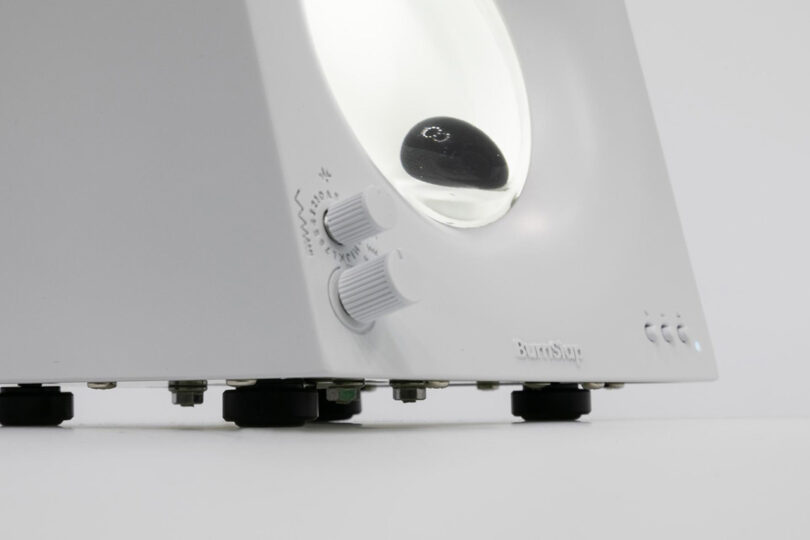
Lower half of the FAV-LE22 Fluid Audio Visualizer's control knobs and circular window showing the globule of nanoparticles at rest.

The biggest challenge proved to be keeping the ferrofluid from sticking to glass. “It is very tricky to keep the ferrofluid from sticking to the glass bottle,” explains the designer. “Most of the existing cheap magnetic fluid toys are difficult to use because the magnetic fluid easily sticks to the glass bottle or the magnetic fluid changes after a certain period of time.” He’d go onto develop a special proprietary glass surface processing technology that prevents magnetic fluid from sticking to the glass surface before moving onto developing the hardware circuit design and software algorithm to make the substance dance.

Detail view of the rear ports and power plug of the FAV-LE22 Fluid Audio Visualizer, alongside its feet stand.

The eventual fruit of his efforts, the FAV-LE22 visualizer, is outfitted with modest 5W speakers and can also be connected for pass-through for more robust audio playback support.

[embedded content]

Unsurprisingly, all of the attention online has made the $985 FAV-LE22 a very popularly sought-after device. Currently sold out with the first batch of visualizers shipped in late November, the designer will hopefully restock soon to bring the magnetic personality of his creation to more admirers.

Gregory Han is a Senior Editor at Design Milk. A Los Angeles native with a profound love and curiosity for design, hiking, tide pools, and road trips, a selection of his adventures and musings can be found at gregoryhan.com.

Watch the FAV-LE22 Fluid Audio Visualizer Turn Music Into Movement

Watch the FAV-LE22 Fluid Audio Visualizer Turn Music Into Movement

Nanoscale ferromagnetic particles are a truly strange substance. Suspended in an oily fluid, the particles can be made to “dance” under the influence of a strong magnetic source, spasming and gesticulating wildly with movements that almost seem alive. Korean artist and designer Dakd Jung uses the substance to impart his creation, the FAV-LE22 Fluid Audio Visualizer with a mesmerizing and otherworldly level of interactivity to add another dimension to music.

Small square-shaped white audio device with small circular window containing a globule of nanoscale ferromagnetic particles designed to move in relation to music.

Originally developed by NASA in the 1960s, nanoscale ferromagnetic particles were first used for fuel transport in zero-gravity space, spacecraft, and sealing connections in space suits. Jung notes the substance was also suited as a damper for high-end speakers, alongside use in rotating shafts for motors, and for gas sealing.

“While researching ferrofluids, I discovered their interesting movement and prototyped ferromagnetic particles to respond to music,” explains Jung, “Immediately after posting the production video on social media and overseas community websites, the video spread quickly, and I noted how many people liked it.”

Flooded with requests about collaborative opportunities and custom production designs, the artist/designer went to further develop the design into a production model. Thus began the development of the BurnSlap FAV-LE22 Fluid Audio Visualizer.

Top detail of the speaker grill of the square-shaped white audio device with small circular window containing a globule of nanoscale ferromagnetic particles designed to move in relation to music.

Lower half of the FAV-LE22 Fluid Audio Visualizer's control knobs and circular window showing the globule of nanoparticles at rest.

The biggest challenge proved to be keeping the ferrofluid from sticking to glass. “It is very tricky to keep the ferrofluid from sticking to the glass bottle,” explains the designer. “Most of the existing cheap magnetic fluid toys are difficult to use because the magnetic fluid easily sticks to the glass bottle or the magnetic fluid changes after a certain period of time.” He’d go onto develop a special proprietary glass surface processing technology that prevents magnetic fluid from sticking to the glass surface before moving onto developing the hardware circuit design and software algorithm to make the substance dance.

Detail view of the rear ports and power plug of the FAV-LE22 Fluid Audio Visualizer, alongside its feet stand.

The eventual fruit of his efforts, the FAV-LE22 visualizer, is outfitted with modest 5W speakers and can also be connected for pass-through for more robust audio playback support.

[embedded content]

Unsurprisingly, all of the attention online has made the $985 FAV-LE22 a very popularly sought-after device. Currently sold out with the first batch of visualizers shipped in late November, the designer will hopefully restock soon to bring the magnetic personality of his creation to more admirers.

Gregory Han is a Senior Editor at Design Milk. A Los Angeles native with a profound love and curiosity for design, hiking, tide pools, and road trips, a selection of his adventures and musings can be found at gregoryhan.com.

Photos: Missoulian photographers’ photos of the week

Photos: Missoulian photographers’ photos of the week
image

From left, artist Lily Luna Bennett, Allez! gallery co-owner Karen Sippy, artist Lily Kip, artist Jules Lucero, Allez! co-owner Brian Sippy and University of Montana art professor Kevin Bell on Thursday night help set up the alleyway gallery’s newest mural project, “New Perspectives: Art at UM,” which will showcase work by current UM art students and recent graduates in the School of Visual and Media Arts. The alleyway mural gallery is part of a new collaboration with the university.

Hélène Amouzou review – spectral self-portraits of a soul in torment

Hélène Amouzou review – spectral self-portraits of a soul in torment

Hélène Amouzou’s story is hard to stomach. She was forced to flee her home country, Togo, in 1992, as years of political turbulence erupted into protests and violence. Her husband’s political affiliations put them in danger – they, like hundreds of thousands of Togolese, ended up in Benin, Toga’s eastern neighbour. From there, the couple and their infant daughter went to Germany to seek asylum, but soon after their arrival, found their name on a deportation list. When Amouzou’s husband went to attend a registration appointment, he never returned. Amouzou and her young daughter went into hiding.

Amouzou eventually returned to Benin to search for her husband, not realising the German government had sent him back to Togo. In the autumn of 1997, she decided to return to Europe, but this time to Brussels. She began again, building a life from scratch, without her husband. But for almost two decades, Amouzou lived without any official status – that hellish loop that forces immigrants to live in intolerable conditions, tormented by bureaucracy. She eventually became a Belgian citizen in 2015.

Amouzou took photographs throughout. In a small but sublime solo show at Autograph in London, aptly titled Voyages, we see her becoming and growing as an artist, going from her first camera, a classic 35mm Canon AE-1, and later a medium format Rolleicord.

Self-portraits that all but obliterate the self … from the series Autoportrait, Molenbeek, 2007-2011.

Voyages is focused around a series of self-portraits taken in the decrepit, abandoned attic of the building Amouzou lived in, in the Molenbeek area of Brussels, from 2007 to 2011. In many, Amouzou is barely there – a ghostly blur, the result of experimenting with long exposures of more than a minute, while she moved around in the frame. These are self-portraits that all but obliterate the self, reducing it to only a thin image on a peeling wall. In this cold and uninviting space, Amouzou drifts in and out of the frame, clothed and nude, always alone, save for a suitcase. Unwittingly, her self-portraits are reminiscent of Francesca Woodman’s, though Amouzou was not aware of Woodman when she started. Yet they share a sensibility: in a world that didn’t see them, both are trying to figure out whether they are really there or not.

The exhibition spans 15 years of Amouzou’s life, but time slips away – lost or stolen? – in the photographs. Amouzou is still in the attic, with the same symbolic suitcase, the bag that is always packed and ready should she need to leave at short notice once again. In a pair of pictures, also blown up to larger-than-life size, the artist sits on top of her suitcase, fixing the camera with a deep stare. In the next picture, the identical scene appears – but Amouzou is gone. It is a devastating image that lets you into her despair. It is like a scream, piercing but silent.

‘Photography has helped me’ … Hélène Amouzou.

“Photography has helped me,” Amouzou says, “and continues to help me – to escape, to think about something other than my everyday life.” In a more recent self-portrait, shot in colour, she appears in the attic again – but this time resplendent in traditional Togolese dress, seated on a coral-hued chaise longue, her whole figure visible and in focus. It is no surprise to learn the photograph was taken after Amouzou gained citizenship. It is a statement about the reclamation of identity, about confidence, but it also shows Amouzou’s ability to shift to formal portraiture. It’s a world away from the earlier photographs.

The self-portraits, all exquisitely handprinted by Amouzou, represent a significant chapter in Amouzou’s life, moving from an atmosphere of stark oppression to jubilant self-exploration. The works perhaps begin and end with her life experiences, but ultimately shirk them off. Instead, they become lyrical expressions of instability, grief, loss and resilience.

8) Hélène Amouzou, from the series Togo, 2011.

There are glimpses, too, of the outside world beyond the privacy and safety of the attic – such as a clutch of photographs taken during a trip to Togo in 2011, when the artist was at last able to return to visit her mother after 20 years. In one image, a hand extends across the frame, towards a beach, where tents are pitched in the background. The ocean curls on the shore. Home is there – but it is still beyond reach, as flimsy as the canvas of these temporary structures, dwarfed by the infinity of the ocean.

Home cannot be grasped or held. Memories with loved ones cannot be remade. Amouzou tries to repair lost time with photography, in a solemn portrait with her mother. This woman, now elderly, is seated as her daughter, now a mother too, stands by her side. It is a formal portrait, not the typical image of the long-awaited reunion. The faces of two women are etched with the exile that has kept them apart. Their gaze is penetrating, hard to shake off, long after I’ve left the gallery.

In an interview with Bindi Vora, the exhibition curator, Amouzou says: “I look at my passport and identification cards and sometimes think, ‘All my life for this.’ I don’t think I could do this again.”

Jury Awards Architecture Photographer $6.3 Million in Copyright Infringement Case

image

Business

Scott Hargis Photo Vs. Pacifica Senior Living has wound its way through California’s Central District court system and the result is a massive victory for photographers everywhere. The damages award is one of the largest ever recorded for a photographic copyright infringement case.

Scott Hargis Photo Vs. Pacifica Senior Living began as a routine infringement case that escalated when the infringing party refused to offer a settlement. The 43 images in question were used by the infringing party without a license agreement, and after surviving multiple lines of argument from the defendants claiming that there was no infringement, a jury found every image in question to be a willful infringement, awarding Hargis the maximum $150,000 per image allowed by law.  

There are three categories of infringement: innocent, non-willful, and willful, and each category can be awarded a different range of statutory damages depending on the degree of severity that a judge or jury perceives. The penalty for a willful infringement of a timely-registered image ranges from $30,000 to $150,000 each. Clearly, the jury intended to send a very clear message with this verdict.

This verdict further solidifies the importance of timely registration of photographs with the United States Copyright Office and the importance of diligently tracking usage and licensing.

This case is a victory for photographers and creatives everywhere, and will go a long way towards making potential infringers reconsider their actions in the future. There likely isn’t a single photographer reading this who has not had their work infringed one way or another (whether or not they know it) – and if it hasn’t happened yet, it absolutely will over the course of a photographer’s career; It’s part and parcel of working in this field. 

During a brief interview, Hargis mentioned that he was ‘thrilled’ with the result and that he ‘hadn’t quite processed it yet’. The toll that a case this size can take on one’s psyche cannot be overstated, and I am sure we will learn more details as more news and interviews are released. 

Remember, if your photographs are registered with the USCO, you have many options in an infringement situation. While this is an issue that photographers face every single day, you have recourse if you take the simple steps of registering your photographs. It is personally something that I do four times a year – once a quarter – to ensure that I am staying current with registrations and that I have a leg to stand on when my work is infringed.

Indigenous Weaver Naiomi Glasses Is Ralph Lauren’s First Artist In Residence

Indigenous Weaver Naiomi Glasses Is Ralph Lauren’s First Artist In Residence
Phillip Bread

Phillip Bread

Ryan Redcorn and Darren Sells

“It’s incredible seeing a lot of brands are starting to work with the actual Indigenous artists, instead of pulling inspiration from us,” says Glasses. “It’s beautiful to see that collaboration because you get to see these designs interpreted from these original artists.”

It’s a full-circle moment for Glasses, who often wore Ralph Lauren clothing as a child. Once she and her brother chose to weave full-time, their business-minded parents asked them to come up with some practical goals. She replied that she’d like to one day make floor rugs, blankets and clothing with Diné designs. Asked to write down which brands she wanted to collaborate with, she put Ralph Lauren at the top of the list. Seeing her name on the tags beside Ralph Lauren’s is completely unreal, she says. “There are no words to describe it.”

On a video call ahead of the launch, Glasses wears a multitude of turquoise and silver jewellery pieces – they appear on her fingers, earlobes and scarf – representing each of the seven Navajo and Hopi artist families whose jewellery she curated for the collection’s campaign. A selection of their handcrafted pieces was used to style the capsule and will also be available for purchase.

Quannah Chasinghorse

Quannah Chasinghorse

Ryan Redcorn and Darren Sells

Phillip Bread

Phillip Bread

Ryan Redcorn and Darren Sells

“I wanted to lift up other Indigenous artists along with me because this is going to be a huge release,” she says. “It’s a big platform, and I would love to be able to share that along with others.”

Jean Jullien Designs a Cheery Whale Sculpture with a Functional Blowhole

Jean Jullien Designs a Cheery Whale Sculpture with a Functional Blowhole

All images courtesy of Case Studyo

French artist Jean Jullien (previously) has teamed up with Case Studyo to create a jolly sculpture titled “La Baleine,” a.k.a. “The Whale.” With a functional blowhole that can hold pencils, plants, or flowers, the porcelain vessel features Jullien’s signature chunky line drawings. The wide, toothy grin adds a sense of optimism and goodwill, while the artist likens the blowhole to “an emblem of exhaling and releasing creative energy.”

“La Baleine” is available in an edition of 500 from Case Studyo. Find more from Jullien on Instagram. (via Hypebeast)


a smiling whale sculpture with a plant in the blowhole

a smiling whale sculpture with a drawn plant in the blowhole

a smiling whale sculpture with a plant in the blowhole

a smiling whale sculpture resting atop a box with a drawing of the sculpture on the side

a smiling whale sculpture with a removable blowhole vase


Do stories and artists like this matter to you? Become a Colossal Member today and support independent arts publishing for as little as $5 per month. The article Jean Jullien Designs a Cheery Whale Sculpture with a Functional Blowhole appeared first on Colossal.