About

Posts by :

WayForward Resources hosts Holiday Art Market to fight growing need for food and housing

WayForward Resources hosts Holiday Art Market to fight growing need for food and housing
image

MIDDLETON, Wis. (WKOW) — WayForward Resources organized its annual charity-driven Holiday Art Market this weekend.

Located on Parmenter Street, the market featured over 50 artists with a variety of crafted goods. 

Over 20 percent of profits were directed towards the growing need for food assistance. 

According to Dana Monogue, school superintendent and WayForward Resources board of directors member, there has been a “200 percent increase in families seeking food assistance.”

Monogue revealed that this has been the largest jump in demand that the organization has seen. 

But for Monogue and the other organizers, the event is about more than just raising funds.

“It’s a wonderful way for us to promote what WayForward Resources does as an organization … at a time where we’ve seen unprecedented need,” she said.

For the vendors, the market is a great opportunity to feature their crafts in a meaningful way. 

Betsy Nordstrom is a volunteer for ReMitts, an upcycling mitten brand. She discussed how shopping at the market not only supports the WayForward food pantry, but local artists as well.

“The smile you see on the vendor’s face … and the gratitude they have is worth it,” she said.

More information on WayForward Resources can be found on their website.

WWE Live Holiday Tour at the PPL Center in Allentown | Photography by Diane Fleischman & Review by Janel Spiegel

WWE Live Holiday Tour at the PPL Center in Allentown   |   Photography by Diane Fleischman & Review by Janel Spiegel
en flag
es flag

Photography by Diane Fleischman & Review by Janel Spiegel

WWE Live Holiday Tour

Saturday, December 2, 2023

7:30PM

PPL Center – WWE LIVE

ALLENTOWN!!! Allentown, PA. I’m proud of us. Tonight was quite a night. I wound up at the Allentown Christmas Tree Lighting which was beautiful. Lots of vendors, great food, the Marines were there, The Allentown Police Department, a variety of food vendors, live music, a horse drawn carriage. The horses are beautiful. So, then after taking the scenic route, I had to get to the PPL Center for the WWE Live Holiday Tour. Did you ever feel the energy and know it was going to a blast before you even arrived at the venue?! That’s how I felt tonight. I knew it was going to be fun. My awesome magical friend Paula went with me. This was her first wrestling event. I think she’s ready for table matches.

Thank you to Kayla and the PPL Center for always including The Valley Ledger. It’s a lot of work on all ends, and we all work together for everything to come to fruition. Tonight was just electrifying. Wrestling is something that tends to mean a lot to so many people. They played videos from the “Then” and the “Now.” I must say back in the day, “Back in the Day,” wrestling was awesome. You had some of the greats. You would hear a note of the entrance music, and people were HYPED, BEYOND HYPED. We sat in an awesome section. It was funny to see the grown-ups just as excited as the kids, if not even more excited. Kofi Kingston showed up, and had the crowd going wild. He brought the chairs, sticks, and tables out. Allentown can handle it. Some people were ready to jump in. Don’t worry.

The first match was between Bayley and Shotzi. They were entertaining, and the crowd was just losing their minds. We also saw a match between the awesome Bobby Lashley, I was fortunate to meet Lashley a few years ago thanks to the incredibly talented Actress, creator, wrestling talent, mom of 10, and wife of the talented writer, Anthony Saint Thomas. I met Lashley through Monique Dupree who is heavily involved in the wrestling world. Lashey is part of All Mighty. We also saw Cameron Grimes, Charlotte Flair who is the daughter of the one and only, Ric Flair, his ICONIC WHOOO’s!!! echoed throughout the PPL Center all night, and made their way outside and well, I was WHOO-ing all the way home at this point. The impact that Ric Flair had on wrestling is undeniable. To see Charlotte Flair stroll out to the ring in her beautiful sparkly red outfit reminds you of Ric Flair’s out of this world, wild and creative antics. Karrion Kross came out with Scarlett. Odyssey Jones helped out Cameron. What a team. Solo Sikoa also appeared, he looked EXTRA serious, and Dragon Lee wrestled. This was so much fun. My friend had a blast. We made some new friends. Shout out to everyone who was chanting with us, yelling, and having a blast.

L.A. Knight and KO (Kevin Owens) the main event, and boy did they deliver. There is nothing more exciting and fun than wrestling. They wrestled against Solo Sikoa, and Jimmy Uso. We hope they come back next year.

Make sure to follow social media on tour and PPLE Center to learn all the amazing events coming up. Thank you, Kayla, The Allentown Police department for helping to keep everyone safe.

https://www.wwe.com/superstars

https://www.pplcenter.com/

5 Ways Smartphone Photography is Changing How We See the World

5 Ways Smartphone Photography is Changing How We See the World
Photo: T.J. Thomson

Smartphones are a staple of modern life and are changing how we see the world and show it to others. Almost 90% of Aussies own one, and we spend an average of 5.6 hours using them each day. Smartphones are also responsible for more than 90% of all the photographs made this year.

But compare the camera roll of a 60-year-old with that of a 13-year-old, as we recently did, and you’ll find some surprising differences. In research published in the Journal of Visual Literacy, we looked at how different generations use smartphones for photography as well as broader trends that reveal how these devices change the way we see the world.

Here are five patterns we observed.

1. We Make Images More Casually and With a Wider Subject Matter

Before the first smartphone camera was released in 2007, cameras were used more selectively and for a narrower range of purposes. You might only see them at events like weddings and graduations, or at tourist hotspots on holidays.

Now, they’re ubiquitous in everyday life. We use smartphones to document our meals, our daily gym progress, and our classwork as well as the more “special” moments in our lives.

A triptych of everyday photos showing a meal, a book, and a bottle of medicine.
In the old days cameras only came out for special occasions, but we now tend to use our smartphones to document a wider range of subject matter, including our most recent meal, something we see and want to add to our shopping wish list, or an item at the shops that we want to confirm with a family member. T.J. Thomson

Many middle-aged people use smartphones most for work-related purposes. One of our participants put it this way:

I often take photos of info I want to save, or of clients’ work when I want to then email it to myself to put on the computer. I feel like I’ve gotten a little slack on socially taking photos of friends … but in the day-to-day, I feel like I use it very practically now for basically work, grabbing a photo to upload it online somewhere.

2. We Aren’t as Selfie-obsessed as Some Would Think

Our participants only used their phone’s front “selfie” camera 14% of the time. They acknowledged the stigma around selfies and didn’t want to be perceived as narcissistic.

3. We’re Seeing More Vertical Compositions

In years past, whether you had a bulky DSLR camera or a lightweight disposable, the “default” grip was to hold it with two hands in a horizontal way. This leads to photos in landscape orientation.

But the vertical design of smartphones and accompanying apps, such as Instagram and Snapchat, are resulting in more photos in portrait orientation. Participants said holding their smartphone cameras this way was more convenient and faster.

Screenshots from Instagram, X, and Snapchat, showing photos with a vertical orientation or portrait aspect ratio.
The vertical design of smartphones and associated popular social media apps, such as Snapchat, Instagram, and X, influences how people use their smartphone cameras. Instagram / X / Snapchat

4. We Like to Keep Our Distance

Participants made more images of people from farther away compared to getting close. Intimate “head and face” framing was only present in fewer than 10% of the images.

In one participant’s words:

I feel like my friends and I get frustrated with parents, when they’re zooming in a photo or they walk in really close. My mom would always get one like right in my face, like this is too close! I don’t want to see this. The zoom in, oh, it’s frustrating!

5. We Get Inspired by What We See Online

Teenagers in particular mentioned social media, especially Instagram, as influencing their visual sensibilities. Older adults were more likely to attribute their sense of aesthetics to physical media, such as photography books, magazines, and posters.

This aesthetic inspiration impacts what we take photos of, and also how we do it. For example, young people mentioned a centered compositional approach most often. In contrast, older generations invoked the “rule of thirds” approach more often.

One participant contrasted generational differences like this:

There seems to be a real lack of interest [by younger people] in say, composition, or the use of light or that sort of aesthetic side of getting an image. When my partner and I were kids […] our access to different aesthetics and images was actually very limited. You had the four channels on TV, you had magazines, you had the occasional film, you had record covers, and that was it, you know. Whereas, kids these days, they’re saturated with images but the aesthetic aspect doesn’t seem to be that important to them.

Why the Way We Make Images Matters

While technology is changing the way people see the world and make photographs, it’s important to reflect on why we do what we do, and with what effects.

For example, the camera angle we use might either give or take away symbolic power from the subject. Photographing an athlete or politician from below makes them look more strong and heroic, while photographing a refugee from above can make them look less powerful.

Two photos: one taken from a low angle looking up at a posing skateboarder, the other taken from a standing height looking down at three people sitting on the ground at the base of a wall.
The vertical camera angle can sometimes be used pragmatically but sometimes connotes symbolic power differences. The low angle of the athlete at left provides more symbolic power than the high angle of the three figures at right. Vladislav Todorov via Unsplash (left) / Aleksandr Kadykov via Unsplash (right)

Sometimes the camera angles we use are harmless or driven by practicality – think photographing a receipt to get reimbursed later – but other times, the angles we use matter and can reinforce existing inequalities.

As the number of images made each year increases and new ways to make images emerge, being thoughtful about how we use our cameras or other image-making technology becomes more important.


The ConversationAbout the author: T.J. Thomson is Senior Lecturer in Visual Communication & Digital Media at RMIT University. Shehab Uddin is Program Director of Higher Degree Research at Pathshala South Asian Media Institute. The opinions expressed in this article are solely those of the author. This article was originally published at The Conversation and is being republished under a Creative Commons license.

Meow Wolf Announces Inaugural Community Grant Awardees

Meow Wolf Announces Inaugural Community Grant Awardees

The Meow Wolf Foundation, a 501(c)3 nonprofit organization, has announced its inaugural Community Grant awardees, which include nine Texas-based organizations.

While Meow Wolf is a Public Benefit Corporation (B Corp) that focuses both on social impact and profit, in 2022 it established The Meow Wolf Foundation as a private charitable foundation. According to the foundation’s webpage, it supports organizations that provide increased access to arts education and training, utilizes arts as a tool to improve mental and emotional well-being, and conduct research and projects focusing on art and creativity as tools to develop innovative solutions.

In a press release, Jose Tolosa, Meow Wolf CEO and board chair of the Meow Wolf Foundation, stated, “As a company founded by artists, that employs artists, and celebrates the inner creative in everyone, Meow Wolf understands firsthand how creativity, imagination, and play can truly transform lives. Meow Wolf launched the Meow Wolf Foundation to deepen our commitment to communities and help amplify the critical work of those using art and creativity to change lives and build thriving creative communities.”

Julie Heinrich, Chief Impact Officer and head of the Meow Wolf Foundation, added, “Art and creativity has too often been seen as a nice-to-have, instead of a must-have. We want to change this conversation. Art and culture organizations typically receive the least amount of philanthropic giving nationally and we think there’s a tremendous opportunity to use art and creativity to heal and transform lives.”

In its inaugural year, the Community Grant program donated a total of $600,000 to 63 organizations in areas where Meow Wolf currently has (or is developing) locations: New Mexico, Colorado, Nevada, and Texas. With Meow Wolf’s The Real Unreal opening earlier this year in Grapevine and a Houston location scheduled to open next summer, the Texas locations are the newest venues. 

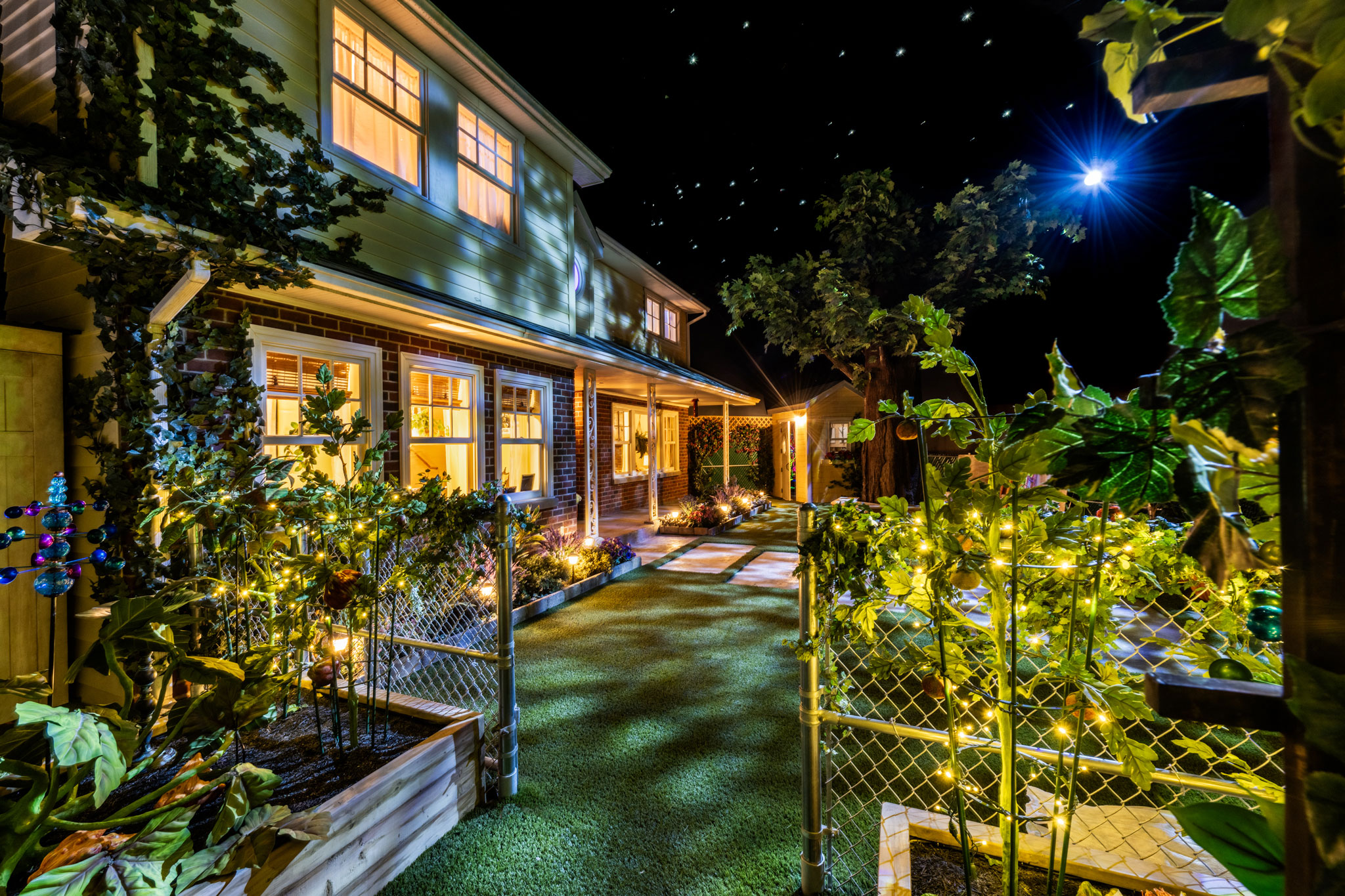
Photo of a lifelike sculpture of the front yard of a home

Exhibition Detail of Meow Wolf Grapevine’s “The Real Unreal,” Photo by Jess Gallo. Photo Courtesy of Meow-Wolf.

The Texas grant recipients include Cara Mia Theatre, Dallas Art Therapy, Spark! Dallas, Forest Forward, House of Shine, Resource Center, the Fifth Ward Community Redevelopment Corporation, The Orange Show Center for Visionary Art, and Project Row Houses.

A photograph of two men holding a large stencil used to spray paint the Meow Wolf logo on a white brick wall.

Harrison Guy, Director of Arts & Culture for the Fifth Ward Cultural Arts District and graffiti artist Mario Enrique Figueroa Jr., known as GONZO247, hold a stencil used to spray paint the Meow Wolf logo on a brick wall.

About receiving the grant, Harrison Guy, Director of Arts & Culture for Fifth Ward Community Redevelopment Corporation, remarked, “We are so excited to see The Meow Wolf Foundation invest in the 5th Ward community. This award will help us to continue our mission of creating an art rich community that celebrates the musical legacy of the 5th Ward with the support of The Mini-Music Museum.” Meow Wolf’s Houston location is set to debut in the Fifth Ward in 2024. 

See the full list of grantees below.

516 Arts – Fulcrum Fund
Access Gallery
ArtWalk Santa Fe
Axle Projects
Cara Mia Theatre
Children’s Hospital Colorado Foundation
City of the World
Cleo Parker Robinson Dance
Colectiva
Colorado Business Committee for the Arts
Creative Santa Fe
Dallas Art Therapy
Denver Art Society
Denver’s Art District on Santa Fe
Discovery Children’s Museum
Downtown Aurora Visual Arts
Earthseed Black Arts Alliance
Fifth Ward Community Redevelopment Corporation (5th Ward Cultural Arts District)
Film Prize Foundation
Forest Forward
House of Shine
Indigenous Ways
IndigenousAF (IAF Inc.)
Keres Learning Center
Keshet Dance Company
La Semilla Food Center
Las Vegas Indian Center
Latino Cultural Arts Center
Left of Center Art Gallery
Make Santa Fe
Marjorie Barrick Museum of Art
Moving Arts Española
Museo de Las Américas
Native Realities
Nevada School for the Arts
New Mexico School for the Arts – Art Institute
Obodo Collective
Opportunity Village
The Orange Show Center for Visionary Art
Parallel Studios, Inc.
Paseo Project
Poeh Cultural Center
Project Row Houses
RedLine Contemporary Art Center
Resource Center
Reunity Resources
Sacred Voices
Santa Fe Portalfest
Solidarity Fridge
Spark! Dallas
Su Teatro
Sun Valley Kitchen + Community Center
Sun Valley Youth Center
Teatro Paraguas
Tewa Women United
The Center
The Neon Museum
Think 360 Arts for Learning
Tierra Nueva Counseling Center
University of New Mexico Foundation (UNM Children’s Psychiatric Center)
Vital Spaces
Working Classroom
Zuni Youth Enrichment Project

Why you should perfect the art of the follow-up

Why you should perfect the art of the follow-up

Rachel Klaver is a marketing strategist, specialising in lead generation and content marketing.

OPINION: It doesn’t matter how good your marketing is, how much kudos you’ve built with contacts and past clients that leads to them referring you to everyone, or how much advertising you are doing if you’re unable to close a sale.

I’ve been working with a group of small business owners over the last month to help them improve the conversion rate of their sales meetings. Although they’re all experts in the work they do, anyone can run into issues closing a sale.

Here are some of the most common:

Allowing your own mindset issues to impact your meeting

We often focus on the need to sort out our money mindset before we sell in a meeting, but there can be other issues at play too. For example, one of my clients was worried one of the offers she was approached about didn’t have a flash proposal designed for it yet. She was worried the meeting would go well and she would have to design the proposal, even though she could do the actual work it would outline in a flash.

Our solution? We created a very simple and straightforward proposal that could work as an email rather than a complicated document. And it worked.

Another client had some money mindset issues. Things were a little slow for her, so she had been feeling the pinch. When it came to sharing the price for her work, she would speed up when delivering it, with a higher pitched voice. She knew that she wasn’t in a position to spend that money herself, so had to remind herself before each meeting that “my budget is not your budget.”

Leaving things up in the air

One of the worst things to say to someone at the end of a sales meeting is “I look forward to hearing from you”. We want to make sure we can pick up the conversation at any point after that initial time together. When we put all the onus on the potential client to get back in touch, we can get stuck trying to work out how to check in with them.

At the end of a meeting, I like using the “I will, you will, we will” framework. It might look a little like this. “Thank you so much for your time today. I will send you a quote via email within the next twenty-four hours, along with a suggested start time. You will have a look, come back with any questions, and if you are ready, confirm we can get started. Then we will book in a time and start the work.”

If you, like several of my clients, prefer to present your proposal during a meeting, tell them you will send them a digital copy after the meeting and end with the “I will, you will, we will” framework.

Not setting the expectation

The first email after a meeting is incredibly important. Along with supplying a quote or sending the proposal, you also want to reuse the “I will, you will, we will” next steps. In your “I will” steps you might say “I know you are very busy, so if I haven’t heard from you by next Thursday, I’ll send you a follow-up email.”

This gives you an opening to follow up without feeling you are overstepping some sort of hidden boundary. It’s a good idea to pop an action in your CRM.

I personally don’t like to send auto reminders even though I love marketing automation. Sales is person-to-person, and an impersonal auto-reminder often won’t convert nearly as well as one that’s written by you.

Not wanting to annoy people

Of course, we don’t want to annoy potential (or current) clients. We don’t want to start demanding they work with us or harass them. However, it’s really important to make three assumptions, unless told otherwise. The first is that they made time to speak with you because they wanted to work with you. If we assume that someone wants to work with us, we talk in a more confident manner, and find it easier to keep following up.

Marketing strategist Rachel Klaver says if you need more sales in 2024, it’s time to get better in the art of the follow-up. (File photo)

Supplied

Marketing strategist Rachel Klaver says if you need more sales in 2024, it’s time to get better in the art of the follow-up. (File photo)

The second is that they are likely very busy, and they haven’t yet replied with a yes or a no because they are swamped, and need you to remind them to get to the next step. They might have other things that are more pressing, or be waiting for someone else before making a final decision.

The third is that until you get a firm no, the answer could be yes, so assume they are still thinking about it.

Losing confidence after a few “no” replies

If you are getting a “yes” to every single proposal, unless they are coming solely from referrals or a strong content marketing relationship that you’ve built over time, it’s likely your pricing is too low. If your aim is a one-in-three or one-in-four conversion rate, and you’ve had a run of “yes” replies, statistically, you’ll eventually see a run of “no” responses at some stage.

It’s so important to take each meeting as a new opportunity to make the sale, and not come into it already feeling like it’s going to lead to another “no”.

I do like to see sales meetings as a two-way street in working out if you’re going to work together. Sometimes we get so focussed on the drive to get them to want us, and then make the sale that we don’t take the time to check if the person we’re meeting is the right client for us. Sometimes the real reason we don’t want to follow up is that we don’t actually want the sale. That, of course, is a very good reason not to.

For everyone else you meet, however, it’s key to remember sales meetings aren’t where most decisions are made. That is more often done in the follow-up. If you need more sales in 2024, it’s time to get better in the art of the follow-up.

Motion Emphasizing Stillness in Photography

Motion Emphasizing Stillness in Photography

Breaking a pattern can work to bring attention to that pattern. You may not notice how quiet it is until some subtle noise disrupts that silence, reminding you of the context it is punctuating.

Depicting motion in a still photograph is similar to depicting scale, in that it requires the motion to be relative to something stationary, just as something large only exists relative to something small.

Photography can make a speeding bullet appear as still as the stationary target it is about to hit. The eye can’t even process a bullet in motion, but a camera can produce results that are detached from that reality, while not feeling “unreal”.

“The wind drops but the petals keep falling,
The bird calls and the mountain becomes more mysterious.
Little sounds emphasizing silence,
Little motions emphasizing stillness.”
A Chinese poem

While we experience motion blur naturally, like the glowing trail we perceive as being left by a light source in the dark, it doesn’t come close to what a camera can capture. A slow shutter speed can leave the ocean looking entirely unfamiliar, flat, and untextured, not something the eye can naturally perceive. Without a stationary aspect, like an anchored ship, or beach in the foreground, we may not know what we are looking at, if all we are shown is blurry, formless substance.

Recognizing that motion is relative to stillness means being able to really emphasize speed, or to bend visual reality in some interesting ways. Either I need to be fairly still, to produce a stationary world for something to move inside, or I need to move with my subject to produce a world of motion, in which my subject is “stationary”, but obviously in motion in context.

Combining this with other techniques, like a flash to freeze motion while dragging the shutter is fun, and can offer areas of clarity within chaos, which can be a striking effect.

Unintentional blur from unsteady hands or shutter speed compromises in low light is often seen as undesirable, but working despite adverse conditions can be especially rewarding. In the winter, the cold makes stability tricky, and with constant overcast conditions, there isn’t a lot of available light to work with. Methods that incorporate intentional camera movement, or which channel movement to synchronize photographer and subject, can be learned quickly and applied in all kinds of scenarios.

I prefer motion blur to communication motion as opposed to context clues. A sports photographer freezing a somersaulting gymnast at 1/2000ths makes a great sports image, but they are translating speed into something almost mundane in my opinion. For many of my images, I’d rather have a sense of speed from something I can’t make out, existing on the edge of surrealism, than something clinical. A mess of imperfection, but perfectly communicating what I want that image to say in a way that “technical perfection” would not achieve.

In my recent collaborative publication Flames Cast No Shadows, I use images with motion blur a few times to convey relative speed and stillness in order to offer that association to the broader theme of the work, which is about the movement of “prayer” across the waters of the Ganges. Movement is a central theme, but not the only theme, it wouldn’t make sense to have something moving in every image, but the feeling of progress between two shores is essential.

In this spread, for example, on the left I use an image that is totally blurred, but in which you can still make out a man in a moment of prayer, while on the opposite page a boat glows in motion against the stillness of the shore which you can see on the other side. The result makes the familiar a little unfamiliar.

A double-spread image in this book shows a still life of petals stretched out against a black expanse, no motion blur but still with a sense of progress and movement within the context of the book.

In another book, Dream Grieving, I wanted to impart a sense of what I was feeling while working on the book, and part of this involved concepts emerging from a fog, almost like a magic eye puzzle. The best image I had to represent this was an image of sand on the beach, made with a very grainy, heavily expired film, which is not in motion at all, but which seems to shift when you really look at it, almost an optical illusion of movement.

I used that image for inner and rear cover spreads, to bring the reader into the idea of patterns and perspective, and I think it works nicely to tie thematically to an image of a piece of chalk caught in seaweed, also on the beach, which I use to represent an icon of death.

I was recently inspired by the body of work “Moksha” by Faizal Sheikh (https://streetdances.wordpress.com/2023/03/15/moksha-by-fazal-sheikh/) which is actually available to read for free online (https://www.fazalsheikh.org/online_editions/moksha/online_edition_en/start.php). His work uses perfectly still images blended together with foggy and blurry images of motion and context, which work towards an especially dreamy and ethereal atmosphere — very unique among publications I have read. The opening pages especially lead you along a path, winding alleys, and through doorways until you meet people who flow by just as the environment did.

Once you start to incorporate motion in the form of multiple stills (like a video, or even a flip book), or sequenced frames like a photo book you can build out from there into something more complicated, use it to convey more than just an overarching concept but lead a reader through a specific path. I hope to explore this more in my upcoming projects. That relationship between stillness and motion which ends up emphasizing both has so much potential I hope to incorporate.


P.S. Pre-order for my winter release, consisting of Dream Grieving, Fames Cast No Shadows, and an 8×10 darkroom print totaling £20 (including shipping for UK customers) is now live at this link.


About the author: Simon King is a London-based photographer and photojournalist, currently working on a number of long-term documentary and street photography projects. The opinions expressed in this article are solely those of the author. You can follow his work through his documentary collective, The New Exit Photography Group, and on Instagram.


Image credits: Photographs by Simon King

Studies in contrasts: ‘Shades of Gray’ photography exhibit features 187 images by 90 New Mexico artists

Studies in contrasts: ‘Shades of Gray’ photography exhibit features 187 images by 90 New Mexico artists

The annual “Shades of Gray” photography exhibition presents studies in contrast through landscapes, portraits and still lifes.

Open in the Fine Arts Building at Expo New Mexico beginning Sunday, Dec. 3, the show features 187 images by 90 New Mexico artists.

This page requires Javascript.

Javascript is required for you to be able to read premium content. Please enable it in your browser settings.