
BRATTLEBORO, VT — On Thursday, Nov. 30, at 7 p.m., artist Lia Rothstein, the Brattleboro Museum & Art Center (BMAC)’s 2023 Climate Change Artist in Residence, will give a free
Artist Lia Rothstein to demonstrate innovative, non-toxic art


Colorful Threads: The Interwoven Worlds of Art and Culture in the Western Indian Ocean
Multi-disciplinary conference of panels and performance
December 14–16, 2023
The Africa Institute
Sharjah
United Arab Emirates
This December, The Africa Institute continues its series of conferences on the subject of the Indian Ocean, the third edition of the Institute’s annual initiative exploring one African country or African diaspora community through a range of scholarly and public programs. From December 14–16, the symposium titled “Colorful Threads: The Interwoven Worlds of Art and Culture in the Western Indian Ocean” will take place in Sharjah and will include performances and four panel discussions led by scholars around the world. The panel topics include Women, Feminism and the Indian Ocean, Material Connections and Rupture, Cinema and Placemaking, and Representations and Imaginaries. Free and open to the public, the conference will also be live streamed on their official YouTube page. The schedule of programs and panelists is available at TheAfricaInstitute.org.
Colorful Threads revolves around the Islands of the Western Indian Ocean region, stretching from the Eastern African coasts of Kenya, Mozambique, Somalia, South Africa, and Tanzania to Comoros, Madagascar, Mauritius, Seychelles, Mayotte, and Reunion, each brimming with historical, socio-cultural, and economic significances. These Islands are not only creole entities, but also important sites of creativity and imagination as evidenced in both symbolic and material cultures such as those expressed in the diversity of languages, ethnicities, rites, and performances, among other artistic forms of human expressions. Nowhere have the influences of the Indian Ocean circularities been more powerfully pronounced than in the aesthetic realms of art and cultural production. From the vast array of the rich artistic traditions of music, photography, theatre, dance, ritual life, and spirit possession performances to mention a few, this symposium’s angle on art and cultural production will pivot around key subjects of critical importance to scholars in the humanities and the social sciences.
Colorful Threads is part of a four-part conference season titled Thinking the Archipelago: Africa’s Indian Ocean Islands, organized by The Africa Institute in collaboration with leading scholars Jeremy Prestholdt, Professor of History at the University of California, San Diego; Rogaia Mustafa Abusharaf, Professor of Anthropology, Georgetown University in Qatar; and Uday Chandra, Assistant Professor of Government, Georgetown University in Qatar. This symposium is co-organized by Prita Meier, Associate Professor of Art History at New York University, and Laura Fair, Professor of African History in the Department of Middle Eastern, South Asian and African Studies at Columbia University.
The Africa Institute created this annual series to highlight the complex history of the African world while also providing a forum for creatively engaging its present and imagining new futures. Inaugurated with Ethiopia: Modern Nation/Ancient Roots in 2019–20 followed by Global Ghana in 2021–22, the country-focused seasons are an integral part of The Africa Institute’s year-round work to develop and support original scholarship and programming that expands understanding of African and African diaspora studies among the academic community and the broader public.
*Image above: A performance representing Siddi group, the lost Africans in India during the Africa Institute’s inaugural conference in 2022.

With the participation of over 100 exhibitors from all over the world, including 71 galleries, seven design studios, and major regional art institutions, India Art Fair 2024 promises to be the “biggest edition yet”. Touted to be the leading platform for showcasing modern and contemporary art from India and South Asia, the 15th edition of the art festival, in partnership with BMW India, will be held here from February 1-4 next year at the NSIC Exhibition Grounds.

It will be the first time that India Art Fair hosts a Design section, highlighting the contemporary design scene emerging in South Asia by featuring limited edition and hand-made collectible furniture, jewellery and fabrics by studios. The 2024 edition of the fair will also see exhibitions by 18 international galleries and institutions, as well as the participation of a number of leaders of global arts organisations in its Talks Programme.
“The landmark 15th edition of India Art Fair comes at an exciting time for both the South Asian art scene and the market, with artists from the region becoming a part of international conversations as never before. As we continue to grow as a fair, we remain focused on our mission to amplify the voices of the most exciting artists from the region and to support the expansion of South Asian creativity,” Jaya Asokan, India Art Fair director, said in a statement. Some of India’s leading contemporary galleries alongside established international names will showcase rare masterpieces and contemporary works, as well as examples drawing from South Asia’s traditional arts heritage.
Indian contemporary art galleries that will be exhibiting at India Art Fair include Vadehra Art Gallery, GALLERYSKE, Nature Morte, Exhibit 320, Gallery Espace, Shrine Empire, Latitude 28, and Blueprint12, Anant Art Gallery, Chatterjee & Lal, Jhaveri Contemporary, Chemould Prescott Road, Gallery Maskara, Galerie Isa, Project 88, Emami Art, Gallery Art Exposure, Experimenter, Vida Heydari Contemporary, Apparao Galleries, Gallery Veda, Archer Art Gallery, Iram Art, ZOCA, Dhi Contemporary, Shrishti Art Gallery, and Kalakriti Art Gallery.
Alongside these will be modern galleries, including DAG, Crayon Art Gallery, Sanchit Art and Dhoomimal Gallery. The art fair will also host two new Indian galleries for the first time: Gallerie Splash and Method. Among the international galleries returning to the fair are Galleria Continua, Marc Straus, Aicon and Aicon Contemporary, 1×1 Art Gallery, neugerriemschneider, Bruno Art Group, Saskia Fernando Gallery, and Grosvenor Gallery.
The fair will also introduce three new international galleries: Carpenters Workshop Gallery, Galerie Geek Art, and Indigo Madder. The Focus section at the art fair will showcase mixed media works by veteran artists, represented by their respective participating galleries, including Probir Gupta, Paresh Maity, V Ramesh, Chippa Sudhakar and emerging practices including Dibin Thilakan.
The Institution section will feature booths and projects by 22 leading cultural foundations, collectives and organisations, including the Foundation of Indian Contemporary Art (FICA), JSW Foundation, Purushottam Public Trust, Egaro Photo Festival, Unnati Cultural Village, The French Institute in India, the Basu Foundation, Galerie Lelong Paris, and Chanakya School of Craft.
The fair will also highlight three Artists-in-Residence: performance and mixed-media artist Merci Thamshangpha Maku from Manipur, textile and installation artist Mayuri Chari from rural Maharashtra, and graffiti and street artist Siddharth Gohil aka Khatra from coastal Gujarat.
Catch your daily dose of Fashion, Health, Festivals, Travel, Relationship, Recipe and all the other Latest Lifestyle News on Hindustan Times Website and APPs
This story has been published from a wire agency feed without modifications to the text. Only the headline has been changed.

Express News Service
CHENNAI: Politicians are like our next-door neighbours. We see them every day — in our newspapers, delivering their fiery speeches on our screens and smiling from the million posters that line our city walls. They are an intrinsic part of our daily lives. We think we know them as there can’t be anything private about their lives, but then, do we really? Jitha Karthikeyan presents a rare glimpse into the artistic side of some of our netas that may completely surprise you.
A Prime Minister’s canvas
Late former Indian Prime Minister, VP Singh may have strived to paint rosy pictures for the nation as a politician, but he also painted haunting pictures, away from the political arena. He started as an accomplished photographer and went on to do pencil sketches, until his political career put his artistic pursuits on hold. For years, he painted without ever bringing it to the public eye, doubting the quality of his work — an insecurity that most artists experience. On the insistence of his friends, he finally held an exhibition and to his astonishment, most of the paintings sold out! Although nature dominated his canvases earlier, he slowly turned to human forms in his post- political life. “I did politics with my head but I paint with my heart,” he once remarked.
The king’s watercolours
Britain’s reigning monarch, King Charles III, started painting in the 1970’s after he was inspired by his art master in school, who guided the artist in him. Primarily painting with watercolours, the king often paints outdoors, favouring the beauty of nature as his subject. A quick painter, he once stated that he preferred to complete his paintings soon, in order to not keep his security guards waiting for too long. The king’s art has been displayed across the world and all proceeds from the sale of his artworks are directed to his charity.
 The disgruntled dictator
The last thing on Earth that anyone would associate Adolf Hitler with, is art. The infamous dictator of Germany who rose to power as the leader of the Nazi Party will always be remembered for starting the Second World War and for his systematic murder of six million Jews during the Holocaust. Not many though, know of the dreams he nursed of becoming an artist. As a young man, he failed to get admitted into the Vienna Academy of Fine Arts despite two attempts. He survived by painting postcards and watercolours to earn a living. With the outbreak of the First World War, his life took a different turn and his days as a struggling artist ended.
Hitler though, was not one to take his rejection by the Arts Academy lightly. His shock and disappointment back then turned into an intolerance for modern art. In 1937 at the peak of his power, he seized around 16,000 artworks from various German museums and held a degenerative art show, intentionally displaying the priceless artworks in an unaesthetic manner with no care. He even hired people to criticise the art. The show, however, attracted three million viewers, while another exhibition he held at the same time with art that he had personally approved had barely any footfalls. Most of Hitler’s own paintings were destroyed under his command but there still remain several of his artworks with the biggest collection housed in the International Museum of World War II, in the US.
The President’s portrait
The world knows him as the former President of the United States, a position so powerful that it simply overshadows anything else he can ever be. George W Bush started painting after his presidency ended and managed to keep it secret until 2013 when his sister’s e-mail account was hacked and images of his art were leaked. Surprised at first by the attention, George soon acknowledged his interest in art and made his paintings public. In the years that followed, Bush has continued to paint. His series titled, Portraits of Courage, features war veterans he had encountered in military hospitals. His canvases bear images of their once seriously injured faces. The psychological scars that the troops still carry from the war he sent them to fight may have left a wound on him too perhaps.
When the CM paints
Mamata Banerjee’s penchant for painting has often managed to court controversy. Fondly called Didi by her supporters, the chief minister of West Bengal has always been open about her love for art. However, not everyone was amused when she proclaimed that the sale of her paintings fetched a whopping amount, which was of course contributed to the CM Relief Fund. She has actively defended her decision to use her art for the political causes she believed in and continues to paint despite all the ups and downs of public life.
Politicians may never fit into the identity of an artist because their primary identity that the world recognises them, will always be that of a leader. With most of them finding the time to indulge in their interest only very late in life, their purpose is beyond making a career of art or even being acknowledged. They paint simply because they owe it to themselves when the dust settles over a life dedicated to public affairs.
Follow The New Indian Express channel on WhatsApp


Larry Fink, an acclaimed and adventurous photographer whose subjects ranged from family portraits and political satire to working class lives and the elite of show business and Manhattan society, has died at 82.
Robert Mann, owner of the Robert Mann Gallery, told the Associated Press that Fink died Saturday at his home in Martins Creek, Pennsylvania. Mann did not cite a specific cause of death, but said that Fink had been in failing health.
“He was a dear friend and a real free spirit,” Mann said. “I’ve known people like Robert Frank and Ansel Adams, and Larry stood out. He was an exceptional and unique individual, a very unconventional man – not only in his personality, but in his photography.”
A “self-described Marxist from Long Island”, Fink was best known for “Social Graces”, a 1979 exhibition at the Museum of Modern Art in which black and white photos of wealthy New Yorkers were juxtaposed against shots of everyday life of families in Martins Creek, Fink’s longtime home. The series was published in book form in 1984.
He would go on to work for the New York Times, Vanity Fair and other publications, photographing such celebrities as Meryl Streep, Natalie Portman and Kate Winslet. He would also spoof former US president George W Bush and other political leaders, while remaining close to a Martin Creeks family, the Sabatines, who appeared often in his work. Fink had solo exhibitions at the Whitney Museum and the Philadelphia Museum of Art among other galleries, and he received numerous honors, including two John Simon Guggenheim fellowships.
Fink, who first took up photography at 13 and later studied under photographer Lisette Model, had a professional life that reflected the diverse outlooks of his parents. He grew up in a politicized family that scorned the free market, while also enjoying stylish automobiles and high-end parties. In the early 1960s, Fink moved to Greenwich Village in New York City, with dreams that he was undertaking not just a career, but a revolution.
“Of course the revolution didn’t quite get there so I was left with a career,” he told Blind Magazine in 2021.
Fink’s survivors include his second wife, the artist Martha Posner, and a daughter, Molly, from his marriage to painter Joan Snyder.


Online voting is now open for the People’s Choice Award winner in the Wildlife Photographer of the Year contest, an annual competition developed and produced by the Natural History Museum, London. You can chose your favorite from among 25 shortlisted photos of the near-50,000 submitted to the competition. From mudskippers and bulrushes to lions and jellyfish, the natural world has something for everyone… and it’s up to you which gets the final say.
You can vote for a winner online or in person at the museum. See the impressive lineup here.
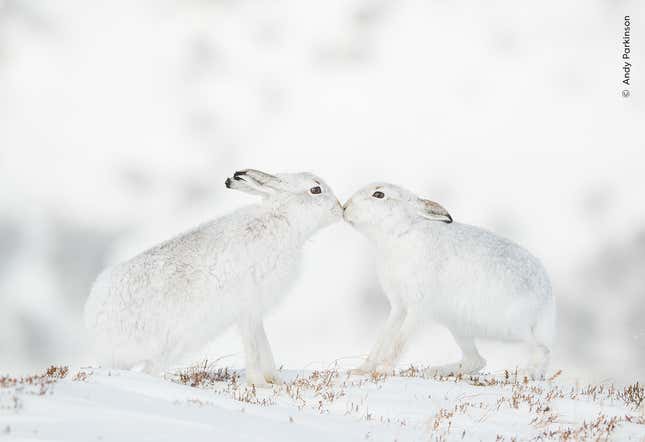
Two courting hares touch noses in the Monadhliath Mountains of Scotland.
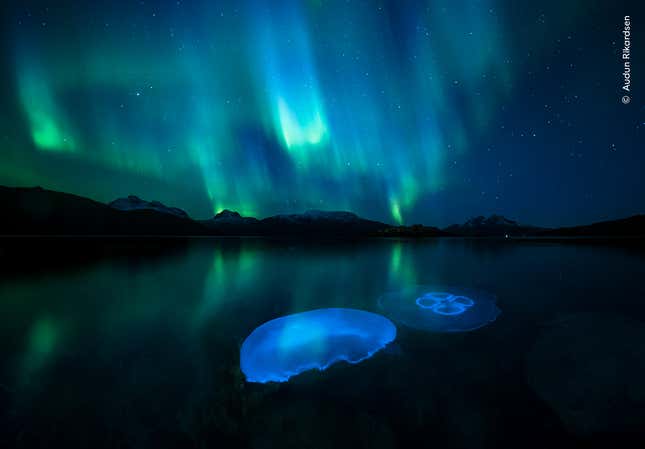
Two moon jellyfish swim under the vibrant blues and greens of the aurora borealis.
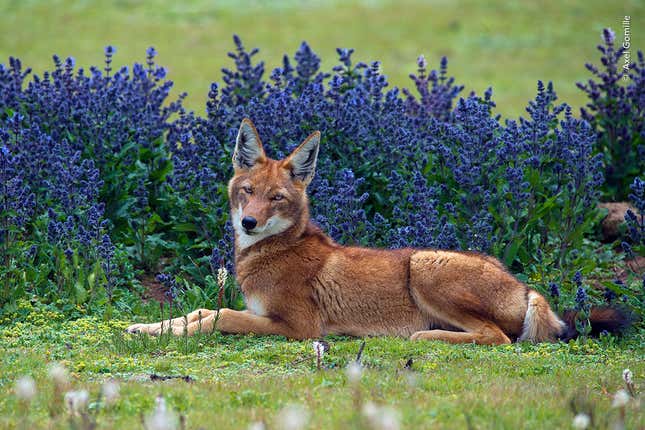
An Ethiopian wolf—an exceedingly rare species of wild dog—takes a break near wildflowers in Bale Mountains National Park.
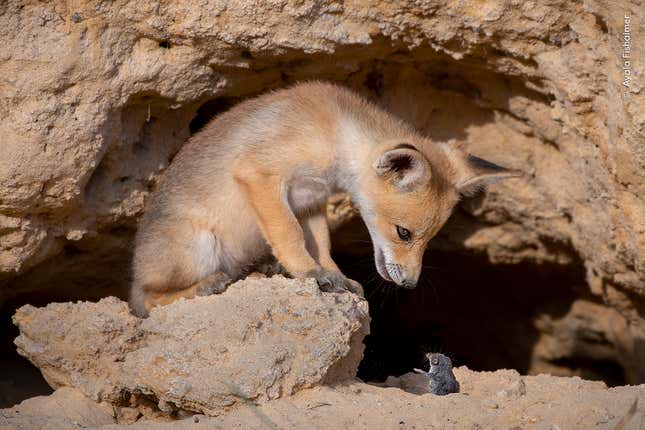
A young red fox takes a moment to study the shrew it just yanked out of the ground and threw into the air.
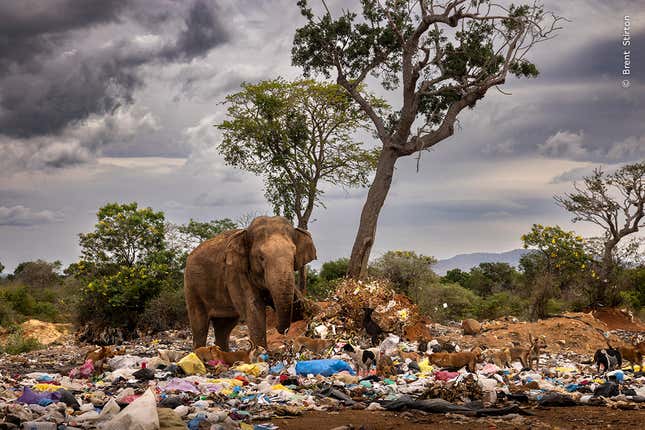
A crop raiding bull elephant looks for food in a garbage dump in Sri Lanka.
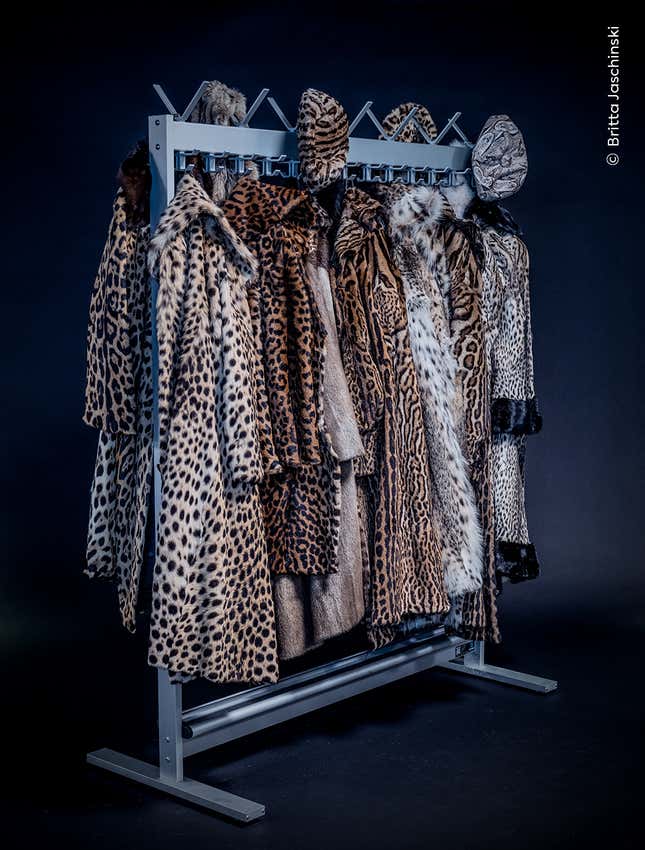
Coats made from big cat skins hang in Hamburg’s Leibniz Institute for the Analysis of Biodiversity Change.
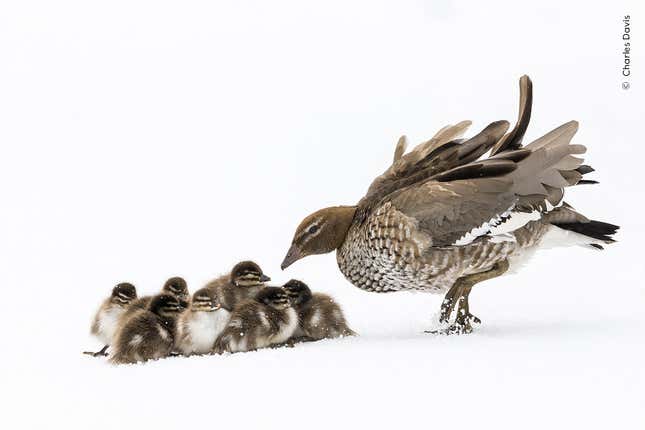
A wood duck checks in on her chicks amid a snowstorm in Australia.
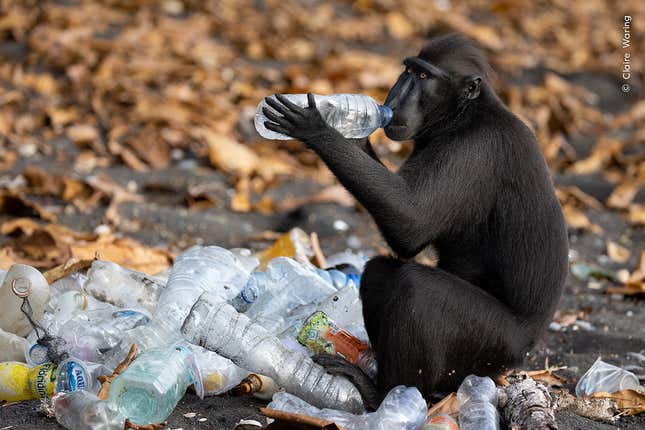
A macaque takes a sip out of a bottle in a pile meant to be recycled on the Indonesian island of Sulawesi.
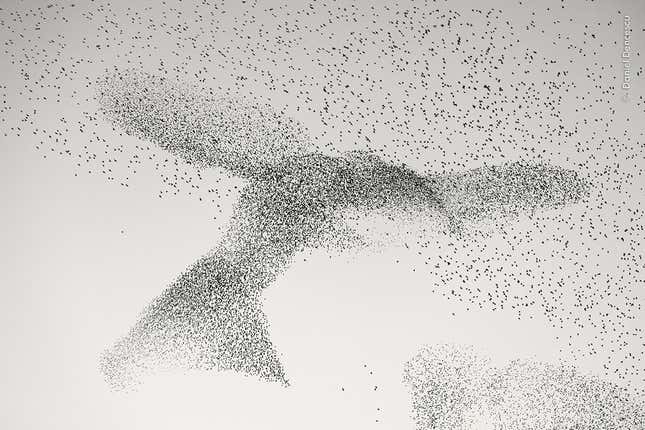
This stupefying shot captures a murmuration of starlings as they fly over Rome. In this moment, the murmuration took a shape reminiscent of a bird in flight.
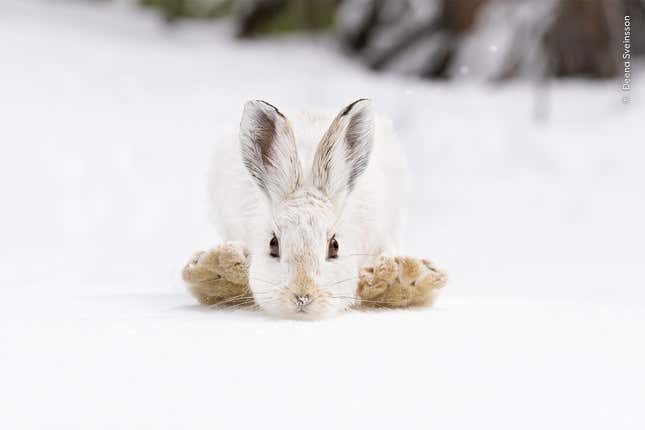
A snowshoe hare’s hind legs line up with its head in this fleeting moment, as the fluffy mammal prepares to take its next leap in Rocky Mountain National Park.
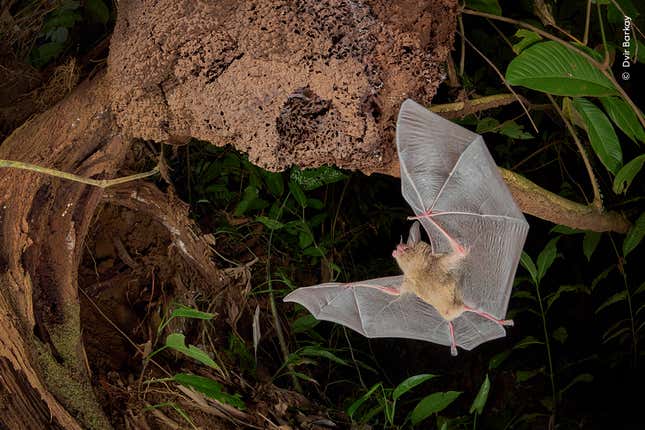
A pygmy round-eared bat returns to its nest, which is carved into the nest of a termite colony.
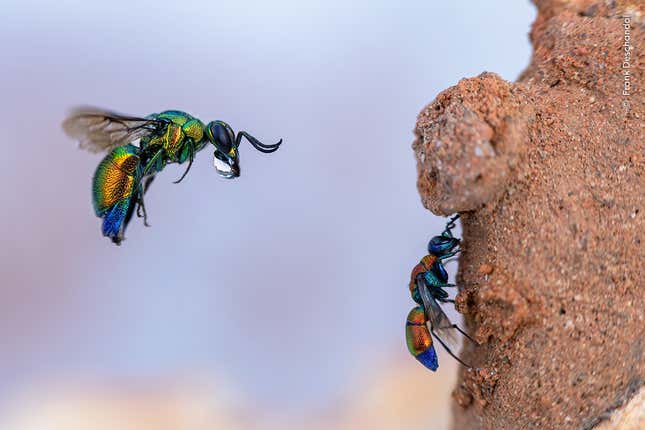
A parasitic cuckoo wasp approaches the clay burrow of a mason bee. The wasp carries a water droplet, which it uses along with its saliva to soften the clay to get at the burrow within. Once inside, the wasp lays its eggs and reseals the burrow; when the eggs hatch, the wasp progeny feeds on mason bee larvae.
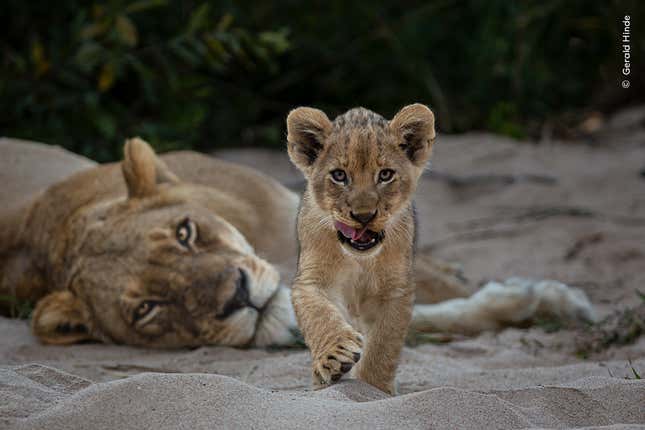
A lion cub checks out the photographer in South Africa’s Greater Kruger National Park.
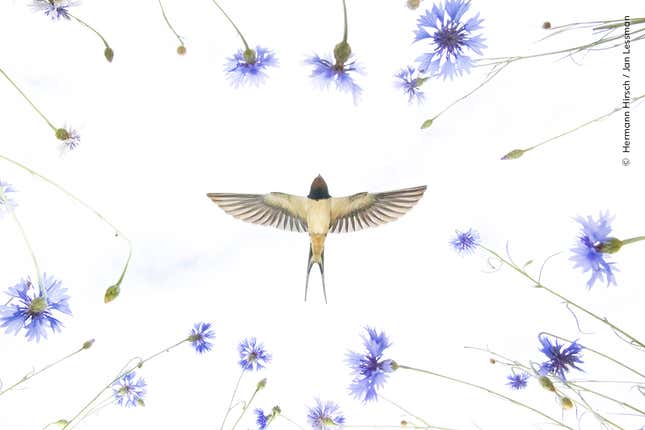
A barn swallow seen from below, flying through a field of cornflowers.
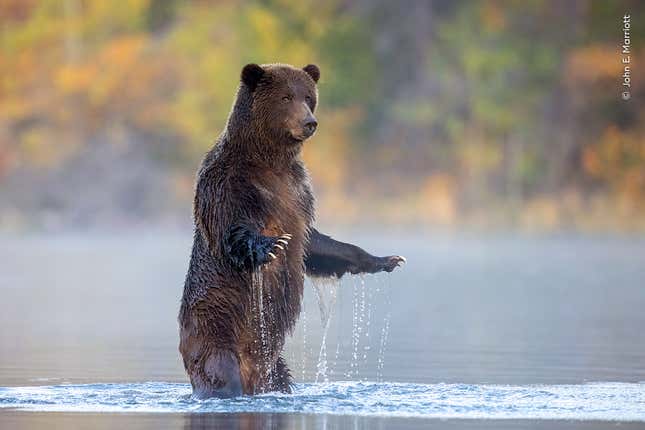
A grizzly bear looks uneasy as it’s captured in the photographer’s frame while salmon fishing in British Columbia’s Chilko River.
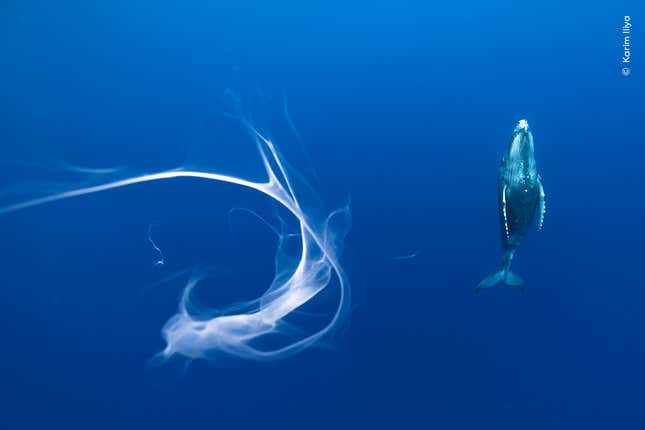
A humpback whale calf missed capturing milk from its mother, and it here swirls aimlessly in the currents off French Polynesia.
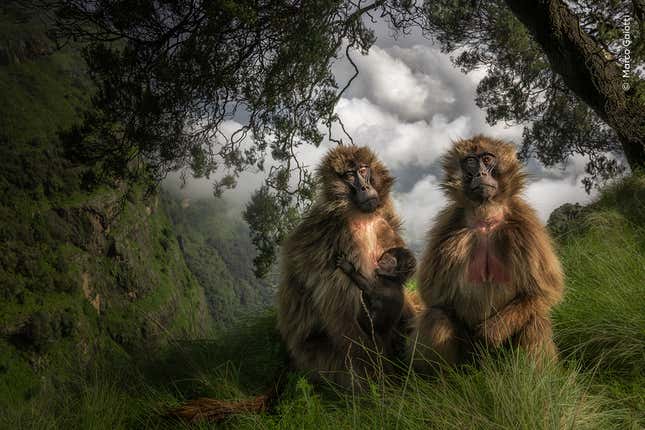
Three geladas in Ethiopia’s Simien Mountains.
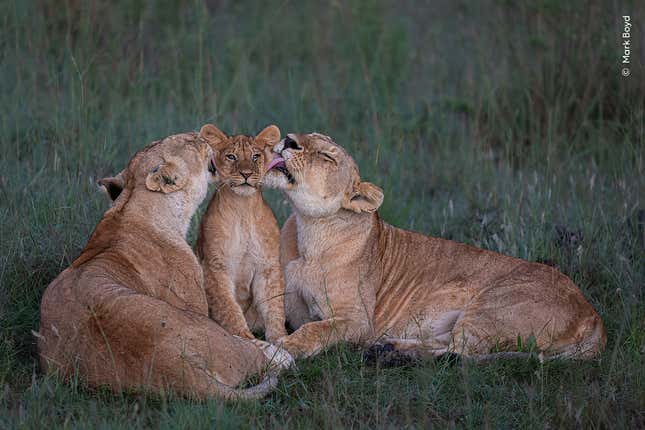
Two lionesses groom a lion cub in their pride.
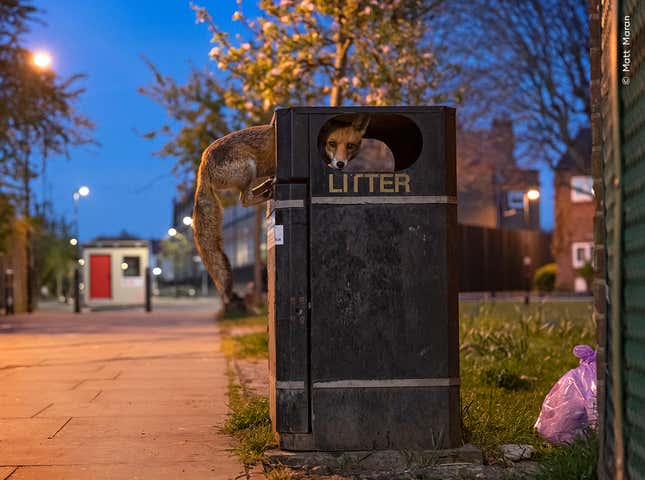
A red fox checks out a rubbish bin in London, England.
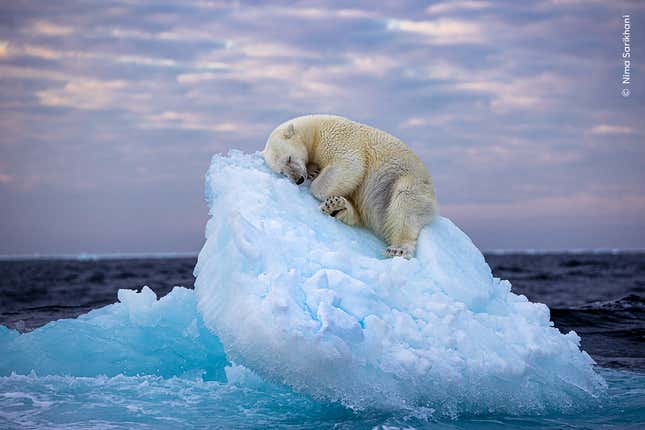
A polar bear finds a surprising place to rest on a lopsided iceberg north of Svalbard.
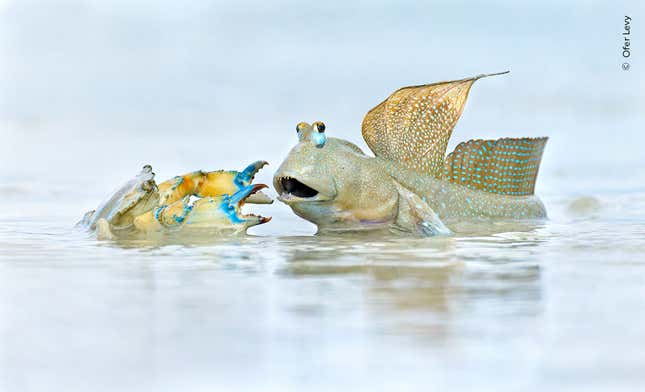
A mudskipper defends itself from a crab in Australia’s Roebuck Bay.
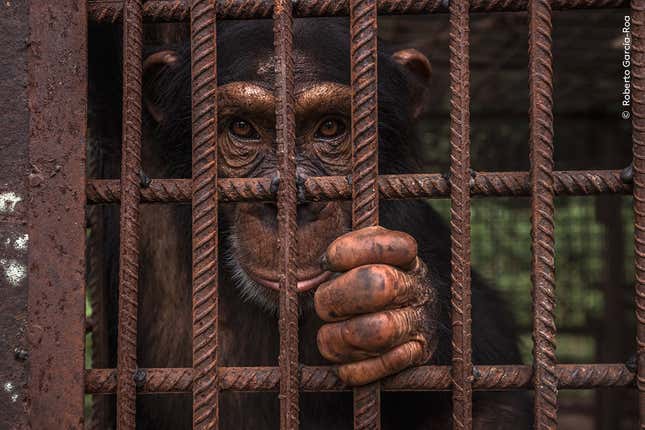
A rescued chimpanzee in the Republic of Guinea’s Chimpanzee Conservation Center. The center houses chimpanzees that were sold as pets after their mothers were killed for bushmeat, according to the Natural History Museum.
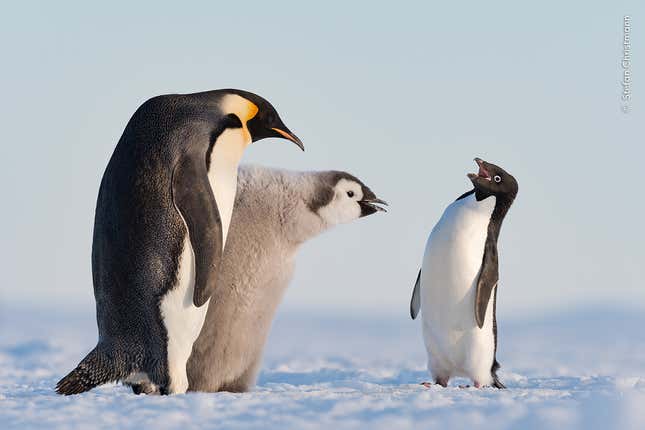
An Adélie penguin approaches an emperor penguin and its chick in Antarctica’s Atka Bay. The smaller penguins sometimes try to opportunistically steal food from the larger penguin species.
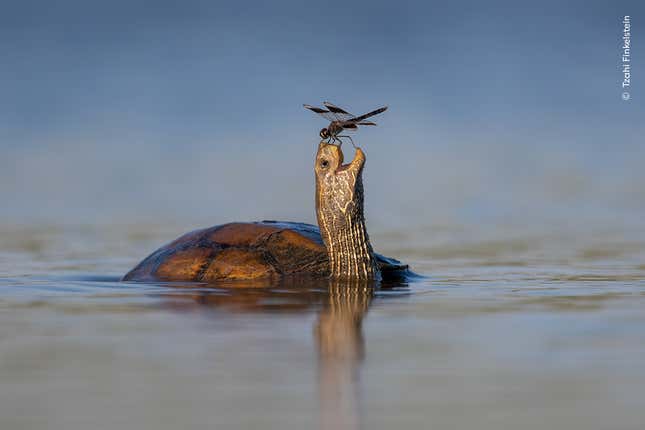
A Balkan pond turtle looks up at a dragonfly balanced on the tip of its nose.
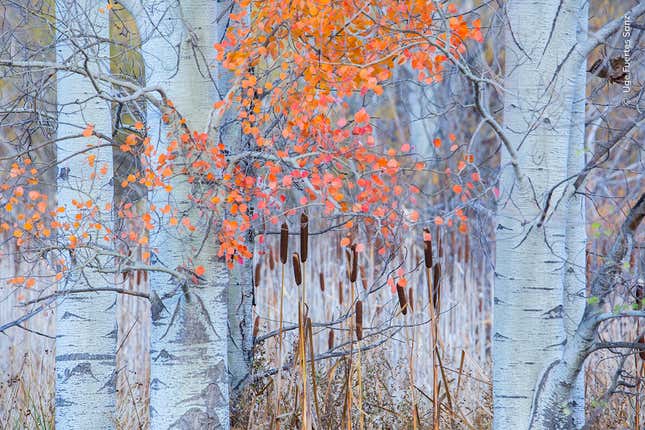
Bulrushes and aspen trees in Spain show the dazzling color palette of autumn.

Will it be a picture that reflects the pristine beauty of the natural world, or one that shows the potentially devastating impact of human beings on their surroundings?
The choice is yours, as fans of wildlife photography around the world are being urged to vote for the Wildlife Photographer of the Year’s People’s Choice Award.
As always, the prestigious contest has a section that it throws open to the public, with the chance to vote from a selection of 25 outstanding images.
These were chosen by the Natural History Museum in London – which hosts the overall exhibition – and an international judging panel. They narrowed the field down from a huge 49,957 entries, sent in from 95 different countries
The public can now vote for their favorites online, choosing from a selection that includes a pair of seemingly kissing hares, a polar bear sleeping on an iceberg and an upright grizzly bear in a shimmering lake.
Also featured are an Adélie penguin approaching an emperor penguin and its chick, and a striking image of a rail of clothing fashioned from some of the world’s most endangered big cats.
Other shots that highlight the negative impact of man on his surroundings include a young fox dining on an overflowing trash can in London and a male elephant striding through a heap of rubbish.
Voting is open online until January 31. The winner and top four images will be announced in February and displayed online, as well as in the in-person exhibition at the Natural History Museum.
Call to Earth is a CNN editorial series committed to reporting on the environmental challenges facing our planet, together with the solutions. Rolex’s Perpetual Planet initiative has partnered with CNN to drive awareness and education around key sustainability issues and to inspire positive action.

“We’re not just a part of the history books and the movies and TV — we’re actual people,” he said. “We’re still living and breathing and we’re still singing our songs and doing our dances and living this way of life every day.”
Norma Jean Locklear-Richardson is a textile artist and a member of the Lumbee Tribe of North Carolina. She runs Skyworld Stitches with her daughter Stevie Lowry designing and sewing ribbon skirts and embroidered regalia.
Ribbon skirts, rather than representing any one tribe, are an artwork shared by many tribes across the United States. They are a relatively recent tradition, emerging from ribbon traded from European settlers in the late 18th century.
Locklear-Richardson, who has been making regalia for around 20 years, said that in the past 10 to 15 years, ribbon skirts have become more casual wear, allowing Native American women a means of displaying their culture in their everyday wardrobe and saving the regalia for special events.
She incorporates an individual’s favorite colors, tribe colors and personal interests to create a personalized representation of their culture and identity. Detailed embroidery sits atop vibrant fabrics in between a rainbow of appliquéd satin and ric rac ribbons, each tailored to the wearer.
Locklear-Richardson taught Lowry to sew when she was 13 years old. Lowry danced in powwows, wearing regalia sewn by her mother, even before that. Now, as an adult, she makes her own.
“I like having different outlets that I can use — being able to dance and create the things that I wear while I’m dancing,” Lowry said. “It really means more than anything.”
Though artists like Oxendine and Locklear-Richardson celebrate art forms with deep roots in history and cultural identity, some deviate from those art forms through new mediums and intersecting identities.
Christopher Kennedy’s drawings stray from the expectation of Native American traditional art. He is a self-taught contemporary artist and a member of the Lumbee Tribe of North Carolina.
Though several of his past drawings highlight his Lumbee heritage, he tends to focus on more technical challenges and broad themes.
Kennedy’s social media pages show the dozens of hours he spends making hyper-realistic colored pencil drawings—mostly hands—reach seemingly off the page. Several of his drawings feature other aspects of human anatomy, like eyes and faces, but hands dominate his portfolio.
“You talk with your mouth, you look with your eyes — but you touch and feel with your hands,” he said. “I think it’s just a bigger, larger universal theme about people when I think about hands.”
To get the day’s news and headlines in your inbox each morning, sign up for our email newsletters.
Though he is drawn to themes beyond race, identity and gender, he said does not identify any less with his Native American heritage.
“Because I’m Native American, the artwork that I do is Native American,” he said.
@dthlifestyle | lifestyle@dailytarheel.com





