About

Posts by :

The big picture: in search of a land where time stands still

The big picture: in search of a land where time stands still
image

Laura Pannack first went to Romania in 2012; she’d been living in a shared house in London and, after the death of a friend, needed to step out of the pace of that life, find a place where time might seem less fleeting. Over the following years she spent extended periods in remote Romanian villages, taking pictures. A translator she was working with had mentioned to her a particular local folktale called Youth Without Age and Life Without Death; the story, about a prince who goes in search of a land where time stands still, gave her the idea for a book of photographs.

In that book, published this month, Pannack has created strange and haunting pictures with some of the villagers she met and lived among to illustrate ideas from that story. This photograph arises from a particular line: “then the sisters made their guest and his hosts known to all the wild beasts”. It happened, Pannack explained to me, that she had been walking along a lane in one village one morning when she met three sisters and started chatting about her project. They entered into the spirit of the story “100%” she says, and helped her make this picture.

Working on these images, inhabiting these small daily adventures, helped Pannack reframe her “always-existing anxiety that time is running out”. In the folktale, when the prince eventually finds the land where time stops, he discovers all the people he loves have died; “the moral,” she says “is that we should not seek infinite time, but spend the time we have with people we love”. Pannack is working on a “second chapter” of the project, this time following the threads of certain German folktales into the forests of north-eastern Germany.

Behind the scenes: Rhona Bitner takes us into America’s performance spaces

Behind the scenes: Rhona Bitner takes us into America’s performance spaces

Photographer Rhona Bitner is fascinated by spaces, capturing them alongside the people and objects related to theatre, music and dance in an exhibition at The Wellin Museum of Art.

   Seven photography series, dating from 1990 to the present day, take us into the circus and the ballet, on to the street and on tour, in a sumptuous capturing of the mundane. ‘What interests me is the idea of performance and what it represents,’ Bitner tells us. 

   ‘“Resound,” my first major museum exhibition, at the Wellin Museum of Art, and presents 30 years of work around this idea. I am fascinated by the parallels between the theatre and the camera: both are black boxes, or spaces, within which an image appears. And that image or experience acts as a laboratory of human experience outside the black box. Samuel Beckett said: “A voice comes to one in the dark. Imagine.” This is what drives my work. There are seven series of photographs presented in the retrospective including the Circus project which explores the language and gestures of the performer and includes images from 10 years of following one-ring circuses around Europe. The Stage project is about the sense of anticipation and excitement as the show is about to begin. And the Listen project focuses on the histories and inner architecture of American popular music.’

photography

Captions for Press Images for Rhona Bitner: Resound KLRU-TV, Austin City Limits, Austin, TX, June 3, 2009, from “Listen,” 2006–18

(Image credit: Courtesy of the artist ©Rhona Bitner / ADAGP, Artist’s Rights Society, New York)

When viewed through Bitner’s lens, images become imbued with a nostalgia, felt especially in spaces she photographed which went on to close, or present in artefacts from past performances. ‘CBGB’s [New York club open for 33 years] eminent closure gave birth to the Listen project and it, like the Grande Ballroom in Detroit, is one of only a few venues in the Listen project that are no longer around. But the project features hundreds of venues that are still thriving, from Electric Lady Studios and Radio City Music Hall in New York to FAME Studios in Muscle Shoals or the Austin City Limits soundstage or First Avenue in Minneapolis or First Church of Deliverance in Chicago or The Whisky a Go Go in Los Angeles or even Folsom Prison or Graceland. It is the memory (sometimes legendary) of what happened in these places that inspires me. The photographs present the spaces empty of the people and performers that made them famous, leaving room for the viewer to imagine themselves in the space.’

photography

(Image credit: Courtesy of the artist ©Rhona Bitner / ADAGP, Artist’s Rights Society, New York)

      Ultimately, Bitner is searching for a sense of place in the stories she captures. ‘[What draws me] depends on the premise of a particular project. The Listen project was entirely about the history of the space and what happened there. The Stage project was about the proscenium itself, so I sought out a variety of theatres and visual elements, mostly in Paris because I had access there, but I was also determined and succeeded in gaining access to the (then) State Theater at Lincoln Center in New York where I saw my first performances as a young person. My other projects, Circus and Pointe for example, focus on the performer or the material trappings of performance such as the shoe a ballerina wears when she performs.’

Rhona Bitner: Resound is on at Wellin Museum of Art until December 9 2023

hamilton.edu/wellin/exhibitions/detail/rhona-bitner

photography

Captions for Press Images for Rhona Bitner: Resound CBGB, New York, NY, October 4, 2006, from “Listen,” 2006–18

(Image credit: Courtesy of the artist ©Rhona Bitner / ADAGP, Artist’s Rights Society, New York)

A deep dive into the photography experience on Google Pixel phones

A deep dive into the photography experience on Google Pixel phones

Google has kept its innovation engine going with new additions to every Pixel phone. Here’s a look at what the Pixel 8 and 8 Pro offer in the camera department

Launched in 2016, Pixel and Pixel XL were Google’s first in-house smartphones. Right from the get-go, Google’s approach to the Pixel was very clear – a clean Android experience with great camera. It offered great colors, superlative bokeh effect that made for terrific portraits, and that signature high contrast.

It was the best camera on a smartphone, and while most manufacturers moved to dual or triple camera setup, Google stuck with a single camera and focused on its machine learning tech and computational photography for long (Pixel 4, launched in 2019, was the first one with a dual camera).

Also read: Google Pixel 8 Pro review: The right idea for the future of phones

Around that time though, Samsung too upped its game and has been trying to stake a claim as the best camera on an Android smartphone. Meanwhile, the Apple iPhone has also delivered stellar advances to share the honors if not reclaim the crown.

But Google has kept its innovation engine going with new additions with every iteration. Whether it was Night Sight (more details in low-light conditions with less motion blur) on the Pixel 3/3XL or the astrophotography capabilities introduced with the Pixel 4/4XL or the AI-powered Magic Eraser (that removes strangers and unwanted objects with one tap) on the Pixel 6 series or the Photo Unblur (removes blur and visual noise in photos) on last year’s Pixel 7 and 7 Pro.

While the competition caught up, and aced in some departments along the way, Google Pixel smartphones have always been on the table in consideration for industry-leading camera capabilities.

Which brings us to the new Google Pixel 8 and Pixel 8 Pro.

What’s new with Google Pixel 8?

Let’s get done with the camera hardware details first.

Both Pixel 8 and Pixel 8 Pro have the same flagship 50-megapixel (f/1.6 aperture) main camera capable of shooting 4K video and a 10.5-megapixel (f/2.2 aperture) front camera. The sensor and lens on the main camera have been upgraded on both phones for better light sensitivity.

The ultrawide lens on the Pro is 48MP with autofocus while it’s 12MP on the younger sibling. However, the ultrawide camera on the latter too includes autofocus now — first time outside of the Pro series.

Pixel 8 Pro also comes with an additional 48MP (f/2.8 aperture) rear telephoto lens with 5x optical zoom.

Pixel 8 can zoom up to 8x (Google calls it ‘Super Res Zoom’) while Pixel 8 Pro can go up to 30x zoom.

More interestingly, it’s the first time that Google offers Pro Controls on the Pixel. The Pixel 8 Pro (not Pixel 8) provides greater control of the camera settings allowing you to not just control white balance, exposure, and shadows brightness but also manually adjust focus, shutter speed, and ISO.

But, of course, Pixel has never been about the specifications.

Google’s pitch through the years has been focused on the computational photography elements of Pixel phones but this time around, there’s significant effort towards enhancing the video capabilities – seemingly to offset the delta it has from iPhone’s spectacular videography prowess.

A new Google Pixel 8 Pro Phone is seen in New York City, U.S., October 4, 2023.

A new Google Pixel 8 Pro Phone is seen in New York City, U.S., October 4, 2023.
(Reuters)

Dual Exposure

The Dual Exposure technology makes videos sharper and less grainy in scenes with tough lighting, like a sunset backdrop. Dual Exposure essentially takes two images simultaneously – one optimized for low-light and the other for high dynamic range – and produces natural-looking videos with vivid colors and low noise.

Best Take

It’s always tricky to capture group photos – my six-year-old is often making faces and the missus is either blinking or looking away. In such cases, Best Take can fix my family photos.

This new feature uses an on-device face detection algorithm to match up people’s faces across group shots taken in a 10-second window. You can manually select the best look from available facial expressions. It’s wild and works for the most part.

But it’s also strange in a way. That frozen moment never happened, but most people wouldn’t mind that philosophical conundrum. Everyone wants a nice group picture for the ‘gram.

Best Take is exclusive to the Google Pixel 8 series at the moment. It might trickle down to older Pixel phones, as has been the case with some past marquee features. Since the feature is part of Google Photos, it may also come to non-Pixel smartphones (like Magic Eraser did). That said, right now on a Pixel 8, you can use the Best Take feature for existing bursts of images taken with other smartphones.

Magic Editor

The new Magic Editor takes the existing Magic Eraser feature to the next level. Now, you can’t just erase but also reposition objects or people in the frame (with AI filling the gaps) and improve the lighting and background, like changing the color of the sky. This feature, available via the Google Photos app, is powered by generative AI.

Once you select an edit, Magic Editor gives you multiple result options to choose from, so you can get the look you want.

Like Best Take, Magic Editor is very, very good when it works. It’s almost like creating a new moment, a new picture. While professional image editing tools like Adobe Photoshop can do much more, this feature available broadly to average users with no learning curve is mindboggling and scary at the same time.

Audio Magic Eraser

There’s an audio feature that augments camera capabilities? Something like that, yes.

Audio Magic Eraser identifies different background sounds in your videos using advanced machine learning, like speech, crowd, wind et al, and sorts them into distinct layers that can be individually controlled.

This new feature brings computational audio functionality like Magic Eraser for photos. It removes unwanted distracting sounds from your videos – like you’d remove a photobomber from a photo via Magic Eraser.

Apart from these new enhancements, there are a few more features that were introduced in the previous generation of Pixel smartphones but continue to be marquee highlights of the Pixel camera experience.

Google Pixel 8 and Google Pixel 8 Pro phones are displayed during a Google product launch event in New York on October 4, 2023.

Google Pixel 8 and Google Pixel 8 Pro phones are displayed during a Google product launch event in New York on October 4, 2023.
(AFP)

Real Tone

Unfortunately, cameras have historically centered on light skin – a racial bias that has crept into most modern digital imaging products. Often, people with darker complexions appear darker, brighter, or more washed out than they do in real life. Essentially, their photos are inauthentic.

It is, of course, critical that cameras work equitably for everyone. Real Tone is a work in progress towards inclusive photography. Google began working on Real Tone in 2020 and introduced its attempt at image equity with Pixel 6.

The idea is to correctly represent skin color in pictures, make skin brightness appear more natural (not unnaturally darker or brighter), reduce washed-out images, and sharpen blurry images even in low light. The improvements also extend to Google Photos, which allows optimizing color and lighting in any picture, across diverse skin tones.

Guided Frame

Guided Frame uses a combination of audio cues, high-contrast animations, and haptic feedback to help people who are blind and have low-vision take photos.

This feature now works on both the front and rear cameras (it was conceived as a way to take selfies) and it recognizes more than just faces now – like pets or food items – to automatically take a photo when such things are centered.

And then there are some new features that are coming soon. Google did showcase a few camera capabilities at the launch of Pixel 8 that aren’t available right away but will be available as a feature drop later.

Video Boost

Google claims its new Video Boost feature can record smoother videos and uses cloud-based processing to automatically adjust color, improve dynamic range, lighting, and stabilization, and reduce graininess in videos. It’s an approach to computational video just like HDR+ helps you capture stunning photos via computational photography.

Processing even a one-minute 4K video is quite intensive, and therefore Google brings together the Tensor G3 chip on the phone as well as the company’s data centers to produce a cloud-enhanced video that shows up in Google Photos after a while. This feature also makes Night Sight Video possible, allowing for better videos in low-light situations, like dimly lit restaurants or cityscapes at night, for instance.

Zoom Enhance

This new feature will allow you to zoom in on any photo and crop to what you want the focus of your photo to be. On top of that, using generative AI, Zoom Enhance intelligently fills in the gaps between pixels and predicts fine details to produce a photo that’s enhanced and sharper than the pixelated one as is often the case.

The AI-powered software magic

In its early days, camera phones focused on doing old-school optics right. As lenses and sensors improved, the biggest advancements now come with the fusion of artificial intelligence and machine learning. These allow Pixel (and other smartphones) to offer professional camera and editing capabilities powered by computational photography… things like taking sharp photos in low light, adding blur to portraits and selfies, removing distractions from a photo, unblurring photos, etc.

For example, the HDR+ feature snaps a dozen or more pictures in rapid succession and then AI aligns and combines them to form a single image that’s free of any blur from camera shake.

Some of Pixel’s camera capabilities (and other features on the phone), mind you, are further enhanced by the Tensor G3 chip that powers the Pixel 8. It’s a custom-built processor that allows the camera to perform complex AI tasks.

Is Pixel the best camera phone?

That depends.

A lot of reviewers do believe that Google Pixel 8 Pro is the most consistent camera across a wider range of scenarios, even if the Apple iPhone 15 Pro trumps it in many departments or goes neck-in-neck. A lot of people who just want a solid point-and-shoot experience over a range of shooting environments prefer a Pixel. Additionally, the introduction of manual shooting controls on Pixel 8 Pro – something which the iPhone doesn’t offer – is a pretty solid differentiation.

In a fiercely competitive market, it is unfair and dishonest to crown one of the smartphone cameras as the absolute best. The phone needs to respond to your individual needs and expectations.

Also, there’s much more to smartphones than just their camera packages. In the case of an iPhone vs Pixel debate, for example, one would also have to consider their comfort with the operating system. Android users may also consider a Samsung Galaxy S23 Ultra for its stellar camera setup and a well-rounded Android experience or the new challengers like the vivo X90 Pro and Xiaomi 13 Pro, overlooking absolute camera comparisons but basing their purchase decision on user experience, design, ancillary features, and after-sales support.

Abhishek Baxi is a technology journalist and digital consultant.

Also read: Google Pixel 7a review: a better deal than the Pixel 7?

Don’t believe your eyes: how tech is changing photography forever

Don’t believe your eyes: how tech is changing photography forever

Fake photos are practically as old as photography itself.

French photographer Hippolyte Bayard felt he had missed out on the recognition for inventing photography and had it taken from him by Louis Daguerre. In protest, he staged a picture of himself, Self Portrait as a Drowned Man, and wrote a note in which he said the man depicted had been “lying in the morgue for days, no-one has recognised him or claimed him!”

He signed it himself: “H.B. 18 October, 1840”; the usually accepted beginning of photography is 1839. As soon as we knew what photographs were, we used them to trick people.

Muscogee Nation hosts Native Christmas Market at Jenks Riverwalk.

Muscogee Nation hosts Native Christmas Market at Jenks Riverwalk.
image

JENKS, Okla. — The Muscogee Nation hosted a Native Christmas Market Saturday at the Jenks Riverwalk.

The event took place at the Jenks Riverwalk from 3 p.m. to 7 p.m.

During that time, more than 25 Native American vendors from various tribes were all showcasing their goods.

Sisters Brittany Hill and Breana Hill were selling handmade goods including beadwork, shellwork, paintings, ledger art and hand painted Christmas ornaments.

“We got it from our father, our father is a self-taught artist, and all our lives we’ve just been painting and drawing and so, we’re just now kind of starting to get into the art market specialty of it all,” Breana said.

They said their art depicts both their Muscogee and Ihanktonwan Dakota art styles.

Brittany said the event was a great place to showcase native art.

“We’re so happy to be here, it’s always such a great time when we have multiple vendors from different tribes come out and it’s just a great place to showcase native art,” she said.

Breana said she was thankful people were supporting local vendors and artists because of the amount of time and work that goes into the pieces.

“People take a lot of time outside of their daily life, whether that be their full-time job or not, to put these pieces together and just show a lot of their hard work and it’s a good depiction that we are still here today as indigenous people and showing our art pieces in modern and traditional times,” Brenea said.

She also said supporting local Native American artists is important because for many, art is a part of their identity.

The event also had live music, carolers, and a kids zone.

‘For Our Stories to be Told’: Hope Valley Native artist Brooke Waldron centers Indigenous narratives in her artwork

‘For Our Stories to be Told’: Hope Valley Native artist Brooke Waldron centers Indigenous narratives in her artwork

HOPKINTON — Native artist Brooke Waldron — painter, potter and proud Seaconke Wampanoag/Narragansett — sat inside her Hope Valley studio one morning last week, turning her pottery wheel and talking about contemporary Native art.

On the wall behind her, a painting of a white horse, framed by an orange rectangle and centered in a rich purple background, hung on a white wall. On the floor nearby, an enormous painting — featuring half a dozen different-colored horses galloping under a starry, moonlit sky — was leaning against a wall.

“We are not just tipis and dream-catchers,” said Waldron with a soft smile as she trimmed the edges of a small clay bowl. “Native art is so much more … and we’ve got to reclaim our seat at the table.”

Contemporary Native art often goes unnoticed, Waldron said, “and our culture and representation continues to be profoundly underrepresented.

“Our narratives, stories and artistic practice is almost exclusively told in the past tense and is rarely exhibited in an equitable way.”

Waldron will talk more about Native art, and take questions from the audience, this afternoon at 4:30 at the Gamm Theatre in Warwick, where an exhibit of her work is currently on display at the Gamm Theatre Gallery.

The solo exhibit — paintings from “Those That Guide Us” — features 12 of Waldron’s newer works, paintings that “present a breadth of style and color,” according to installation organizers, who note that the “collection is steeped in Indigenous symbolism.”

Waldron, who explores the relationship between color, nature and traditional native symbolism and contemporary techniques, has a deep affinity for the natural world and for animals.

“Our four-legged relatives” are common themes in Waldron’s work.

Rabbits and horses appear in her paintings, feathers and ferns pop up in her pottery. Birds and eagles too.

Also an equestrian and riding instructor, Waldron, 33, grew up on a 118-acre farm in Exeter with her parents and an older sister, Kara.

“She’s my biggest supporter,” said Waldron with a smile, “along with my parents, of course.”

Waldron graduated from Exeter-West Greenwich High School before heading off to work and to study at the Community College of Rhode Island.

Waldron, who is employed by the Rhode Island Regional Indian Council and works in the subsidiary office in North Stonington assisting Native communities in career development, said she knew from an early age that she was an artist.

In high school, she said, she was positively influenced by her high school art teacher and friend, Elizabeth Lind, who helped her realize there was space for the art she was making.

“She was very encouraging,” said Waldron. “She made time.”

Waldron participated in her first exhibit — as a teenager — at the Hera Gallery in Wakefield. She exhibited at the Hera again years later. She has also exhibited at the South County Art Association, where she has taken many classes, and the Warwick Center for the Arts. 

In 2007, Waldron attended the solo exhibit of noted Comanche Artist Nocona Burgess at the Peck Gallery in Providence, an event that stays with her.

It was an emotional experience for Waldron who had seen Burgess’ work in Santa Fe and Albuquerque and had become what she calls “a fangirl.”

She said she feels a sort of thread that connects her work with Burgess’ work and “pulls on through.”

Burgess, who has earned widespread recognition for his bold acrylic portraits of historic American Indian figures, including his famous great-great-grandfather, Comanche chief Quanah Parker, is known for his modern depictions of Indigenous men and women from various tribal nations of North America.

According to his biography, Burgess “explores the cultural context, life story and identity of each sitter. In this way, the artist urges us to update our perceptions of Native people and consider the intriguing and often highly politicized place of Native American portraiture.”

It is a philosophy shared by Waldron, who said she’d like to be a sort of change agent for the way people think about contemporary Native American art.

Especially now, during the month of November, which has been designated as Native American Heritage Month.

Waldron said when she was approached about the idea for the exhibit by Lauryn Sasso, the Gamm’s institutional engagement associate who facilitates the theater’s art installations, she was thrilled.

“I’m honored to be there,” said Waldron. “They have been very welcoming and I’m grateful for the space.”

Sasso called Waldron’s use of color in her paintings “stunning.”

“She is an intelligent and unique talent,” said Sasso, who first saw Waldron’s work at an exhibit at the Warwick Center for the Arts.  

Waldron’s work is “really, really singular in the way she delves into and integrates Indigenous lore and symbolism,” added Sasso. “And her ceramic work is beautiful too.”

“The collection is steeped in Indigenous symbolism, a departure from the human form,” reads a statement from the Rhode Island Humanities about the exhibit. “The series invites the viewer to interpret the many lessons we can learn from self-reflection.

“Using animals as the north star of her focus, the artist creates a narrative that shares her own personal story while connecting with the audience in a familiar way.”

Now that she’s completed her “dream project” — the creation of her Hope Valley studio — Waldron is pondering her next steps.

Maybe she’ll open a gallery for Native artists, a place “for our stories to be told,” she said. 

“I’m in a constant experimental state,” Waldron added with a smile.

Waldron plans to participate in a Dec. 9 holiday event in Hope Valley, will have some pieces at the Village Art Studio and maybe she’ll be at a Christmas market or two. In the meantime, “Those That Guide Us” will be on exhibit at the Gamm through Nov. 26. 

For more information, visit www.grayhorsestudioart.com and www.gammtheatre.org.

Little Big Horn College group learns how to make Crow moccasins

Little Big Horn College group learns how to make Crow moccasins

BILLINGS — Little Big Horn College’s Ak Bacheeitchiilewioosh Youth Leadership Council met Saturday at the MSU Billings Native American Achievement Center to learn the traditional art of moccasin making.

“It starts right with their feet. They’re learning how to make these moccasins and get on that cultural path. We talk to them in our language, we speak Crow to them, and we want them to learn leadership and continue on in life knowing who they are and not forgetting where they come from,” said one of the organizers of the council, Jonella Hill.

About a dozen students were taught how to measure their feet and make patterns to design their own buckskin moccasins.

For many, this was their first experience learning how to bead. The group hopes that once the youth members learn how to make their own, they can then teach others and keep the tradition alive.

“In order for them to start learning and having awareness of who they are and where they come from, they need to walk in the shoes of their ancestors. They were pretty tough people back then and they used moccasins to get anywhere,” said Noel Two Leggins, another organizer.

Many of the participants, like Vanessa Afraid of Bear, watched their own grandparents make moccasins growing up.

“I’m almost making my ancestors proud because this is something obviously they did, and for me, to be in a society that we are but still able to return and do that, I think is really significant to me to know how to do it for myself and generations to come,” Afraid of Bear said.

Moccasin making is just one of several activities the council hopes to share with the younger generation. The group is planning on wearing their moccasins in the spring for powwows.

Capybara Coffee hosting fall pop-up market with local vendors

Capybara Coffee hosting fall pop-up market with local vendors


Capybara Coffee

Leticia Fernandes, owner of Capybara Coffee, assists customers at her shop. Wednesday, Nov. 15, 2023.


Capybara Coffee will host a fall pop-up market on Sunday, Nov. 19, from 11 a.m.-4 p.m., located between the University Commons and the Publix just outside of the University of Tennessee campus. 

Leticia Fernandes, owner of Capybara Coffee, said she is very excited about the market. It will be the second pop-up market that Capybara Coffee has hosted.

“There will be around 20 vendors, all local crafts, arts and food as well,” Fernandes said. “There will be energy balls, coffee, honey and sketch artists. I’m trying to do a very eclectic market that has a little bit of everything.”

Due to the success of the first market, which took place back in April, Fernandes is planning on having many more. 

“The vendors were very happy with the sales and the customers were very happy with what we had to offer,” she said. “I wish we could do even more.”

Fernandes originally started the pop-up market as a way of connecting with the Knoxville community. 

“I love the market but I work a lot so I don’t always have time to go,” she said. “So I thought, ‘Might as well bring them here.’ We can help each other and bring something different to the table. I want to throw a big emphasis on communities, especially in a large town like this.”

Fernandes is hoping that Capybara Coffee can be a place where college students can find a connection.

“When you go to college, you have to move and then make a new community in your life,” she said. “This way, the market is within walking distance to all students living in the dorms. I’m trying to bring a sense of the city to them, not just college life but everything that happens around it too. You know, creating your own community.”

Fernandes chose the name “Capybara Coffee” because it is a reminder of her home country of Brazil. She said they are common in her hometown city and very friendly.

“We wanted to honor our origins, where we come from and also have this friendly and welcoming environment,” Fernandes said. “We want to keep it warm and cute.”

Fernandes also really enjoys being a coffee shop owner, as it allows her to get to know her customers intimately. 

“Sometimes people will tell me what research they’re doing, whatever they’re learning or whatever they’re teaching,” she said. “I’ve learned a little bit of everything from music to marketing.” 

The highlight of her day is getting to see customers’ faces light up after having their first sip of coffee. When choosing the vendors for the fall pop-up market lineup, Fernandes was careful to think about her customer base. 

“I invited people with wares that I think would interest our customer base as well as some vendors my customers and friends recommended,” Fernandes said. 

One such vendor is Kathy Cotten Bryant, known as “outsidethebox__vintage” on Instagram and “OTB Outside THe BoX” on Facebook. She collects and sells vintage artifacts and wares and has been doing so for about nine years. A recent retiree, this is now her main gig, and she enjoys it to the fullest.

“I started with a friend to let go of items I no longer needed and items my kids had outgrown,” Bryant said. 

While it is a fun business, she says it can be challenging at times. 

“It requires a constant focus, whether on finding new treasures to sell, marketing those treasures, or keeping up with the in and out of inventory,” Bryant said. “As with any endeavor, discovering my talents and gifts within the resell world and it continues to be a journey.”

Bryant’s love for vintage items goes far and wide. She has even traveled to places like Italy and found things there. 

“Vintage items tell stories and have stood the test of time,” Bryant said. “Repurposing, reimagining, and bringing those items back to the public is exciting and rewarding. They will live another life hopefully as long or longer than their first!” 

Treasure hunting is her favorite part of the business. Just like Fernandes, Bryant is hoping to connect with people through the upcoming pop-up market. 

“The most difficult part is narrowing my focus on what I choose to look for and purchase for resale,” Bryant said. “I feel that if I can narrow my focus, I’ll be able to offer variety and quality and appeal to those individuals looking for just what I have.”

All of the coffee at Capybara Coffee is made in-house, so if you want some authentic Brazilian coffee, consider grabbing a cup at this weekend’s pop-up market.

“We want every cup to be amazing,” Fernandes said. “We want your experience to be amazing.”

‘100 Cameras for 100 kids’ aims to help kids gain photography skills

‘100 Cameras for 100 kids’ aims to help kids gain photography skills

INDIANAPOLIS — A new program is providing undeserved youth the chance to learn photography.

The ‘100 Cameras for 100 Kids’ program is on a mission to empower youth in Indianapolis with the transformative power of photography.

camera2.jpg

“I’ve learned the basics. I’ve learned a lot of techniques — the way to use the camera, ways to use light to bring things to life,” Jordan Warbinton said.

“I’ve learned how to use this camera. This camera is a beast,” Chance McMillion said.

‘100 Cameras for 100 Kids’ gives each participant a free camera. They go through a six-week training course where they get to learn from professionals.

“It means a lot that somebody would actually want to help us out,” Caden Kerr said.

camera.jpg

Dennis Jarrett, with Next Generation Initiative, is the program’s coordinator.

“From an economic point of view, a majority of these kids would not have had the opportunity to have a $600 camera and equipment. That told us they would have been on the sidelines of pursuing their dream just because of economics. That’s where we can step in,” Jarrett said.

camera3.jpg

The goal is to give out 300 cameras over three years. There is still room for 40 kids to join a session this year.

If a student wants to sign up, they need to fill out an application and write a short essay.

For more information on participating or teaming up with 100 Cameras for 100 kids, email Info@thenxgen.org.

An Icelandic artist’s response to climate change

An Icelandic artist’s response to climate change

Charlotta Hauksdóttir is a Palo Alto-based mixed media artist whose works incorporate the stunning natural landscapes of Iceland, her native country. As Hauksdóttir’s awareness of climate change has developed, her works have evolved along with it. This is the story of that evolution.

Enter Here IV, by Charlotta Hauksdóttir

Hauksdóttir has a deep and abiding love for Iceland’s “magical” landscapes with their broad vistas, glowful lighting, varied terrain and ever-changing weather. As a child she spent summers camping, picking blueberries, and recreating outdoors with family and friends, forming deep bonds with people and the land.

After leaving Iceland to study photography at the San Francisco Art Institute, a bout of homesickness led her to put together sets of photographs, “Dreamscapes”, that reflected her memory of the land she loved. Imperfections in our memory, and our movement through the landscapes, are represented by gaps between photos and selective blurring. The photographs are not objective mirrors of landscapes, but instead reflect our perception of places. People are represented in the art, and the connection between people and nature, even though we are not visible.

image
Sharp Edges, by Charlotta Hauksdóttir

It had long been a dream of Hauksdóttir to study in San Francisco, but each time she traveled back to Iceland, even the moss-covered lava fields by the airport reminded her how much she missed her home. Her art diverged from the “fairy tale” dreamscapes to a more immersive format that could almost envelop the viewer. The human-scale art, placed at eye level, allows a viewer to look down by their feet, or up by the horizon, and see what you might see if you were there. Seams between the photos are visible to remind us that perception is not reality.

image
Walk on Water, by Charlotta Hauksdóttir

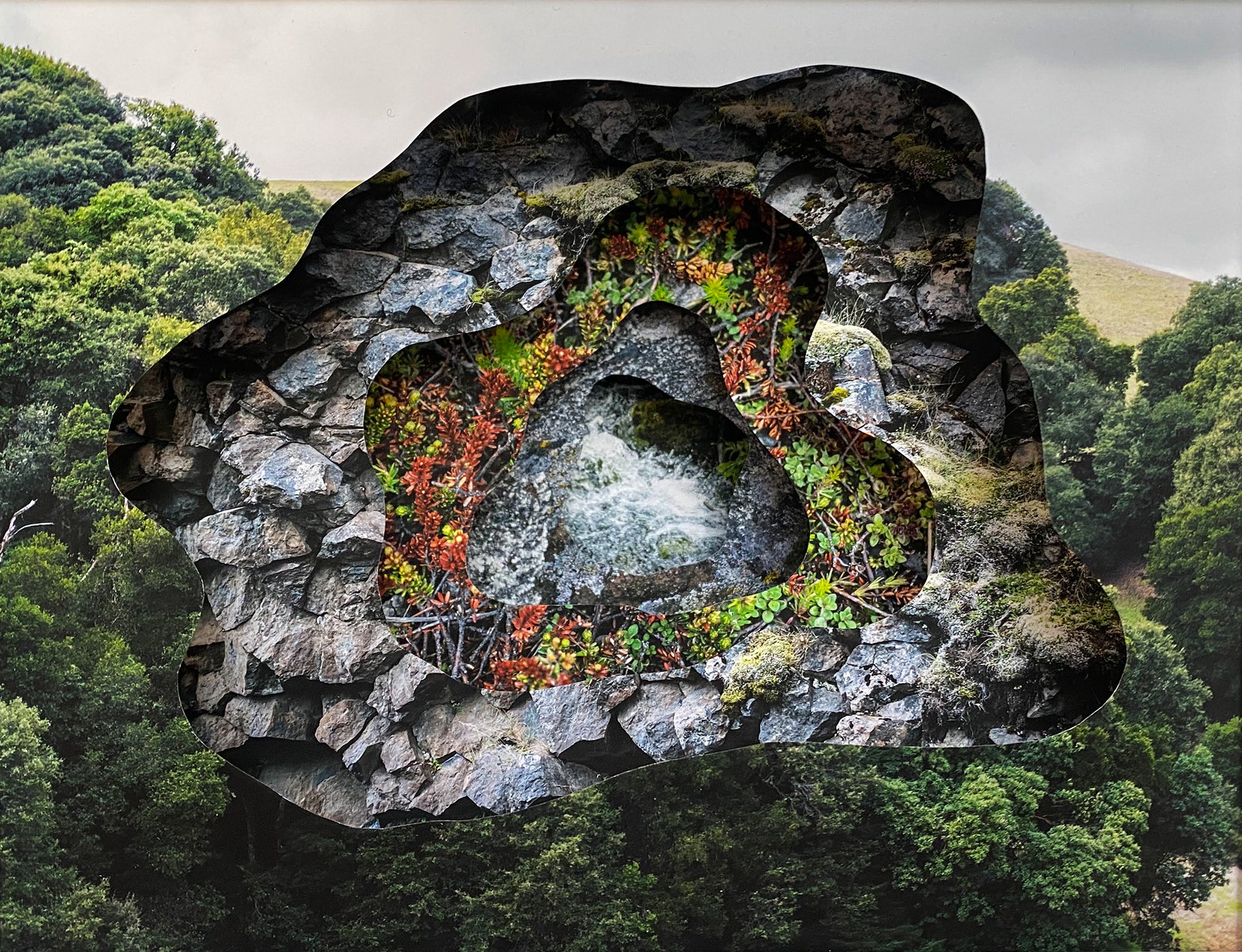
As her children grew, her work switched to focus more on family and life changes, with the themes of time evolving and nostalgia for moments in time coming to the fore. But in 2016 she turned back to landscapes, this time feeling an urgency “not to assemble the landscape, but to disperse it in pieces”. She wasn’t sure where this impetus was coming from, or what it would look like. She knew only that the dispersal should be a meaningful pattern, something organic. It took a lot of trial and error until she found a technique that resonated, cutting up her photographs and layering them. This was a destructive act for her, as she described it, “physically cutting up these memories”. But Iceland was changing, and it felt right.

Hauksdóttir began with a fingerprint pattern, here rendered in black velvet, that reminds viewers that we are more than passive observers of nature.

image
Impression XXV, by Charlotta Hauksdóttir

She also employed a cut-out pattern of retinal veins, conveying “our unwillingness to admit or see what’s happening in nature”.

image
Imperception IV, by Charlotta Hauksdóttir

In other works gaps in the terrain, often where snow or ice might have been, are filled with texts about global warming.

image
Erosion VII, by Charlotta Hauksdóttir

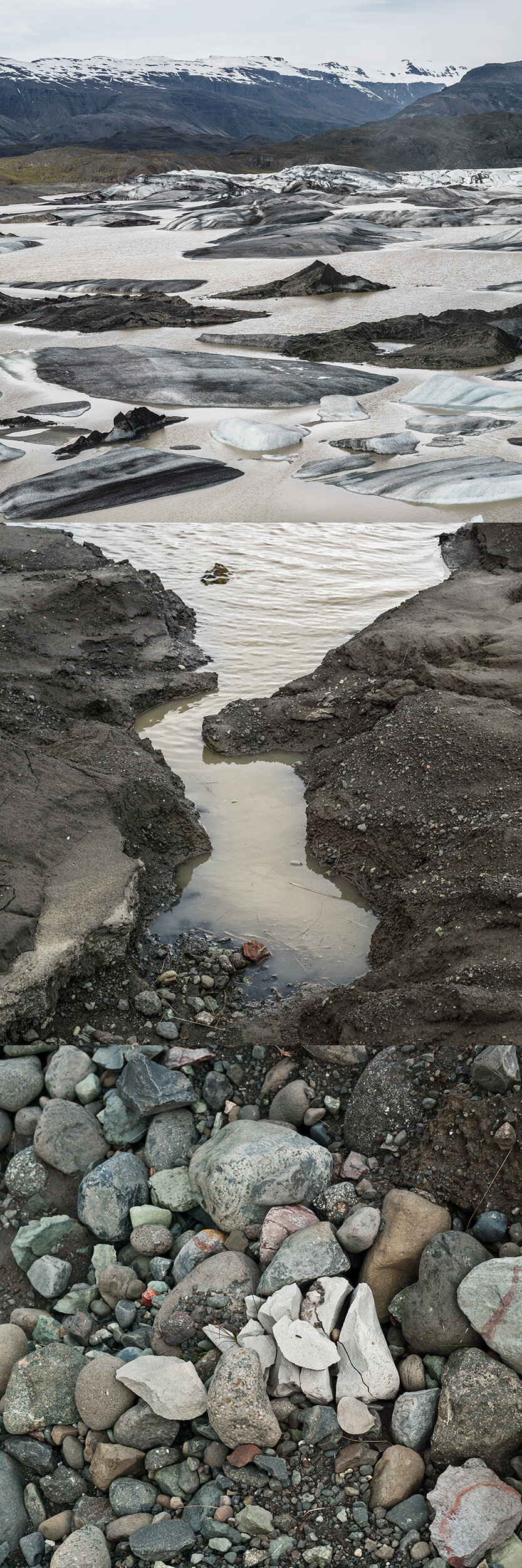
Hauksdóttir recalls seeing Iceland change through her twenty years of photographing it. “If you look at the glacier in this photo, I took that in 2014. I went back in 2019, and the glacier was so much smaller, with pieces coming off as I watched. The erosion of nature that I have witnessed is represented in these works.”

A series of topographic works physically removes pieces of the landscape, giving a sense of time passing as erosion happens.

image
Topography Study XV, by Charlotta Hauksdóttir

“People often visualize topography,” Hauksdóttir observes, “with the pieces being built up from the base. But in mine they are cut away from the surface, showing the wearing away of our natural environment.” In an upcoming exhibition in Berkeley, viewers will themselves be taking away some of these pieces, reinforcing our involvement in the environmental degradation we are seeing.

Hauksdóttir’s work continues to evolve. With the storms of last year, she incorporated both the destructive force of the winds and our ability to repair by weaving together pictures bound around sticks. This work is more hopeful in that it not only cuts things up but also binds things together.

image
Reclamation IV, by Charlotta Hauksdóttir

This year, after many walks with her dog looking at plants growing in the smallest of sidewalk cracks, she developed new works that emphasize the resilience of nature in the face of the changes we are seeing.

image
Resurgence III, by Charlotta Hauksdóttir

“Sometimes I get criticism that my works are too beautiful, that they do not show enough of the destruction from climate change, or the harm that we are doing to the planet. But at the same time, it is important to draw viewers in. I find that people appreciate the works even more when they understand what they are about.”

Art can help us to connect with our feelings. Even Hauksdóttir does not know what her works are about until after she has created them and reflected upon them. We need to bring both our hearts and our minds to the environmental challenges we are facing. It is not enough to know without caring, or to care without knowing. Art that incorporates climate change themes can help us to reflect more deeply on the scale of the change, the destruction, the uncertainty, and the resilience that we are living with as the planet warms.

image
Indentation I, by Charlotta Hauksdóttir

You can see more of Hauksdóttir’s work on her website. She has a studio in Palo Alto’s Cubberley Community Center. She also has multiple pieces up at the Garvey Simon Gallery in San Anselmo, and will soon have several on display at 120710 in Berkeley. I hope many of you will take a look.

Happy Thanksgiving to everyone!

Current Climate Data
Global impacts (October 2023), US impacts (October 2023), CO2 metric, Climate dashboard

Globally, October 2023 was the warmest October in the 174-year NOAA record. The year-to-date (January–October) global surface temperature ranked as the warmest such period on record. October 2023 marked the fifth consecutive month of record-warm global temperatures. According to NCEI’s Global Annual Temperature Outlook and data through October, there is a greater than 99% probability that 2023 will rank as the warmest year on record.

Comment Guidelines
I hope that your contributions will be an important part of this blog. To keep the discussion productive, please adhere to these guidelines or your comment may be edited or removed.
– Avoid disrespectful, disparaging, snide, angry, or ad hominem comments.
– Stay fact-based and refer to reputable sources.
– Stay on topic.
– In general, maintain this as a welcoming space for all readers.