“Canstruction” sculptures are on display through Nov. 13.
Design competition features sculptures made from canned food


Earlier this year, we spoke to Harry Hall about his penchant for documenting people enjoying some of leisure’s greatest niches. At the time, he was capturing a community of fen skaters in East Anglia, catching them in moments of pause with tender portraits. Continuing on his work rooted in a world of reportage and documentary, Harry has taken his camera to photographing ploughmen and women in competition, making up his new venturesome series, The Sow Must Go On.
With a desire to capture the changing of the seasons, the competition presented the chance for Harry to tell another rural story. “I grew up in Suffolk and now I’m based in London, and maybe [in my personal work] I feel a responsibility to tell stories close to home or in the countryside,” he tells us. After some time traversing The Society of Ploughmans’ website, he became familiar with the competitions for the summer to autumn transition. “From the list I was able to contact some farmers and hosts directly to discuss my plans to create a portrait of a ploughing match,” he adds.
With the nature of close-knit community events, it’s no wonder when members become suspicious of outsiders with cameras, but Harry was adamant on building a rapport on his visit to the East Anglican branch of the Vintage Tractor and Engine Club. “They were really receptive to my interest and I had someone to refer to when I went up to people in the fields and asked to take their picture,” he tells us. “People are quick to see through fake curiosity, genuine interest will always help to build relationships quickly.” Much like his last personal series, The Sow Must Go On isn’t overly busy or trying to depict the technicalities of ploughing. They range from communal to familial with an air of mundanity. In one portrait of two young boys and an older ploughman, you get the feeling of ploughing and competitions as something to be passed down to the younger generations, a choice in documentation that perhaps stems from Harry’s relationship to farming through his grandparents.


The event’s inaugural edition showcases works by indigenous contemporary artists across the region, including New Zealand’s Lisa Reihana and Taiwan’s Yuma Taru.

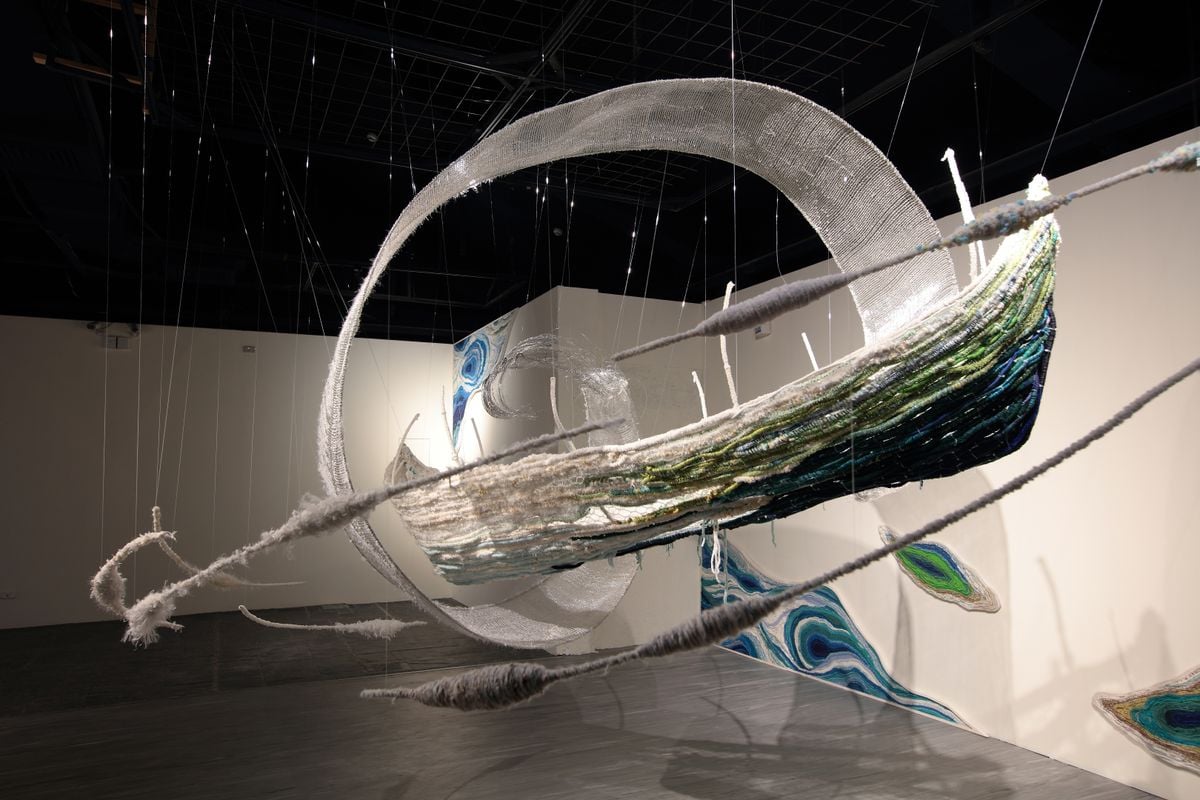
Milay Mavaliw, Dalan (Road) (2023). Huge hemp rope, knitting device, dimensions variable. Courtesy of Taiwan International Austronesian Art Triennial. Photo: Jing Dean Commercial Photography.
The first Taiwan International Austronesian Art Triennial 2023 opened on 29 October at the Taiwan Indigenous Culture Park in Pingtung. It continues through 18 February 2024.
The Triennial’s inaugural theme is RamiS: Tracing Origins. RamiS means ‘root’ in the Proto-Austronesian language, encapsulating the cultural and ecological practices that relate the indigenous people of Taiwan to those of the Australaisa and the Pacific.
Nakaw Putun, an Indigenous Taiwanese Pangcah artist and co-curator of the Triennial, described the title as a ‘reflection of the idea that we perhaps need to actively become spiritual to collaboratively think about the sustainability of humanity.’

Lisa Reihana, Nomads of the Sea (2019). Video, 17 min. Courtesy of Taiwan International Austronesian Art Triennial. Photo: Jing Dean Commercial Photography.
Lisa Reihana, who represented New Zealand at the 57th Venice Biennale, is one of 25 artists from Taiwan and across the Pacific who feature in the show.
Her multi-channel video installation Nomads of the Sea (2018) weaves a narrative that explores colonialism while re-examining traditional Maori culture and gender roles. It’s displayed under the Triennial’s sub-section, Becoming Spiritual, which was curated by Putun and delves into how Austronesian people’s animistic beliefs exemplify a sustainable relationship with nature.
Indigenous Taiwanese artists exhibiting under this theme include Truku-Atayal artist Idas Losin, who will feature in the 24th Biennale of Sydney next year, and Makotaay artist Iyo Kacaw, whose wood sculpture Between You and Me (2023) deals with the degradation of the ocean.

Yuma Taru, Sea・Rise, and River・Flow (2023). Mixed media, dimensions variable. Courtesy of Taiwan International Austronesian Art Triennial. Photo: Jing Dean Commercial Photography.
In the Triennial’s other sub-section, Why We Are Us, co-curator Etan Pavavalung curates an impression of ‘the Austronesian “us”,’ as he describes it, shaped by colonialism, trauma, common challenges, and shared solutions.
Atayal artist Yuma Taru‘s installations Sea·Rise and River·Flow (2023), for instance, are part of a 50-year creative plan that involves weaving and chanting based on observations of shared issues among Austronesian communities.
‘The exhibition shares experiences of existence and attempts to guide viewers into contemplating our affinity with the Austronesian realm’ and ‘our communal trajectory towards a sustainable future,’ Pavavalung said. —[O]

Editor’s Note: Call to Earth is a CNN editorial series committed to reporting on the environmental challenges facing our planet, together with the solutions. Rolex’s Perpetual Planet initiative has partnered with CNN to drive awareness and education around key sustainability issues and to inspire positive action.
An animal grazes, oblivious to another tracking it silently from behind. The predator waits for the perfect moment, then pounces. It’s over in a flash.
It’s a scene most of us might associate with an open savannah in a nature documentary, but photographer Andy Murray is watching the drama unfold from his back garden in Somerset, UK. He’s on his knees, staring through a loupe (a small magnifying glass) as a 6-millimeter-long pseudoscorpion takes out a springtail more than half its size.
To Murray, these microscopic soil animals are as fascinating as the lions and zebras you might see on safari – just far more accessible, if you know where to look.
“They live in this tiny world; it works like our world, it’s just on a really small scale,” he tells CNN. “If you watch it long enough, you can see the same things go on: you can see hunters and the hunted, you can see grazing animals, you see bizarre and funny interactions.”
And your chances of seeing some form of soil life, albeit through a magnifying glass, are high. According to a recent study published in the journal PNAS, more than half of all species live in the soil, making it the most species-rich habitat on Earth.

Yet despite this wealth of life, the creatures living in the soil beneath our feet are relatively unknown. Murray wants this to change and hopes that through macro photography he will be able to unearth the quirks and characteristics of these extraordinary animals and make a case for their protection.
“Photographing a world that hasn’t been photographed much before is a huge thrill,” he says. “It’s an explorer feeling, it’s exactly the same as why people went up Everest or to the North Pole, just on a small scale.”
Murray, 56, recalls how his interest in the microscopic dates to when he was a child, but for years technology limitations meant he was unable to share what he saw. Over a decade ago, when macro photography became possible on a digital camera, he devoted himself to the craft, juggling it alongside jobs as a musician, a chef, and currently as a freelance copy editor.
While he has no scientific background, Murray says he has “the tools and the passion” and has clocked up well over 10,000 hours in the field in Europe as well as Australia and New Zealand.
During this time, he estimates he has discovered 30 new species, including one in a pond in his garden. His photographs have been used in scientific reports, including the recent PNAS study, and he also documents his findings on his website “The Chaos of Delight.”

But there’s a danger that some soil animals may go extinct before they are even identified, as their habitat becomes increasingly degraded due to intensive agriculture and deforestation. According to the United Nations’ Food and Agricultural Organization, a third of the Earth’s soil is already eroded and this could reach a shocking 90% by 2050.
Losing these organisms would have huge ripple effects, explains Mark Anthony, an ecologist at the Swiss Federal Research Institute for Forest, Snow and Landscape Research, and co-author of the PNAS report. The tiny creatures play an outsized role for the planet, both as decomposers and as a key food source for animals higher up on the food chain.
“That decomposition is critical. Without it, we wouldn’t have carbon accumulate in the soil and we would be buried in organic materials,” he says.

The report found that soil is likely home to 59% of the species on Earth, from microbes to mammals (although it notes a large error range of 15%, pointing to the difficulty in estimating soil biodiversity). Anthony hopes that illustrating the sheer scale of soil life will help to conserve it, comparing the research to a government census: “You take a census to get a sense for where people live, or where you need to distribute resources to support them. This is basically a census to try and say, ‘Hey, we have resources we’re putting into the biodiversity crisis, we should reallocate more of those resources to focus on soil conservation.’”
The challenge is making people care about soil’s creepy-crawlies as much as they do about elephants, penguins, or other conventionally cute and more visible animals.
This is where Murray’s photography comes in. Capturing the colors, bulges, textures and faces of these otherworldly creatures can make them relatable.

His heart is with the springtails, the first soil animal, besides regular worms and wood lice, he ever set eyes on. The tiny critters are found all over the world, capable of surviving extreme temperatures, but they are often considered pests and controlled with insecticides because of the damage they can cause to crops.
He believes that if people could see them up close and witness their colors and complexities, this view might change. “They’re just weird and squashy and interesting, and they’ve got faces,” he says. “It’s very hard to look at them and not find them cute.”
By observing the creatures interact in their natural habitat, Murray is also helping to feed the science. “He captures moments of soil life doing interesting and cool things,” says Anthony, such as laying eggs in a place where we would never expect. “It gives us an appreciation of what they’re doing when they’re in their home.”
Despite the seemingly limitless subject material, Murray believes he may be one of only a dozen or so professional photographers in the world focusing on soil animals. There is so much more to be discovered, and these extraordinary, alien-like animals are on all our doorsteps.
“Every single person with a loupe can go into a garden or a park and they can see the things that I see,” says Murray. “It’s all there – it’s just another world.”


Wendy Ewald is an American photographer and teacher. Ewald has collaborated on photography projects with children, families, women, workers and teachers. Her projects start as documentary investigations and move on to probe questions of identity and cultural differences. Her work is in the collections of Detroit Art Institute, Metropolitan Museum of Art, Duke University, Rhode Island School of Design and Whitney Museum of American Art, among others
Photograph: Wendy Ewald/Courtesy Stephen Bulger Gallery