Flag raising ceremony, new sculpture display at Myrtle Beach World War II Memorial site
By Admin in Art World News
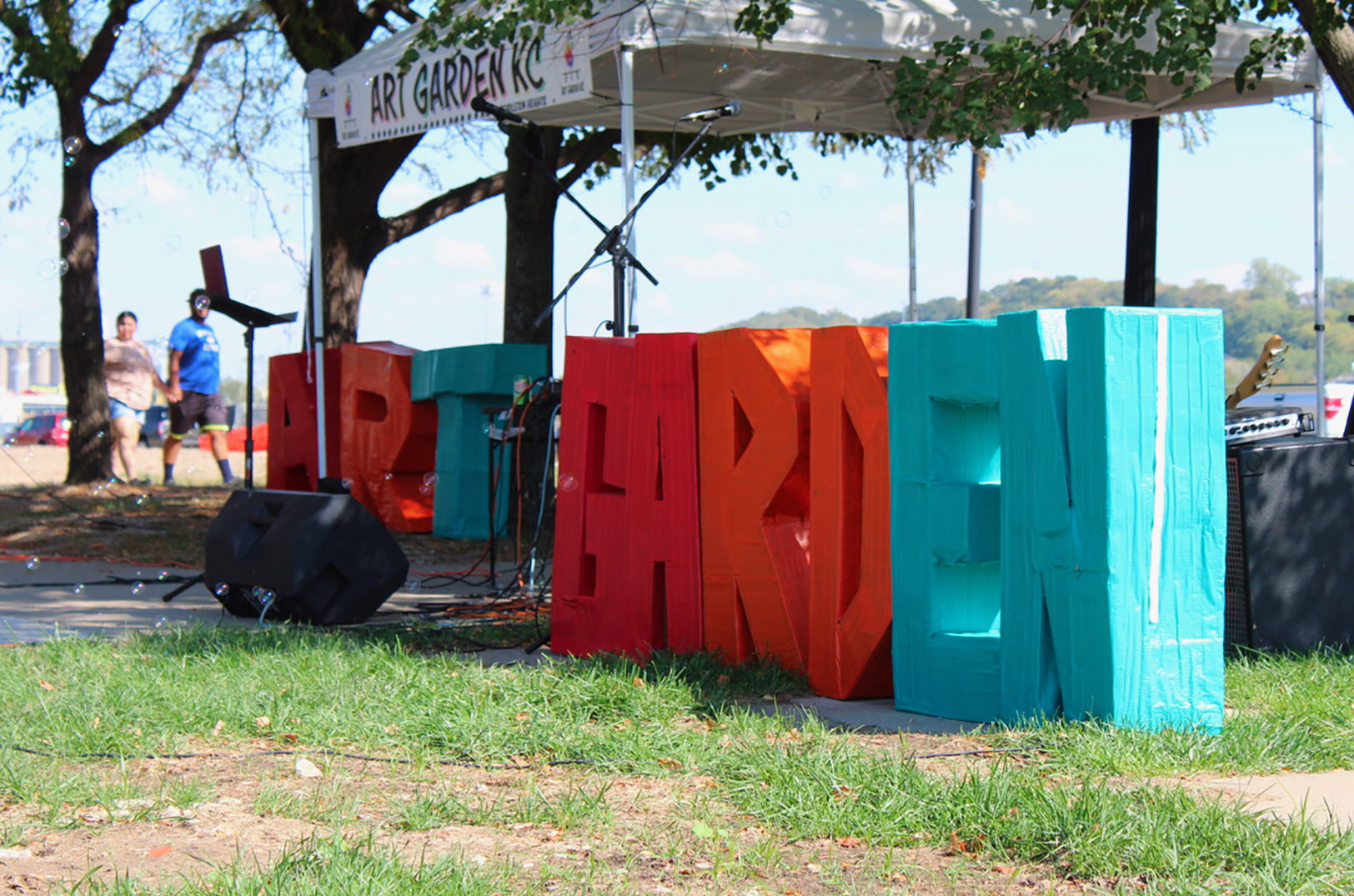
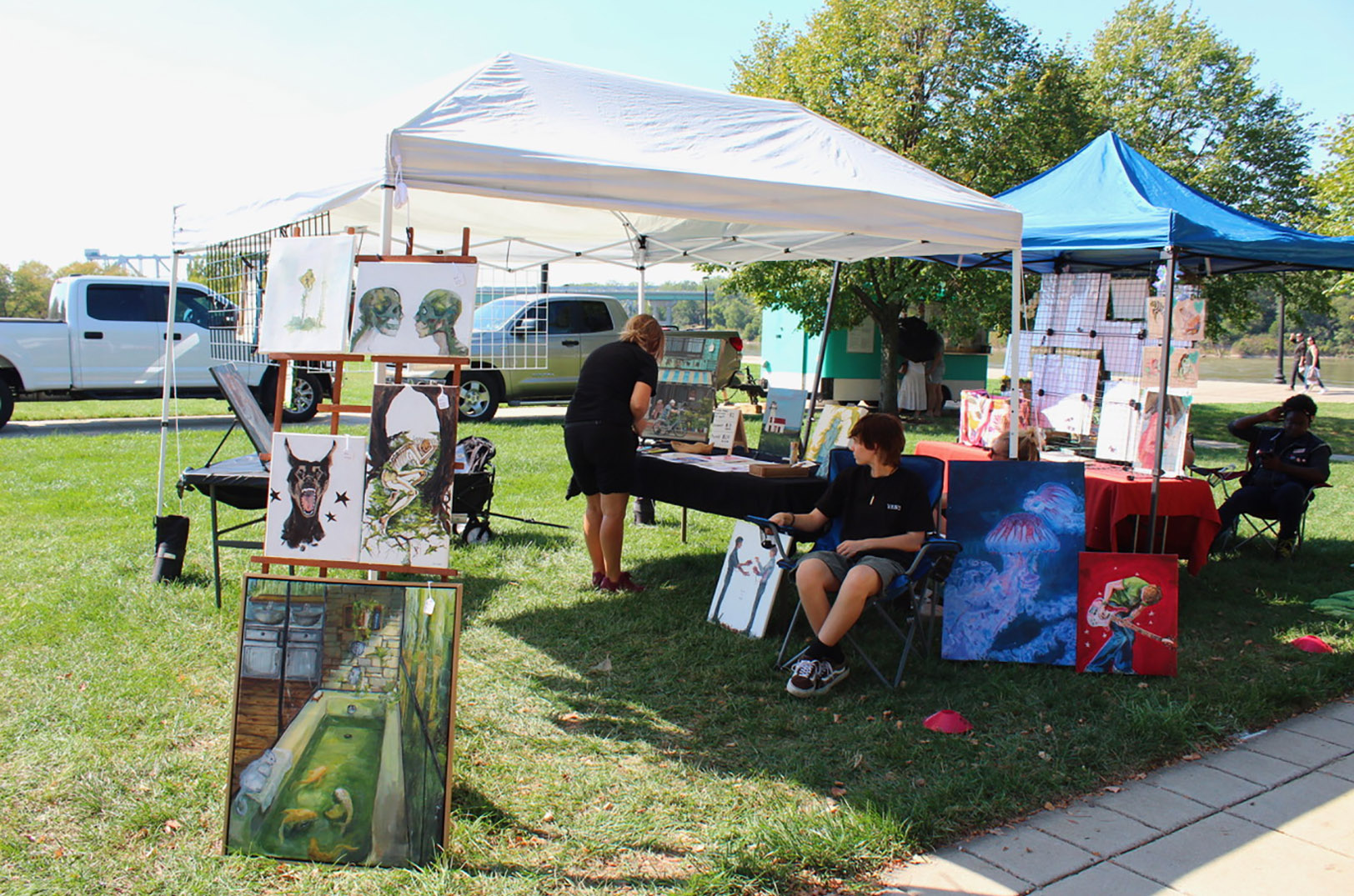
While unpredictable Midwest weather canceled the outdoor finale of Art Garden KC’s season this weekend at the Berkley Riverfront, the spirit of the maker market will pop up again soon with an indoor event in the Crossroads.
Art Garden KC’s Beggars Bazaar — set for 6 .m. to 9 p.m. Friday Nov. 3 — returns to the Beggars Table, 2010 Baltimore Ave., for First Friday. The open and inclusive church/gallery space is committed to supporting local arts, organizers said, making room for a number of Kansas City artists and makers.
Click here to learn more about Beggars Bazaar.
Art Garden KC, a grassroots, artist-led collective, organizes affordable, low barrier pop-up markets and festivals in Kansas City with the mission to create equal economic opportunity for local creative entrepreneurs while hosting engaging, community-centric events in safe, inclusive spaces for creative expression and collaboration.
It was set to close its third season — typically spanning April to October at Berkley Riverfront Park — this weekend with Halloween on the Riverfront, but the Sunday event was canceled because of recent prolonged rain and cold weather at the venue.
More shopping opportunities are set to return on Black Friday, when Art Garden KC’s Merry Market opens at City Market. The holiday-focused event series runs weekends, Thanksgiving through Christmas.
Click here for details on the Merry Market.
It started with Sundays
Since 2021, Art Garden KC has brought together Kansas City artists every Sunday to build community and share their creations. Like many ventures popping up in the past few years, the effort was born amid new pandemic-era perspectives.
Bethany Alzandi, the founder of Art Garden KC, had just moved into the Pendelton Arts Block in Kansas City’s Northeast, an apartment community with a preference for artists and creatives in Pendelton Heights, with her husband Mustafa right before COVID-19 hit Kansas City.
Alzandi saw the need for a place for artists to come together more than ever, especially as COVID put a stop to all in person events in the community.
“You had a lot of great people and great artists that had moved in that were ready to start creating and collaborating and building some community programming in the Northeast area,” Alzanadi said.
“I feel like a lot of artists weren’t working or vending or showing their art throughout COVID,” she continued. “We felt that mental health had declined in the building we lived in, and substance abuse had gone up. So, we imagined that was something people were facing community wide.”
A year later, in spring 2021, Bethany and Mustafa organized their first event: a gathering of five artists in a field, coming together to share their crafts.
“We found an area across from our local coffee shop that was an outdoor space and chose to do something every Sunday. It was accessible for families, the after-church crowd, and a day when not much else was going on,” Alzanadi said. “We just started inviting artists from all over the city to come join us and hang out on Sundays.”
The Sunday meetups organically grew into an art market and received plenty of feedback from the community. They added spaces for other creatives to showcase their crafts, including an open mic and group yoga practice.
“,”load_all”:false,”error_template”:”
{{ERROR}}
“,”inner_caption”:false,”caption_position”:false,”arrow_position”:false,”toolbar”:true,”infobar”:false,”show_smallbtn”:false,”idle_time”:false,”click_content”:false,”click_slide”:false,”click_outside”:false,”animation_duration”:false,”transition_duration”:false,”small_btn_template”:”“}”>
No imposters here
After organizing its 2022 season at City Market, the art fair found a new home at the Berkley Riverfront Park in 2023 with support from Port KC and the Troost Market Collective.
As its fiscal agent, Troost Market Collective allows Art Garden KC to keep its booth fees for vendors low — at just $10, Alzanadi said. Compared to other markets that might charge $150 to $500 in booth fees, this allows artists who are just starting out or have limited financial resources to participate in their festivals.
Art Garden KC also provides local artists a place to build community and confidence, in addition to a venue to showcase and sell their work.
“We had artists coming up and with tears in their eyes, saying, ‘Thank you so much. I made $300 today,’” Alzanadi said. “My husband and I looked at each other and said, ‘OK, we’ve got something here. There’s a need for this. The community supports it. Let’s start getting organized.’”
In the next year, Alzanadi said, she hopes to expand Art Garden KC by offering Vendor 101 classes to teach artists how to sell their work in markets and galleries.
Alzandi has come far, she said — initially feeling like an imposter trying to break into the art scene when she first moved to Kansas City. Now, she’s inviting artists from across the city to hang out with her on Sundays.
“When you lower the booth fees, and you don’t tell people their art isn’t good enough to get in, it takes away that competitive nature,” Alzanadi said. “It takes away that fear and anxiety that most artists would feel when entering an art market or a gallery.”
By Admin in Photography
Henri Cartier-Bresson, often regarded as the father of modern photojournalism, once said, “To photograph is to hold one’s breath when all faculties converge to capture fleeting reality. It’s at that precise moment that mastering an image becomes a great physical and intellectual joy.”
This profound understanding of the medium is vividly evident in his iconic photograph, “Behind the Gare Saint Lazare.”
Here are the lessons I’ve gathered from it during my photos analysis of “Behind the Gare Saint-Lazare”. Watch the video I created on this topic here:
Henri Cartier-Bresson’s concept of the “decisive moment” suggests that there is a precise and unique instant when the visual and emotional elements of a scene come together in perfect harmony. “Behind the Gare Saint Lazare” epitomizes this notion.
In the photograph, we witness a man mid-leap over a puddle, creating a mirrored reflection juxtaposed against the background of a circus poster. Everything in that frame harmonizes in such a way that even a split second earlier or later would not convey the same story or emotion.
Lesson: Be present and observant. Wait for the perfect confluence of events to tell a compelling story.
Henri Cartier-Bresson shot “Behind the Gare Saint Lazare” through a fence, which would typically be seen as an obstruction. Yet, he used it to his advantage, adding another layer of depth and intrigue. The fence’s bars offer a sense of containment, making the leap appear even more daring.
Lesson: Don’t be confined by conventional photography rules. Embrace obstructions and leverage them creatively.
The background circus poster in the photo, depicting another leap, provides a surreal context that elevates the narrative. This serendipitous backdrop makes the photograph more than just a man jumping over a puddle; it adds a layer of whimsy and artistry.
Lesson: Always be aware of the background. It can provide context, enhancing the narrative of your shot.
Cartier-Bresson did not use the viewfinder for this shot. Instead, he acted on instinct, capturing a moment he felt rather than one he meticulously planned. The result wasn’t technically perfect, but it was emotionally resonant.
Lesson: Trust your gut feeling. Not every great shot comes from careful planning; sometimes, it’s the spontaneous ones that leave a lasting impact.
As the video highlighted, Cartier-Bresson’s consistent dedication to street photography and his commitment to the process led to masterpieces like this. He once remarked, “Your first 10,000 photographs are your worst.”
Lesson: Persistence and consistent practice are key. Every shot you take, good or bad, contributes to your growth as a photographer.
In conclusion, “Behind the Gare Saint Lazare” is not just a photograph; it’s a lesson in storytelling, intuition, and the art of observation. Henri Cartier-Bresson’s masterpiece serves as a reminder that photography is as much about the photographer’s vision and approach as it is about the subject. Through understanding and learning from iconic works such as this, we can push our boundaries and redefine our perspective on the world through our lens.
By Admin in Photography

Talented, charismatic and internationally well-connected, Rosellina Burri-Bischof organised groundbreaking photo exhibitions in Switzerland as early as the 1950s. She was also the director of Magnum Photos in Switzerland and the co-founder and long-time head of the Swiss Foundation for Photography.
This content was published on October 28, 2023 – 10:30
October 28, 2023 – 10:30
Text by Monica Boirar; photos edited by Thomas Kern
Rosellina Burri-Bischof dedicated her life to promoting photography in Switzerland. Her contemporaries remember her as a great networker, a beautiful woman with a black lion’s mane, and a charismatic philanthropist.
She was a very empathetic person and a lobbyist for photography, says Rolf Sachsse, photographer and professor emeritus at the Saar College of Fine Arts in Germany.
In the October 1974 issue of the Swiss cultural magazine Du, the then editor-in-chief Manuel Gasser wrote: “Ms. Rosellina Burri-Bischof was the first person to recognise the need for an institution to actively promote the interests of photography. She became the driving force behind its establishment.”
In the international photography magazine Camera, the journalist and writer Hugo Loetscher declared that it was not he, but Rosellina Burri-Bischof, who had created the Swiss Foundation for Photography today’s Fotostiftung Schweiz. Yet by the time the foundation officially came into being in 1971, Burri-Bischof had already been working with heart and soul for two decades to promote photography in Switzerland.


The only child of a Hungarian-Jewish emigrant couple, Moses and Anna Mandel, Burri-Bischof was born in Zurich on June 5, 1925. After training as a kindergarten teacher, she worked in Rimini, Italy, from 1946, where she looked after war-traumatised orphans at the Italo-Swiss education centre (Centro Educativo Italo-Svizzero). There she met and fell in love with Swiss photographer Werner Bischof, who was preparing a report on the centre’s work. Back then she was still called Rosa Mandel, although her friends called her Rösli. To the Italians she was Rosellina.

The couple were married in May 1949 and, according to their eldest son, Marco Bischof, his mother immediately started working in the “back office”. She saw to all the administrative aspects of her husband’s photographic work and accompanied him on trips to Europe, Asia, Japan, the United States and Mexico.
On May 16, 1954, Werner Bischof was killed in a tragic accident, when the vehicle he was travelling in plunged into a ravine in the Peruvian Andes. A geologist and the driver also lost their lives.
News of the death of the renowned photographer – who was a member of the still young agency Magnum Photos – spread like wildfire in Zurich, where it was met with grief and shock. The road they were travelling on was “no better and no worse than any other road in that region”, Gasser wrote in his biography of Werner Bischof, in accompaniment to the photo book A Photographer’s Odyssey, published by Rosellina Bischof in 1957.
When Werner Bischof died, his wife was heavily pregnant with their second son, Daniel, who was born nine days after the accident. Now a widow and single mother of two sons, Rosellina Bischof devoted herself to managing her husband’s valuable trove of images.
In autumn 1954, she organised a vernissage to celebrate the launch of the photo book Japan as well as a travelling exhibition. Two years later, she became the director of Magnum Photos in Switzerland. The agency was a cooperative in structure and committed to socially critical, humanistic photography.
In 1956, Rosellina Bischof, together with the Parisian publisher Robert Delpire, persuaded the Kunstgewerbemuseum (the Museum of Decorative Arts, now the Museum of Design) in Zurich to hold an exhibition on Henri Cartier-Bresson. In 1957, she launched a travelling exhibition of the photographs of Werner Bischof, in cooperation with the same museum. In 1961, she showcased war photographs by Robert Capa, which she managed to bring over from New York.
With these three presentations of top-class photographs, Burri-Bischof deepened the Swiss public’s understanding of photography as an art form; it was a real “school of seeing”. And this was just the beginning.
The photo exhibition The Family of Man, curated by star photographer Edward Steichen, opened in New York in 1955 and was hosted by the Kunstgewerbemuseum in Zurich in 1958. Steichen was an important role model for Burri-Bischof. From 1947, he had directed the substantial photography department of the New York Museum of Modern Art (MoMA), which had already been collecting photography on a par with all other arts since the early 1930s.
At the time, few people in Switzerland had thought of collecting photographs professionally, although the photographic medium was present at the highest level. Thus, the Swiss-published international monthly review of photography and film, Camera, was sold by subscription around the globe.
The photography teacher Hans Finsler was legendary: together with Alfred Willimann, he trained scores of photographers, many of whom went on to become famous – among them were Werner Bischof, Ernst Scheidegger and René Burri. Arnold Kübler was also a great promoter of photojournalism in Switzerland, supporting and encouraging Paul Senn and Annemarie Schwarzenbach, for instance.
In 1963, Rosellina Bischof married the Magnum photographer René Burri. Their union produced two children, Yasmine and Olivier. Burri-Bischof maintained friendly relations with the Magnum agency, the Center of Photography in New York, and many important photographers.
Cornell Capa, Robert Capa’s brother, founded the Bischof-Capa-Seymour Photographic Memorial Fund in New York in 1966 in memory of the three Magnum photographers who had been killed in the course of their work. Burri-Bischof was appointed by Capa to the fund’s board of trustees. In 1968, the fund, now renamed the International Fund for Concerned Photography, held a first exhibition in New York.
Burri-Bischof was invited by Capa to bring the entire display to Zurich. There it was shown at the Heidi Weber Museum–Centre Le Corbusier in the lakefront neighbourhood of Seefeld, in 1970. The exhibition was a great success. Many well-known photographers and prominent figures from Paris and New York attended the opening event.
Originally envisaged as a Swiss offshoot of Cornell Capa’s New York-based foundation, the Swiss Foundation for Photography was officially created on May 4, 1971 as an autonomous institution under Swiss law.
According to its own figures, the Fotostiftung Schweiz (the Swiss Foundation for Photography) holds a collection of more than 50 estates and some 50,000 original prints. Together with the Photo Elysée museum in Lausanne, it is a major institution dedicated to Swiss photography.
End of insertion
Burri-Bischof was one of eight co-founders of the institution. The first president, Manuel Gasser, was very well connected, both on the Zurich cultural scene and with big names in industry and business. Together, Gasser and Burri-Bischof skillfully negotiated hospitality rights for the new foundation at the Kunsthaus Zürich art museum.
The path was now open for a photography department like the one at New York’s MoMA. A first exhibition, Photography in Switzerland – 1840 to the Present, was held in the museum’s Bührle room in autumn 1974. It was a resounding success. A first stock-staking of photographic creation in Switzerland, it went on tour for several years.

The journalist and photo historian Charles-Henri Favrod was among those who contributed to the book publication of the same name. This led to closer exchange with the French-speaking part of Switzerland, in particular the Lausanne photography museum, the Musée de l’Élysée, which Favrod had founded in the 1980s.
Burri-Bischof played a key role in the decision-making process within the Swiss Foundation for Photography; her warm-hearted nature and ability to build and cultivate friendships were also reflected in her professional work.
Over the years, Burri-Bischof was able to organise six to seven exhibitions a year at the Kunsthaus Photo Gallery – not just on Swiss photography, but also international greats and old masters. The first solo exhibition was devoted to Robert Frank in 1976. Gasser had already dedicated an entire issue of Du to the prominent Zurich native and adoptive New Yorker in 1962. By the tenth anniversary of the Foundation for Photography in 1981, Burri-Bischof had a total of 36 exhibitions to her name.
At the Kunsthaus Zürich, Burri-Bischof was a pioneer in bringing photography as an art to the public at large. This also benefitted the Stockeregg Photo Gallery, founded in 1979, for the exhibitions at the Kunsthaus had awakened an appetite for photography among well-heeled collectors.

Burri-Bischof, woman of the world and promoter of photography in Switzerland, died in 1986. She did not live to see the retrospective of Werner Bischof’s photographs at the Kunsthaus Zürich, which she had worked on for two years. Without her, photography in Switzerland would not have had the same status or achieved the same recognition that it does today.
Edited by David Eugster. Translated from German by Julia Bassam.
In compliance with the JTI standards
More: SWI swissinfo.ch certified by the Journalism Trust Initiative
By Admin in Photography
Deirdre BrennanIf you are named Brigid, or know someone who is, there is a photographer who would like to speak with you.
Deirdre Brennan is creating a special series of portraits in honour of Ireland’s only female patron saint.
St Brigid is one of Ireland’s three official patron saints, along with St Patrick and St Colmcille.
Ms Brennan will be in the Playhouse theatre in Londonderry next week for the project, which is being billed as a celebration of modern-day Irish women.
The photographer is asking each woman to bring an object to hold in their photograph that symbolises their lives, work, interests, achievements or also their relationship to St Brigid.
The project, which started in September, is hoping to be finished for 1 February on the reported anniversary of St Brigid’s death.
Ms Brennan said women and children of all ages named Brigid, Bridget, Bríd, or any spelling of the name, can get their portrait taken as part of the project.
Speaking to BBC’s The North West Today, the Dublin-born photographer has said the project has taken her all across the island of Ireland.
She said she is particularly hoping to find women named Brigid, who are synonymous with Derry.

“I’m particularly keen to speak to Brigids who were involved in the civil rights movement and who were there in Derry for the Bloody Sunday march on 30 January 1972,” she said.
She said she is also hoping to capture any Brigids involved with the hit Channel 4 comedy series Derry Girls and also women who worked in some of the city’s 44 historic shirt factories.
Derry was a world leader in shirt production and the city’s female workforce powered much of the industrial development of the city.


Brigid was a triple goddess of healing, fire and of poetry.
The saint, who took her name, carried some of those associations.
She was reportedly born in 450 AD and died around 525 AD and was the patron saint of poets and midwives.
Brigid’s roots lie in the Celtic festival of Imbolc, celebrated at least five millennia ago.
The first Irish bank holiday for St Brigid took place in the Republic of Ireland in February.
In Ireland, 1 February marks the beginning of spring and the celebration of Lá Fhéile Bríde – St Brigid’s Day.
Brigid’s name is synonymous with Kildare as it is believed she founded the Church of Kildare.

Ms Brennan said she has been blown away by the response she has got to her appeal for Brigids on social media and through word-of-mouth.
“I think there have been well over a thousand requests to be a part of the project which I will then have to whittle down to about 50 or 70,” Ms Brennan said.
“Everyone has a great story to tell and this is just a way to channel that into this kind of historical archive piece.”
Ms Brennan said she has met so many incredible Brigids so far on her search for people with the name.
“I met a woman who was born in Kenya called Brigid, there was also a nun named Brigid who helped set up the first refuge in Cork in the 60s for victims of domestic violence,” she said.
The photographer said one of her favourite encounters was meeting the mother of a young girl called Brigid who had Down’s syndrome.
“The mum really wanted her daughter to be involved with this project to make sure there is greater representation for people with Down’s syndrome,” she said.
“The girl also had an incredible story in that she had very serious heart surgery at a young age and was fitted with a valve from a cow and has since went on to live a healthy and full life because of that.
“There’s an amazing connection there given Brigid is also the patron saint of cattle.”
Ms Brennan hopes her work can highlight the importance of the name Brigid in the modern day and showcase people’s own stories for future generations.
The LeClaire Community Library will host several events in November including two presentations to celebrate Native American Heritage month.
The library will host the special presentation, “Native American and Western Art,” at 6 p.m. Tuesday, Nov. 7.
Every month the library hosts Hands-on Art History. During the event the library explores different artists or art movements and applies these themes to a fun craft for all ages.
This month the Figge Art Museum will give a talk and share a craft on Indian Ledger Art and other Native American art.
Ledger Art features narrative drawings or paintings done on paper or cloth. This flourished primarily from the 1860s to the 1920s and mainly used paper from accounting ledgers.
This event is recommended for participants 8 years and older.
Storyteller and historian, Brian “Fox” Ellis, will present, “Blackhawk’s View of American History,” at 6 p.m. Thursday, Nov. 16 at the library.
During the program he will share with the audience how his family avoided the Trail of Tears and the forced removal of the Cherokee Nation. Participants will be transported back into the dark days of American history with both humor and insight.
Ellis is part Cherokee and has studied with native elders from several tribes. In recent years he was invited to perform at the Apple River Fort for the commemoration of the Black Hawk War and for a group of Sauk and Fox elders at the Black Hawk Museum in Rock Island.
His programs, like this one, give voice to the Native American view of American history, including much that is left out of history books.
The library recently announced the formation of a new recurring program for senior citizens.
Senior Activities and Socializing, will feature refreshments, conversation and guest speakers on a variety of topics.
The new group was the idea of new LeClaire resident, Donna Andruch, who was looking for activities and a way to meet other retired seniors after her move.
The first get-together was held recently with new meetings taking place on the second Tuesday of every month from 10 to 11:30 a.m. The next meeting will be on Tuesday, Nov. 14, in the Community Room. Future activities and special guest speakers will be discussed.
All events take place at the library located at 323 Wisconsin St. in LeClaire. For more information on these events or the library, visit leclairelibrary.org or call 563-289-6007.
Photos: Tugfest 2023 between LeClaire and Port Byron over the Mississippi River.
Adam McKinley wearing a kilt as he pulls for the IBEW team during the The annual Tugfest Saturday in LeClaire as they tug against Port Byron across the Mississippi river.
GARY L. KRAMBECK
Adam McKinley wearing a kilt as he pulls for the IBEW team during the The annual Tugfest Saturday in LeClaire as they tug against Port Byron across the Mississippi river.
GARY L. KRAMBECK
Nick Engelbrecht of Eldridge pulls hard for his team during the annual Tugfest Saturday in LeClaire as they tug against Port Byron across the Mississippi river.
GARY L. KRAMBECK
Allyson Lewis shows the foot markings for the rope travel during the annual Tugfest Saturday in LeClaire as they tug against Port Byron across the Mississippi river.
GARY L. KRAMBECK
John Wayne Brown wearing his cowboy hat pulling for the LeClaire Auto “Albee Strong” team during the annual Tugfest Saturday in LeClaire as they tug against Port Byron across the Mississippi river.
GARY L. KRAMBECK
Members of the women’s team give it their all as they pull against the Port Byron side of the river during the annual Tugfest Saturday in LeClaire as they tug against Port Byron across the Mississippi river.
GARY L. KRAMBECK
Members of the F&S Enterprises team pull against the Illinois team during the annual Tugfest, Saturday in LeClaire as they tug against Port Byron across the Mississippi River.
GARY L. KRAMBECK
Area Iowa high school students participate in the high school tug at the annual Tugfest Saturday in LeClaire as they tug against Port Byron across the Mississippi river.
GARY L. KRAMBECK
North Scott High school student Sawyer Gravert of Eldridge wears his sun glasses during the High School tug at the annual Tugfest Saturday in LeClaire as they tug against Port Byron across the Mississippi river.
GARY L. KRAMBECK
Members of the Van Pelt’s Drywall pull against the Larson Pump team on the Port Byron, Illinois team during the annual Tugfest Saturday in LeClaire as they tug against Port Byron across the Mississippi river.
GARY L. KRAMBECK
Members of the Van Pelt’s Drywall pull against the Larson Pump team on the Port Byron, Illinois team during the annual Tugfest Saturday in LeClaire as they tug against Port Byron across the Mississippi river.
GARY L. KRAMBECK
People cheer on their team as they watch the annual Tugfest Saturday in LeClaire as they tug against Port Byron across the Mississippi river.
GARY L. KRAMBECK
Judges from both the Iowa and Illinois side take down the rope traveled measurements during the annual Tugfest Saturday in LeClaire as they tug against Port Byron across the Mississippi river.
GARY L. KRAMBECK
Tuggers celebrate their wins during the conclusion of the annual Tugfest Saturday in LeClaire as they tug against Port Byron across the Mississippi river.
GARY L. KRAMBECK
Crowds gather along the fence line to watch the annual Tugfest Saturday in LeClaire as they tug against Port Byron across the Mississippi river.
GARY L. KRAMBECK
Peyton Imsland and her father Brett Imsland of Riverdale enjoy the rides during the carnival at the annual Tugfest Saturday in LeClaire as they tug against Port Byron across the Mississippi river.
GARY L. KRAMBECK
Members of the Keith and Company lay on their rope in the last seconds of their tug against DeClercq Farms at the annual Tugfest Saturday in LeClaire as they tug against Port Byron across the Mississippi river.
GARY L. KRAMBECK
#lee-rev-content { margin:0 -5px; }
#lee-rev-content h3 {
font-family: inherit!important;
font-weight: 700!important;
border-left: 8px solid var(–lee-blox-link-color);
text-indent: 7px;
font-size: 24px!important;
line-height: 24px;
}
#lee-rev-content .rc-provider {
font-family: inherit!important;
}
#lee-rev-content h4 {
line-height: 24px!important;
font-family: “serif-ds”,Times,”Times New Roman”,serif!important;
margin-top: 10px!important;
}
@media (max-width: 991px) {
#lee-rev-content h3 {
font-size: 18px!important;
line-height: 18px;
}
}
#pu-email-form-breaking-email-article {
clear: both;
background-color: #fff;
color: #222;
background-position: bottom;
background-repeat: no-repeat;
padding: 15px 0 20px;
margin-bottom: 40px;
border-top: 4px solid rgba(0,0,0,.8);
border-bottom: 1px solid rgba(0,0,0,.2);
display: none;
}
#pu-email-form-breaking-email-article,
#pu-email-form-breaking-email-article p {
font-family: -apple-system, BlinkMacSystemFont, “Segoe UI”, Helvetica, Arial, sans-serif, “Apple Color Emoji”, “Segoe UI Emoji”, “Segoe UI Symbol”;
}
#pu-email-form-breaking-email-article h2 {
font-size: 24px;
margin: 15px 0 5px 0;
font-family: “serif-ds”, Times, “Times New Roman”, serif;
}
#pu-email-form-breaking-email-article .lead {
margin-bottom: 5px;
}
#pu-email-form-breaking-email-article .email-desc {
font-size: 16px;
line-height: 20px;
margin-bottom: 5px;
opacity: 0.7;
}
#pu-email-form-breaking-email-article form {
padding: 10px 30px 5px 30px;
}
#pu-email-form-breaking-email-article .disclaimer {
opacity: 0.5;
margin-bottom: 0;
line-height: 100%;
}
#pu-email-form-breaking-email-article .disclaimer a {
color: #222;
text-decoration: underline;
}
#pu-email-form-breaking-email-article .email-hammer {
border-bottom: 3px solid #222;
opacity: .5;
display: inline-block;
padding: 0 10px 5px 10px;
margin-bottom: -5px;
font-size: 16px;
}
@media (max-width: 991px) {
#pu-email-form-breaking-email-article form {
padding: 10px 0 5px 0;
}
}
.grecaptcha-badge { visibility: hidden; }
Get local news delivered to your inbox!
By Admin in Photography
Milwaukee Art Museum announces new Herzfeld Center for Photography show
Wondering what’s the importance of PDF editing software for photographers? Hop inside this guide to find out!
The loon traveled from Los Angeles to its permanent home in the Twin Cities.
A new beetle species has been named to honor a fellow Husker, bridging the worlds of academia and wildlife conservation.
Silversea, a premier brand in experiential luxury and expedition travel, recently concluded the inaugural season of its first Nova-class ship, Silver Nova,
The Desert Foothills Land Trust (DFLT) is proud to announce a special presentation event featuring acclaimed botanical photographer Jimmy Fike on Saturday, Oct. 12 at 6:30 p.m. at the Sanderson