About

Posts by :

Untold Stories of San Luis Valley

Untold Stories of San Luis Valley

Colorado’s Fort Garland Museum in the Sangre de Cristo National Heritage Area reveals the converging stories of Hispanic, Native American and African American cultures in the 19th century.

A sea of silvery native shrubs and potato fields stretch across southern Colorado’s vast San Luis Valley. To the west lies the headwaters of the Rio Grande, where craggy rhyolite canyons hint of a turbulent volcanic past. To the east, the 14,000-foot peaks of the Sangre de Cristo range cradle Great Sand Dunes National Park and Preserve. Throughout, wild horses, crumbling adobe churches and sandhill cranes dot the landscape.

The valley is home to deep-rooted culture and history, particularly at the intersection of Hispanic, Native American and African American heritage. That’s one of the reasons the region was designated as a national heritage area — the Sangre de Cristo National Heritage Area — in 2009.

“The valley is an interesting and unexpected convergence of people who have had to learn how to live with each other,” said Eric Carpio, director of the Fort Garland Museum and Cultural Center, which is among nearby attractions the National Park Service suggests to Great Sand Dunes visitors. “Sometimes it has resulted in remarkable collaborations, and other times with violence and trauma. But for a long time, much of its history was swept under the rug.”

So, for the last few years, Carpio and his staff have made bold and elegant moves to better share some of the valley’s complicated legacies. To fully grasp the magnitude of what they’ve done, it’s necessary to first know a bit about the valley’s history.

People have lived in the region since at least the time of the mammoths. Navajo, Ute, Apache, Kiowa and Comanche all called it home. After the Spanish arrived in 1598, the Hispanic population gradually grew to prominence. Then in 1848, the Treaty of Guadalupe Hildago ceded the San Luis Valley and much of the West from Mexico to the United States. Residents suddenly found themselves living in U.S. territory, and many lost their property when their land grants were revoked.


Buffalo Soldiers exhibit sign
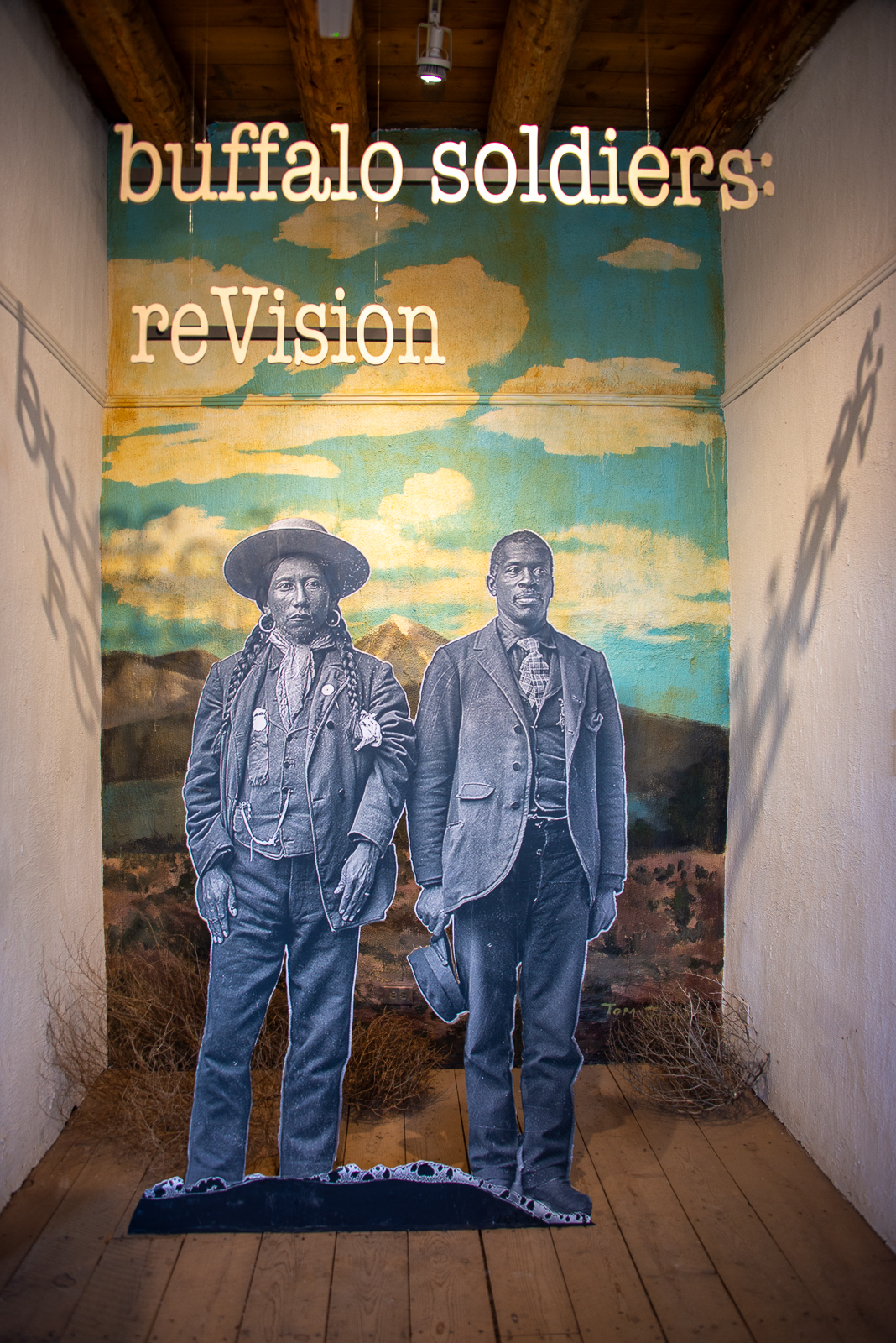
Signage for Fort Garland Museum’s “buffalo soldiers: reVision” exhibit, which runs through 2025.

camera icon

©Steve Alberts

By 1858, Fort Garland was built to protect Manifest Destiny, the philosophy that the United States had a divine mission to expand westward into what it inaccurately touted as virgin lands and create a transcontinental nation.

After the Civil War, the all-Black 9th Calvary became stationed at the fort. They were dubbed the Buffalo Soldiers by Comanches and Cheyennes — one possible reason, historians believe, was due to their physical fortitude and hair, which the Native Americans generally perceived to be curly. Tasked with protecting white settlers, the Buffalo Soldiers often had the unenviable duty of being on the front lines of Native American removal. They were well-respected by the U.S. government for their valiant and honorable service, and they often established friendships with Native Americans.

“Here in the valley, we are at the intersection of several Indigenous homelands, the northernmost edge of Spanish and Mexican settlement, and American westward expansion,” Carpio said. “Ultimately, this region was shaped by how those relationships evolved. It’s a wildly complex history which still directly impacts how people live their lives today.”

So, how did a rural, small-town museum go about unraveling such an intricate, nuanced puzzle?

The first step was dismantling the 69-year-old centerpiece of the fort-turned-museum: a life-size mannequin of Kit Carson, an American brigadier general perhaps best known for his merciless campaign against the Diné people (also known as Navajo).

The museum then began collaborating with Tribal partners and artist Chip Thomas, an African American physician who worked on the Navajo Nation for 35 years. In June 2021, the exhibit “Unsilenced: Indigenous Enslavement in Southern Colorado” officially took Carson’s place, in the very rooms of the fort that were likely his historical living quarters.

The exhibit includes two room-sized translucent cloths, each with a page from an 1865 document printed on them. The title reads “List of Indian Captives Acquired by Purchase,” and underneath are the names of enslaved people, with ages and Tribal affiliations. As Carpio points out, most of the Indigenous names have been changed to Western ones, as women and children were often baptized into the Catholic Church and prohibited from speaking their Native language. This led to generations of Native Americans who had lost all connection to their cultural traditions and Tribal heritage, including a Navajo boy who Carson kept enslaved.

Though those practices ended 150 years ago, the reverberations of that detachment are still affecting the community. “A lot of families have come forward and told us they had heard their ancestors were enslaved but doubted the story because no one ever heard about Native American enslavement,” Carpio said. “Now families have felt validated that there’s truth to the stories their parents and grandparents told.”

One visitor even found his ancestor’s name in the documents. “The emotion that’s suddenly unleashed from that, the pain and anger of their heritage stripped away, there’s a lot of history we have to unpack,” Carpio said. “That’s what we’re trying to reconcile. Sharing these powerful images hopefully starts a dialogue.”

In 2022, the museum expanded its efforts by hosting the temporary exhibit “Merciless Indian Savages,” in which Pyramid Lake Paiute artist Gregg Deal interpreted what American Democracy means in Indian Country. Then this summer, “buffalo soldiers: reVision” opened as a collection of works by eight artists. The exhibit runs through 2025.

“How did formerly enslaved peoples rationalize the subjugation of another race, and in what ways do Buffalo Soldiers connect with the lands they were helping to take away from Indigenous people?” asked Thomas, in an artist’s statement. “The land provided solace and space for contemplation, maturation and dreaming of new possibilities in a way the black soldier couldn’t consider in the Reconstruction South.”

Telling stories such as these through contemporary art is an unusual choice for a history museum, but Carpio says the approach has started a lot of meaningful dialogue. “Particularly in communities of color, artists are the knowledge keepers,” he said. “Plus, artists have a good way of not hitting you over the head with it, opening new perspectives without being condemning.”

Earlier this year, the museum earned a finalist spot in the National Medal for Museum and Library Science, and visitors often tell Carpio that it’s a more welcoming and relevant space to them now than it was before. After viewing the exhibits, one couple even asked Carpio how they could better honor the Buffalo Soldiers and Native Americans who once lived in the valley.

“That people came in and reflected on the exhibits in that way, in all of our wildest hopes and goals as a museum, that’s it,” Carpio said. “And the stories are still expanding. We have empty rooms in some of our exhibit spaces as a signal to the community there’s more to be done. The reconciliation and healing is ongoing.”

Photographer’s film ‘Dhaanto’ about Somali dance troupe is ‘a love letter to my community’

Photographer’s film ‘Dhaanto’ about Somali dance troupe is ‘a love letter to my community’

Photographer Yasmin Yassin knew she wanted to capture a Somali dance troupe that performs at festivals and weddings.

But she waited months before turning on a camera.

Instead, she showed up — at performances, rehearsals and meetings. She sat with them, ate with them. Then Yassin and her crew asked the troupe, based out of the Somali Museum of Minnesota, how they’d feel about them taking photographs and, later, video.

“That helped make this whole thing feel like it wasn’t extractive,” Yassin said. “That it was something that felt it was a mutual project we could do together.

“It felt like a collaboration.”

The resulting 18-minute documentary, “Dhaanto,” captures not only the traditional Somali dances that have become a fixture of Twin Cities events and TikTok feeds but the importance of keeping them alive and passing them on. And for that, it credits the troupe’s coach, Mohamoud Osman Mohamed.

“He’s the connector piece of all of this,” Yassin said. “It’s a culture that could have been lost in the diaspora if there wasn’t somebody who cared.”

The short film, named after a dance, debuted this fall as part of Yassin’s photo exhibition at Public Functionary in northeast Minneapolis. It gets its next screening this week at Soomaal House of Art — where Yassin’s artistic career began.

Created with a team of 20 people, “Dhaanto” is Yassin’s directorial debut. She had long taken photographs for friends and family, but it wasn’t until after moving to Minnesota from Canada five years ago that she began nabbing professional gigs.

Still, most days, she’s a scientist. Yassin earned a master’s degree in public health from Johns Hopkins University and works as a research scientist with an emphasis on science communication.

“Sometimes scientists go in, they extract data from the community and they present it to each other — and they never present it back to the community,” she told the crowd at an artist talk at Public Functionary in September. “And when they do, it doesn’t make any sense to them.”

So Yassin became interested in that circling back: “How can I tell the community in a way that’s accessible?”

By phone, she noted a public health strategy called “photovoice,” in which researchers go into a community and hand people cameras. By allowing people to photograph things themselves, researchers get a much more accurate picture of what’s important to them.

That ethos has informed Yassin’s artmaking. With “Dhaanto,” the dance troupe’s coach became a consultant. The teenage dancers had a say in the story. The film reveals their dedication, their friendship, their delight.

“One thing I like about the Dhaanto dance is, you can’t really dance it with just anyone,” someone says. “And so, when you find the right people that know each other well, when performing the dance moves, you move together as one.”

Others showing up in the Somali community might have focused on trauma, pain or controversy, Yassin said. But she decided to show another, better side.

“It’s a love letter to my community,” she said. Now, she’s hoping to continue that thread, “in the sense of, what would you write in a love letter? You would write the good things, you would show the good qualities.”

‘Dhaanto’
What: Film screening, artist talk and dance performance
When: 6:30 p.m. Fri.
Where: Soomaal House of Art, 2200 Minnehaha Av. S., Mpls.
Cost: Free, but space is limited.

Elton John and David Furnish to exhibit private photography collection at the V&A

Elton John and David Furnish to exhibit private photography collection at the V&A

Never seen before photographs from the private collection of Elton John and husband David Furnish will go on display at the Victoria and Albert Museum next year.

The exhibition, titled Fragile Beauty, will be the V&A’s largest temporary photography exhibition to date, showcasing more than 300 rare prints from over 140 photographers – the majority of which will be on display to the public for the first time.

John and Canadian filmmaker Furnish, who have been together since 1993, own an impressive collection of works by the world’s leading contemporary photographers.

Works by American photographers Robert Mapplethorpe, Diane Arbus, and Sally Mann will be exhibited alongside photography by Ai Weiwei, Carrie Mae Weems, and South African artist Zanele Muholi.

In celebration of 30 years of collecting artwork together, the exhibition will recognise the couple’s passion for photography across eight themes, including fashion, reportage, celebrity, the male body, and American photography.

It is promised that Fragile Beauty will feature a range of portraits of starry faces from stage and screen, including photographs of Marilyn Monroe, Miles Davis, and Chet Baker.

Key historical moments, including the Civil Rights movement of the 1960s, AIDs activism, and the events of 11 September 2001, will all be chronicled within the hundreds of prints on display.

John and Furnish said that their relationship with the V&A has grown since they first loaned a selection of photographs by German-American fashion photographer Horst to the west London museum in 2014.

Fragile Beauty takes our collaboration to really exciting new heights, showcasing some of the most beloved photographers and iconic images from within our collection,” the couple said in a statement.

David Furnish and Elton John photographed in 2019

“Working alongside the V&A again has been a truly memorable experience, and we look forward to sharing this exhibition with the public.”

The “Rocket Man” singer and his husband are known for their world-class photography collections. In 2016, the Tate Modern exhibited The Radical Eye: Modernist Photography from the Sir Elton John Collection, in which the singer’s classic modernist photography collection from the 1920s to 1950s went on display. It included portraits of Matisse, Picasso, and Breton.

Fragile Beauty: Photographs from the Sir Elton John and David Furnish Collection will go on display at the Victoria and Albert Museum from 18 May 2024 to 5 January 2025.

Growing and showing: Jack Kenyon captures a giant vegetable competition

Growing and showing: Jack Kenyon captures a giant vegetable competition

Peter and Ian’s rigour and determination are perfectly captured across Jack’s series, building on – and ultimately epitomising – his joyous, vibrant style. “Being eccentric and visually quirky, the world of giant vegetable growing seemed like the perfect fit,” he says.

Though one of the greatest challenges was maintaining a level of aesthetic consistency, with the series being shot over vastly different seasons and weather conditions. “With our unpredictable weather I was a bit worried their seeds might fail to flourish,” Jack says, “I was also anxious that making pictures in these different weather conditions might make the project feel a bit disjointed.” However, due to Ian and Peter’s expertise, this was far from the case. “Fortunately, they somehow navigated the heatwaves and downpours to grow some herculean produce,” Jack says, “and, to my surprise, I think the pictures also benefited from the erratic English weather.”

Looking back on his 2023, Jack found photographic freedom in the slow, relatively-repetitive nature of gardening. “When the show came around, I’d become friends with Ian and Peter,” Jack recalls, “so it was easy to pull them aside for more formal portraits,” alongside capturing more casual scenes of vegetable admirers. “People were so engrossed with the collosal nature of the vegetables,” he adds, “it was fairly simple to compose these more documentary pictures in a way that I think fits with the earlier work,” as well as his overall documentary style. “I’ve spent years making pictures locally, capturing the quirks of Englishness,” he concludes, “but I’m excited to experiment and take the same approach abroad,” looking to document a camel festival in India across the final months of 2023.

Lebanon native’s photo of SCI Cresson wins first place at Art of the State 2023

Lebanon native’s photo of SCI Cresson wins first place at Art of the State 2023

Lebanon County native Michael Hower was awarded the first prize in photography/digital media of Art of the State 2023 for an almost three-foot print of Transparency. He took the award-winning photograph at SCI Cresson, an abandoned prison in western Pennsylvania.

Art of the State 2023 will display 86 art pieces, ranging from photography/digital media to work on paper, painting, sculpture, and craft, produced by 86 artists from across the state until Jan. 7, at the State Museum of Pennsylvania. This is Hower’s second year exhibiting and first year winning.

“The Art of the State Pennsylvania is a very exclusive juried art show. You have about a 2 percent chance of getting into it roughly. There were over 1,800 entries this year,” Hower said. “It’s a show that I covet.”

A Cumberland County resident, 44-year-old Hower is the son of Jonestown residents, a Northern Lebanon alumnus of 1997, a Cornwall Manor employee of 26 years, and the father of an 8- and 14-year-old. He has practiced photography for the past 12 years since his oldest son was 2.

“I went to art school, and I studied painting and drawing,” Hower said of his background. “And I actually never took the photography course because at that time … it was still all film. And I had little interest in spending time in the dark room and learning that whole process. It seemed completely foreign to me.”

Hower experienced burnout with these art mediums during college and stopped until he started making collages as a new father.

“I started seeking out things to photograph to use in the collages,” Hower said. “And the immediacy of … digital photography worked well because I could just go out, take a picture, put the memory card in the computer, download it, work on it, print it out, and use it. So over time, that wasn’t even over a lot of time, I started to recognize that the pictures were better than the collages.”

This realization led Hower to upgrade from using a point-and-shoot and, in an effort to learn how to use his new camera, read a book about it from cover to cover “about seven times.”

When asked how his background in art contributed to his growth as a photographer, Hower said, “There are some of the basic principles of design and composition and color, that sort of stuff came over. But there was also the learning of a brand-new medium, and it being exciting. And it didn’t have the ‘baggage’ that came with the other stuff.”

“So, I had that sort of design sensibility that I was a good foundation to learn the photography from. And through the years, too, it’s something I’ve noticed, and something I’ve been told by other people and critics is that my photos have a very painterly quality to them.”

Regarding his sources of creative inspiration, Hower said, “I have photographer friends, but I don’t spend a lot of time looking at works of famous photographers. I’m more apt to still look at works of artists that do painting or installation pieces, cultural pieces, stuff of that nature. I still go back to the more art side of it.”

Michael Hower at a photography exhibit. (Provided by Michael Hower)

Hower started his photography career seeking “old garages” and “canal locks,” spaces of graffiti and abandonment, to photograph.

“I often say to people, ‘My subject matter is that of urban exploration. But I am not an urban explorer,’” Hower said. “I seek out places that I know where there’ll be opportunities and where I’ll have permission.”

In addition to being the type of person who doesn’t “operate well in the thrill of the moment,” Hower said being a father requires him to research locations before visiting them because his time out in the field is limited.

Hower grew up with parts of the Union Canal in his backyard and visited canal lock sites as his father wrote articles about the canal for the Lebanon Daily News. His father still had some original documents, and Hower used them as fuel for his research. “From there, it just snowballed into doing more research and finding bigger and better and more exciting places.”

“It was the discovery of the old Michter’s Distillery in southeastern Lebanon County,” Hower said of how his fascination with abandoned spaces began. “Most of it’s largely gone now. They saved a warehouse and one of the original buildings. But it was sort of an ‘aha’ moment. Like I had grown up in Lebanon County … but here is this place that I had never seen. I had never heard of.”

Hower said places of industry often tell stories with multiple layers that connect to the history of a municipality, a state, or a country.

“I’m not interested in a neat-looking abandoned house along the side of the road,” Hower said of what he does, and doesn’t, look for when shooting pictures. “If there’s no story to me, the visual interest, it goes by the wayside.”

“For example, there’s a ghost town I like to photograph called Concrete City outside Wilkes-Barre,” Hower said. “It was a miner’s village. But it was a cutting-edge design for the 1910s that they built the buildings out of all poured concrete.”

Delaware, Lackawanna & Western Railroad Co. owned the coal company and the railroad company that transported the anthracite. Following a Supreme Court case and the breaking up of the monopoly, the Glen Alden Coal Co. purchased the homes almost a century ago and subsequently abandoned them.

Alongside Art of the State 2023, Hower will be part of a two-person show on “abandoned prisons” at the Howard County Arts Council in Ellicott City, Maryland, that opens in December.

Hower also booked a solo show featuring about 40 photographs on “abandonment and graffiti” at The Boyer Gallery of The Hill School in Pottstown that opens in January.

In addition to preparing for his upcoming exhibits, Hower continues to work on his portfolio of abandoned prisons. In the past year, he took trips to Ohio and Tennessee with that purpose and is “taking any opportunity as they arise really,” he said.

Click here to view more of Hower’s photography.

Questions about this story? Suggestions for a future LebTown article? Reach our newsroom using this contact form and we’ll do our best to get back to you.

Do you want to see more from LebTown?

Support local news. Cancel anytime.

Already a member? Login here

Free news isn’t cheap. If you value the journalism LebTown provides to the community, then help us make it sustainable by becoming a champion of local news. You can unlock additional coverage for the community by supporting our work with a one-time contribution, or joining as a monthly or annual member. You can cancel anytime.

#placement_660354_0_i{width: 100%;margin: 0 auto;}

#placement_660352_0_i{width: 100%;margin: 0 auto;}

Photography Auction – Photographies & Lothar Schirmer’s Glamour Collection

Photography Auction – Photographies & Lothar Schirmer’s Glamour Collection

From October 26 to November 9, Christie’s will present its online Photographs sale, featuring over 130 prints by major artists of the 20th and 21st centuries, including Helmut Newton, Robert Mapplethorpe, Irving Penn, Peter Beard, William Klein, Hiroshi Sugimoto, Man Ray and Constantin Brancusi. The first part of Lothar Schirmer’s Glamour Collection sale (82 lots) will be devoted to the famous art publisher’s collection. The overall estimate for the sale is between 1.7 and 2.3 million euros.

With over 1,500 publications devoted to art and photography, including 386 books still available, Schirmer / Mosel Editions needs no introduction. But behind this name lies its founder, who continues to run this famous publishing house with the same passion, and who has just published Lothar Schirmer’s Glamour Collection, devoted to part of his personal collection. On the eve of the 50th anniversary of his publishing house (April 2024), and as he approaches his 80th birthday, Lothar Schirmer realizes that his collection, which illustrates the zeitgeist of his youth, is now complete.

The second part of the sale will feature a group of iconic photographs, with Helmut Newton’s portfolios Private Property, Suites I, II & III (1975-1983) as the highlight, estimated at €300,000-500,000. Helmut Newton has put together an anthology of 45 images from the previous ten years, presented in three suites of fifteen. Each suite includes iconic photographs by this brilliant photographer, who combined the disciplines of fashion, portraiture and eroticism, as in Portrait of Elsa Peretti as a Bunny, Woman into Man, Tied-up torso and Sie Kommen, to name but a few.

Another highlight of the sale was Robert Mapplethorpe’s Man in Polyester Suit (1980), estimated at €200,000-€300,000, is one of the photographer’s best-known and most controversial images. This photograph powerfully conveys Mapplethorpe’s erotic attachment to the anatomy of the model, his lover, it has above all a provocative intent and shock effect that make it, according to Randy Kennedy of the New York Times (October 1, 2015), Mapplethorpe’s “most slyly powerful work, a deadpan commentary on race, stereotypes and the slippery nature of photography itself, that continues to rattle nerves.”

Halfway between still life and fashion photography, Irving Penn’s Man Lighting Girl’s Cigarette (1949) (estimated at €70,000-90,000), features the elegant and graceful American model Jean Patchett. The play of transparency and contrasts creates a superb dialogue between foreground and background. The Metropolitan Museum of Arts in New York has a print in its collection.

Christie’s will also present two photographs by Constantin Brancusi, La Négresse blanche de trois-quarts vue de nuit and Le poisson, (estimated at €30,000-50,000 and €20,000-30,000 respectively), which reflect the artist’s own view of his work. Considered one of the founding fathers of modern sculpture, Brancusi turned to photography, particularly after his meeting with Man Ray in 1914, as a privileged means of looking at his work. Light, framing and the setting up of each piece in the studio were all essential elements to which Brancusi attached the utmost importance, the latter sometimes betrayed by the presence of a reflection, as here with Fish, in which the artist’s tripod and camera can be seen in the polished bronze of the fish reduced to a simple ellipsoidal shape.

Online sale from October 26 to November 9, 2023
Exhibition from November 4 to 9, 2023, free admission

CHRISTIE’S
9 Av‌enue Ma‌tignon
7‌5008 Pa‌ris

chr‌isties.c‌om

Announcing the 2023 Soros Arts Fellows

Announcing the 2023 Soros Arts Fellows

NEW YORK—The Open Society Foundations today announced the recipients of their 2023 Soros Arts Fellowships, the preeminent award supporting socially engaged art. This year marks the fellowship’s largest cohort, awarding $100,000 to 18 mid-career artists for impact-driven art projects that propose bold solutions to address the climate crisis, reclaim and uplift indigenous knowledge, and imagine and build sustainable futures.

Open Society’s 2023 Fellowships are centered around the theme of “Art, Land, and Public Memory,” focusing on artists who are pursuing projects that offer tangible solutions to address environmental harms. The fellowships recognize artists from around the world—from Brazil, Colombia, Guinea, Iraq, Mexico, Morocco, Palestine, Philippines, Portugal, Puerto Rico, St. Maarten, South Africa, Syria, Mandan, Hidatsa, Arikara, Lakota Tribes, the U.S. and their diasporas. Their work also engages communities in which they work across the Global South, places often on the frontlines of the climate crisis and environmental injustice driven by global settler colonialism, capitalism, and white supremacy. 

“Art and culture are essential drivers for social change,” said Tatiana Mouarbes, Open Society’s team manager for Culture and Art, Expression. “One of the greatest challenges of the 21st century is the health of our planet. Through their art and culture work, the 2023 Soros Arts Fellows are taking action to help heal a planet in crisis through community-led solutions for environmental justice. We are proud to support their visions.” 

In addition to unrestricted funding, the fellowships offer recipients a holistic suite of services and resources to help the artists build sustainable artistic careers, including leadership development, mentorship, peer-to-peer exchanges, and networking opportunities.  

Working in diverse forms and global contexts, some of the artists and projects include: 

  • Chemi Rosado-Seijo (Puerto Rico) is working with residents to transform the community of El Cerro into a “Green Barriada,” a self-sustaining and environmentally resilient community
  • Martha Atienza (Philippines) is creating a series of collaborative artworks with fishing communities of Bantayan Island to raise awareness of environmental justice, displacement, and cultural erasure
  • Mónica De Miranda (Portugal) is working with African migrant communities in Lisbon to document stories of migration and land ecologies, bringing together artists, activists, and ecologists to reimagine more inclusive, equitable, and sustainable public spaces
  • Jordan Weber (U.S.) is producing a regenerative ecologies project to transform a square acre of forest in East Detroit into an air remediation zone, trauma informed community center, and open-air environmental justice classroom

With a long history of supporting arts and culture to advance social change, the Open Society Foundations recognize the importance of artists’ contributions and the essential role that art plays in civic discourse and open societies. In particular, the Foundations seek to honor the aesthetic, political, and capacity needs of arts leaders, individual artists, and cultural activists.  

Since 2018, the Soros Arts Fellowship has awarded more than $3 million in unrestricted funding to 29 artists around the world; this year’s $1.7 million is the largest annual amount to date. The fellowship was on a hiatus from 2021–2022 during the height of the COVID-19 pandemic, when more than $500,000 was awarded to support existing fellows.  

The 2023 Soros Arts Fellowship selection committee includes Azu Nwagbogu, curator and founder of African Artists’ Foundation; Diane Lima, curator of the 35th Bienal de São Paulo; Eriola Pira, curator at the Vera List Center for Art and Politics; Helena Nassif, director of Culture Resource (Al Mawred Al Thaqafy); Paulina Suárez, general director of Ambulante; Rocío Aranda-Alvarado, senior program officer, Creativity and Free Expression, Ford Foundation; Siobhan Riordan, consultant and creative Strategist; Tania El Khoury, artist and director of the Center for Human Rights and the Arts at Bard College; Open Society’s Culture and Art staffers Tatiana Mouarbes, Ayoka Wiles, and Ibrahima Niang, and Alvin Starks, director, Narrative and Culture Change at Open Society-United States. 

2023 Soros Arts Fellows

Bilia Bah will produce a collaborative and participatory theater production to launch public dialogue around climate change, urbanization, and the impacts of unregulated water drilling across Conakry, Guinea.

Cannupa Hanska Luger will publish SURVIVA, centering Indigenous knowledge and survival practices related to land, climate, and the environment— and to boldly assert how Indigenous technologies are critical to sustaining life and humanity worldwide.

Carolina Caycedo will produce We Place Life at the Center—Situamos la vida al centro, bringing together ancestral and embodied approaches to the natural world as alternatives to the global climate crisis, grounded in field research and engagement with Natives, campesino/peasant communities, and climate activists throughout the Americas.

Chemi Rosado-Seijo will work with residents of El Cerro, Puerto Rico, to transform the community into a “Green Barriada,” a self-sustaining and environmentally resilient community.

Dalton Paula will organize Quilombo-Escola, an arts and education project that supports Afro-Brazilian artists through artistic residencies and training, and fosters community collaboration and exchanges with art, the environment, and ancestral and traditional knowledge rooted in a Quilombo perspective across Brazil.

Deborah Jack will create To Make A Map of My Memory: Wayfinding Along Synaptic Topographies, linking cultural memory preservation in St. Maarten with climate justice through an archive of oral histories, a connected film and multimedia installation.

Fehras Publishing Practices (Kenan Darwich and Sami Rustom) will create Hader Halal (With Regard to Presence) a multi-format project that aims to reclaim forgotten collective memory in the Eastern Mediterranean and North Africa region and rewrite narratives of modern Arab history from a queer, migrant, and feminist perspective.

Ixchel Tonāntzin Xōchitlzihuatl will organize We the Trees, a multi-tribal art and land rematriation project in the Ecuadorian Amazon.

Jordan Weber will organize a regenerative ecologies project in East Detroit that will revitalize a square acre of forest as an air remediation zone, a trauma informed community center, an open-air environmental justice classroom, and a site for conifer tree transplants to counter the harmful effects of pollution from nearby automobile plants.

Martha Atienza will organize collaborative artworks and actions with fisherfolk and farmer communities on Bantayan Island and its group of islets in the Philippines for Tigpanalipod (The Protectors) to raise awareness around environmental justice, displacement, and cultural erasure.

Molemo Moiloa will produce a series of art and community engaged works under the framework of the “house of ungovernability,” an informal center for sharing and co-developing tactics for sustaining in times of uncertainty, rooted in our relationships to the land.

Mónica de Miranda will work with African migrant communities in Lisbon to document stories of migration and land ecologies for Where cities are invisible, gardens grow, bringing together artists, activists, and ecologists to reimagine more inclusive, equitable, and sustainable public spaces.

Nida Sinnokrot will produce Storytelling Stones: How far does your mother’s voice carry?, a series of collaborative and site-specific sculptures that uplift indigenous practices and reclaim cultural memory, expand discourse and action on environmental justice, and activate public spaces in ways that are resonant and impactful for Palestinian and indigenous communities globally.

Omar Berrada will examine anti-Black racism in North Africa and propose poetic re-articulations of Moroccan identity, reclaiming marginalized narratives and invoking histories of pan-African solidarity.

Rijin Sahakian, through images and text, will trace the legacies of war-making on the physical, cultural, and psychic landscapes between Iraq and America, centering the Iraqi experience.

Sari Dennise will organize Almárcigo, a collaborative, multidisciplinary, and archival project with communities in Xochimilco, Mexico to preserve and articulate water-related knowledge and practices, and promote shared learning around alternative ways of being with the environment.

Yto Barrada will expand botanical literacy to disseminate radical ways of making and thinking with the Mothership Manifesto, a collaborative, multidisciplinary, transgenerational and educational textile project at the Mothership, an eco-feminist residency, garden, and studio in Tangier, Morocco. 

Raymond Mfon’s Photography Locates the Subjects’ Stories

Raymond Mfon’s Photography Locates the Subjects’ Stories

Raymond Mfon has the creative instinct. Some
people are very good at one thing through years of practice or an innate
ability; few – like Raymond – have the creative disposition that they can bring
to just about anything. By ‘day’ Raymond is Tag’s studio manager for the
retouching team, a role he’s held for over eight years. In that time, he’s
worked on CGI and animation jobs too, transitioning to look after the post
production that Tag’s shoot production team does.

His creative roots, however, reach much further than that.

One of Raymond’s first creative ventures was the clothing
brand, Happy Chap, which was worn by multiple musicians, including Ed Sheeran.
He started the brand while still at university as a bit of an experiment that
grew in success over the five years that he ran it. As for photography, Raymond
says he was a big fan from a young age though he didn’t start to explore it
properly until 2016. “One of my friends, a musician, asked me if I would join
him on tour to help with photography and styling. He didn’t have the budget to
pay a professional,” Raymond laughs while recalling the story. “I had no
camera, no anything, but I had a passion to help a friend out.”

image

Raymond says that he knew the basics of photography, but he
didn’t have his own camera or have the skills to take professional-grade
photos. He reached out to a then-colleague and talented photographer, Mark
Diamond, asking for a crash-course in how to capture images. “He recommended a
low budget camera, which I bought, showed me the basics and then with that
knowledge I spent two weeks going around the UK shooting for my friend’s tour.”

“I got thrown in the deep end, and everything that I
would’ve spent maybe two, three years learning about photography, I had to learn
within those two weeks,” Raymond says.

A year later, another opportunity popped up at the right
time. Raymond’s friend living in Uganda invited him along. After some
hesitation, he decided to join the trip and take the time to further develop
his photography skills, especially street photography and portraiture. “I
bought a new camera and two weeks later I was in Uganda. I threw myself into
photography.”

He really wanted to take portraits, but Raymond discovered
that he was too nervous to ask the locals to take their picture. “Even asking
the questions felt like climbing a mountain.” He turned to street photography
in the meantime, honing his eyes on the seemingly mundane to find the real
story, the casual beauty of what others might miss. Raymond is nothing but
humble when discussing his eye for a good picture. “If you ask me to break down
the science and the specifics of the process, I won’t be able to do that in a
way that someone who studied photography could. But I do think that God has
given me a gift to see and capture moments.” That first trip to Uganda put
Raymond in touch with his surroundings, and the omnipresence of a camera around
his neck helped him attune to different moments, to locate their significance.

After returning to the UK,
Raymond knew that he needed to continue growing as a photographer. “I didn’t
really know what direction I wanted to take my photography in, but I decided to
offer my service and time to my church, taking photos, and this is where I
truly learned that I loved capturing moments. It helped me craft my skill and I
believe this was where the seed was planted that has been growing ever since,”
he explains. 

A creative sabbatical

In 2020, Raymond decided it was time for a sabbatical to
further develop his passion for photography. (We all know why that didn’t go to
plan.) Fast forward to 2023 and the idea was still fresh in his mind. With full
support of his manager at Tag, Raymond and his family embarked on another trip
to Uganda, travelling to Kampala for three months to witness the good work that
his friend, a head teacher at a school, and others were carrying out. “I love
my managers; they were really supportive. It’s not always the easiest to get
something like this signed off but they all encouraged me to go,” Raymond says.

image

In Kampala, Raymond spent time immersing himself in the
local community and culture, getting to know the individuals that would later
feature in his photos. “It was a very holistic trip with a lot of road trips to
see the projects my friend is involved in. I spent a lot of time with the
locals and made some really great friends; everyone was really welcoming and
made me feel at home,” he recalls. It was on this trip that Raymond felt his
photography really start to evolve. He moved away from being, in his own words,
“trigger happy” and towards “shooting because you see the story, you’re aware
of your surroundings and environment.” He spent days getting to know people and
their stories so when the time to photograph them came, some of that biography
would make it into the final images.

One photo from the trip particularly stands out for Raymond.
After a five-hour walking trip, he was walking through a village when he
spotted a young boy in the distance. The boy was perfectly framed by a half
tire in the ground – a frame within a frame. Raymond snapped just three
pictures, fast, before the boy moved. The second shot captured the light
shining on the boy’s silhouette and his figure in that impossibly precise spot.
When posting the image to his Instagram, Raymond wrote: “Sometimes your favourite photograph isn’t planned.
Sometimes it’s simply being in the right place at the right time. When that
time comes there’s an excitement and a rush. Time seems to stand still, but not
for long. The race is on, because what you see, you know in a moment will be
gone. But, when you fire that shutter and capture that moment, it’s a moment in
time captured forever.

Raymond took thousands of photos on his trip. He captured
the beauty of the landscapes, the energy of the children, and the daily life of
locals. When he returned to Tag from his sabbatical, the head of photography, Amanda
Wallis, suggested that more people need to see his work. The result is an
upcoming exhibition, which he’s planning to title ‘EWAFE’, at Tag’s London HQ.
On display will be many of Raymond’s favourite and treasured photos from the
trip. For Raymond, it’s an opportunity to “honour the people that I met out
there and the projects that are supporting those communities.” Kitintale Skate
Park (supported by Skate Aid Uganda and the Uganda Skateboard Union), East
Coast Boxing Club, and Groundbreaker Talents.

While the exhibition will be free to attend, visitors are
encouraged to make a charitable donation towards the charities and community projects that are dear to
Raymond’s heart; the donations can be monetary or in the form of a books or an item of clothing, all of which will go towards the great work that Raymond observed and
documented being done in Kampala.

Raymond’s exhibition, EWAFE, will
launch on 16th November with a private, intimate event, and it will remain on
display at Tag HQ until the end of the year. If you are visiting Tag over the
next few months, come and see Raymond’s work for yourself. If you would like to
register interest in attending the launch event, please click
here.

About Raymond Mfon

Raymond Mfon is a portrait and cultural photographer and studio manager at leading production and advertising company Tag. Since 2016, he has photographed a variety of talent including Giggs, Letitia Wright and the Bloom Twins, as well as working with brands such as Mercedes, Tesco and Visit Britain.  

As studio manager at Tag, he manages client relationships with global brands and talent, whilst leading on producing advertising campaigns for household names including Toyota, Lexus, Rimmel London, L’Oreal and Tesco. In managing postproduction, Ray has also worked with photographers including Jean Yves Lemoigne, Julia-Fullerton Batten and David Clerihew.





