About

Posts by :

Frieze at 20: how the fair revolutionised London’s art world

The night before the inaugural Frieze art fair in October 2003, co-founder Matthew Slotover had a nightmare. That auspicious morning, he dreamt he’d arrived at Regent’s Park only to encounter a completely different tent, something far more incongruous than the white minimalist construction we’ve come to know. “It was a big top circus tent; they’d ordered the wrong one!” The inside was empty with a grass floor and horses roaming in the dark.

Luckily, the first fair went without incident — at least nothing like Slotover’s anxiety dream. Having etched itself into the art-world calendar, Frieze went on to transform the London art world, and while there’s much to celebrate, the anniversary also comes at a time of uncertainty for the art market and London; much has changed since those early heady days.

Before Frieze, the big European fairs were Art Basel (still is) and Art Cologne, which sold blue-chip art from a glass monolith on the Rhine. Locked out of the main fair, younger gallerists in Cologne took it upon themselves to break away and started the aptly named Unfair, which took place in 1992 and 1993. Held in a disused commercial space, the Unfair was abuzz, not just with gallerists and collectors but artists such as Damien Hirst, who staged a performance with identical twins sitting beneath a pair of Spot paintings, and Skip Arnold, who delivered himself in a crate. For the first time, the Unfair brought together emerging gallerists such as Daniel Buchholz, Jay Jopling, Maureen Paley and David Zwirner, now mainstays of the art market, all under the same roof.

A crowd of people gather around a large arch with a sign saying ‘Frieze Art Fair’.
Visitors entering Frieze at Regent’s Park in 2009 © Linda Nylind

The earliest discussions around a London fair took place in the mid-Nineties at the Atlantic Bar & Grill, in the sumptuous Art Deco basement of the Regent Palace Hotel just off Piccadilly Circus, when New York gallerist Matthew Marks floated the idea of supporting an event at the hotel. Restaurateur Oliver Peyton had just revived the Atlantic, filling its walls with contemporary art.

Marks’s suggestion came off the back of a similar initiative taking place in New York, where a group of gallerists came together to take over the Gramercy Park Hotel, turning individual rooms into art-fair booths. (Tracey Emin lay in a bed covered with one of her embroidered quilts, smoking cigarettes, becoming one of the fair’s main attractions.) The Gramercy International Art Fair eventually gave rise to The Armory Show, a far more ambitious project held across two waterfront piers, which was recently acquired by Frieze along with Expo Chicago.

When they first launched, these indie fairs, with artists on hand to present their projects, offered a viable alternative to the otherwise staid approach taken by the established fairs, which felt sterile by comparison, like a car showroom.

When the Frieze Art Fair opened in 2003, Tate Modern was only three years old, its visitor figures having surpassed expectations by millions. The British public, once scathing of contemporary art, had become more accepting thanks in part to the media interest surrounding the Young British Artists and the Turner Prize. As gallerist Sadie Coles says, “The opening of the Frieze fair was yet another symbol of progressive internationalism, reflecting the energy of London in the new millennium — a city with unparalleled public spaces, art schools and a rapidly expanding commercial gallery sector.”

An indigo magazine cover with with ‘frieze’ in lower-case yellow letters at the top and a painting of a yellow and orange butterfly at the centre. Below it is a yellow circle with the text: ‘pilot issue summer 1991 £3’.
The first issue of Frieze magazine, from 1991 © Courtesy Frieze

The Frieze brand had been established earlier through its magazine, launched in 1991, which lent the fair an air of curatorial authenticity. As co-founder Amanda Sharp recalls, “Our background through the magazine was with the artists, gallerists, writers and curators. We didn’t come to the fair knowing the collecting world.”

Many recall the fair’s early experimental leanings, with a mix of young and established galleries, sometimes facing each other across the aisles. Artist spaces such as Townhouse in Cairo and Vitamin Creative Space in Guangzhou were included even though they weren’t considered obvious commercial galleries. In the first year, The Wrong Gallery (an art project involving artist Maurizio Cattelan) presented an empty booth where child actors approached people in an attempt to sell a “constructed situation” by Tino Sehgal, reciting the edition number and price of their performative art work.

A man playing a banjo sits next to a table covered in candle holders, candelabras and lit candles.
The booth of Gavin Brown’s Enterprise was transformed into a flea market in 2007 © Frieze/Linda Nylind

Over time, certain gallerists allowed artists to take over their booths. Rob Pruitt turned Gavin Brown’s Enterprise into a flea market; Hauser & Wirth invited classics professor Mary Beard to open a fake museum; Anthea Hamilton presented huge pumpkins at Thomas Dane Gallery. With the arrival of Frieze Masters in 2012 for art from before the year 2000, Helly Nahmad Gallery transformed its booth into a series of immersive sets, including a recreation of a 1960s collector’s home and a 1940s psychiatric hospital inspired by Jean Dubuffet.

The fair’s artistic programme — Frieze Projects and Talks and Frieze Music — helped distinguish it from its rivals. While not alone in presenting talks or art projects, Frieze’s commissioning strategy was much more invested, ultimately changing the dynamic between artists and art fairs. As Sarah McCrory, who used to commission these projects for Frieze, says, “There was a special kind of naive ambition that came through Frieze Projects, where curators were allowed to run riot with large-scale commissions.” Some of the earliest Frieze Projects included an artificial hillside made from real grass by Paola Pivi, which visitors were invited to “roll down at their leisure”. Frieze was different. As Sharp says, “We believed a fair could be more than a purely transactional market space, which is why the architecture, design, food, projects and the talks programme were so important to us.”

An audience gathers around a large artificial grass slope while a person rolls down it.
‘Untitled (slope)’ (2003) by Paola Pivi at Frieze Projects © Courtesy Frieze

Over the years, the fair has also helped both the London art market and the city more broadly, with galleries reporting strong sales and new clients. Sensing the number of collectors passing through town, the auction houses moved their midseason sales into “Frieze Week”; across Christie’s, Sotheby’s and Phillips, last October’s evening sales totalled nearly £160mn. London hotels continue to welcome guests in the lull after the summer, while top-end galleries book out entire restaurants. Then there are the countless people employed by the fair, from logistics companies to an army of ground staff.

Moreover, galleries and museums across the country benefit from special acquisition funds to spend at Frieze, such as the Frieze Tate Fund and the Contemporary Art Society’s Collections Fund, giving cash-strapped institutions the chance to buy transformative works.

It’s also refreshing to see a collegiate approach to Frieze Week, with galleries and institutions coming together to pull out all the stops. As the fair’s success radiates outwards, visitors are encouraged to explore West End and East End galleries, with the offer of an exemplary London-wide programme, which this year includes El Anatsui’s Hyundai Commission at Tate Modern and Nicole Eisenman at the Whitechapel Gallery.

An oil painting depicting a surreal scene of different-coloured figures gathered around an orange car. The moon, some trees and a house looms ominously in the background.
‘The Triumph of Poverty’ (2009) by Nicole Eisenman © Leo Koenig Inc

So where are we now? Twenty years on and it is hard to escape a Covid- and austerity-bashed economy — arts organisations reel from budget cuts — and Brexit, which has left the UK struggling to compete and far less welcoming. Art Basel’s new Paris+ fair and the number of commercial galleries opening branches there represent a serious challenge to London. Moreover, during a cost of living crisis, can the public even afford Frieze tickets? It’s £245 for a “combined first preview” for both fairs; a single ticket at £75 is reduced to £46 at the weekend. Before Covid, the number of visitors across both fairs proved consistently high, with a peak of 110,000 in 2019. Last year’s 90,000 visitors, up from the previous year, suggests a return to form, but will London’s art world automatically do the same?

There’s a sense that the glitz and glamour of fairs such as Frieze detracts from regular gallery visits across the year and more intimate engagements with art. Where commercial galleries are concerned, big or small, fairs have become all-consuming one-stop extravaganzas, leaving them little choice other than to participate. But as galleries become more dependent on fairs, often appearing in several a year, they become exposed to sharply increased transport costs and rising overheads. Might this explain the trend for galleries to de-risk by focusing on more commercially viable practices such as figurative painting, as opposed to complex installations or time-based media?

A large multi-coloured abstract sculpture covered in patterns displayed on the grass of a leafy park.
Work by Yinka Shonibare in Frieze Sculpture in Regent’s Park © Linda Nylind

Frieze now sits alongside 300 art fairs worldwide that relentlessly contribute to the commercialisation of art — pressuring artists to come up with the goods, jettisoning fragile careers in favour of what the market desires. There’s also a tendency for fairs to become fashionable in the pursuit of bringing hot artists to an aspirant collector class. Seeing A-listers in the aisles makes Frieze seem sexier than most fairs, placing added pressure on galleries to live up to the advertisements and sponsorship provided by high-end fashion brands and luxury goods.

As fairs become more polished and more generic, should Frieze’s format change? Change may be in the air anyway, given concerns around the art world’s carbon footprint and the vast number of flights and long-haul shipments required to service international fairs.

A talking point at this year’s Art Basel was the Basel Social Club, an informal gathering of artists in a disused factory where artworks, including performances, appeared alongside ad hoc bars, sound stages, and food stations. A non-selling exhibition centred on artist interactions, collectors nevertheless descended in droves, with former Art Basel director Marc Spiegler serving cocktails. Is there life beyond the booth? When Frieze first opened it did things differently (just like new “non-fair” Minor Attractions will do this Frieze Week). Should it do so again?

As a sign of London’s resilience, the return of galleries to Cork Street and St James’s is welcome news. Eva Langret, director of Frieze London, says, “The UK remains the largest art market in Europe, and the second largest globally. It’s energising to see existing galleries such as Pilar Corrias, Stephen Friedman, Alison Jacques and Tiwani Contemporary taking up major new spaces.” With the opening of younger galleries such as Alice Amati, Guts Gallery and Harlesden High Street, London still offers the promise of discoveries, along with new art centres such as Margate and Manchester.

Meanwhile, the energy behind Frieze has far from dissipated. With its extended network of fairs including New York, Los Angeles and Seoul and recent full acquisition by entertainment giant Endeavor, Frieze is not hanging around. Victoria Siddall, former global director of Frieze’s fairs, points to the bigger picture: “Frieze has been constantly growing and adapting since it began, and it’s no surprise that it continues to do so today.” With its legacy of internationalism, the fair reminds us how 20 years ago the world came to London, just as Frieze now goes out to the world.

October 11-15, frieze.com

Indigenous Australians tell their own stories in the Karrabing Film Collective

The start of the Karrabing Film Collective’s 2016 film “Wutharr, Saltwater Dreams” hints at the universe that viewers are about to enter. Three Indigenous men are attempting to fix the outboard motor of a boat marooned near a shack. The oldest says the ancestors have broken it — they are angry because they have been neglected. An onlooker disagrees. She says the problem stems from his lack of faith in the Lord, adding that he shouldn’t believe “in old-people things”. A young man says he knows nothing about either, and seawater has eaten away the wiring.

The film is intercut with dreamlike shots of water lapping on a deserted shore. A white police officer wanders through the bush — where the ancestors, represented as figures covered in pale clay designs, also live — apparently seeking the boat’s owner. The film is subtitled because the dialogue is in a local creole.

A woman leans against a fence with a tree and a house behind her. A text caption reads ‘You want to believe in old people things.’
Still from ‘Wutharr, Saltwater Dreams’ (2016) © Courtesy the Karrabing Film Collective

The Karrabing Film Collective is a loose group of 30 mostly Indigenous Australians based in the tiny Northern Territory settlement of Belyuen, near Darwin. It chose its name — which means “low tide turning” in Emmiyangel — to indicate that Indigenous peoples, ancestral lands and the environment are interconnected in ways not always understood by central authorities.

The collective came to international attention when one of their early works, “When the Dogs Talked” (2014), won an award at the Melbourne Film Festival and since then their films have been shown at Documenta 14, MoMA PS1 in New York and the Haus der Kunst in Munich. Their latest film, “Night Fishing with Ancestors”, is included in an exhibition of the same name at the Goldsmiths Centre for Contemporary Art in south London, which opens to coincide with the Frieze art fairs.

A woman adjusts a camera next to a girl holding a microphone in the Australian bush
Natasha Bigfoot Lewis (left) and Chloe Gordon filming ‘Wutharr, Saltwater Dreams’ © Courtesy the Karrabing Film Collective

Angelina Lewis, a member of the collective, says it was formed in 2012 following violent clashes five years earlier over land rights which tore apart poverty-stricken Belyuen. Reporters from Australian media came to document the tensions, which left several people temporarily homeless. “That experience led us to try to find a way to tell our own stories,” Lewis says. Families help develop the stories, shooting on phones and acting the various roles. “Our community is losing its language, it is losing its ancestor stories. This is a way of keeping a spark alive,” she adds.

Karrabing’s films are a mesmerising blend of documentary and fiction, meandering between the prosaic and the mystical. The ancestors are ever-present, as are the Cox peninsula’s rugged landscapes. But so are rusting trucks, bored teenagers and cans of lager. There are undercurrents of colonial expropriation and violence.

Three blurred figures covered in white face paint stand near the ocean
Still from ‘Night Fishing with Ancestors’ (2023) © Courtesy the Karrabing Film Collective

In “Night Fishing with Ancestors”, the same actor plays an 18th-century British explorer and a contemporary mining engineer. Permission has been granted by the government for a large lithium mine close to Belyuen, Lewis says, and its metal fencing is visible in the film. “The mine stretches up to a hunting ground, it crosses wild cattle and turtle tracks, right up the saltwater coastline and fishing grounds,” Lewis says. “They promise Indigenous people jobs, they promise they won’t destroy our land. But we eat from there.”

In “Windjarrameru” (2015), police chase youths through a sacred but contaminated mangrove, incorrectly accusing them of drinking stolen alcohol. Meanwhile, poor local men collude with miners in illegal blasting to pay off small fines. Periodically the collective, who improvise their roles, break off to take a rest on the ground while shadowy figures pass secretly by.

A blurred image of four figures with white face paint against an ochre and brow background
Still from ‘Windjarrameru, The Stealing C*nt$’ (2015) © Courtesy the Karrabing Film Collective

The film obliquely references 2007’s Northern Territory National Emergency Response, or “The Intervention”, a government action to tackle the alleged abuse of children in Indigenous communities. It brought in punitive restrictions on alcohol, imposed conditions on welfare payments and partially suspended race-discrimination and land-rights acts. But the film also draws on the traditional beliefs of the collective’s ancestors.

“There’s a dual effect in their films, there’s so much you can empathise with, even laugh at,” says Natasha Hoare, the curator at Goldsmiths CCA. “But there’s another realm running alongside the mundane, one you are tantalisingly aware of but know you can’t really understand.”

Karrabing are not the only Indigenous artists catching the attention of contemporary art curators. The National Gallery of Art in Washington, DC, opened The Land Carries our Ancestors: Contemporary Art by Native Americans last month, while the Museu de Arte de São Paulo (MASP) launches an exhibition, Indigenous Histories, later in October. It is a major show of work by artists from North and South America, Oceania and Scandinavia. MASP’s artistic director, Adriano Pedrosa, will direct the next Venice Biennale in 2024 and there are expectations that he will include work by Indigenous artists.

Four people kneel or squat in front of corrugated iron wall covered in colourful graffiti
Members of the collective in Brisbane in 2018 © Courtesy the Karrabing Film Collective

Of course, Indigenous artists, especially from Australia, have been part of art history for some years. But Hoare says Indigenous voices are resonating more loudly in an era of climate change. “There is a sense that colonisation and environmental degradation has led to a world that is not a fit place for us all to live in,” she says. “Undoing the ills of modernity and paying attention to Indigenous forms of knowledge suddenly seems more important and timely.”

Lewis hopes that visitors to the exhibition in London will be taken on “a mysterious journey” but one they will understand. “I know we can relate to other people,” she says. “Everybody has a past. Everybody has ancestors. Everybody has a story, no matter where they come from.”

October 7-January 14, goldsmithscca.art

Workshop Will Cover iPhone Photography

Workshop Will Cover iPhone Photography

The Cahoon Museum of American Art will host an afternoon workshop on taking professional photographs with an iPhone on Thursday, October 12, from 1 to 4 PM. Award-winning photographer Linda Sharpe will lead participants through phone camera settings and share tips and tricks to taking a strong photo.

The workshop is limited to iPhone users. Bring a charged phone with enough memory to take new photos. Class size is limited to six participants. The cost is $50, $40 for museum members. Registration is online.

Woman’s Club Will Present Talk On Jeffyfish Photography

Woman’s Club Will Present Talk On Jeffyfish Photography

Lawrence Madin, senior science adviser at the Woods Hole Oceanographic Institution, will speak about jellyfish photography and ecology at the next gathering of the Woods Hole Woman’s Club on Tuesday, October 10, at 11:30 AM at the Church of the Messiah parish and community center, 16 Church Street in Woods Hole.

Visitors are welcome to attend. Light refreshments will be served and those attending may bring a brown bag lunch if they wish. Windows will be open for ventilation.

Frame.io Review: Photography’s Next Big Thing?

Frame.io Review: Photography’s Next Big Thing?

Photographers become photographers for, well, the part of the process that actually involves taking photos. Backing up photos is a necessary but mundane part of the art. But what if tasks like backing up photos to the cloud were automatic? What if you could work on a creative team and get feedback from across the world just a few minutes after actually taking the images? Those are just some of the things that could be possible with camera-to-cloud technology. And at the forefront of that technology is frame.io.

Frame.io started as a video collaboration tool—and is still heavily invested in Premiere Pro and After Effects. But, recently, the software has also opened up to still photographers. But the software’s biggest perk for photographers isn’t the ability to comment and share with a team. No, the biggest perk is the ability to do all of that with automatic camera-to-cloud uploads.

Is camera to cloud the next big thing in photography technology? I took Frame.io for a spin to answer precisely that question. The software solves a few pain points for photographers and has big potential. But, early on in the game, the types of photographers that will benefit most are limited, and there are some glitches to contend with.

What is Frame.io?

Frame.io is an Adobe software that’s designed for media collaboration. The software allows photographers to share and review images in a team-based environment. But, the software’s biggest draw is camera to cloud, where supported cameras will automatically upload images to the cloud using Wi-Fi or a smartphone network. This allows photographers to quickly send images to team members—not to mention the potential for automatic cloud backups. Only a few cameras support the feature so far, including Fujifilm’s latest flagships, the XH2, XH2s, and GFX100 II. A Frame.io plan that includes camera-to-cloud starts at $15 a month per team member and includes 2 TB of storage.

The Big Picture

For photographers working in a studio and sending work to a team, camera to cloud on Frame.io shortens the to-do list by automating the upload process. And for busy photographers, anything that saves time is a game changer. Frame.io allows photographers to automatically upload images straight from the camera to cloud storage, either for safekeeping or to collaborate with editors and other team members.

Frame.io and camera-to-cloud have the potential to change a big part of how future cameras work. But, this early in the concept’s young life, Frame.io has limited appeal. Someday, perhaps journalists and event photographers will automatically back up to the cloud. But, the need for the camera to be close to a Wi-Fi router and a buggy smartphone connection process is not the case today. I can see studio photographers really loving frame.io, but as a wedding and on-site portrait photographer, the young technology just isn’t where I would need it to be to make a big impact on my workflow. I can see big potential, but the infrastructure — as well as camera battery life and integration with Lightroom and Capture One— will have to grow along with Frame.io in order for such tech to become the norm.

I’m giving Frame.io three out of five stars.


Rating: 3 out of 5.

Pros

  • Camera to cloud capability
  • Automatic uploads whenever the network is within reach
  • Easy team collaboration
  • Multiple ways to share, including options for non-paying team members
  • Option to upload with the camera off

Cons

  • Needs to be closer to the Wi-Fi router than other tech like laptops
  • As a new technology, it’s a bit more glitchy
  • I had difficulty connecting via smartphone
  • Integration with image editors not available yet

Gear Used

I tested Frame.io with the Fujifilm X-H2 and X-H2s, both on loan from Fujifilm for review purposes. Adobe also provided a complimentary Frame.io subscription for review. I accessed Frame.io from Safari on an iPhone and MacBook.

Innovations

Camera to cloud is a relatively new concept — which means there is a lot of innovation in the background to make that possible. But, outside of the camera-to-cloud possibilities, users will find some Frame.io features feel a bit like sharing from a fancier version of Google Drive, which is a plus because it makes the software a bit more user-friendly.

Ease of Use

The two main components of frame.io are uploading and sharing. Both concepts are quite simple, though there is a bit of a learning curve to frame.io’s terminology and troubleshoot the camera connection. Once you figure out how to connect the camera and what the different sharing options are, the interface is fairly intuitive.

Frame.io: Connecting a camera

While I can often connect a new camera to a Wi-Fi app without instructions, setting up a Frame.io camera connection requires a more detailed list of instructions and some troubleshooting. Both the Fujifilm XH2 and XH2s need the FT-XH File Transmitter battery grip accessory, as well as updated firmware, while the GFX100 II supports the camera to cloud without the grip accessory. Photographers will also need internet access and a Frame.io subscription. (The free version of Frame.io doesn’t support camera to cloud and has a limited 2 GB of storage).

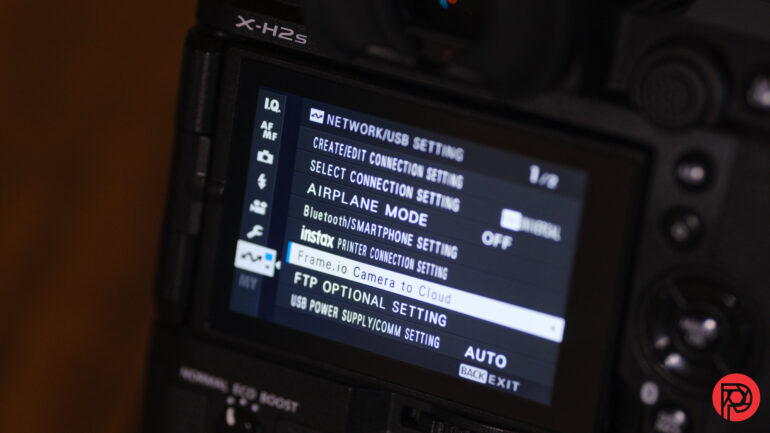
The camera-to-cloud process starts in the camera. For Fujifilm cameras, the Frame.io settings are inside the network settings menu. On-screen prompts walk through connecting via Wi-Fi by typing in the network and password. From there, photographers will also want to use the menu to select which file type to transfer, RAW, or JPEGs, the latter being a bit friendlier for slower internet speeds. Auto image transfer then needs to be turned on in the upload settings. Images can still be transferred with the camera powered off under the upload settings as well.

The second half of setting up camera-to-cloud is within Frame.io itself. Navigate to an existing Frame.io project or create a new one. Once inside the desired project, head to the C2C Connections tab and follow the instructions there. Back inside the camera, you’ll generate a pairing code in the Frame.io Camera to Cloud menu to type into Frame.io and finish the connection.

The compatible cameras also offer an option to connect and upload without a Wi-Fi network using a USB-C cord and a smartphone, relying on the smartphone network instead. However, I couldn’t connect the XH2 or the XH2s this way, even trying multiple smartphones. Despite repeated attempts, I have not yet figured out what the error is.

Frame.io originally started as a video collaboration tool — and the expansion into photography is quite young. But, ideally, the software would connect to image editors the way it talks to Adobe Premiere Pro and After Effects. Automatic uploads are great but worth little if they don’t sync up to my culls and edits. Compatibility with Lightroom will be critical for really falling in love with the feature, but it’s currently not integrated unless using a third party like Zapier.

Here’s the odd part: Capture One has already announced an upcoming Frame.io integration, though the “first half of 2023” prediction has long passed. Frame.io is now owned by Adobe, so arriving first in a competing image editor is definitely odd.

Frame.io: Sharing and collaborating

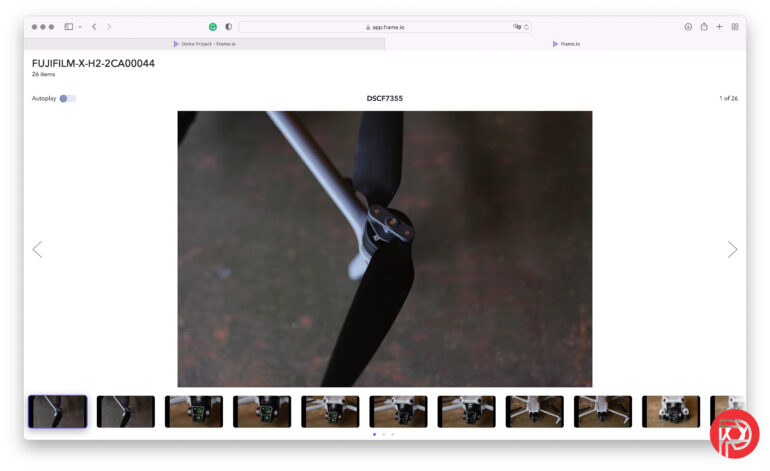
Once auto transfer is set up, images are sent directly to the Frame.io album, accessible from the Frame.io website or the app. While uploading to a shared album requires a Frame.io subscription, the images can be shared for collaboration with clients or team members who don’t have a Frame.io subscription.

There are two ways to share the images with someone without a Frame.io subscription. A review link displays the images and allows for features like comments. This is designed to work with a team and receive feedback through those comments.

A presentation is meant more as a method of sharing final files with a client — there are no comment options, but there are different layout choices and custom branding options, such as colors. Settings include allowing or preventing downloads so presentations can be used as a display or to deliver digital downloads. Password protection, link expiration, and watermarks are also presentation options.

Project members, however, will need a Frame.io account for further collaboration beyond comments. Project members with a subscription can contribute to the album by adding images as well.

Sharing options felt similar to existing software and wasn’t difficult to use. The only real learning curve to the sharing was figuring out the difference between members, reviews, and presentations. The first time I attempted to share, I used the person plus icon, which requires a Frame.io membership for the recipient — the share button is the one to use for non-Frame.io users.

Speed and Reliability

The speed of automatic Frame.io transfers is primarily determined by the internet connection speed. Automatically uploading JPEGs from the XH2 and XH2s on my Wi-Fi network performed at a speed similar to uploading images to Google Drive from my laptop. 

The camera-to-cloud uploads will work best in smaller spaces close to the Wi-Fi source.

But uploading directly from the camera means everything is uploaded pre-cull. That means photographers will want fast internet speeds to work with the automatic frame.io uploads. Using my own rural internet speed was a challenge but an expected one based on the speeds of my network. The camera-to-cloud feature will be a more significant feature for photographers with access to fast internet and can be more frustrating for users with slower speeds.

The bigger issue that I had is that the camera needs to be relatively close to the Wi-Fi router to maintain a strong wireless connection. On the opposite side of my house—where my Wi-Fi still reaches my TV and laptop just fine—the XH2 and XH2s dropped connection. The uploads worked just fine when the camera was close to the router. The camera-to-cloud uploads will work best in smaller spaces close to the Wi-Fi source. Otherwise, I can also see photographers setting up a charging station near the router and automatically creating a cloud backup after returning home from a shoot.

Who Should Buy It?

If you have fast internet and need to send every photo to a team as fast as possible, Frame.io really has no competition. The ability to wirelessly upload as you shoot is an advantage for creative teams, particularly when communication is necessary before even leaving the shoot. If you work in a studio or want to create a charging station with automatic uploads, camera-to-cloud is a nice advantage as well.

However, camera to cloud is a young technology — and, as such, has a steeper learning curve and a higher likelihood of glitches. Setting up frame.io, I was immediately reminded of the very first camera apps that communicated between smartphone and camera. The technology will likely soon be a huge advantage, but this early on, there’s a lot of frustration in getting set up.

Using camera-to-cloud on Frame.io is more of a collaboration tool than a backup solution. I know many event photographers like myself are intrigued at the possibility of being able to automatically backup photos in the cloud so damaged SD cards aren’t a crisis. But, at least this early in the game, the technology has to be too close to the router, and I couldn’t get the mobile hotspot option set up. Integration with Lightroom would also be a huge advantage. For now, the technology remains more of a studio tool for collaboration — but that could change very quickly. If the kinks get ironed out, Frame.io could be used by commercial studio photographers and journalists in the field. But, for now, the photographers likely to get the best experience are team members doing most of their work in-studio. 

Frame.io Tech Specs and System Requirements

  • Browser: The latest two versions of Google Chrome (desktop and Android), Safari (MacOS and iOS), Firefox, Microsoft Edge, and Android Browser. Chrome and Safari are recommended.
  • Operating system: Windows, MacOS, Chrome OS
  • RAM: 4 GM required, 8 GB or more recommended

The Phoblographer may receive affiliate compensation for products purchased using links in this blog post.

Frame.io Review: Is Camera To Cloud Photography’s Next Big Thing?
For photographers working in a studio and sending work to a team, camera to cloud on Frame.io shortens the to-do list by automating the upload process. And for busy photographers, anything that saves time is a game changer. Frame.io allows photographers to automatically upload images straight from the camera to cloud storage, either for safekeeping or to collaborate with editors and other team members.

Frame.io and camera-to-cloud have the potential to change a big part of how future cameras work. But, this early in the concept’s young life, Frame.io has limited appeal. Someday, perhaps journalists and event photographers will automatically back up to the cloud. But, the need for the camera to be close to a Wi-Fi router and a buggy smartphone connection process is not the case today. I can see studio photographers really loving frame.io, but as a wedding and on-site portrait photographer, the young technology just isn’t where I would need it to be to make a big impact on my workflow. I can see big potential, but the infrastructure — as well as camera battery life and integration with Lightroom and Capture One— will have to grow along with Frame.io in order for such tech to become the norm.

Ballina Contemporary Art Market on next week

Ballina Contemporary Art Market on next week

Ballina Contemporary Art Market on next week (Saturday 14 October)

The inaugural Ballina Contemporary Art Market (BCAM) is a free, one-day, fun-filled arts and cultural event taking place on Saturday 14 October from 10am-7pm at the Northern Rivers Community Gallery (NRCG) & Ignite Studios creative precinct in Ballina, showcasing the creative talent of the region.

Free to attend, the event will feature more than 60 arts and crafts stalls selling a range of artworks, products, and wares by artists and artisans from across the Northern Rivers. Just some of the artists featured include Casino Wake Up Time, Dave Sparkes, Dreaming of Country, Karena Wynn-Moylan, Natalia Santos, Nic Palmer, Outpost Studios, Penelope Sienna, The Field ARI, Vickki King and Yao Mikami.

Throughout the day, an exciting program of free creative workshops will be available for market goers. BCAM will also feature live music, food stalls, and a chance for kids to meet the amazing dinosaurs from acclaimed theatre company Erth Visual & Physical Inc. The event will close with a twilight laneway party featuring a musical performance from local 6-piece Byron favourite the Versace Boys.

BCAM Event Program

Market Stalls 10am – 5pm

Food Stalls all day 10am – 7pm

Public Art

‘Go Play on the Road’ Kate Stroud

Murals | Beki Davies, Gala Jane, Allan Leisk

Free Workshops

11am – 1pm Ceramics Wheel Throwing Demo

11.30am – 1.30pm Dinosaur Puppet Making for kids

2pm -4pm Weaving w/Jugan Dandii

2pm – 5pm Collage for kids w/ Claudie Frock

Roving Performances

10am – 3.30pm Erth & Sprung! Creatures

11am Meet the Australovenator Dinosaur

3pm Meet the Australovenator Dinosaur

4.30pm – 7pm Erth & Sprung! Deep Sea Diver

Laneway Stage 10.30am – 7pm

10.30am Welcome to Country w/ Aunty Nancy Walke

10.45am – 12pm DJ Chop Suey

12pm – 2pm Paradise FM Busking Competition

2pm – 3.30pm DJ Chop Suey

3.30pm – 4.30pm Myki Jay Duo

5pm – 7pm Versace Boys

This event has been made possible through funding from the NSW Government.

Event Details:

Ballina Contemporary Art Market 2023

Saturday 14 October 2023

10am – 7pm

Northern Rivers Community Gallery & Ignite Studios Creative precinct.

Cnr Cherry St and Crane St, Ballina

Free event

www.ballinacontemporaryartmarket.com.au

/Public Release. This material from the originating organization/author(s) might be of the point-in-time nature, and edited for clarity, style and length. Mirage.News does not take institutional positions or sides, and all views, positions, and conclusions expressed herein are solely those of the author(s).View in full here.

Evening for Educators: Black Artist of Oregon

Evening for Educators: Black Artist of Oregon

Beginning in the 1880s and spanning through today, the exhibition Black Artists of Oregon captures the Black diasporic experiences particular to the Pacific Northwest with 69 artists and over 200 objects. In the words of guest curator Intisar Abioto, it is “a heralding of Black presence, interchange, influence, and impact.” Please join us for a kitchen table conversation with curators Intisar Abioto and Grace Kook-Anderson and two artists and educators whose artwork is in the exhibition: Bobby Fouther and Kayin Talton Davis.

Kayin Talton-Davis (American, born 1980), The Negro Colony, 2023. Mixed media acrylic; 24 × 48 inches. Courtesy the artist. Photo by Jason Hill Photo
Kayin Talton-Davis (American, born 1980), The Negro Colony, 2023. Mixed media acrylic; 24 × 48 inches. Courtesy the artist. Photo by Jason Hill Photo.

Deepen your knowledge of Black Artists of Oregon, make connections to your teaching, and find community with educators from around the metro region.

Schedule:

5:15 – 5:45 pm Visit the exhibition after regular hours. Enter the museum from SW Park Avenue. (Main Museum, 2nd floor)

6:00 – 7:30 pm Conversation and sharing resources (Fields Sunken Ballroom, Mark Building, 1st floor)

Admission is free. Registration requested. Light refreshments provided. PDU credits available.

Four Exhibits to Open at BMAC

Four Exhibits to Open at BMAC
BRATTLEBORO, VT — The Brattleboro Museum & Art Center welcomes museum members and the public to celebrate the opening of four new exhibits on Saturday, Oct. 14, at 11 a.m.

Air guitar roos and flossing beavers are among the finalists of the 2023 Comedy Wildlife Photo Awards

Air guitar roos and flossing beavers are among the finalists of the 2023 Comedy Wildlife Photo Awards

The animal kingdom is a dynamic place, filled with plenty of action and drama. Freeze and capture any moment in time and an animal’s behaviour can become hilarious.

A smoking fox, a flying seal, and an avian family dispute are among the 41 images shortlisted for this year’s Comedy Wildlife Photo awards.

Narrowed down from thousands of entries submitted by professional and amateur photographers from around the world, the competition aims to celebrate the hilarity of our natural wildlife.

And this year’s selection does not disappoint.

The overall winner, category and highly commended winners will be announced on November 23.

Last year’s winner was US photographer Jennifer Hadley’s shot of a baby lion misjudging what could have been his first leap.

Here’s a selection of some of the finalists in the running for 2023.

A spotty leopard in the grass looking surprised

Air-apparent by Paul Goldstein.(Paul Goldstein: Comedy Wildlife Photography Awards 2023)

An otter in a ballerina position with a green leafy background

Otter ballerina by Otter Kwek.(Otter Kwek: Comedy Wildlife Photography Awards 2023)

A baby monkey with its mouth open and a finger touching its cheek

Just a kiss by Brigitte Alcalay Marcon.(Brigitte Alcalay Marcon: Comedy Wildlife Photography Awards 2023)

Two kangaroos with one baby kangaroo jumping behind the other with its arms up

Boing by Lara Mathews.(Lara Mathews: Comedy Wildlife Photography Awards 2023)

A black and white money with its mouth wide open in the trees

Scream by Sergey Savvi.(Sergey Savvi: Comedy Wildlife Photography Awards 2023)

A brown bear lying down in the bush putting his paw up

Picture me, picture me by Dikla Gabriely.(Dikla Gabriely: Comedy Wildlife Photography Awards 2023)

A spotty seal jumping on the sand

Everyone can fly by Adrian Slazok.(Adrian Slazok: Comedy Wildlife Photography Awards 2023)

A hyena on a dirt road smiling with its sharp teeth

What nice teeth you have by Henry Keepin.(Henry Keepin: Comedy Wildlife Photography Awards 2023)

A brown beaver sitting in grass with a piece of grass in its paws

Flossing beaver by Jorn Vangoidtsenhoven.(Jorn Vangoidtsenhoven: Comedy Wildlife Photography Awards 2023)

A turtle with its shell and neck out of the water with a bug hanging on its mouth

Happy turtle by Tzahi Finkelstein.(Tzahi Finkelstein: Comedy Wildlife Photography Awards 2023)

A bird that has accidentally flown into a tree

That wasn’t here yesterday by Wendy Kaveney.(Wendy Kaveney: Comedy Wildlife Photography Awards 2023)

Three birds on a tree branch with one of the birds pointing their wing

Dispute by Jacek Stankiewicz.(Jacek Stankiewicz: Comedy Wildlife Photography Awards 2023)

A fox laying in the leaves with a stick in its mouth

Fox with a cigar by Dakota Vaccaro.(Dakota Vaccaro: Comedy Wildlife Photography Awards 2023)

A white bird that has puffed up into a ball in the snow

Snowball by Jacques Poulard.(Jacques Poulard: Comedy Wildlife Photography Awards 2023)

A monkey lying down holding its tail on a green, mossy step

The rainforest dandy by Delphine Casimir.(Delphine Casimir: Comedy Wildlife Photography Awards 2023)

Art and technology too often butt heads, festival planners say; River Market event paints a reality where they coexist

Art and technology too often butt heads, festival planners say; River Market event paints a reality where they coexist

The River Market Art Festival is back after a 20-year hiatus — with a nod to the past and an eye toward the future, shared The AI Hub’s Taylor Burris and James Spikes, startup founders who are hosting the event in partnership with the River Market Community Association.

The revival of the art festival — featuring more than 40 local artists — is set for 6 p.m. to 10 p.m. Friday, Oct. 7 at the City Market.

“The biggest thing is trying to connect the historical aspects of the River Market — while also connecting with the other local communities in the area — and bringing in this new idea of what art looks like,” said Burris, who launched the one-stop art incubator in the River Market with her husband a year ago.

RELATED: AI Hub builds creative space in River Market, giving artists access to business tech, tools

While traditional art booths and exhibits are planned, the festival is also expected to feature works that mix art and technology, Spikes noted.

“They come from artists that are creating in different ways and from the conversation of technology, artificial intelligence, augmented reality, and just bringing in something that we don’t want people to shy away from,” he continued.

“We understand the context of people and the relationship between technology and art right now,” Spikes said. “They’re butting heads — well, at least people would like for them to butt heads — and we saw this opportunity to present a way that these things can coexist.”

Interactive exhibits will include a large-scale gallery exhibition with a unique extended reality experience produced by The Phoenix Collective in collaboration with Blazttech Inc., and virtual reality experiences with the UMKC Innovation Studio.

“I think one thing that we added that’s really different is the ability to get people involved,” Burris explained, “not just viewing it, not just like a passerby. But we really want you to be immersed into what art in technology is — and experience it and have fun with it — instead of just thinking it’s out of your grasp.”

“We want to introduce artists that may be afraid of what technology does to that setting and show them that they can coexist,” Spikes added.

The art festival — sponsored by the City Market, CID, Sandlot and Co., Port KC, Second + Delaware, and Unity Lofts — will also feature free arts and crafts for kids sponsored by Art Garden KC, and live music by the Holliday/Walsh Band and DJ Dru Fresco (Andrew Burris).

“We have a lot of elements happening,” Burris said. “And we’re just excited to get all of these people in the community connected and having fun.”


The idea to revive the River Market Art Festival came from Janet Schlake, a board member and events chairperson for the River Market Community Association, whose mission — in part — is to promote and enhance a sense of community through events. She approached the AI Hub duo about partnering on the event, Spikes shared. They had already been thinking about organizing a festival, so it was an easy yes.

“It was like an alignment or somebody handing the opportunity to you in your lap,” he added. “So we jumped at that.”

The art festival, Burris noted, also aligns with their goal for the AI Hub: to provide even more opportunity for artists and getting them on that pathway to entrepreneurship. 

“We are opening doors for people,” Spikes continued. “We’ve got some first time festival artists that have never had a booth before. We have people who are typically intimidated by festivals. So it opens those doors and even provides some conversation about equity in the art space.”

[embedded content]