
Printing and papermaking works can be seen in New Brunswick through Dec. 22.
Zimmerli exhibition celebrates the vision and daring of Brodsky Center artists


Kodak was once one of the biggest names in photography. For decades, it stood head and shoulders above not only its competitors but every other brand in the photography industry. Their film was used by everybody, from seasoned professionals to those shooting family snapshots.
Then digital came, and Kodak seemed to just sort of disappear from our collective consciousness. Kodak literally invented the digital camera. So, what went wrong? Let’s find out, as James Warner of Snappiness tells the story.
Kodak seemed to be everywhere in the 80s. Fujifilm started to gain some ground in the 90s, at least as I remember it in the UK at the time. Kodak had already invented the digital camera 25 years before the turn of the century when digital started to take off.

So, what happened? How did the company that had so much influence over the photography industry completely fail on photography’s future?
Well, the popular myth is that Kodak was too busy being a dinosaur, clinging onto the past – film, its primary money maker – pretending that digital was just a fad and film would make its triumphant return! A gamble that Kodak would lose.
But this doesn’t appear to be completely accurate. The way James tells it, part of Kodak’s problem was its reliance on film. It didn’t want to give up what was, at the time, still a very good earner – that was increasing in popularity.
But Kodak didn’t ignore digital. It actually started producing cameras in the late 1980s and early 1990s. Well, they produced Kodak electronics Frankensteined into a Nikon SLR. The frame size was smaller than film and the resolution was terrible, but the speed of delivery made them ideal for news photographers.

In fact, it embraced it with its in-store digital printing kiosks. You’ve definitely seen them sitting in some high street department store. Just walk up, slot in your memory card or USB stick, tap on a touchscreen interface for a few minutes, and it spits out your prints. Kodak also makes money on paper and chemicals.
But Kodak’s venture into higher-end cameras, kicking off with the Kodak DCS14n (the world’s second full-frame DSLR), proved to be less successful than hoped. A camera plagued with issues – I knew a couple of DCS14n owners back then who complained about a lot – didn’t land Kodak the prestige it had hoped to bring into the digital age.

The failure of the DCS14n ended Kodak’s dabble into the high-end, causing the company to shift to consumers. But what looked to be the future of consumer digital photography was short-lived by the influx of smartphones with built-in cameras that were much more convenient and, eventually, at least as good quality.
Then, social media came and people no longer print their photos. They share them in their feeds.
Kodak filed for bankruptcy in 2012, although the Kodak brand is still around today. And, funnily enough, their business seems to be increasing. Film’s becoming popular again.


Courtesy of Phillips
Fred and Laura Bidwell’s 30-plus years—so far—spent building a collection of 1,300 works by living photographers has hardly been a passive pursuit.
The Cleveland couple has also empowered artists to do new pieces or finish bodies of work and provided their gallery space on the city’s West Side, Transformer Station, as a platform for sharing the resulting images with the public, Fred Bidwell says.
“So much of our collection is very deep in certain artists because of a long piece of work that we really empowered,” he says.
The Bidwells commissioned a show by photographer Todd Hido in 2013, for example, titled Excerpts From Silver Meadows. The work evoked the Kent, Ohio, neighborhood where Hido had grown up. On Oct. 11, a unique portfolio of more than 100 chromogenic prints from Silver Meadows will be among several works in the Bidwell collection that will come to auction as a dedicated section within Phillips photographs sale in New York, the auction house announced Monday. The presale estimate for Hido’s works is between US$12,000 and US$18,000,

Courtesy of Phillips
Phillips has titled the Bidwell collection “High Voltage” in a nod to the couple’s artistic vision, but also to several striking works in the collection. Hiroshi Sugimoto’s 7-foot-tall Lightning Fields 128, 2009, is literally made from an electric charge generated by the artist in his dark room. That work “is both graphically and literally shocking,” Bidwell says. Its presale estimate is between US$40,000 and US$60,000.
The sale follows the couple’s gift of the Transformer Station to the Cleveland Museum of Art earlier this year, and signals a transition for the couple, who began collecting photographs soon after they were married in 1991. Fred is on the board of the Cleveland Foundation in addition to the museum, and has made “big commitments” to both, he says, in addition to a variety of other organizations the couple supports. Proceeds from the Phillips auction will fund these philanthropic activities, he says.
“The idea of taking a small slice of our art collection and putting it up for auction to help expand those efforts was a really attractive way to both keep some wonderful objects in circulation in the world but also to use it to power some causes that we care about in our community,” Bidwell says.
The couple’s collection originated with their own passion for art and photography. Fred’s love of the medium began in high school; he later got a degree in art history and worked as a commercial photographer by day, and a fine art photographer by night. He turned to advertising as a creative outlet when he realized he couldn’t make a living as an artist.

Courtesy of Phillips
At the advertising firm he later led as president, he met Laura, an artist herself. They were both drawn to photography, which they also used daily as a communications tool. Though Laura’s own art practice goes beyond photography as does his interest in art, “we’ve always come back to it for its seductive appeal—the fact that photography is in this constant state of revolution and evolution in a way that no other medium really is,” Bidwell says.
The couple mutually agree to purchase every piece in their collection, although they do have different tastes. Fred says he’s drawn to abstraction and conceptual images, while Laura is drawn to materials, portraiture, and images with emotional impact.
“The combination of those two points of view has led to a really interesting diversity in the collection,” Bidwell says. The couple does come together, however, in responding “to the immediacy of photography and how artists have used photography to reflect contemporary issues that are important today.”
An example of this is Dawoud Bey’s 2017 series Night Coming Tenderly, Black, which was commissioned by Front International: Cleveland Triennial for Art, a free, public art exhibition in Cleveland, Akron, and Oberlin that Bidwell founded in 2018.
Bey’s gelatin silver prints are a study of Lake Erie intended to evoke the experience of formerly enslaved fugitives traveling the Underground Railroad to Canada. The lake would have been the “last obstacle that many escaped slaves encountered,” according to Phillips. The work was among images shown in a 2021 exhibition titled “Dawoud Bey: An American Project,” that was organized by the Whitney Museum of American Art and the San Francisco Museum of Art. Untitled #25 (Lake Erie and Sky), from the series, is being sold with an estimated range between US$20,000 and US$30,000.
“That body of work is sort of a watershed moment in Dawoud Bey’s career,” Bidwell says. “The fact I had the opportunity to work with (him) to realize that project was such an important experience.”
A series that the Bidwells helped to support before they established the Transformer Station was Andrew Moore’s Detroit Disassembled. It was a “body of work that looked at the destruction and resurrection of Detroit through the ruins of its industrial infrastructure,” Bidwell says.
The series became a book, traveled to a number of museums, and “virtually every picture from that body of work is part of our collection,” he says. The Rouge, Dearborn, Michigan from Detroit Disassembled, 2008, is being sold at Phillips for an estimate between US$25,000 and US$35,000.
Being able to work on projects such as these alongside artists became, in some ways, the most important part of collecting for the Bidwells.
“The objects were incredibly important, obviously, but it’s the relationships that are valuable and, in some ways, that’s how Laura and I have gotten comfortable with the idea of letting go of some of the collection,” Bidwell says. “Those relationships remain no matter where the pictures go.”
For the sale, Phillips chose works by “heavy hitters,” such as Bey and Hank Willis Thomas, whose Baron of the Crossroads, 2012—a stark image of the artist Sanford Biggers as Yoruba deity Elegba rendered in half black, half white—is included with an estimated range between US$25,000 and US$35,000. But Sarah Krueger, Phillips head of photography, says they also included artists who “show the full breadth of what the medium can do.”
The Oct. 11 sale of 40 lots will also include works by Ann Hamilton, Zanele Muholi, Hank Willis Thomas, Kehinde Wiley, and many others. A select offering of additional works will be sold in Phillips’ photographs auction in April, too.
The sale will leave the Bidwells with plenty of works that they intend to enjoy in their home and lend to institutions. And they’re not done collecting. They may become a little more focused and selective, and they may increasingly look to support local and regional artists in Ohio, reflecting their involvement in the community, Bidwell says.
“But we’re always open to discovery,” he says. “That’s always been the spirit of our collecting. We’re not interested in going back to find the most valuable trophies of the past; we’re all about discovering what’s new, and when we can, helping the best ideas come to the forefront.”

Pete Burford is an award-winning macro photographer based in the United Kingdom who uses very specific camera technology to take remarkably detailed, incredible images of live, unharmed insects.
Photographers not well-versed in macro insect photography may think, “Of course, the insects are unharmed.” However, some are not opposed to chilling or killing insects to make them easier to shoot, especially when using focus-stacking techniques that require shooting multiple images at different focus distances.

However, Burford — an OM System Ambassador — is firmly planted in the other camp and only captures images of live, unharmed arthropods.
“I am a big believer in trying not to disturb nature as much as possible. Every now and again I may cut a leaf that an insect is sitting on to get the composition I am after, but I will gently place the insect back on the plant. I never grab them with my fingers or hurt them for a photo, and mainly use sticks if I need to move them. Sometimes they are happy enough to jump or crawl onto my hand. But I’m always respectful towards them, no matter the insect,” Burford tells PetaPixel.

Burford says OM System’s technology makes this approach easier, namely when using handheld camera techniques and shooting focus stacks. Burford uses the OM System OM-D E-M1 Mark II, a 20.4-megapixel Micro Four Thirds camera released in 2017.
“This camera has great features for macro photography, including the focus bracketing and stacking feature,” Burford explains. “With macro photography, the more we magnify, the more depth of field we lose, so to combat this I do focus stacking, which is taking a series of images at the sharpest aperture of the lens, at different focus points/planes along the subject from front to back, then merging all these photos together in Helicon Focus or Photoshop.”
Burford’s OM camera allows him to focus bracket, which means that he selects a starting focus point and a number of frames, and when he presses the shutter, the camera quickly shoots a series of images with different focal planes. The E-M1 II can also merge up to 15 images in-camera, although many macro photographers opt for a manual approach on their computers.

Burford is a relatively new shutterbug, having gotten into macro photography in August 2020. “I had no photography experience previously, and my hobby was working out at the gym. But with them being closed because of CVOID, I was looking for another hobby.”
Funny enough, Burford was the beneficiary of targeted social media ads. After buying a framed entomology print from a tattoo artist that showed a death’s-head hawkmoth, Burford began being served suggested accounts focused on macro insect photography.
“I was then inspired to have a try with a cheap clip-on macro lens for my phone,” Buford explains. The following month, he bought his first camera. By the next summer, he was committed to improving his photography skills, learned how to do focus stacking, and began to search out new and interesting insects to photograph.

Given his rapid progression from non-photographer to OM System Ambassador, Burford is a great source of inspiration and tips for beginning photographers.
“The tips I would give to improve your photography is to keep determined and remember to be patient. The best shots I have taken have been situations where I have had to be trying to take photos of a certain insect for hours,” Burford says.

“Sometimes I have gone back to the same spot for days trying to get a photo of a certain insect. The more time and effort you put into macro photography, the more you get out. Also, get some inspiration from other photographers within your genre, there’s always room for improvement, and looking at other photographers might inspire you to take a different direction or style,” he adds.
Photographers looking specifically to improve their macro photography should invest in a dedicated macro lens, Burford says. While some non-macro lenses offer decent close-up capabilities, photographers will be hard-pressed to do better than a lens designed specifically for macro shooting.

“I’m currently using the OM System M.Zuiko Digital ED 90mm f/3.5 Macro IS Pro lens,” Burford explains. “It is an incredibly sharp which I have been enjoying a lot.” He also has an OM System M.Zuiko Digital ED 60mm f/2.8 Macro lens, which was his primary workhorse before he got the 90mm lens.
When doing handheld macro photography, using a flash and diffuser is “crucial,” Burford asserts. He shoots using the Godox V860 III flash with a Cygnustech Diffuser, the same diffuser that fellow macro photographer David Joseph recently told PetaPixel he uses for his amazing close-up shots of spiders.

The combination creates “a nice soft light over the insect” which Buford says helps bring out important details on his subjects. He says using natural light or a flash without a diffuser can blow out fine details and create harsh shadows.
Concerning time of day, Burford recommends that macro shooters go out early in the morning or at nighttime. “This is because insects are cold-blooded and need the sun and warmth to move. At night, they are roosting on plants waiting for it to heat up. This is the best time to take stacked images because they are still enough and won’t fly away.” This is similar to people intentionally putting insects into refrigerated spaces, but of course, Burford’s approach is natural and does not harm the bugs.
Burford often shoots at around 1/250 second, the highest shutter speed his camera syncs with strobes. Burford uses a good handholding technique to ensure stable images, especially during a burst for focus stacking. He uses the ground or trees to help keep the camera steady when possible.
Never one to shy away from a challenge, some of Burford’s favorite insects have been the ones most challenging to shoot.
“The tiger beetle is one of the fastest beetles on the planet. They run so fast they temporarily blind themselves. Everytime I have tried to photograph them I have been out for hours trying to get a portrait shot,” Burford explains.

Another of his favorite subjects is the ruby-tail wasp. Buford needed to do a lot of research about the insect to find where it lived and be able to track it down. When someone saw the wasp in his area, he headed out to search. He ultimately saw it land on a wooden signpost after waiting a few hours, where it sat for about 15 seconds before flying off, not to be seen again that day.
Pete Burford is very active on Instagram and has a YouTube channel. Alongside being an OM System Ambassador, he also won the Royal Entomological Society’s photo contest last year.
Image credits: All images © Pete Burford (@pbmacro)


“Austfonna Ice Cap” by Thomas Vijayan (Canada). Overall winner and Landscapes, Winner. Location: Svalbard, Norway
“Austfonna Ice Cap, the world’s third-largest, on Nordaustlandet Island in Norway’s Svalbard archipelago, covers about 8,000 square kilometers. It is melting at alarming rates due to global warming and contributing to rising sea levels; a grave concern. I visited Austfonna Ice Cap and captured a striking image of a waterfall created by the melting ice. Although I had been here before, it was disheartening to see the sea ice had melted in June.”
Renowned wildlife photographer Thomas Vijayan adds another award to his impressive résumé by being named Nature TTL Photographer of the Year 2023. His winning photograph of the Austfonna Ice Cap beat over 8,000 images that were entered into the competition. The haunting photo is not only beautiful, but also a stark reminder of how global warming is rapidly melting sea ice.
“This is nature in its most urgent state of decay. The vibrant colors of the towering waterfall are juxtaposed with the reality of its creation,” says Audrey Granger, manager of Nature TTL, of the panoramic image. “The stark reality is that this image shows global warming’s impact on sea ice, where it is melting at alarming rates.”
In the youth competition, open to young photographers under the age of 17, Lucy Monckton of the United Kingdom took home the top prize. Her close-up portrait of honey bees is impressive, not only for the composition but for the calm and composure it surely took to capture the image. Monckton came upon a branch swarmed by thousands of bees and had to muster all of her courage to get the photo she was after while thinking of her own safety.
Beyond the overall winners, top photographs were also selected in eight categories, including Animal Behavior, Underwater, Urban Wildlife, and Wild Portraits. Particularly interesting are the top photographs in the Camera Traps category, which show how this technology can be used to focus on all types of animals. Winner Fernando Constantino Martínez Belmar used his to photograph an elusive jaguar in Mexico, while runner-up Igor Mikula set up in a friend’s window to get a unique view of a blackbird parenting her young.
See all the winners below, and if you are a nature photographer yourself, get ready for next year’s competition, which will open for entries in January 2024.

“Crossing Barriers” by Fernando Constantino Martínez Belmar (Mexico). Camera Traps, Winner. Location: Solidaridad, Quintana Roo, Mexico
“This jaguar had been seen before, so I decided to place a camera trap in a broken wall that led to the jungle. I placed one of the flashes strategically to get the jaguar’s shadow reflected on the wall behind. Poaching, deforestation, and habitat fragmentation have caused an increase in interactions with humans, and most of the time, it doesn’t end well for these cats.”

“House Hunting” by Lucy Monckton (United Kingdom). Overall Youth Winner and Winner, Under 17. Location: Staffordshire, United Kingdom
“On a walk in Staffordshire, UK, I was alerted to the presence of this swarm by a loud buzzing sound. I cautiously walked into the center of the swarm, where thousands of bees were crawling over a branch. It was important to remain calm, so while I was apprehensive about having hundreds of bees crawling over me, their well-being was my priority. Relocation is a natural process that occurs when a colony becomes too big for its home; the queen leaves with a few of the bees to find another home.”

“Caring Parent” by Igor Mikula (Slovakia). Camera Traps, Runner-up. Location: Czech Republic
“The next generation of the common blackbird lives in the bathroom window at my friend’s cottage. I watched their behavior for many
hours, and the presence of my camera did not bother them, even when feeding. No bait was used; I took the photo here using a remote trigger.”

“Depth Perception” by Rowan Dear (Wales). Underwater, Winner. Location: Manly Beach, Sydney, Australia
“Over the last few years, I have witnessed a large gathering of Jelly Blubber in Sydney around March to April when the wind and currents are right to bring them from further up North. This year, we had 2-3 times more than I had ever seen. One area had a large condensed gathering, which extended down by around 5m deep. From the surface, shooting downwards, it was great to get a real depth perception of how many there were and create this alien-like environment.”

“Seal Hunting” by Florian Ledoux (France). Animal Behavior, Winner. Location: Svalbard, Norway
“We witnessed a polar bear’s patience during a sleepy hunt on the ice in Svalbard’s frozen expanse. This male polar bear stalked seals at their breathing holes. After they evaded him, he opted to rest, vigilant and patient. As we endured the long Arctic day of 24 hours without sleeping, we eventually retreated, in awe of his resilience. In this Arctic symphony of survival, the polar bear’s unwavering determination left an indelible mark on our souls.”

“Strong Solar Storm Through an Icelandic Cave” by Josselin Cornou (France). The Night Sky, Runner-up. Location: Iceland
“This photo captures a moment of pure awe and wonder, one of my most challenging shots to date. It’s incredibly rare to witness auroras from this Icelandic waterfall cave, as they are typically visible to the north or overhead. The stars aligned with clear weather and a G1/G2 forecast. After waiting for three hours in the cold, at 3:00 a.m., the auroras shifted south, putting on a breathtaking display. I quickly took photos to capture the moment, using a 14mm lens with two exposures (0.6s, f1.8, ISO 6400 for the auroras & ~20s, f1.8, ISO 1250 for the cave at EV-1) to ensure noiseless shadows. Fifteen minutes later, the auroras moved north again.”

“Crowd Control” by Andy Schmid (Switzerland). Underwater, Runner-up. Location: Skjervøy, Norway
“Every winter, enormous schools of herring migrate from the open ocean into the fjords of Northern Norway and attract large numbers of big predators, such as orcas and humpback whales. Witnessing orcas feeding on herring using the so-called carousel feeding technique is very exciting but not easy to capture due to various factors: limited light and visibility, fast-paced action, plus cold surface and water temperature. Being able to free dive and capture the action in an ongoing feeding frenzy in these conditions is difficult, but I managed to capture this female orca splitting a herring bait ball.”

“My Kingdom” by Simon Biddie (United Kingdom). Wild Portrait, Winner. Location: Los Islotes, La Paz, Mexico
“Compared to their female counterparts, male California sea lions are larger, have thicker necks, and possess a protruding, grey sagittal crest. During mating seasons, the males become territorial and protect their harem of up to 30 females. This male allowed us to stay with the group for a long period and was more curious about us than territorial. The sea lions in this area have expanded in number compared to other colonies in Mexico. This is thanks to the protection offered by being a UNESCO World Heritage site and a National Marine Park, where the no-take zone protects the entire food chain, providing a rich food source for the sea lions.”

“When We’re Gone” by Florian Smit (Germany). Urban Wildlife, Winner. Location: Lower Saxony, Germany
“This image shows a brown rat in an abandoned house captured back in 2018. I used three flashes to illuminate the scene, and used a PIR motion sensor to trigger the camera.”

“Point, Line and Plane” by Yicai Chang (Australia). Small World, Runner-up. Location: Canberra, Australia
“I found a colony of carpenter ants in the Black Mountain Nature Reserve in Canberra. I spent several weekends observing their behavior. During a return visit, I noticed that they kept shuttling among the leaves of a grass tree, as if they were searching for a new food source. When a carpenter ant climbed onto one of the leaves, a simple but miraculous scene came into view. The ant, the leaves, and the focal plane seemed to be frozen in a fraction of time. This perfectly aligned with the theme I had longed to express: the connection between nature and the universe. Without any hesitation, I grabbed my camera to capture this moment forever.”

“Walk on the Hill” by Ákos Őrsi (Hungary). Under 17, Runner-up. Location: Tápióság, Hungary
“We were bird-ringing with my friends during our winter school break. In the setting sun, I spotted these deer on top of a small hill. They were quite far away, but I managed to create a nice composition.”

“Fighting Robins” by Jane Hope (United Kingdom). Animal Behavior, Runner-up. Location: Scotland, United Kingdom
“In spring, the cute-looking Robin as seen on our Christmas cards becomes an aggressive defender of territory and breeding rights. In April 2021, I witnessed these two robins playing out their battles in front of me. The conditions were challenging for photography – there was sun and snow on the ground, but the action took place in the shadow of the hide, so the ISO ended up pretty high, and exposure compensation was needed.”

“Paintbox” by Florian Smit (Germany). Landscapes. Runner-up. Location: Rio Tinto, Spain
“Using a drone to gain a unique perspective, I captured this image of a trickle from the Rio Tinto River in Spain.”

“Painting” by Florian Smit (Germany). Small World, Winner. Location: Rondane National Park, Norway
“This image was captured in Rondane National Park in Norway. It shows a dead moth lying on the surface of a bacterial film. As I looked through the viewfinder, it looked like a painting to me.”

“Fading Away” by Robert Gloeckner (United States). Wild Portraits, Runner-up. Location: Dunedin, Florida, USA
“A Great blue heron fades away in the green light on the coast of Florida. The green light is actually the reflection of the traffic light in the water. With decreasing natural habitat, the Great blue herons often interfere with humans, especially fishermen, to get an easy meal. Purposefully, I focused on the green background of the bird and used intentional camera movement to give this image a fading perspective.”

“Traffic Intersection” by Simone Baumeister (Germany). Urban wildlife, Runner-up. Location: Ibbenüren, Germany
“I really wanted to do some photography one evening, but without light, this is always difficult. So, I went to a pedestrian bridge that offered a direct view of one of the main traffic intersections in our city. There were many spiders on the railing of this bridge. Using an old analog lens, I photographed a spider in front of the colorful lights of the city intersection with the many cars.”

“Milky Way” by Bence Mate (Hungary). The Night Sky, Winner. Location: Gyulaj, Hungary
“I keep searching for new perspectives on photographing wildlife. This picture was taken with a remote-controlled camera placed into a fish tank. It was lucky that the wild boar stayed unmoved for the moment the picture was taken. In Hungary, where this composition was captured, the Milky Way is very rarely low enough in the sky to touch the horizon, and this phenomenon occurs only for a few days in the month of August.”

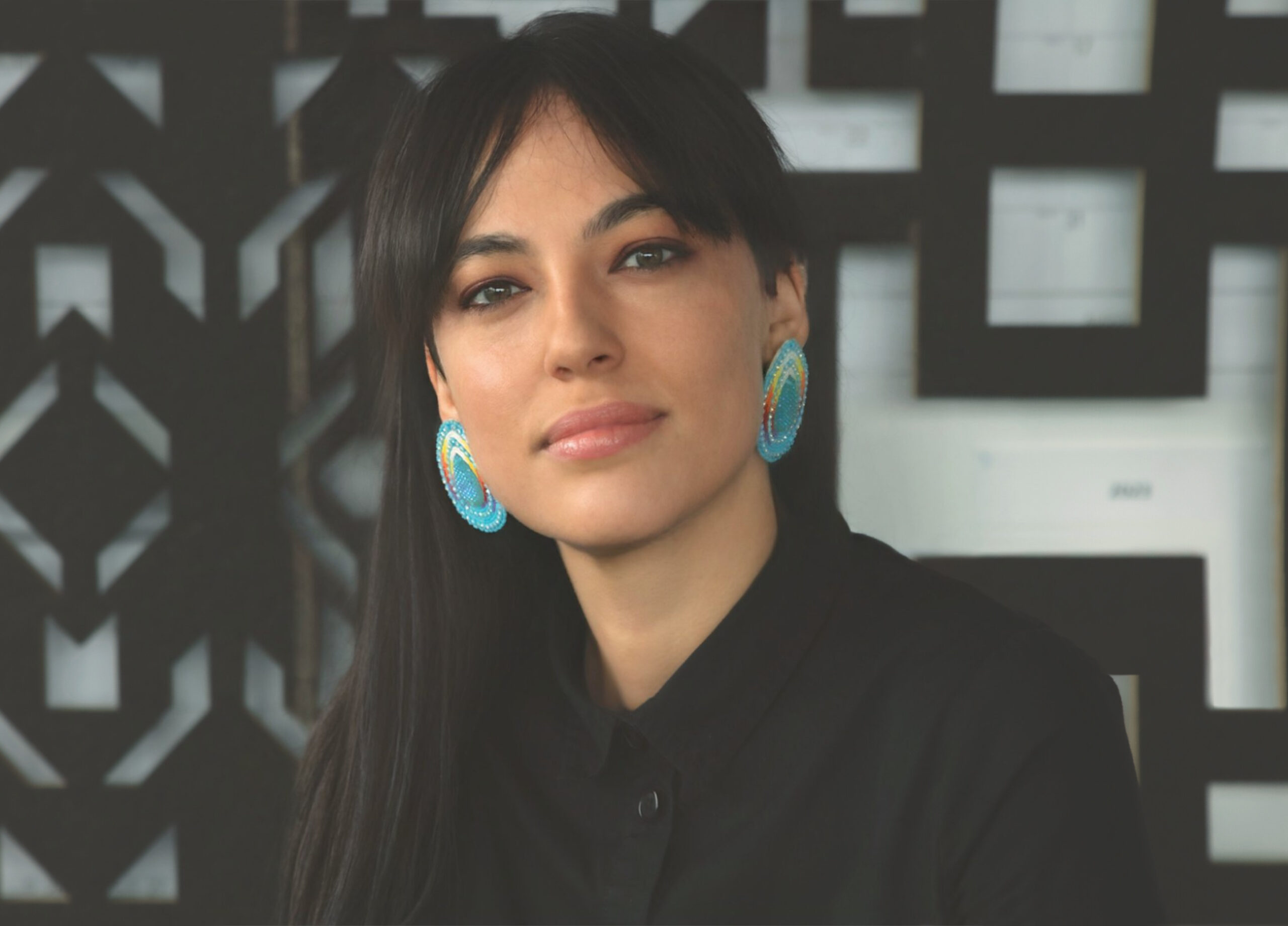
“Kwe kakina. Caroline nindijinkaz, nin Anishinaabekwe. Outaouais nitotci, tanjeh kitchi-minendan nindi nonggom. Kitchi migwetch.
I would like to start by thanking the Shoshone, Paiute, Goshute, and Ute Tribal Nations for having me as a guest on their traditional and ancestral homelands. I am deeply honored and feel privileged to be named this year’s Merata Mita fellow and to be following in the legacy of such talented Indigenous women that have accomplished groundbreaking work.
While I never had the opportunity to meet Merata Mita — her vision, commitment and resilience are legendary. When reflecting on the work she has accomplished, I am reminded of the importance of trusting your instincts, working with your community, and that telling our stories without compromise can go a very long way. It is a true honor to walk in the shoes of such a strong, visionary, independent, and determined woman that has blazed a trail for my generations, and those to follow. Her legacy continues to be a source of inspiration for creativity and innovation. It gives me strength, power, and vision.
It is through art and film that I found a sense of belonging, a sense of purpose and self-confidence. And through my process of becoming a filmmaker, I also realized how movies can be a powerful tool for education, empowerment, and revolution. This acknowledgment from the Sundance Institute comes at a pivotal time for me as I embark on the journey of writing and directing my second feature film. I have always worked towards bringing positive and authentic indigenous representation on screen, hoping to shed light on the chaos of the past, but also offer a glimpse into the future. A future filled with love, compassion, and intention.
My next film project is no different, titled Thunderbirds. It’s a story based on real events that took place in 1976 during the final months leading up to the permanent closure of an experimental college for indigenous youth in Quebec. Called Manitou College, it only existed three years, but the experience, however brief, deeply transformed the indigenous youth that were fortunate enough to attend. It is said that the government decision to close the college was motivated by fear in the face of the rising Indigenous intelligentsia. Basically, they were scared of a bunch of native youth making art and film. And they were right. Because when we control the narrative, we can achieve great things.
Thunderbirds is a project that seems incredibly fitting for this Fellowship, considering the impact Merata Mita had not only in film, but also for her community and for the rise of Indigenous voices at large. While I will be focusing on themes of love, friendship, freedom, humor, and sense of belonging in my film, I will keep in mind the struggles and achievements Merata Mita carried through her remarkable career with energy, vibrancy, and ideas of hope for the future. It means a great deal to me to be part of this Sundance native community and to be surrounded by like minded individuals. I am humbled that the work that I’m so passionate about can resonate with others. This recognition will allow me to continue my journey as a filmmaker and enables me to strengthen and further define my cinematic voice. It inspires me to continue to challenge myself and to strive to make impactful work that can be healing, inspiring and transformative.
I realized I could not have made it here today without the invaluable and continuous support of my community and my peers. I am deeply grateful to the Sundance Indigenous Program, to Adam [Piron] and his team for its support, and for paving the way for Indigenous artists like me to tell their stories. Receiving this fellowship today fills me with the confidence and the inspiration to continue Merata Mita’s legacy. I am proud to be Anishinaabe Kwe and I am proud to contribute to Indigenous cinema. I am surrounded by such incredible Indigenous talents from all over the world. You are truly inspiring. Your voices bring about change, allowing us to dream. These are really exciting times to be making films and to tell their stories. Kitchi migwetch.”







