About

Posts by :

U-Turn Audio Puts an Audiophile Spin With Orbit Turntables Series

U-Turn Audio Puts an Audiophile Spin With Orbit Turntables Series

If you’re just entering the hobbyist stage of vinyl record listening and collecting, you’re probably not at the stage of concerning yourself too much about features like a magnesium tonearm, electronic speed control, and a silicone belt driven system. They’re all options a vinyl listener can grow to appreciate over time, something American turntable maker U-Turn Audio is hoping to capitalize on with the announcement of a series of three updated modular turntables: the Orbit Plus, Orbit Special, and Orbit Basic, alongside a made-to-order Orbit Custom option.

Founded in 2012 by Benjamin Carter, Robert Hertig, and Peter Maltzan, U-Turn Audio has made a name for themselves as an independent American maker of audio equipment ranging from turntables, phono preamps, and speakers. Their Orbit turntables have earned popularity for their clean modern aesthetic, prosumer-to-audiophile specs, and the reasonable entry price into their brand. The newly updated Orbit turntables offer something for nearly everyone seeking a capable and handsome looking turntable intended to openly display your affinity of analog audio.

Person with tattooed arm reaching to place Red Ortofon needle and tone arm onto record with ORBIT wood plinth turntable. Houseplants can be seen blurred in the background alongside a brick wall.

Orbit is designed around a customizable and modular platform, allowing the customers to choose which components to prioritize up and down the turntable series. Parts such as the cartridge, preamp, speed control, platter, and isolation feet can all be customized, either at the time of purchase or down the line as an add-on replacement. The new generation of Orbit Turntables feature an updated single piece magnesium OA3 tonearm for improved tracking, an electronic speed control to easily switch from playing speeds between 33/45 RPM with the turn of a knob.

Upgrade to the Orbit Special or Orbit Custom, and you’ll get a seamless silicone belt drive with new grooved platter design for even smoother playback than its two lower-tier counterparts.

Recognizing the love for vinyl comes attached to an entire lifestyle element, U-Turn Audio has made sure to add a choice of five colors and two hardwood options to improve the chances you find a deck that ties together the whole listening room. It’s worth mentioning the wood turntables are not simply given the cheap veneer treatment, but are constructed from 100% sustainably-harvested, US-sourced hardwoods for stability and durability.

Angled view of ORBIT turntable with green plinth, clear acrylic platter, and cover open placed on top of a small vinyl record storage shelf with potted houseplant in the background.

If you’re a little more discerning about keeping your U-Turn Audio turntable perfectly stable, the company offers optional adjustable-height aluminum feet outfitted with Sorbothane to reduce external vibrations.

White Orbit Basic turntable from overhead against white background with black felt slip cover.

Orbit Basic starts at $249, an entry model that comes equipped with the newly designed magnesium OA3 tonearm, grooved MDF platter with seamless silicone belt, and five new color and two wood options.

Blue Orbit Plus with semi-opaque acrylic platter shot from overhead against all white background.

The Orbit Plus starts at $399, arguably the sweet spot model for most listeners seeking “great” but not necessarily the “best.” The Plus comes with an upgraded acrylic platter and an Ortofon OM5E cartridge with elliptical diamond stylus.

For a minimalist setup, U-Turn Audio offers to add a built-in Pluto 2 Phono Preamp that allows them to connect the turntable directly to powered speakers without any additional space required – an increasingly popular configuration when budget, space, or a preference for keeping things simple eclipses audiophile precepts for larger discrete components.

Green Orbit Special turntable with clear acrylic platter with Red Ortofon needle and dust cover opened, staged against white background.

Green Orbit Special turntable with clear acrylic platter with Red Ortofon needle without dust cover, staged against white background and viewed from overhead showing its seamless belt drive in the upper left corner and speed dial control in the lower left.

The $549 Orbit Special adds several premium bells and whistles: an Ortofon 2M Red cartridge with elliptical diamond stylus, electronic speed control that allows users to adjust between 33/45 RPM playing speeds with the turn of a knob, and a cue lever for precise tonearm operation.

U-Turn Audio continues to offer Orbit Custom starting at $249 (fully maxed out, expect to part northward of $600; not an unreasonable price within the turntable category). If you harbor aspirations for a turntable under the pretense of one-and-done, the Orbit Theory delivers the brand’s best performance, attributed to the genuine hardwood plinth, seamless silicone belt drive powered by an ultra-quiet motor with electronic speed control (33/45 RPM), with the option to top the one-piece magnesium OA3 Pro Tonearm with either an Ortofon 2M Blue or Bronze cartridge.

This post contains affiliate links, so if you make a purchase from an affiliate link, we earn a commission. Thanks for supporting Design Milk!

Gregory Han is a Senior Editor at Design Milk. A Los Angeles native with a profound love and curiosity for design, hiking, tide pools, and road trips, a selection of his adventures and musings can be found at gregoryhan.com.

Fraya Replinger’s photography elevates the everyday

Fraya Replinger’s photography elevates the everyday

This year’s Boneyard Arts Festival, my first event as Arts Editor, introduced me to the work of many talented local artists. One of my favorite things that I encountered was quite simple in theory: a photograph of a lemon. Yet, the photograph was vibrant, clear, intricate, refreshing, and above all, memorable. The close-up shot was the work of Fraya Replinger, a photographer born and raised in Urbana. Replinger’s family has long been a part of the C-U art community: her grandfather, Jack Replinger, was a professor of architecture at the University of Illinois from 1950s through the 80s, and built many houses in the community. Her grandmother, Dot, was an art teacher and prolific fiber artist. Although Replinger moved away from C-U for several years, she “felt called back to Champaign-Urbana.”

Since Boneyard, I’ve encountered Replinger’s work at other venues around C-U, and likely you have as well. She had work at Art Around the Block, Crystal Lake Art Fair, and currently has a collaborative billboard up as part of 40 North’s Sky Gallery. Replinger’s work is interesting, and her portfolio is quite diverse: you can tell that she isn’t afraid to try new things. I recently corresponded with Replinger about that lemon photograph, her billboard for Sky Gallery, and more.

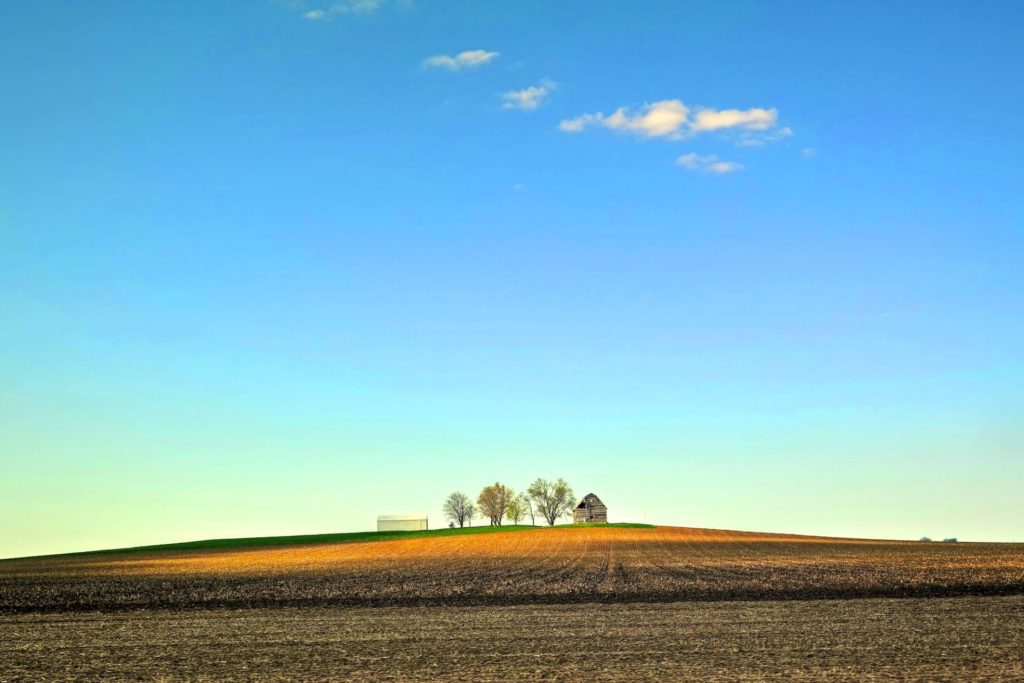
Bare landscape with a bright blue sky and a few trees in the center in the far distance.Bare landscape with a bright blue sky and a few trees in the center in the far distance.
Fraya Replinger

Some responses have edited for length and clarity

Smile Politely: How long have you been a photographer? How did you get started?

Replinger: I have been a photographer for as long as I can remember. My father is a photographer and I recall following him with my pink 35mm point-and-shoot camera, taking pictures of flowers, clouds, and people. I contribute my love and passion for photography to him. I also took photography classes in high school and college. Over time, my perspective and style began to crystalize. In 2009 I entered the Champaign County Camera Club Best in Show Competition and participated each year until 2018. Part of the competition is a critique moderated by the judges. I found this incredibly valuable and I applied much of what I learned into my photographic style. Thanks to encouragement from my family and a number of artists I admire, I continued to evolve and began showing my work in 2017.

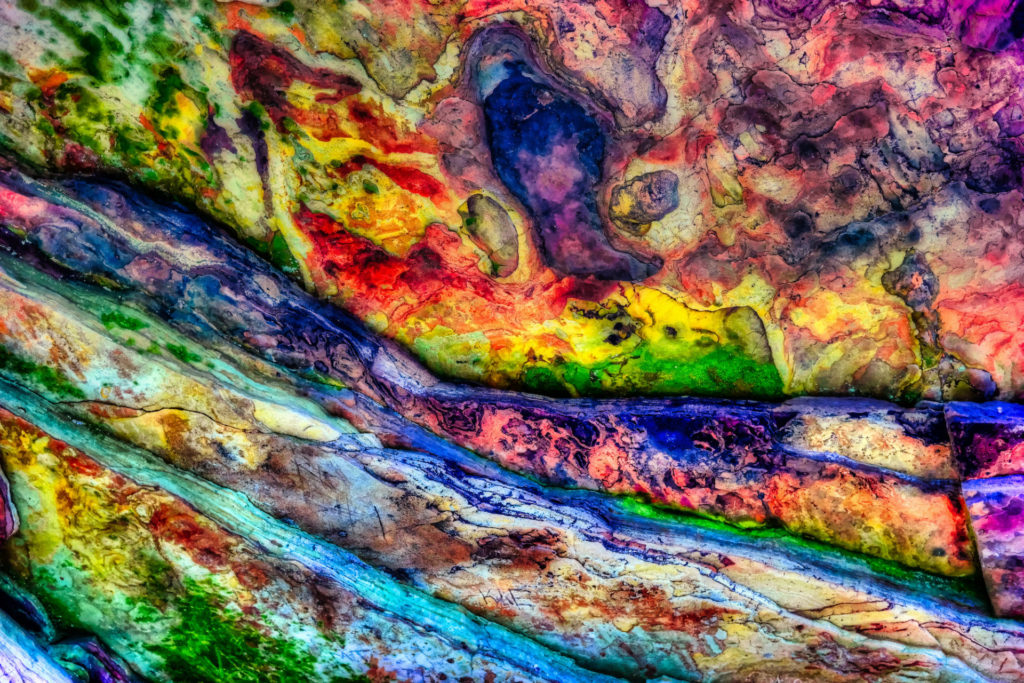
Close up of vibrantly colored rocksClose up of vibrantly colored rocks
Fraya Replinger, Colorful rocks

SP: I first saw your work at Boneyard; you had this incredible close-up photo of a lemon called Citrus, and I felt it was this perfect example of an artist taking something that we see every day and elevating it to this higher level. What inspired you to photograph food in this way? 

Replinger: Each year I take part in the Boneyard Arts Festival, I try to come up with something different — something outside of my usual landscapes and colorful sunsets. Last year I focused on close-up, colorful images of rock formations and printed the images on aluminum. This year I explored macro photography. While shooting landscapes takes me outside of my home and usual daily routine, shooting food and other everyday items reminded me of the energy and delight that can flow from something as simple as a lemon.

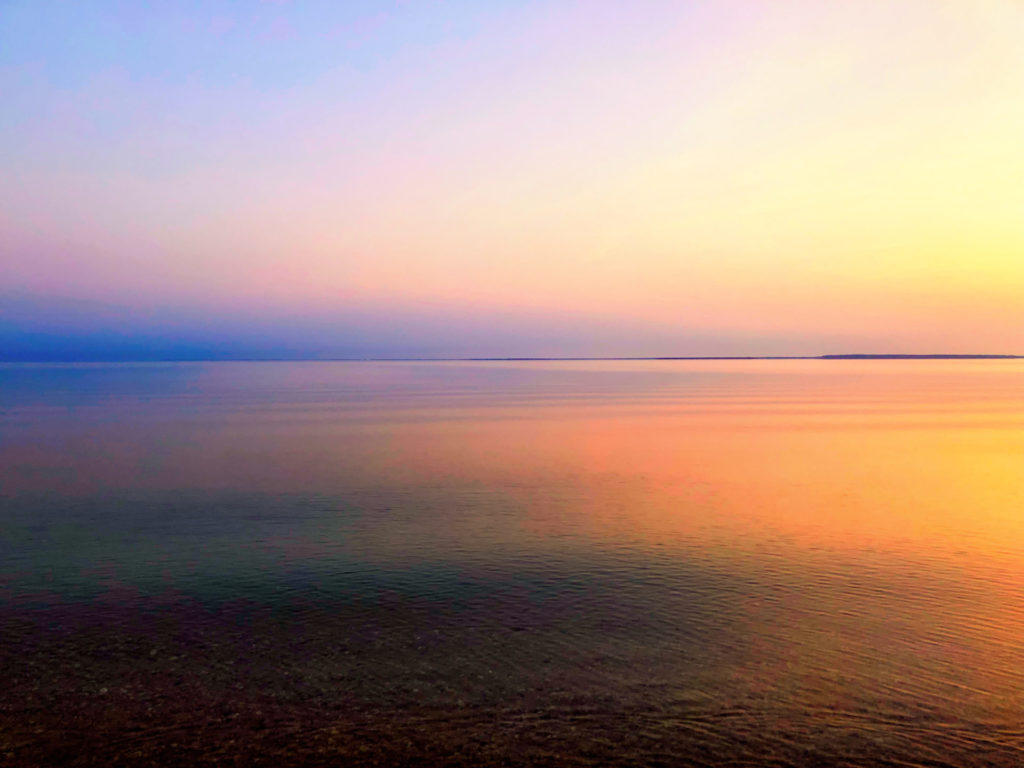
Colorful sunset over a body of waterColorful sunset over a body of water
Fraya Replinger

SP: I noticed a lot of your work skews either very large scale or very small scale: you photograph wide open landscapes and also have photographs showing the end of a crayon, or a single thin piece of garlic skin. Do you deliberately set up this juxtaposition with your displays? What draws you to each?

Replinger: Shooting macro has opened a new side of my work. The contrast between a wide, expansive landscape and the tiny details of a vegetable demonstrates that there’s beauty everywhere, in big places and in small ones. When I set up my macro shots, the challenge is in planning the shots while leaving room for experimentation. I’m always thinking about color and form. For my garlic pieces, for example, I emphasized the purples of the peel. There’s a whimsical softness to garlic that I discovered and played up through observing and capturing the way the peels reacted to the light. As for my landscapes, it’s all about capturing the right moment. I love to shoot dramatic cloud formations — the challenge with that is that I’m a little weary of thunderstorms. Capturing a scene with the perfect light is also a challenge, and so is maintaining restraint in the post-production process. But each time I go out and explore the world around me with my camera in my hand, I return having learned something new.

SP: Is there a difference with large versus small scale when it comes to planning and experimentation/improvisation? 

Replinger: With my large-scale landscapes, I often have no plan. It’s almost always spontaneous. The weather can change in an instant, especially on those late afternoons in the summer. The small-scale, close-up images are planned set-ups with room to adjust on the fly. As I have grown in my artmaking practice, I’ve realized I approach the work in the same way a painter might. I have my still-life-esq works, shot in my home using what I have around, allowing me to hone my technique and take my time capturing details. I also have my landscapes, each one captured as a plein-air artist would, each click of my shutter a brand-new moment, like brushstrokes. There’s a time for planning and crafting. And there’s also a time to abandon your plan and go where the land and the sky takes you.

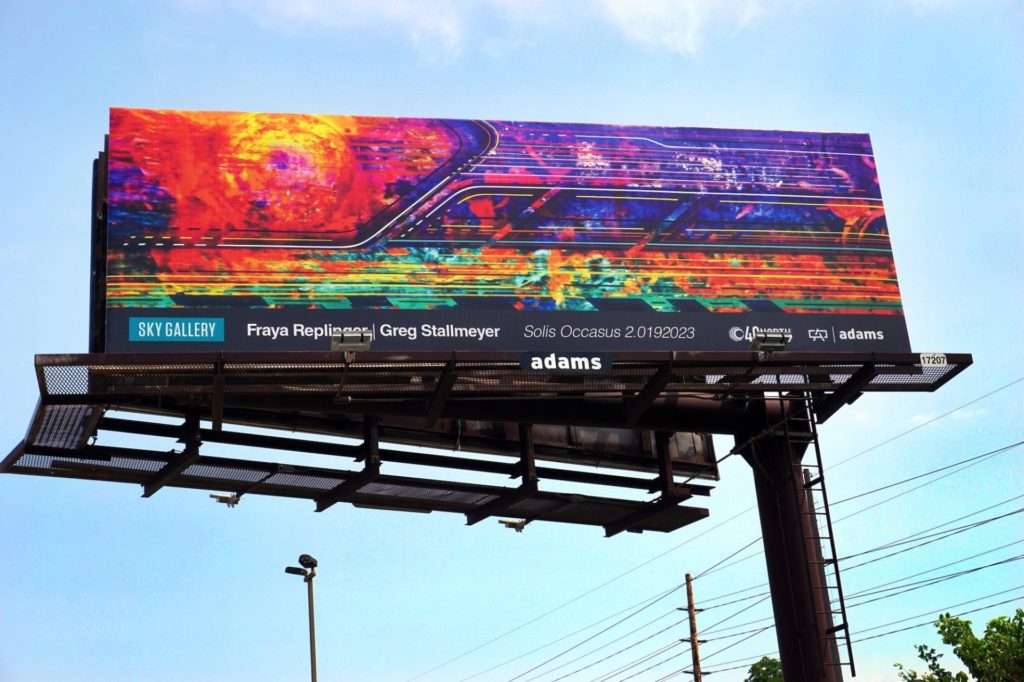
a billboard of Replinger and Stallwater's brightly colored abstract collaborative piece.a billboard of Replinger and Stallwater's brightly colored abstract collaborative piece.
40 North on Facebook

SP: You currently have a mural up as part of Sky Gallery. Congratulations! I’ve really enjoyed seeing all of these around town. Yours is a collaborative piece with Greg Stallmeyer. How did that collaboration come about? As you were working on the piece, did you ever envision it on a billboard?

Replinger: Thank you! Greg and I started working on our collaboration in 2019 with the intention of it being displayed in a large format. It began with an image I created of Greg’s welding table and blossomed from there. Working with Greg inspired me to explore abstract photography more.

SP: Do you have more plans for future collaborations? 

Replinger: Greg and I talk often and have ideas, but no solid plans yet. As my friends and family could tell you, I spend much of my time at my shows chatting with other artists, exchanging inspiration and learning more about their processes. I hope to explore more collaborations with my network of art friends in the future.

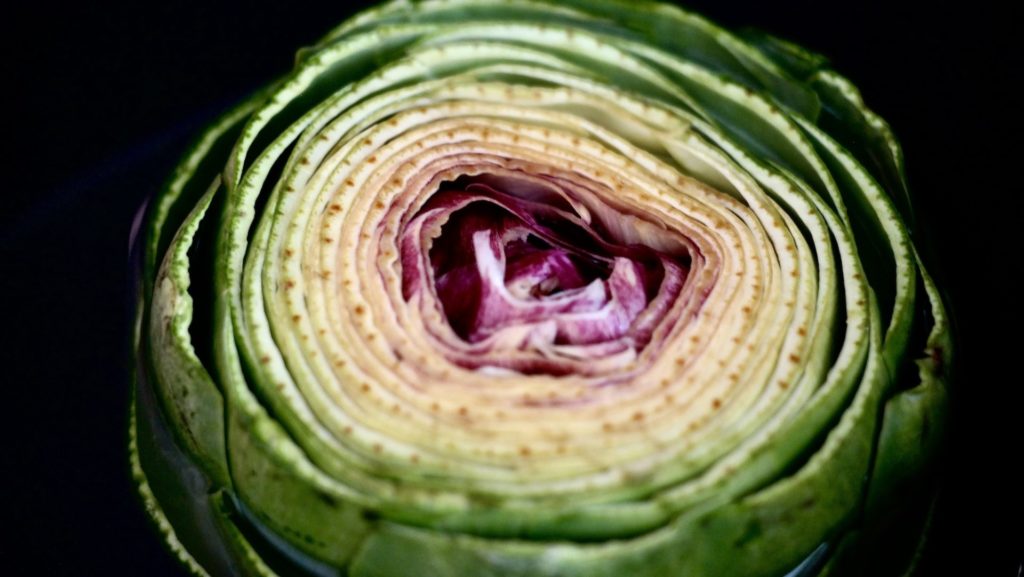
close up of an artichokeclose up of an artichoke
Fraya Replinger, Artichoke

SP: If you had to choose, which fruit or vegetable do you think is the most interesting to photograph?

Replinger: My current favorite is the kiwi. The vibrant color and the thin, radiating lines make for an energetic image. My first favorite was raw artichoke. An image I created years ago, with the help of my mother, that highlights the rich magenta and fresh green of the heart makes me smile every time I see it.

SP: What are you currently working on?

Replinger: My wheels are always turning. Lately, I have been exploring nostalgia and my own personal images and symbols from childhood and adolescence. I have also started examining old barns and farmhouses around the Champaign-Urbana area. I have several shows coming up and am in a constant flow of preparation for these events.

An abandoned wood barn sits in an overgrown fieldAn abandoned wood barn sits in an overgrown field
Fraya Replinger

SP: Is there any place around C-U where people can check out your photography?

Replinger: I am currently showing work at Allerton Park & Retreat Center in the Mansion and in the Greenhouse Café. I am also showing work at Po’Boys in Urbana.

This fall, you can also find Replinger at West Side Arts, Sugar Creek Arts Festival, and the Craft League of Champaign Urbana 40th Annual Art Fair.

UA Little Rock to Host Exhibition from Husband-and-Wife Photography Team – News

UA Little Rock to Host Exhibition from Husband-and-Wife Photography Team – News

The University of Arkansas at Little Rock Art Gallery will host an exhibition from the internationally renowned husband-and-wife photography team of Robert and Shana ParkeHarrison.

Their exhibition, “ParkeHarrison: Earth Elegies,” begins Sept. 11 and ends Oct. 3. The exhibition, which is free and open to the public, will be on display in the Brad Cushman Gallery in the Windgate Center of Art and Design.

The ParkeHarrisons will give a presentation on their work from 6:30-7:30 p.m. Thursday, Sept. 28, in the Stella Boyle Smith Concert Hall in the Fine Arts Building. UA Little Rock will hold a reception for the exhibition from 5:30-8 p.m. Friday, Sept. 29, in the Windgate Center lobby and Brad Cushman Gallery.

“Our photographs offer visual poems of loss, human struggle, and personal exploration within landscapes scarred by technology and over-use,” the ParkeHarrisons said in an artist statement. “As collaborative artists, we strive to metaphorically and poetically link laborious actions, idiosyncratic rituals and strangely crude machines into tales about our contemporary experiences. We construct elaborate sets made from found objects. Our scenes combine real and constructed landscapes. These scenes have a sense of determination and irony while addressing mankind’s responsibility to heal the damage inflicted on the environment.”

Robert ParkeHarrison earned a Bachelor of Fine Arts from Kansas City Art Institute and a Master of Fine Arts from the University of New Mexico. Shana ParkeHarrison earned a Bachelor of Fine Arts from William Woods College and completed graduate studies at the University of New Mexico.

Their photographs have been displayed in more than 45 solo exhibitions and more than 100 group shows worldwide. Their work can also be found in over 35 collections, including the National Museum of American Art at the Smithsonian Institution, the George Eastman House, the Whitney Museum of American Art, and the Los Angeles County Museum of Art. Their book, “Robert and Shana ParkeHarrison: The Architect’s Brother,” was named as one of the 10 best photography books of the year in 2000 by the New York Times.

The UA Little Rock Art Galleries in the Windgate Center are open from 9 a.m. to 5 p.m. Monday through Friday, 10 a.m. – 1 p.m. Saturday, and 2-5 p.m. Sunday.

For more information, contact Nathan Larson, interim art gallery director and curator, at 501-916-5104 or nglarson@ualr.edu.

Share this Post:

Steven Meisel and Zara launch collection inspired by the fashion photographer’s personal style

Steven Meisel and Zara launch collection inspired by the fashion photographer’s personal style

Poker-straight black hair, trapper hat, black bandana, slouchy jeans, dark sunglasses – seminal American image-maker Steven Meisel’s distinct look is (almost) as recognisable as his photography, which came to define 1990s fashion and cemented the era of the supermodel. 

Coinciding with the arrival of New York Fashion Week – which begins today (Friday 8 2023) with Peter Do’s debut collection for Helmut Lang – Meisel reveals a new collaborative collection with Galicia-based fashion behemoth Zara, which mines both his personal wardrobe and his catalogue of photography, particularly that from the 1990s. Titled ‘Steven Meisel New York’, it also pays homage to the city where he was born – ‘a love letter to the photographer’s hometown’, as the notes describe. 

A first look at Steven Meisel’s collection for Zara

Model wears Steven Meisel New York Zara Collection

(Image credit: Photography by Steven Meisel, courtesy of Zara)

As such, the collection includes Meisel signatures – an oversized black trapper hat, checkered kilt, slouchy leather boots and biker jacket all feature – alongside pieces that capture the spirit of the 1990s, from a grunge-inspired plaid shirt to an oversized striped sweater and baggy denim shirt. Others capture ‘the dreamy realms of his own obsessions’, like a croc-print coat designed to evoke the 1960s, another era that has fascinated the image-maker. 

Elsewhere, T-shirts and sweaters are stamped with ‘Steven Meisel New York’, while smaller accessories include black-rimmed sunglasses, leather cuffs, and an array of jewellery including simple studs and chains in silver that nod to the punk movement. Of the ‘darkly seductive’ collection – much of which is designed for both men and women – Zara says it draws on the same ‘edgy confluence of music and fashion’ that has defined Meisel’s photographic output. 

Steven Meisel New York Zara Collection trapper hat

(Image credit: Photography by Steven Meisel, courtesy of Zara)

The project is launched with a series of portraits, photographed by Meisel, of 26 figures who ‘act as different faces’ of the image-maker. Notably, these include his perennial muse Linda Evangelista, alongside Amber Valletta, Liya Kebede, Irina Shayk, Gigi Hadid, Kaia Gerber, Penelope Tree, Eva Herzigova, Alton Mason, Ash Stymest and Scott Barnhill, among others. Meisel worked on the portfolio with perhaps his closest collaborators: stylist Karl Templer, make-up artist Pat McGrath, and hair stylist Guido Palau.

The collection will launch in two dedicated pop-ups, the first running from 9-13 September 2023 at 33 Howard Street, SoHo in New York; the second from 15-17 September 2023 at Dover Street Market London, coinciding with London Fashion Week. 

The collection will launch more widely on September 18 2023 in Zara stores and online. 

Steven Meisel New York Zara Collection model wears trapper hat

(Image credit: Photography by Steven Meisel, courtesy of Zara)

The collaboration continues a longstanding partnership between Zara and Meisel, the latter having captured several recent campaigns for the brand. Last year, an exhibition in A Coruña, Spain, ‘Steven Meisel 1993 A Year in Photographs’ – documenting one particularly prolific year in the photographer’s career – was hosted by Marta Ortega, chair of Inditex, the Spanish textile conglomerate which owns Zara.

zara.com

Photographer Patricia Caulfield dies

Photographer Patricia Caulfield dies

A woman who sued Andy Warhol and won after he used one of her photos has died.

Patricia Caulfield was 91.

>> Read more trending news

Caulfield was an editor at Modern Photography magazine in the 1960s. She had sued Warhol after he used a photo she had taken of hibiscus blossoms. She had published the image in an article in June of 1964 and the artist had reached out to the magazine, asking to buy the photo, but he didn’t want to pay the price they had said.

Instead, according to Caufiled’s lawsuit filed in 1966, Warhol cut the photo from the magazine, cropped it and made silkscreen paintings of the image to create his “Flowers” series of art. The series was displayed at the Leo Castelli Gallery in Manhattan in November 1964, just months after the photo’s initial publication.

“He didn’t think it would be a big thing, but ‘Flowers’ sold like crazy,” Caulfield’s sister Kathleen Hall told The New York Times.

Caulfield and Warhol settled and part of the agreement was that Warhol would make two new “Flowers” paintings, which eventually sold for $6,000. She also received 25% of the realities from the original “Flowers” prints.

Her suit against Warhol was one of several where photographers sued the artist for using their images to create his work, according to The Columbia Journal of Law & the Arts.

Caulfield eventually left Modern Photography and became a freelance photojournalist, focusing on the environment and wildlife.

“I guess there’s the hope somebody may see my photographs and think, ‘that’s a wonderful animal, maybe it’s worth making an effort to save,’” Caulfield told the Knight-Ridder in 1977, the Times reported. “But at least I’m effective in making a record of something before it all gets ruined.”

Caulfield was born in Chicago on March 17, 1932. Her father was a doctor and her mother was a nurse. She attended the University of Rochester. She started picking up photography after appearing on a television show hosted by the curator of the then-George Eastman House. She moved to San Francisco after graduating in 1953, taking photography courses at night and working at a camera store during the day. Caulfield was eventually hired by Modern Photography in New York as a secretary, but within 11 years had been named executive editor, the Times reported.

In addition to Modern Photography, her photos also appeared in National Geographic, Audubon, Smithsonian and The American Sportsman publications. She also published several books.

Her library of photographs was recently donated to the Dolph Briscoe Center for American History at the University of Texas at Austin.

Caulfield died at a Manhattan assisted living facility on July 16, the Times reported. She leaves behind her sister.

F5: Glen Baldridge Loves Gummi Bears, Printmaking + More

F5: Glen Baldridge Loves Gummi Bears, Printmaking + More

“Garbage Pail Kids cards blew my mind,” said accomplished painter, printmaker, and draftsman Glen Baldridge. “My mom would drive me to every gas station in Great Falls, Montana to look for them. I remember the excitement of finding and ripping open those little packages. The play with language combined with the gross out drawings was just the best. That was the first art I collected, and [it] definitely made me want to draw and make art as well as live with it.”

Glen’s recent works have embedded sardonic phrases from youth sub-culture into ultra-complex painted patterns. Often working with traditional craft processes like paper marbling, he obscures the words’ readability. Fissures in the otherwise smooth paint on the surface merge darkness with youth and beauty. Recurring phrases like “No Way” and “Wait, What” invoke a detached attitude juxtaposed by a colorful palette, speaking to attempts to navigate the unpredictable conditions of the current time in history.

Glen Baldridge

But the creative knows that even though it’s his hand painting, he’s not the only one responsible for success. “My dealers, Ryan Wallace (Halsey McKay Gallery), Sam Wilson, Ingrid Bromberg Kennedy, and Rob Hult (Klaus von Nichtssagend Gallery) gave me my first shows,” he shared. “They’ve been so supportive of my work through all its weird stages. I have always had a number of other freelance jobs within the art world, and the gallery exhibitions have kept me focused on making my own work and allowed me to flesh out and develop ideas. I love getting weird in the studio the most, and my dealers help facilitate that pursuit and have given me many opportunities to present the work formally.”

Glen’s work doesn’t happen too far from the majority of the rest of his life these days. “My studio is now attached to my home, so it can be difficult to create a separation. I used to ride the subway or road-rage my way to the studio in New York, but now I don’t even have to put on shoes,” he quipped. “Picking up my son from school is a pretty clear switch back to personal life from work. However, I try to keep the creativity flowing and often work on making drawings, paintings, and collages with him. I have a 44-inch roll of sticker paper for my large format inkjet printer. We’ll do a Google image search for “cool cars,” “deep sea animals,” etc. and make sticker collages together. It’s not work, but [it] still gives me ideas that may pop up in the studio.”

Today, Glen Baldridge is joining us with a few of his favorite things for Friday Five!

interior of a print shop with lots of machinery

1. Printmaking

I have met some of my best friends through making prints. I studied printmaking in college and love hanging around in print shops. I ran Forth Estate Editions (a print publishing company) with Luther Davis for 10 years. Together, we produced over 60 editions with emerging artists and worked with so many great people. I’ve worked as the artist, printer, consultant, and publisher on numerous other editions for other artists and galleries. I love the collective creative problem solving required to compose even the simplest of prints in multiples. Printmaking continues to be an important part of my artistic practice and greatly influences my approach to making paintings as well. Last year, I made print editions with Flying Horse Editions (Orlando, Florida), Du-Good Press (Brooklyn, New York), and Phil Sanders Studio (Asheville, North Carolina). All of those projects have allowed me to travel and brainstorm with master printers about technique and concept, and get me out of my head and my studio. These working relationships continue to grow over many years and multiple projects as well.

green landscape of a forest and hazy sun

2. The Woods

I grew up in Montana backpacking every summer, and continued to make annual trips there into my adult life. Getting into the solitude of the forest provided some kind of mental reset for me. When trail cameras became widely available I continued to explore the forest remotely from New York City and made artworks with those images triggered by both unseen forces and wildlife. Sorting through thousands of images from the trail cams scratched that itch for a while. Now, my studio window looks into the forest in rural Maine. I find just staring out the window into the trees continues to spark my imagination and curiosity.

looking down into a hole in the ground with a closed sarcophagus at the bottom

3. “let people drink the red liquid from the dark sarcophagus” Petition

The internet is a dark place, but sometimes it delivers moments of hilarity and joy. In 2018, a sarcophagus containing several skeletons and a soupy liquid was unearthed in Egypt. The internet naturally thought it was cursed and a Change.org petition was created to ‘let the people drink’ its bony broth. Almost 40k broth lovers signed the petition and left incredible commentary. This also spawned countless hilarious text threads with my friends and continues to be funny five years later. Let them drink!

a wall of scratch off lottery tickets

4. Scratch Lottery Tickets

Scratch lotto tickets have such a gripping aura of hope and loss and the best/worst design. I love the overload of color, pattern, symbols, and language. I’m not really into gambling, but I do love the design aesthetics. I grew up with video keno and poker machines in every restaurant. For years I picked up the losing scratchers I’d find on the floors and sidewalks of gas stations and bodegas and kept them around for color/pattern inspiration. I’ve even made print editions using the “scratch” coating – where the surface had to be scratched off to reveal the image.

a bag of Haribo gummy bears

5. Gummi Bears

Gummi bears are my favorite candy. It used to be Nerds, but I’m an adult now. I’ll go way out of my way to find a “share size” bag of Haribo bears with limited edition party hats included. It’s sort of a problem. When my wife was in labor she was not allowed to eat any food, but her doula and I would feed her gummi bears when the doctor’s backs were turned. We started this new chapter of our lives pretty revved up on gummi bears, so they’ve also become a symbol of strength for my family.

colorful, abstract painting

Glen Baldridge, No Way, 2022, gouache on paper, 38 3/8 × 29 7/8 inches (97.47 × 75.88 cm)

colorful, abstract painting

Glen Baldridge, Guys, What?, 2022, gouache on paper, 58 × 38 1/2 inches (147.32 × 97.79 cm)

colorful, abstract painting

Glen Baldridge, No Way, 2022, gouache on paper, 38 3/8 × 27 1/2 inches (97.47 × 69.85 cm)

colorful, abstract painting

Glen Baldridge, Whatever Forever, 2022, gouache on paper, 38 3/8 × 30 3/4 inches

Kelly Beall is Director of Branded Content at Design Milk. The Pittsburgh-based writer and designer has had a deep love of art and design for as long as she can remember, from Fashion Plates to MoMA and far beyond. When not searching out the visual arts, she’s likely sharing her favorite finds with others. Kelly can also be found tracking down new music, teaching herself to play the ukulele, or on the couch with her three pets – Bebe, Rainey, and Remy. Find her @designcrush on social.

Photographer Who Was Hit at Football Game Dies After Life Support is Turned Off

Photographer Who Was Hit at Football Game Dies After Life Support is Turned Off
Photographer Linda Gregory
Courtesy of Wichita Northwest Grizzly Football team.

High school football photographer Linda Gregory has died after an accident during a game she was covering caused her to hit her head.

Her husband Mel confirmed the sad news after it had been reported that Linda was on life support with “little hope left” after the incident in Kansas on Monday night.

Further details of what happened have come to light during the junior varsity game between Wichita Northwest High School and Bishop Carroll High School.

Two players were engaged in a block that carried on out of bounds where they collided with Linda. The photographer had her camera trained somewhere else on the field and noticed the players coming toward her very late. After she fell backward and hit her head on the concrete apron, the players immediately stopped to help her as the medics were called over within seconds.

Linda’s husband Mel made the decision to to take Linda off life support and move her to Kansas City where her organs will be donated. Mel says that this is what Linda would have wanted and she had requested a do-not-resuscitate order which the family conformed to.

Linda Gregory

Tributes for Linda have poured in, led by her husband Mel who revealed Linda’s photography enabled her to travel extensively — including to Romania where she was invited to take photos of various sports teams there and was even commissioned to shoot a wedding in the Eastern European country.

The incident highlights the dangers for sports photographers covering not only football but baseball as well. Photographer Tony Morano had to be taken to hospital after an incident during the XFL championship game. And YES cameraman Pete Stendel has only just returned to work after a two-month hiatus after he was struck in the head by a wayward baseball.

“Linda was an amazing person who breathed life into our students here at Northwest,” Northwest Grizzlies football coach Steve Martin says.

“Her passion for kids was amazing, but it went deeper than taking pictures for Linda and Mel. They were a part of our football team and always will be. They are family! She was a mentor and friend to some of our boys, past and present, and they are hurting right now.”