
Love will be all around the Sydney and Walda Bestoff Sculpture Garden Sept. 22 for LOVE in the Garden, the annual NOMA fundraiser.
LOVE in the Garden blends food, cocktails and sculptures


A new “Light Photography” colorway of Nike Air Max Plus sneakers looks like it is heavily inspired by light painting photography.
The sneakers sport a fiery red and orange with bright white laces, and white lines branch out spreading from top to bottom, making the shoes look like a wearable canvas of light photography. The design can even be seen peeking out from inside as the pattern is also emblazoned on the footbeds.
Obviously, light plays a crucial role in all photography, but the shoes evoke images that use light painting. The style uses long exposure to manipulate how a moving light source (or a still light source and a moving camera) appears in the final picture. It’s been around since the late 1880s, so a bit longer than the Nike Air Max.

Nike’s Air Max line debuted in 1987 and has been a massive success for the company since.
“1987 saw the birth of the Air Max lineage, showcasing visible Air for the first time,” Nike’s website reads. “What began as an experiment in cushioning soon evolved into an icon on the track and the streets. Over the years, it’s been reimagined and retooled, but the heritage always remains.”
The light painting-inspired design is an interesting take on the line’s look. The “light” lines on the fabric are typically made from plastic accents that ripple down from the laces to the soles.

PetaPixel reached out to Nike for information on the design and whether it uses an actual photograph that uses light painting. However, Nike did not return the request for comment. Still, the look and name evoke the popular photography method as the white lines cut across the bold orange and red hues.
“Let your attitude have the edge with a flame-like design that adds heat to the streets while airy mesh keeps you cool. The Air Max Plus gives you a tuned Nike Air experience that offers premium stability and unbelievable cushioning,” the description for the upcoming Air Max Plus design reads.

The Light Photography shoes release on Thursday, September 7. However, it seems like they’ll only be available in certain markets at launch. The Light Photography line appears on Nike sites for locations in Europe, Canada, and South Africa. For those with access, the Air Max Plus sneaker will cost €190, or a little over $200 USD. Nike has not shared information on a release of its Light Photography sneakers in the Americas (with the exception of Canada), Asia, or Australia.
Image Credits: Nike
… I spent a little time going through the photos I took of the redtail hawk family this spring and it was fun remembering the antics of the young red tails as they explored their newfound freedom of flight and some of the photos like the one above brought back memories of the days when I first learned how to ride a bike and taught my girls how to do the same. Although I have never leaped off a cliff in a hang glider, I imagine the feelings going through my mind would have mimicked the young red tail as he contemplated going over the edge of the cliff and flying … I took this shot the day he first fledged (left the nest) and it was awesome watching him teeter around … finally he elected to stay on the cliff for a bit longer.
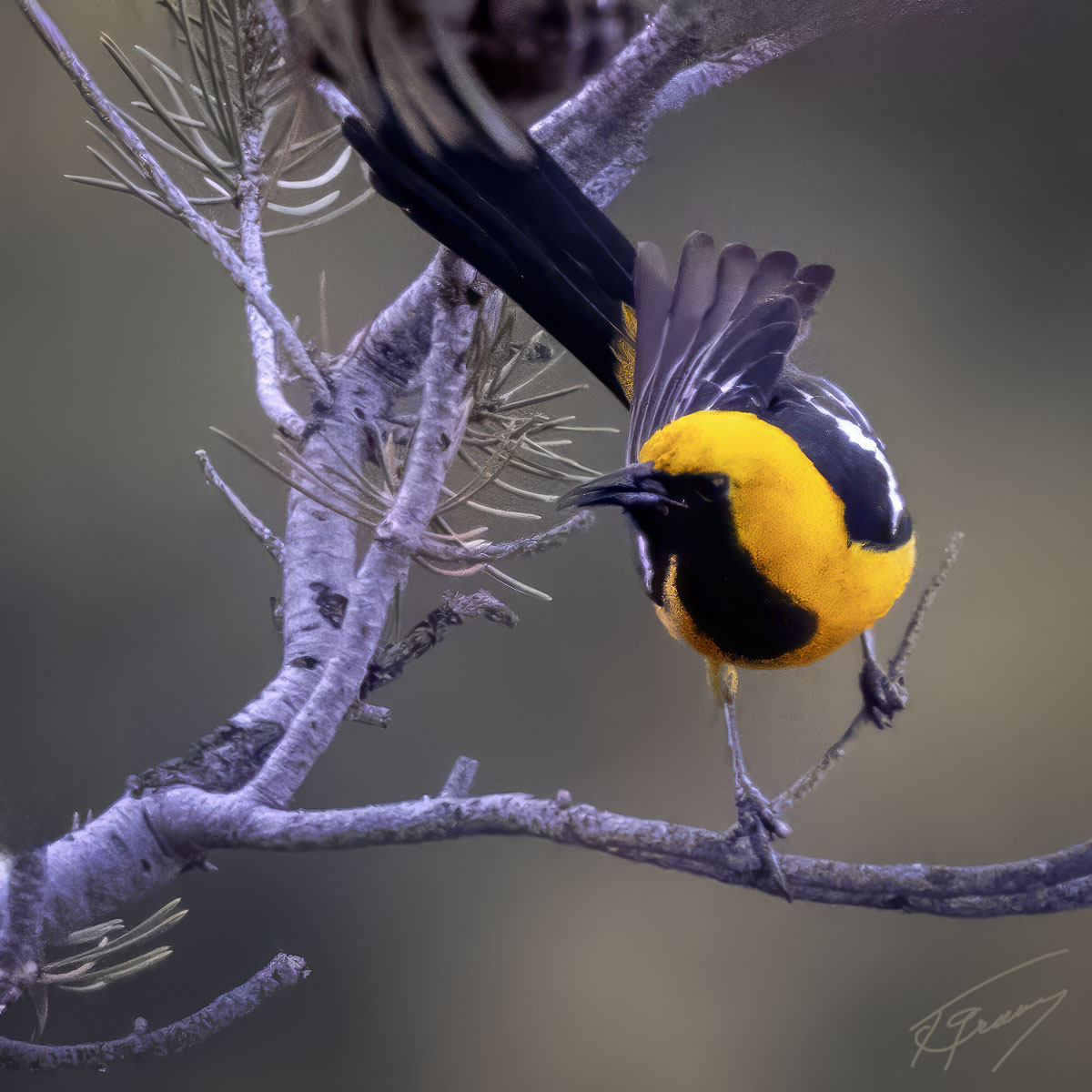
Another day when I was in my own perch in Glendon’s tram about 150 above the surface, a hooded oriole joined another of the young red tails hawks in a tree on the side of the cliff about 50 feet to my right. There were many other birds, particularly cliff swallows who flew by or entered nests on the cliff wall. It is amazing how abundant the life found on the cliff face is.

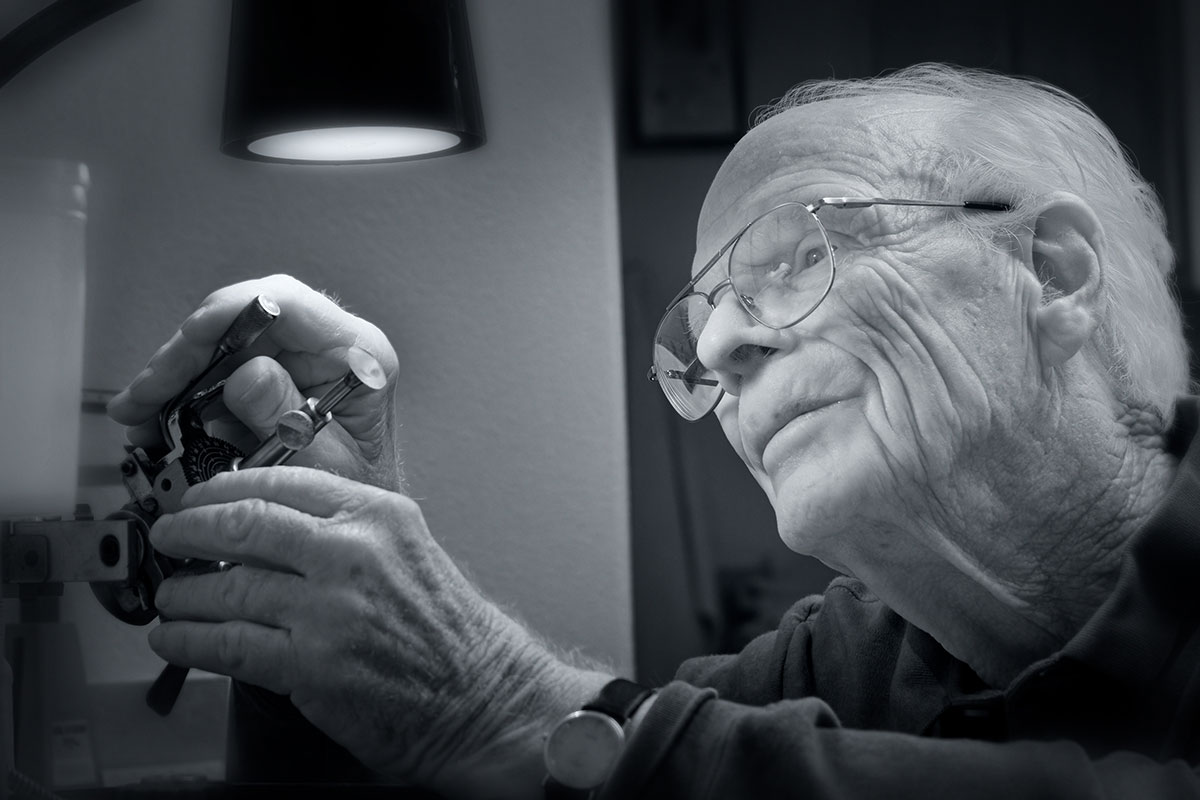
Another terrific day of life is now in the books, visits with friends and work on both gemstones and photographs. Yesterday my friend Jim did a series of photos of me faceting a piece of morganite, a member of the beryl family of gemstones … morganite is pink, light green is green beryl, blue is aquamarine, yellow is heliodor and the intense green is emerald … beryl is a beryllium aluminum silicate … see image of me below 🙂
Tomorrow the photos come off the walls and will be hung in the Sedona Renegades Gallery at Hozho for the duration. Friday is … Meet the Artist First Friday of the month … I’ll be there beginning at 5PM on Friday and hope to see you there.
Have a beautiful day … we are here, and life is great … enjoy it each day whilst you have it.
Smiles,
Ted
Though I know I shall sometime no more open
my eyes to the night or day,
I am one who looks at the stars when unchained from
the work-bench at nightfall.
They are a sign that I am not ephemeral, not you, nor
you, whoever you are.
The dawn comes and the dark and the sign sparkling
in the brooding night forever and forever.
At Nightfall by Max Ehrmann
###
 The easiest way to reach Mr. Grussing is by email: ted@tedgrussing.com
In addition to sales of photographs already taken Ted does special shoots for patrons on request and also does air-to-air photography for those who want photographs of their airplanes in flight. All special photographic sessions are billed on an hourly basis.
Ted also does one-on-one workshops for those interested in learning the techniques he uses. By special arrangement Ted will do one-on-one aerial photography workshops which will include actual photo sessions in the air.
More about Ted Grussing …

This is an advertisement

Rowan University this academic year celebrates its centennial – 100 years of academic achievement and community engagement – with a series of special programming and events.
Included among those events, Rowan University Art Gallery, 301 W. High Street, will host four exhibitions by acclaimed artists, the first with a direct, though subtle, connection to Rowan’s centennial.
On view from Sept. 5 through Oct. 28, “The Lightness of Bearing,” an exhibition by Virginia Maksymowicz, honors Rowan’s history by incorporating a reproduction of ornate crown molding from Hollybush Mansion. The University’s former presidential home, Hollybush hosted the 1967 Glassboro Summit between President Lyndon B. Johnson and Russian Premier Alexei Kosygin.
Maksymowicz, a retired professor of Art at Franklin & Marshall College in Lancaster, Pa., said she included the reproduced molding as an homage to Josephine Allen Whitney, matriarch to the family that built and lived in the home, as part of a larger exhibit celebrating the role of women within the context of architecture.
Working in various media, including drawings, photography and sculpture, Maksymowicz celebrates women in various forms, from ancient caryatids – stone carvings used as pillars in Greek and Greek-style buildings – to multi-layered silks, sculptures and prints.
Ahead of the current show, Maksymowicz researched Whitney after a visit to Hollybush, only to find that she virtually vanished in the shadow of her husband, well-known glassmaker Thomas Whitney.
Still, she said, “I realized there’s a connection between the restoration of Hollybush and my trying to sort through her life.”
In addition to her homage to Josephine Whitney, Maksymowicz included in the exhibition a silk overlay of a Lenni Lenape woman, a tribute to the native people who occupied the region that now contains Rowan.
Gallery Director Mary Salvante said she curates exhibitions with a theme in mind.
“When I approach a new season, I think about what’s relevant in current events,” she said. “This year I was thinking of the centennial.”
Maksymowicz’s “The Lightness of Bearing” opens Sept. 5 and runs through Oct. 28. There will be a public reception and artist’s talk Sept. 14 from 5-7.
Other exhibitions for the academic year include:
For more information, please visit the Rowan University Art Gallery.


Raja Deen Dayal’s portraits of Indian royalty and the British colonial elite are stunning documents of the beginnings of photography.
In 1887, a photographer named Lala Deen Dayal took a picture of Frederick Temple-Blackwood, First Marquess of Dufferin and Ava. The men were in Shimla, in the foothills of the Himalayas, because the British colonial government in India moved there every summer to escape the heat of Kolkata. Dufferin was the British viceroy, and Dayal, who had worked as a surveyor for the colonial government before leaving to pursue his passion as a freelancer, was his official photographer.
Dayal posed Dufferin, a short, balding, goateed, intelligent-looking man, at the center of the photo, behind a round table covered in a patterned cloth. To either side of him sit three other men, all seven constituting the Supreme Council of Government of India. Beneath them is an enormous, intricately patterned carpet; behind them, a nondescript curtain and rough wooden walls. They look like what they were: fresh conquerors who hadn’t yet built themselves palaces.
They also look pretty discomfited by the camera in what were still its early days. Two look at the viceroy, who leans aside to deliver some incidental remark; one gazes at the floor; two stare stiffly into nowhere; and only one councilor, like a faint glimmer of self-awareness within the raj, peers suspiciously into the lens.
The photograph became one of a deep file of stock images available in Dayal’s shop. One souvenir album, assembled by an unidentified purchaser and later broken apart, was partially acquired by the Cleveland Museum of Art in 2016. In “Raja Deen Dayal: King of Indian Photographers,” the museum combines this cache of 37 photographs with roughly contemporary miniature paintings and objets to create a small but incisive look at cross-cultural projections of power — Dayal was official photographer to the British military commander in chief, too, as well as to the Nizam of Hyderabad, who gave him the title Raja.
An acute wall label next to “His Eminence Commander in Chief and Party, Simla” draws attention to the tiger skin on the floor, flung carelessly under British feet; beside the photo, on the gallery wall, to illustrate the Indian association of this animal with royalty, hangs a 19th-century painting from Rajasthan showing a “Tiger Hunt of Ram Singh II.”
It’s just one of the show’s many examples of the casual degradations of imperial rule, which also include an English-style silver teapot with a goddess for a handle, and a painting of an Indian servant walking British dogs — a mordant wall label notes that Indian art traditionally pictured “dogs and jackals” only in cremation grounds. But it’s the rows of Indian servants lined up like stiff accessories behind rickshaws, buggies and English garden parties that really stand out. They’re shocking, but the fact that they were photographed that way by an Indian photographer complicates any easy read of what they mean.
Also in 1887, give or take a year or two, Raja Deen Dayal made a portrait of “His Highness the Maharaja of Rewa,” one of the semi-independent “princely states” of central India. Draped in gold and jewels, with a stylized footprint of Vishnu painted on his forehead, slumping comfortably sideways in an ornate chair with his stocking feet curled underneath, the boy king is pretty much the opposite of the severely styled Lord Dufferin. But Dayal posed and composed Indian royalty exactly as he did his photographs of British leadership, with the most important person in the center, often surrounded by advisers and subordinates. Head-on to the camera, stately but not overly formal, viceroys and rajahs alike became accessibly human but at imposing removes. In retrospect, Dayal’s pictures aren’t just portraits of royal and imperial power — they’re portraits of the nascent power of photography.
Raja Deen Dayal: King of Indian Photographers
Through Feb. 4, 2024 at Cleveland Museum of Art, 11150 East Boulevard, Cleveland; 216-421-7350, clevelandart.org.

NORMAN, Okla. – The Jacobson House Native Art Center in Norman had a call for artwork. Entries will be exhibited in their “Twenty First Century” show planned for Sept. 9 – Nov. 11, with an opening reception on Sept 8.
According to the entry rules, the artist must be 21 years or older, a resident of Oklahoma or Indian Country, and a member of one of the 39 federal or state recognized tribes. It is open to a broad range of mediums from painting to textile, sculpture and mixed media, photography and installation work. The artwork must have been completed on or after January 2001. Best-of-show prize money for first place is $1,000. Prizes for second and third place are $500 and $250. To apply, applicants were required to complete an online application and upload a photo of their artwork. The deadline was Wednesday, Aug 30.
Borders and Boundaries
EJ Sweetly (Comanche), programming chair for the art center, said the idea for the exhibition has been both collaborative and thoughtful, even down to the call-out flier itself. “The show evokes themes of borders and boundaries because we are currently redefining who we are as Native people with the reestablishment of Indian Territory in the 21st century.” Sweetly said.
Indian Territory as a present, jurisdictional entity was an important acknowledgement for Sweetly as was the collaborative nature of planning the show.
“It’s definitely been a board endeavor for sure. It was really fun putting together this show and thinking about what we could try to do to help cultivate Indian art here in our community…I’ve been leading the planning but I don’t want to say that I’ve done this all on my own. This show came together this year, all of this has just come from years of our talking about it.” Sweetly said.
Partnerships and Community
The call-out flier for the exhibition brought to mind the current shift in Indian Country jurisdiction since the 2020 McGirt decision that ruled portions of eastern Oklahoma are tribal reservation land. The art center has also gone though its own recent redefinition: a structural one.
The last public exhibition of new work held at the Jacobson House was “Azhwakwa: Contemporary Anishinaabe Art”. Curated by artist and publishing editor of First American Art Magazine America Meredith (Cherokee), the 2020 exhibition was an all-Woodlands artist show. It featured the work of artists from numerous tribes including the Citizen Potawatomi Nation, Prairie Band Potawatomi, Gun Lake Potawatomi and Chippewas of Rama First Nation.
Held during the Covid-19 pandemic, the facility had numerous safety precautions in place for visitors and staff. The art center would then close temporarily for much-needed renovations. Partnering with the University of Oklahoma, the upgrades included structural repairs and display updates. The overhaul modernized the art center and was capped off with a reopening in May with an exhibition of its permanent collection of Kiowa Six works and other American Indian artists.
The Jacobson House is named after Swedish born artist, scholar, and curator Oscar Jacobson who headed the School of Art at the University of Oklahoma until the mid 1950s. Located at 609 Chautauqua Ave on the northwest side of the campus, it was built by Jacobson in 1917 as a family residence. The house has been part of the campus art community life in Norman ever since. Jacobson was a portrait and landscape painter, but is most known for his support and elevation of Native American Art, most notably the Kiowa Six.
The mentorship and partnership that he provided his students and collaborators extends to the current ethos the art center operates under. “The Norman Arts Council is supporting this show, which has been really awesome, because it does take partnerships to make all this work.” Sweetly said.
Sweetly, whose professional experience extends to past involvement in the Kimbell Art Museum and the Amon Carter Museum of American Art in Fort Worth, TX, hopes to see the exhibition become part of a tradition. “It’s kind of a learning curve for us in a way, because it is one of the bigger shows that we’re doing here at the house in a few years. If it is successful, I think it’d be really cool to turn this into a biennial.” Sweetly said. She is also hoping for opportunities to showcase the show winners in future exhibits.
For more information on submitting artwork, visit their website, Jacobson House Native Art Center.

Leica is arguably the most polarizing photography brand out there, though its users tend to be fiercely loyal to the brand, which is why it is always interesting to hear why when one leaves them for another system. This insightful video essay features a photographer discussing why he might leave Leica after four years with the brand and switch to Nikon.
Coming to you from Evan Ranft, this interesting video essay discusses why he may leave Leica for Nikon after four years with the system. No doubt, there are a lot of good things about Leica: they offer some truly stunning image quality, strong construction, and an experience like none other. On the other hand, they are very expensive, which is something worth considering if you are running a business and need to minimize expenses. In addition, because of the rangefinder mechanism, you will always be stuck to using a fairly narrow range of focal lengths, ruling them out for anyone who needs particularly long focal lengths. While they arguably offer the purest photography experience, there may be some better options out there for professionals who need certain features and capabilities. Check out the video above for Ranft’s full thoughts on the matter.
Leica is arguably the most polarizing photography brand out there, though its users tend to be fiercely loyal to the brand, which is why it is always interesting to hear why when one leaves them for another system. This insightful video essay features a photographer discussing why he left Leica after four years with the brand and switched to Nikon.
Coming to you from Evan Ranft, this interesting video essay discusses why he left Leica for Nikon after four years with the system. No doubt, there are a lot of good things about Leica: they offer some truly stunning image quality, strong construction, and an experience like none other. On the other hand, they are very expensive, which is something worth considering if you are running a business and need to minimize expenses. In addition, because of the rangefinder mechanism, you will always be stuck to using a fairly narrow range of focal lengths, ruling them out for anyone who needs particularly long focal lengths. While they arguably offer the purest photography experience, there may be some better options out there for professionals who need certain features and capabilities. Check out the video above for Ranft’s full thoughts on the matter.

Gift this Article

It’s that time again to get behind the lens of some of the world’s best wildlife photographers with a first selection of images entered in the 2023 Wildlife Photographer of the Year competition.
This year’s contest, organized by London’s Natural History Museum, attracted an astounding 49,957 entries from photographers of all ages and experience levels from 95 countries. Entries were judged anonymously on their creativity, originality and technical excellence by an international panel of industry experts.
Among the newly-released Highly Commended images is an unusual interaction of a macaque jumping on a deer, the drama of a snow leopard hunting a Pallas’s cat, the hopeful moment a team opens a crate to check on a tiger cub evacuated from Ukraine and the heart-wrenching story of an elephant struck by a train in Gabon.
“What most impressed the jury was the range of subjects, from absolute beauty, rarely seen behaviors and species to images that are stark reminders of what we are doing to the natural world,” said Kathy Moran, chair of the judging panel.
‘We are facing urgent biodiversity and climate crises, and photography is a powerful catalyst for change,” explained Dr. Doug Gurr, Director of the Natural History Museum.
The winners of each category and the Grand Title and Young Grand Title Awards will be announced on October 10 at an awards ceremony and the Wildlife Photographer of the Year exhibition showcasing 100 extraordinary photographs will open on October 13 at the museum in London and close Sunday June 30, 2024.
After the launch of the flagship exhibition, it will embark on a UK and international tour connecting millions of people with the world’s best wildlife photography and the call to act for the planet.
Snow bison, Highly Commended, Animal Portraits
Photo: Max Waugh, USA – Wildlife Photographer of the Year
A plains bison kicks up flurries of snow over its bulky frame.
From his vehicle, Waugh saw the bison start to head downhill toward the road, gathering momentum, and he drew up to give them space to cross.
Once abundant and wide-ranging across most of North America, bison were hunted to near extinction by the late 1800s. Numbers are slowly increasing, but they’re confined to discrete populations, dependent on conservation management and constrained by land-use changes and land ownership. This was shot at Yellowstone National Park in Wyoming.
Death in waiting, Highly Commended, Animal Portraits
Pietro Formis, Italy – Wildlife Photographer of the Year
A Mediterranean stargazer peers through the sandy floor in coastal waters.
Formis approached the stargazer with care in order not to disturb it. Combining the concentrated light from the flash with a slow shutter speed and deliberate movement from his camera, Formis presents the stargazer lit through a curtain of turquoise water.
The stargazer is an ambush predator. It buries itself in the sand by wriggling its body until it’s invisible but for its eyes and teeth, then lies in wait for small fish and invertebrates. Its coastal habitat is under pressure from erosion and pollution, and it is often caught as bycatch. The shot was made at Rijeka, Croatia.
Race for life, Highly Commended, Behaviour: Mammals
Photo: Donglin Zhou, China – Wildlife Photographer of the Year
The drama of a snow leopard hunting a Pallas’s cat: When the snow leopard sprang into action, Zhou assumed it was after a marmot as ‘the Pallas’s cat blended in so well with the rocks.’
But in less than a minute, it was in the snow leopard’s jaws. Both species are well camouflaged and are hard to see at any time, let alone together. While large birds of prey and wolves are known to hunt Pallas’s cats, it’s a rare sight to see them hunted by snow leopards. This was shot at Gayi, Sichuan, China.
Mason bee at work, Highly commended, Behaviour: Invertebrates.
Photo: Solvin Zankl, Germany – Wildlife Photographer of the Year
A two-colored mason-bee is building its nest and Zanki knew the bee was memorizing landmarks around the nest so it could find it again. So as not to disorientate it, he edged his equipment closer each time it left. After two hours, the bee was using his equipment as a landmark.
Two-coloured mason bees use snail shells for egg laying. They pack the shell with pollen and nectar for their larvae, then seal it with grass and sticky saliva. Humans sometimes consider snails to be pests, but this species could not survive without them. Location: Near Witzenhausen, Hesse, Germany
Firebirds, Highly Commended, Behaviour: Birds category
Photo: Elza Friedlaender, Germany – Wildlife Photographer of the Year
A pair of white storks flanked by shimmering heat against the burnt ground caused by a controlled fire.
As Friedlaender had anticipated, shortly after the controlled fire was lit on an area of Kenya’s Maasai Mara, hundreds of birds arrived, particularly storks and kites. Most kept a reasonable distance, but the storks pressed up to the front line in search of easy prey.
Starting fires is a common though controversial way of managing grasslands to stimulate lush new growth and to control the spread of bushland. This can be a dangerous tactic especially in times of drought when fire spreads easily.
Coot on ice, Highly Commended,,Young Wildlife Photographer of the Year, , 10 Years and Under
Photo: Zhai Zeyu, China – Wildlife Photographer of the Year
A coot struggles to stay upright on ice while subduing a wriggling loach.
Young photographer Zeyu waited in the cold, watching coots as they moved across a frozen pond in Dalian, northeast China. This coot had been scrambling in the water for food and eventually caught a loach.
Common coots are among the most widespread birds, with a range that extends across Europe and Asia and into North Africa and Australia. They require large areas of open water with nearby cover for nesting, and populations can be affected when their habitat is disturbed by humans.
Forest rodeo, Highly Commended, Behaviour: Mammals
Photo: Atsuyuki Ohshima, Japan – Wildlife Photographer of the Year
An unusual interaction: Using a tree as a springboard, the young Yakushima macaque jumped onto the deer’s back.
Rodeo-riding of deer by the monkeys of Yakushima Island is rare, but not unheard of. Young male macaques have been seen clinging to female deer and trying to mate with them. In this case, however, the macaque was a young female, appearing just to be enjoying a free ride.
Possum’s midnight snack, Highly Commended, Urban Wildlife
Photo: Caitlin Henderson, Australia – Wildlife Photographer of the Year
The photographer finds an unexpected guest on her balcony as a possum snacks on a large cicada.
“There were heads here, wings there,” Henderson says. She had peeked out and spotted a common brushtail possum sitting on the windowsill as it hungrily dismembered a large northern greengrocer cicada while carrying a baby in its pouch.
This nocturnal marsupial, native to Australia, is widespread and locally abundant. Its long, sharp claws are made for a life in the trees, but it has readily adapted to urban environments and come into conflicts with humans. Location: Malanda, Queensland, Australia
The vanishing seal, Highly Commended, Natural Artistry
Photo: Bruno D’Amicis, Italy – Wildlife Photographer of the Year
A mosaic-like image of a Mediterranean monk seal: Working under permit, D’Amicis lay hidden on a ledge for several hours before a Mediterranean monk seal glided through the shallows and disappeared into a cave below.
The reflections on the water helped hide this elusive seal and allude to the risk of the species totally disappearing. This species is now one of the most endangered mammals on Earth due to historic hunting and human encroachment on its habitat. Mediterranean monk seals once rested on open beaches, but most now seek the safety of caves. Location: Greece
The face of the persecuted, Highly Commended, Photojournalism.
Photo: Neil Aldridge, South Africa – Wildlife Photographer of the Year
The injuries sustained by this fox were most likely caused by dogs.
Aldridge framed this fox’s permanently-exposed teeth and eye as it peered out from its makeshift den in a rehabilitation centers. This image is part of a nine-year project photographing the complex relationship the British have with the red fox. Since 2005 in England and Wales it has been illegal to poison foxes, block or destroy foxholes, or use dogs to hunt them.
The injuries suffered by this animal were likely inflicted by dogs illegally sent into the fox’s den to flush it out. Location: Kent, England.
Fight to the death, Highly Commended, Photojournalism
Photo: Jasper Doest, the Netherlands – Wildlife Photographer of the Year
These were the final moments of extreme distress felt by an elephant hit by a train. The collision shattered the elephant’s hip beyond repair, and it had to be killed.
After being shot the male elephant shows its frustration as it angrily sprays water at the crowd of bystanders after one of them had tried to cut off the elephants trunk.
Doest, who was in the park on a different assignment, witnessed the episode. Despite the park director’s efforts to get the train company to slow trains, there are regular wildlife–train collisions in Lopé National Park, including up to 20 incidents with elephants a year.
Trains transport manganese from the Moanda mine, which holds 25% of known reserves. Manganese is a metal used in iron and steel production. Location: Lopé National Park, Gabon.
Prize catch, Highly Commended, Oceans: The Bigger Picture
Photo: Jef Pattyn, Belgium – Wildlife Photographer of the Year
An artisan fisher drags a sailfish across the beach: Pattyn had spent days watching fishers bring their catch to shore surrounded by birds trying to get their share.
The fish were prepared at sea then loaded onto trucks early in the morning when this photograph was taken. Artisan fishing provides vital employment opportunities for people living around Ecuador’s Eastern Pacific waters.
This is small in scale compared to the industrial-scale fishing undertaken by international fleets. However, artisan fishing does still have an impact as marine mammals can be entangled in nets. Location: Puerto López, Manabí Province, Ecuador.
War cub, Highly Commended, Photojournalism.
Photo: Michał Siarek, Poland – Wildlife Photographer of the Year
A team from Poznań Zoo opens a crate to check on an evacuated tiger cub.
Michał Siarek documents the efforts to evacuate animals including wild animals in private ownership such as tigers from across war-torn Ukraine. “That night changed me,” he says. ”Hearing the cry of a lion still in the truck made me decide to help with the next evacuation run”
The first transport from Popova was probably the most dramatic. As Russian forces were nearing Kiev, that first transport of big cats was improvised with makeshift crates. Once sealed, the driver couldn’t open them.
Many of the animals were rescued from fighting hotspots in eastern Ukraine in 2022. At the Polish border, the animals were re-crated and rushed to Poznań Zoo, then on to sanctuaries in Europe. More than 200 animals have since been saved. Location: Poznań Zoo, Poznań, Poland.
Coral connections, Highly Commended, Underwater.
Photo: Alexander Mustard, UK – Wildlife Photographer of the Year
At a healthy coral reef, ghost gobies swim within the branches of a sea fan.
Mustard is particularly fond of gobies, which are normally skittish. But he was determined to picture more than one in the frame. Unexpected was the copepod parasite on one fish.
Capturing the vibrant, contrasting colors meant holding steady in the current to get a long enough exposure. Ghost gobies use gorgonian sea fans as a refuge or feeding platform and blend perfectly into their surroundings. Coral reefs support a diversity of interconnected species but are at risk due to the warming seas of climate change. Location: Lembeh Strait, North Sulawesi, Indonesia.
Mushroom magic, Highly Commended, Plants and Fungi category.
Photo: Agorastos Papatsanis, Greece – Wildlife Photographer of the Year
Swirls of spores seem to dance beneath the gills of a deer shield mushroom. Intent on revealing the magic of spore dispersal, Papatsanis set up umbrellas to minimize air flow, positioned a light and a reflector, and angled his camera to highlight this often-unseen action as waves of ethereal dust.
Billions of these tiny egg-shaped spores are dispersed by air currents. This wood-rotting fungus most often emerges on the stumps and fallen branches of broad-leaved trees. Location: Mount Olympus, Pieria, Greece.






