About

Posts by :

Drone Photographer Seeks First Amendment Rights for His Aerial Images

Drone Photographer Seeks First Amendment Rights for His Aerial Images
Drone photographer Michael Jones (above) has filed a petition with the U.S. Supreme Court requesting First Amendment protection for his aerial images.

A drone photographer is asking the U.S. Supreme Court to protect his aerial images with First Amendment Rights — in the same way as free speech.

On September 9, drone photographer and entrepreneur Michael Jones, who is based in Goldsboro, North Carolina, filed a petition of certiorari with the Supreme Court.

In his petition, the drone photographer is asking the Supreme Court to offer First Amendment protection for his aerial images.

Jones argues that the useful “data” and “information” that he provides clients in his aerial photographs qualify as free speech in the digital age and that state licensing boards do not have the authority to censor it.

Photographer and FAA-licensed drone operator Jones runs an aerial-mapping business in North Carolina, according to a press release by the Institute of Justice (IJ), the public interest law firm that is representing him.

Many landowners find a bird’s-eye perspective on their property useful in situations where they do not need a full-blown land survey and Jones’ aerial-mapping business provides a solution for this.

Jones takes aerial photographs of private property in North Carolina with the owners’ permission. He then uses publicly available digital tools to stitch the images together into high-definition maps for clients.

Fate of a Drone Photographer Lies With Supreme Court

Jones follows all safety and privacy laws with his drone photography. However, despite this, North Carolina’s surveying board has tried to crack down on Jones’ aerial business.

[embedded content]

In 2019, the North Carolina surveying board issued a cease-and-desist letter. The board ordered Michael to shut down his operations or face civil and criminal penalties.

In response, Michael sued the board, arguing that his aerial photographs and maps are forms of speech protected by the First Amendment. The photographer says that government cannot criminalize the communication of aerial photographs simply because of the “data” and “information” they contain.

Now, it is likely that state regulators will shut the drone photographer’s business down — unless the Supreme Court intervenes in his case.

In his petition filed this month, Jones is asking the Supreme Court to take up his case and protect the First Amendment rights for everyone who is simply providing information to willing customers.

“Drone technology may be new, but the principles at stake in Michael’s case are as old as the nation itself,” IJ Senior Attorney Sam Gedge.

“Taking photos and providing information to willing clients is speech, and it’s fully protected by the First Amendment.”

Prior to his petition with the Supreme Court, Jones’ case was rejected by the Fourth U.S. Circuit Court of Appeals in May this year. The court carved out the photographer’s creation of maps as “conduct,” not speech.

“When a government agency sends a cease-and-desist letter telling you to stop communicating photographs containing specific types of ‘data’ and ‘information,’ that’s a red flag that serious First Amendment interests are in play,” IJ Attorney James Knight argues.

“The Fourth Circuit’s ruling was badly flawed, and it spotlights the lower courts’ confusion about the power of licensing boards to censor speech.”


Image credits: All photos via the Institute of Justice

A drag queen doing her shopping: Sarah Bork’s best photograph

A drag queen doing her shopping: Sarah Bork’s best photograph

I started working on a series called Girls Gotta Eat in 2016. It was born out of anguish. A perfect storm had been brewing. My eldest child was getting ready to go to college and Trump was in office, beginning to wreak havoc on the US, particularly the minds of self-possessed, authority-questioning women. The #MeToo movement had gone viral and then a relative, an evangelical Christian, wrote on my Facebook wall: “Donald Trump and Harvey Weinstein are just two poor guys who have been maligned by the media, and the truth about their good character will be revealed.”

I was quaking with rage. How could this woman, so close to me in age and also the mother of two daughters, say something so blindly naive, something that she was so sure was correct? I tried to appeal but she was unreachable and uninterested. I realised I needed to turn my distress into something positive that might help me reach this woman and people like her.

Not long after, I was in a grocery store – my happy place – when I saw a couple who had really interesting and very different body types. They were being private in public, having a discussion about the cold cuts they each wanted for the week. One of them had eyebrows painted high on her forehead and four-inch long white fingernails. A clear thought came into my head: “Of course drag queens are in a grocery store – a girl’s gotta eat!” I asked if I could take their picture and they posed on the spot. It turned out they were not a couple, but friends who were legendary local drag performers here in Austin, Texas.

After I left, I kept wondering about the other things that might be in their grocery carts. I love connecting over food and self-care and I wanted to honour their humanness in a way that might be interesting to people like my conservative relative. So I began photographing drag performers grocery shopping and displaying each artist’s grocery list alongside their picture in the hope that people could begin to relate.

In my photographs, the drag performer is beautiful, dressed in a flamboyant way, yet is always doing something ordinary like reading the ingredients or weighing bananas. And it turns out a drag performer’s grocery list looks a lot like everyone else’s – scrawled on the back of an envelope or a sticky note with things like chicken breasts, baby spinach and Coke.

One of the things I didn’t anticipate when I started doing these shoots is how anxiety-inducing it can be to go out in public in drag. Most performers live outside the heteronormative binary, often identifying as gender fluid, trans or queer in some other way, and have experienced bullying, physical harm or even rejection from their families. In Texas in the last year, they have been the target of over 140 anti-drag or anti-trans bills. For many, just living their daily lives is a psychological drain, always being reminded they are different.

When I met Monica Monáe Davenport, who is in this picture, she was training to be a hair stylist by day and competing in drag competitions at night. The day we went to the grocery store was one of the first times she had been in drag outside during the day. We chose her closest store, which had wide aisles perfect for shooting and affordable prices so Monica could buy the groceries during her session.

Through this project I have discovered a whole new world in the town I have been living in for more than 20 years. My degree is in theatre, so in some ways it felt like a homecoming. I started photographing events in the drag community regularly and the performers collectively expressed gratitude for my work saying they felt “seen as people” and “many of us don’t have moms that see us the way you do”.

This project has changed my life. By redirecting my fury into curiosity, life outside heteronormative thinking has been revealed and I am proud to be encouraging acceptance. Action alleviates anguish. Groceries are groceries. Love is love. Other is us.

Sarah Bork’s CV

Born: 1965, Syosset, New York.
Trained: Theatre/psychology degree, Connecticut College, New London, CT.
Influences: Independent films of the 60s, 70s, 80s and 90s. Carol Burnett, Broadway Musicals, Annie Leibovitz, Elliott Erwitt, Helen Levitt and Cartier-Bresson.
High point: “Raising two wonderful women to be thoughtful, sensitive, strong-minded contributing adults.”
Low point: “As a wedding photographer I tripped over a shrub near the altar with all my equipment just as the bride and groom were about to walk down the aisle. It might be funny in the movie of my life but at the time it was mortifying.”
Top tip: “Become one with your equipment and take care of your body. It’s a strenuous job and I believe photographers use our whole body’s intuition to know when to push the button.”

A drag queen doing her shopping: Sarah Bork’s best photograph

A drag queen doing her shopping: Sarah Bork’s best photograph

I started working on a series called Girls Gotta Eat in 2016. It was born out of anguish. A perfect storm had been brewing. My eldest child was getting ready to go to college and Trump was in office, beginning to wreak havoc on the US, particularly the minds of self-possessed, authority-questioning women. The #MeToo movement had gone viral and then a relative, an evangelical Christian, wrote on my Facebook wall: “Donald Trump and Harvey Weinstein are just two poor guys who have been maligned by the media, and the truth about their good character will be revealed.”

I was quaking with rage. How could this woman, so close to me in age and also the mother of two daughters, say something so blindly naive, something that she was so sure was correct? I tried to appeal but she was unreachable and uninterested. I realised I needed to turn my distress into something positive that might help me reach this woman and people like her.

Not long after, I was in a grocery store – my happy place – when I saw a couple who had really interesting and very different body types. They were being private in public, having a discussion about the cold cuts they each wanted for the week. One of them had eyebrows painted high on her forehead and four-inch long white fingernails. A clear thought came into my head: “Of course drag queens are in a grocery store – a girl’s gotta eat!” I asked if I could take their picture and they posed on the spot. It turned out they were not a couple, but friends who were legendary local drag performers here in Austin, Texas.

After I left, I kept wondering about the other things that might be in their grocery carts. I love connecting over food and self-care and I wanted to honour their humanness in a way that might be interesting to people like my conservative relative. So I began photographing drag performers grocery shopping and displaying each artist’s grocery list alongside their picture in the hope that people could begin to relate.

In my photographs, the drag performer is beautiful, dressed in a flamboyant way, yet is always doing something ordinary like reading the ingredients or weighing bananas. And it turns out a drag performer’s grocery list looks a lot like everyone else’s – scrawled on the back of an envelope or a sticky note with things like chicken breasts, baby spinach and Coke.

One of the things I didn’t anticipate when I started doing these shoots is how anxiety-inducing it can be to go out in public in drag. Most performers live outside the heteronormative binary, often identifying as gender fluid, trans or queer in some other way, and have experienced bullying, physical harm or even rejection from their families. In Texas in the last year, they have been the target of over 140 anti-drag or anti-trans bills. For many, just living their daily lives is a psychological drain, always being reminded they are different.

When I met Monica Monáe Davenport, who is in this picture, she was training to be a hair stylist by day and competing in drag competitions at night. The day we went to the grocery store was one of the first times she had been in drag outside during the day. We chose her closest store, which had wide aisles perfect for shooting and affordable prices so Monica could buy the groceries during her session.

Through this project I have discovered a whole new world in the town I have been living in for more than 20 years. My degree is in theatre, so in some ways it felt like a homecoming. I started photographing events in the drag community regularly and the performers collectively expressed gratitude for my work saying they felt “seen as people” and “many of us don’t have moms that see us the way you do”.

This project has changed my life. By redirecting my fury into curiosity, life outside heteronormative thinking has been revealed and I am proud to be encouraging acceptance. Action alleviates anguish. Groceries are groceries. Love is love. Other is us.

Sarah Bork’s CV

Born: 1965, Syosset, New York.
Trained: Theatre/psychology degree, Connecticut College, New London, CT.
Influences: Independent films of the 60s, 70s, 80s and 90s. Carol Burnett, Broadway Musicals, Annie Leibovitz, Elliott Erwitt, Helen Levitt and Cartier-Bresson.
High point: “Raising two wonderful women to be thoughtful, sensitive, strong-minded contributing adults.”
Low point: “As a wedding photographer I tripped over a shrub near the altar with all my equipment just as the bride and groom were about to walk down the aisle. It might be funny in the movie of my life but at the time it was mortifying.”
Top tip: “Become one with your equipment and take care of your body. It’s a strenuous job and I believe photographers use our whole body’s intuition to know when to push the button.”

Corrales through the lens: Photography book collects images from ‘Eighteen Years in the Village’

Corrales through the lens: Photography book collects images from ‘Eighteen Years in the Village’

Photographer Dennis Chamberlain has organized a book that has a minimum amount of words and a maximum amount of images.

The book is titled “Eighteen Years in the Village: A Photographic Tour of Corrales, New Mexico.” Chamberlain has been living in the village for that long.

This page requires Javascript.

Javascript is required for you to be able to read premium content. Please enable it in your browser settings.

Corrales through the lens: Photography book collects images from ‘Eighteen Years in the Village’

Corrales through the lens: Photography book collects images from ‘Eighteen Years in the Village’

Photographer Dennis Chamberlain has organized a book that has a minimum amount of words and a maximum amount of images.

The book is titled “Eighteen Years in the Village: A Photographic Tour of Corrales, New Mexico.” Chamberlain has been living in the village for that long.

This page requires Javascript.

Javascript is required for you to be able to read premium content. Please enable it in your browser settings.

After ‘Protest City,’ Rian Dundon’s New Book Is a Quieter Ride

After ‘Protest City,’ Rian Dundon’s New Book Is a Quieter Ride
Passenger on his regular commute, passively cataloging the city’s energy.” data-image-selection=”{“x1″:0,”y1″:0,”x2″:1969,”y2″:2954,”width”:1969,”height”:2954}” readability=”-19.760563380282″>image

Rian Dundon made many of the photos in Passenger on his regular commute, passively cataloging the city’s energy.

A matrix of safety yellow weaves together the first image in Portland photographer Rian Dundon’s latest book, Passenger. Signage, an LED banner; hand grips, railings, and their reflections in the windows right and left. Out the windshield is an upturned yellow recycling bin and the dead grass it sits on. And there’s the yellow cord you pull to let the driver know you’re ready to get off the bus. “The photographer is a 43-year-old, divorced American dad,” Dundon writes in the introduction, like stage directions. “His family and city are splintering…. We are scattered between points of departure and arrival.” Wherever you’re headed, surely this yellow cage will deliver you in one piece.

Dundon made the photo from his regular seat on either the 71 or the 12, one of two buses he’d take to his supermarket security job through most of 2023. It’s a new day. The sun’s fresh energy persists through the bus’s sturdy grid of handles and poles, a private joy held in Dundon’s lens before the monotony of yet another day sets in. The first of four images in the book of this same scene, it’s a picture that asks: “Do you ever have déjà vu, Mrs. Lancaster?” And the world can only answer back: “I don’t think so, but I could check with the kitchen.”

Protest City, reported directly on Portland’s Black Lives Matter protests, Passenger gives a more diffused look at the city’s prolonged turmoil.” data-image-selection=”{“x1″:0,”y1″:0,”x2″:2000,”y2″:3000,”width”:2000,”height”:3000}” readability=”-19.904761904762″>image

Whereas Dundon’s previous book, Protest City, reported directly on Portland’s Black Lives Matter protests, Passenger gives a more diffused look at the city’s prolonged turmoil.

The camera is Dundon’s defense against Groundhog Day. “The pictures are a kind of therapy,” he told me, a “balm for uncertainty,” something to place him in the world. Passenger is somewhat diffuse contrasted with Dundon’s previous three books. His first, Changsha, is a personal and artful travelog of his moving to China in the early aughts; Fan a portrait of working as the Chinese singer and movie star Fan Bingbing’s “fake” English teacher, a semiconscious prop of her manufactured celebrity. Protest City, from 2023, is about Portland’s Black Lives Matter protests. But Dundon sees each book’s framing as retroactive: “It’s a bit of a misnomer to be like, ‘This is a project that I went out and shot.’” Instead, they’re “culled from a way of living with photography,” he says, “making pictures rolling through the world.”

Editing is also where the projects find their critical angle. People always want to know—as if it can be so reduced—what “side” Dundon is on after reading Protest City, which features both assault rifle–toting members of the far-right group Patriot Prayer and presumably leftist protesters wearing play-action armor. Many are strapped with live-streaming cameras, identified in the book as weaponized tools of documentation. The New Yorker called the book a “powerful defense of photography as a craft” and a “welcome counterpoint to the so-called protest photographer”: a person whose conspicuous signaling as a member of the press, formal or otherwise, is used both for their own protection and to advertise their virtue. Dundon escapes the same label—because? For starters, his only equipment is a compact point-and-shoot, and he points it in all directions.

Passenger, this photograph of Dundon’s daughter, Mazie, is as much about what’s behind the camera as is in front of it.” data-image-selection=”{“x1″:0,”y1″:0,”x2″:2000,”y2″:3000,”width”:2000,”height”:3000}” readability=”-19.317073170732″>image

Like many in Passenger, this photograph of Dundon’s daughter, Mazie, is as much about what’s behind the camera as is in front of it.

There are remnants of the protests in Passenger, as there are in Portland. Dundon, who is 43 and, outside of a slew of day jobs, adjuncts at Clark College and Portland State University, sees it in part as a follow-up to Protest City. This time around, however, pointing the camera at his immediate surroundings became a way of pointing it at himself. It’s nighttime before we see the bus interior again, 11:09pm by its clock: we’re going home. Its track lights have shone an electric rhubarb color across the scene. The windowsills and grips glow with Dundon’s daughter Mazie’s favorite color, the color (or a rhyming hue) she wears most of the eight times she appears in the book. Like many in Passenger, the photograph is as much about what’s behind the camera as is in front of it.

image

A close look reveals a tag: “Keep clean & don’t burn down PLEASE! —your local users.”

The city Dundon commutes through, and what the book incidentally adopts as a subject, is the nebulous consequence of the past five years. What is Portland like now? What slow changes brew in the wake of these monumental shifts? Was it alarming to read the number “five” in the sentence above? Texturally, his photos are unpolished and almost exclusively shot with a hard flash—an aesthetic that suits this clash of interior warmth (humanity, which has a way of shining through) and the imposing cold of systemic failures. The most violent photo is of a burning porta-potty, presumably supplied by the city for its unhoused population. A close look reveals a tag: “Keep clean & don’t burn down PLEASE! —your local users.”

The photo is crude at face value. Literal and metaphorical pyrotechnics abound. Yet it eludes the quality Dundon is so critical of: the “protest” photographer’s self-interested recording and broadcasting others’ suffering. How? It’s his life he’s recording. The images are notable because Dundon hasn’t sought them out. Making a record of the tableaus he, and anyone living in the city, sees each day is a way of questioning the existing condition.

image

For Dundon, making a record of the what he sees each day is a way of questioning the status quo.

Short of one direct self-portrait, we see Dundon mostly in reflective surfaces lit up by his flash. In one, bounced off a glossy window ad, he wears a duck canvas jacket and dark beanie. On the opposite page is a portrait of two unhoused men, one of whom wears a similar outfit. “I realized that later,” Dundon says. “You know, Carhartt weather.” Yet the symmetry is powerful.

It’s hard to pin down what gives a photograph visual empathy: you know a photographer’s genuine investment when you see it. For Dundon, gaining subjects’ consent is crucial. In contrast to documentary photography’s classic ideals of “catching” a fleeting, and therefore true-to-life, moment, it’s apparent his subjects know they’re being photographed (the man in the matching outfit wears an awkward half-smile). What he’s capturing isn’t moving quite so fast, anyway. It’s on a treadmill, on the bus, Groundhog Day.

“That’s the rhythm, right?” Dundon says. “The grind, the wheels on the bus. We’re back, we’re crossing over the same bridge. It’s two seasons later, but it’s the same view as it is every day.” Is it?

After ‘Protest City,’ Rian Dundon’s New Book Is a Quieter Ride

After ‘Protest City,’ Rian Dundon’s New Book Is a Quieter Ride
Passenger on his regular commute, passively cataloging the city’s energy.” data-image-selection=”{“x1″:0,”y1″:0,”x2″:1969,”y2″:2954,”width”:1969,”height”:2954}” readability=”-19.760563380282″>image

Rian Dundon made many of the photos in Passenger on his regular commute, passively cataloging the city’s energy.

A matrix of safety yellow weaves together the first image in Portland photographer Rian Dundon’s latest book, Passenger. Signage, an LED banner; hand grips, railings, and their reflections in the windows right and left. Out the windshield is an upturned yellow recycling bin and the dead grass it sits on. And there’s the yellow cord you pull to let the driver know you’re ready to get off the bus. “The photographer is a 43-year-old, divorced American dad,” Dundon writes in the introduction, like stage directions. “His family and city are splintering…. We are scattered between points of departure and arrival.” Wherever you’re headed, surely this yellow cage will deliver you in one piece.

Dundon made the photo from his regular seat on either the 71 or the 12, one of two buses he’d take to his supermarket security job through most of 2023. It’s a new day. The sun’s fresh energy persists through the bus’s sturdy grid of handles and poles, a private joy held in Dundon’s lens before the monotony of yet another day sets in. The first of four images in the book of this same scene, it’s a picture that asks: “Do you ever have déjà vu, Mrs. Lancaster?” And the world can only answer back: “I don’t think so, but I could check with the kitchen.”

Protest City, reported directly on Portland’s Black Lives Matter protests, Passenger gives a more diffused look at the city’s prolonged turmoil.” data-image-selection=”{“x1″:0,”y1″:0,”x2″:2000,”y2″:3000,”width”:2000,”height”:3000}” readability=”-19.904761904762″>image

Whereas Dundon’s previous book, Protest City, reported directly on Portland’s Black Lives Matter protests, Passenger gives a more diffused look at the city’s prolonged turmoil.

The camera is Dundon’s defense against Groundhog Day. “The pictures are a kind of therapy,” he told me, a “balm for uncertainty,” something to place him in the world. Passenger is somewhat diffuse contrasted with Dundon’s previous three books. His first, Changsha, is a personal and artful travelog of his moving to China in the early aughts; Fan a portrait of working as the Chinese singer and movie star Fan Bingbing’s “fake” English teacher, a semiconscious prop of her manufactured celebrity. Protest City, from 2023, is about Portland’s Black Lives Matter protests. But Dundon sees each book’s framing as retroactive: “It’s a bit of a misnomer to be like, ‘This is a project that I went out and shot.’” Instead, they’re “culled from a way of living with photography,” he says, “making pictures rolling through the world.”

Editing is also where the projects find their critical angle. People always want to know—as if it can be so reduced—what “side” Dundon is on after reading Protest City, which features both assault rifle–toting members of the far-right group Patriot Prayer and presumably leftist protesters wearing play-action armor. Many are strapped with live-streaming cameras, identified in the book as weaponized tools of documentation. The New Yorker called the book a “powerful defense of photography as a craft” and a “welcome counterpoint to the so-called protest photographer”: a person whose conspicuous signaling as a member of the press, formal or otherwise, is used both for their own protection and to advertise their virtue. Dundon escapes the same label—because? For starters, his only equipment is a compact point-and-shoot, and he points it in all directions.

Passenger, this photograph of Dundon’s daughter, Mazie, is as much about what’s behind the camera as is in front of it.” data-image-selection=”{“x1″:0,”y1″:0,”x2″:2000,”y2″:3000,”width”:2000,”height”:3000}” readability=”-19.317073170732″>image

Like many in Passenger, this photograph of Dundon’s daughter, Mazie, is as much about what’s behind the camera as is in front of it.

There are remnants of the protests in Passenger, as there are in Portland. Dundon, who is 43 and, outside of a slew of day jobs, adjuncts at Clark College and Portland State University, sees it in part as a follow-up to Protest City. This time around, however, pointing the camera at his immediate surroundings became a way of pointing it at himself. It’s nighttime before we see the bus interior again, 11:09pm by its clock: we’re going home. Its track lights have shone an electric rhubarb color across the scene. The windowsills and grips glow with Dundon’s daughter Mazie’s favorite color, the color (or a rhyming hue) she wears most of the eight times she appears in the book. Like many in Passenger, the photograph is as much about what’s behind the camera as is in front of it.

image

A close look reveals a tag: “Keep clean & don’t burn down PLEASE! —your local users.”

The city Dundon commutes through, and what the book incidentally adopts as a subject, is the nebulous consequence of the past five years. What is Portland like now? What slow changes brew in the wake of these monumental shifts? Was it alarming to read the number “five” in the sentence above? Texturally, his photos are unpolished and almost exclusively shot with a hard flash—an aesthetic that suits this clash of interior warmth (humanity, which has a way of shining through) and the imposing cold of systemic failures. The most violent photo is of a burning porta-potty, presumably supplied by the city for its unhoused population. A close look reveals a tag: “Keep clean & don’t burn down PLEASE! —your local users.”

The photo is crude at face value. Literal and metaphorical pyrotechnics abound. Yet it eludes the quality Dundon is so critical of: the “protest” photographer’s self-interested recording and broadcasting others’ suffering. How? It’s his life he’s recording. The images are notable because Dundon hasn’t sought them out. Making a record of the tableaus he, and anyone living in the city, sees each day is a way of questioning the existing condition.

image

For Dundon, making a record of the what he sees each day is a way of questioning the status quo.

Short of one direct self-portrait, we see Dundon mostly in reflective surfaces lit up by his flash. In one, bounced off a glossy window ad, he wears a duck canvas jacket and dark beanie. On the opposite page is a portrait of two unhoused men, one of whom wears a similar outfit. “I realized that later,” Dundon says. “You know, Carhartt weather.” Yet the symmetry is powerful.

It’s hard to pin down what gives a photograph visual empathy: you know a photographer’s genuine investment when you see it. For Dundon, gaining subjects’ consent is crucial. In contrast to documentary photography’s classic ideals of “catching” a fleeting, and therefore true-to-life, moment, it’s apparent his subjects know they’re being photographed (the man in the matching outfit wears an awkward half-smile). What he’s capturing isn’t moving quite so fast, anyway. It’s on a treadmill, on the bus, Groundhog Day.

“That’s the rhythm, right?” Dundon says. “The grind, the wheels on the bus. We’re back, we’re crossing over the same bridge. It’s two seasons later, but it’s the same view as it is every day.” Is it?

Intrepid Makes Large Format Photography More Accessible With New Shutter and Lens

Intrepid Makes Large Format Photography More Accessible With New Shutter and Lens

A close-up of a wooden large format camera with bellows, mounted on a tripod against a blue background. A person is holding a remote control attached to the camera, preparing to take a photograph.

British large format photography company Intrepid Camera, known for its handmade 4×5 cameras, has launched a new lens and electronic shutter system for large format cameras on Kickstarter.

The Intrepid Lens and Shutter Project, which has already shattered its Kickstarter funding target after a day, comprises the Intrepid 150mm f/6.3 lens and the Intrepid I-0 Shutter.

Starting with the lens, it features a compact and lightweight Cooke triplet design. The 150mm f/6.3 lens, given the vast image area of large format, delivers a depth of field similar to an f/1.8 lens on a full-frame camera. Intrepid notes the lens has a big enough image circle to support tilt and shift movement, “one of the unique selling points of large format.”

A pair of hands holding two different-sized camera lenses against a black background. The left hand holds a larger lens with visible glass elements, while the right hand holds a smaller lens with a similar design.

The lens promises “excellent sharpness” when stopped down to f/11 and beyond and “nice bokeh” when used wide open at f/6.3. Intrepid notes that the lens delivers beautiful color rendering.

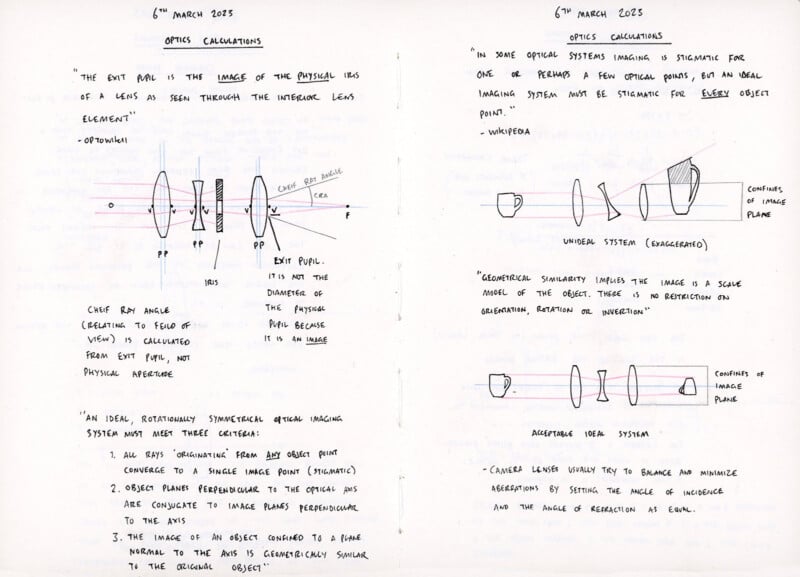
For lens design enthusiasts, here are some images from the notebook of Intrepid’s head designer (Will).

“There are plenty of 150mm 4×5 lenses out there,” Intrepid acknowledges, “but one of the main barriers to entry we get from first time customers is how intimidating it is to find all the second-hand equipment needed to put together a 4×5 kit.”

Informational poster advertising the Intrepid 150mm f6.3 camera lens. It features a chart comparing the MTF (Modulation Transfer Function) of different lenses, highlighting the sharpness and all-around performance of the Intrepid lens for 4x5 film photography.

With the film holders Intrepid launched last year, plus the new lens and shutter, Intrepid believes it has significantly reduced the barrier to entry for new customers.

A close-up of a camera lens module connected by a cable to a handheld device with an LCD screen and buttons. The setup is on a smooth, dark surface, with both devices casting slight shadows. The overall lighting is soft and dim.
Intrepid I-0 Shutter

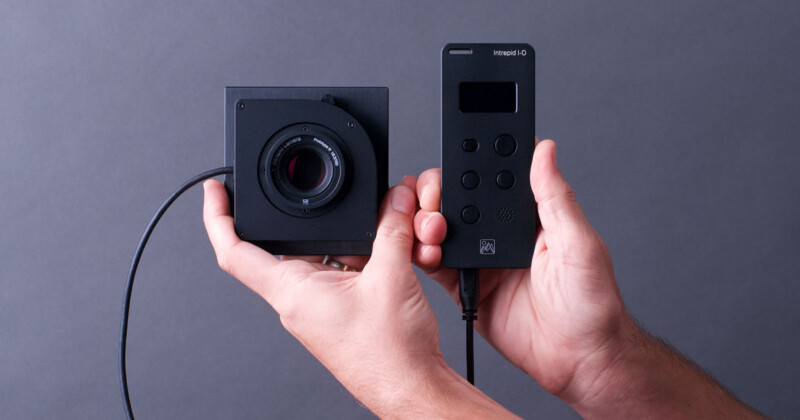
Speaking of the Intrepid I-0 Shutter, the company says the shutter is “like a super smart cable release with a screen.” The electronic shutter is compatible with all Copal 0 size lenses and supports shutter speeds as long “as you want” to 1/125s. It also includes a self-timer function. “Just set your target aperture and ISO to get live EV readings so. You don’t have to keep going back to your light meter,” Intrepid explains.

The shutter includes a shutter-open warning, works with modern flash equipment via a 3.5mm jack, and can be controlled directly from a connected Mac or PC. The shutter mechanism has a rechargeable battery, which charges via USB-C. The shutter controller is enclosed within a weatherproof aluminum body and features a bright screen suitable for outdoor use.

Close-up of a black industrial camera lens mounted on a flat, square base. The lens has text on its rim and is connected by a cable extending from the left side. The background is a smooth, dark surface.

A person holds a square, black, wired camera and a rectangular remote control device in their hands against a gray background. The camera has a circular lens in the center, and the remote control has a digital display and various buttons.

Much like with the new 150mm f/6.3 lens, Intrepid is looking forward and considering new photographers with its electronic shutter.

“There are still a lot of second hand mechanical shutters out there, but they are not getting any younger and the skills required to repair them, as well as spare parts, are getting harder to come by. You don’t exactly get people starting a career in large format shutter repair anymore. So an alternative solution is quickly needed and we think we have it,” the company explains, noting that it has invested heavily into the design of this new shutter, which required 18 months of continuous work.

Pricing and Availability

The Intrepid 150mm f/6.3 lens is available to early backers for £189, which is just over $250. It is expected to ship in February 2025. The Intrepid I-0 Shutter starts as low as £289 (about $390) and includes the shutter mechanism itself and the shutter controller. The shutter is expected to begin shipping next March.

Photographers interested in diving headfirst into large format photography can pledge £729, or about $980, to get the 150mm f/6.3 lens, Intrepid I-O shutter, and Intrepid 4×5 camera in a bundle. This, like the shutter itself, will ship in March 2025. A complete breakdown of all available backer options is available on Kickstarter.

While all Kickstarter campaigns must come with the usual disclaimer below, it is worth noting that this is Intrepid Camera’s fifth Kickstarter campaign. While occasionally met with delays, the prior four have been successful and culminated in complete, shipped products.


Disclaimer: Make sure you do your own research into any crowdfunding project you’re considering backing. While we aim to only share legitimate and trustworthy campaigns, there’s always a real chance that you can lose your money when backing any crowdfunded project. PetaPixel does not participate in any crowdfunding affiliate programs.


Image credits: Intrepid Camera

Intrepid Makes Large Format Photography More Accessible With New Shutter and Lens

Intrepid Makes Large Format Photography More Accessible With New Shutter and Lens

A close-up of a wooden large format camera with bellows, mounted on a tripod against a blue background. A person is holding a remote control attached to the camera, preparing to take a photograph.

British large format photography company Intrepid Camera, known for its handmade 4×5 cameras, has launched a new lens and electronic shutter system for large format cameras on Kickstarter.

The Intrepid Lens and Shutter Project, which has already shattered its Kickstarter funding target after a day, comprises the Intrepid 150mm f/6.3 lens and the Intrepid I-0 Shutter.

Starting with the lens, it features a compact and lightweight Cooke triplet design. The 150mm f/6.3 lens, given the vast image area of large format, delivers a depth of field similar to an f/1.8 lens on a full-frame camera. Intrepid notes the lens has a big enough image circle to support tilt and shift movement, “one of the unique selling points of large format.”

A pair of hands holding two different-sized camera lenses against a black background. The left hand holds a larger lens with visible glass elements, while the right hand holds a smaller lens with a similar design.

The lens promises “excellent sharpness” when stopped down to f/11 and beyond and “nice bokeh” when used wide open at f/6.3. Intrepid notes that the lens delivers beautiful color rendering.

For lens design enthusiasts, here are some images from the notebook of Intrepid’s head designer (Will).

“There are plenty of 150mm 4×5 lenses out there,” Intrepid acknowledges, “but one of the main barriers to entry we get from first time customers is how intimidating it is to find all the second-hand equipment needed to put together a 4×5 kit.”

Informational poster advertising the Intrepid 150mm f6.3 camera lens. It features a chart comparing the MTF (Modulation Transfer Function) of different lenses, highlighting the sharpness and all-around performance of the Intrepid lens for 4x5 film photography.

With the film holders Intrepid launched last year, plus the new lens and shutter, Intrepid believes it has significantly reduced the barrier to entry for new customers.

A close-up of a camera lens module connected by a cable to a handheld device with an LCD screen and buttons. The setup is on a smooth, dark surface, with both devices casting slight shadows. The overall lighting is soft and dim.
Intrepid I-0 Shutter

Speaking of the Intrepid I-0 Shutter, the company says the shutter is “like a super smart cable release with a screen.” The electronic shutter is compatible with all Copal 0 size lenses and supports shutter speeds as long “as you want” to 1/125s. It also includes a self-timer function. “Just set your target aperture and ISO to get live EV readings so. You don’t have to keep going back to your light meter,” Intrepid explains.

The shutter includes a shutter-open warning, works with modern flash equipment via a 3.5mm jack, and can be controlled directly from a connected Mac or PC. The shutter mechanism has a rechargeable battery, which charges via USB-C. The shutter controller is enclosed within a weatherproof aluminum body and features a bright screen suitable for outdoor use.

Close-up of a black industrial camera lens mounted on a flat, square base. The lens has text on its rim and is connected by a cable extending from the left side. The background is a smooth, dark surface.

A person holds a square, black, wired camera and a rectangular remote control device in their hands against a gray background. The camera has a circular lens in the center, and the remote control has a digital display and various buttons.

Much like with the new 150mm f/6.3 lens, Intrepid is looking forward and considering new photographers with its electronic shutter.

“There are still a lot of second hand mechanical shutters out there, but they are not getting any younger and the skills required to repair them, as well as spare parts, are getting harder to come by. You don’t exactly get people starting a career in large format shutter repair anymore. So an alternative solution is quickly needed and we think we have it,” the company explains, noting that it has invested heavily into the design of this new shutter, which required 18 months of continuous work.

Pricing and Availability

The Intrepid 150mm f/6.3 lens is available to early backers for £189, which is just over $250. It is expected to ship in February 2025. The Intrepid I-0 Shutter starts as low as £289 (about $390) and includes the shutter mechanism itself and the shutter controller. The shutter is expected to begin shipping next March.

Photographers interested in diving headfirst into large format photography can pledge £729, or about $980, to get the 150mm f/6.3 lens, Intrepid I-O shutter, and Intrepid 4×5 camera in a bundle. This, like the shutter itself, will ship in March 2025. A complete breakdown of all available backer options is available on Kickstarter.

While all Kickstarter campaigns must come with the usual disclaimer below, it is worth noting that this is Intrepid Camera’s fifth Kickstarter campaign. While occasionally met with delays, the prior four have been successful and culminated in complete, shipped products.


Disclaimer: Make sure you do your own research into any crowdfunding project you’re considering backing. While we aim to only share legitimate and trustworthy campaigns, there’s always a real chance that you can lose your money when backing any crowdfunded project. PetaPixel does not participate in any crowdfunding affiliate programs.


Image credits: Intrepid Camera