About

Posts by :

Exhibition honors art, legacy of Oscar Howe

Exhibition honors art, legacy of Oscar Howe

Aug. 23, 2023

This paid piece is sponsored by the University of South Dakota.

The University of South Dakota honors Oscar Howe’s legacy as an artist and mentor through a traveling exhibition being seen nationwide.
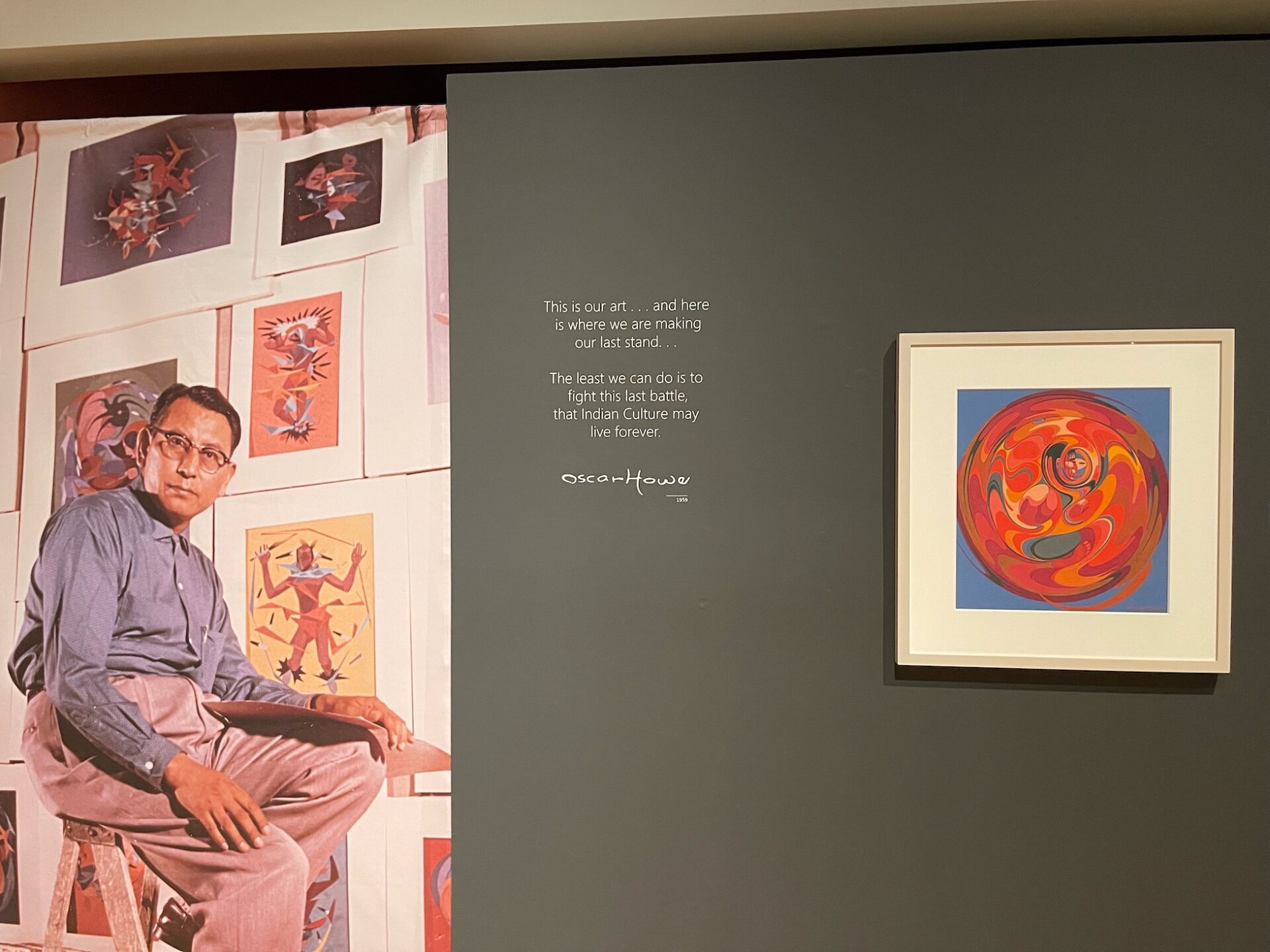
“Howe’s legacy reminds us of the tremendous power of inspiration and perseverance,” said Bruce Kelley, dean of the College of Fine Arts. “As his own artistry evolved, Howe challenged the notion that he had to fit a certain mold. He spent most of his life in small communities in South Dakota and yet proved to be a global force. His legacy lives on in both his art and his teachings, which continue to impact generations of students and artists.”

“Dakota Modern: The Art of Oscar Howe” takes viewers on a journey of more than 40 years of Oscar Howe’s career and development, from early conventional work he created while in high school in the 1930s through the emergence of Howe’s innovative and abstract approach to painting in the 1950s and 1960s.
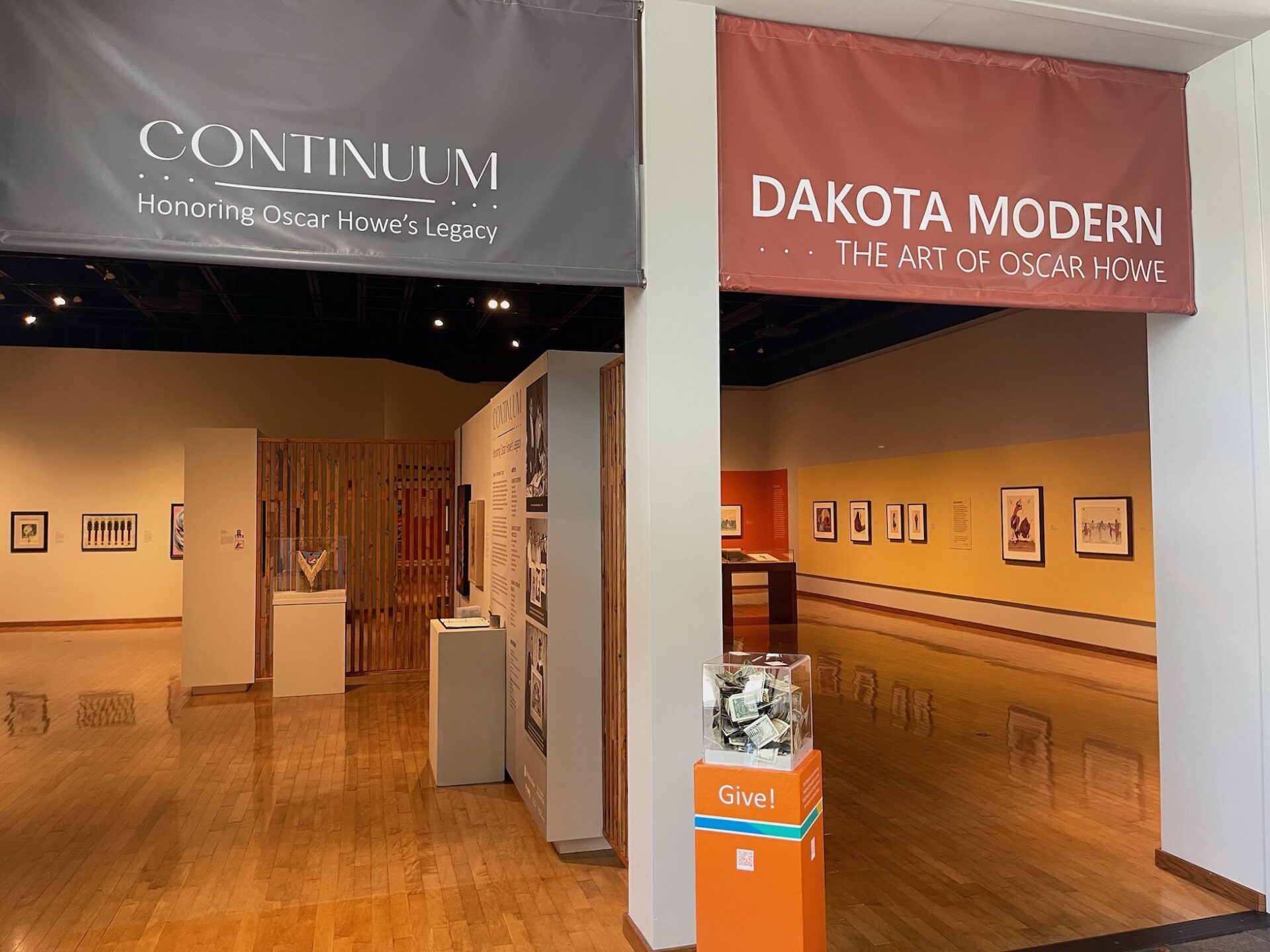
This exhibition, developed in collaboration with the Portland Art Museum and curated by Kathleen Ash-Milby, curator of Native American art at PAM, introduces new generations to Howe, who is considered to be one of the 20th century’s most innovative Native American painters.

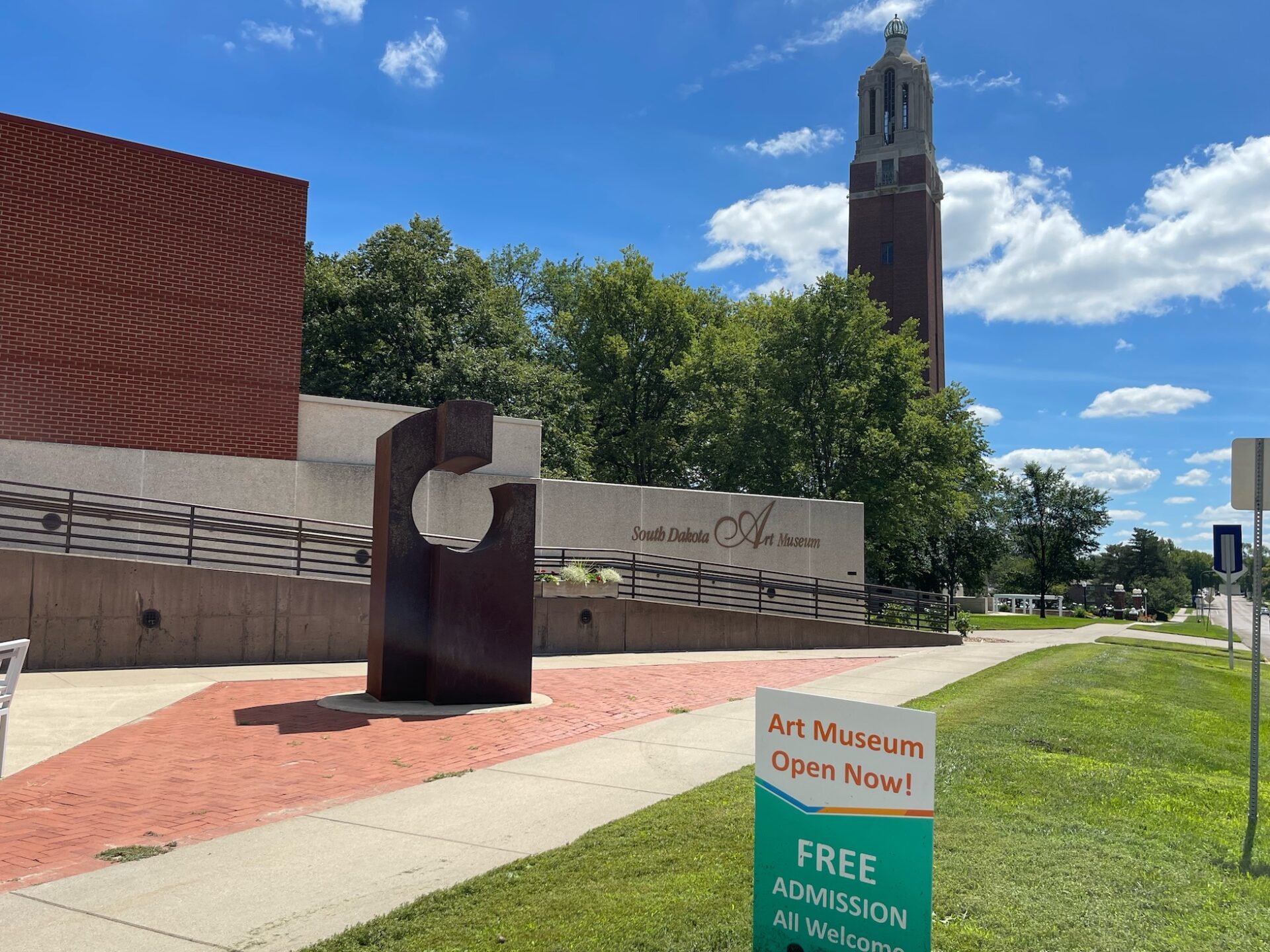
“Dakota Modern: The Art of Oscar Howe” has been on display across the country – from Portland to the Smithsonian’s National Museum of the American Indian in the nation’s capital. Now, it has traveled to Howe’s home state of South Dakota and is on display at the South Dakota Art Museum in Brookings through Sept. 17.
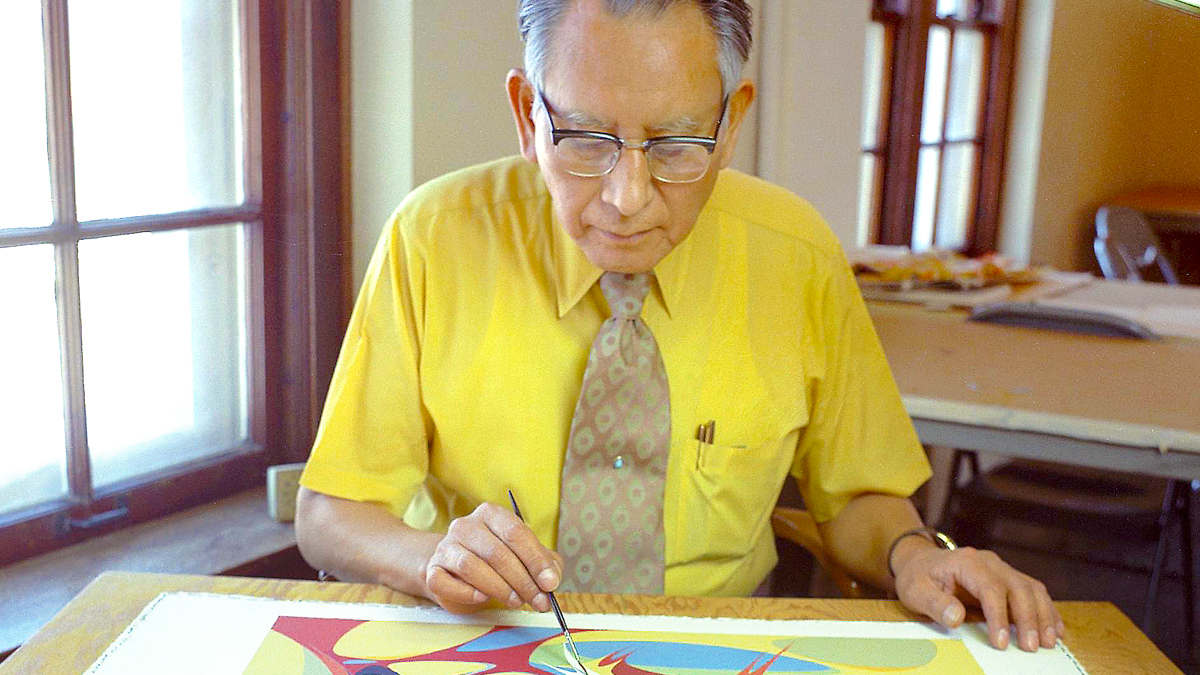
To truly understand and appreciate the craft of a man who catalyzed a movement among Native artists to express their individuality rather than conforming to an established style, it is important to appreciate the culture and tradition of the artist who wielded the brush.

The history

Born in 1915 at Joe Creek on the Crow Creek Reservation, Howe would come to be a renowned artist whose work would be seen around the globe by the time he turned 18.

Howe attended the Pierre Indian School before returning home to learn from his grandmother Shell Face. While there, he spent hours drawing and painting, using anything he could get his hands on as tools for his craft. His grandmother would share the history of their people, telling stories and legends of the generations before them.

In 1933, Howe left the Plains for New Mexico and attended the Santa Fe Indian School, where he joined the art program established by Dorothy Dunn. Though he could have taken his talents anywhere, Howe chose to return to his roots in South Dakota upon graduating in 1938.

Around this time, he joined the South Dakota Works Progress Administration and completed mural projects in Mitchell and Mobridge.
In 1942, Howe was drafted into the Army and would return from his time abroad with his wife, Adelheid Hample. The couple had one child, Inge Dawn.

Howe earned his bachelor’s degree from Dakota Wesleyan University and later received his MFA from the University of Oklahoma. In 1957, after teaching at Pierre High School for three years, he became an artist-in-residence and professor of art at the University of South Dakota.

Howe dedicated 23 years of his career to USD. He retired as emeritus professor of art in 1980, leaving behind a legacy that would influence generations of students for decades to come.

The artist exhibited works in New York, London and Paris while he was a student in the 1930s and later was represented by more than 50 solo shows. He was named artist laureate of the Middle Border in 1954 and artist laureate of South Dakota in 1960. He was also the first recipient of the South Dakota Governor’s Award for Creative Achievement in 1973.

Rituals rooted in family

When Inge Dawn Howe Maresh was a child, she thought everyone’s dad painted at night after they watched the news.

She grew up watching her father set up an art studio in each home they lived in. Sometimes it was a dedicated corner of a room; other times he and his wife sacrificed a bedroom as a studio and slept in the living room — all so he could have space to create.

“My father was a wonderful father,” Howe Maresh said. “He was gentle and kind; he taught by example. He loved his family very much.”

According to Howe Maresh, the family’s routine was comfortable and well structured. Her father would come home promptly at 5 p.m. when her mother had dinner prepared and on the table. They would eat together as a family, sharing stories about their days before her father would move to the living room to watch the news. After the news, it was time to paint.

“In preparation for his next piece, my father would draw a sketch of the story he wanted to tell with his painting,” Howe Maresh reflected. “He would study his paper before establishing three ‘esthetic points’ (beauty points) and connect them with lines (symbols of truth). This process is called ‘owa’ and means writing with a point-to-point movement.”

Howe incorporated Native American symbols into his works, and every element of his pieces was layered with deep meaning and intentionality that paid homage to his Dakota heritage.
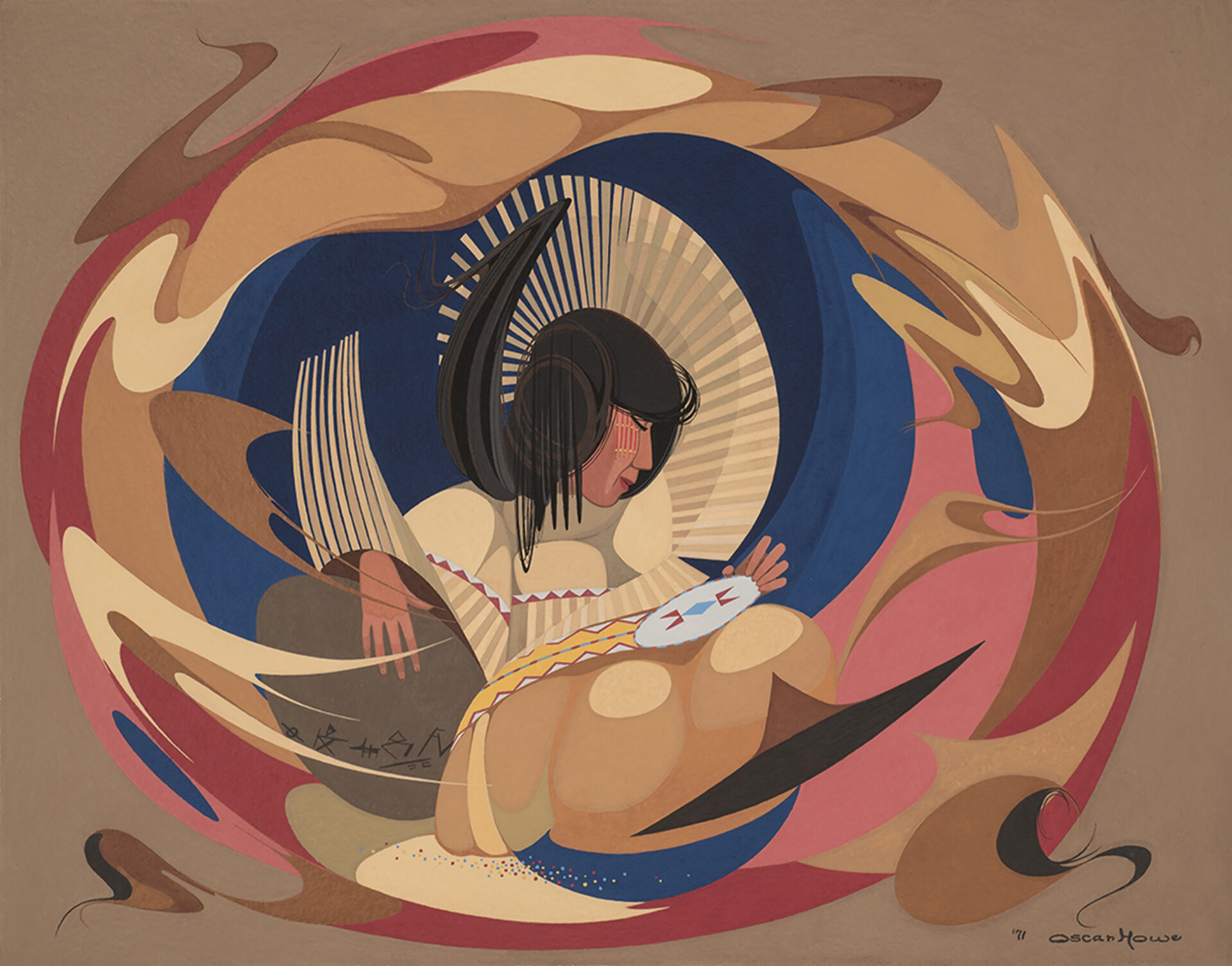
“Dance of Double Woman,” 1971, Oscar Howe, © Howe LLC

Howe Maresh described the care he took into each color he mixed by hand and remembered a bathtub full of Fabriano paper that she would help him soak in preparation for his next piece. Howe emulated the process of painting on skins and visually represented the oral history of his people.

“He wished to stay close to traditional Dakota Indian painting (on skins) called the painting of the truth,” Howe Maresh said. “I think his art fulfilled his hope to represent the best of Dakota culture, and he was able to capture the spirituality of his people in very powerful ways and introduce it to modern cultures.”

“Kaska” (Trial by Riding a Wild Horse), Oscar Howe, © Howe LLC

One summer, Howe Maresh took a workshop from her father and witnessed his teachings firsthand.

“I think he touched all his students with inspiration for setting goals in your life and feeding your creative spirit,” she said. “He certainly respected individuality and positivity in life. He believed it was everyone’s responsibility to make the world a better place by connecting with and respecting your own culture so you can expand your horizons to value and appreciate other cultures.”

Paving the way for Native artists

Howe paved a path for Native artists, giving them expressive permission to own their talents, embrace their history and break down barriers that fought to keep them contained.

As a teacher, father, husband and artist, Howe’s approach was calm and unapologetic. He never underestimated the power of community or the value of integrity.

“I try to faithfully and truthfully bring out the true meaning of the fine and good things of the past Sioux culture,” Howe said in his 1958 letter to the Philbrook Art Center. “It is my greatest hope that my paintings may serve to bring the best of Indian culture to the modern way of life.”

Howe created paintings that could be appreciated for their basic aesthetic appeal, but he challenged viewers to consider something far more meaningful — to feel the movement of a ceremonial sun dance, watch dancers transcend a traditional powwow and witness traditions that are honored to this day.

Howe wove deeply rooted tradition and ceremony into the sharp lines of modernism. He intentionally used both the positive and negative space on the page, creating magic in noncontextual landscapes. This timeless appeal to his art invites viewers to think beyond the image of a reservation on the plains of South Dakota and see Native people, culture and tradition across all timelines in all corners of the world.

Howe’s influence in artistry expanded far beyond the legacy of his paintings. In addition to teaching on USD’s campus and serving as a faculty adviser for the Wapaha Club – the USD Native Student Club founded in 1957 – Howe began to offer summer art classes to high school students in 1960.
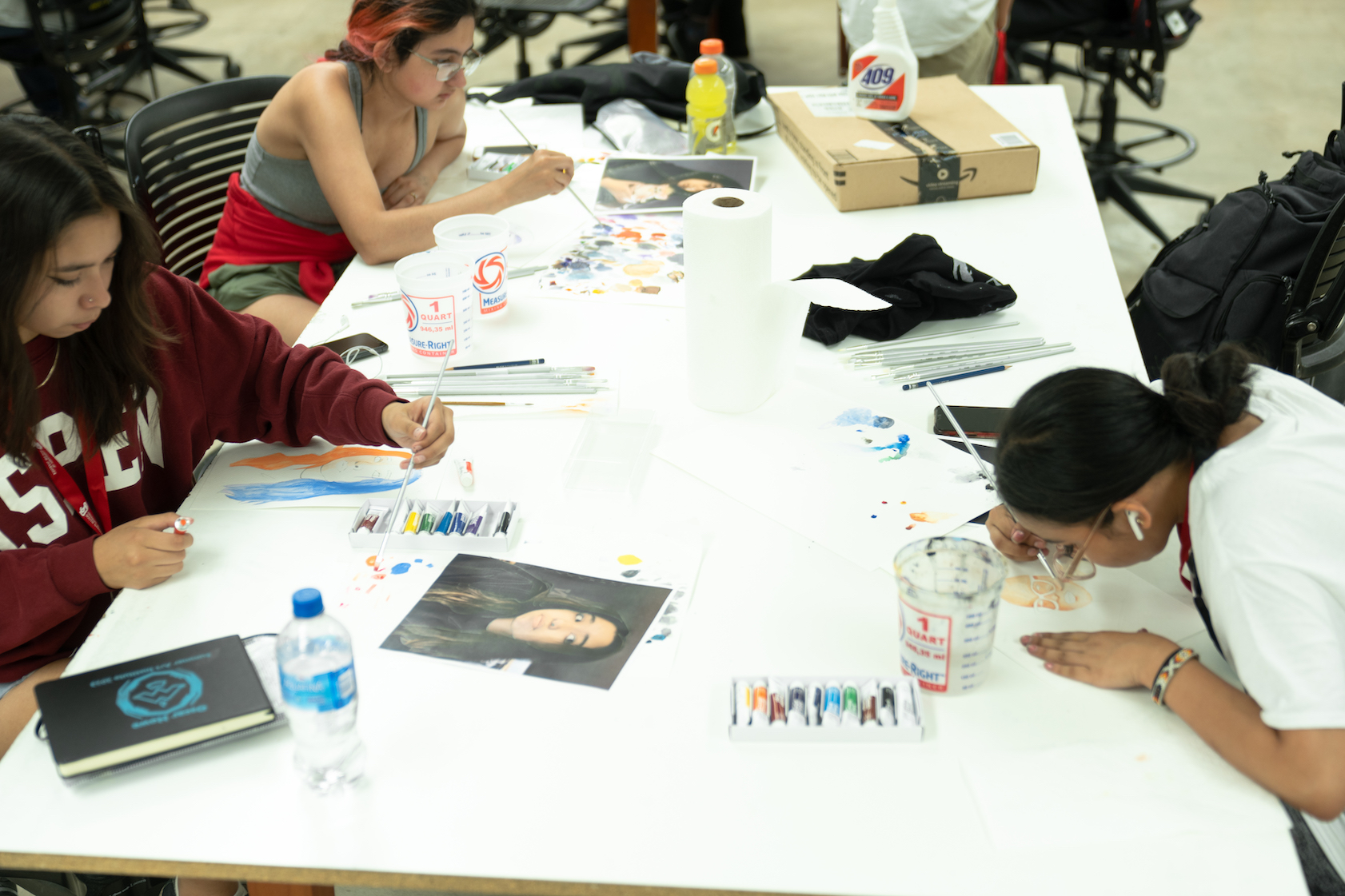
Primarily dedicated to Native Americans, the classes offered by Howe created an opportunity for students to visit a college campus, learn from a successful Native artist and be exposed to an educational experience they otherwise might not have received. The students were provided with a sense of community and connection that expanded beyond the borders of where they grew up.

Through the stroke of a brush, Howe brought their history to life — teaching about the past while honoring the present. He introduced students to a new opportunity, encouraging them to pave their own path in the world.

Decades later, students who had the benefit of being taught by Howe would carry on this tradition through the Oscar Howe Summer Art Institute, or OHSAI.

Leaving a legacy

“For all of our pride in Oscar Howe as a South Dakotan, we must acknowledge that he belongs to the world.” – John A. Day

While his paintings have graced the walls of museums around the globe, Howe was not driven by fame; rather, the humble, generous artist was motivated to encourage and support the generations that would follow.

In 1991, Robert Penn, a former student of Howe’s who experienced firsthand a life-changing education from Howe, joined forces with John A. Day to restart the OHSAI in honor of the late artist.

In the early years of the institute, funding was scarce, and at times, the faculty who led the programming weren’t paid. Later, with the help of transformative grant dollars, the institute was able to not only attract incredibly talented artists as teachers and lecturers but also welcome students from beyond the region.

Like Penn, many students who have attended the institute have found success and fame as artists and have come back years later to pay it forward, acting as student counselors, teachers and lecturers.
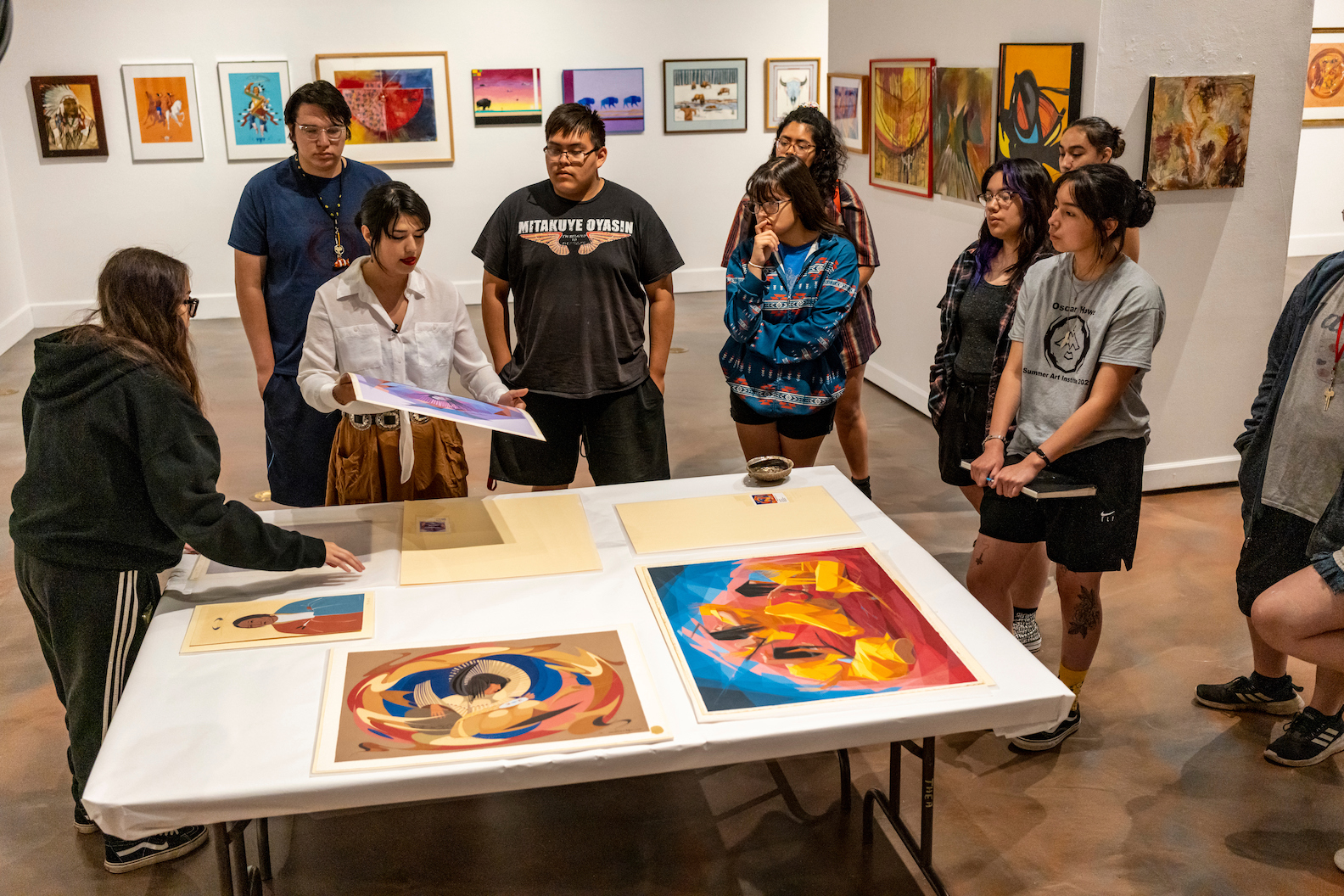
“The importance of Oscar Howe’s influence on Native American artists and arts programing cannot be understated,” said Cory Knedler, chair of the UDS art department and director of the OHSAI.

“Without Howe’s influence on Bobby Penn, there would be no Oscar Howe Summer Art Institute. Penn was Howe’s protege and understood the importance of a strong mentor and providing transference of knowledge from one generation to the next. Without the institute, there would be countless artists that would not have had the opportunity to meet the mentors that changed their lives and encouraged them to pursue an art career. We continue to see this today as students who went through the early OHSAI are now back as instructors, continuing to transfer what they learned to the next generation of young artists.”

To learn more about the traveling exhibition, click here.

Will Masterworks Maintain Market Share Since Fractional Art Investing Has Gone Mainstream?

Will Masterworks Maintain Market Share Since Fractional Art Investing Has Gone Mainstream?

Fractional art investing has gone from a quirky alternative asset to a powerful trend. The returns that art investing platforms report comfortably outpace the S&P 500, and new opportunities pop up seemingly daily.

Founded in 2017, the Masterworks app is the pioneer that launched fractional art investing into mainstream consciousness. Today the company claims to have over $850 million in assets under management, having purchased 320 blue-chip paintings to date, onboarding some 780,000 users along the way. The fintech industry has clearly taken note, too, as several new fractional art investment platforms have started popping up in recent months.

The rising popularity of art investments has led to an interesting question for industry observers: Can Masterworks combat the rise of new competitors? Is the new wave of challengers ready to topple the pioneer? Let’s take a look.

Just a fad, or in it for the long haul?

One of the dangers of new trends is the possibility of a fizzle-out. While art investing has been popular for decades, with wealthy investors buying and selling expensive works of art via private sales and auctions, fractional art investing is relatively new.

Masterworks’ approach is easy to understand due to its simplicity. The company buys a work of art, securitizes it as an LLC, and issues shares in the LLC to investors. It charges a management fee and a profit fee upon sale. While investors on the platform can trade shares with each other before the painting is resold, if they’re going to see a true payday, they essentially need to sit tight for up to ten years. A portion of the new wave of challenger platforms is trying to differentiate themselves by tinkering with this model.

For instance, some new platforms point to blockchain and distributed ledger technology usage to investors as a critical reason to purchase art with them. The Rat, based out of the United Arab Emirates, is a good example of a platform combining multiple buzzwords into a single offer. Dubious naming aside, the platform doesn’t offer any details of its approach or why a token is safer than shares in a physical LLC.

P2P trading has become popular thanks to cryptocurrencies, and the ARTEX Stock Exchange, based out of Liechtenstein, is apparently bent on leveraging this trend. The company helps investors purchase portions of works of art and promises a liquid market in which they can speculate on their investment’s value.

These attempts to turn art into a speculative token are unlikely to topple Masterworks’ entrenched business model. Masterworks’ employment of industry-leading art experts further dispels the notion these new exchanges can draw market share away from it.

Online and physical presence

Mintus, a UK-based platform, offers a similar deal to Masterworks but with a lower investment minimum. Similar to Masterworks, Mintus employs a team of vetted art experts, securitizes its artwork, and offers investors the option to sell shares in the secondary market.

Given its lower entry barrier, Mintus seems poised to seriously damage Masterworks’ market share. However, there’s one barrier Mintus cannot overcome right now. Secondary market liquidity has long been a sticking point for fractional art investors, as sourcing liquidity can be challenging. In some cases, it is non-existent.

In such scenarios, a platform’s active user count becomes important, since more users mean more potential liquidity. This gives Masterworks’ investors a higher probability of cashing out their investments ahead of time instead of being forced to lock up their funds until the platform sells a given painting.

Marketing and advertising are critical too, since they directly contribute to user counts. Masterworks is an established name and has a competitive moat that is tough to overcome. It is a recognized-enough name in the art world that its recent Level & Co. gallery opening in Manhattan’s Upper East Side drew significant attention.

Simply put, an established brand name and deeper pockets gives Masterworks an edge over platforms that follow similar operating models. While Mintus is highly credible, it is unlikely to overcome Masterworks’ economic moat unless it changes its business model drastically.

Opportunities in narrower niches

The most credible challenge to Masterworks might come from platforms offering alternative takes on art investment. For instance, Rares specializes in offering investors fractional ownership of rare sneakers in a model similar to Masterworks.

Other platforms like Fractional help investors buy portions of NFTs and hold those units in their crypto wallets. These platforms operate in different art niches and complement investor appetites, along with Masterworks.

Yieldstreet is arguably Masterworks’ biggest competitor at the moment. The platform covers a similar breadth of art as Masterworks does but operates a different business model, effectively creating a niche for itself. Unlike Masterworks, Yieldstreet does not offer shares in an LLC tied to a piece of art.

Instead, it operates as a mutual fund, selling investors units in a portfolio that an investment manager has purchased.

In effect, investors can diversify their investment in a portfolio instead of sinking all of their money into a single piece of art. While this approach is likely to appeal to risk-averse investors, the question is: Will risk-averse investors even consider alternative investments like art? Art and other alternative investments are often used as hedges to a primary portfolio.

Diversifying a primary portfolio makes sense since the bulk of investor funds will reside in it. Hedges are meant to generate outsized returns in a non-correlated manner and demand concentration. Diversifying a hedge will likely dampen yields, defeating the purpose of investing in a hedge.

For this reason, Yieldstreet may appeal only to investors seeking to invest a significant sum of their money in art, unlike the majority of investors who use it as a hedge.

Plenty of challenges but few headwinds

Masterworks has established a significant first-mover advantage in the fractional art investing world and has democratized investment opportunities. While the platform has significant and growing competition, it seems unlikely that any of these alternate platforms will overcome the advantage Masterworks has established.

While the future isn’t certain, Masterworks seems set to remain the primary choice for fractional art investors in the near term.

Fractional art investing has gone from a quirky alternative asset to a powerful trend. The returns that art investing platforms report comfortably outpace the S&P 500, and new opportunities pop up seemingly daily.

Founded in 2017, the Masterworks app is the pioneer that launched fractional art investing into mainstream consciousness. Today the company claims to have over $850 million in assets under management, having purchased 320 blue-chip paintings to date, onboarding some 780,000 users along the way. The fintech industry has clearly taken note, too, as several new fractional art investment platforms have started popping up in recent months.

The rising popularity of art investments has led to an interesting question for industry observers: Can Masterworks combat the rise of new competitors? Is the new wave of challengers ready to topple the pioneer? Let’s take a look.

Just a fad, or in it for the long haul?

One of the dangers of new trends is the possibility of a fizzle-out. While art investing has been popular for decades, with wealthy investors buying and selling expensive works of art via private sales and auctions, fractional art investing is relatively new.

Masterworks’ approach is easy to understand due to its simplicity. The company buys a work of art, securitizes it as an LLC, and issues shares in the LLC to investors. It charges a management fee and a profit fee upon sale. While investors on the platform can trade shares with each other before the painting is resold, if they’re going to see a true payday, they essentially need to sit tight for up to ten years. A portion of the new wave of challenger platforms is trying to differentiate themselves by tinkering with this model.

For instance, some new platforms point to blockchain and distributed ledger technology usage to investors as a critical reason to purchase art with them. The Rat, based out of the United Arab Emirates, is a good example of a platform combining multiple buzzwords into a single offer. Dubious naming aside, the platform doesn’t offer any details of its approach or why a token is safer than shares in a physical LLC.

P2P trading has become popular thanks to cryptocurrencies, and the ARTEX Stock Exchange, based out of Liechtenstein, is apparently bent on leveraging this trend. The company helps investors purchase portions of works of art and promises a liquid market in which they can speculate on their investment’s value.

These attempts to turn art into a speculative token are unlikely to topple Masterworks’ entrenched business model. Masterworks’ employment of industry-leading art experts further dispels the notion these new exchanges can draw market share away from it.

Online and physical presence

Mintus, a UK-based platform, offers a similar deal to Masterworks but with a lower investment minimum. Similar to Masterworks, Mintus employs a team of vetted art experts, securitizes its artwork, and offers investors the option to sell shares in the secondary market.

Given its lower entry barrier, Mintus seems poised to seriously damage Masterworks’ market share. However, there’s one barrier Mintus cannot overcome right now. Secondary market liquidity has long been a sticking point for fractional art investors, as sourcing liquidity can be challenging. In some cases, it is non-existent.

In such scenarios, a platform’s active user count becomes important, since more users mean more potential liquidity. This gives Masterworks’ investors a higher probability of cashing out their investments ahead of time instead of being forced to lock up their funds until the platform sells a given painting.

Marketing and advertising are critical too, since they directly contribute to user counts. Masterworks is an established name and has a competitive moat that is tough to overcome. It is a recognized-enough name in the art world that its recent Level & Co. gallery opening in Manhattan’s Upper East Side drew significant attention.

Simply put, an established brand name and deeper pockets gives Masterworks an edge over platforms that follow similar operating models. While Mintus is highly credible, it is unlikely to overcome Masterworks’ economic moat unless it changes its business model drastically.

Opportunities in narrower niches

The most credible challenge to Masterworks might come from platforms offering alternative takes on art investment. For instance, Rares specializes in offering investors fractional ownership of rare sneakers in a model similar to Masterworks.

Other platforms like Fractional help investors buy portions of NFTs and hold those units in their crypto wallets. These platforms operate in different art niches and complement investor appetites, along with Masterworks.

Yieldstreet is arguably Masterworks’ biggest competitor at the moment. The platform covers a similar breadth of art as Masterworks does but operates a different business model, effectively creating a niche for itself. Unlike Masterworks, Yieldstreet does not offer shares in an LLC tied to a piece of art.

Instead, it operates as a mutual fund, selling investors units in a portfolio that an investment manager has purchased.

In effect, investors can diversify their investment in a portfolio instead of sinking all of their money into a single piece of art. While this approach is likely to appeal to risk-averse investors, the question is: Will risk-averse investors even consider alternative investments like art? Art and other alternative investments are often used as hedges to a primary portfolio.

Diversifying a primary portfolio makes sense since the bulk of investor funds will reside in it. Hedges are meant to generate outsized returns in a non-correlated manner and demand concentration. Diversifying a hedge will likely dampen yields, defeating the purpose of investing in a hedge.

For this reason, Yieldstreet may appeal only to investors seeking to invest a significant sum of their money in art, unlike the majority of investors who use it as a hedge.

Plenty of challenges but few headwinds

Masterworks has established a significant first-mover advantage in the fractional art investing world and has democratized investment opportunities. While the platform has significant and growing competition, it seems unlikely that any of these alternate platforms will overcome the advantage Masterworks has established.

While the future isn’t certain, Masterworks seems set to remain the primary choice for fractional art investors in the near term.

Japanese Artist Tetsuya Ishida Dreamed of Having a Solo Show in New York Before His Untimely Death. Two Decades Later, Gagosian Is Honoring His Wish

Japanese Artist Tetsuya Ishida Dreamed of Having a Solo Show in New York Before His Untimely Death. Two Decades Later, Gagosian Is Honoring His Wish

More than two decades ago, when Tetsuya Ishida was still a young emerging artist in Japan, he was already dreaming big. He had his eyes set on New York, wishing that he would one day have his solo exhibition in the center of the contemporary art world. He was preparing himself, saving money from a part-time job and learning English when he was not painting.

Ishida’s dream, however, did not materialize prior to his untimely death in 2005 at the age of 31 due to a train accident. But that was not the end of his story: This fall, the late Japanese artist’s wish will come true next month when Gagosian opens “Tetsuya Ishida: My Anxious Self” at its 555 West 24th Street space in New York on September 12.

Featuring more than 80 works, the exhibition, curated by Cecilia Alemani, is set to be the artist’s largest show outside of his native Japan. The gallery is also now representing Ishida globally in association with the artist’s estate, Artnet News can exclusively reveal.

Tetsuya Ishida

Tetsuya Ishida, Exercise Equipment (1997). © Tetsuya Ishida Estate. Photo: Rob McKeever. Courtesy Gagosian.

“In getting to know the family over the past several years, we learned that an exhibition in New York was Tetsuya’s greatest artistic ambition, and we are incredibly honored to present his paintings in New York on the 50th anniversary of his birth,” Nick Simunovic, senior director of Gagosian in Asia, told Artnet News.

Born in Yaizu, Japan, in 1973, Ishida grew up as part of the country’s “lost generation,” a term referring to those who graduated during the 1990s and 2000s in a period of recession. During his short-lived artist career, Ishida created about 200 works. The sentiment of loss and despair experienced among this generation during a decade marred by high unemployment and high suicide rates can be felt in Ishida’s poignant paintings and graphic works.

Often meticulously detailed, Ishida’s paintings depict expressionless or sad faces of young men, their human bodies merged with objects surrounding them, including plastic bags, airplanes, buildings, broken satellites, machine parts, and animals like crabs and seahorses. At times, his human figures appear nearly lifeless in his paintings, lying on a conveyor belt or arriving as packaged goods.

Critics in Japan relate Ishida’s work with the country’s dominating manga and anime culture, but at the same time, this “convergence” with objects can also be understood as a visualization of the psychological survival mechanism needed during a repressive time.

“At first, it was a self-portrait. I tried to make myself—my weak self, my pitiful self, my anxious self—into a joke or something funny that could be laughed at… It was sometimes seen as a parody or satire referring to contemporary people. As I continued to think about this, I expanded it to include consumers, city-dwellers, workers, and the Japanese people,” the artist was quoted in a statement.

Ishida’s works were exhibited and collected in some parts of Asia but they did not get to travel beyond the region until November 2013, when Gagosian held a solo exhibition of the artist at its Hong Kong space, the artist’s first outside of Japan.

Tetsuya Ishida

Tetsuya Ishida c. 1995 © Tetsuya Ishida Estate. Courtesy the artist and Gagosian

Recalling the organization of the exhibition, Simunovic, who was leading the gallery’s Hong Kong operation at the time, was first introduced to the artist’s enigmatic paintings through a Hong Kong collector more than 12 years ago. “I was immediately taken with the work and showed it to Larry [Gagosian], who was equally captivated,” Simunovic said. “We both agreed that it would be interesting to present an exhibition and, as we didn’t know the family at the time, we began making plans to mount a show of work from the secondary market. We secured great loans from collectors across Asia.”

The 2013 Hong Kong exhibition became a turning point for Ishida’s art. Jessica Morgan, a curator at the Tate at the time, saw the show and subsequently included the artist in the 2014 edition of Gwangju Biennale, when she served as its artistic director. “Okwui Enwezor, who was on the Gwangju jury at the time, was fascinated by Ishida and the power of his work, and, in turn, featured the artist in his exhibition for the 56th Venice Biennale in 2015,” Simunovic noted. And then, Reina Sofia’s curatorial team saw the Venice show and subsequently offered Ishida’s family a solo show at the museum in Madrid in 2019.

In between, the artist’s relatives became aware of the growing reputation of his work and reached out to Simunovic. “We slowly began building a relationship and we were given works for sale, which we placed in esteemed collections around the world,” he said.

Tetsuya Ishida

Tetsuya Ishida, Refuel Meal (1996) © Tetsuya Ishida Estate. Courtesy the artist, Shizuoka Prefectural Museum of Art, and Gagosian.

The gallery and the artist’s family were initially working on a show in New York, which was stalled due to the Covid-19 lockdowns. “We believe in his work and feel it’s extremely important that it be seen and understood in the West,” Simunovic said. The 80 works to be featured in the New York show represent nearly half of Ishida’s entire body of work. Some of them are on loan from the collection of the Shizuoka Prefectural Museum of Art, which is located in the artist’s home town in Japan, as well as other private collections. Others are from the estate and will be available for sale, but Simunovic declined to reveal exactly how many works and the price range.

Simunovic is confident the show will resonate with an audience in the West. Ishida’s art, which addresses the themes of disconnection, alienation, and despair, are universal and highly relevant to the current times, he added.

“We live in a pluralistic art world where there are countless western collectors who enjoy collecting Asian contemporary art, just as there are countless Asian collectors who are avidly collecting western contemporary art,” he said.

More Trending Stories:  

An 1837 Portrait of an Enslaved Child, Obscured by Overpainting for a Century, Has Been Restored and Acquired by the Met 

Rising Artist Ronan Day-Lewis’s ‘Punk Romanticism’ Imbues Desolate American Landscapes With an Eerie, Cinematic Aura 

Why Did Yoko Ono’s Arboretum Art Installation in New York Shut Down Early? ‘Unfortunately, Trees Died’ 

LGDR Gallery Splits Up After Less than Two Years as Founding Partner Jeanne Greenberg Rohatyn Departs 

Photographers Recreate Old Master Paintings in Witty and Profound Ways in a New Show at a Princeton University Art Gallery 

Blue-Chip Artworks Seized From Top Portuguese Collector Will Be Featured in New Art Museum in Lisbon 

Once Celebrated and Then Forgotten, the French Artist Marie Laurencin Is About to Step Into the Limelight Again, Three Decades After Her Death 

Follow Artnet News on Facebook:
Want to stay ahead of the art world? Subscribe to our newsletter to get the breaking news, eye-opening interviews, and incisive critical takes that drive the conversation forward.

UNO Unveils New Artiste Series Collab With Shantell Martin

UNO Unveils New Artiste Series Collab With Shantell Martin

Multi-talented visual artist Shantell Martin has teamed up with the world’s #1 card game, UNO, on the sixth deck of the brand’s Artiste Series. UNO Artiste Series: Shantell Martin adds a playful twist to gameplay, featuring Martin’s signature, illustrative style against a backdrop of saturated color. Throughout the deck, each card is adorned with fluid black lines that take on the shape of faces, stick figures, sailboats, and more. It hits shelves September 25th.

Photo: Jason Tidwell

The ever-expanding UNO Artiste Series infuses the art of influential artists into individually themed decks. Since launching in September 2019, the brand has featured Jean-Michel Basquiat, Keith Haring, Nina Chanel Abney, and Shepard Fairey. The most recent release prior to Martin, in 2022, showcased the work of Japanese contemporary artist Takashi Murakami.

brown-skinned woman with pulled up curly black hair wearing a black t-shirt reading ARE YOU YOU leans over a table illustrating

“The UNO Artiste Series offers an incredible opportunity to infuse my art into one of the most iconic card games in the world,” Martin shared. “I’m honored to be part of the series and share my playful take on UNO, joining an impressive group of artists… My art is just like my life – never following a straight line – and I hope fans find comfort in the twists and turns along the way.”

playing card box reading UNO Card Game with a black line drawing of a face

Photo: Jason Tidwell

For its own unique touch, Martin’s deck also has a surprise – fun meanings and hidden messages on different UNO cards. The 8-card plays off of “don’t be late,” while four double-sided “Extra Cards” create two images of Martin’s original designs when combined. We can’t wait to get our hands on a deck for game night!

colorful numbered playing cards with black line illustrations on a white background

Photo: Jason Tidwell

colorful numbered playing cards with black line illustrations on a white background

Photo: Jason Tidwell

a hand holding colorful numbered playing cards with black line illustrations on a white background

Photo: Jason Tidwell

brown-skinned woman with pulled up curly black hair wearing a black t-shirt reading ARE YOU YOU hold up a hand of colorful cards

Shantell Martin

To learn more about UNO Artiste Series: Shantell Martin or purchase your own deck when it’s released on September 25th, visit creations.mattel.com.

Kelly Beall is Director of Branded Content at Design Milk. The Pittsburgh-based writer and designer has had a deep love of art and design for as long as she can remember, from Fashion Plates to MoMA and far beyond. When not searching out the visual arts, she’s likely sharing her favorite finds with others. Kelly can also be found tracking down new music, teaching herself to play the ukulele, or on the couch with her three pets – Bebe, Rainey, and Remy. Find her @designcrush on social.

Pixels for Pizzo: City recognizes young photographers in first youth photo contest

Pixels for Pizzo: City recognizes young photographers in first youth photo contest

The city of Ormond Beach celebrated the four winners of its first Young Adult Photography Contest on Aug. 5.

The contest, themed around the city’s parks, nature and green spaces, was created in memory of city photographer David Pizzo, who died in January at 73 years old. Pizzo — who, according to his obituary moved to Ormond Beach from New York in 2007 — had worked for Eastman Kodak Company for more than 20 years

“He was proud to hold the distinguished reputation of being the professional photographer for the city, as well as for local businesses and the community,” a Jan. 21 mayor’s proclamation in honor of Pizzo reads.

“… His work was an art, he did it well and with much zeal,” the proclamation states.

And art was created during the contest, which was open to all children ages 12-17 living in Volusia County.

Gabriella Rosa, of Ormond Beach, won best of show for her photograph, titled “Flowers.” She heard about the contest from her dad, who saw the city’s post about the contest on Facebook. She’d gotten a GoPro camera for Christmas and has spent the last couple months exploring photography.

Rosa, a freshman at Seabreeze High School, said she took her camera to a field with her sister one day, just for fun.

“I decided to take my camera for some sky pics, and then I noticed the flowers,” she said. “I’m like, ‘Hey I can get a really cool shot with this.’”

She wasn’t expecting to win the contest.

“It was incredible to see everybody’s artwork too,” Rosa said.

Evan Doane, an Ormond Beach 17-year-old, got a camera in June and started taking pictures. 

The Mainland High School senior won first place for his photograph, titled “Transparent.”

“For the past year and a half, I’ve taken photos on my phone, and I’ve always wanted a camera for myself so I can take photos like that,” Doane said.

Winning first place in his first contest caught him by surprise, he said. Everybody’s work was amazing, he added.

“It’s really cool to see a photo that you’ve taken be hung up around everybody else’s that has had experience with photography, and it kind of just looks like it fits in with everybody else’s,” he said.

DC Pickering, of Ponce Inlet, won second place for her photograph titled “Incognito.” Pickering has been interested in photography for a couple years and saw the local contest as an opportunity that doesn’t come very often — there aren’t that many competitions in the area, the Spruce Creek High School sophomore said.

This was Pickering’s first time placing in a competition.

“It was really awesome to see my photo in The Casements,” Pickering said. “And for future people who want to enter the competition, I would say it’s a great opportunity, even if you don’t win anything; it’s just a cool experience.”

Pickering’s mother Tara found the competition online.

“I think that having different organizations allow youth in our area to show their skillset and show their creativity is fantastic,” Tara Pickering said.

The third place winner was Lily Chiofalo, a seventh grader from Port Orange. Her photograph was titled “Orange Wings in Yellow Flowers,” and Chiofalo said she knew once she spotted the butterfly that it would make a great photograph.

“It really stood out against the flowers, and I love animals and taking pictures of them,” she said.

This was her first contest too. When she found out she’d won, she said, she was “really excited and surprised.”

Her mother, Shannon Chiofalo, added that the setup at The Casements was very professional.

“Everybody’s entries were so beautiful,” she said. “I felt really proud to see her work up there on the wall.”

The art will remain on display through Friday, Aug. 25. The prize ribbons were sponsored by The Casements Camera Club.

An extreme dance on top of a bus shelter: Emmanuel Cole’s best photograph

An extreme dance on top of a bus shelter: Emmanuel Cole’s best photograph

Technically, the first time I was at the Notting Hill carnival was in 1990. My mum went there when she was pregnant with me. I started going properly, though, when I was seven or eight. The first time I photographed it was 2014 but I messed up and didn’t get any shots. So I really went for it the next year. I was in the thick of the action. I’d just come from a confined space, almost like a mosh pit. As I stumbled out, I saw a group of youngsters climbing on top of a bus stop. I had to anticipate what was coming next. I needed to change lenses, which wasn’t ideal. As the trio on the left started moving, I bent down, put a different lens on, and started photographing.

It all happened so fast. I have no idea who the three people are. To this day, I’ve never been able to identify them. They’re just people celebrating carnival. What they are doing is called daggering, a form of dancing in the Caribbean. It usually has a run-up and a jump, then a dancing motion. It’s very common in Jamaican dancehall. This was an extreme version, performed on the top of a bus stop. They have since changed those bus stops as people would mount them and there were several accidents. This bus stop has been made into a glass one, to stop people getting on top of it during carnival.

Carnival is special. Being a Black Londoner, I feel as if I’m in a place where there are lots of people from the same walk of life as me. There are so many incredible smells, foods, sounds, cultures and clothes. It’s a natural environment for me to be in.

My family is from Nigeria. Over the years, carnival has become more inclusive, but it started off as a Caribbean/Jamaican thing – a lot of the Windrush generation ended up in that corner of London, and it was a way to celebrate all the cultures of the Caribbean islands. You see a lot of African, South American and other cultures now. It’s beautiful. It will keep changing for as long as they allow carnival to go on.

For almost 10 years now, I’ve made it my mission to document it. The crowds are intense but this is the kind of environment I thrive on. I’ve photographed all over London. Usually, you are walking, watching and waiting until something happens, but carnival is the opposite. There’s so much happening all the time. You have to take ownership of situations. Catching unique moments is my thing. It’s about being sharp. I become a hyper-focused version of myself.

I got my first camera in 2010 for my 20th birthday. Prior to that, I had a random conversation with a photographer on a bus coming back from a night out. He showed me his camera and talked me through his images. As I got off the bus, I felt inspired – the world of photography had just entered my life. A few months later, my uncle asked me what I wanted for my birthday and I said a camera.

I’ve always been a visual person, watching street life pass by and picking out details. My grandma raised me, mainly because my mum was working three jobs. She was always pushing me down busy high streets and through London’s markets, which got me used to seeing lots of things happening at the same time.

When I got into photography, I started going into central London, exploring empty underground tunnels and photographing landmarks such as Big Ben. Then I went travelling in 2015 in Europe and Asia. Hong Kong was where my street photography really developed. I came back to London with a different drive – I abandoned empty tunnels and landmarks and started focusing on people. I spent time exploring Peckham, which has a big Nigerian population, so I felt a real connection there.

As a tall Black guy, it’s not easy to blend in on the street. But I am good at connecting with people so, as well as capturing candid moments, I engage with characters I see around the city. I sometimes stop people and take a proper portrait. I hope that when people see my portraits, they feel as if they are looking into the eyes of real Londoners – and, with my street photography, that they’re seeing a side of the city people don’t always see. My eyes have really been opened up to how much there is in London. Every corner has so much going on.

Emmanuel Cole’s CV

Emmanuel Cole.

Born: Hammersmith, London, 1990.
Trained: “Self-taught.”
Influences:Shane Vincent, Bruce Davidson, Jeff Mermelstein, Trent Parke.”
High point: “Hiking up to the top of Lantau Peak in Hong Kong. It’s unusual that the clouds and mist don’t cover the city completely when you do that hike, but it was a rare morning – I got an incredibly beautiful view.”
Low point: “When my Canon EOS 5D Mark III camera was stolen in 2016. That really knocked my confidence, but I dusted myself off and just got on with it.”
Top tip: “Warm up by taking a picture of something mundane. That way, you are more likely to react when the right situation falls into your frame.”

London’s Fall Frieze Week Has a New Addition With a Mission: An Art Fair Dedicated to Promoting Women Artists

London’s Fall Frieze Week Has a New Addition With a Mission: An Art Fair Dedicated to Promoting Women Artists

A new fair will arrive alongside Frieze London this fall—and it will show exclusively women artists.  

Set to take place from October 11 through 16 at the Mall Galleries in Westminster, the Women in Art Fair (WIAF) aims to redress the inequalities of what its founder and director, Jacqueline Harvey, calls a “female-unfriendly” sector. 

“It is not easy to enter the commercial art market as a woman artist. Career progression is difficult, as is gaining serious credibility,” Harvey, a former managing director of the West London gallery Art Strategics, told Artnet News. “I see it as industry-wide discrimination.”

The fair’s inaugural edition will comprise three parts. In the first and main section, located at the site’s West Gallery, 21 galleries will set up shop in expo-style booths. The full list of participants has yet to be announced but will represent a mixture of “established and cutting-edge” galleries, Harvey explained. (Galleries do not necessarily need to be run by women to apply.)  

The other two sections are both curated exhibitions. In the East Gallery will be a presentation of historical and contemporary artists who explore humankind’s relationship to nature, while the North Gallery will offer a show of artwork submitted through an open call. In all cases, the work on display will have been made by women-identifying artists. (Harvey clarified that trans and non-binary artists are eligible too: “WIAF is about inclusion not discrimination,” she said.) 

Jacqueline Harvey, founder of the Women in Art Fair. Courtesy of WIAF.

What the fair will actually look like come October is, at this point, somewhat unclear. The WIAF team is still sorting through gallery applications, and the open call for artists just closed yesterday. But Harvey said the idea isn’t to approximate the polish of more established fairs like Frieze right away; it’s more about starting a conversation.

Critics might suggest that developing a separate fair for women may actually calcify, not correct, the industry’s gender divides. But Harvey doesn’t see it that way. “The issue,” she said, “is that women are already being ‘otherized’ or limited in the art world.” 

“Ultimately, time will tell if we create a niche market or succeed, as is our intention, in changing the dynamics of the mainstream art market,” Harvey concluded. 

More Trending Stories:  

An 1837 Portrait of an Enslaved Child, Obscured by Overpainting for a Century, Has Been Restored and Acquired by the Met 

Rising Artist Ronan Day-Lewis’s ‘Punk Romanticism’ Imbues Desolate American Landscapes With an Eerie, Cinematic Aura 

Why Did Yoko Ono’s Arboretum Art Installation in New York Shut Down Early? ‘Unfortunately, Trees Died’ 

LGDR Gallery Splits Up After Less than Two Years as Founding Partner Jeanne Greenberg Rohatyn Departs 

Photographers Recreate Old Master Paintings in Witty and Profound Ways in a New Show at a Princeton University Art Gallery 

Blue-Chip Artworks Seized From Top Portuguese Collector Will Be Featured in New Art Museum in Lisbon 

Once Celebrated and Then Forgotten, the French Artist Marie Laurencin Is About to Step Into the Limelight Again, Three Decades After Her Death 

Follow Artnet News on Facebook:
Want to stay ahead of the art world? Subscribe to our newsletter to get the breaking news, eye-opening interviews, and incisive critical takes that drive the conversation forward.

AJ Stotler Photography

AJ Stotler Photography
image

Alton, IL

(62002)

Today

A mix of clouds and sun. Hot. High near 95F. Winds WSW at 5 to 10 mph..

Tonight

Partly cloudy skies. Low 77F. Winds light and variable.

Updated: August 23, 2023 @ 11:33 am

Laurent Ballesta’s Luminous Photographs Reveal the Astounding Diversity of Ocean Life

Laurent Ballesta’s Luminous Photographs Reveal the Astounding Diversity of Ocean Life


Photography
Science

#animals
#fish
#Laurent Ballesta
#oceans
#wildlife

August 23, 2023

Kate Mothes

An up-close photograph of tiny squids.

All images © Laurent Ballesta, shared with permission

The earth’s oceans are mindbogglingly expansive, and less than 20 percent has been mapped, explored, or seen by humans. For Laurent Ballesta, the underwater world provides an endless stream of remarkable aquatic personalities. The French photographer seeks exciting formations of fish, coral, and crustaceans, capturing their behaviors and honing in on individual traits: a hefty crab carries numerous barnacles on its back, a colony of shrimp look as if they want to say hello, and a shiver of sharks swarms around a meal.

Trained as a marine biologist, Ballesta has been a photographer for National Geographic since 2011 and won the Wildlife Photographer of the Year award three times, capturing life below the surface with an eye for beauty and a focus on scientific inquiry. As the director of Andromède Océanologie for more than 20 years, in addition to leading group dives through Gombessa Expeditions, Ballesta emphasizes undersea exploration where there is “a scientific mystery to be solved, a diving challenge to be met, and the promise of unprecedented images.”

Prints are available for purchase on Ballesta’s website along with a selection of books. Follow updates on Facebook and Instagram to stay apprised of new releases. You might also enjoy taking a deep dive into footage of rare jellyfishes spotted over the past few years. (via Blind Magazine)

A photograph of a large crab on the sea floor with a heavily barnacled shell.

A photograph of yellow and white spirally coral.

Fish swimming around a coral reef.

A photograph showing a group of shrimp swim directly toward the camera.

A cloud of activity undersea with a spiral-shaped pattern and fish emerging from it.

A close-up view of a crab's face.

A shiver or sharks, featuring one with a fish in its mouth.

Fronds of a sea plant.

A colorful jellyfish.

#animals
#fish
#Laurent Ballesta
#oceans
#wildlife

Do stories and artists like this matter to you? Become a Colossal Member today and support independent arts publishing for as little as $5 per month. You’ll connect with a community of like-minded readers who are passionate about contemporary art, read articles and newsletters ad-free, sustain our interview series, get discounts and early access to our limited-edition print releases, and much more. Join now!



Laurent Ballesta’s Luminous Photographs Reveal the Astounding Diversity of Ocean Life

Laurent Ballesta’s Luminous Photographs Reveal the Astounding Diversity of Ocean Life

All images © Laurent Ballesta, shared with permission

The earth’s oceans are mindbogglingly expansive, and less than 20 percent has been mapped, explored, or seen by humans. For Laurent Ballesta, the underwater world provides an endless stream of remarkable aquatic personalities. The French photographer seeks exciting formations of fish, coral, and crustaceans, capturing their behaviors and honing in on individual traits: a hefty crab carries numerous barnacles on its back, a colony of shrimp look as if they want to say hello, and a shiver of sharks swarms around a meal.

Trained as a marine biologist, Ballesta has been a photographer for National Geographic since 2011 and won the Wildlife Photographer of the Year award three times, capturing life below the surface with an eye for beauty and a focus on scientific inquiry. As the director of Andremède Océanologie for more than 20 years, in addition to leading group dives through Gombessa Expeditions, Ballesta emphasizes undersea exploration where there is “a scientific mystery to be solved, a diving challenge to be met, and the promise of unprecedented images.”

Prints are available for purchase on Ballesta’s website along with a selection of books. Follow updates on Facebook and Instagram to stay apprised of new releases. You might also enjoy taking a deep dive into footage of rare jellyfishes spotted over the past few years. (via Blind Magazine)


A photograph of a large crab on the sea floor with a heavily barnacled shell.

A photograph of yellow and white spirally coral.

Fish swimming around a coral reef.  A photograph showing a group of shrimp swim directly toward the camera.

A cloud of activity undersea with a spiral-shaped pattern and fish emerging from it.

A close-up view of a crab's face.

A shiver or sharks, featuring one with a fish in its mouth.

Fronds of a sea plant.

A colorful jellyfish.

Do stories and artists like this matter to you? Become a Colossal Member today and support independent arts publishing for as little as $5 per month. The article Laurent Ballesta’s Luminous Photographs Reveal the Astounding Diversity of Ocean Life appeared first on Colossal.



