About

Posts by :

Man photographs Bristol Balloon Fiesta with 1890s camera

Man photographs Bristol Balloon Fiesta with 1890s camera
Photo taken of balloons over Clifton Suspension Bridge with 1890s cameraSimon Williams

A photographer has used a 100-year-old camera to take pictures of the Bristol International Balloon Fiesta.

Simon Williams, who is from the city, used a Kodak Panoram to take photos of the Clifton Suspension Bridge as balloons flew over during Friday morning’s mass ascent.

The panoramic camera was designed in the 1890s but was taken out of production 30 years later.

“I just love the look you get from the camera,” Mr Williams said.

Simon Williams with one of his 19th century cameras

Simon Williams

He bought his first 19th-century camera five years ago, after he retired from being a teacher.

“I saw one for sale and it felt like a challenge I wanted to take on,” Mr Williams said.

“Now I’ve got a bit of a collection going.”

He said he takes photos of places around Bristol such as the historic Underfall Yard on the city’s harbourside, and the Clifton Suspension Bridge.

One of Simon Williams's cameras on location

Simon Williams

“I love that you can hold the photos in your hand. I got a bit disillusioned with digital photography,” Mr Williams added.

“The cameras need maintenance and you can improve them by hand – I love the satisfaction of using something I’ve made.”

Mr Williams will be exhibiting some of his work at the Artport festival in Portishead in September.

Presentational grey line

Follow BBC West on Facebook, Twitter and Instagram. Send your story ideas to: bristol@bbc.co.uk

Related Topics

Today’s Photo from Ted Grussing Photography: Without Which … We Perish

Today’s Photo from Ted Grussing Photography: Without Which … We Perish

… humans have done a miraculous job in creating a complex food gathering, processing and distribution system for the primary necessities of life and especially this is true with food … most of us never have to think about where or how we get our food, we simply go to the grocery store and choose from an incredible variety of food products (my current preference is Entenmann’s chocolate covered donuts) bring our choices home and then feed our families.

It was not always so for us, and we used to be much closer to what the other species on the planet still do on daily basis … that is to daily gather food so that we can make it to the next day. Above is a photo I took last Thursday as Lo IV carried his hard-earned dinner of cottontail rabbit into the arroyo for a hard one feast. I had thought about making some humorous comments concerning the manner in which he is gripping the rabbit, but decided to take a pass on it 🙂

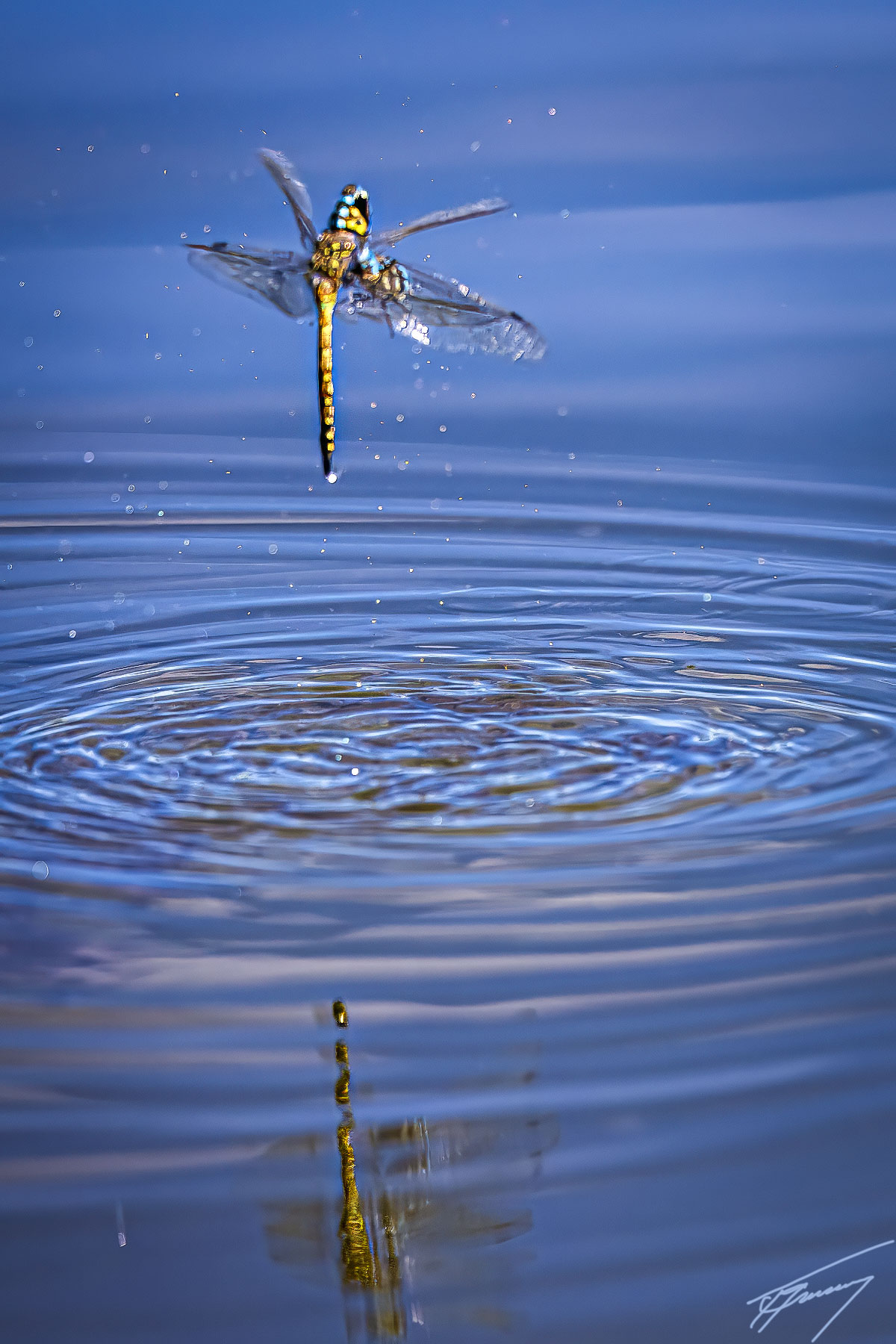
Below is a photo I took on my last outing on Lake Mary and it shows a variegated meadow hawk dragon fly as he is taking off from the surface of the lake after engaging in an incredible battle on the surface with a blue darner dragon fly, he prevailed and is taking his prey off so that he can consume him for breakfast. The prey is almost the same size as the predator and yes, dragon flies do eat each other!

Into a new day and week … methinks it is going to be a very good one! Smile, keep breathing and enjoy each moment you have the privilege of being here … also that we are high up on the predator list …

Smiles,

Ted

Let saints declare I shall not dare
or burn in the pits of hell.
Let loud men scorn and women mourn
Whene’re my tale they tell;

I cannot stay in the deadened way
Of sorrow, hide-bound creeds;
I’ll win the smile that shall beguile
My heart where’re it leads.

Away with tears and shrinking fears
That breed from the gossip’s tongue.
I’ll live today in my own way,
Though night shall find me hung,
And my good name be dragged to shame
And damned for evermore;
So here’s farewell to them that tell
My tale when all is o’er.

His Last Toast by Max Ehrmann

###

photo_tedgrussingThe easiest way to reach Mr. Grussing is by email: ted@tedgrussing.com

In addition to sales of photographs already taken Ted does special shoots for patrons on request and also does air-to-air photography for those who want photographs of their airplanes in flight. All special photographic sessions are billed on an hourly basis.

Ted also does one-on-one workshops for those interested in learning the techniques he uses.  By special arrangement Ted will do one-on-one aerial photography workshops which will include actual photo sessions in the air.

More about Ted Grussing


Healing Paws

Healing Paws

This is an advertisement

Ukraine Launches Database to Track Art Owned by Sanctioned Russians

Ukraine Launches Database to Track Art Owned by Sanctioned Russians
Francis Bacon Triptych

This triptych by Francis Bacon is listed as being owned by Roman Abramovich in the new database.
Cate Gillon / Getty Images

Amid the Russian invasion, Ukraine has launched a new database that tracks art owned by Russian nationals under Western sanctions.

“Russian oligarchs, despite the sanctions imposed on them, can still easily hide and launder their money through art objects,” writes Ukraine’s National Agency on Corruption Prevention (NACP) in a statement. “Painting, sculptures, artistic jewelry—this is exactly what is used as a loophole to circumvent sanctions.”

Currently, the searchable list, part of the Ukrainian “War & Sanctions” project, contains some 300 art objects, according to the NACP. Entries note the work’s title, artist, price and current owner.

“The inclusion of famous works by artists as varied as Claude Monet, Damien Hirst and Auguste Rodin highlights the extraordinary wealth accumulated by those said to be supporting the Russian leadership,” writes the Guardian’s Daniel Boffey.

Other major entries in the database include a triptych by Francis Bacon (said to be owned by billionaire Roman Abramovich), René Magritte’s The Domain of Arnheim and several works by Mark Rothko.

“Each listing contains basic details about the given artwork, including who made it and when, as well as its estimated value and connection to sanctioned individuals,” reports Artnet’s Taylor Dafoe. “The portal also contains a system through which users can report other relevant artworks and owners.”

The database includes art currently owned by sanctioned Russians, as well as pieces they’ve bought or sold, since 2014. Information in the database is collected from open sources and can be changed or updated during the verification process, according to the NACP.

Per the NACP’s statement, the agency hopes the database will “make it easier for virtuous art market participants to carry out ‘sanctions’ checks and make it difficult for Russian oligarchs to sell such assets.” Art dealers and insurers often use resources like the Art Loss Register to perform similar investigations into a work’s provenance to ensure it hasn’t been marked as stolen, notes Business Insider’s Mia Jankowicz.

Art has played a key role throughout the war. As part of a larger effort to erase Ukraine’s cultural heritage, Russian forces have been looting, damaging and destroying a number of valuable Ukrainian artifacts and cultural institutions.

The United States, the United Kingdom and the European Union are among the world powers that have issued sanctions against Russia and Russian oligarchs. The individuals under sanctions include billionaires Petr Aven, Viatcheslav Kantor, Andrey Melnichenko and Arkady Rotenberg, all of whom are listed in the new art database, reports Artnet.

“From now on,” says the NACP, “everyone can easily monitor the circulation of art products that are bought or sold by sanctioned Russians.”

Beyond art, Ukraine’s allies have introduced sanctions targetting a number of Russian oligarchs’ assets. These policies are meant to “[promote] accountability for President Putin and those enabling Russian aggression,” as U.S. Secretary of State Antony Blinken said in a statement last year.

Get the latest stories in your inbox every weekday.

New gallery Good Medicine Creatives highlights Seneca artists

New gallery Good Medicine Creatives highlights Seneca artists
image

SALAMANCA — Good Medicine Creatives art gallery has opened its doors at 215 Broad St., the former WGWE radio station building, serving as both a classroom and space for 10 local Seneca Nation artists to display and sell their work.

The gallery will give the artists a space to create new art and interact with the public by teaching classes and holding exhibits to educate, connect and inspire the community.

In addition to workshops and classes, the artists plan to have speakers and, eventually, some digital art classes. Artist Penelope Minner said they also plan to have an open studio where the public can observe an artist at work.

Fellow artist Cliff Redeye said he’ll be working on a leather project Wednesdays from 1 to 6 p.m. He invites people to stop in and watch. He’ll be happy to answer any leather-related questions.

Minner said there are stories behind every piece the artists create. A number of her handmade baskets are on display that she has incorporated with her delicate beadwork. She is also showing corn husk dolls, an art that was passed on to her by her mother.

“The dolls make us realize we are not alone,” she explained. “They were a play object for the Haudenosaunee children way back when.”

Minner is trying to make at least six to eight dolls this season representing women in the Haudenosaunee culture. The first one was a no-face doll and it has a story explaining why the corn husk dolls don’t have a face. According to Minner, several different stories have been handed down through the generations between the nations and tribes. She said “it’s all about vanity.”

The basketmaker, shown in a display case, was her second doll. Minner laughed as she said “this one is like a self-portrait of me busy making my baskets.”

There are some particularly moving art pieces in the gallery, especially that of Redeye, who explained a few currently on display. He dedicated a large leather tooled bag to his grandmother, Phoebe Redeye, who went to the Thomas Indian School when orphaned at 7 years old.

“The piece portrays her going to the school as a child and having the native teachings of the Three Sisters (corn, beans and squash) discouraged by the school matrons around her,” he said. “The piece represents the traditional teachings of the Seneca being replaced by the school. The wooden handle actually came from my grandmother’s house.”

Trending Food Videos

Good Medicine Creatives is part of the Artist Employment Program under the Creatives Rebuild New York (CRNY) award in collaboration with the Seneca-Iroquois National Museum (SINM).

Minner said the gallery was made possible through the two-year program that funds employment for 300 artists working in collaboration with community-based organizations across New York state. She said participating artists receive an annual $65,000 salary plus benefits and dedicated time to focus on their artistic practice. Collaboratives, the SINM/OCC, will receive money for hosting the artists and working with them. Each collaboration is different across the state.

“We began showing our work and selling it at the SINM, but this gallery is an extension of the museum and (the artists) are a separate entity,” she said. “Hayden Haynes, director of the Onöhsagwë:de’ Cultural Center at the museum, oversees the program and has worked with the artists from the start.”

Minner said the 10 artists from the Allegany and Cattaraugus territories came together as a group and applied for the grant under the SINM. Redeye said they applied as a group and developed what they wanted and envisioned.

“When we applied for the grant, we had a goal to get a building to create an arts district of sorts. There are so many artists in town and it’s a way to highlight the ones that people don’t realize are here,” he said.

Good Medicine Creatives is an art collective established in 2022 on the Seneca Nation Allegany Territory. As artists and culture bearers, they seek to inspire and be inspired by art in all forms to promote positivity and good medicine for the people.

The artists and culture bearers include Cliff Redeye (leatherwork, painting, carving); Leeora White (traditional Iroquois interpreter, watercolor, crafts; Patrick Redeye (photography, video); Maurice John Jr. (painting, visual art, photography); Tami Watt (graphic art, photography, beadwork); Penelope Minner (baskets, beadwork, corn husk dolls); Karlene Familo (painting, beadwork, skirts, hats); Hilton Johnny-John (gustowehs, gunstocks, rattles, drums, performer); Jocelyn Jones (performing and body artist, public speaker, botanicals); and Brett Maybee (traditional Iroquois orator, musician, and host of a national radio show with Native Voice called Gaënö’ that highlights native artists).

Regular gallery hours are Wednesday through Friday from 1 to 6 p.m., Saturday and Sunday from 10 a.m. to 4 p.m. Closed Monday and Tuesday. For more information, visit goodmedicinecreatives.com

For information about classes, events and featured speakers, scan the QR code found in the gallery. For more details about Creatives Rebuild New York, visit creativesrebuildny.org.

Workshop – Pricing Your Work: Value + Art Market

Workshop – Pricing Your Work: Value + Art Market

Pricing Your Work: Value + Art Market

How do I price my art? Kristen Brown, artist and founder/CEO of Rela, will provide some answers to this common question. In this virtual workshop, Kristen will present pricing formulas, context for market pricing and new approaches to value assessments.

August 15, 2023
5:30 – 6:30pm

Indigenous Artists Speak Out Against Stereotypes in “Savages and Princesses: The Persistence of Native American Stereotypes,” at the Pauly Friedman Art Gallery

Indigenous Artists Speak Out Against Stereotypes in “Savages and Princesses: The Persistence of Native American Stereotypes,” at the Pauly Friedman Art Gallery

Indigenous Artists Speak Out Against Stereotypes in “Savages and Princesses: The Persistence of Native American Stereotypes,” at the Pauly Friedman Art Gallery

Indigenous Artists Speak Out Against Stereotypes in “Savages and Princesses: The Persistence of Native American Stereotypes,” at the Pauly Friedman Art Gallery

Misericordia University’s Pauly Friedman Art Gallery fall exhibit “Savages and Princesses: The Persistence of Native American Stereotypes,” will run from Tuesday, September 5 through Sunday, October 22, 2023.

Zachary Presley, Genuineness, 2015; archival digital print, 20 1/2 x 20 1/2 inches; Courtesy of private collection.

Zachary Presley, Genuineness, 2015; archival digital print, 20 1/2 x 20 1/2 inches; Courtesy of
private collection.

In the exhibition “Savages and Princesses: The Persistence of Native American Stereotypes,” twelve contemporary Native American visual artists confront misconceptions of Indigenous identity and culture with humor, defiance, and honesty. Artworks include ceramics, prints, and mixed media pieces from found objects such as vinyl records. Oklahoma artist and editor of First American Art Magazine America Meredith initially curated this nationally-touring exhibit.

“Savages and Princesses: The Persistence of Native American Stereotypes” embraces Native Americans’ power to replace stereotypical images that permeate the current pop culture landscape. Recognizing that stereotypes often occur without conscious awareness, the exhibition includes didactic information that explores common stereotypes about Native Americans that are falsehoods, followed by the truths behind them.

Presented originally at Tulsa’s “108|Contemporary” in 2016, this exhibition is organized by “ExhibitsUSA,” a program of the Mid-America Arts Alliance.

There will be a free reception and artmaking event on Saturday, October 21, from 3:00 p.m. to 4:30 p.m. Live music performance by Patrick Temple, professor of Guitar at Misericordia University.

Exhibition: “Savages and Princesses: The Persistence of Native American Stereotypes”

Host Organization: Misericordia University’s Pauly Friedman Art Gallery

Dates: September 5 – October 22, 2023

Gallery Hours: Tuesday – Thursday, 12:00 p.m. to 7:00 p.m.; Friday – Sunday, 12:00 p.m. to 5:00 p.m.; all other times are by appointment

Location: Misericordia University, 2nd floor Insalaco Hall; 301 Lake St, Dallas, PA, 18612

Admission: Free

Contact: (570) 674-6250; misericordia.edu/art

About ExhibitsUSA

ExhibitsUSA, a Mid-America Arts Alliance national program, tours this exhibit. ExhibitsUSA annually sends more than twenty-five exhibitions on tour to over 100 small- and mid-sized communities. These exhibitions create access to an array of arts and humanities experiences, nurture the understanding of diverse cultures and art forms, and encourage the expanding depth and breadth of cultural life in local communities. For more about ExhibitsUSA, email MoreArt@maaa.org or visit www.eusa.org.

About Mid-America Arts Alliance.

Mid-America Arts Alliance (M-AAA) strengthens and supports artists, cultural organizations, and communities throughout our region and beyond. We achieve this primarily through our national traveling exhibition programs, innovative leadership development, and strategic grant-making. We are especially committed to enriching the cultural life of historically underserved communities by providing high-quality, meaningful, and accessible arts and culture programs and services. We believe in more art for more people. Additional information about M-AAA is available at www.maaa.org.

About the Pauly Friedman Art Gallery

The Mission of the Pauly Friedman and MacDonald Art Galleries is to engage the Misericordia campus and community in creative experiences through visual arts exhibitions and programs that foster critical thinking, intellectual curiosity, and global citizenship. Regular gallery hours are 12-7 p.m. Tuesday to Thursday and 12-5 p.m. Fridays to Sundays. Other times are available by appointment. Closed during university closings and holidays. Admission is always free to all. Please call or check the gallery website, www.misericordia.edu/art, to confirm your visit. To schedule a free tour or private appointment, or for more information, contact the art gallery director, Lalaine Bangilan Little, Ph.D., at (570) 674-6250 or email llittle@misericordia.edu.

Keiser University Graduate Follows in Mother’s Global Footsteps as a Cinematic Art Scholar

Keiser University Graduate Follows in Mother’s Global Footsteps as a Cinematic Art Scholar

Keiser University valedictorian Audrey Chouraqui Azoulay gained an appreciation for cinematic life and behind-the-scenes post-production efforts while growing up the daughter of a British film and television translator. Raised in Paris, France, she and her brother Ethan enjoyed watching black and white ‘old Hollywood’ and ‘film noir’ era films from the 1940s and 1950s throughout their childhood as their mother Vanessa translated them. The experience ignited the spark for young Audrey’s interest in film production. “Mom’s profession impacted more of the family culture than anything. As a film translator, she always had an eye for specific language contrasts, which we had a lot of fun practicing with her,” recalled Chouraqui Azoulay.

Chouraqui Azoulay who is fluent in French, English, and Spanish, shared that global travel has always played an integral role in her family’s lifestyle and offered ‘mind-opening’ experiences. “I have been around the world and loved every second of it,” said Chouraqui Azoulay who has visited about 20 countries from Cambodia to Cuba, Senegal, and the Dominican Republic. “One afternoon, while on vacation in the south of France, as I was telling my grandmother a story that I wanted to see on screens one day, she told me to just write it down. One year later, I filmed, edited, and produced it myself. I was fifteen. That’s when the passion for the whole process began,” she recalled. “I always knew that I didn’t want to translate. I was much more of a storyteller.”

Now graduating as Keiser University Flagship campus co-valedictorian along with Errolesha Thompson, Chouraqui Azoulay is looking forward to working professionally for a year before earning her master’s degree and then joining the cinematic world as a producer.

Thankful for the encouragement and guidance of Cinematic Art Professors Samantha Kountz and Jean Jacques as well as Marketing Professor Sunday Barbaro, she also shared appreciation for the person who started it all. “My mum has always been my biggest fan. I would go as far as to say that I do what I do thanks to her. She has been there since day one and I think she’s very proud of what I’ve accomplished so far. I also think she loves it when I have to add subtitles to my films and documentaries because that way, she can help me with it. She is truly the best and I couldn’t have asked for a better supporter in life,” she smiled.

Keiser University’s Bachelor of Arts degree in Cinematic Arts provides students with a solid foundation in cinematography, storytelling, and film production while incorporating business principles, as well as more advanced coursework and a strong general education program. An interdisciplinary approach enables students to demonstrate their artistic expertise and application of business knowledge to enhance their career opportunities.

Keiser University is a private, independent, non-profit university serving nearly 20,000 students at 21 Florida campuses, online, and two international sites. Co-founded in 1977 by Chancellor Arthur Keiser, Ph.D., and Evelyn Keiser, Keiser University currently offers more than 100 degrees from associate to the doctoral level. Keiser University is a designated Hispanic-Serving Institution, a member of the Hispanic Association of Colleges and Universities and was ranked No. 1 in the U.S. in providing Social Mobility by U.S. News and World Report in 2023.

NYC Socialite Accused of Unleashing Bonkers Attack on Photographer

NYC Socialite Accused of Unleashing Bonkers Attack on Photographer

A New York City socialite perhaps best known for her unspeakably acrimonious divorce from the world’s leading Andy Warhol collector allegedly threatened to have a professional photographer shot dead over a petty interpersonal spat, then allegedly had the man thrown in jail on bogus criminal charges and destroyed his once-promising career.

In an explosive new lawsuit, shutterbug Jacob Beam says his entire life has gone down the tubes thanks to Libbie Mugrabi—who reportedly once had a physical altercation with ex-husband David Mugrabi over a $500,000 Keith Haring sculpture—and that he now works as a part-time food deliveryman while attempting to get past the “psychological and emotional issues caused by [the] horrific ordeal he has undergone.”

The multi-million-dollar suit was filed Sunday by Beam’s attorney, Kenneth McCallion, in New York State Supreme Court. McCallion declined to comment on the case, or to make Beam available on Monday for an interview.

Mugrabi, 42, made headlines in 2018 for a nasty divorce she said she financed by selling her engagement ring for $100,000. (“The same thing that got me into this marriage is going to get me out,” she told The New York Times.) The split was touched off by accusations of psilocybin-and-ketamine-fueled infidelity, and the pair battled in court over everything from tens of millions in art to a $72 million Upper East Side townhouse to a nine-bedroom Hamptons house to a classic 1974 Ferrari.

Earlier this summer, Mugrabi showed up to court in body armor, claiming her ex was scheming to have her killed. (David Mugrabi called the claim “the most ridiculous story I ever heard.”) In June 2020, at the height of the COVID pandemic, an unrepentant Mugrabi disregarded public health guidelines and held a dinner for 50 people during Art Basel in Miami. The following year, Mugrabi was arrested for allegedly pulling a knife on her live-in housekeeper, who also said her hotheaded boss threatened her with a mop handle. She pleaded not guilty last December to charges of menacing, criminal mischief, and criminal possession of a weapon; it is unclear exactly where the case currently stands.

A photo of Libbie Mugrabi stepping out of an SUV in London.

Libbie Mugrabi attends an October 2022 event in London.

David M. Benett/Getty Images

Today, Mugrabi produces a line of streetwear under the label Libbie Love, selling accessories like trucker hats, handbags, and vibrators. It was through Libbie Love that Beam first got involved with Mugrabi, according to his complaint.

The two met in December 2021, through a mutual friend, the complaint states. Mugrabi was impressed with Beam’s photography portfolio, and flew him to Hawaii for a photoshoot, it says. And although the Hawaii shoot was later canceled, Beam, who was living at the time in Bloomington, Indiana, says Mugrabi asked him to come work with her in New York, which he agreed to do.

Mugrabi paid for Beam to pick up and move in with her, according to the complaint. He says he worked out of Mugrabi’s home studio, doing web design, graphic design, and photography for Libbie Love while also working as Mugrabi’s personal assistant.

But on May 22, 2022, things suddenly took a turn for the bizarre. That’s when Beam says Mugrabi “had a fit of rage, and impulsively shouted at [Beam] to ‘get out’ of the townhouse,” the complaint states.

“[Mugrabi] had apparently rummaged through [Beam’s] personal belongings and had found a journal that he was keeping, which made reference to her,” it goes on. “She loudly told him, ‘How dare you write about me. You know I have a book deal with Simon and Schuster, and if you try to profit off my name I will send someone to shoot you through the head. Do you understand?’” (Mugrabi did reportedly sign a “six-figure” book deal in 2020, for an as-yet unreleased novel based on her bitter split from David.)

Beam dutifully left, and Mugrabi’s then-publicist booked him a room at a nearby hotel, which Beam paid for upon arrival, according to the complaint. The next evening, Beam was taking a walk through Central Park when Mugrabi called, demanding he return some clothing designs he had stored on his laptop, the complaint continues.

“She also threatened him, telling him that she was calling the police,” it states. “[Beam’s] co-worker later told [him] that she was present with [Mugrabi] during a conversation with the police, and that [she] had a wine glass in her hand and there were prescription pills all over the place. The co-worker also overheard [Mugrabi] tell the police that they needed to take her seriously because she was a rich woman.”

Libbie Mugrabi with model Tyson Beckford and singer Little Paris last month, in Paris.

Libbie Mugrabi with model Tyson Beckford and singer Little Paris last month, in Paris.

Victor Boyko/Getty Images for L’Scher

After Beam got back to the hotel, the NYPD showed up at his door, according to the complaint. It says the officers informed Beam that “a woman reported that you had held her at gunpoint and forced her to book this hotel room.” Beam was also told that Mugrabi had accused him of stealing her camera, which in fact belonged to Beam, the complaint states, adding that Beam “was never in possession of and has never owned a gun.”

Nevertheless, Beam was arrested on a raft of charges, including stalking, menacing, and criminal possession of a weapon, the complaint says. He spent a night in jail before being arraigned the next day in New York County Criminal Court and released on his own recognizance.

After Beam was sprung, he went back home to Indiana “in a total state of shock and mortification,” according to the complaint.

“Thereafter, he has continuously suffered from extreme anxiety and depression,” it says.

On Sept. 6, 2022, all of the charges against Beam were dismissed.

“Due to the post-traumatic distress that he has continued to experience, [Beam] has been unable to work full-time, and has been in a near-constant state of anxiety and depression,” the complaint states. “He supports himself as best he can by delivering food on a part-time basis, and he has sought the assistance of a therapist to help him try to function and to try to overcome his psychological and emotional issues caused by horrific ordeal he has undergone, which was directly caused by [Mugrabi’s] outrageous and malicious actions.”

Beam is asking for a jury trial and at least $5 million in damages. Mugrabi did not immediately respond on Monday to a voicemail, email, and text seeking comment.

Elaborate Flower Arrangements by Lewis Miller Design Cascade From Fixtures of New York City Streets

Elaborate Flower Arrangements by Lewis Miller Design Cascade From Fixtures of New York City Streets

All images © Lewis Miller Design, shared with permission

Sprays of vibrant blooms and foliage erupt from New York City trash cans, trucks, and road signs by Lewis Miller Design (previously). Known for his temporary Flower Flash installations, Miller sees phone booths and stacks of pallets as vessels for enormous floral arrangements, which often remain in place for only a few hours before they disappear. He delights in setting the scene for unexpected encounters and often collaborates with local businesses, events, and other artists, like in a series of cascading displays around artist Scott Froschauer’s reimagined road signs for L.E.A.F. Flower Show.

Find a variety of vivid arrangements on Miller’s Instagram and website.


A cascade of flowers spilling out of a city garbage can.

Two images of cascading floral arrangements around signs by Scott Froschauer.

A floral arrangement in a city garbage can. A large floral arrangement inside of a garbage can in New York City.

A cascade of flowers spilling out of a city garbage can.

A cascade of flowers around and spilling out of an ice cream truck.

A floral arrangement in the shape of a heart with the Empire State Building in the distance.  A cascade of flowers spilling out of a city garbage can.   A cascade of flowers spilling out over a stack of pallets.

Do stories and artists like this matter to you? Become a Colossal Member today and support independent arts publishing for as little as $5 per month. The article Elaborate Flower Arrangements by Lewis Miller Design Cascade From Fixtures of New York City Streets appeared first on Colossal.