
Going on view at Gagosian in Beverly Hills starting July 20.
Urs Fischer Probes Into the Power of Broadcasting Ads in New Digital Sculpture


Native American activists are calling out Yellowstone creator Taylor Sheridan for his recent comments claiming that his 2017 film Wind River “changed a law” affecting violence against Indigenous people.
In a June profile in the Hollywood Reporter, Sheridan discusses the behind-the-scenes drama that has affected his Paramount Network series Yellowstone, which stars Kevin Costner as John Dutton, the head of a prominent Montana ranching family who is constantly fighting to protect the land he lives on from those who want it.
The irony, especially for Sheridan, who is white, is that his main character Dutton is fighting for land that once belonged (and arguably still belongs) to the Native tribe he often spars with in his constant efforts to protect the valuable acreage for his own descendants.
While that storyline in and of itself is rich fodder for discussion among Native communities, it’s what Sheridan said about his 2017 film spotlighting the issue of missing and murdered Indigenous women and people that is raising eyebrows among Native activists, artists and creators.
“[Wind River] actually changed a law, where you can now be prosecuted if you’re a U.S. citizen for committing rape on an Indian reservation, and there’s now a database for missing murdered Indigenous women,” Sheridan told the industry publication.
“That law had a profound impact,” he added. “All social change begins with the artist, and that’s the responsibility you have.”
Sheridan is referring to the Violence Against Women Act (VAWA) Reauthorization Act, which President Biden signed into law in 2022. The law, which first passed under President Bill Clinton in 1994 and has since been renewed four times, has strengthened its reach in Native communities, “expanding special criminal jurisdiction of Tribal courts to cover non-Native perpetrators of sexual assault, child abuse, stalking, sex trafficking, and assaults on tribal law enforcement officers on tribal lands.”
What Native groups have taken issue with is Sheridan’s assertion that he and his film, which stars white actors Jeremy Renner and Elizabeth Olsen in the lead roles investigating the murder of an Indigenous woman (played by Julia Jones, who is of Choctaw and Chickasaw descent), were responsible for the law’s reauthorization.
“Yellowstone creator Taylor Sheridan’s attempt to take credit for the passage of VAWA is gross and completely discredits years of tireless advocacy from the Native community,” Native rights attorney Mary Kathryn Nagle (Cherokee) said in a statement shared by Native social justice organization IllumiNative. “His movie Wind River perpetuates the myth that the FBI investigates MMIW cases. They do not. Sheridan should be apologizing, not taking credit for a victory secured by Indian Country advocates and led by Native women.”
Among those advocates are organizations such as the National Indigenous Women’s Resource Center, a nonprofit founded in 2011 “dedicated to ending violence against Native women and children,” and Sovereign Bodies Institute, founded in 2018, another Native female-led nonprofit with its own MMIP database that “builds on Indigenous traditions of data gathering and knowledge transfer to create, disseminate, and put into action research on gender and sexual violence against Indigenous people.”
Nagle and IllumiNative aren’t the only Native voices that are speaking out. In addition to TikTokers like Ethan Young Wolfe (Cherokee), who also shouts out Native women and Indigenous communities that have “fought to pass” the law, actress and writer Jana Schmieding (Lakota), who starred in and wrote for the TV series Rutherford Falls on Peacock and also stars on FX on Hulu’s Reservation Dogs, spoke to In The Know by Yahoo about her reaction to Sheridan’s statement.
“None of it is surprising, and all of it is offensive,” Schmieding tells In The Know. “And that’s colonizer behavior. It’s also ‘white man in Hollywood with power’ behavior.”
The Rutherford Falls actress, who starred as Native museum curator Reagan Wells, also wrote an episode of the series titled “Adirondack,” which is a not-so-subtle satire of Yellowstone and a swipe at the practice of using Native talent as consultants rather than as writers, directors or producers on shows.
On that episode, Schmieding points out, Native casino owner Terry Thomas (played by Michael Greyeyes, who is Plains Cree) says, “I grew up watching Indians played by Italian men getting shot off of their horses by white men playing cowboys. So this is a step up.”
That statement highlights some of the frustrations encountered by Native creators, who have had a long history of being sidelined, or even erased, in Hollywood — often in their own stories — by white creators. In fact, among broadcast, cable and digitally scripted TV shows in the 2020-21 season, Indigenous people represented less than 1% of lead characters, with cable showing no Native lead representation whatsoever, according to UCLA’s 2022 Hollywood Diversity Report.
In his productions of Yellowstone and Wind River, Sheridan has employed Native actors in supporting roles, including Gil Birmingham (Comanche), Mo Brings Plenty (Oglala Lakota) and the aforementioned Jones (who also, coincidentally, worked on Rutherford Falls). While that could potentially raise eyebrows in the Native community, given the strong sentiments about Sheridan’s practice of not hiring Native writers (or any writers, for that matter), Schmieding stresses that she doesn’t take issue with their work on Sheridan’s projects.
“I never blame Native people for the projects that we get hired for. We are so unrepresented in this industry, the amount of jobs that we have available to us are so slim, and that is the fault of white creators,” she says. “If more non-Native people would hire Native folks to perform in their content and not just as stereotypical Native characters in somebody’s western, then we wouldn’t be in this pickle where we have to be in Taylor Sheridan television shows to make ends meet.
“We can’t afford to boycott him,” she adds. “He’s too powerful.”
For Wind River, arguably a white-character-centered movie about an important issue in the Native community that had no Native voice in its creation, the addition of Sheridan’s statement claiming ownership of a law affecting Indigenous people adds insult to injury.
“I genuinely think he believes that he is that important to Native people’s existence, which is the hubris of a colonizer,” Schmieding says. “For him to believe that he had any involvement in the Violence Against Women Act being passed, any touch on the murdered and missing Indigenous persons issue in Indian country, I’m so offended.”
That’s why she “stands with” and is helping to support efforts by organizations like IllumiNative to raise awareness about the appropriation of Native work and ownership of issues that preexisted Sheridan’s involvement in Hollywood’s Indigenous storytelling — ironically the same message as the tribal leaders give to Dutton in his Yellowstone series.
“I feel that we disrupt sometimes this liberal fantasy of racial reconciliation,” Schmieding says about Native communities speaking out, “because we’re not really satisfied with how it is for us and we’re not satisfied accepting the scraps of the industry.”
In The Know by Yahoo reached out to Sheridan’s representatives for comment but have not received a reply.
In The Know by Yahoo is now available on Apple News — follow us here!
More from In The Know:
Two-spirit powwow dancers represent LGBTQ2S pride in traditional Native spaces
Indigenous singer-songwriter Raye Zaragoza wants to ‘lift up women of color’
From Hailey Bieber’s favorite sunscreen to fast-acting pimple patches and essential oil diffusers, the list is endless.
Whether it’s a 5-star hotel or a 1-star, she always does this in every room she stays in.
The truth behind those pieces of hairbrush fluff is majorly grossing people out.
Amazon shoppers love them, too.


Abstract photographer Jack Sal lived here for more than 30 years in the front rooms of a former synagogue on East 6th Street — just up the stairs from his former roommate William Wegman. This was the section where the women of the Proskurover Zion Congregation would have prayed separately.
Photo: Allyson Lubow Photography/Allyson Lubow
In the early 1980s, photographer and East Village resident Timothy Greenfield-Sanders was obsessed with his neighborhood’s stock of old religious buildings. He’d just closed on an old rectory on Second Avenue when a synagogue nearby on 6th Street went on the market. “It was a building that longed for a new beginning,” he says. The problem was he didn’t have money for another down payment. So he started talking it up to other people who might. Like the photographer William Wegman, who was quickly gaining fame for shooting his own Weimaraner dogs. On a shoot, Greenfield-Sanders found out Wegman had just lost his apartment to a divorce and was living with a roommate, the abstract photographer Jack Sal. Wegman and Sal were interested, and so was Greenfield-Sanders’s teenage neighbor on Second Avenue, Maria von Hartz. “I’d just been discovered and suddenly had some money,” says von Hartz.
Together, the 18-year-old model and the three professional photographers bought the building in 1982 for $154,500, dividing up the price and the space. Wegman paid five-eighths of the mortgage and taxes for the main worship room — a first-floor duplex with 20-foot-tall ceilings and a second story that overlooks the grand space thanks to two wide balconies. Sal paid two-eighths for the front of the building, where the women of the congregation would have once worshiped separately, a bright, cheerful space thanks to high arched windows. For one-eighth, Greenfield-Sanders took the smallest apartment on the fourth floor — believed to have belonged to the building’s former caretaker. And for two-eighths, von Hartz took the third floor, the home of what Greenfield-Sanders remembers as a former Polish or Ukrainian social club when he arrived in 1982 but was archived in a 1923 copy of The Worker as Katz Hall, the meeting place for “sympathizers” of the Polish Branch of the Workers Party.
“It was this cavernous space,” says von Hartz. “This huge loft with urinals in the front, pool tables, a 30-foot Art Deco bar with beer signs, neon signs, card tables, four pool tables. I was like, ‘Oh my God! I’ll take it.’” She and her friends would often run into Wegman’s crowd. “He was always coming in and out with his dogs, and there would be famous people in the halls. I’d be coming in with all my makeup on from a modeling shoot and the B-52’s are in the hallway, getting their album cover done.”
“I remember once Bill had a shoot with Steve Martin, who came to pose with the dogs,” says Greenfield-Sanders. “It was kind of glamorous in that way.” For Wegman, it was a perfect workspace — the balconies meant he could shoot from overhead, the high ceilings let him work with bigger lights, and the space was so immense that he could carve out a separate small apartment in front where his assistants could crash. “Another thing that I used, not legally, was the yard,” he admitted. But the neighbors, which incidentally included the playwright Lee Breuer, were friendly and gave Wegman’s dogs freedom to roam.
Things changed when — per Wegman — “the Pyramid Club kicked up.” The club — which opened in 1979 — meant bass lines made a constant boomp boomp boomp in Wegman’s bedroom from midnight to 4 a.m. despite all efforts at soundproofing. For Sal, whose rooms faced the street, the noise came years later. “Towards the end, there was this horrendous bar called Death & Co.,” he said. “There’d be people out at all hours. We tried to fight them.”
Wegman officially grew out of the studio when he had kids. “With children, it became a kind of hair-raising space,” he says. So he eventually found 40,000 square feet across two empty buildings in Chelsea. In 1996, he sold his share of the synagogue to Paola Igliori, an artist and writer who had just published American Magus, a book about Harry Smith, the Beat Generation artist and visionary. “Harry Smith would be there all the time,” Sal remembered. “And all these other crazy people. Crazy in a good sense of the word.”
“I always had huge parties with, I don’t know, Allen Ginsberg and the rapper Killah Priest from Wu-Tang Clan,” Igliori says. She furnished the small apartment Wegman had built for his assistants with furniture from the Chelsea hotel suite that had once belonged to the artist and poet Rene Ricard, whom she wrote a book with. In 2014, Igliori bought out Sal, too, taking over his apartment but renting out Sal’s basement studio to Vito Schnabel, who, before he opened his own gallery, used it to stage shows for the Bruce High Quality Foundation. “I’m like the godmother of Lola Schnabel,” she says. Lola and Vito’s mother, May Andersen, moved into Sal’s old apartment for a time, and Andersen’s friend, the performance artist Kembra Pfahler, ended up using the basement studio. Greenfield-Sanders got out of the building in 2004, in part because despite only owning one-eighth, he found himself doing an outsize portion of upkeep. “It was too much work.”
Von Hartz was on the third floor-through most of this mayhem, gradually transforming the space to match her life, which later included a husband and children. She added bedroom walls, upgraded bathrooms, and expanded the kitchen, getting rid of the old bar, which never stopped smelling of beer. “It kind of just morphed into a kitchen bar.” Recently, she rented the space to a tenant and moved into the townhouse her parents had bought when she was a kid, right next to the former rectory on Second Avenue where Greenfield-Sanders still lives. This year, she listed the loft at 431 East 6th. “I have to go to therapy about actually selling it,” she says.
Igliori refuses to move out entirely, keeping Wegman’s old duplex for herself. But this week she listed Sal’s front apartment, the small studio apartment Wegman built for his assistants, and Sal’s basement studio — an offering of three stories at the front of the building that broker Brian Goldfarb is marketing as a “maisonette.”
On tours, Goldfarb has found himself forced to explain who Wegman is. (“I say, ‘You know, the guy who takes the photographs of the dogs?’ And they’re like, ‘What?’ and I explain.”) But Wegman’s career is sometimes less confusing than explaining how the building’s ownership was divided up into eighths, and how that agreement still stands, 41 years later. “It’s basically an agreement between friends.”
The 1851 building was turned into a synagogue in 1927 by Ukrainian immigrants, according to nonprofit Village Preservation. It was home to the Proskurover Zion Congregation and Kranken Untershtitsung Verein (KUV, or Sick Benevolent Society).
Photo: Rachel Kuzma/Sotheby’s International Realty
Tin ceilings are original to the synagogue. This section, where Sal lived on the second floor, was where the women of the congregation would pray separately.
Photo: Allyson Lubow Photography/Allyson Lubow
Sal lived here from 1982 to 2014, when he sold to the poet and author Paola Igliori, who had already overtaken Wegman’s duplex in the back of the building.
Photo: Allyson Lubow Photography/Allyson Lubow
The tiles in Sal’s former kitchen he bought in Delft, the Netherlands. The stove is a turn-of-the-century model. Sal found one just like it at an old appliance shop on Kenmare Street and loved it so much that he insisted on taking it when he left. Igliori agreed but made him replace it with an exact match. “I love that stove,” she said.
Photo: Allyson Lubow Photography/Allyson Lubow
Sal turned the 2,500-square-foot basement, which extends to every property line, into a studio. When he got here in 1982, the basement was a kitchen for a yeshiva. He turned one bathroom into a darkroom and kept the other.
Photo: Allyson Lubow Photography
Igliori rented the basement out to her family friend Vito Schnabel, who ran it as a gallery before running his own name-brand space and staged shows by the Bruce High Quality Foundation. Later, Igliori let artist Kembra Pfahler work downstairs.
Photo: Allyson Lubow Photography
Upstairs, on the third floor, is what Maria von Hartz calls “the loft.” She first saw the floor-through apartment when she was in high school and working as a model, making money her parents were hoping to invest in property.
Photo: Rachel Kuzma/Sotheby’s International Realty
The skylight once loomed over an old clubhouse. Von Hartz remembered “urinals in the front, a 30-foot Art Deco bar with beer signs, neon signs, card tables, four pool tables.”
Photo: Rachel Kuzma/Sotheby’s International Realty
The loft was ideal for throwing ragers. “When you’re 20 and people are coming into your party that you’re throwing and it’s a 1,900-square-foot loft, it was kind of magical,” von Hartz said.
Photo: Rachel Kuzma/Sotheby’s International Realty
Eventually, she got rid of the old bar, which never stopped smelling of beer, and expanded the kitchen. “It kind of just morphed into a kitchen bar.”
Photo: Rachel Kuzma/Sotheby’s International Realty
There was no kitchen when von Hartz saw the place: This was where a row of urinals was. The social club was a Polish or Ukrainian club when von Hartz bought, but it was listed in a 1923 copy of The Worker as Katz Hall, the location of a party given to “sympathizers” of the Polish branch of the Workers’ Party.
Photo: Rachel Kuzma/Sotheby’s International Realty
She changed the apartment so often over the years, adding and removing walls, that it inspired her to pursue a career in interior design. She now runs her own firm.
Photo: Rachel Kuzma/Sotheby’s International Realty
William Wegman remembers barricading this door back when the East Village “wasn’t exactly completely gentrified.” But down the block was the studio of Walter De Maria, who gave him advice. “He told me I should get a cat and name it Anaïs Nin and start working with a cat.”
Photo: Rachel Kuzma/Sotheby’s International Realty

… today was one of those rare days that come along once in a while … things did not go along quite as expected, but as always, issues were resolved again, it was a terrific day! This brought to mind a little confusion that can occur when getting a look at raptors in flight and wondering which of several different species we are looking at. One source of confusion can be in putting an ID on black raptors. Above we have a photo of a Zone Tail hawk that I shot as he was flying down the fairway towards our home … below is a photo of a Black Hawk which I shot down at Bubbling Ponds Fishery in Page Springs.
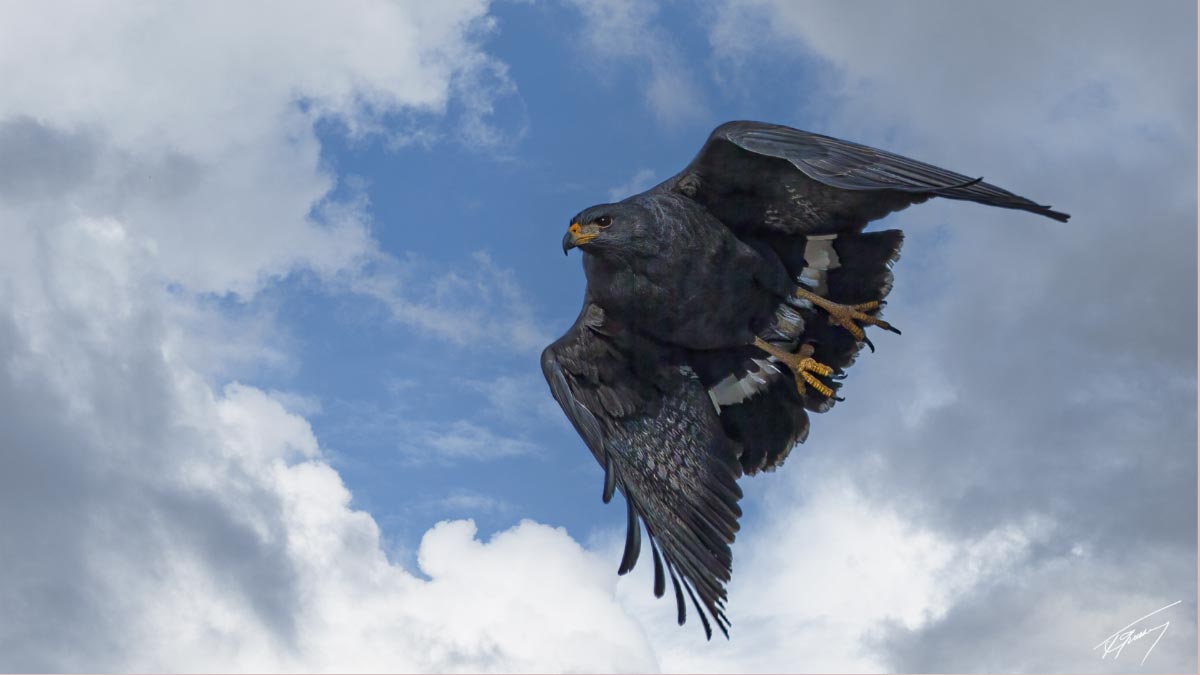

The Zone Tail has multiple white bands on his tail and the ends of his wings appear to look more like those of a turkey vulture than a hawk … good reason for this because the Zone Tails will frequently fly with the vultures. Over the millennia creatures on the earth below have learned that the vultures do not do fresh kills, but only eat that which something else has killed and this equals a sense of safety when they see vultures overhead. Zone Tail hawks have evolved too and from the ground appear very much like a vulture … the crucial difference is that they do kill live food like the lizard that is firmly gripped in his talons … whoops, guessed wrong!
Black Hawks only have a single broad white band on the tail and are a little bigger than Zone Tails. Check out Audubon for Black Hawks and for Zone Tail Hawks.
Have a beautiful day, keep breathing and look around … we share the planet with some pretty amazing creatures!
Smiles,
Ted
To you my boy, the only world I know.
Remember this: whichever course you choose,
You’ll sometimes turn about and walk awhile
The other way, for none of human kind
Is all of good or all of evil made.
Let this and honest poverty not turn
Your heart in bitterness and wild despair
To hardened thoughts of Him who made all things.

excerpt from Breaking Home Ties by Max Ehrmann
###
 The easiest way to reach Mr. Grussing is by email: ted@tedgrussing.com
In addition to sales of photographs already taken Ted does special shoots for patrons on request and also does air-to-air photography for those who want photographs of their airplanes in flight. All special photographic sessions are billed on an hourly basis.
Ted also does one-on-one workshops for those interested in learning the techniques he uses. By special arrangement Ted will do one-on-one aerial photography workshops which will include actual photo sessions in the air.
More about Ted Grussing …

This is an advertisement

Artists may find inspiration in unexpected places. For photographer Kari Greer of Idaho, a summer job in college as a firefighter with the U.S. Forest Service opened the door to a more than 25-year career as a wildfire photographer.
Her work will be on display from July to October at Greenville’s Upcountry History Museum.
Greer was first exposed to fighting wildfires when she took a summer job in 1994 at Gifford Pinchot National Forest in Washington while she was attending California State University, where she majored in film production and photography.
Following her first summer, Greer said she developed a passion for the job and returned three additional summers where she worked on a Type 2 IA hand crew, a 20-person team where they would take fire assignments, dig handlines, conduct burn operations, mop up, fight fires and do rehabilitation following fires.

Once college was behind her, Greer said she took her two passions and combined them by working as a firefighter through 1997 and then obtaining a contract with the U.S. Forest Service in 1998 to photograph fires.
“Photography was basically my first love and then during college, I started fighting fire and the two just mingled,” Greer said. “It was like such a smooth transition. It was such a wonderful niche to fall into.”

While Greer is not actively employed as a firefighter, she has maintained her qualifications by completing a fitness course and fire-line certification training each year.
Every time she goes into the field, she said she credits her training and experience for allowing her to stay safe while doing her job and communicating with firefighting teams on the scene.
“I believe you really need to have fire experience and understand the incident-command system in order to operate efficiently out there,” said Greer. “(You need) to know how to be in the right place at the right time and how to communicate with other fire resources so that you are part of the group that’s out there. (You should) try to be as seamless as possible and not get in the way.”
Drawing from Greer’s 25-year career, the Moscow Contemporary Art Gallery in Moscow, Idaho, compiled a 64-photo exhibit, “Facing the Inferno: The Wildfire Photography of Kari Greer,” which will feature images from 85 fires across nine states.
The exhibit will run from July 1 to Oct. 22 at the Upcountry History Museum in Greenville. It will be accompanied by a companion exhibition with artifacts and archival materials focused on wildfires and wildland firefighting in the Carolinas.
For more information, visit upcountryhistory.org.

Get the top stories of the day around the DMV.
“One Life: Frederick Douglass,” a new exhibition at the Smithsonian National Portrait Gallery, explores the life and legacy of one of the 19th century’s most influential global writers, speakers, and intellectuals. The exhibition, which is rooted in Douglass’ love of photography, showcases more than 35 objects and will be on view until April 21, 2024.
Frederick Douglass by an unidentified artist. Wood engraving on paper c. 1883 (Courtesy of National Portrait Gallery, Smithsonian Institution)
” data-medium-file=”https://i0.wp.com/www.washingtoninformer.com/wp-content/uploads/2023/06/image-155.jpg?fit=195%2C300&ssl=1″ data-large-file=”https://i0.wp.com/www.washingtoninformer.com/wp-content/uploads/2023/06/image-155.jpg?fit=665%2C1024&ssl=1″ decoding=”async” src=”https://i0.wp.com/www.washingtoninformer.com/wp-content/uploads/2023/06/image-155.jpg?resize=322%2C495&ssl=1″ alt=”Frederick Douglass by an unidentified artist. Wood engraving on paper c. 1883 (Courtesy of National Portrait Gallery, Smithsonian Institution)” class=”wp-image-1187845″ width=”322″ height=”495″ srcset=”https://i0.wp.com/www.washingtoninformer.com/wp-content/uploads/2023/06/image-155.jpg?resize=665%2C1024&ssl=1 665w, https://i0.wp.com/www.washingtoninformer.com/wp-content/uploads/2023/06/image-155.jpg?resize=195%2C300&ssl=1 195w, https://i0.wp.com/www.washingtoninformer.com/wp-content/uploads/2023/06/image-155.jpg?resize=97%2C150&ssl=1 97w, https://i0.wp.com/www.washingtoninformer.com/wp-content/uploads/2023/06/image-155.jpg?resize=768%2C1182&ssl=1 768w, https://i0.wp.com/www.washingtoninformer.com/wp-content/uploads/2023/06/image-155.jpg?resize=998%2C1536&ssl=1 998w, https://i0.wp.com/www.washingtoninformer.com/wp-content/uploads/2023/06/image-155.jpg?resize=400%2C616&ssl=1 400w, https://i0.wp.com/www.washingtoninformer.com/wp-content/uploads/2023/06/image-155.jpg?w=1200&ssl=1 1200w, https://i0.wp.com/www.washingtoninformer.com/wp-content/uploads/2023/06/image-155-665×1024.jpg?w=370&ssl=1 370w” sizes=”(max-width: 322px) 100vw, 322px” data-recalc-dims=”1″>
“One Life: Frederick Douglass” is guest-curated by John Stauffer, Ph.D., Sumner R. and Marshall S. Kates Professor of English and African and African American Studies at Harvard University, and consulting curator Ann Shumard, National Portrait Gallery’s senior curator of photographs.
At age 14, Stauffer was given a copy of Douglass’ narrative, which he said was hard to read, but very powerful.
“That led me to my interest in abolitionism and activism in the civil war,” said Stauffer, who has authored several books about Douglass. “I was the first to really write about Douglass’ love of photography and words. He was essential to my dissertation and my first book, “Black Hearts of Men.”
Stauffer continued by explaining that Douglass believed photography was crucial to the fight for democracy. He strategically set out to correct the suffering Blacks experienced from slavery and any efforts geared toward tearing down the races.
Douglass incorporated descriptions of Blacks struggling in America in his writings, meetings with other abolitionists and public speaking.
“One Life: Frederick Douglass,” documents Douglass’ work for justice.
Douglass was the most photographed man during the 19th century. Even with that recognition, he was thinking about how he wanted to be seen.
“He knew a lot of photographers. He had his set of favorite photographers,” Stauffer said. “He engaged Black, white, and women photographers he felt would present him in a specific way.”
Consulting curator Shumard began working on the Douglass exhibition in January 2021. The process involved reviewing a list of pieces that would properly show the extent of Douglass’ mission with photography.
“The ‘One Life’ exhibitions really take a visual approach to charting the trajectory of a featured individual’s biography,” said Shumard. “Stauffer approached the layout as though representing chapters in a biography.”
There are seven subtitles that identify each chapter of the exhibition, beginning with enslavement and escape, then ending with the afterlife.
The afterlife section contains portraits of the Black leaders Ida B. Wells-Barnett, Booker T. Washington, W.E.B. DuBois and Langston Hughes, all of whom carried on Douglass’ legacy.
The National Portrait Gallery is located at 8th and G streets NW, Washington, D.C. To learn more about “One Life: Frederick Douglass,” and other exhibitions, connect with the museum at npg.si.edu and on Facebook, Instagram, Twitter and YouTube.

PHOTOS COURTESY OF BRETT FREEDMAN | ACTRESS MARLEE MATLIN HAS SOME FUN TURNING THE BRUSH ON MAKEUP ARTIST AND MONROEVILLE NATIVE BRETT FREEDMAN WHILE GETTING READY FOR THE 2021 OSCARS.
Armed with more brushes than Van Gogh, Brett Freedman works tirelessly to create beautiful masterpieces — on some of Hollywood’s best faces.
The Monroeville native has always envisioned glam looks for celebs, even while doodling on old covers of The Enquirer as a boy.
“I would draw on Joan Collins, men, women, it didn’t matter; they all got a makeover. I loved pink. Everyone got pink lips and cheeks, and indigo and silver eyes. My looks were subtle and classy,” adds Freedman, 55.
After decades of perfecting his craft, Freedman is sought after by many of Hollywood’s best to complete their look, whether they’re about to grace the red carpet or step in front of the camera for a photoshoot or interview.
He has also created his own line of affordable cosmetics, Brett Glam Beauty, that focuses on his specialty — eyebrows.
Academy Award-winner Jodie Foster, who starred in 1991’s The Silence of the Lambs, which was largely filmed in the Pittsburgh area, shared in a statement for Pittsburgh Magazine: “There’s nothing like Brett’s hand in the natural look department. He understands skin and brings that freshness without piling on a ton of makeup. He’s got snap instincts that know how to change small things quickly to give a whole new look. Because he’s great with hair, too, he can play with different periods and references. Honestly, I’m not a makeup person, but Brett brings out the dress up fun in me.”
Always an Artist
Freedman says he always knew he would be an artist like his father.
“My dad ended up owning a catering company when he bought an old church in the ’70s and turned it into the Mellwood Party Center,” Freedman says. “There would be two weddings there on the weekends, and I used to help out there. It’s now getting a new life as a production space called Sunken Bus Studios.”
At a time when it was taboo for a teenaged boy to work with makeup (he would borrow mascara and other staples from his neighborhood friends), Freedman continued to push the boundaries and never gave up shooting for the stars.
“I never really focused on academics because I knew I was going to be an artist,” he adds.
He started by transforming his shy gal pals into fashionistas in his makeshift Glamour Shots studio in the basement gameroom.
Experimenting with makeup in the 1980s meant bold colors, thick, sweeping lines of blush (rug burn blush), big hair and lots of lace.
“I was really into Madonna,” he recalls. “I would take my high school gal pals, put hot rollers in their hair, use lace hair ties and give them makeovers. Then I would put up a red backdrop and use an industrial light to take their picture. Back then, we went to the mall to drop off our film and waited anxiously for an hour for them to be developed.”
The Gateway High School and Art Institute of Pittsburgh graduate also recalls reading his sister’s Teen magazines and having his own skincare regimen.
Though his parents, Jess and Reda Freedman, initially hoped he would choose a different path because of those taboo views at the time, he notes they became his biggest allies and have been incredibly supportive through his career.

Pursuing His Career
Freedman began working as a rotating makeup artist at both Kaufmann’s and Horne’s department stores Downtown in the late 1980s, and was one of the few men to do so back then.
He eventually landed a lucrative position with an advertising agency following graduation from the former Art Institute, but makeup always had its way of finding him. He would do makeup for photography students’ photoshoots and “word got out that I could do makeup.”
“I would also do weddings in the Pittsburgh region. I wasn’t even trying and the phone would ring for different opportunities. So I thought, ‘What if I lean into this and just do it?’”
His first paid gig as a makeup artist was a photoshoot for a plus-size shop in Monroeville.
“I got $50 and we shot it in someone’s condo in Churchill,” he says. “That’s how the makeup career began. After that, I started working for a Glamour Shots knockoff in Dormont called Image Makers where we turned housewives into hookers with lots of rug burn blush and pink, frosted lipstick!”
In 1991, Freedman read an article in Allure magazine about makeup artists doing photoshoots on the beach in Miami that also highlighted male hairstylists.
“I told my family I was going to move to South Beach, get a studio apartment and work at a makeup store on the beach,” he says. “They were concerned, but I had this feeling of why not? There’s gotta be something for me there. So, I moved to Miami in 1992.”
When Freedman arrived in The Magic City, he told everyone he was a makeup artist and did any job that came his way — even makeup for Black Tail adult magazine.
Freedman notes he became familiar with styling eyebrows while working in the makeup store.
“One of my coworkers asked me if I wanted him to do my brows, and I said I don’t do that. He said we will just clean them up. The brows really change the look. Then he said, ‘Let me give you some advice. Learn how to do eyebrows and do them because a lot of artists are afraid.’ So I did.”
While working with models in Miami, he was mentioned in an Allure article on eyebrow grooming, which garnered attention and landed him an agent.
He began getting deals with companies such as Revlon and Lancôme, and started doing commercials, along with models’ makeup.
In 1996, Freedman decided to relocate once more to Los Angeles.
“I visited California with my family in 1980 and we toured Universal Studios. I remember riding the open-air tram and seeing everyone working on the lot, going in and out of the studios, and I thought, ‘I want to live in Hollywood!’”
Early in his Hollywood career, he did models’ makeup for Fantastic Sams posters and covers for TV Guide.
“That was impressive to my parents because they could see that in the grocery store,” he says. “My mom also went to the Fantastic Sams in Monroeville and told them her son did the makeup for the posters. It was fun seeing their reaction to pop culture then.”
Freedman recalls his agent telling him he needed more actresses in his portfolio to make it in Hollywood, noting that it would help to get actresses from “Friends.”
“Now I do Lisa Kudrow’s makeup and even did her makeup for the ‘Friends: The Reunion’ that aired on HBO in 2021. Everyone I work with, I’ve worked with for years. They’re all my favorites in different ways.”
Some other early clients were Sharon Lawrence of “NYPD Blue” for McCall’s Magazine and Courtney Thorne-Smith of “Melrose Place,” whose publicist began sending actors and actresses his way.

ACTRESS CATHERINE ZETA-JONES HAS SAID IN INTERVIEWS THAT SHE LIKES HOW MAKEUP ARTIST BRETT FREEDMAN PUTS HER LOOK FROM HEAD TO TOE INTO CONSIDERATION WHEN STYLING HER FOR PREMIERES.
He has since enhanced the beauty of Patricia Heaton, Mariah Carey, Gwyneth Paltrow, Marlee Matlin, Sarah Silverman, Taylor Swift, Anna Camp, Kirsten Dunst, Britney Spears, Reba McEntire and Catherine Zeta-Jones.
Creating His Brand
Freedman eventually decided it was time to branch out and create his own line of cosmetics. Brett Glam Beauty products mainly focus on eyebrows (of course!), but he also sells lip gloss (GLOSS-A-HOLIC) and balm (Dr. Kiss).
“I felt that there was a hole in the market with eyebrow products,” he notes. “I created a very pale blonde and a very gingery red in my line.”
He acknowledges that creating the line was tough because he doesn’t consider himself to be a “natural businessman.”
“It turns out creating the makeup line, naming the products and demonstrating how to use them is only about 4% of the process. The hardest part is you don’t know what you’re doing for like a year and a half!”
Freedman is thankful his line took off because when the pandemic hit, he couldn’t do makeup from 6 feet away. He also doesn’t know if he can “run around with my makeup box forever.”
“I always had this feeling that my career would end and I wouldn’t be the flavor of the month. I wanted to do something that I could age into.”
Freedman says he is fortunate for the success he has had and eventually learned to step back and enjoy life. He married his husband, Andrew, in 2019. The couple has a puppy and soon plans to adopt a child.
They also plan to venture back to the East Coast this summer to visit family. Freedman is excited to return to Kennywood for the first time in years and discover some new restaurants.
Expert Tips
What makeup tips does Freedman have for those who may only dream of stepping foot on the red carpet?
“It depends on how you want to move through the world. If you don’t want to wear makeup, don’t. There’s no cookie-cutter face. I will say now is an exciting time for makeup. People are being really creative with different looks,” he says.
He adds most working women want tips on looking fresher and less tired. This look can be achieved with a tinted moisturizer with SPF, a light foundation that is matched to your upper chest/breastbone, curled eyelashes (even if you don’t use mascara), a luminous blush and lip products in pink, peach or mango hues.
“When we get older our skin starts to lose its vibrancy and our lips get paler,” he notes. “Those juicy hues will help freshen your look.”

And the key to on-fleek eyebrows?
“Get a pencil or a powder that’s a bit lighter than the hairs, and fill in the spaces behind them. I also recommend doing a little of one brow and volleying back and forth between them to notice any holes you might be missing. I also think everyone would benefit from an eyebrow gel. Brush them up and out to make them look fuller for a more wide-eyed look.”
He recommends going to a store like Ulta or Sephora, finding an associate sporting a look that you like and asking them questions.
“Whether you want a look that’s just me, but a little more vivid or want to look like a Kardashian, they can help you find what you need to complete that look,” he adds.
Two rules he lives by: asking clients what doesn’t work for them and always making sessions fun.
“You want them to feel like they’re in the driver’s seat,” he adds. “I’m just there to make them look like them.”

The event will run October 12-15, 2023 with programming details now live at refractseattle.org
SEATTLE – Get ready for a captivating fusion of color, heat, light, and passion as Refract: The Seattle Glass Experience, returns to Seattle Oct. 12-15, 2023. Now in its fifth year, this highly anticipated event offers an array of new exhibitions, extravagant galas, rare studio tours, live demonstrations, and the unique opportunity to engage with a new generation of local glass artists of varying backgrounds – all showcasing why Seattle is recognized as the nation’s largest hub of glass art.
“I’m deeply proud that Refract has successfully reached its 5th year, “says Michelle Bufano, Executive Director at Chihuly Garden and Glass. “We couldn’t do this without our incredibly talented glass art community in the Greater Seattle region. Dale Chihuly put Washington on the map decades ago, and our incredible artists, studios, museums, and art enthusiasts keep pushing boundaries and showing the world what it’s like to be at the forefront of glassblowing here in America. This is a significant milestone and we can’t wait to celebrate!”
“More and more travelers are interested in glass art, and we are delighted to have this opportunity to showcase the incredible talent in our region. Refract has something for everyone, from long-time collectors to curious newcomers, and offers the chance to meet the artists, get up close to the creation process, and experience a truly unique event. This is the perfect way for us to celebrate Seattle and the Pacific Northwest region as the epicenter of glass art in the United States,” says Tracey Wickersham, Senior Director of Cultural Tourism for Visit Seattle.
With the 2023 program designed to mark the festival’s momentous fifth anniversary, Refract will reach across Seattle and neighboring cities, including Everett, Bainbridge Island, Issaquah and Tacoma.
More than 80 events will feature the works of nearly 60 talented artists. As a testament to Visit Seattle and Chihuly Garden and Glass’ commitment to making the festival accessible to all art enthusiasts, much of the programming will remain free.
Details of the festival’s exciting lineup can now be found on the official website, RefractSeattle.org. Highlights and new elements for this year include:
* Denotes ticketed or RSVP-required event. Visit RefractSeattle.org to secure your spot and see the full list of programs and events.
Top hotels throughout the region will also offer exclusive overnight packages for Refract getaways. Details on Refract hotel packages will be added to the website in August.
Images for media use can be found here.
About Refract: The Seattle Glass Experience
Visit Seattle, Chihuly Garden and Glass, and more than 60 Pacific Northwest arts organizations are joining together for this annual festival, taking place October 12-15, 2023. This year’s festival offers a unique mix of in-person shows, demonstrations, parties, and exhibitions, alongside virtual programming options. Visit RefractSeattle.org for further details.
About Visit Seattle
Visit Seattle has served as the official destination marketing organization (DMO) for Seattle and King County for more than 50 years. A 501(c)(6) organization, Visit Seattle enhances the economic prosperity of the region through global destination branding along with competitive programs and campaigns in leisure travel marketing, convention sales, and overseas tourism development. Visit visitseattle.org.
About Chihuly Garden and Glass
Located at Seattle Center, Chihuly Garden and Glass brings together all the elements of artist Dale Chihuly’s work, including drawings, signature glass series, large architectural installations, and personal collections. This long-term exhibition features indoor galleries, the centerpiece Glasshouse, and an ever-changing Garden, along with live glass demonstrations, a Theatre, and The Bar, offering unique cocktails and light bites surrounded by Dale Chihuly’s collections. Learn more at chihulygardenandglass.com.

The International Traditional Games Society is hosting a week-long event in Great Falls this fall to bring tribal nations in Montana together. The event may include double-ball, a team sport similar to lacrosse.
This fall, for the first time, tribal leaders and community members from across the state will convene in Great Falls for a week of events, including traditional games, powwows, storytelling and a conference.
The event, called Gathering of Families, is hosted by the International Traditional Games Society in Great Falls and was made possible, in part, thanks to a $25,000 tribal tourism grant.
DeeAnna Brady-Leader, grants and planning director for the games society, said while some tribes in Montana have their own events, like the Arlee powwow, Crow Fair or North American Indian Days in Browning, there is no single event in the state “that brings everyone together in a central location that has lodging options for people who want to meet with other Montana tribes.”
Brady-Leader, who has worked to recover some traditional games, said she remembers watching Browning High School students play Native games in the early ’90s.
Photo from an International Traditional Games Society clinic at Little Big Horn College.
“I remember the kids laughing all the way through it,” she said. “One boy said, ‘Wouldn’t it be wonderful to have an Indian Olympics?’ And that idea just really stuck.”
At the Gathering of Families events, attendees will have the chance to play or watch stickgame, a buffalo run biathlon, high school competitions in traditional sports, Native kickball, cross country and more.
“Tribes had different expressions in each of their games,” Brady-Leader explained. “It wasn’t just a game. It was teaching the ways of life. It taught you values, culture, skills and ways to survive.”
Travis Wilmore, executive director of the International Traditional Games Society, said tribal leaders are excited for the event.
“Everyone is interested and wants to know how they can participate and be involved,” he said.
MAPS Media Institute offered to partner with the games society, the C.M. Russell Museum offered to bring in a few Native language speakers, Paris Gibson Square Museum of Art is hoping to bring in Native artists and possibly host some hands-on classes that week, University of Providence and Great Falls College MSU have donated space for the conference and the Indian Education for All department at Great Falls Public Schools will provide tipis.
“There’s so much we can learn about each other,” said Brady-Leader. “I hope people will come away with a greater understanding of the richness of tribal cultures here in Montana.”
To learn more about the events, happening Oct. 8 through Oct. 14, visit GatheringOfFamilies.com. All events, except the conference, are free and open to the public. A ticket to the conference is $300. To register to attend the conference or request to be a featured speaker, visit the website.
#lee-rev-content { margin:0 -5px; }
#lee-rev-content h3 {
font-family: inherit!important;
font-weight: 700!important;
border-left: 8px solid var(–lee-blox-link-color);
text-indent: 7px;
font-size: 24px!important;
line-height: 24px;
}
#lee-rev-content .rc-provider {
font-family: inherit!important;
}
#lee-rev-content h4 {
line-height: 24px!important;
font-family: “serif-ds”,Times,”Times New Roman”,serif!important;
margin-top: 10px!important;
}
@media (max-width: 991px) {
#lee-rev-content h3 {
font-size: 18px!important;
line-height: 18px;
}
}
#pu-email-form-breaking-email-article {
clear: both;
background-color: #fff;
color: #222;
background-position: bottom;
background-repeat: no-repeat;
padding: 15px 0 20px;
margin-bottom: 40px;
border-top: 4px solid rgba(0,0,0,.8);
border-bottom: 1px solid rgba(0,0,0,.2);
display: none;
}
#pu-email-form-breaking-email-article,
#pu-email-form-breaking-email-article p {
font-family: -apple-system, BlinkMacSystemFont, “Segoe UI”, Helvetica, Arial, sans-serif, “Apple Color Emoji”, “Segoe UI Emoji”, “Segoe UI Symbol”;
}
#pu-email-form-breaking-email-article h2 {
font-size: 24px;
margin: 15px 0 5px 0;
font-family: “serif-ds”, Times, “Times New Roman”, serif;
}
#pu-email-form-breaking-email-article .lead {
margin-bottom: 5px;
}
#pu-email-form-breaking-email-article .email-desc {
font-size: 16px;
line-height: 20px;
margin-bottom: 5px;
opacity: 0.7;
}
#pu-email-form-breaking-email-article form {
padding: 10px 30px 5px 30px;
}
#pu-email-form-breaking-email-article .disclaimer {
opacity: 0.5;
margin-bottom: 0;
line-height: 100%;
}
#pu-email-form-breaking-email-article .disclaimer a {
color: #222;
text-decoration: underline;
}
#pu-email-form-breaking-email-article .email-hammer {
border-bottom: 3px solid #222;
opacity: .5;
display: inline-block;
padding: 0 10px 5px 10px;
margin-bottom: -5px;
font-size: 16px;
}
@media (max-width: 991px) {
#pu-email-form-breaking-email-article form {
padding: 10px 0 5px 0;
}
}
.grecaptcha-badge { visibility: hidden; }

The walls and floors were vibrating when Indigenous hip-hop duo, Snotty Nose Rez Kids, took the stage at the St. Catharines First Performing Arts Centre Wednesday night.
The Haisla First Nation duo hail from Kitamaat Village, B.C. and came to St. Catharines to headline a free concert for Indigenous Peoples’ Day.
The concert was organized by the Niagara Regional Native Centre, based in Niagara-on-the-Lake, and featured performances from local Indigenous artists as well.
Throughout their set, the Snotty Nose Rez Kids had the crowd head-banging to its biggest hits, like “Boujee Natives” and “Long Hair Don’t Care,” and some of its latest tracks.
Community member Cherie Bernard was in the corner dancing with several younger listeners.
“I’m really excited to be able to be of support and to just listen to and enjoy the entertainment,” Bernard said between acts.
“It’s about all of us gathering together and just becoming one with music,” she said.
The opening acts included Ol’ Child, Low Animal and The Pappy Johns Band.
Sean Vanderklis, an Anishinaabe man from St. Catharines and co-host of the radio show One Dish One Mic, was thrilled to see Indigenous artists represented on the stage.
“It’s one of the most important things for Indigenous peoples,” he said.
Vanderklis said celebrating and supporting Indigenous culture “started as an act of resistance” against the attempts of settler colonialists to erase their culture throughout history.
By continuing to celebrate their culture in public, they are “creating space for (their) children,” in the future, he added.
After the opening acts warmed up the hall, Snotty Nose Rez Kids stepped out to an audience of about 400 to 500 people.
Darren “Young D” Metz and Quinton “Yung Trybez” Nyce, who both front the band, have carved their name into the rap scene over the course of five albums.
Back-to-back releases “Trapline” and “Life After” were both nominated for the Polaris Music Award in 2019 and 2022 respectively.
The band was also nominated for Indigenous Artist of the Year at the 2018 Western Canadian Music Awards.
“They use a lot of Anishinaabe words,” Vanderklis said of the rappers, which he said makes him feel seen, and is “good for my kids” to hear.
Vanderklis was not the only one to bring kids to the show.
After playing a couple of crowd favourites, the band invited the youth of the crowd on stage to dance to the sound of “Boujee Natives.”
There were about 25 to 30 kids on stage with the rap duo by the end of the song.
Later, As Vanderklis was filming the hip-hop duo from the front row, community member Cherie Bernard was off in a corner dancing with the younger listeners.
“I’m really excited to be able to be of support and to just listen to and enjoy the entertainment,” Bernard said between acts.
“It’s about all of us gathering together and just becoming one with music,” she said.
Her Mi’kmaw friend Venette Gerden, Bernard’s friend who is Mi’kmaw, agreed with the sentiment that the experience was about becoming one with music.
“It all goes back to that heartbeat,” Gerden said, describing music.
“Music sings to everybody,” she added, whether you listen to opera, death metal or hip-hop.
“What better way to celebrate culture than through music?”





