About

Posts by :

Today’s Photo from Ted Grussing Photography: Within the Basin

Today’s Photo from Ted Grussing Photography: Within the Basin

… spending time going through images that can be used in a feature article that Wayne Ranney and I are doing about the San Francisco Volcanic Field located on the Colorado Plateau … on occasion when weather conditions are benign I have flown deep with the inner basin of the San Francisco Peaks and above is an image taken while deep within the basin and looking to the west. The highest peak in the photo is Agassiz towering more than a half mile above me … you can see the old toll road that people used to drive to get to the top as it zigzags its way to the top. The color was beautiful and even though it is kind of a confined space to be flying in, flying a very maneuverable motorglider made it a breeze. There are 75 avalanche zones on the peaks and you can see a few in this photo.
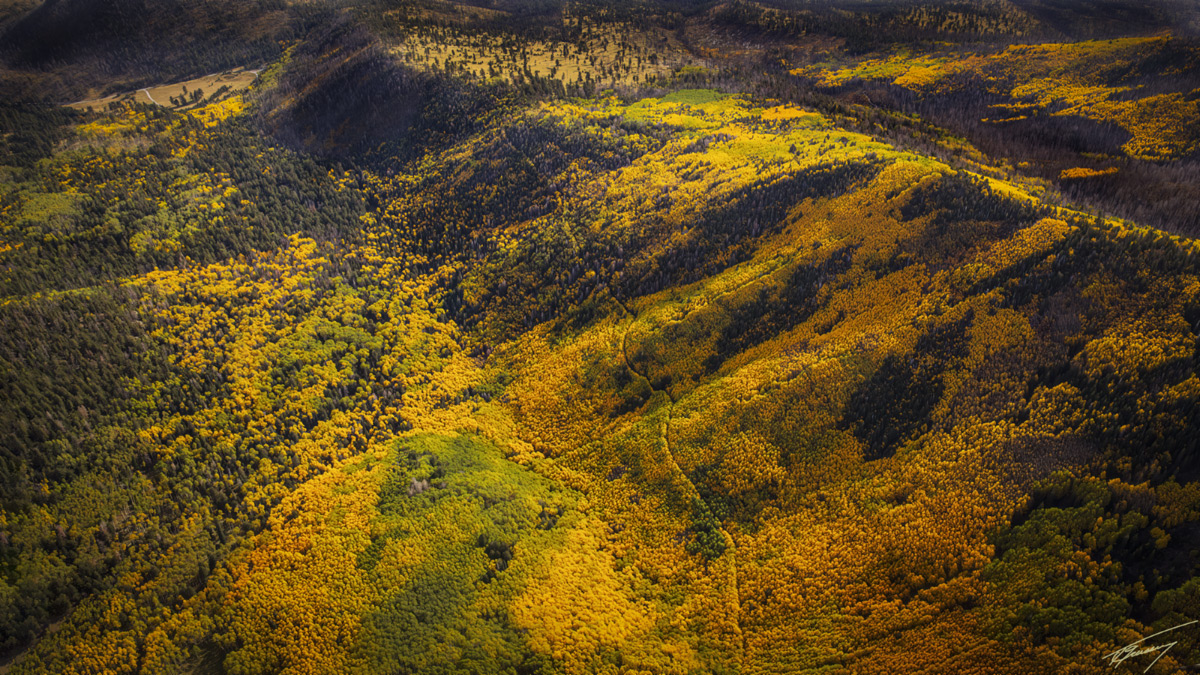
Swinging around and looking down to the east you can see Lockett Meadow in the upper left corner of the photo … it is a long way down to it … a drive I have only made once … need a parachute if I do it again.

Into a new and methinks wonderful week. Going to shoot the red tail hawks in not many hours so will wrap the day and hope to have an update on the red tails tomorrow morning.

Have a beautiful day … smile and keep breathing 🙂

Ted

I bring but this one common thought
My life has wrought;
That from the dregs of drear despair
Still everywhere
There is a joy I yet may sip—
‘Tis comradeship
With all mankind, the high and low
I know.

excerpt from I Know by Max Ehrmann

###

photo_tedgrussingThe easiest way to reach Mr. Grussing is by email: ted@tedgrussing.com

In addition to sales of photographs already taken Ted does special shoots for patrons on request and also does air-to-air photography for those who want photographs of their airplanes in flight. All special photographic sessions are billed on an hourly basis.

Ted also does one-on-one workshops for those interested in learning the techniques he uses.  By special arrangement Ted will do one-on-one aerial photography workshops which will include actual photo sessions in the air.

More about Ted Grussing

Retrospective of Mohawk Artist’s Work To Go on View at the National Museum of the American Indian

Retrospective of Mohawk Artist’s Work To Go on View at the National Museum of the American Indian

Exhibition Confronts the Challenges of Being Indigenous and Female in the United States and Canada

New York, N.Y. – The Smithsonian’s National Museum of the American Indian in New York will host “Shelley Niro: 500 Year Itch,” the first major retrospective of work by the multimedia artist Shelley Niro (Six Nations Reserve, Bay of Quinte Mohawk, Turtle Clan, b. 1954). For more than 50 years, Niro has been creating art building upon Kanyen’kehá:ka (Mohawk) philosophies, deep understandings of history and a woman-centered worldview. The exhibition will be open May 27 through Jan. 1, 2024.

Accessible, humorous and peppered with references to popular culture, Niro’s art delves into the timeless cultural knowledge and generational histories of her Six Nations Kanyen’kehá:ka community to provide purpose and healing. Niro employs a wide variety of art practices in her work, including paintings, photographs, mixed-media works and films. The exhibition is divided into four sections titled: Memory, Matriarchy, Actors and Relations. Each provides vantage points from which Niro probes ideas central to her experience and identity as a Mohawk woman, such as the story of Sky Woman, the gender roles and stereotypes imposed on her culture by patriarchal settler culture and the persistence of Haudenosaunee matrilineal culture.

The exhibition is curated by David W. Penney, associate director of museum scholarship at the National Museum of the American Indian; Melissa Bennett, senior curator of contemporary art at the Art Gallery of Hamilton; and Greg Hill, multidisciplinary artist, curator and art consultant.

“Shelley Niro employs humor and wit to probe the joy, sorrow and contradictions of Indigenous existence, and she delivers hard truths with a smile,” said Cynthia Chavez Lamar (San Felipe Pueblo, Hopi, Tewa and Navajo), director of the National Museum of the American Indian. “Her inclusion of Native people, including family members, in much of her work, allows us to see Indigeneity in its complexity while also addressing themes of empowerment, matrilineal kinship and dispossession. The museum is very pleased to celebrate Niro’s art through this exhibition.”

Media Preview

A media preview is scheduled for Thursday, May 25, 9–11 a.m. To attend, members of the media should send an email to nmaipressoffice@si.edu. 

Program

On Saturday, June 17, at 1 p.m., the museum will host a special screening of Niro’s latest feature-length film, Café Daughter (Canada, 2023). The film is based on a play by Kenneth T. Williams about retired Canadian Senator Lillian Dyck, the first Aboriginal senator and first Chinese senator. It tells the story of Yvette Wong, a young Chinese-Cree girl who tries to find her place in a small Saskatchewan town in the 1960s. The screening will be followed by a conversation with Niro.

Catalog

The accompanying exhibition catalog is published by the Art Gallery of Hamilton and the National Museum of the American Indian. It brings together 215 reproductions from Niro’s expansive oeuvre, including work published for the first time. Also included in the career retrospective are three major essays about Niro’s work by the exhibition’s curators Bennett, Hill and Penney, as well as texts from seven guest artists, scholars and curators. 

Exhibition Tour 

After the presentation at the National Museum of the American Indian, an expanded version of the exhibition will embark on a multiyear tour organized by the Art Gallery of Hamilton. Upcoming Canadian tour dates:

Art Gallery of Hamilton, Hamilton Ontario; Feb. 10–May 26, 2024 

National Gallery of Canada, Ottawa, Ontario; June 14–Aug. 18, 2024 

Vancouver Art Gallery, Vancouver, British Columbia; Sept. 21, 2024–Feb. 2, 2025

Remai Modern, Saskatoon, Saskatchewan; spring 2025 

Acknowledgements

Organized and circulated by the Art Gallery of Hamilton with the National Museum of the American Indian and with curatorial support from the National Gallery of Canada. Major support for the project is provided by the Canada Council for the Arts, the Terra Foundation for American Art, The Andy Warhol Foundation for the Visual Arts, and the Smithsonian American Women’s History Initiative Pool. This program is supported, in part, by public funds from the New York City Department of Cultural Affairs, in partnership with the City Council.

About the National Museum of the American Indian

In partnership with Native peoples and their allies, the National Museum of the American Indian fosters a richer shared human experience through a more informed understanding of Native peoples. The museum strives toward equity and social justice for the Native peoples of the Western Hemisphere through education, inspiration and empowerment. Through two locations, it features exhibitions and programs in New York City and the National Mall in Washington, D.C. For additional information, including hours and directions, visit AmericanIndian.si.edu. Follow the museum via social media on FacebookTwitter and Instagram.

About the Art Gallery of Hamilton

Founded in 1914, the Art Gallery of Hamilton is the oldest and largest public art gallery in southwestern Ontario. Its permanent collection, which is focused on historical Canadian, 19th-century European, and International and Contemporary art, numbers more than 10,000 works and is recognized as one of Canada’s finest. The AGH is a vital creative hub and centre of lifelong learning that enables people of all ages to enrich their lives by gaining a deeper understanding of art. To learn more about the AGH, visit the gallery online at artgalleryofhamilton.com, or connect on social media on FacebookTwitterInstagram and TikTok.

# # #

Photo: Shelley Niro (Six Nations Reserve, Bay of Quinte Mohawk, Turtle Clan, b. 1954), The 500 Year Itch from This Land Is Mime Land series (detail), 1992. Hand-tinted gelatin silver prints in hand-drilled mat board, 37 x 22 in. National Gallery of Canada

A press kit, including images and captions, is available here: https://www.dropbox.com/scl/fo/nabfwx9d9wgs8ccpqludq/h?dl=0&rlkey=vsjx2jnu1zlog1vr49zinz40b

Media only:          Lisa Austin       (212) 514-3826  |  austinl@si.edu 

Media website:    http://newsdesk.si.edu

Petaluma’s New Tiki Bar Dances Between Appropriation and Appreciation

Petaluma’s New Tiki Bar Dances Between Appropriation and Appreciation
image

If you’ve ever vacationed in Hawai‘i, you may have noticed the word “kapu” scrawled on a fence or gate. Often taken by visitors to mean “no trespassing,” that assumption isn’t wrong, but it isn’t totally accurate either.

While “forbidden” is perhaps the closest English equivalent to the word kapu, it doesn’t quite communicate the spirituality that informs its meaning. Historically, kapu is an ancient code of conduct that ruled the islands during Hawai‘i’s pre-contact times. While that system was put to rest over two centuries ago, the concept of kapu endures in the islands.

Often applied to ancient burial grounds, a warning of kapu communicates to others that there’s a spiritual sacredness to the land that garners it completely off limits. “It’s a sacred place with a special meaning to the person and nobody else,” explains Keoni Kealoha Alvarez, a Native Hawaiian and director of the film Kapu: Sacred Hawaiian Burials. Kapu isn’t just a warning; it represents an intimate relationship with the ‘aina, the land. Without having a connection or responsibility to its preservation, there’s no meaning to putting kapu on a sacred space.

Knowing this, when I saw a social media post about a new tiki bar called Kapu opening in Petaluma in early 2023, my interest was immediately piqued. While I live in the East Bay, my dad was born and raised in Hawai‘i — before it became a state in 1959. My Asian American identity is very much informed by the immigrant traditions of the Hawaiian Islands, even though I’ve never lived there. Tiki culture, however, has never been meaningfully connected to Hawaiian culture. While naming a tiki bar Kapu does connect it back to Native Hawaiian roots, it carries a certain responsibility by invoking a sacred cultural concept. With a new crop of culturally sensitive tiki bars making waves and the old guard trying to maintain relevancy in a more culturally inclusive world, I was curious where Kapu was going to land.

The short answer is: somewhere in the middle. The Kapu team called in tiki bar veteran Michael Richardson to head up the project. After a dozen years mixing drinks at Frankie’s Tiki Room in Las Vegas, Richardson made his way to Sonoma. With Kapu, Richardson says his goal was to play with the already-fluid boundaries of tiki culture. Ironically, the bar was ultimately dubbed Kapu, an extremely firm boundary. The team declined to say who chose the name. The only name listed on the bar’s liquor license is David Ducommun, also the founding investor of Duke’s Spirited Cocktails in Healdsburg, Sonoma Magazine reported in 2021. Neither Ducommun nor Richardson responded to questions about the bar’s ownership structure.

Kapu offers about 20 classic and original cocktails. The classic section of the menu features more than a dozen drinks, deeply researched and allegedly as true to the originals as possible. It kicks off with the original Oakland Trader Vic’s mai tai and includes about a half dozen other tiki concoctions created by Trader Vic and Texas native Donn Beach, who is widely credited with inventing tiki culture in the 1930s. But the menu isn’t strictly tiki. It travels across the world to Malaysia, Egypt, and the Caribbean, featuring drinks that stretch back to 1919.

Richardson explains the globetrotting nature of the menu is meant to highlight spice trade routes and port cities. He talks excitedly of Egyptian officer’s clubs and bartenders returning to the States from the Caribbean post-Prohibition, bringing rum and the baking-spice flavor profile back with them. Each drink includes an illustration and credits its creator, as well as where and when they were shaken into existence. The menu does an excellent job selling the beverages, along with bits of education that go down as easily as a Fog Cutter.

Like the drinks, the food speaks clearly of global influence, but in the distinct pidgin English of the Hawaiian Islands. Richardson didn’t want the teriyaki chicken and coconut shrimp typical of many tiki establishments, but a truer representation of the Hawaiian-style food he’d tasted via transplant friends in Vegas.

Richardson hired chef Mike Lutz for his expertise and perspective on Hawaiian local-style food. As a military brat, Lutz bounced around growing up. He ended up in Hawai‘i in high school, where he began his cooking career. He then spent the next 15 years in various kitchens around O‘ahu, before returning to the mainland in 2017 with an itch to couple local grinds with wine country’s famed local produce. “Most of the food you get in Hawai‘i is shipped in from the mainland,” Lutz explains. “I wanted to use the local, sustainable foods we have here to make local Hawaiian-style food.”

For Kapu, Lutz created a menu of bar snacks and shareable “‘ohana-style” plates. He replaced standard bar nuts with boiled Chinese-style peanuts. His take on pipikaula sees soy sauce-flavored and smoked short ribs, a salty, meaty stand-in for the typical meat and cheese board. Crispy gau gee, rarely seen on menus mainland side, is the crunchy, golden, deep-fried snack to accompany your second round of drinks. The menu is specific in a way that could only be done by someone close to the source. There’s been a learning curve introducing some of the new foods to Petaluma, Lutz says, but the aloha the chef puts into his food translates no matter what language you speak.

Food and drink are integral to most bars, but it’s really the interiors that set tiki bars apart from your typical neighborhood watering hole.

Tiki culture started with Don the Beachcomber’s drinks but became what it is today thanks to Eli Hedley. The Midwestern grocer-turned-decorator collaborated with Beach in the 1930s to create the shipwreck-meets-faux-Polynesian decor that would become tiki’s signature look. Hedley’s grandson, self-proclaimed third-generation tiki builder “Bamboo” Ben Bassham, collaborated on Kapu. Richardson had a specific vision for the space, which involved dividing it up into three distinct areas. “I wanted to go the traditional route, the kind of nautical, new-style route,” Richardson says. “And then kind of just do something completely off the rails.” Bassham and Richardson filled the space with imports, salvaged Art Deco pieces, work from artist friends, and reworked materials from the restaurant that filled the space prior.

The main room features the typical tiki tropes, what Richardson calls the “quiet village vibe”— booths crowned with thatched roofs, coconut brassiere-wearing hula girls, and hand-carved tikis shipped in from Bali. The Captain’s Quarters is a smaller room with a sunken-ship theme. This more intimate space was created for bespoke cocktails and “tiki talk,” Richardson says. These two reservation-only spaces harken back to the golden age of tiki culture, Richardson says, when families and 9-to-5 workers came to these bars to escape into an alternate reality.

But Kapu puts the “bar” in tiki bar with its “Big Trouble” room. Open for walk-ins, the lounge space is intended to host a louder, rowdier crowd. The original inspiration was a mashup of 1920s Hong Kong-Shanghai-pachinko parlor vibes. Bamboo Ben put his “no white walls” policy into play, painting the space red and gold, which inspired an installation of Chinese dragons, firecrackers, and pachinko and pinball machines for an “East meets West vibe,” he describes. Pinup-style images of women in qipaos and calligraphy decorate the walls. “I catch people that have been doing tiki all their life off guard with that place,” Richardson says with a laugh. “They’re like, ‘I wouldn’t take this as tiki, but this is definitely tiki.’”

The room’s decor does lean into old-school tiki culture, edging back to its roots of appropriation and Orientalism. While part of Kapu’s theme is the sharing of ideas through trade routes, the mishmash of Asian imagery is a little tough to stomach. It tainted my view of the rest of the place, serving as a stark reminder of how faux-Polynesian culture was fabricated by white men with little respect for the cultures from which tiki borrows.

There has been pushback from the community about the name. A social media response to direct criticism explains that the name plays with the idea that “forbidden fruit is always the tastiest.” Richardson sees Kapu as a way of celebrating artists and keeping tiki culture alive. Much of the art and materials were sourced from local artists, as well as from carvers from the Southeast Asian island of Bali. “A lot of this imagery, the ways these things are being made are dangerously close to going away,” he says. “I understand cultural preservation. We can preserve it by only keeping these things in cultural centers, universities, museums, and art galleries, or we can feed families by supporting the artists that are doing this and passing it on.”

Alvarez, director of Kapu, notes that bars are known to push the envelope. And while he understands using the sacred concept of kapu as marketing is not meant to be taken literally, he disagrees with its usage. “It’s the owner who has to sit with that and really kind of think about that,” he says. Built largely around both cocktails and the midcentury “Polynesian pop” aesthetic of kitschy replica tiki totems and mugs, rattan furniture, and Aloha shirts, tiki bar culture at its best is about having fun. But it has also skated around its cultural issues in part by hiding behind its ethos of escapism.

Richardson says he would love to broaden his perspective. His goal is to inspire tiki bars new to the scene to source their art ethically from Indigenous artists and establish a long-term community in Petaluma. He created Kapu to be a bar first and foremost, a place to get away from the drudgery of the everyday and encourage connection. He’s excited about providing a space to discuss the history of drinks and rum varietals for tiki culture geeks, but perfectly happy to blend up a basic pina colada for someone just looking to relax with friends and family. He leaves it up to the customer to decide which experience they’re looking for.

But the sentiment feels a little empty considering the signage over the door. Kapu, the bar, is meant to be about escaping and decompressing, but as Alvarez notes, that runs counter to the word’s true meaning. “There’s no way people would go to a kapu place to relax,” he says. With the depth of knowledge poured into some aspects of the bar, including its ability to make educating its customers about some things both effortless and enjoyable, it feels unacceptable that there hasn’t been more work done around cultural appreciation.

Much of Western culture has been built by ignoring boundaries, while Native Hawaiians have been attempting to enforce theirs for centuries. “Native culture has always been suppressed like that, and it’s not a good thing,” Alvarez says. “It’s not a right thing. But sometimes when you don’t have a culture, people like to pick up cultures that they don’t have.”

A.I. May Help Design Your Favorite Video Game Character

A.I. May Help Design Your Favorite Video Game Character
image

Generative A.I. is already changing how games are made, with Blizzard Entertainment training an image generator on assets from World of Warcraft, Diablo and Overwatch.

Intrigued by the potential that generative artificial intelligence holds for video game design, the studio Blizzard Entertainment has trained an image generator on its own hit titles. By feeding assets like the combative orcs of World of Warcraft, the macabre dungeons of Diablo and the vivacious heroes of Overwatch into the machine, Blizzard can effortlessly produce concept art for new ideas.

Because generative artificial intelligence creates art faster than any human can, studios like Blizzard, a division of Activision Blizzard, are hopeful that the technology can cut out some design and development drudgery and make the creation of video games more fun.

Blizzard’s chief design officer, Allen Adham, told employees about the initiative last month in an email that was obtained by The New York Times. Its internal tool is called Blizzard Diffusion, a riff on Stable Diffusion, one of the popular image generators that enables anyone to turn text into art.

“Prepare to be amazed,” Adham wrote, adding, “We are on the brink of a major evolution in how we build and manage our games.”

Generative artificial intelligence, the technology behind tools like ChatGPT and Midjourney, uses considerable computing power to identify patterns in text or images and produce new content from the data.

Some researchers are wary of the technology, warning of copyright abuses, job displacement, and its potential to help the spread of false information. But video game developers, already relying on artificial intelligence so that nonplayer characters can make humanlike decisions, believe that harnessing generative A.I. can speed up the creative process in a labor-intensive industry plagued by delays.

There is a gaming A.I. division at Microsoft, which makes the Xbox console, and Ubisoft has built a tool called Ghostwriter that could produce basic dialogue for games like Assassin’s Creed. Several start-ups say their technology can make it easier to design the look of the nonplayer characters, known as NPCs, that give video game worlds heft.

Chris Lee, the former studio head of Halo Infinite at 343 Industries, said generative A.I. could improve game development by reducing the human toil required to make an enormous open-world game.

“Game developers have never been able to keep up with the demands of our audiences,” said Lee, who is now the head of immersive technologies at Amazon Web Services.

Halo Infinite was supposed to be the flagship launch game for the Xbox Series X in 2020, but its graphics were derided by fans as flat and ugly after an eight-minute preview was released. The studio ultimately delayed the game for another year.

The game’s developers were miserable, Lee said, because even working on place-holder encounters required slowly moving pixels frame by frame. “To load this giant world, it’s painful, it’s like specialized data entry,” he said.

Generative A.I. could also streamline quality assurance testing. At a recent conference for game developers, Kate Rayner, technical director for the Coalition, the studio behind Gears of War, talked about how A.I. could be used to catch bugs and glitches so players would see fewer crashes on launch day.

Many of the promises of generative A.I. are speculative, with Blizzard already abandoning machine-learning technology it had patented to create environmental textures like stone and brick.

Andrew Guerrero, Blizzard’s vice president of global insights, said the tool was taking up too much artist time to be effective. But he said another A.I. tool was helping fit cosmetic headpieces to player models in World of Warcraft.

“The goal is to remove a repetitive and manual process and enable artists to spend more time on creativity,” Guerrero said in a statement. “Our goal with A.I. has been, and will continue to be, to try to make creative work easier.”

The internal email about Blizzard Diffusion said it was being used to help generate concept art for game environments as well as characters and their outfits. It also mentioned possible tools for “autonomous, intelligent, in-game NPCs,” “procedurally assisted level design” and A.I.-assisted “voice cloning,” “game coding” and “anti-toxicity.”

Ghostwriter, Ubisoft’s A.I. dialogue tool, was a request by writers who faced the daunting and sometimes tedious task of filling open-world games with more than 100,000 lines of dialogue, the company said.

Many of those lines are the background chatter of characters that help simulate a living world; one mundane interaction may require a dozen or more variations.

In a promotional video for Ghostwriter, an employee begins with the prompt “I used to be an adventurer like you” (a nod to an infamous line in Skyrim) and hones several suggestions by the A.I., including “I was once the most talented and famous adventurer in the land” and “I remember when I was young and strong.”

These simple lines of dialogue have been a way for people to start careers in video game writing, and developers argued on social media that automating these tasks could threaten such jobs. Simon Johnson, an economist at the M.I.T. Sloan School of Management who has a new book about the impact of automation, said it was a bad idea for tech companies to invent algorithms that mimic humans.

“We should be focused on machines that help humans improve human capabilities, rather than displacing people,” he said.

Yves Jacquier, the executive director of Ubisoft La Forge, the research and development team responsible for Ghostwriter, said there had been a similar but unfounded fear that video game animators would be replaced when motion capture was introduced decades ago.

“While the future may involve more technology, it doesn’t take away the human in the loop,” Jacquier said in a statement. “Artists, writers and coders will always be at the heart of the development process, and while A.I. can now do a better job at assisting creators in their workflow, it’s the artistic vision and perspective of individuals that are essential in the creation of games.”

Another inescapable concern about A.I.-produced content is copyright. In one high-profile lawsuit, Getty Images has accused Stable Diffusion of scraping 12 million images from its photo database.

Employees of Activision Blizzard received an email this month from Michael Vance, its chief technology officer, that warned them not to use the company’s intellectual property with external image generators. (Microsoft is looking to purchase Activision for nearly $70 billion, but regulators want to block the deal.)

“These new tools come with new and unknown risks, and we will proceed carefully to avoid pitfalls,” Vance wrote in the email, which was obtained by The Times.

Some Activision Blizzard employees said the company’s A.I. tools have not always delivered as promised, pointing to those that struggled to catch bugs or interact properly with game environments.

“Leadership’s focus on A.I. doesn’t feel like it is solving a problem that individual contributors care about,” said Valentine Powell, a former World of Warcraft engineer who left Blizzard last August. “It feels like ignoring their problems and focusing on hype words that they think will sound impressive to shareholders.”

An ogre created by Didimo’s character generator, which is powered by generative artificial intelligence. The technology can be used to quickly create thousands of characters.Didimo

Smaller video game studios that do not have the resources to create generative A.I. tools are turning to start-ups for help.

Scenario, which raised $6 million in seed funding in January, creates image databases to turn text prompts into assets — such as a lizard in a spacesuit — that can then be incorporated into games.

Its image generator is being used by a few small games. In tests by The Times, it sometimes spit out animated characters with unrealistic-looking hands, a common weakness for image generators.

Another start-up, Didimo, said that Soleil Game Studios, which makes fighting games based on properties like Naruto and Samurai Jack, had created hundreds of nonplayer characters using its A.I.-powered generator.

“We just automated that process, allowing them to remove the mundane jobs, because it just gets boring after a while,” Sean Cooper, a Didimo developer, said.

Video games can take years to create, and it is early enough in the hype cycle that few published games have used generative A.I. But some companies like Niantic, the developer behind Pokémon Go, have experimented with the tools to create marketing materials, for instance writing a news release in Dr. Seuss’s tone of voice.

Niantic also used ChatGPT while working on Peridot, a new augmented reality game that leverages ’90s nostalgia for digital pets.

Kellee Santiago, Niantic’s head of production, said that it was expensive to fill a room with creative people, and that the technology condensed the time needed to generate ideas.

“I, for one, am happy to have the first six hours of a brainstorm taken care of for me,” she said.

Creating a photo project that may launch your photography career

Creating a photo project that may launch your photography career

Tamron – Need lightweight, compact mirrorless lenses? Tamron has you covered, with superior optics perfect for any situation. With weather sealing and advanced image stabilization, you’ll open up your creative possibilities.

Radiant Photo – Radiant Photo superior quality finished photos with perfect color rendition, delivered in record time. Your photos — simply RADIANT. The way they are meant to be.

AfterShoot – AfterShoot helps photographers cull their photos faster, leaving them more time to spend on creative tasks. Save $10 with the code PHOTOFOCUS10.

Mylio Photos – Access your photos from anywhere, without the cloud! Easily showcase your photos on-the-go, resolve duplicates, find faces and look for those stunning locations.

Skylum – Your photos, more beautiful in minutes. Skylum adapts to your style and skill level. Check out Luminar Neo’s unique sky replacement and portrait editing tools, now available.

B&H – B&H is a world renowned supplier of all the gear photographers, videographers, and cinematographers need and want to create their very best work.

MPB – Grab used but perfectly working cameras and lenses for less, or turn your old gear into cash by trading and selling them on MPB!

Experience the history and culture at Crazy Horse Memorial

Experience the history and culture at Crazy Horse Memorial

Located in the majestic Black Hills, the Crazy Horse Memorial stands as a remarkable tribute to Native American culture and history. With its awe-inspiring sculpture, engaging museum and vibrant cultural programs, this memorial offers visitors a truly enriching and unforgettable experience. Travis Dewes, the Cultural Programs Manager at Crazy Horse Memorial, explains what visitors can expect when visiting Crazy Horse Memorial.

“We usually start each visitor off in our movie theaters that are upfront,” Travis said. “We have about a 25 minute short film about the history and the and the mission of the memorial. And then the visitor has a really good understanding of what we’re trying to do here.”

Next, visitors venture into the Indian Museum of North America, an expansive space spanning 40,000 square feet and housing an impressive collection of over 12,000 artifacts. Within its walls, one can immerse themselves in the rich tapestry of Native American heritage, gaining insights into diverse cultures and traditions.

“It’s a very expansive museum. There’s a lot to see within the museum, and beyond that, we have cultural programs that happen from May through September.” Travis explained. “So no matter what, if you come within one of those months, you’re going to have a culture bearer, an artist, somebody from a native community to talk to and learn from and to appreciate the culture that they come from.”

Among the highlights of the memorial is the bus tour, reminiscent of a bygone era. For a nominal fee, visitors embark on a 30-minute round trip tour, guided by experts who share fascinating details about the mountain and its significance. A true bargain at $4 per person, this tour offers a wealth of knowledge.

For a more immersive experience, visitors can opt for the van rides to the top. Although a larger donation is required, this tour is an hour to an hour-and-a-half.

“And it’s just you and whoever else you want to take up, and it’s a great because you can actually go up on the arm and you walk along the arm and you walk out to his fingertips. And it’s a really cool thing to experience,” said Travis.


Crazy Horse Programs 11.png

To satisfy your appetite, the Laughing Water restaurant awaits, serving a range of delectable Native American dishes. From the beloved Buffalo Stew to Native American Tacos, these culinary delights are sure to tantalize your taste buds.

As the day draws to a close, visitors are treated to a mesmerizing spectacle at dusk. From Memorial Day to Labor Day, the memorial presents a captivating laser light show, beaming lasers onto the mountain. Lasting approximately 30 minutes, this unique display is a visual feast for all.

The veranda at the Crazy Horse Memorial is where the most prolific program takes place. Three performances a day, for around 130 days, showcase Native American storytellers, dancers and musicians.

“So at any given day, our visitor can expect to see hoop dancing, traditional dancing, powwow dancing, storytelling that goes along with all of that,” said Travis. “So you’re not just watching a dancer perform, you’re actually learning about the dance and learning what it means and why it’s culturally significant.”

Additionally, the memorial hosts an artist-in-residence program from May to September, where artists create artwork on-site and engage with visitors. Through this program, guests can witness the creative process firsthand and gain a deeper understanding of Native American artistry.

For those seeking hands-on experiences, the living treasures craft workshops provide an avenue to learn traditional art forms from skilled artists. By participating in these workshops, visitors gain an appreciation for the cultural significance of various crafts without aspiring to become native artists themselves.

Lastly, Mahkoche Kin offers a guided walk through the woods of the memorial, led by cultural bearer Darrell Red Cloud.

“He spends time talking about Mahkoche, which is the land, and so we talk about the land as a home, the uses of the land and then why Crazy Horse Memorial is in this land,” Travis explained. “You know, there are several areas of the country where Korczak had proposed to build this memorial, but to Henry Standing Bear and the other elders that contacted Korczak, it was very, very, very important that it was right here in the Black Hills, no matter what.”





