
Sourcewell Regional Art Contest recognizes exceptional works
Pequot Lakes and Pine River-Backus students win art competition honors


Paul Trevor’s Constant Exposure, a patchwork print of black-and-white television stills, looks just like life in the age of the smartphone, quite a feat when you consider that it was created back in the 1980s. A news anchor, a war plane dropping bombs and bare breasts are among the multitude of jumbled images. Standing in front of it in the V&A’s new Photography Centre, I can’t help but laugh – here I am contemplating a work about the everyday onslaught of pictures in a new suite of galleries filled with them.
But that’s the thing. While out in the real world images come at you hot and heavy, in here they offer a respite, access to another time and place. Spread across seven 19th-century galleries in the north-east wing are 600 works out of the museum’s 800,000-strong collection that stretch from the 1840s to the present. There’s a lot – a lot of images and a lot of labels – but take your time and you’ll be duly rewarded.

The first couple of galleries opened in 2018 and have been rehung with a focus on energy in photography. That’s as vague as it sounds, but the outcome is less muddled than you might think. I find myself lingering in front of Adolphe Braun’s still life of jostling flowers mid-bloom, and William Henry Fox Talbot’s delicate depictions of leaves and ferns. My favourite: the ghostly sciagraphs of reptiles taken by James Green and James H Gardiner in 1897, soon after X-rays were discovered, presented in a glass vitrine as if they’re real specimens ribbiting with life.
We go from froggy silhouettes to vast railways with soaring, whale-like roofs. Captured on camera are advances in cars, trains, planes. Disasters both natural (the eruption of Mount Vesuvius) and not (the atomic bomb). Moon landings. All hand in hand with advances in the medium: created without a camera, Man Ray’s Le Souffle (1931) is an experimental type of photograph achieved by placing a fan on light-sensitive paper. Unfolding chronologically, the display unravels the history of both photography and the world. Among the most poignant portraits are Bill Brandt’s sooty impressions of mining communities in northern England and Wales, and Dorothea Lange’s images of migrant families forced to abandon dried and damaged land in dust bowl America.
See something that piques your interest? Delve deeper in a gallery dedicated to photographic books. Since they first appeared in 1843, four years after the invention of photography was made public, such tomes have provided an alternative, more intimate way of looking. More than 20,000 books from the Royal Photographic Society’s library are available to visitors on request, while others are at your disposal on open shelves. I spy everything from Susan Sontag’s seminal collection On Photography and monographs on Diane Arbus and Nan Goldin to Kodak data books and Photo Lab indices.

My feeling is that it would have made sense to go straight from the opening galleries to the library, which takes so much of what we’ve seen so far and translates it to the page. Instead, we pass through a digital gallery housing a specially commissioned work that will change every six months. First up, The Zizi Show by Jake Elwes, an all-singing, all-dancing deepfake drag cabaret that draws attention to the bias in AI. With a colourful cast of kings, queens and more, the artist celebrates community and difference.

That’s a thread that runs through the contemporary galleries, too. Recent acquisitions include a series of beautiful blue-tinged self-portraits by Tarrah Krajnak. Born in an orphanage in Peru in 1979 and adopted by Slovak Americans as a baby, in 2019 she projected media photos of the political upheaval that took place in her home country during the year of her birth on to her body. The result: a striking exploration of identity and a multi-layered historical narrative.
A colourful echo of the makeshift homes set up by those families photographed by Lange in the US, Gauri Gill’s 2020 series The Village on the Highway depicts the temporary dwellings assembled by rural workers on major routes into Delhi. Protesting new laws that threatened their livelihoods, and banned from entering the capital, they remained in lodgings fashioned from farming equipment for over a year, when eventually their voices were heard. Wrapping around a corner are carefully considered images of tarpaulin-topped trailers, camp beds, stoves. A bumper sticker behind an empty deckchair reads: “Good Luck.”
If you’re still not sure about how cameras work, you’ll find out in the final room, where you can experience the camera obscura. Step into a light room and your image will be projected upside down on to the wall of a dark room for others to see. A neat way to wrap up, and a reminder that the things we encounter every day on our smartphones aren’t exactly as they appear.


Mercedes have presented the next stage in a £70 million renovation of their Formula 1 factory in Brackley, the UK, as the team work hard on and off the track to return to winning ways.
Mercedes moved into the site in 2010, when they returned to F1 as a works team after acquiring Brawn GP, with previous guises Honda and British American Racing – stretching back to the turn of the 21st century – also based there.
WATCH: What are sustainable fuels, how are they made – and how could this affect you?
Having carried out 30 different projects to reshape the design and production facilities in their factory since 2017, Mercedes are now working towards an expanded “Silicon Valley-style” parkland campus, which is set to house modern buildings, restaurant facilities, gyms and more.
The team’s Net Zero targets sit at the heart of the plans, with power to come from 100% renewable energy via onsite and offsite sources, while a new, relocated car park – which will make the campus a pedestrian zone – is set to incorporate a full solar array.
Mercedes’ upgraded facilities will also be more efficient in how they are used, with the team aiming for a 50% reduction in water consumption per person per day and to achieve greater than 60% recycling of office waste.
“Our campus was originally built to accommodate 350 people,” said Mercedes Team Principal and CEO Toto Wolff. “Today, we are at 1,250.”
The new phase of development will see the outfit make a £30 million investment commitment, having purchased the Brackley site outright in 2022.
“The development of the campus over the last five years was done at an astonishing pace,” Wolff continued. “Now, what we are planning to do is to expand with multiple new buildings and creating a modern style campus. There will be breakout areas, restaurants, and a state-of-the-art gym and marketing building.”
READ MORE: ‘Where did Ferrari and Mercedes go?’ – Horner baffled by rivals after latest Red Bull 1-2
The campus developments will include the creation of a new Health and Wellbeing Centre, a gateway Marketing Building at the entrance to the site as well as a brand-new parking structure, part of which will be shared with Brackley Town Football Club.
This will offer matchday improvements for the community and enable a nearly ‘car-free’ environment within the campus. The parking structure will also feature a full solar array, to enable charging of over 70 electric vehicles through Mercedes’ own renewable energy infrastructure.
Wolff added: “This is all being done for our people. Here, form follows function – not the other way round. It’s all being done to create a great place to work and spend time. We want it to become its own little village, with all the amenities and benefits that you would expect from a Silicon Valley-style environment.”
Alongside their Brackley headquarters, Mercedes have a dedicated engine facility – Mercedes AMG High Performance Powertrains – located some 27 miles to the north in the village of Brixworth.
For more information on the Brackley HQ development click here.

Photoshop has been steadily adding AI-powered tools to its menus in recent years, but an incredible new demo from an independent research team shows where the best photo editors are heading next.
DragGAN may not be a fully-fledged consumer product yet, but the research paper (picked up on Twitter by AI researchers @_akhaliq and @icreatelife) shows the kinds of reality-warping photo manipulation that’s going to be possible very soon. This AI-powered tech will again challenge our definition of what a photo actually is.
While we’ve seen similar photo editing effects before – most notably in Photoshop tools like Perspective Warp – the DragGAN demo takes the idea and user interface to a new level. As the examples below show, DragGAN lets you precisely manipulate photos to change their subject’s expressions, body positions and even minor details like reflections.
The results aren’t always perfect, but they are impressive – and that’s because DragGAN (whose name is a combination of ‘drag’ and ‘generative adversarial network’) actually generates new pixels based on the surrounding context and where you place the ‘drag’ points.
Photoshop’s neural filters, particularly those available in the app’s beta version, have dabbled in similar effects for a while, for example giving you sliders for ‘happy’ and ‘anger’ expressions for tweaking portrait images. DxO software like Photolab also has U Point technology that lets you point at the part of a photo that you’d like to make local adjustments on.
But the power of the DragGAN demo is that it combines both concepts in a pretty user-friendly way, letting you pick the part of a photo you want to change and then completely changing your subject’s pose, expression and more with very realistic results.
When a refined version of this technology ultimately lands on smartphones, imperfect photos will be a thing of the past – as will the idea of a photo being a record of a real moment captured in time.
DragGAN also offers more granular controls, too. If you don’t want to change the entire photo, you can apply a mask to a particular area – for example, your dog’s head – and the algorithm will only affect that selected area. That level of control should also help reduce artifacts and errors.
The research team has also promised that in the near future it plans “to extend point-based editing to 3D generative models.” Until then, expect to see this kind of reality-warping photo editing improve at a rapid pace in some of the best Photoshop alternatives soon.

These AI-powered photo editing tricks have echoes of the first early demos of Photoshop over 35 years ago – and will likely have the same level of impact, both culturally and on the democratization of photo editing.
In 1987, the co-creator of Adobe Photoshop John Knoll took the photo above – one of the most significant of the last century – on a Tahiti beach and used it to demo the incredible tools that would appear in the world’s most famous photo editing app.
Now we’re seeing some similarly momentous demos of image-manipulating tools, from Google’s Magic Eraser and Face Unblur to Photoshop’s new Remove Tool, which lets you remove unwanted objects in your snaps.
But this DragGAN demo, while only at the research paper phase, does take the whole concept of ‘photo retouching’ up a notch. It’s reforming, rather than retouching, the contents of our photos, using the original expression or pose simply as a starting point for something completely different.
Photographers may argue that this is more digital art than ‘drawing with light’ (the phrase that gives photography its name). But just like the original Photoshop, these AI-powered tools will change photography as we know it – whether we want to embrace them or not.


The Hollywood sign is easily the biggest star in Los Angeles, and both easy to photograph and very elusive.
It sits atop Mt. Lee looking down at Los Angeles, so it’s easy to spot all over town. But if you want to get up close and personal with it, you have to climb to get there. The best shot is through a residential neighborhood, and the folks in Beachwood Canyon have put up blockades and no parking signs to keep you away.
So what to do? There are several, authorized ways to see the sign without bothering the residents, however, so if you’re not up on the options, please read up.

Griffith Observatory, one of the busiest tourist attractions in Los Angeles, has a viewing area of the Sign, by the James Dean statue, but the Sign looks tiny in the distance. I wouldn’t make this my first stop. The Ovation Mall (formerly Hollywood & Highland) has a similar viewing area on the fourth level, and the sign is even more distant than from Griffith. Parking is really hard to come by at the Observatory and city officials recommend taking public transportation there. You can also park in the Greek Theater parking lot during the day and take a shuttle bus up the hill. (Or climb the mile yourself.)
That said, anyone coming to Los Angeles should definitely visit Griffith Observatory. It has the best scenic views of the city in town, especially at magic hour.

Lake Hollywood Park, which is near Universal Studios, has a way better view of the sign, public parking, and facilities than Griffith or Ovation. This is probably the most logical stop for out-of-town visitors, due to the ease of getting there. However, know that there are only so many parking spots, so you’ll want to get there early before the spaces are all gone.

For the best views of the sign, you’ll have to work for it. The Brush Canyon hike is off Bronson Avenue, has plenty of parking (more than Lake Hollywood) and facilities. It will take you at least one hour to hike uphill to get to the Sign, but you’re afforded two great, close-up views. Here’s where your jump in front of the sign will work out perfectly. From this vantage point, you’ll also get killer views of Los Angeles from high above.
From the Brush Canyon hike, you can also take it all the way to the top, directly behind the Hollywood sign letters, with the city in the distance. Everyone visiting should do this at least once.
Brush Hike gives you one more bonus: a chance to go into the “Batcave” used on the 1960s “Batman” TV show, which you’ll pass as you climb.
The Mt. Hollywood Griffith Park hike, which starts at Griffith Observatory, is a longer climb that will also take you to Mt. Lee. Expect two to three hours of climbing.

Cahuenga Park Trail
Here’s how Allhikes.com describes it: “Get to know this 3.9-mile loop trail near Los Angeles, California. Generally considered a challenging route, it takes an average of 2 h 36 min to complete.” The Hollywood Sign Trust, which manages the Sign, calls this one “hard”, even though it’s the shortest of the hikes. That would be because it’s the steepest.
The Hollywood Sign Trust, which manages the Sign, is celebrating the Centennial all year long, but the actual birthday is considered to be Dec. 8th.
And the Trust has a great birthday present for everyone. It’s announced plans to build a Visitor Center that would make visiting the Sign way easier. The idea is that visitors would park, board a shuttle bus and get whisked up to a special viewing area.
“Over the years, visitors and locals have expressed great interest in a ‘close-up’ experience where they can learn more about the roots of the Hollywood Sign, its legendary stories, and the epic hopes and dreams the Sign continues to inspire,” said Jeff Zarrinnam, chair of the Hollywood Sign Trust.
So let’s all say Happy Birthday and hooray for Hollywood!
More photos available for viewing here.

Music companies are jumping into the virtual-artist space in a big way.

The three majors – Sony [1,753 articles]” href=”https://www.musicbusinessworldwide.com/companies/sony/”>Sony Music, Universal Music Group [3,124 articles]” href=”https://www.musicbusinessworldwide.com/companies/universal-music-group/”>Universal Music Group and Warner Music Group [2,429 articles]” href=”https://www.musicbusinessworldwide.com/companies/access-industries/warner-music-group/”>Warner Music Group – have all invested in virtual artist projects, but they are hardly the first.
The trend really began in Japan and Korea as far back as the 1990s, but back then, the technology was experimental, expensive and – maybe most importantly – audiences may not have been ready for virtual singers and bands, represented by cartoons or avatars and with no presence in the real world.
All that seems to be changing today, with social media sites often acting as incubators for a new generation of virtual artists.
Polar, created by TheSoul Publishing, boasts 1.9 million followers on TikTok. Lil Miquela, the brainchild of music producer Trevor McFedries and tech entrepreneur Sara DeCou, has 2.8 million Instagram followers.
But the phenomenon didn’t start with social media.
In fact, you can trace the history of virtual artists all the way back to the middle of the 20th Century, when Hollywood cartoon producers and comic book companies cashed in on the burgeoning rock music scene with bands like The Archies and the Grammy Award-winning Alvin and the Chipmunks.
These were fictional bands that existed in cartoons or comic strips, but they released real-life record albums, with songs written and performed by artists whose real identities were obscured behind the band’s brand.
In the 1990s, innovators in Japan and South Korea took this in a new direction, creating computer-generated avatars as music performers. Japanese talent agency HoriPro created Kyoko Date, a pop singer who put out singles like Love Communication and Albatross. (In 2018, HoriPro debuted Kyoko Date’s “daughter,” Ayano Date, on YouTube.)
In the late 1990s, Korean software company Adamsoft unveiled Adam, a virtual singer who went on to release two albums, Genesis and Exodus.
Around the same time, Blur frontman Damon Albarn and illustrator Jamie Hewlett of Tank Girl fame came together to form what remains to this day the biggest virtual musical act so far: Gorillaz, who have racked up 33 million equivalent album sales and numerous hit singles like Feel Good Inc., DARE and Clint Eastwood.
But today, with the proliferation of generative AI technology, the virtual-artist game is changing rapidly.
While The Archies and Gorillaz feature real musicians behind avatars created by real designers, today it’s possible for everything about a virtual artist – from their avatar to their compositions to their vocals – to be created with the help of AI.
And that is opening up a world of possibilities – while at the same time landing some not-entirely-unfounded worries on the minds of real-life musicians and music companies.
Are they right to be worried? At least for now, real-life musicians are holding up very well, as can be seen in Ticketmaster’s latest sales numbers, showing 41% YoY growth in ticket sales in the first quarter of this year.
Still, more and more entertainment companies are investing in the world of virtual artists. Here are what some of them are up to in this field…
Empire [141 articles]” href=”https://www.musicbusinessworldwide.com/companies/empire/”>EMPIRE
San Francisco-headquartered music company EMPIRE is behind virtual R&B artist Teflon Sega, who made his debut on social media in 2018.
Since that debut, Teflon has evolved from 2D anime into a 3D avatar who lives in the metaverse.
This artist is extremely prolific; in 2019, he released a new single every week. Despite this, his debut album, Welcome to the Mourning Show, only dropped on April 28 of this year.
Maybe not surprisingly, Teflon is a huge fan of new technology, particularly web3 and NFTs. In 2022, he released a “fan-edition NFT” collection in partnership with Quincy Jones-backed NFT platform OneOf and virtual entertainment company Wave, in which Warner Music Group is an investor.
According to EMPIRE, Teflon Sega is “the number one virtual R&B singer in the world, amassing 150 million streams across DSPs.”
His Instagram has 150,000 followers, his YouTube channel has 112,000 subscribers, and he has some 493,000 monthly listeners on Spotify [3,237 articles]” href=”https://www.musicbusinessworldwide.com/companies/spotify/”>Spotify.
HYBE
K-pop music giant HYBE (formerly known as Big Hit Entertainment) introduced the world to virtual artist MIDNATT this past Monday (May 15).
HYBE also released their new single, Masquerade, in six different languages – Korean, English, Chinese, Japanese, Spanish and Vietnamese – using AI vocal technology developed by Supertone, an AI voice company with a roster of AI audio products, including SVS, an “AI technology that brings life to a new voice.”
Founded in 2020, and acquired by HYBE last year, Supertone says it can create “a hyper-realistic and expressive voice that [is not] distinguishable from real humans.”
But that’s not exactly what’s happening with MIDNATT. The artist is actually the alter ego of Lee Hyun, a well-known Korean singer who was previously part of the vocal ensemble 8Eight, as well as the duo Homme.
Supertone’s AI gave Big Hit Music, MIDNATT’s label, the ability to replicate Lee’s vocals convincingly in other languages. It was also able to alter Lee’s vocals to allow Midnatt to sing in a woman’s voice, Fast Company reports.
Kakao Entertainment
Kakao Entertainment, the entertainment subsidiary of Korean internet company Kakao, had what is arguably the year’s biggest virtual-artist debut so far with the launch in January of MAVE, a virtual K-pop girl band.
As of mid-May, the band’s first single, Pandora [536 articles]” href=”https://www.musicbusinessworldwide.com/companies/siriusxm/pandora/”>Pandora – which Rolling Stone India described as a “synthpop/trap blend” – had racked up nearly 30.5 million streams on Spotify. The YouTube video had 22 million views as of last count.
Like MIDNATT, the four members of MAVE: are multilingual, speaking Korean, English, French and Bahasa, and the vocals in Pandora jump seamlessly from one language to the next. However, as Reuters reported, the avatars aren’t able to respond to prompts, and they have to rely on scripts prepared by humans.
In the four months since dropping their first single, MAVE have garnered 460,000 followers on TikTok and 212,000 followers on Instagram [400 articles]” href=”https://www.musicbusinessworldwide.com/companies/facebook/instagram/”>Instagram.
Kakao launched MAVE: through Metaverse Entertainment, a joint venture with South Korean mobile game maker Netmarble, and the K-pop group isn’t Metaverse Entertainment’s only foray into virtual people.
Last year, it launched RINA, a virtual character with a “free-spirited lifestyle who loves fashion and music and is passionate about what she likes.” Her role appears to be primarily as a social media influencer, with 138,000 followers on TikTok and 33,000 followers on Instagram.
Perhaps surprisingly, there are fewer more successful companies producing virtual artists than Riot Games, the game maker behind League of Legends that is owned by Tencent.
They’ve been in the virtual artist game since 2014, when they launched Pentakill, a virtual heavy metal band. The six virtual members of Pentakill – Karthus, Kayle, Mordekaiser, Olaf, Sona and Yorick – are basically promotions for skins that can be purchased in the game.
Pentakill’s biggest hit on Spotify, Lightbringer, has 37.9 million streams, and the band receives about 520,000 streams per month on the DSP. The official audio has been viewed 36 million times on YouTube [1,519 articles]” href=”https://www.musicbusinessworldwide.com/companies/youtube/”>YouTube.
Riot draws on real musicians to generate Pentakill, and it doesn’t keep their identities hidden. For instance, it’s known that drummer Tommy Lee of Motley Crue played on Pentakill’s second album, Grasp of the Undying. That album, which came out in 2017, reached number one on the iTunes metal charts.
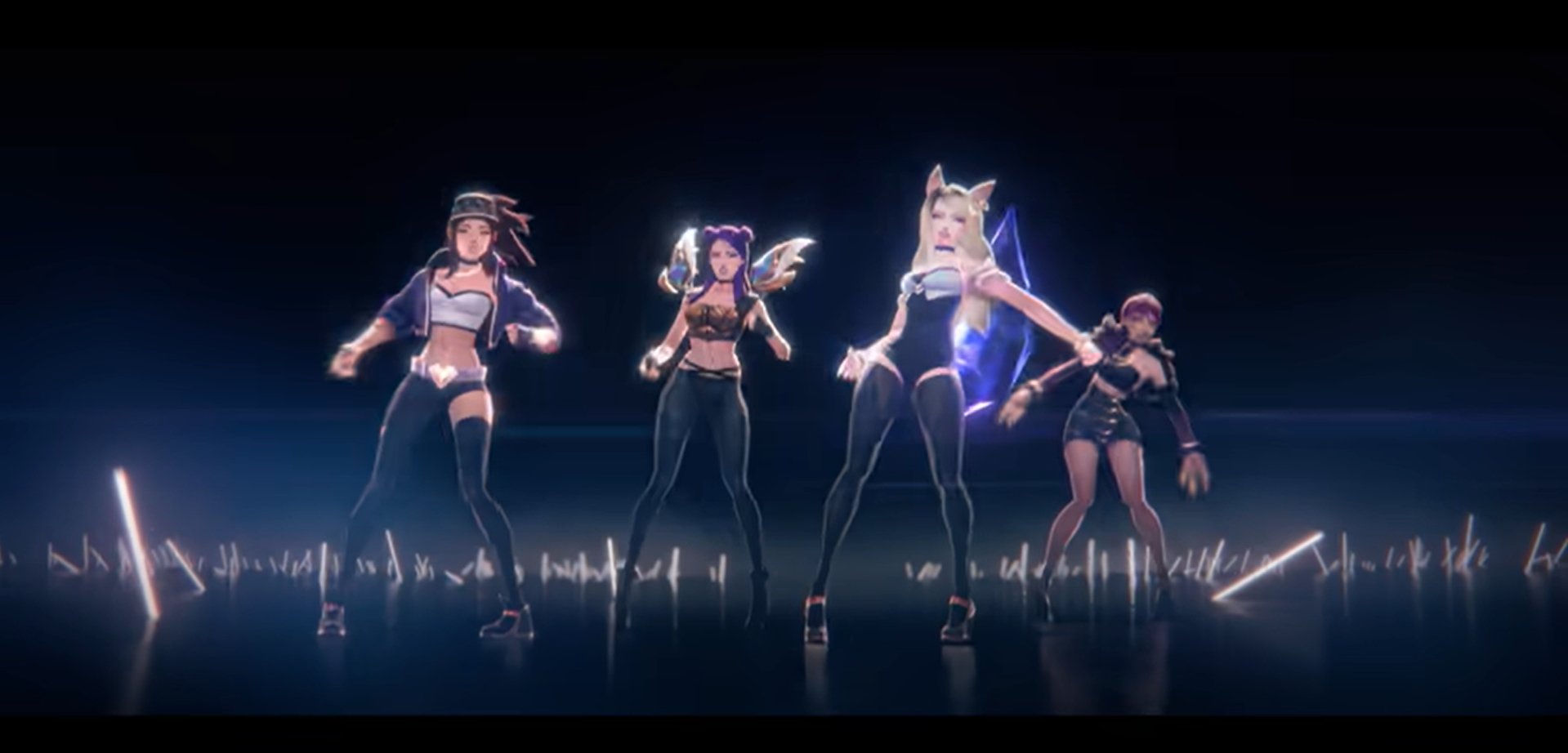
Riot Games’ next foray into virtual bands came in 2018, when it launched K-pop girl group K/DA at that year’s League of Legends World Championship. As with Pentakill, the four K/DA members – Ahri, Akali, Evelynn and Kai-sa – are promotions for skins that can be purchased in the game.
K/DA – which is composed of singers Madison Beer and Jairan Burns, as well I-dle members Miyeon and Soeyeon – is a hugely popular group, by any standard. Their first single, Pop/Stars, has had 302 million streams on Spotify, and the band has more than 3 million monthly listeners on the platform. Several other tracks of theirs have blown past the 100-million-streams mark.
The video for Pop/Stars, on the League of Legends YouTube channel, has had an incredible 551 million views, while a more recent track, MORE, has clocked 184 million views. They have 290,000 followers on TikTok, and nearly 540,000 on Instagram.
A year after launching K/DA, Riot Games did it again, this time with a hip-hop group called True Damage. As expected, their four members – Akali, Ekko, Qiyana, Senna, and Yasuo – are skins that can be bought in-game.
The real-life musicians behind True Damage – Becky G, Duckwrth, Keke Palmer, Thutmose and Soyeon – performed a live version of their debut song, Giants, at the 2019 League of Legends World Championship, performing with holographic versions of their avatars (not unlike what Gorillaz do on tour).
Giants has garnered more than 128 million streams on Spotify, and the band has some 574,000 monthly listeners on their one track. That track is about to break 200 million views on YouTube.
K-pop label SM Entertainment’s entry into virtual artistry has been quite unique.
Their girl group, aespa, straddles the line between real life and the virtual world: while aespa’s four members are real people, each of them has a virtual alter ego, an avatar that often appears alongside the real artist in videos and promotional materials.
aespa also comes with a fictional storyline that serves as a backstory for the four members and their alter egos. And earlier this year, SM Entertainment debuted one of the virtual characters who appeared in aespa’s lore – Naevis – as a virtual artist in her own right.
Naevis, who first appeared in aespa’s video My, Karina, in 2021, is described in aespa lore as an AI system that enables aespa members’ virtual alter egos, known as “ae’s,” to contact and communicate with their real-life versions.
SM Entertainment had announced that Naevis would make her debut as a virtual artist at this year’s SXSW festival.
However, it appears the debut never took place, and some fans speculate that this might have had to do with the corporate battle between HYBE and Kakao over control of SM, which was ongoing when SXSW took place this past March, and which Kakao won.
Sony Music Entertainment (Japan) which operates independently of global music giant Sony Music Entertainment, is working on two virtual entertainment projects, one of which it calls “the largest virtual talent development and management project in history.”
That project is called Vee Virtual Entertainment, and the idea behind it is to develop talented Vtubers – online performers who work behind an avatar – into commercial successes.
In May of 2022, Vee unveiled its “first wave” of virtual talent – three previously unknown artists going by the names of Otokado Ruki, Tulsi-Nightmare Madness IV and Hinahoshi Airu, as well as two previously known Vtubers, Kujo Ringo and Syusetu Kohaku.
So far, these artists haven’t seen breakout success, with a handful of YouTube videos hitting views in the tens of thousands, and not much presence on Spotify. Their Twitter and Twitch accounts have garnered followers in the single thousands.
SMEJ’s other virtual-artist endeavor is their PRISM Project, which also recruits Vtuber talent. PRISM has been building its roster aggressively, and last month announced its “fifth generation” of virtual artists – Ami Amami, Kou Tsubame and Lana Shikami.
As with VEE, so far PRISM hasn’t seen a major breakout artist. Among PRISM’s 15 virtual artists, the two biggest ones so far appear to be Shiki Miyoshino, with 139,000 YouTube subscribers, and Iko Hoshifuri, with 53,000 YouTube subscribers and about 7,700 monthly listeners on Spotify.
SMEJ also works with Apoki, a virtual K-pop artist that debuted in 2021.
Tencent Music Entertainment (TME)
TME is making big moves in the virtual artist space and in AI-generated music.
During an earnings call in November of 2022, TME Executive Chairman Cuisson Pang told analysts that the company had created more than 1,000 musical tracks using generative AI, one of which had already clocked more than 100 million streams.
The following month TME unveiled Lucy, which the company described as its first “hyper-real virtual pop idol,” built by TME’s in-house LyraLab.
Despite only being in existence for some six months, Lucy already has 17 singles on her account at QQ Music, one of TME’s streaming services in China.
In the company’s Q4 and FY 2022 earnings announcement, TME noted that, in the quarter, TME “Brought to life TME’s first hyper-real virtual pop idol, Lucy, along with our other virtual performers Xiaoqin, Shanbao and Anko with original content, unique voices and dance moves”.
The company added: “With a record-grade, automatically generated vocal print developed by TME LYRA LAB’s LyraSinger Engine, Lucy has received partnership interest for joint performances from a broad array of global brands.”
On TME’s Q1 earnings call this past Tuesday (May 16), Tony Yip, TME’s chief strategy officer, said the company plans to create more virtual idols with an eye to bringing them on to TME’s live-streaming services.
Universal Music Group (UMG)
UMG stepped into the virtual artist arena in late 2021, when it announced the formation of Kingship, a virtual band based on four characters from the NFT collections Bored Ape Yacht Club and Mutant Ape Yacht Club.
The band was the creation of 10:22PM, a UMG subsidiary formed by former Sony exec Celine Joshua that describes itself as a “next-gen web3 label.” Its goal is to sign artists, social media influencers and digital media creators with a focus on multimedia content.
UMG, via Universal Music Italy also ‘works with’ Zero Pain, a virtual artist that currently has 92,000 monthly listeners on Spotify, and whose biggest hit, PECCATO, has 2.6 million streams on the service.
Zero Pain’s roughly two-minute tracks are so-called ‘phonk’ – a genre that’s become popular on TikTok over the past few years.
One interesting innovation with Zero Pain is that the artist’s music and fictional backstory is being crowdsourced on their Discord server, where fans can vote on such things as song titles, the character’s backstory and even social media posts.
UMG has also been working on avatars for its existing, real-life artists. The company inked a partnership with Genies, an avatar technology company, in 2021, to “equip artists with official virtual identities for use in Web 3.0 and the shifting age of the Internet, providing a persistent virtual representation of themselves across the metaverse to engage with fans in expressive and authentic ways.”
UMG’s Capitol Music Group [452 articles]” href=”https://www.musicbusinessworldwide.com/companies/universal-music-group/capitol-music-group/”>Capitol Records was also briefly involved with controversial virtual artist FN Meka, which was signed, but then ultimately dropped by the label.
Back in 2021, Whet Records, WMG’s pan-Asian dance label based out of China, claimed to have become the first major label to sign a virtual artist – Ha Jiang, a virtual idol that had amassed 100,000 followers on Chinese social media, appearing as a road safety ambassador and an esports anchor, among other things.
So far, Ha Jiang has released three singles and has been credited with a remix of Marvus’ Drunk Groove, which is her largest hit on YouTube, with 106,000 views.
But that’s not WMG’s only foray into the virtual artist arena. In 2022, it invested in Authentic Artists, a music platform headquartered in San Francisco that describes itself as a developer of “metaverse-native virtual artists, digital collectibles and interactive music experiences.”
So far, Authentic Artists has launched 12 prototype virtual artists, among them Nayomi, DJ Dragoon, Gnar Heart and Glitch. In April of this year, the company announced the launch of a “proprietary, generative, audio-visual production platform that instantly composes and produces fully-formed, high-quality songs performed by AI-powered Virtual Artists.”
Chris McGarry, founder and CEO of Authentic Artists, said: “Virtual entertainment is the new cultural center of gravity, and today’s digital natives want agency over their worlds. Our adaptive artists will give it to them, co-creating new shared musical experiences and making new art and culture with fans across every connected platform.”Music Business Worldwide






